“Stay Back,” She Warned — The Former Navy SEAL Said, “I’m Trying to Help, Not Miss Dinner.” – Part 1
“Stay Back,” She Warned — The Former Navy SEAL Said, “I’m Trying to Help, Not Miss Dinner.”
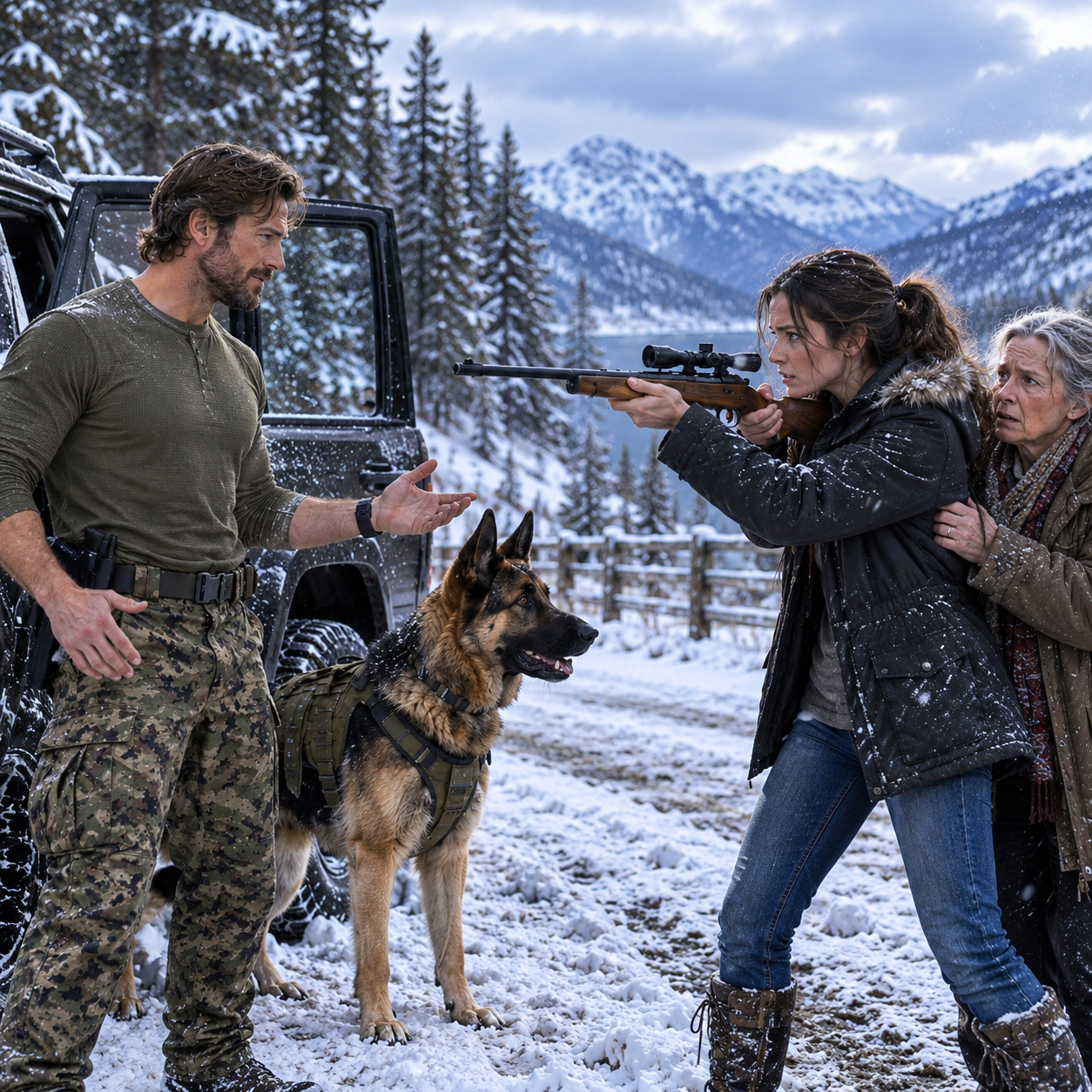
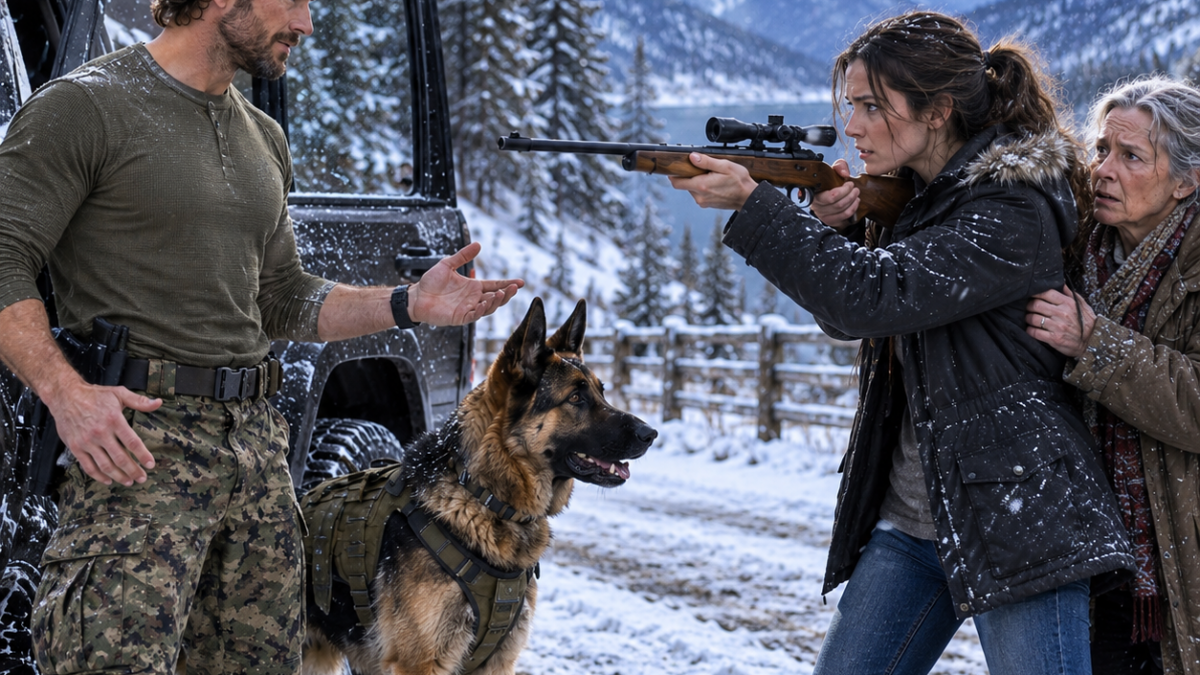
Mason Kerr was almost home when Dutch lifted his head and stared through the windshield.
Two women were walking along the roadside with one suitcase between them.
The older woman moved carefully while the younger one carried an old hunting rifle and watched Mason’s truck as if stopping might be the worst thing he could do.
He pulled over anyway. Stay back, she warned, raising the rifle. Mason lifted both hands.
All right.
I’m only trying to help and I’d really hate to miss dinner over this.
She didn’t smile, but her mother did.
Mason thought he was offering them a ride and a warm place for the night. He had no idea how much trouble had already followed them that far.
By the time Mason Kerr left Celely Lake, the groceries had begun sliding around in the back of his old Toyota 4Erunner. Two propane cylinders were strapped down behind them, and Dutch had settled himself into the only patch of cargo space he considered acceptable.
The German Shepherd had been asleep for most of the drive north. At 9, Dutch no longer wasted energy on roads he had traveled before.
But whenever Mason eased off the accelerator or touched the brake, one ear came up before the rest of the dog followed. Mason noticed it without looking back.
“Nothing,” he said.
Dutch lowered his head again. The rain had started before Mason cleared the edge of town, thin and cold enough to shine on the pavement without washing anything clean. Farther north, a few wet flakes mixed into it, catching briefly in the headlights of oncoming trucks before disappearing against the road.
Low clouds sat heavily along the Swan Range, but there was no storm yet, only the unsettled kind of afternoon that could turn into three different kinds of weather before dark. Mason had planned around it anyway.
He had enough food for a week, more coffee than any reasonable person needed, dog food, propane, and a new belt for the snowblower that had been making a noise. Tom would have called character, and Mason called a failure waiting for a colder day. That was the whole purpose of the trip.
Get supplies. Go back to the cabin. Stack wood before dark.
Simpla. Dutch lifted his head again. This time, Mason saw why.
Two figures were walking north along the shoulder several hundred yards ahead. Both keeping as close to the edge of the road as the snowbank allowed. One was pulling a hard-sided suitcase that bumped against the uneven shoulder every few steps.
The other carried a smaller bag and moved more slowly. Shoulders rounded beneath a dark winter coat. Mason eased off the gas.
Dutch stood. Yeah.
As they drew closer, Mason saw the younger woman first. Mid30s, maybe.
Dark hair damp around the edges of a knit cap. Jeans darken near the cuffs. One gloved hand on the suitcase handle.
The other hand held a hunting rifle. Not slung, dazzled.
Mason passed them by 20 yards before pulling onto the shoulder. In the mirror, the younger woman stopped immediately.
So did the older one. Mason left the engine running for heat and watched them for a moment.
Neither woman made any move toward the vehicle. The younger one shifted herself slightly between the road and the older woman.
That told him more than the rifle did. He put the 4Runner in park. Dutch remained standing behind him, watching through the side glass.
Stay. The dog did.
Mason opened his door slowly and stepped out where both women could see him. The rifle came up.
Don’t come any closer.
Mason stopped. The woman knew what she wanted the gun to accomplish. The problem was that her hands and shoulders suggested she had spent more time carrying it during the past few days than using one over the course of her life.
He raised both hands. All right, get back in the truck.
I can do that. Then do it. Mason glanced once at the older woman.
She was upright, alert, and visibly annoyed by being looked at as though she might fall apart, but her breathing was shallow enough that he could hear the roughness in it between passing cars.
“There were not many passing cars.
That was part of the problem.”
Mason looked back at the woman with the rifle.
“I’m only trying to help,” he said.
“And I’d really hate to miss dinner over this.
My groceries are already making bad decisions.”
The rifle stayed where it was. The older woman gave a small cough that almost became a laugh.
The younger woman shot her a look. Mom, what?
It was mildly funny. Mason kept his hands up.
That earned him no points with the younger woman, but it told him the older one was still thinking clearly.
Name’s Mason, he said.
That’s Dutch in the truck.
I’ve got a cabin a few miles from here.
We don’t need a cabin.
Okay, we don’t need a ride.
Also, okay. The older woman coughed again, longer this time, pressing one glove lightly against the center of her chest until it passed.
Mason waited. The younger woman tightened her grip on the rifle, but did not raise it farther. He had seen people grow more dangerous when they were frightened.
He had also seen people grow clumsy. There was a difference between the two, and the woman standing in front of him seemed to be working hard not to become either.
behind him. Dutch shifted his weight once inside the forerunner.
Mason did not turn. How far are you going? He asked.
That’s none of your business.
Fair enough, he looked at the suitcase, then at the empty stretch of highway behind them.
You’ve still got daylight.
Not much of it. We know. The older woman spoke before her daughter could stop her.
We were supposed to be picked up. The younger woman closed her eyes for half a second.
Mom, he already knows we’re walking beside a highway.
June, I don’t believe secrecy is doing much for us at the moment.
So, June. Mason filed the name away and nothing else. The older woman adjusted the scarf at her throat.
Helen. Mason. Yes, you mentioned that.
June looked between them as though both had violated some agreement. She had never actually stated.
Mason lowered his hands a few inches but stopped when June’s rifle shifted.
still here.
He said, “Keep them up.”
“Sure, Helen Seihood.”
June, if he planned to rob us, I suspect the groceries are a strangely elaborate cover. June did not answer.
For a few seconds, the only sound was the low engine of the Toyota, tires hissing on wet pavement somewhere behind them, and Helen’s breathing settling after the cough.
Mason’s eyes moved past June toward the treeine, not because he expected anyone there, but because June had looked that way twice since he stopped.
Then she checked the road behind them. Not the road ahead. He noticed that too.
You walking into Condan? He asked.
June said nothing. Helen did. We were, Mom.
To a market. Someone was meeting us there. Mason looked at the suitcase again.
It was the kind built for airports, not highway shoulders.
You’ve got about 2 miles left.
We know. Jun<unks answer came quicker than before.
Mason nodded, then I’ll leave you to it.
He began to step backward. Helen took one step toward the suitcase, then stopped. She did not collapse.
Her knees did not give out. She simply stood with one hand on the handle and waited for her breathing to catch up with the rest of her.
June immediately lowered the rifle enough to reach for her.
I’m fine.
You’re not?
I said, “I’m fine.”
Mason watched Helen wave her daughter off with the impatience of someone who had probably been telling people she was fine for several weeks. He finally lowered his hands.
June looked back at him, put them up. Your mother needs to get warm.
She’s recovering from something.
We know what we’re doing.
I didn’t say you didn’t.
That slowed June more effectively than arguing would have. Mason nodded toward Helen.
I’m saying whatever she’s recovering from.
Another hour out here isn’t improving it.
Helen looked at him as if considering the evidence. June looked away first.
The wet snow had thickened enough to cling to the shoulders of her coat. Not much, just enough to show how long they had already been standing there. Mason took a slow breath.
I don’t need to know where you came from.
I don’t need to know who you’re avoiding.
If you’re avoiding somebody, you can sit in the back.
Keep the rifle away from me and get out anywhere you want.
Jun<unk’s expression changed slightly at the word avoiding.
Mason let it pass.
My cabin’s closer than town, he continued.
There’s heat, food, and a phone that sometimes works if you stand by the kitchen window and insult it.
Helen smiled. June did not.
No. Mason nodded. Okay.
He turned back toward the forerunner. That surprised her more than another argument would have.
He had reached the driver’s door when Helen spoke.
“June, no, I didn’t ask yet.
I know what you’re going to ask.
That’s because I raised you.”
Well, Mason kept his back to them and pretended to check the straps on the propane tanks through the rear glass. Helen lowered her voice, though not quite enough.
“We have spent 3 days trying not to depend on anyone.
I think we’ve proven the point.
That’s not what this is about.”
“I know.”
Jun<unks reply came softer. Helen waited a moment. One night under a roof does not mean we surrendered.
There was a long silence after that. When Mason turned, June had lowered the rifle until the barrel pointed toward the ground.
Where exactly is this cabin? Off of forest road north of here. Anyone else there?
No. June did not like that answer. Mason could see it.
My brother owns it, he added. He lives in Spokane.
I’m the current squatter.
Helen nodded toward Dutch. And him?
He contributes almost nothing financially. That finally pulled the edge of a smile from June, though it disappeared almost immediately. She looked at Helen.
Helen said nothing. June let out a tired breath and lowered the rifle completely.
One night?
That’s usually how one night works.
June gave him a flat look. Do you always do that? Do what?
Make jokes when someone points a gun at you? Not always.
He did not elaborate. Mason opened the rear passenger door and gave Dutch a quiet cue.
The German Shepherd jumped down carefully, landing with less spring than he would have a few years earlier. He looked at June first, then Helen, then returned his attention to Mason. No growl, no performance.
Helen held out one gloved hand without stepping toward him.
Dutch walked over, sniffed it once, then turned and came back to Mason’s leg.
Helen looked mildly offended.
I’ve had warmer greetings.
He charges extra. June set the rifle carefully into the rear cargo area only after Mason moved aside. She kept the suitcase with her until Helen was settled, then finally loaded that, too.
Within minutes, the 4ERunner was moving north again. Helen sat behind Mason with the heater vent turned toward her.
June sat in the passenger seat, shoulders still tight, hands empty now, but never entirely at rest. They had been driving less than a mile when Helen explained part of it without really intending to. A friend named Marlene Pike had driven them from Swan Lake that morning.
They had an appointment in Missoula and were supposed to meet someone in Condan along the way. June had seen a dark SUV near their motel twice during the week.
And when she noticed what looked like the same vehicle behind Marlene’s car, she insisted they get out at a Forest Service pull out.
Marlene had protested. June had lied and told her someone else was coming.
The SUV continued after Marlene for a while. June and Helen started walking. That had seemed manageable when the sky was only gray.
Then the temperature dropped. The signal disappeared and no one arrived at the market because they never reached it.
Helen told most of this in fragments while June corrected only the practical details. Mason did not ask who had been in the SUV.
He could feel June watching for the question. It never came.
The road curved. A set of headlights appeared far behind them.
June immediately checked the side mirror, then the rear view, then turned just enough to look through the back glass herself. Mason noticed. He said nothing.
A few minutes later, he leaned forward to adjust the heater. The collar of his shirt shifted and a plain wedding band slipped into view on the thin chain around his neck.
June saw it. Her eyes stayed there for less than a second. She did not ask.
That made two of them. Mason turned off MT83 onto a narrower road lined with dark timber.
The pavement gave way to packed gravel farther in. The sound beneath the tires changing as the forest closed around them.
Jun’s phone, dead for most of the walk, suddenly vibrated.
Then again and again. A weak pocket of service had found them.
The screen filled with missed calls and messages.
Mason kept his eyes on the road, but June’s thumb stopped moving when one name appeared repeatedly.
Derek. She dismissed those notifications without opening them. Then another name appeared.
Rachel Mercer. June straightened in her seat.
Outside the road curved between tall pines, and a warm square of light appeared ahead through the trees, the cabin.
June stared at Rachel’s name until the signal disappeared again.
By the time Mason turned into the drive, whatever plan had taken June and Helen toward Missoula that morning was gone. For tonight, there was only the cabin.
The cabin looked smaller from the driveway than June had expected. A single porch ran across the front beneath a shallow roof, with two windows glowing amber on either side of the door. Snow had collected unevenly along the railing, leaving dark strips of wood where Mason had brushed it away earlier that week.
A stack of split firewood sat beneath a leanto near the sidewall covered with a blue tarp that had been repaired in three places with gray tape. Nothing about the place looked temporary.
Mason parked close enough to the porch that Helen would not have far to walk before shutting off the engine. He glanced toward the passenger seat.
You two wait here a minute. June looked at him for what? Heat.
He was already outside before she could answer. Mason crossed the porch.
unlocked the front door, then disappeared inside. A light came on near the back of the cabin.
A few seconds later came the dull metallic knock of a stove door, followed by the scrape of something heavy being moved across a floor. Dutch remained in the cargo area, watching him through the rear window. Helen leaned back against the seat and closed her eyes.
June turned toward her. You okay?
I’ve been better.
That’s not an answer.
It’s the answer you’ve been getting for 6 weeks.
June looked away. Helen opened one eye.
And I’m still here.
By the time Mason returned, the cabin had begun to breathe warmth into the cold air that followed him through the open door.
He took Helen’s bag first, then reached for the suitcase.
June kept hold of it.
I’ve got it.
Mason released the handle without argument. That more than anything he had said on the road, made June follow him inside.
The main room combined a narrow kitchen, dining area, and living space around an old cast iron wood stove. The furniture did not match. A brown leather sofa had softened nearly flat in the center.
Two wooden chairs faced the stove, and a scratched table stood beneath a window crowded with small jars, batteries, fishing line, and a ceramic mug filled with screws. The place smelled faintly of pine smoke, coffee, dog, and something fried several meals ago.
Helen stood inside the doorway long enough to take it in.
Well, she said, “You weren’t lying about the cabin.”
Mason set her bag down.
“I tried to save my lies for taxes and fishing.”
June did not know whether he was serious. Helen seemed to decide it did not matter.
Wet coats went on hooks beside the mudroom. Boots collected below them in a slow puddle.
Mason added wood to the stove, turned on a small propane heater near the hall, then disappeared into the first bedroom, and returned carrying clean towels. He gave Helen the room at the back.
There’s a bathroom through there.
Hot water takes a minute.
Don’t trust the left faucet completely.
Helen studied him. What did it do?
Depends how emotionally attached you are to consistent temperature. She nodded as though that were useful information and disappeared with her bag. June remained near the front door.
The rifle was still in the forerunner. Mason noticed where her eyes went, but said nothing about it. Instead, he walked to a storage bench beneath the window and pulled out a plastic tote.
The lid had a strip of masking tape across it. The ink faded enough that June could not read the writing. He stood over it for a moment before opening it.
Inside were folded clothes. Mason lifted out a dark flannel shirt, then a gray wool sweater.
Both looked older, but well-kept. These should fit close enough. June did not take them immediately.
Whose?
Mason’s gaze stayed on the sweater.
My wife’s.
The answer landed quietly. Jun<unks eyes moved to the thin chain at his neck, though the ring had disappeared beneath his shirt again.
Mason folded the sweater once across his forearm.
They’ve been in there a long time.
They’re not helping anybody in a box.
June took the clothes. Thank you. He closed the tote.
Nothing more was said. That was enough.
By the time Helen came back in dry clothes, the windows had begun to cloud from the heat inside. June had changed too, the sleeves of the flannel slightly long at her wrists.
She had hung her damp sweater near the stove and placed her father’s rifle in the mudroom where Mason could see it, but where no one needed to step around it.
Mason did not comment. He had already started dinner. A pot sat on the stove with broth, potatoes, carrots, onions, and enough leftover chicken to turn it into something closer to stew than soup.
Mason worked without ceremony, chopping vegetables on a board, scarred deeply enough to suggest it had outlived several owners. Dutch moved from one side of the kitchen to the other, depending on where the food was. June watched him once.
Does he always do that? He calls it supervision. Dutch sat.
Mason looked down at him.
You’re not helping.
Dutch continued sitting. Helen had taken the chair nearest the wood stove. She held a mug of tea with both hands while the color gradually returned to her face.
Her breathing still carried a rough edge. But once she was warm and no longer walking, it became easier and slower. Mason never asked for her diagnosis.
He did not hover. He simply placed a folded blanket on the back of her chair and returned to the cutting board.
That mattered to June. She had spent enough time lately around people who asked questions only because they wanted information they could use later. Mason seemed content with what was in front of him.
At some point, Helen opened the sleeve of crackers Mason had set beside her tea. Dutch appeared.
Not quickly, just efficiently. Helen looked at him.
You’re old enough to know better.
Dutch sat beside her chair. She broke off a piece no larger than a thumbnail and looked toward Mason. Is the old man a loud one?
Mason glanced over. The dog or me?
Helen considered him.
I haven’t decided.
June covered a smile with her hand. Mason nodded toward Dutch. One.
Helen offered the piece on her palm. Dutch sniffed it, took it carefully, and settled beside her feet.
He stayed there. June noticed because until then, Dutch had almost always positioned himself near Mason.
Now his shoulder rested against the leg of Helen’s chair as though the decision required no explanation.
Helen looked down.
I suppose I’ve been accepted.
Mason stirred the pot.
He’s mostly waiting for a second cracker.
That’s still a relationship.
Dinner happened without much conversation. Helen ate slowly.
June ate more than she expected. Mason finished first and carried his bowl to the sink before anyone could thank him.
The quieter stretches did not feel uncomfortable after the first few minutes. The stove clicked as the iron expanded.
Water tapped from the wet coats onto the floor mat.
Dutch sighed heavily beneath Helen’s chair.
Outside, wet snow collected against the dark windows. June checked her phone three times. No service.
The fourth time, Mason noticed. Kitchen windows usually best. June looked up for signal.
If you’re lucky, and if I’m not, you can threaten the phone.
Sometimes helps. Helen gave Mason an approving look.
June carried the phone toward the window, but got nothing. She returned it to the table. Mason did not ask who she was trying to reach.
Later, while June helped clear the dishes despite Mason insisting there was no need, Helen wandered only far enough to inspect the short hallway. Two bedrooms sat opposite each other.
with a bathroom between them. She returned to the main room just as Mason unfolded a narrow military-style cot he had taken from a closet. Helen watched him spread it open beside the far wall.
Are you planning to sleep there for tonight? In your own cabin?
Technically my brother’s cabin.
Helen looked toward the sofa. Dutch had climbed onto it sometime during cleanup and was stretched across nearly all of it. Mason followed her gaze.
As you can see, real estate negotiations are ongoing. Helen smiled into her tea.
June shook her head. He gets the entire sofa.
He was here first. You just told us it belongs to your brother.
Dutch doesn’t respect property law.
The humor faded naturally rather than being chased. Mason gave Helen the warmer bedroom at the back. June took the smaller room near the front.
Mason put the cot in the living room and laid an extra blanket over it without complaint. Before bed, June went outside long enough to retrieve the rifle.
She paused in the mudroom. For several seconds, she seemed unsure whether to carry it down the hall. In the end, she set it beside her boots, well away from the door, and took only her phone with her.
Mason noticed from the kitchen. Again, he said nothing.
The cabin settled after midnight. The snow stopped first, then the wind.
By morning, the forest looked entirely different. Cold blue light came through the windows long before direct sun reached the cabin.
The cloud cover had broken during the night, leaving the sky pale and clear. Frost edged the glass. Along the roof line, thin icicles had begun dripping where sunlight touched them.
June woke before Helen. The first thing she did was check the lock. The second was check her phone.
Still nothing. She dressed quietly and stepped into the main room. Mason was already awake.
He sat at the table with coffee, one hand around the mug, reading something on a folded piece of paper. Dutch lay beneath the table. June stopped.
“You sleep some?”
She looked at the cot. It had already been folded away.
Mason pushed the coffee pot slightly toward her. She poured a cup. Neither mentioned the previous evening.
On a shelf near the dining table, June noticed several framed photographs she had missed in the dimmer light. One showed Mason years younger beside another man who looked enough like him to be family.
Both held fish beside a dock, grinning with the unmbarrassed pride of men who had clearly spent too many hours earning something that would later fit in a frying pan. Behind them was a wide sheet of water and forested mountains.
“Swan Lake?”
June asked. Mason followed her gaze. Yeah, your brother.
Tom, you two fish used to? His answer did not invite another question, so June left it alone.
Beside that frame sat another photograph. A woman in her 40s stood beside Mason on a porch.
June did not recognize. A young man stood between them, taller than both, his expression caught halfway between amusement and impatience. June looked at the picture for only a few seconds.
Mason had already turned back to his coffee. She did the same.
Around 9, his phone rang. Mason checked the screen.
Tom, he answered while standing near the kitchen. The conversation lasted less than 2 minutes and was mostly practical.
Tom wanted to know whether Mason had replaced the propane before temperatures dropped again, whether the roof over the porch was still leaking near the east corner, and whether Dutch had destroyed another blanket. Mason answered no to the last one.
Dutch lifted his head.
Tom’s voice was loud enough through the speaker that June caught one sentence.
You’re still calling it my cabin when people ask.
Mason looked toward June. Because it is.
You’ve been there long enough to start paying property taxes.
Mason ended the call shortly afterward with a promise to inspect the roof. June said nothing, but now she understood something she had not the night before.
The cabin was not Mason’s.
Not exactly. Around 10:00, Helen was awake and moving more comfortably.
She insisted on making her own tea and complained that Mason’s coffee smelled strong enough to remove paint.
The morning remained quiet. June tried her phone near the kitchen window. Nothing.
Then she went outside. The cold was sharper than the day before, but the sky was clear enough that sunlight bounced hard from the snow. She walked toward the edge of the driveway, holding the phone above shoulder height like someone trying to convince technology through posture.
One bar appeared, then two. The phone vibrated immediately. June turned away from the cabin.
She called Rachel. The woman answered on the second ring.
June listened more than she spoke. Rachel asked where she was, whether Helen was safe, and why neither of them had reached Condan the day before.
Her assistant had waited at the market nearly 40 minutes before calling the office. June explained the missed pickup without mentioning Mason beyond saying they had found somewhere safe to stay. Rachel did not press.
Then her voice changed. June, I need to ask you something before we talk about anything else. June looked toward the cabin.
Mason was outside near the wood pile checking the tarp. He was far enough away not to hear. Rachel asked whether June had signed anything else from Derek Voss since their last conversation.
June’s fingers tightened around the phone.
No. Nothing. No.
A pause. Good.
June waited. Rachel did not explain. Keep it that way until I see you.
The signal flickered. Rachel, what happened? But the call had already broken.
June stared at the screen. No service. behind her.
The cabin door opened and Helen stepped onto the porch, wearing Mason’s spare jacket over her clothes.
Dutch stood beside her. June slipped the phone into her pocket. The rifle remained in the mudroom, exactly where she had left it the night before.
For the first time since they had left Swan Lake. June walked back toward the cabin without reaching for it.
By late morning, the sharp blue sky had softened into a flat layer of cloud. There was almost no wind.
Snow rested on the trees without moving, and the woods beyond the cabin had gone quiet enough that Mason could hear the small metallic scrape of the snowblower cover every time he shifted it across the porch. The machine had been complaining for weeks. Tom would have kept using it until something broke completely.
Mason preferred fewer surprises. He knelt beside the housing with a wrench and the replacement belt he had bought in Celely Lake, while Dutch stood nearby, supervising from a distance that suggested no intention of helping.
Inside, June had opened her laptop at the dining table. The weak signal from outside had disappeared again, but she had enough files saved locally to work through a folder of documents Rachel had sent earlier in the week.
Helen sat in the chair nearest the wood stove, folding the last of the dry clothes into careful stacks. The cabin had developed a rhythm without anyone agreeing to one.
Mason worked outside. June worked at the table. Helen folded laundry.
Dutch moved among all three. Every 15 minutes, he checked the porch, then returned to Helen, then wandered beneath the table in case June had discovered food by accident.
It was the first part of the week that did not feel like someone was waiting for something to go wrong. That lasted until June found the map. She had been sorting through scanned documents when a county parcel image appeared on the screen.
Most of it was green and white, broken into irregular boundaries with numbers printed too small to read comfortably. Mason came in carrying the old belt. He dropped it beside the door.
Found the problem. June glanced over.
It was broken almost. So Tom was right. Mason stopped about what?
That the machine still worked. He considered this.
That’s not the same thing as being right.
Helen smiled without looking up from the sweater she was folding. Mason went to wash his hands.
When he returned, June was still looking at the parcel map. He poured coffee and leaned against the counter far enough away that he did not seem to be reading over her shoulder.
What is it? June hesitated. She had spent most of the morning deciding how much to tell him.
Rachel’s warning had changed the shape of the problem.
Until then, June had been treating Derek as someone she needed distance from. Now she was beginning to wonder whether distance was enough. She turned the laptop slightly.
My father’s land.
Mason looked at the map. There were several parcels north of Swan Lake. Most of them long stretches of timber broken by narrow access roads and irregular strips of private property.
How much? Just over 300 acres.
Mason nodded once.
That’s not nothing.
No. June enlarged the image.
Most of the property looked ordinary on a satellite map. Trees, slope, old logging cuts, a creek running along the western edge.
She moved the cursor to a narrow piece along the southeast boundary. This is the part everybody cares about. Mason looked closer.
The strip connected a county road with a larger section of undeveloped land beyond the Callahan property. access. June glanced at him.
You know land deals? I know roads.
That was all he offered. June turned back to the screen. Granite Crest Development had spent almost 3 years acquiring land north of Swan Lake for a small lodge in a group of mountain homes.
Nothing enormous by resort standards, but large enough that the developers needed dependable vehicle access and a practical route for utilities. The Callahan land sat in the wrong place for everyone except the Callahanss.
The easiest planned route crossed it.
My dad didn’t want to sell the whole property.
June said he was willing to talk about an easement. Mason listened. June described Martin without making him into a saint.
He had bought the land 30 years earlier when timber prices were low and plans were smaller. He liked having somewhere that was not paved, landscaped, or improved simply because someone had money to improve it. He also understood that land could become a burden.

