A Former Navy SEAL Followed His K9 Into the Mountains—Then Found a Woman Thought Gone – Part 1
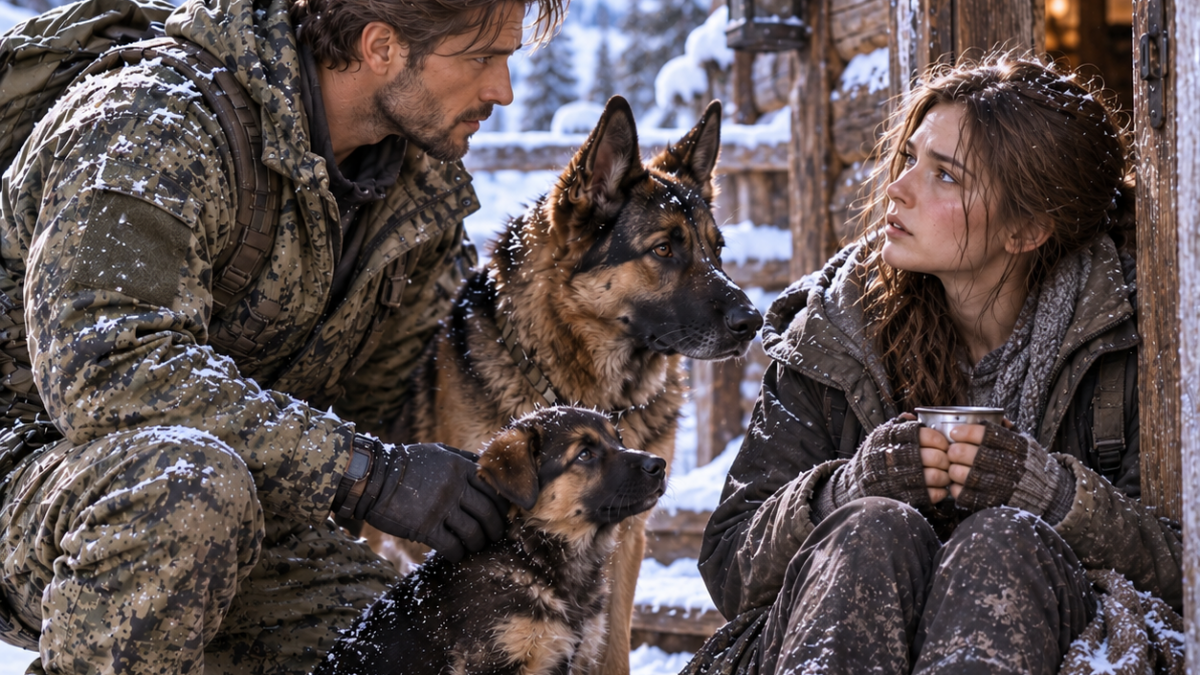
A Former Navy SEAL Followed His K9 Into the Mountains—Then Found a Woman Thought Gone
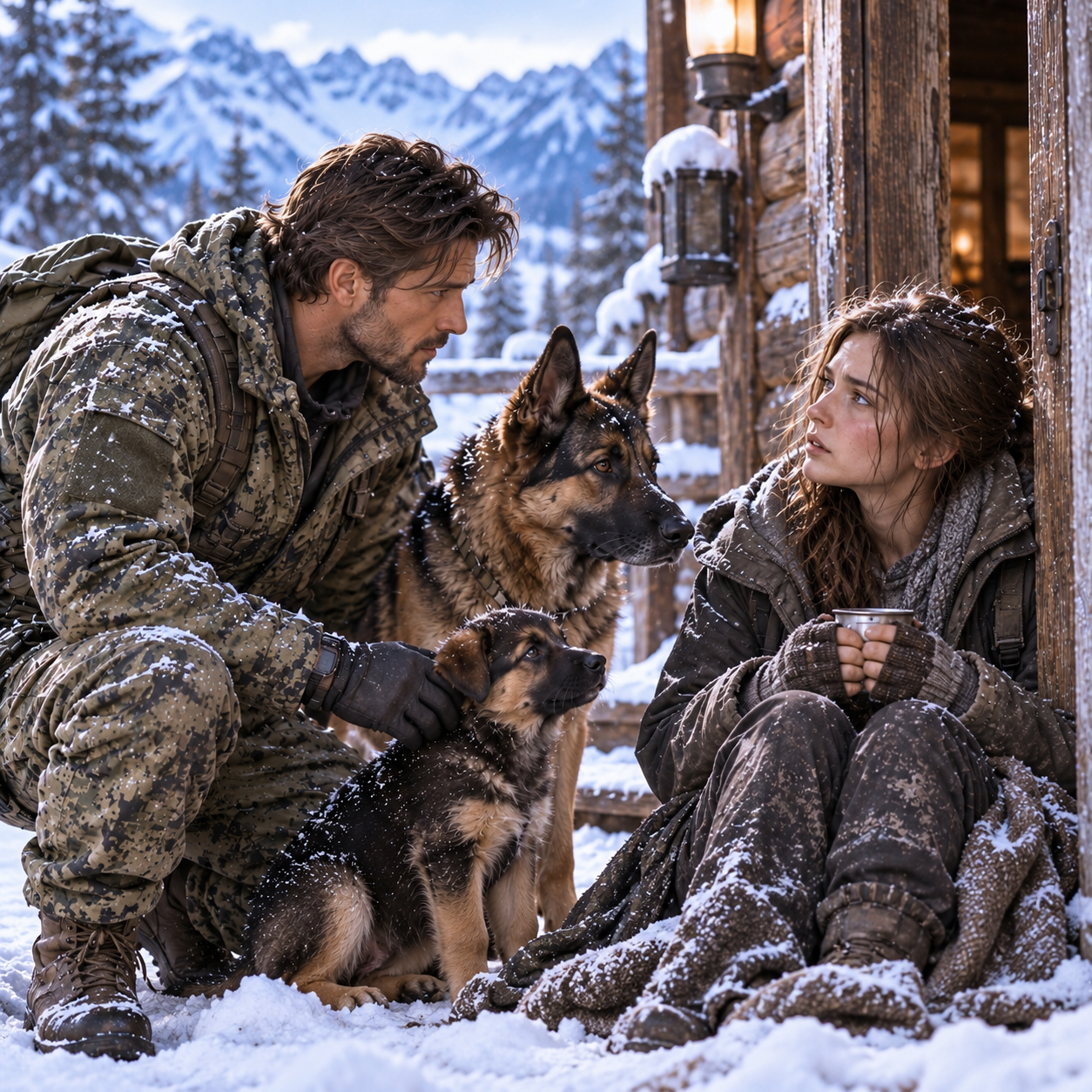
Kanan Valley, West Virginia, January 29th. Reporter Clare Mercer had been missing for 31 days.
Her SUV had been found without her, and the men she had been investigating had finally begun to believe she wasn’t coming back.
Graham Voss no longer cared where Clare was. He wanted her notes.
That same morning, former Navy Seal Nate Holloway was checking an old training property with Rook, his retired German Shepherd. When Rook stopped beside a trail of tiny paw prints. Minutes later, Nate saw a 12-week old puppy staring back at him.
The puppy wasn’t alone, and what Nate found beyond those tracks would uncover a secret that had been moving quietly through America’s working dog world for years.
By 8 that morning, the road climbing toward Walter Dean’s property had narrowed to two pale tracks between Spruce and Hardwoods.
Nate Holloway kept the Tacoma in low gear and watched the surface ahead, where yesterday’s snow had been pressed thin enough in places to show a darker shine underneath.
He did not hurry those patches. There was no reason to turn a favor for an old dog trainer into a toe bill. Rook rode behind the passenger seat with his head up, steady against the changes in grade.
At 8 years old, the German Shepherd no longer spent a drive testing every smell that came through a cracked window. He conserved himself now and paid attention when something earned it.
Walter had called from Arizona the previous evening and asked Nate to check the roof of the old training cabin after the latest snow. Nate knew that check the roof also meant look at the propane gauge, make sure the hand pump had not frozen, and tell Walter if mice had found the oats again. Nate remembered the last turn without checking the map.
He passed the leaning hemlock Walter used as a marker, crossed a shallow drainage, and stopped where the private road widened enough for the truck. He killed the engine and listened before opening the door. A branch released a small load of snow uphill.
Water ticked beneath the ice in the drainage. Farther off, a woodpecker worked at a dead trunk.
Nate reached for his gloves, checked the tool bag he had packed before dawn, then opened Rook’s door first.
The dog stepped down and stretched while Nate clipped on a long lead. Rook looked toward the cabin trail, then back at Nate as if to confirm they were actually inspecting a roof.
“Walter owes you,” Nate said.
Rook started walking. At 44, Nate had been back in West Virginia long enough for people near Harmon to stop asking whether he planned to stay.
He had grown up in the state, spent close to two decades in the Navy, and returned without the dramatic reinvention people sometimes expected. Holloway Working Dog Services had begun with one county asking him to evaluate a difficult dog, then another wanting a handler workshop, then a nonprofit needing help with retired placements.
The work expanded because he showed up and was good at turning a problem into smaller parts. That habit had served him well for most of his life. The cabin sat several hundred yards beyond the parking area, low beneath tall trees with a small porch and a metal roof.
Nate could see the roof line through the trunks. When Rook stopped, the dog lowered his nose toward the snow. A line of small paw prints crossed the trail from right to left, fresh enough that the edges had not softened.
They were too small for Rook and close together in the uneven pattern of something young that had not learned the efficiency of walking in a straight line. Rook followed the scent for a few yards, paused, and looked back.
Walter sometimes loaned the cabin to trainers he trusted, though he usually mentioned it. Nate considered the simplest explanation first. Somebody had brought a puppy up for a few quiet days away from town.
The tracks curved through a stand of young spruce. Then a puppy came out. It was a German Shepherd, maybe 12 weeks old, black and tan, with paws that seemed borrowed from a larger dog.
It stopped when it saw Rook. Rook stopped, too.
The puppy walked forward and tried to get closer. Rook stepped sideways.
The puppy followed.
Rook moved another step and looked at Nate with the expression of an older dog who had discovered that someone else’s enthusiasm had become his problem.
Be gracious, Nate said. The puppy sneezed into the snow and continued following him.
That was when the cabin door opened. A woman came onto the porch wearing dark jeans, weathered boots, and a gray sweater under a canvas jacket.
Her dark brown hair was longer than it had been in the photographs Nate remembered, and pulled back loosely. She was thinner than those photographs, but not alarmingly so, and she stood with her weight balanced instead of leaning on the door frame. She looked first at Rook, then at Nate.
He knew the name before the face settled completely into place. Clareire Mercer. For most of the month, her photograph had been attached to local news stories.
Reporter missing. Vehicle recovered near a forest road.
Search efforts continuing. Then the updates had become less frequent.
Nate had never met her. Clare came down one porch step. Did you tell anyone you were coming here today?
There was no greeting in front of it. Nate took a second before answering.
Walter knows. Anybody else? No.
Her attention stayed on him long enough to make clear that the answer mattered for reasons he did not yet have. The puppy circled back to her boots. Clare touched two fingers to the top of its head, then looked toward the road behind Nate.
Is Walter with you?
He’s in Arizona.
I know. That answer changed the shape of the morning.
He shortened Rook’s lead and let the dog settle beside him.
“Your Clare Mercer,” she nodded.
He could have asked where she had been or told her how many people had searched for her. None of that appeared likely to be news to her.
Instead, he asked, “Is the puppy yours?”
Foster.
“His name’s Milo.”
Milo had reached Rook again and was investigating one large front paw. Rook lifted the paw, placed it somewhere else, and stared into the middle distance.
Clare noticed, and the corner of her mouth moved once. That small reaction told Nate enough for the moment.
She was tired and guarded, but she was not confused. There was no visible injury demanding immediate attention.
Whatever had brought her here, she had been managing it. A split stack of firewood sat beneath the porch roof, and a narrow path had been kept clear to the hand pump.
Through the window, Nate could see a kettle, canned goods, and a wool blanket. Someone had been living here with care rather than merely sheltering from weather.
“You’ve been here a while,” he said.
Clare did not answer directly.
“How well do you know, Walter?”
“Long enough to know he<unkll be offended you found his emergency beans this time.”
She almost smiled.
“Then you probably know the cabin stocked.”
“I do.”
Inside the cabin carried the dry heat of a wood stove and the mixed smell of coffee, dog food, wool, and old pine boards. Supplies had been sorted by use. Empty cans were rinsed and flattened in a box.
A bag of puppy kibble sat near Milo’s water bowl.
On the table lay a road atlas, a pencil, and three library books that had nothing to do with survival. Nate sat down his tool bag and checked the stove pipe, propane gauge, and hand pump.
Walter had asked him to, and ordinary work gave the room somewhere to put its tension. Clare led him.
By early afternoon, he had cleared one overloaded section of the roof and tightened a loose piece of flashing. Clare carried split wood inside without asking whether she should help.
Milo discovered that Rook would tolerate being followed, but drew a firm line at having his ears climbed on. The weather changed after three.
Snow began wet and heavy, tapping against the windows before turning to a thin glaze on the porch rail. Nate walked down far enough to look at the road and came back without starting the truck. The shaded turns would be worse by dark.
I’m staying tonight, he said.
Roads icing. Clare looked toward the window and nodded once.
There’s another bunk.
No argument. No gratitude either.
That suited him. Near dusk, Nate found a dented pot, tomatoes, beans, dried onion, and enough seasoning to make something that qualified as soup.
Clare fed Milo first. Rook settled beside the stove.
Milo spent almost two full minutes circling him before deciding Rook’s tail was the warmest available place to sleep.
Rook opened one eye and left the tail where it was. Across the room, Clare crouched at the lowest cupboard and worked one narrow floorboard loose with her fingertips. She reached into the shallow space beneath it and brought out a black notebook held shut by a wide rubber band.
She placed it on the table between them. She did not open it.
Nate lowered the burner under the soup. Clare rested one hand beside the notebook and looked at him with the same careful attention she had given his first answer on the porch.
“I wasn’t lost,” she said.
Freezing drizzle made a soft, steady sound against the roof. Clare looked down at the closed notebook. I stayed here because I needed them to keep believing I was.
The soup had thickened while Clare decided how much of the truth she was willing to put on the table.
Nate ladled it into two chipped bowls that looked as though Walter had owned them longer than the cabin, then set one beside Clare’s closed notebook.
Outside, the freezing drizzle had settled into a steady tapping against the metal roof. It was not dramatic weather, only persistent, the kind that turned a passable mountain road into something better left alone until daylight.
Clare ate several spoonfuls before touching the rubber band around the notebook. Nate did not ask her to hurry.
That seemed to register with her. Milo had finished his food and returned to the stove where Rook occupied the better half of the warm floor.
The puppy approached from behind this time, considered the older dog’s tail, then dropped beside it with his front legs stretched forward.
Rook lifted his head briefly and watched him settle. Whatever judgment he reached, he kept it to himself.
Clare slipped the rubber band free.
The first pages did not resemble a dramatic investigator’s notebook.
There were phone numbers, dates, county names, veterinary clinics, department abbreviations, reminders to return calls, and descriptions of dogs written in the compressed shorthand of someone who expected to understand her own notes later. Several pages had coffee stains.
One had a faint half circle where Milo had apparently put a wet nose against the paper. Nate saw the heading repeated several times near the top margins. after the vest.
“That’s your series,” he said.
Clare nodded. She was 31 and had worked for the Mountain State Ledger in Morgantown long enough to have learned that the stories people remembered were not always the ones editors expected to matter. 3 years earlier, the paper had sent her to interview a retired police K9 handler for what was supposed to be a straightforward weekend feature.
The dog had spent years working narcotics cases and public events. But by the time Clare arrived, he was sleeping beneath a kitchen table and stealing slices of toast whenever his former handler looked away. The service record had been impressive.
It had also turned out to be the least interesting part of the afternoon. The former handler had talked about the first weeks after retirement when he still woke before dawn because the dog did. He had explained how quickly an animal built around routine could become restless when the uniform, vehicle, commands, and daily purpose suddenly disappeared.
There were veterinary expenses, questions about ownership, departments with different retirement policies, and families learning that bringing home a working dog was not the same as adopting an ordinary pet. Clare had written the article she had been assigned.
Then she wrote another. After the vest slowly became a recurring series about what happened to working dogs when the job changed or ended, retired police K9s, search dogs aging out of fieldwork, candidates that never completed training, and handlers trying to make
responsible decisions for animals whose working lives had been structured more carefully than many human schedules.
She had never trained one herself. Clare made that point clearly without sounding defensive. She understood enough terminology to follow a handler, enough dog behavior to know when she needed to ask someone who knew more, and enough journalism to recognize when two documents that were supposed to describe the same event were telling different stories.
That part I understand, Nate said. Clare looked at him.
Knowing where your knowledge stops. For the first time since opening the notebook, her attention left the pages for more than a few seconds. I wish more people did.
The remark might have become a conversation. Nate let it remain what it was.
The first problems around Sentinel Ridge working dogs had looked too ordinary to be interesting. A retired county dog had supposedly gone to a placement organization, but the former handler could never get a final confirmation from the destination.
Another animal appeared months later in promotional material connected to Sentinel Ridge with a different call name and a history that did not match Clare’s notes from an earlier interview.
None of it proved much. Organizations made clerical errors. Records were updated late.
Dogs changed names. Photos were mislabeled. Small departments sometimes relied on outside vendors because they lacked staff to manage every stage of evaluation, transport, retirement placement, and acquisition themselves.
Clare had spent the first weeks assuming she was looking at exactly that kind of mess. Then the same kinds of discrepancies kept appearing.
Sentinel Ridge based near Buckhan and owned by Graham Voss had a strong reputation in the region. The company worked with departments, private training groups, and handlers who needed help placing or evaluating working dogs. Voss knew people in several counties and had built his business by being useful where public agencies were often short on time and money.
Clare had interviewed him twice. He was good on record, she said.
Nate glanced up from his soup. That means he answered questions without sounding like he was answering questions.
There was almost humor in the way she said it, but only almost. Clare had begun downloading public records whenever one of her older sources mentioned a transfer that felt wrong. She compared dates with veterinary entries, former handler interviews, archived social media posts, and the documents departments were willing to release without a formal fight.
Gradually, a pattern appeared that was harder to dismiss as sloppy administration. Nate did not ask her how many dogs were involved.
She had not reached that page yet, and he was beginning to understand that Clare told a story in the order she had verified it. Not in the order another person wanted to hear it.
The drizzle ticked against the roof.
Milo shifted in his sleep until one paw rested on Rook’s tail.
Rook opened an eye. Nate waited.
The old shepherd put his head back down. Clare turned another page. Near the middle was a single sentence box twice in blue ink.
Someone is warning them. She tapped it with one finger.
That line came from a call she had made to Redstone County Sheriff’s Office several weeks before her disappearance.
She had been checking the transfer history of one retired K9 for a possible follow-up article. The question itself had been routine, and the specific detail she asked about had not appeared in anything she had published.
Within hours, the destination listed for that dog changed. A related online record was updated soon afterward.
Clare had no proof that anyone in the sheriff’s office had contacted Sentinel Ridge.
There were other explanations. Someone else might have been asking the same questions.
A clerk might have corrected the file by coincidence. But by then, Clare had been doing the work long enough to understand when coincidence was becoming expensive. She stopped calling local law enforcement about the transfers.
Nate leaned back slightly in the wooden chair. He could have offered three explanations and a plan for testing each one. His mind had already started doing it without permission.
Identify everyone with access. Isolate the timing. Compare later changes.
Establish an independent contact outside the chain. Instead, he picked up his coffee. Clare noticed.
You were going to say something. Probably. What?
That I’d want more before I called it a leak.
So would I. That was enough. She had not hidden for a month because she knew a deputy was corrupt.
She had hidden because she did not know who, if anyone, could safely be told that she was still working. The difference mattered.
The cabin stove gave a quiet metal click as it heated. Clare got up to add a small piece of wood.
checked Milo’s water, then returned to the table.
The movement broke the story in a useful place. Nate had spent enough years listening to people under pressure to know that uninterrupted talking was not always the same thing as truth coming more easily. The SUV incident came later.
Clare had been driving away from a meeting with a source on a winter road when the vehicle left the roadway and became unusable. She did not describe the moment in detail, and Nate did not ask her to.
The weather had been poor, visibility uneven, and there were parts of what happened that Clare still was not willing to label as accident or intent without evidence. Her phone and some belongings remained with the vehicle. Milo was with her, secured for the drive and unharmed.
At 8 weeks old, he had mostly objected to the change in schedule.
Clare knew Walter’s training cabin from an earlier article.
Walter Dean had once brought her there while explaining how he introduced young working dogs to unfamiliar environments without overwhelming them. The cabin was within reach, stocked for winter use, and isolated enough that arriving there did not require Clare to pass through a town.
She walked away from the road with Milo and went there. Search teams found the SUV afterward.
Then the story on the outside moved without her. Her photograph ran in local news reports.
Volunteers joined organized searches. The Mountain State Ledger published updates.
Search crews covered likely areas and gradually reduced their activity when no reliable trace appeared. Clare knew some of that only later.
From an old battery radio Walter kept in the cabin, and from occasional checks she made when she could reach a weak public signal without exposing where she was. She had not sat inside listening to people mourn her.
Nor had she spent the month watching coverage of herself. Mostly she worked.
That was the part nobody would understand, she said. Nate rinsed his empty bowl in a small basin. Try me.
Clare considered him for a moment before continuing. Once it became clear that the outside world believed she was genuinely missing, the pattern around Sentinel Ridge changed. People who had become careful started behaving as though the reporter asking inconvenient questions was no longer part of the equation.
Transport schedules returned to normal. Names Clare had been watching resurfaced. A few records that had gone quiet began moving again.
She had gained something journalists almost never received willingly. Time in which the subject believed no one was watching, so she stayed.
Not because the cabin was comfortable. It was adequate.
Walter kept canned food, rice, oatmeal, peanut butter, coffee, propane, blankets, basic medical supplies, and enough firewood nearby for short winter stays. Clare had brought a large bag of puppy food in the SUV because Milo had only recently come into her foster care.
She reduced her own portions when supplies ran lower, but Milo ate on schedule and gained weight through the month. The evidence of that was currently asleep beside the stove with paws too large for the rest of him. Nate looked over.
He seems to have suffered terribly. Milo rolled onto his back.
Clare gave Nate the first actual smile he had seen from her. Walter had a jar of peanut butter. That explains the resilience.
Rook exhaled through his nose as Milo’s hind foot landed against his shoulder.
The moment passed without needing to become anything larger.
Clare’s month at the cabin had been repetitive by design.
She read what she had already collected, built timelines, compared department names, checked veterinary dates, and marked transfers that appeared in one place but failed to arrive cleanly in another. On a few occasions, from a distant place along the property where part of the county road could be seen through the trees, she noticed Sentinel Ridge transport vehicles moving on dates that matched entries in her notes.
She never followed them.
She did not approach the company’s facilities or sneak onto private property.
There was enough uncertainty without creating more of it. What she had now was not a completed criminal case.
It was a pattern supported by documents, interviews, and a growing list of dogs whose histories did not line up. Nate dried his hands.
And Voss thinks you’re gone.
Clare looked toward the dark window.
I think he stopped worrying that I wasn’t.
There was a difference there, too. She closed the notebook and replaced the rubber band. For a while, neither of them spoke.
Nate checked the stove, then went to the porch and opened the door just far enough to test the surface with one boot. A thin skin of ice had formed on the boards. The road would not improve before morning.
When he came back inside, Clare was packing the notebook into a canvas shoulder bag.
“You said this wasn’t all of it,” Nate said.
“No.”
She sat down again but did not reopen the bag. Before the SUV incident, Clare had made duplicates of the records she considered most important. She had stored them separately from the material she carried everyday because keeping the only copy of an investigation in one place struck her as an excellent way to lose an investigation.
The backup was not in Walter’s cabin.
Several miles away on another part of his property stood a small training shed used for scent equipment. old kennels, field gear, and weatherproof storage boxes. Clare had left one of those cases there before the night her SUV was found.
Inside it were printed transfer records, photographs, interview notes, and a digital copy of the files she had spent months gathering. Nate looked toward the window again. Beyond it, the freezing drizzle had begun to ease.
Clare followed his glance.
If the road opens tomorrow, she said, “I need to get that case.”
Nate did not answer immediately. He had come up the mountain to check a roof. By morning, apparently, he would be checking a storage shed.
Rook shifted beside the stove as Milo pushed closer into the warm space between his four legs.
Nate looked at the two dogs, then at Clare’s packed notebook.
First light, he said. Clare nodded.
That was all they settled before the cabin went quiet for the night. The freezing rain moved out before dawn, leaving the mountain under a hard blue sky that made everything look cleaner than it was.
Ice glazed the outer branches of the spruce trees. Snow along the road had formed a thin crust that held for half a second under a boot before giving way.
The cold was sharper than the day before, but the visibility was good, and by 7, Nate could see the lower section of Walter’s access road clearly enough to know the truck would make it.
Clare was already dressed when he came in from checking the Tacoma. Milo had eaten. Rook was standing near the door with the patience of a dog who understood that departure depended on humans finishing several unnecessary steps first.
Clare had packed her notebook into the canvas shoulder bag and added a thermos, two bottles of water, and Milo’s food.
She moved with the same economy Nate had noticed the day before. Nothing wandered from one hand to the other. She did not put something down and then look for it.
5 minutes later. Road? She asked.
Better. That was all either of them needed. Milo traveled in a secured crate behind the front seats.
He objected to this arrangement for the first 6 minutes. Stopped when the truck began moving steadily, then discovered Rook beside him. Rook had his own space.
Milo apparently considered that space negotiable. At the first stop, when Nate got out to check a shaded turn, Milo stood with both front paws against the side of the crate and watched Rook jump down. When Rook sniffed the edge of the road, Milo pushed his nose between the crate bars and tried to do the same thing from 3 ft away.
Clare saw it.
He thinks he’s learning.
He is learning what how to be annoying efficiently. Clare looked toward the back seat where Rook had returned and was now facing the opposite window.
That seems advanced.
The secondary training shed stood farther west on another piece of Walter’s property, past a narrow stand of hardwoods and an old field that had once been used for tracking exercises.
The building was more utility than shelter. Corrugated roof, treated plywood walls, two small windows covered from inside, and a padlock that Walter had replaced so many times the metal around the latch showed layers of old screw holes. Clare had the key.
Nate did not ask why. Inside, the shed smelled of canvas, rubber, dust, and cold metal.
Old scent boxes were stacked against one wall. Retired long lines hung from hooks beside faded training vests. A metal cabinet held muzzles, cones, first aid supplies, and enough spare equipment to explain why Walter never threw anything away.
Clare went to the back corner. Three weatherproof cases were stacked beneath a workbench. She pulled out the middle one.
For the first time since Nate had met her, her hands slowed. Not from fear.
Not quite. The latches opened with two dull clicks. Inside were folders sealed in plastic sleeves, printed photographs, photocopied forms, index cards, and a small external drive wrapped in a cloth pouch.
The material was organized by dog, not by agency.
Each folder had a name written at the top in Clare’s compact handwriting, and beside many of them was another name in parenthesis.
Some had question marks. Some had dates circled in blue. Several had destinations crossed out and replaced.
Nate stood beside the workbench without reaching for anything. Clare lifted one folder and opened it.
A photograph showed a black Labrador beside a handler in a reflective vest. Another page listed a transfer to a nonprofit several states away.
Beneath that was a later screenshot placing what appeared to be the same dog at a vendor demonstration under a different call name. The next folder held a shepherd, then a Malininoa, then another shepherd.
Nate stopped counting after 20. Not every case was strong.
Clare said that before he could assume otherwise. Some were only inconsistencies.
In a few, the dog’s identity depended on markings she could not verify from photographs.
Others had clean enough overlap between records, interviews, and archived material that she believed a former handler could identify the dog without seeing the paperwork first. That matters, Nate said.
Clare glanced at him.
If I show somebody a file and then ask what they recognize, I’ve already changed the answer.
Nate nodded once. She had thought about contamination. That was reassuring.
Near the bottom of the case sat a thick envelope with printed event material. Clare opened it and spread three sheets on the workbench.
Appalachin Working Dog and Public Safety Expo. The event was scheduled at the Alagany Working Dog Center in Elkins 12 days from now. Sentinel Ridge Working Dogs appeared on the vendor list.
Clare tapped the page once. This was where I was headed before everything happened. Nate read the event description.
Agency demonstrations. vendor evaluations, handler clinics, working dog equipment, procurement meetings, private training groups, public safety representatives, a lot of people who normally existed in separate pieces of the same system would
be in one place.
You were planning to confront Voss there? No.
The answer came immediately. Clare gathered the loose pages into a neater stack.
I was planning to watch. She had no interest in walking into a crowded hall and accusing a company owner in front of cameras.

