“Leave it in the press. We finish the batch.”
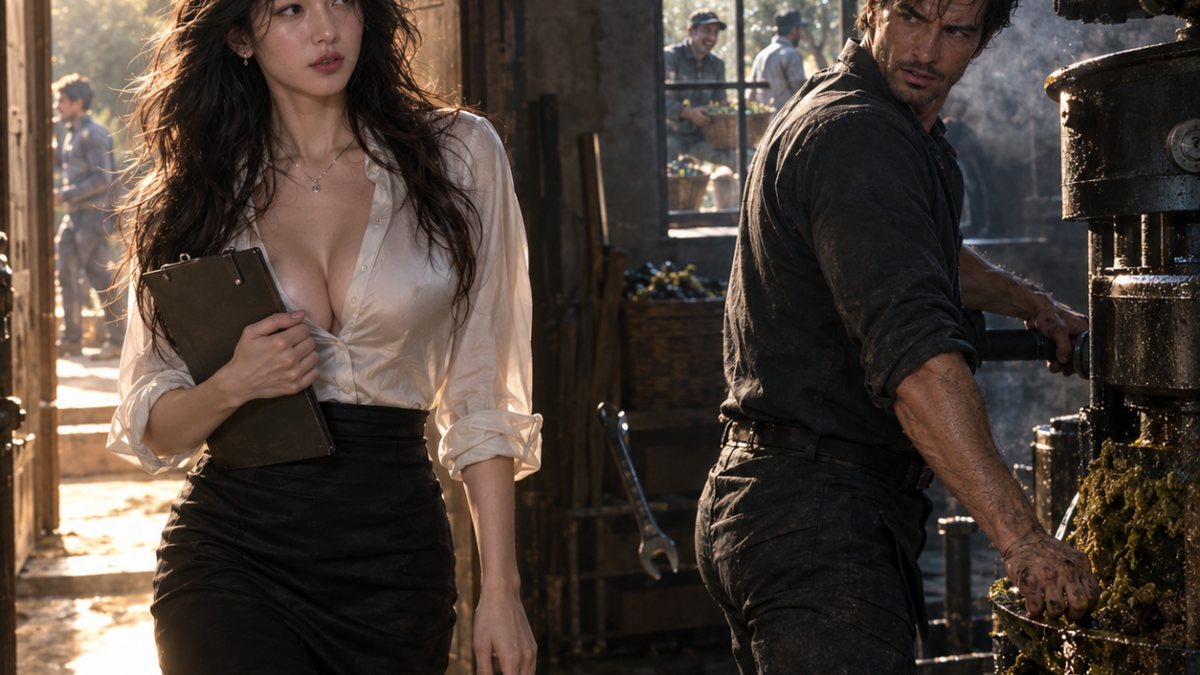
“Leave it in the press. We finish the batch.”
She was hired to inspect his machines. She found a list of names that could get them both killed.
ELENA
The olive press was broken again.
I knew it before I stepped out of my car — before I even killed the engine. The sound was wrong. A press that’s running properly has a rhythm, a deep mechanical heartbeat that you feel in your chest before you hear it. This one was stuttering, coughing, grinding metal against metal in a way that made my teeth ache.
I’d been in the Belice Valley for three weeks, and this was the fourth “mechanical failure” I’d documented at the Càssaro cooperative. Four failures in three weeks. The regional agriculture office had sent me here to certify equipment for a subsidy program — a routine audit, they’d said. Sign the forms, verify the machinery, go home.
Except nothing about this place was routine.
I grabbed my clipboard and stepped out into the September heat. The press house sat at the end of a dirt road lined with olive trees so old their trunks had split and twisted into shapes that looked almost human. The building itself was functional — concrete walls, corrugated metal roof, a faded sign above the door that read FRANTOIO CÀSSARO — DAL 1952. The smell hit me before I reached the entrance: crushed olives, sharp and green and faintly bitter, mixed with diesel and hot metal.
A man was standing in the doorway, blocking my path.
He was tall — taller than he’d looked from the car — with broad shoulders and hands that had done real work, not the soft hands of a man who only signed checks. His shirtsleeves were rolled to the elbow, revealing forearms marked with faint scars and a tattoo I couldn’t quite make out. Dark hair, dark eyes, a jaw that looked like it had been carved with a knife and never smoothed out.
Matteo Càssaro. The press operator. The son of the family that owned this valley.
“You’re early,” he said.
“Your machine’s been broken for six days,” I replied. “I’m actually late.”
Something flickered in his expression — too fast to read. “The inspector. Elena Rinaldi.”
I didn’t ask how he knew my name. Men like him always knew. “I need to see the press. And the maintenance logs. All of them.”
“The logs are in the office.” He didn’t move. “The press is offline. You can’t inspect a machine that’s not running.”
“I can inspect whatever I want. That’s how audits work.”
We stared at each other. The sun was hot on the back of my neck, and somewhere in the trees behind me, a cicada was screaming its death song. I’d dealt with difficult owners before — men who thought they could charm or intimidate their way past an inspection. Usually, a firm reminder of the legal consequences was enough.
Matteo Càssaro didn’t look like a man who cared about legal consequences.
“You’re not going to find anything,” he said finally.
“I’ll be the judge of that.”
He held my gaze for a long moment, then stepped aside. “Office is to the left. Logs are in the bottom drawer of the desk. I’ll be in the press room if you need me.”
He walked away before I could respond, disappearing into the dark mouth of the building. I stood there for a second, my heart beating faster than it should have been, and told myself it was just the heat.
The office was small and cluttered — a desk buried under paperwork, a filing cabinet with a broken lock, a window that looked out onto the press floor. I could see Matteo through the glass, bent over the machinery, his back to me. He moved with the kind of ease that came from years of physical labor, his hands finding bolts and levers without hesitation.
I sat down at the desk and pulled open the bottom drawer.
The logs were there, exactly where he’d said they’d be. Three thick binders, each one filled with handwritten entries dating back five years. I flipped to the most recent pages and started reading.
12 September — Press #2 — hydraulic failure — Part #A-447 replaced. Downtime: 3 days.
28 September — Press #1 — motor seizure — Part #B-219 replaced. Downtime: 4 days.
14 October — Press #3 — belt rupture — Part #C-881 replaced. Downtime: 5 days.
The pattern was clear from the first page. Every failure was logged with a part number, a date, and a duration. It looked professional. It looked thorough.
It looked wrong.
I pulled out my phone and opened the spreadsheet I’d been building since I arrived. Four failures in three weeks, all at the Càssaro cooperative, all affecting the same group of farms. The Bellini farm. The Russo farm. The Moretti farm. The Ferrara farm.
All farms that had been seized by the Càssaro family in the past two years.
All farms whose harvests were supposed to be processed here under new management.
I flipped back through the logs, my fingers moving faster now. The failures didn’t happen randomly. They happened exactly when a seized farm’s harvest was scheduled to arrive. The press would break, the harvest would be delayed, and by the time the machines were “fixed,” the rightful owners would have missed their window to file an appeal.
It was sabotage. Deliberate, systematic sabotage.
And Matteo Càssaro — the man who’d told me I wouldn’t find anything — was the one doing it.
I looked up through the window. He was still there, still working, his shoulders tense under his shirt. He looked up at the same moment, his eyes meeting mine through the glass.
Neither of us looked away.
CHAPTER TWO: THE PATTERN
MATTEO
She was going to find it.
I’d known that from the moment I saw her car pull up — known it the way you know a storm is coming before the first drop of rain hits your skin. Elena Rinaldi was too smart, too thorough, too stubborn. She’d been poking around the valley for three weeks, asking questions, taking notes, and she wasn’t going to stop until she understood what was really happening at the press.
I should have been more careful. I should have hidden the logs, or destroyed them, or at least made the failures look more random.
But I couldn’t do that.
The logs were the only proof I had. Every “part number” I’d written down was a name — a code only I understood. *A-447* was Antonio Bellini. *B-219* was Biagio Russo. *C-881* was Carmela Ferrara. Every failure was a record of what I’d done to protect them, to give them time, to keep their harvests out of the family’s hands until they could fight back.
If I destroyed the logs, I’d lose the only evidence that their farms had ever belonged to them.
If I kept them, I was putting a target on my own back.
And now Elena was reading them.
I watched her through the window, my hands moving automatically over the press machinery. She’d been in the office for twenty minutes, and she hadn’t come out. She was still at the desk, flipping through the binders, her brow furrowed in concentration.
She looked up. Our eyes met through the glass.
I felt it like a punch to the chest — that same jolt I’d felt the first time I saw her, three weeks ago, when she’d walked into the press house with her clipboard and her government badge and her sharp, assessing eyes. She was beautiful, in the way a knife is beautiful — lean and precise and dangerous if you got too close. Dark hair pulled back, olive skin, a mouth that looked like it had never once smiled out of politeness.
I’d wanted her from the moment I saw her. And that was exactly why I needed to stay away.
The press coughed beneath my hands, a shudder running through the metal frame. I swore under my breath and grabbed a wrench, tightening a bolt that had come loose. The machine was old, held together with spit and stubbornness, but it still worked when it needed to. The failures were mine — deliberate, calculated, timed to coincide with the arrival of seized harvests.
I’d been doing it for two years. Two years of fake breakdowns and delayed deliveries and paperwork that never quite made it to the right office. Two years of watching the family’s capos get more and more frustrated, wondering why the press kept breaking at the worst possible moments.
Two years of buying time for the families who’d lost everything.
It wasn’t enough. I knew that. Every harvest I delayed was just a temporary stay of execution — the family would take the farms eventually, one way or another. But it was something. It was the only thing I could do.
And now the inspector was going to blow it all open.
I set down the wrench and wiped my hands on a rag. The press was as fixed as it was going to get — I’d need to let it run for a few hours to check the calibration, but the immediate problem was solved. The Bellini harvest could go through tomorrow, just in time for Antonio Bellini’s daughter to file her appeal.
If Elena didn’t figure out what I was doing first.
I walked back to the office and pushed open the door. She was still at the desk, but she’d closed the binders and was writing something in her notebook, her pen moving fast across the page.
“Find what you were looking for?” I asked.
She looked up. Her eyes were dark brown, almost black, and they held mine with an intensity that made my stomach tighten.
“How long have you been sabotaging the press?”
The question hit me like a slap. I didn’t flinch — I’d spent too many years learning not to flinch — but I felt the blood drain from my face.
“I don’t know what you’re talking about.”
“The failures.” She flipped open one of the binders and pointed to a page. “Twelve September. Press #2. Hydraulic failure. That was the day the Bellini harvest was scheduled to arrive. Twenty-eight September. Press #1. Motor seizure. The day the Russo harvest was supposed to come in. Fourteen October. Press #3. Belt rupture. The Ferrara harvest.” She looked up at me. “Every single failure coincides with a seized farm’s delivery. Every single one.”
I stared at her. She was smarter than I’d thought — and I’d already thought she was smart.
“Coincidence,” I said.
“Bullshit.”
“Careful, signorina. That’s not very professional.”
“Neither is sabotage.” She stood up, her notebook clutched to her chest. “I don’t know why you’re doing it, and I don’t know who you’re doing it for, but I know what I saw. And I’m going to report it.”
The room felt very small. I could hear the press humming in the background, the cicadas screaming outside, the blood rushing in my ears.
“Report it to who?” I asked. “The regional office? The same office that’s been ‘forgetting’ to process the seized farms’ appeals for two years? The same office that sent you here to certify equipment that hasn’t worked properly since 2019?”
She blinked. “What are you talking about?”
“I’m talking about the fact that you’re not the first inspector they’ve sent. You’re the third. The first two filed reports that never went anywhere. The office is compromised, signorina. Reporting this won’t do anything except put a target on your back.”
She was quiet for a moment, her jaw tight. I could see her processing — the same sharp intelligence I’d noticed the first day, working through the implications.
“Then I’ll go higher,” she said. “The regional director. The anti-mafia commission. Someone who isn’t compromised.”
“And what do you think will happen when the Càssaro family finds out you’re talking to the anti-mafia commission?” I stepped closer, my voice dropping. “You think they’ll just let you file your report and go home? You think they won’t notice?”
“I’m not afraid of your family.”
“You should be.”
The words hung in the air between us. She was close enough now that I could see the flecks of gold in her eyes, the faint scar on her chin, the way her pulse fluttered at the base of her throat. She was afraid — I could see it — but she was also furious, and the fury was winning.
“You’re the one who should be afraid,” she said. “You’re the one who’s been sabotaging your own family’s business. What do you think they’ll do when they find out?”
I held her gaze. “They won’t find out.”
“Won’t they?”
“No.” I took another step closer, close enough that I could smell her — clean soap and something floral, jasmine maybe, mixed with the dust of the valley. “Because you’re not going to tell them.”
Her eyes widened. “Is that a threat?”
“It’s a fact.” I reached past her, grabbing the binders from the desk, and tucked them under my arm. “You’re going to finish your inspection. You’re going to certify the equipment. And then you’re going to leave the valley and forget you ever saw those logs.”
“And if I don’t?”
I looked at her for a long moment. She was standing her ground, her chin lifted, her hands clenched at her sides. She wasn’t going to back down easily. She wasn’t going to be intimidated.
She was going to be a problem.
“Then we’ll both find out what the family does when they discover what I’ve been doing,” I said. “And I promise you, signorina — you won’t like the answer.”
I turned and walked out of the office, the binders under my arm, my heart pounding in my chest.
I’d bought myself some time. But not much.
And I had a feeling Elena Rinaldi wasn’t going to let this go.
CHAPTER THREE: THE BARGAIN
ELENA
He was lying.
Not about the sabotage — I was certain about that. The pattern was too clear, the timing too precise. Matteo Càssaro had been deliberately breaking the press, and he’d been doing it for years.
But he was lying about the reason.
I’d seen the way he looked at those logs. Not like a man protecting his own interests, but like a man protecting something precious. Something he was willing to risk everything for.
I needed to know what.
I spent the rest of the day finishing my inspection — the parts of it I could actually do without the press running at full capacity. Matteo avoided me, staying in the press room while I checked the storage facilities and the loading docks. But I could feel his eyes on me through the windows, tracking my movements, waiting for me to leave.
I didn’t leave.
Instead, I waited until the sun went down and the workers had all gone home. I sat in my car, watching the press house, until the lights in the office went out and Matteo walked out the front door.
He didn’t go to his car. He walked toward the olive grove behind the building, disappearing into the trees.
I followed him.
The grove was dark, the only light coming from the moon filtering through the branches. I kept my distance, my footsteps quiet on the soft earth, until I saw him stop at the edge of a small clearing.
There was a house there — a crumbling stone farmhouse with a collapsed roof and windows that had been boarded up for years. It looked abandoned, but there was a light on inside, a faint glow seeping through the cracks in the boards.
Matteo knocked on the door. A moment later, it opened, and an old woman appeared in the doorway.
“Matteo,” she said, her voice cracked with age. “You shouldn’t be here. It’s not safe.”
“I know.” He reached into his jacket and pulled out an envelope. “The harvest is scheduled for tomorrow. The press is fixed — for now. But you need to file the appeal before the end of the week. I’ve included the paperwork, and the name of a lawyer who can help.”
The old woman took the envelope, her hands trembling. “Why are you doing this? Your family—”
“My family doesn’t know.” His voice was soft. “And they’re not going to find out.”
I stood frozen in the shadows, my heart pounding. The old woman — I recognized her now, from the photos in the case files. Carmela Ferrara. The matriarch of the Ferrara family, whose farm had been seized eighteen months ago.
Matteo was helping her. He was sabotaging the press to buy her time to fight back.
The realization hit me like a wave, leaving me dizzy. He wasn’t a criminal. He was a saboteur — but not for personal gain. He was using his position inside the family to protect the people they’d dispossessed.
The same people I was supposed to be helping.
“You’re a fool,” Carmela said, but there was affection in her voice. “A brave fool. But a fool nonetheless.”
“Maybe.” Matteo smiled — a real smile, the first I’d seen from him. “But I’d rather be a fool than a coward.”
Carmela’s eyes flickered toward the trees where I was hiding. “You have company.”
Matteo spun around, his body going tense. “Who’s there?”
I stepped out of the shadows. “Me.”
His face went pale. “Rinaldi. What the hell are you doing here?”
“Following you.” I walked toward them, my hands raised slightly. “I wanted to know why you were breaking the press. Now I do.”
Carmela looked between us, her expression wary. “Matteo, who is this?”
“The inspector.” His voice was flat. “The one I told you about.”
“I see.” Carmela studied me for a long moment. “She doesn’t look like the family’s usual people.”
“She’s not.” Matteo was still staring at me, his jaw tight. “She’s government. Which is worse.”
“I’m not worse,” I said. “I’m the person who’s been trying to help you.”
“You’ve been trying to do your job. There’s a difference.”
“No, there isn’t.” I stepped closer, my voice rising. “I’ve spent three weeks in this valley, watching your family steal farms from people who’ve worked them for generations. I’ve seen the paperwork, the false claims, the way the regional office has been burying every appeal. I know what’s happening here, and I want to stop it.”
Matteo stared at me. “You can’t stop it.”
“Maybe not alone. But with your help—”
“My help?” He laughed, a bitter sound. “You want my help? I’ve been doing this for two years — two years of sabotage and lies and watching my back every second. And now you show up, with your government badge and your righteous anger, and you think you can fix everything?”
“I think I can try.”
“Why?” He stepped closer, his eyes blazing. “Why do you care? This isn’t your family. This isn’t your valley. You’re just passing through, and when this is all over, you’ll go back to your life and forget about us.”
“That’s not true.”
“Isn’t it?”
I looked at him — at the anger in his face, the exhaustion, the loneliness. He was fighting alone, I realized. He’d been fighting alone for years, with no one to help him, no one to share the burden. And he’d assumed I would be just another person who didn’t care.
But he was wrong.
“I care because it’s right,” I said. “I care because those families deserve their land back. I care because what your family is doing is illegal and cruel and wrong, and I can’t just walk away from that.”
“It’s dangerous.”
“I know.”
“You could get killed.”
“I know that too.”
He stared at me for a long moment. The anger in his eyes was fading, replaced by something else — something softer, more vulnerable. Something that made my chest ache.
“Fine,” he said finally. “You want to help? Then here’s how it works. We meet tomorrow, at noon, in the back of the grocery store in town. I’ll give you everything I have — the logs, the files, the names. You do what you can with it.”
“And what about you?”
“I’ll keep doing what I’ve been doing. Buying time.”
“That’s not a plan. That’s a suicide mission.”
“It’s the only plan I’ve got.”
I shook my head. “No. We do this together, or we don’t do it at all.”
He raised an eyebrow. “You don’t trust me?”
“I don’t trust anyone.” I met his gaze, holding it. “But I’m willing to try. Are you?”
The moon hung low in the sky, casting silver light across the olive grove. Somewhere in the distance, a dog barked. I could hear the old woman breathing behind us, her presence a quiet witness to whatever was happening between us.
Matteo Càssaro looked at me for a long moment. And then, slowly, he nodded.
“Tomorrow,” he said. “Noon. Don’t be late.”
He turned and walked away, disappearing into the darkness. I stood there, my heart pounding, my mind racing.
I’d just made a deal with the devil’s son. And I had no idea if I was going to survive it.
CHAPTER FOUR: THE ALLIANCE
MATTEO
She was going to get herself killed.
That was my first thought when I woke up the next morning — before I even opened my eyes, before I remembered where I was or what had happened the night before. Elena Rinaldi was going to get herself killed, and it was going to be my fault.
I’d been careful for two years. I’d kept my head down, my secrets hidden, my plans close to my chest. And then she’d shown up, with her sharp eyes and her stubborn jaw and her infuriating insistence on doing the right thing, and suddenly everything was spinning out of control.
The smart thing to do would be to cut her loose. Give her enough information to satisfy her curiosity, then send her back to Palermo with a warning. Let her file her report and watch it disappear into the bureaucracy. Let her forget about the Càssaro family and their broken press and the families they’d destroyed.
But I couldn’t do that.
Because the truth was, I needed her. Not just as an ally — as someone who could do the things I couldn’t. I was trapped inside the family, watched by the capos, expected to do whatever my father ordered. I couldn’t go to the authorities, couldn’t file appeals, couldn’t do anything that would draw attention to what I’d been doing. But Elena — she was on the outside. She had connections, resources, a badge that opened doors.
She was my best chance at making this right.
And she was also the most dangerous person I’d ever met.
I met her at noon in the back room of the grocery store, exactly where I’d promised. She was already there when I arrived, sitting on a crate of tomatoes, her clipboard on her lap.
“You’re on time,” she said.
“I said I would be.”
“I didn’t believe you.”
I almost smiled. “You’re not a trusting person.”
“I’m not an idiot.” She stood up, brushing dust from her jeans. “Did you bring the files?”
I set the binders on the table between us. “Everything I have. Logs, correspondence, financial records. It’s not enough to make a case on its own — the family’s lawyers are too good for that — but it’s a start.”
She opened one of the binders, flipping through the pages. “These are the part numbers?”
“Yes. Each one is a code. The first letter is the farm — A for Bellini, B for Russo, C for Ferrara. The numbers are the date the farm was seized.”
She looked up at me, her eyes wide. “You’ve been keeping records of every seizure. Every single one.”
“I started the list two years ago, after I realized what my father was doing.” I sat down across from her, suddenly exhausted. “I thought if I could document everything, I could find a way to fight back. But the family is too powerful. I couldn’t prove anything without revealing what I’d done.”
“But I can.” She closed the binder, her jaw set with determination. “I can take this to the anti-mafia commission. They’ll investigate.”
“They’ll investigate, and they’ll find nothing. My father has friends in the commission — friends he’s paid very well. The only way to make this stick is to go public.”
“Public?”
“The press. The media. The court of public opinion.” I leaned forward, my voice low. “My father cares about one thing: his reputation. He’s spent his whole life building the image of the Càssaro family as honest businessmen, respected members of the community. If that image is destroyed — if people start asking questions about where the farms came from — he’ll lose everything.”
Elena was quiet for a moment. I could see her thinking, her mind working through the possibilities.
“You want to expose your own family.”
“I want to stop them. There’s a difference.”
“Is there?” She looked at me, her expression unreadable. “You’ve been working for them for years. You’ve been running their press, processing their stolen harvests, keeping their secrets. How do I know you’re not just trying to save yourself?”
The accusation stung, but I didn’t flinch. “You don’t know. But I’m here, aren’t I? I’m the one who brought you these files. I’m the one who’s been sabotaging the press for two years, trying to buy time for the families. I’m the one who’s risking everything.”
She held my gaze for a long moment. And then, slowly, she nodded.
“Fine,” she said. “I’ll help you. But there are conditions.”
“Name them.”
“First, I’m not going to be a pawn in whatever game you’re playing. I have my own reasons for wanting to take down your family, and I’m not going to let you use me without knowing what I’m getting into.”
“What are your reasons?”
She hesitated. For a moment, I saw something flicker in her eyes — pain, maybe, or grief.
“My grandmother,” she said finally. “She lived in this valley her whole life. Her family had an olive farm, just like the ones your father took. They lost it fifty years ago — to the Càssaros.”
The words hit me like a fist. “I didn’t know.”
“Of course you didn’t. Your family doesn’t keep records of the people they’ve destroyed. They just move on to the next farm, the next family.” Her voice was bitter. “I grew up hearing stories about it — the farm that was stolen, the grandparents who died poor and heartbroken. I became an inspector because I wanted to make sure it never happened to anyone else.”
“And now it has.”
“And now it has.” She leaned forward. “So I’m not here to help you, Matteo. I’m here to help them. The families your family has destroyed. If our goals happen to align, fine. But I’m not your ally. I’m not your friend. I’m not your anything.”
I should have been relieved. Her distrust made things simpler — no emotional complications, no messy feelings to navigate. But somehow, her words felt like a punch to the gut.
“I understand,” I said.
“Do you?”
“Yes.” I met her eyes. “You don’t trust me. That’s fine. I don’t trust you either. We’re not doing this because we like each other. We’re doing this because we both want the same thing.”
“Which is what?”
“Justice.” I slid the binders toward her. “For the families. For your grandparents. For everyone my father has hurt.”
She looked at the binders, then back at me. “And what happens when this is over? What happens to you?”
“I don’t know.” I hadn’t let myself think that far. “I’ll deal with it when the time comes.”
“That’s not a plan.”
“It’s the best I have.”
She was quiet for a long moment, studying me with those dark eyes. And then, slowly, she reached out and took the binders.
“Fine,” she said. “Let’s get to work.”
CHAPTER FIVE: THE SPY
ELENA
The next two weeks were the most dangerous of my life.
I met with Matteo three times a week, always in different locations — the back of the grocery store, a roadside chapel outside of town, an abandoned farmhouse that he said belonged to a family who’d fled to Germany. We went over the files together, building a case piece by piece.
The Càssaro family, it turned out, had been systematically seizing farms for decades. They’d start by offering “protection” — insurance against crop failures, theft, natural disasters. The farmers who accepted paid a small monthly fee and were left alone. The farmers who refused found themselves facing a different kind of attention: mysterious fires, stolen equipment, threats delivered in the middle of the night.
The farms that were seized were always the most valuable ones — the ones with the oldest trees, the best soil, the strongest yields. And the paperwork was always impeccable. The Càssaros had a team of lawyers who specialized in “forgetfulness” — lost deeds, missing documents, claims that appeared out of nowhere. By the time the rightful owners realized what had happened, it was too late.
My grandmother’s family had been one of the first.
I didn’t tell Matteo how much this affected me — how every file I read felt like a wound reopening. But he must have seen it anyway, because sometimes, in the middle of our work, he would look at me with an expression I couldn’t quite read.
“What?” I asked one night, after we’d spent three hours going through financial records in a dusty attic.
“Nothing.” He looked away. “You’re just — you’re very focused.”
“I have a reason to be.”
“I know.” He was quiet for a moment. “I’m sorry. About your grandmother.”
The words surprised me. I hadn’t expected an apology — hadn’t expected him to remember.
“It was a long time ago,” I said.
“That doesn’t make it better.”
“No.” I looked down at the papers in front of me. “It doesn’t.”
We sat there in silence for a moment, the only sound the wind outside and the rustle of pages. And then Matteo reached across the table and touched my hand — just briefly, just for a second. A gesture of comfort, not seduction.
“We’re going to fix this,” he said. “I promise.”
I wanted to believe him. But promises were cheap, and I’d learned long ago not to trust them.
It was the third week when I noticed the car.
I was driving back from a meeting with Matteo — a late-night planning session in the ruined farmhouse — when I saw it in my rearview mirror. A black sedan, sleek and unfamiliar, following at a steady distance.
I’d been an inspector for six years. I knew what it meant when a car followed you.
I tried to stay calm. I made a few turns, testing to see if the car would keep following. It did. I sped up, and it matched my pace. I slowed down, and it did the same.
Someone knew I was in the valley. Someone knew what I was doing.
I pulled over at the next gas station and called Matteo.
“Someone’s following me,” I said.
“Where are you?”
“Gas station on the main road. About ten kilometers from the press.”
“Get out of the car. Go inside the gas station. Stay in the bathroom until I get there.”
“What if they—”
“Just do it. Now.”
I hung up and did what he said. The bathroom was small and smelled like bleach, but it was locked, and there was no window. I leaned against the wall, my heart pounding, and waited.
It took Matteo twenty minutes to arrive. When he knocked on the door, I almost cried with relief.
“It’s me,” he said. “Come out.”
I opened the door. He was standing in the hallway, his expression grim. Behind him, I could see a bodyguards — two men in dark suits who I didn’t recognize.
“Who were they?” I asked.
“Someone from my family.” His voice was tight. “One of my father’s men. He saw you with me last night. Now they know I’ve been talking to the inspector.”
“Are we in danger?”
“Yes.” He took my arm, steering me toward the exit. “We need to move. Now.”
CHAPTER SIX: THE SAFE HOUSE
MATTEO
I drove her to a safe house I’d been keeping for years — a small apartment above a bakery in the town of Castelvetrano, owned by a friend of mine who owed me favors. It wasn’t much: one bedroom, a tiny kitchen, a bathroom that was barely bigger than a closet. But it had a sturdy lock on the door and a fire escape out the back window.
“You can stay here tonight,” I said. “Tomorrow, we’ll figure out what to do.”
Elena looked around the apartment, her expression unreadable. “This is yours?”
“It’s safe. That’s what matters.”
She dropped onto the couch, suddenly looking exhausted. “I don’t understand. I’ve been careful. How did they find me?”
“My father has connections everywhere. Once they realized you weren’t just a routine inspection, they started watching.” I sat down across from her. “I should have anticipated this. I’m sorry.”
“It’s not your fault.” She rubbed her eyes. “I should have expected it too. I know how these people operate.”
“You know more than you let on.”
She looked at me sharply. “What do you mean?”
“Your grandmother’s farm. The Càssaro family. You said you grew up hearing stories, but it’s more than that, isn’t it? You’ve been researching us for years.”
She was quiet for a long moment. And then, slowly, she nodded.
“I wrote my thesis on mafia land seizures in Sicily. I spent three years interviewing families, collecting documents, building a database.” She laughed humorlessly. “I thought I could make a difference. I thought I could expose what was happening.”
“But you couldn’t.”
“No. The more I researched, the more I realized how deep the corruption went. The Càssaros weren’t just a local crime family — they were part of a network that stretched all the way to the government. Every time I tried to report something, it got buried. Every time I tried to go public, I got threats.” She looked up at me. “I became an inspector because I thought if I could work from the inside, if I could document the violations firsthand, I might be able to build a case that couldn’t be ignored.”
“And now you’re here.”
“And now I’m here.” She shook her head. “I don’t know why I thought this time would be different. The Càssaros have been doing this for generations. They’re not going to stop just because two people with a grudge decide to fight back.”
“Two people with a grudge and a lot of evidence,” I said. “That’s more than anyone else has had.”
“It’s not enough.”
“It has to be.”
She looked at me, her dark eyes searching my face. In the dim light of the apartment, she looked younger than before — more vulnerable. I’d thought of her as sharp and guarded, but underneath that armor, she was just as scared as I was.
“Why are you doing this?” she asked. “You could just walk away. You could let your family do what they want and go on with your life. You’d be safe. You’d be rich. You’d have everything.”
“Except my conscience.”
She was quiet.
“I know what my family is,” I said. “I’ve known since I was a child. I watched my father destroy people, watched him take everything they had and give them nothing in return. I told myself I couldn’t do anything about it. I told myself I was just one person, that fighting would be pointless.”
“But you did fight.”
“I tried. I started with the press. Small things — delays, errors, paperwork that got ‘misplaced.’ I told myself it was enough, that I was saving people even if they didn’t know it.” I shook my head. “But it wasn’t enough. It was never going to be enough.”
“So you decided to do more.”
“I decided to do what I should have done years ago.” I met her eyes. “I decided to take down my father. No matter what it costs.”
She held my gaze for a long moment. And then, slowly, she nodded.
“Then we do it together,” she said. “No matter what it costs.”
The next few days were tense. We stayed in the safe house, barely leaving, working on the case from dawn until midnight. The evidence was damning — bank records, land deeds, threatening letters, photographs of the seizures. But we still didn’t have what we needed: a witness willing to testify.
“The families are too scared,” Elena said one afternoon, scrolling through her notes. “Everyone I’ve contacted has either refused to talk or disappeared. They think the Càssaros will kill them if they speak out.”
“They’re not wrong.”
“I know.” She closed her laptop, frustrated. “But without a witness, we can’t make this stick. The evidence alone isn’t enough — the family’s lawyers will find a way to discredit it.”
I thought for a moment. “What about a public gathering? The harvest festival is next week. The whole valley will be there — including the Càssaro family and all the families they’ve dispossessed. If we could get someone to speak out, to tell their story in front of everyone—”
“They’d be killed before they finished the first sentence.”
“Not if we protect them. Not if we’re prepared.”
She looked at me, her eyes narrowing. “You’re serious.”
“I’m serious.” I leaned forward. “The harvest festival is our best chance. The whole valley will be watching. The media will be there. If we can expose the family’s crimes in front of everyone, they won’t be able to cover it up.”
“It’s a suicide mission.”
“Maybe. But it’s the only option we have.”
She was quiet for a long moment. I could see her thinking, weighing the risks, calculating the odds. She was scared — I could see it in her eyes — but she was also determined.
“Fine,” she said finally. “But we do it my way. No more secrets. No more lies. We tell the families the truth, we ask them to fight, and we give them a chance to decide for themselves.”
“And if they say no?”
“Then we do it anyway. Because we don’t have a choice.”
I nodded. “Then let’s get to work.”
CHAPTER SEVEN: THE GATHERING
ELENA
The harvest festival was held in the main square of the village, under the shadow of a church that had stood there for five hundred years. The whole valley came: farmers and their families, merchants and their wives, children running wild in their Sunday best. There was music and food and wine, and everywhere I looked, I saw people laughing, dancing, celebrating.
I saw something else too. I saw the families the Càssaros had destroyed — the Ferraras, the Russos, the Bellinis. They stood at the edges of the crowd, watching, waiting. They knew something was about to happen. They just didn’t know what.
Matteo stood beside me in the shadow of the church, his expression grim. “Are you ready?”
“No.” I took a deep breath. “But let’s do it anyway.”
We walked into the center of the square. The music stopped. The crowd turned to look at us.
And then I opened my mouth and started to read.
I read from Matteo’s logs — every failure, every part number, every name. I read from the case files — every seizure, every threat, every family destroyed. I read from my own notes — the story of my grandmother, the farm she’d lost, the family she’d never recovered.
At first, the crowd was silent. They didn’t understand what they were hearing. But as I kept reading, as I told the story of the Càssaro family’s crimes — the extortion, the theft, the violence — I saw the realization spread across their faces. I saw the anger. I saw the grief.
And then I saw the fear.
“These are the crimes of the Càssaro family,” I said, my voice ringing across the square. “These are the lives they have destroyed. These are the farms they have stolen. And this is the man who has been fighting them from the inside.”
I pointed at Matteo. He stepped forward, his face pale but determined.
“My name is Matteo Càssaro,” he said. “My father is Salvatore Càssaro. And I am here to tell you that everything she said is true.”
The silence was deafening. And then, from the back of the crowd, a voice rang out.
“Liar!”
I saw Matteo’s father pushing through the crowd — Salvatore Càssaro, a tall man with silver hair and cold eyes. Beside him were his capos, their hands reaching for their guns.
“Liar!” he shouted again. “You are not my son. You are a traitor. A spy. You have disgraced this family and this valley.”
“The only disgrace is you,” Matteo said, his voice steady. “You have stolen from these people. You have hurt them. You have killed them. And now everyone knows.”
Salvatore’s face twisted with rage. He reached for his gun.
And then a woman stepped out of the crowd.
Carmela Ferrara, the old woman I’d seen in the olive grove, walked toward Salvatore with her head held high. Behind her came others — the Russos, the Bellinis, the families I’d read about in the files. They formed a circle around us, their faces set with determination.
“You will not touch him,” Carmela said. “You will not touch any of us. Not anymore.”
Salvatore stared at her, his gun half-raised. And then, slowly, he lowered it.
“This isn’t over,” he said. “You will all pay for this.”
But he was already retreating. His capos followed him, their faces pale, their guns holstered. The crowd watched them go in silence.
And then, slowly, the cheering started.
I stood in the middle of the square, surrounded by people who had been strangers an hour ago, and felt something I hadn’t felt in years: hope.
CHAPTER EIGHT: THE AFTERMATH
MATTEO
The cheering didn’t last.
By midnight, the square was empty, the festival decorations torn down, the villagers retreated to their homes with their doors locked and their windows shuttered. The Càssaros had retreated too — but not far. I knew my father. He wouldn’t run. He’d regroup, re-strategize, and come back harder.
We had maybe forty-eight hours before he made his next move.
“We need to leave the valley,” I said, pacing the small kitchen of the safe house. Elena was sitting at the table, her clipboard in front of her, her face pale but composed. “Tonight. Before he has time to organize.”
“And go where?”
“Palermo. I have contacts there — people who aren’t loyal to my father. We can lay low, figure out our next steps.”
“Your father will find us.”
“Maybe. But it’ll take him longer than if we stay here.” I stopped pacing, looking at her. “We bought ourselves time tonight. We exposed him in front of the whole valley. That’s not nothing.”
“It’s not enough either.” She rubbed her eyes. “He’ll deny everything. He’ll say you’re a traitor, a liar, a disgruntled son with a grudge. He’ll produce documents, witnesses, whatever he needs to discredit us. And people will believe him, because they’re scared.”
“Some will. But not all.” I sat down across from her. “The families who stood with us tonight — they won’t forget. They’ll talk. They’ll organize. And when the time comes, they’ll be ready to fight.”
“You’re an optimist.”
“I’m a realist. My father’s power depends on fear. Once people stop being afraid, he has nothing.” I leaned forward. “Tonight, we showed them they don’t have to be afraid. That’s worth something.”
She was quiet for a moment, her dark eyes searching my face. “You really believe that.”
“I have to.”
She nodded slowly. “Okay. Palermo. But we need a plan — not just for hiding, but for fighting back. Your father has resources. We need more.”
“What do you suggest?”
She pulled out her phone, scrolling through her contacts. “I know a journalist. Investigative reporter for La Repubblica. She’s been covering mafia land seizures for years, but she’s never had enough evidence to publish anything major. If we give her what we have—”
“It could blow the whole thing open.”
“Or it could get her killed.” Elena looked up at me. “We need to be careful. We need to protect her, and anyone else who helps us.”
“We will.” I stood up. “Pack your things. We leave in an hour.”
The drive to Palermo took three hours. We didn’t talk much — Elena stared out the window, watching the dark Sicilian countryside roll past, and I focused on the road, checking the rearview mirror every few minutes to make sure we weren’t being followed.
The safe house in Palermo was a small apartment in the historic center, tucked away on a narrow street that was barely wide enough for a car. It belonged to a friend of mine — Luca, a former soldier who’d left the family years ago and now ran a small restaurant. He met us at the door, his face creased with worry.
“Matteo. I heard what happened in the valley.”
“News travels fast.”
“Bad news travels faster.” He looked at Elena, his expression curious. “This is the inspector?”
“Elena Rinaldi.” She extended her hand. “Thank you for letting us stay here.”
Luca shook her hand, his eyes still wary. “Any friend of Matteo’s is welcome. But you should know — there are people looking for you. Men from the Càssaro family. They’ve been asking questions.”
“How many?”
“At least four. Maybe more.” Luca stepped aside, letting us into the apartment. “They’re staying at a hotel near the port. They’ve been seen talking to local police.”
“Corruption,” Elena said flatly.
“Probably.” Luca closed the door behind us. “You can’t stay here long. A few days at most.”
“We know.” I set down my bag. “We just need time to organize.”
“Time is something you don’t have much of.” Luca looked at me, his expression serious. “Your father is offering a reward for information about your whereabouts. Fifty thousand euros.”
I felt Elena’s eyes on me. “That’s a lot of money.”
“It’s nothing to him. He’s making a point.” I turned to Luca. “We need to move fast. Can you get a message to Sofia Mancini at La Repubblica?”
Luca’s eyebrows rose. “The journalist? She’s been investigating the Càssaros for years. She’s dangerous.”
“She’s exactly what we need.” I glanced at Elena. “If we can get her to publish the story — with the documents, the logs, everything — it won’t matter what my father says. The truth will be out there.”
“And what happens to us when the truth is out?” Elena asked. “Your father won’t just let us walk away.”
“No.” I met her eyes. “But at least we’ll have a chance.”
CHAPTER NINE: THE JOURNALIST
ELENA
Sofia Mancini was not what I expected.
I’d imagined a hard-bitten investigative reporter — someone in her fifties, maybe, with gray hair and a cynical expression. Instead, I found myself sitting across from a woman in her early thirties, with sharp green eyes and a quick smile, who looked more like a fashion model than a crime reporter.
“You’re the inspector,” she said, leaning back in her chair. We were in her apartment in Palermo, a sleek modern space that overlooked the harbor. “I’ve been following your work. The audit reports, the inspections. You’ve been poking at the Càssaros for months.”
“I didn’t know I had an audience.”
“Everyone has an audience. They just don’t know it.” Sofia turned to Matteo. “And you’re the son. The one who’s been sabotaging the press.”
“I’m the one who’s been trying to do the right thing.”
“Same thing, from where I’m sitting.” She picked up the binders we’d brought, flipping through them. “This is good. This is really good. The logs, the financial records, the witness statements — it’s enough for a major exposé.”
“But?”
“But it’s not enough to bring them down. Not completely.” She set the binders down. “The Càssaros have been operating for decades. They have lawyers, politicians, judges in their pocket. A single article won’t change that.”
“What will?”
Sofia was quiet for a moment, her eyes moving between us. “A coordinated attack. The article, yes — but also the families. The ones whose farms were seized. If they’re willing to speak publicly, to tell their stories, to file a joint lawsuit — that changes things. It makes it a movement, not just a scandal.”
“Will the families do that?”
“Some will. The ones who are brave enough.” She looked at Matteo. “Your father has made a lot of enemies. People who’ve been waiting for a chance to fight back. If you can give them that chance—”
“We can give them that chance.” Matteo leaned forward. “But we need to do it quickly. My father isn’t going to wait forever.”
“No, he’s not.” Sofia stood up, walking to the window. “I can have the article ready in a week. But I need more evidence — something that ties your father directly to the seizures. Something that proves he ordered them personally.”
Matteo was quiet. I could see him thinking, his jaw tight.
“There might be something,” he said finally. “In my father’s office. A safe. He keeps his most sensitive documents there — orders, communications, records of payments to officials.”
“Can you get it?”
“I can try.” He looked at me. “But I’ll need help.”
The next few days were a blur of planning and preparation. We met with Sofia twice, refining the article and mapping out our strategy. We met with lawyers — a team that specialized in mafia-related cases, recommended by Sofia — who agreed to represent the families in a joint lawsuit. We met with some of the families themselves, the ones who were brave enough to fight, and listened to their stories.
It was exhausting. It was terrifying. And it was the most alive I’d felt in years.
Matteo and I spent most of our time together — sharing the small apartment, eating meals at Luca’s restaurant, working late into the night on the details of the plan. We bickered constantly, about everything from the best way to approach the lawyers to what to eat for dinner. But somewhere along the way, the bickering started to feel less like fighting and more like… something else.
“You’re eating the last cannoli,” I said one night, reaching for the pastry. “That’s mine.”
“You didn’t call dibs.”
“Dibs aren’t a thing in Italy.”
“They are now.” He held the cannoli out of reach, a smirk playing at the corner of his mouth. “Unless you want to make a deal.”
“What kind of deal?”
“You take the cannoli. I get the last of the espresso.”
“Deal.” I grabbed the cannoli from his hand before he could react, biting into it with a triumphant grin. “Sucker.”
He laughed — a real laugh, the first I’d heard from him. It transformed his face, softening the hard lines, making him look younger. More human.
“Fine,” he said. “But you owe me.”
“I owe you nothing.”
“We’ll see.”
I felt my cheeks flush. The casual flirtation caught me off guard — I’d been so focused on the danger, on the plan, on the constant threat of discovery. I’d forgotten what it felt like to just… be. To laugh. To tease.
To want someone.
I pushed the feeling away. This wasn’t the time. This wasn’t the place. And Matteo Càssaro was the last person I should be thinking about like that.
But the feeling lingered.
 [Tap here for the Next Part ]