“Play it again. I dare you to tell me that note sounds the same as it did fifty years ago.”
“Play it again. I dare you to tell me that note sounds the same as it did fifty years ago.”
She thought she was cataloguing her grandfather’s legacy. She discovered a fortune built on silence—and a family willing to destroy her to keep it.
The glass harmonica sang under my fingertips, and I knew immediately that something was wrong.
I pulled my hand back as if the instrument had burned me, staring down at the rows of spinning glass bowls set into the mahogany case. The note still hung in the air—a thin, watery A that should have resonated through my chest and settled somewhere behind my sternum. Instead, it had landed flat. Dead. Like a voice with a cold.
“Miss Ashworth?” The museum’s appraiser, a nervous man named Gerald who had the complexion of someone who spent too much time indoors with old documents, checked his watch. “We’re on rather a tight schedule. The acquisition committee meets Thursday, and—”
“Play it again.” I didn’t look at him. I was already reaching for the foot pedal, already preparing to run the scale my grandfather had taught me when I was seven years old. The same scale he’d played on this very instrument, his hands trembling with age but his ear still perfect.
“Miss Ashworth, I’ve already tested it twice. The provenance is impeccable. Your aunt has been most thorough—”
“Play it again.“
Gerald fell silent. Behind me, I heard the soft shuffle of his assistant’s feet on the marble floor of the Ashworth family conservatory. The room stretched around us like a cathedral to sound—vaulted ceilings designed for acoustic perfection, mahogany shelves lined with instruments that represented three generations of obsessive collecting. Violins that had belonged to minor European royalty. A harpsichord rumored to have been played by Mozart himself. And here, in the center of the room on a pedestal that caught the afternoon light like a halo, the glass harmonica that had been my grandfather’s most prized possession.
I pressed the pedal. The bowls began to spin. I touched the rim of the largest one with wet fingers.
The note emerged, shimmering.
And I felt my stomach drop.
“That’s not right,” I whispered.
“I beg your pardon?”
I turned to face Gerald, and I saw him flinch at whatever expression was on my face. Good. Let him flinch. Let him understand that something was deeply, fundamentally wrong here.
“When was this instrument last serviced?”
Gerald’s brow furrowed. “I’m not certain. Your aunt provided documentation that it had been recently restored by a specialist in Vienna. Everything appeared to be in order—”
“Everything appeared to be in order,” I repeated slowly, “but you never actually tested it, did you? You never played it against the historical recordings. You never checked the resonant frequencies. You never—” I stopped myself, pressing my fingers against my temples. “Gerald, this instrument is a fake.”
The silence that followed was so absolute I could hear the dust settling on the shelves.
“That’s… that’s a very serious accusation, Miss Ashworth.” Gerald’s voice had gone high and tight. “The provenance documentation alone—”
“I don’t care about the documentation.” I was already moving toward the door, my heels clicking a sharp staccato across the marble. “Where is my aunt?”
“She’s in the east wing, but—”
I was already gone.
Chapter Two: The Aunt’s Domain
The east wing of Ashworth House smelled like old money and fresh flowers—a combination that had always made me feel slightly nauseous as a child. My aunt Vivian had redecorated after my grandfather’s death five years ago, stripping away the dusty Victorian clutter and replacing it with something sleek and cold and modern. The only thing that remained untouched was the instrument collection itself, housed in climate-controlled rooms that Vivian showed off to potential buyers with the practiced smile of a woman who had never met a piece of family history she couldn’t turn into a profit.
I found her in the blue salon, entertaining a man in a suit that cost more than my entire apartment.
“Clara!” Vivian rose from the velvet settee with the grace of a woman who had spent her entire life practicing the art of appearing delighted. “I didn’t expect you until Thursday. Gerald mentioned you were doing some last-minute cataloguing—”
“The glass harmonica is a fake.”
The man on the settee froze with his wine glass halfway to his lips. Vivian’s smile flickered—just for a fraction of a second—before settling back into place.
“Darling, I think the excitement of being back home is affecting your judgment. Perhaps we should discuss this privately—”
“The glass harmonica is a fake,” I repeated, louder this time. “And I’m willing to bet it’s not the only one.”
Vivian’s eyes—the same pale gray as my own, the same gray as my father’s, the same gray that had looked down at me from family portraits for three generations—narrowed almost imperceptibly.
“If you have concerns about the collection, you should bring them to me privately. Not in front of our guests.”
“Mr. Harrison, isn’t it?” I turned to the man on the settee, who had set down his wine glass and was watching us with the fascinated expression of someone who had just realized they were witnessing a scene. “I’m sorry to interrupt, but if you’re here to purchase any of the instruments in this house, I’d strongly suggest you verify their authenticity before signing anything.”
“Clara, that’s enough—”
“Because my aunt,” I continued, not looking away from Mr. Harrison’s widening eyes, “appears to have been selling off the originals and replacing them with replicas. Which means that when the Metropolitan Museum of Art acquires this collection—which I assume is what we’re all here to discuss—they’ll be paying museum prices for forgeries.”
The silence that followed was the most satisfying sound I’d heard in years.
“Get out,” Vivian said, very quietly.
I turned to face her. My aunt was standing now, her carefully maintained composure cracking around the edges like old porcelain. I could see her calculating—I’d seen that same expression on her face when I was twelve and had accidentally broken a Limoges teacup. She was figuring out how much damage had been done, and what it would cost to make it go away.
“I’m not going anywhere,” I said. “Not until we’ve had the entire collection re-appraised. Properly this time—with actual testing, not just a review of whatever forged documents you’ve provided.”
“You have no idea what you’re talking about.”
“I have my grandfather’s ear.” I held up my phone, which I’d been recording on since I stepped into the salon. “And I have the recordings he made of himself playing every instrument in this collection. The tapes he left to me in his will—the ones he specifically said not to give to you.” I watched the color drain from Vivian’s face. “Did you think I never listened to them? Did you think I wouldn’t notice?”
Vivian’s hand found the back of the settee, gripping it so hard her knuckles went white. For a moment, she looked almost old—almost frail. Then her expression hardened, and I saw something I’d never seen before in her pale gray eyes.
Rage. Pure, calculating, unrepentant rage.
“You have no proof,” she said. “Those recordings prove nothing. You have no evidence that I—”
“I have the instruments themselves. That’s all the evidence I need.” I turned back toward the door, my heart pounding so hard I could feel it in my throat. “I’ll be contacting the museum directly. And I’ll be bringing an independent appraiser—someone who actually knows how to test materials and resonance. I’d suggest you start preparing your explanation for why the collection your father spent sixty years building has somehow become a museum’s worst nightmare.”
“You’re making a mistake.”
I paused at the door, my hand on the frame. “No, Aunt Vivian. The mistake was thinking I wouldn’t come back. The mistake was thinking I’d stay in Vienna forever, teaching music theory to undergraduates and forgetting that I’m a goddamned Ashworth.”
I walked out before she could respond.
Chapter Three: The Tapes
My grandfather’s study had been locked since his death. Vivian claimed it was for preservation purposes—that the room was too delicate to be disturbed. But I’d always suspected the truth was simpler: she didn’t want anyone going through his things. Didn’t want anyone finding something she’d rather keep hidden.
I found the key in the same place he’d always kept it—taped to the underside of the third drawer in his desk, where he thought no one would look. The tape had yellowed with age, but the key still fit perfectly in the lock.
The room smelled like him. That was the first thing I noticed—the ghost of pipe tobacco and old paper, the faint chemical smell of the solvents he’d used to clean the instruments. Nothing had been changed since he’d died. His reading glasses still sat on the desk, folded neatly beside a half-finished crossword puzzle. His favorite sweater was draped over the back of the leather armchair, the elbows worn thin from decades of leaning on this same desk, in this same room, listening to the same instruments sing.
I had to take a moment. I had to press my hand against the wall and breathe and remind myself that I was here for a reason—that grief could wait.
The tapes were exactly where he’d said they’d be, in a fireproof safe hidden behind a false panel in the bookshelf. Thirty-seven cassette tapes, each labeled in his precise handwriting with the name of an instrument and a date. The earliest recordings dated back to the 1970s, when he’d first started collecting. The most recent were from just a few months before his death.
I pulled out the tape labeled GLASS HARMONICA — SCALE AND CHORALE — 1987 and inserted it into the player that still sat on his desk.
The sound that emerged made me close my eyes.
It was like being wrapped in warm water. Like hearing my grandfather’s voice from the other side of death, telling me that everything was going to be all right. The glass harmonica sang under his fingertips—truly sang, the notes shimmering and overlapping like light on water, each tone carrying harmonics that seemed to multiply and divide and recombine in infinite patterns. This was what the instrument was supposed to sound like. This was what it had sounded like for two hundred years, before someone had stripped out the original glass bowls and replaced them with cheap replicas.
I played the tape three times before I let myself do what I knew I needed to do next.
The recordings weren’t just proof that the instruments had been replaced. They were proof that someone—my grandfather—had known they might be. Each tape was a baseline. A fingerprint. He’d recorded every instrument in the collection playing the same scale, the same simple melody, with the same technique. If anyone ever tried to swap out an original for a fake, the recordings would catch it. The tonal qualities, the resonances, the subtle imperfections that made each instrument unique—all of it was preserved here, on magnetic tape, waiting for someone to listen.
He’d known. He’d known someone might try to sell the collection out from under the family. And he’d left me the key.
I picked up my phone and dialed the first number that came to mind.
“Clara?” Dr. Marcus Webb’s voice was warm with surprise. “It’s been months. I thought you were still in Vienna—”
“I’m at Ashworth House. I need you to come. And I need you to bring your testing equipment.”
A pause. Marcus and I had gone to graduate school together—he was one of the only people in the world who understood the glass harmonica as deeply as I did. We’d spent years studying historical instruments, learning to identify forgeries, learning to hear the difference between genuine eighteenth-century craftsmanship and modern reproductions.
“What’s going on?”
“My aunt has been selling off my family’s instrument collection. And I need someone who can prove it.”
Another pause, longer this time. “Clara, that’s… that’s a very serious accusation.”
“I know.”
“Your aunt is a powerful woman. If you’re wrong about this—”
“I’m not wrong. I have the recordings. I have the proof. But I need an independent expert to verify the materials—someone the museum will actually listen to.” I took a breath. “Please, Marcus. My grandfather trusted you. I trust you.”
“When do you need me?”
“Yesterday.”
“I’ll be there tomorrow morning. First flight.”
“Thank you.”
I hung up and sat back in my grandfather’s chair, surrounded by the ghosts of his life, the tapes that held his voice, the instruments that carried his legacy. Through the window, I could see the garden stretching out toward the cliffs, the sea beyond glowing gold in the late afternoon light. This was my home. This was my heritage. And someone had been quietly stealing it out from under me, piece by piece.
“Don’t worry, Grandfather,” I whispered. “I won’t let her get away with it.”
Chapter Four: The Appraiser
Marcus arrived at eight in the morning, looking like he’d spent the night on a plane and the three hours before that drinking very bad coffee.
“You look terrible,” I said by way of greeting.
“You look like you’ve been up all night.”
“I have.” I led him into the conservatory, where the glass harmonica still sat on its pedestal. “Start with this one. I want you to test the composition of the glass. The resonance frequencies. Everything.”
Marcus set down his equipment bag—a heavy case filled with tools I’d seen him use a hundred times before: ultraviolet lights, material testing kits, a specialized microphone that could measure sonic frequencies. He pulled out a pair of gloves and approached the instrument like a doctor approaching a patient.
“I have to say, Clara, when you called, I almost didn’t believe you.” He ran a gloved finger along the rim of one of the bowls. “Your aunt has been very careful. The documentation alone—”
“The documentation is forged. Or at least, it’s been manipulated.” I pulled out my phone and played the recording I’d made of the authentic 1987 tape. The note sang through the conservatory, shimmering and alive. “Listen to this. Now listen to the instrument.”
Marcus played the scale on the glass harmonica. The notes emerged thin and dull, like a photocopy of a photograph.
“Christ,” he breathed. “That’s… that’s not even close.”
“That’s what I said.”
He spent the next four hours going through every instrument in the collection. By the time he was finished, his face had gone pale, and his hands were shaking slightly as he wrote down his findings in a notebook.
“Seventeen,” he said finally. “Seventeen instruments have been replaced with replicas. The glass harmonica, the Stradivarius, the Amati violin, the 1740 harpsichord—” He shook his head. “Clara, do you know what this is worth? The originals, I mean. If these are all good forgeries—and they are, they’re excellent forgeries—someone’s been selling the real ones on the black market for years. We’re talking millions of dollars.”
“Seventeen.” I felt something cold settle in my chest. “She’s been doing this for years. Decades, maybe. My grandfather must have known—that’s why he made the tapes. He was trying to catch her.”
“Did he ever confront her?”
“I don’t know. He never told me. He just… left me the recordings. And the key to his study.” I pressed my fingers against my temples. “I should have come home sooner. I should have—”
“You were in Vienna. You were building a career. You couldn’t have known.”
“I should have known.” I turned away, staring out the window at the sea. “My grandfather called me three months before he died. He said he needed to tell me something important. Something about the collection. But I was busy with a grant application, and I told him I’d call him back when things calmed down. And then—”
I couldn’t finish the sentence. I didn’t have to. Marcus knew the rest of the story—knew how my grandfather had died suddenly, a heart attack in his sleep, before I ever had a chance to call him back.
“I’m sorry,” Marcus said quietly.
“Don’t be sorry. Help me figure out what to do next.” I turned back to face him. “The museum acquisition is scheduled for Thursday. If I can’t stop it—”
“You can stop it. We have evidence. Hard evidence. The museum can’t acquire a collection that’s been proven to be forgeries.”
“But my aunt has connections. She has lawyers, and money, and—”
“Clara.” Marcus stepped forward, his eyes serious behind his glasses. “This isn’t just about your family anymore. This is fraud. This is international trafficking of cultural artifacts. If what we’ve found here is real—if seventeen instruments have been stolen and replaced—that’s a federal crime. Your aunt isn’t just going to lose a museum deal. She’s going to go to prison.”
I let that sink in. My aunt. My father’s sister. The woman who had taught me to play the piano when I was six, who had bought me my first violin, who had smiled at my graduation and told me she was proud of me.
“Is there any chance,” I said slowly, “that she didn’t know? That someone else—”
Marcus was already shaking his head. “The forgeries are too sophisticated. Whoever did this had access to the collection for years—decades. They had to know exactly which instruments to target, exactly how to replicate them. This wasn’t a stranger. This was someone who knew the collection intimately.”
“Someone in the family.”
“Someone with access to your grandfather’s records, his workshop, his materials.” Marcus hesitated. “Clara, I have to ask—is there anyone else who could have done this? Anyone else who had motive, and opportunity, and knowledge?”
I thought about it. Thought about my parents, dead for a decade. Thought about my cousins, scattered across the country, none of them particularly interested in the family collection. Thought about the staff who had worked at Ashworth House over the years—the conservators, the curators, the assistants.
And then I thought about Vivian. Vivian, who had moved back into Ashworth House the day after my grandfather’s funeral. Vivian, who had taken over the collection’s management without consulting anyone. Vivian, who had insisted on handling every appraisal, every sale, every acquisition personally.
“There’s only one person,” I said. “And she’s been hiding in plain sight for years.”
Chapter Five: The Dinner
The family dinner was scheduled for Wednesday night—the evening before the museum acquisition was set to be finalized. Vivian had sent out invitations to the entire extended family, a grand performance designed to show that everything was perfectly normal, perfectly harmonious, perfectly under control.
I arrived an hour early.
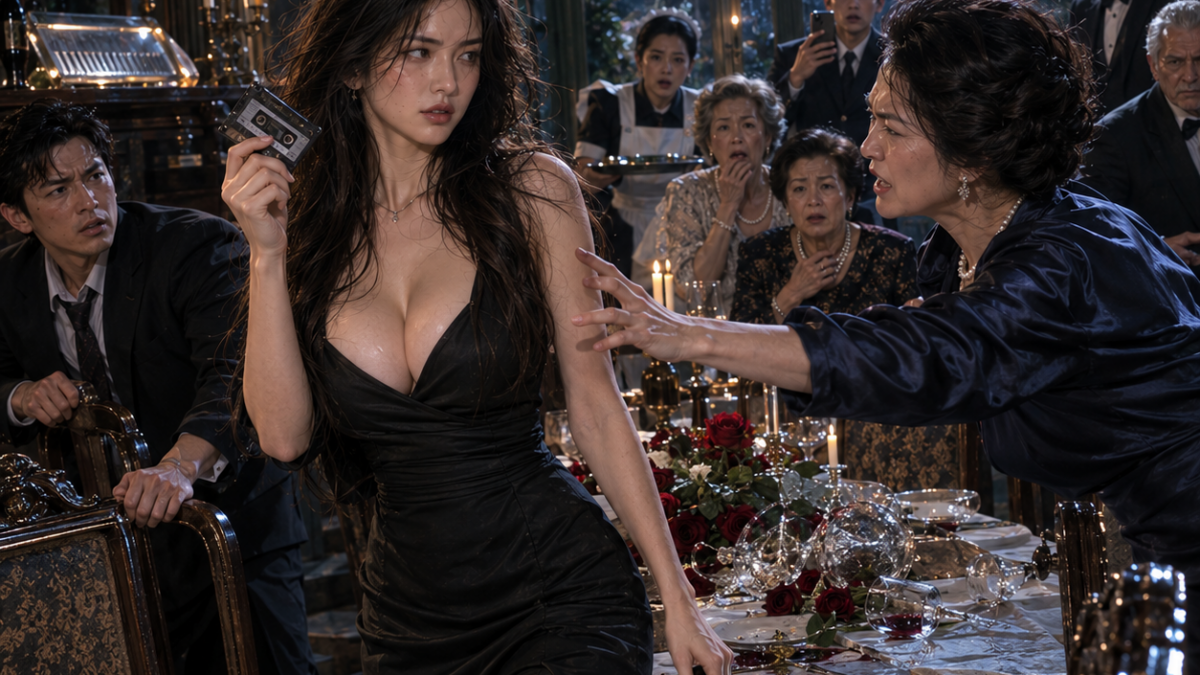
The dining room of Ashworth House had been transformed for the occasion. Candles flickered in silver holders. Flowers spilled from crystal vases. The long mahogany table groaned under the weight of china and silverware and a centerpiece that probably cost more than my annual salary. And there, in the center of the room, my aunt Vivian stood like a queen surveying her domain.
“Clara.” Her smile was colder than the champagne being poured by the caterers. “I’m surprised you came.”
“I wouldn’t miss it for the world.”
She approached me, her heels clicking softly on the marble floor. She was wearing a navy dress that matched her eyes, diamonds glittering at her throat—the same diamonds my grandmother had worn, the ones that had been promised to me in my grandfather’s will. Another item Vivian had quietly appropriated.
“I hope you’re not planning to make a scene.”
“I’m not planning anything.” I smiled, and it felt like glass in my mouth. “I’m just here to enjoy the evening with my family.”
Vivian’s eyes narrowed. “Whatever you think you’ve found—”
“I found seventeen forged instruments, Aunt Vivian. Seventeen. That’s a lot of scenes waiting to happen.”
Her face went white. “You have no proof—”
“I have the tapes. I have Marcus Webb’s report. I have everything I need to destroy you.” I leaned in closer, close enough to smell her perfume—the same scent my mother had worn, the same scent that still lingered in the closets of Ashworth House. “So here’s what’s going to happen. You’re going to tell the museum that you’ve discovered problems with the collection. You’re going to withdraw the sale. And then you’re going to leave this house, this family, and this country, and you’re going to never, ever come back.”
“And if I don’t?”
“Then tomorrow morning, I’m going to hand over everything I’ve found to the FBI. And you’re going to spend the rest of your life in prison.”
Vivian stared at me for a long moment. Then, slowly, she began to laugh.
“Oh, Clara.” She shook her head, a genuine smile spreading across her face. “You always were your grandfather’s favorite. So earnest. So determined. So sure that the truth will set you free.”
“What’s that supposed to mean?”
“It means—” She stepped closer, her voice dropping to a whisper. “That you have no idea what you’ve walked into. You think this is about money? About instruments? You think I’ve been stealing from the family for some kind of personal gain?”
“Aren’t you?”
“I’ve been trying to protect this family. From the truth. From what your grandfather was really doing with those instruments—why he really made those tapes.” Vivian’s smile widened. “You want to know the truth, Clara? The real truth? Those recordings aren’t just a record of what the instruments sounded like. They’re a record of what your grandfather did. The deals he made. The people he hurt. The crimes he committed—crimes that would have destroyed this family if anyone ever found out.”
I felt the floor tilt beneath my feet. “What are you talking about?”
“I’m talking about the fact that your grandfather was a thief, a smuggler, and a collaborator with some of the worst criminals in Europe. I’m talking about the fact that those instruments weren’t collected—they were stolen. From families who are still looking for them. From museums that have been searching for them for decades.” Vivian’s voice was almost gentle now. “I’ve been selling the originals back to their rightful owners, Clara. Quietly. Carefully. Trying to undo the damage before anyone found out.”
I opened my mouth to respond—to argue, to deny, to tell her she was lying. But before I could speak, a voice interrupted from the doorway.
“I think,” said my cousin James, stepping into the room with a drink in his hand and a curious expression on his face, “that I need to hear more about this. And I suspect the rest of the family will, too.”
Behind him, I saw the others gathering—aunts, uncles, cousins, the entire extended Ashworth clan, all of them drawn by the raised voices and the tension crackling through the room like electricity.
Vivian looked at them, then back at me. Her smile was triumphant.
“Well, Clara? Would you like to tell the family what you’ve accused me of? Or shall I?”
I felt the room closing in around me. The faces of my relatives, all of them watching, all of them waiting. The weight of everything I’d discovered—and everything I’d just learned.
“By all means,” I said, my voice steady despite the chaos in my chest. “Tell them everything. But I’m going to need to hear the rest of the story first. About my grandfather. About the tapes. About what he really did.”
Vivian’s smile flickered. “That’s not—”
“You said the tapes held the truth. So let’s listen to them. All of them. Right now. In front of everyone.” I stepped toward the dining table, toward the seat at the head that had always been my grandfather’s. “Or are you afraid of what we’ll hear?”
The room went silent.
And for the first time, I saw something like fear flicker in my aunt’s eyes.
Chapter Six: The Voice on the Tape
The cassette player sat on the dining table like a bomb waiting to detonate.
I had to push aside a spilled champagne flute and a scattering of silver forks to make room for it—my grandfather’s old portable recorder, the one he’d used to make every tape in his collection. The family watched in silence as I inserted the first cassette, the one labeled GLASS HARMONICA — SCALE AND CHORALE — 1987. Vivian stood frozen at the opposite end of the table, her face a mask of controlled fury, her fingers gripping the back of a chair so hard the wood creaked.
“Clara, don’t do this,” my cousin James said quietly. He was the closest to me in age, the only one of my relatives who had ever shown any genuine interest in the collection. “Whatever’s on that tape—whatever you think you’ve found—we can handle this privately. As a family.”
“The family has been handling things privately for thirty years,” I said. “Look where that’s gotten us.”
I pressed play.
For a moment, there was only the hiss of magnetic tape, the soft whir of the cassette turning. Then my grandfather’s voice filled the room—warm, slightly raspy, the voice I remembered from a thousand childhood afternoons in this very house.
“This is Edmund Ashworth, recording on the fifteenth of June, 1987. The instrument is the glass harmonica, acquired from the estate of Heinrich Müller, Vienna, in 1972. I am playing the C major scale, followed by the chorale from Bach’s Cantata 147. This recording serves as a tonal baseline for future reference.”
The scale began. Even through the small speaker of the portable player, the notes shimmered and bloomed, each one carrying harmonics that seemed to multiply and divide in the air. I saw several of my relatives shift uncomfortably—even they, with their tin ears and their indifference to the collection, could hear the difference between this sound and the thin, dead notes of the replica.
Then the chorale began, and the room went absolutely still.
My grandfather had been a talented amateur musician—not a professional, but someone who played with genuine feeling, with an understanding of the music that went beyond technique. The Bach chorale swelled and receded, the glass harmonica’s ethereal tones weaving through the melody like light through water. I closed my eyes and let myself remember—sitting at his feet as a child, watching his fingers dance across the spinning bowls, feeling the music resonate in my chest like a second heartbeat.
When the recording ended, the silence was so profound I could hear the rain against the windows.
“That’s beautiful,” my aunt Margaret said softly. She was my father’s younger sister, the one who had moved to California decades ago and only returned for funerals and weddings. “Edmund played so beautifully.”
“Yes,” I said. “He did. And that’s the point.” I turned to face Vivian. “That recording is the baseline for the glass harmonica. The instrument currently sitting in the conservatory doesn’t match it. I’ve had it tested by an independent appraiser—an expert in historical instrument authentication. The glass bowls are modern reproductions. The mechanism is twentieth-century. The case is original, but everything inside it has been replaced.”
“That’s impossible,” James said. “I was here six months ago. The instrument looked fine.”
“It looked fine because it’s a very good forgery. But it’s not the instrument Grandfather recorded in 1987. That instrument—the real one—has been gone for years. Sold, presumably, to someone who knew exactly what they were buying.”
Vivian’s voice cut through the murmur that rippled through the family. “You’re basing this on a cassette tape? On your opinion?”
“I’m basing this on materials analysis, resonance testing, and the documented evidence of my grandfather’s own recordings. Seventeen instruments in this collection have been replaced with replicas. Seventeen, Aunt Vivian. That’s not an opinion. That’s a fact.”
“If what you’re saying is true—” My uncle Richard, the family lawyer, stepped forward. He was a tall, stooped man with a perpetually worried expression, the kind of person who had spent his entire career managing crises and had never quite learned to relax. “If the collection has been compromised, then the museum acquisition is—”
“The museum acquisition is fraud,” I said. “And someone in this room is responsible.”
The silence that followed was different from the ones before it. This one had teeth.
“I think,” Vivian said, her voice very calm, “that we should all take a moment to consider what Clara is actually claiming. She’s accusing me—her own aunt, her father’s sister—of orchestrating an elaborate scheme to steal from our family’s collection. She has no proof beyond a few old tapes and the word of a colleague who, I’m sure, has his own reasons for supporting her claims.”
“Marcus Webb is a respected musicologist,” I said. “He has no reason to lie.”
“Everyone has reasons, Clara. You’re old enough to know that by now.”
“Then let’s hear the rest of the tapes.” I pulled out the next cassette—STRADIVARIUS — SCALE AND ARPEGGIO — 1991—and held it up. “If you’re innocent, Aunt Vivian, you have nothing to fear. Unless there’s something on these tapes you don’t want the family to hear.”
For just a moment—a fraction of a second—I saw something flicker behind Vivian’s carefully constructed mask. Fear. Real, undeniable fear.
Then it was gone.
“Fine,” she said. “Play the tapes. But I should warn you, Clara—the truth is rarely as simple as you’d like it to be. And once it’s out, you can’t put it back.”
She turned and walked out of the room.
The family stared after her, then back at me. James cleared his throat.
“Maybe we should—”
“No.” I inserted the next tape and pressed play. “We’re going to finish this.”
The Stradivarius recording began. My grandfather’s voice, younger this time, more confident: “This is Edmund Ashworth, recording on the third of November, 1991. The instrument is the Stradivarius violin, acquired from the estate of Countess Elisabeth von Habsburg, Vienna, in 1978.”
The scale began—rich, golden, the sound of a violin that had been played for three hundred years and had absorbed every note into its very wood. Even through the small speaker, the tone was unmistakable. This was an instrument that had lived. That had been loved.
Then my grandfather’s voice returned. But this time, it wasn’t the voice I remembered.
“The Countess von Habsburg was not informed of the sale. The instrument was acquired through intermediaries acting on behalf of a collector who wishes to remain anonymous. Payment was made in cash. The provenance documents were created by a specialist in Vienna who has since relocated to South America. I am recording this for my own records, as a precaution. If anything should happen to me, this tape will serve as evidence of the transaction and the circumstances surrounding it.”
The room erupted.
“What the hell?” My uncle Richard’s voice cut through the chaos. “Edmund stole it? He stole a violin from a countess?”
“There’s got to be an explanation,” James said, but his voice was uncertain. “Grandfather wouldn’t—”
“Play the next one.” My aunt Margaret’s voice was cold. “If my brother did something wrong, I want to know.”
I played the next tape. And the next. And the next.
They weren’t all stolen. Some of the instruments had been acquired legally, through auctions and estate sales and private dealers. But others—at least eight that I counted—had been acquired through methods that ranged from ethically questionable to outright criminal. Theft. Smuggling. Bribery. Forgery of provenance documents. My grandfather’s voice, calm and methodical, documented every transaction, every crime, every secret.
And then, on the final tape—the one labeled PERSONAL — 1998—his voice changed.
“This is Edmund Ashworth, recording on the twenty-fifth of December, 1998. Christmas Day. I am recording this for my granddaughter, Clara, in the hope that she will never need to hear it.”
I felt the blood drain from my face.
“Clara, if you’re listening to this, it means I’m gone, and the truth has finally come out. I’m sorry. I’m sorry for the things I did—the things I justified to myself because I told myself I was protecting the family. I told myself that the collection was worth more than the people I hurt to build it. I told myself that beauty, art, music—that these things justified any cost. I was wrong.”
The room was absolutely silent.
“Your aunt Vivian knows the truth. She’s known for years. She found out when she was still in her twenties, and she used that knowledge to gain control of the collection after my death. She’s been selling the originals—not to return them to their rightful owners, as she claims, but to line her own pockets. She’s been replacing them with forgeries, and she’s been using the proceeds to fund a lifestyle that this family could never have afforded otherwise. I know this because I’ve watched her do it. And I’ve done nothing to stop her.”
“That’s the real reason I made these tapes. Not just to document what I did, but to document what she’s been doing. I’ve been a coward, Clara. I’ve been complicit in her crimes because I was too afraid of what would happen if the truth came out. I was too afraid of losing everything—the house, the collection, the respect of the people I loved. So I stayed silent. And now she’s going to sell the entire collection to a museum, and they’ll never know the difference. They’ll pay millions for forgeries, and the real instruments will be scattered across the world, and the families who lost them will never get them back.”
“I’m leaving you these tapes because I believe you’re strong enough to do what I couldn’t. I believe you’re brave enough to face the truth, even when it costs you everything. I believe you’re the only one in this family who can put things right.”
“I’m sorry, Clara. I’m so sorry. I hope you can forgive me.”
The tape clicked off.
I stood in the wreckage of the dinner, surrounded by my family—some of them weeping, some of them white-faced with shock, some of them looking at me with expressions I couldn’t read. The rain lashed against the windows. The candles had burned down to nothing, leaving only the harsh electric light from the chandelier.
“I didn’t know,” James said finally. His voice was hoarse. “Clara, I swear I didn’t know. I thought she was just—I thought she was managing the collection. I thought she was trying to help.”
“Most of us didn’t know.” My uncle Richard looked old suddenly, older than I’d ever seen him. “But she did. Vivian knew. She’s known for years.”
“She’s been stealing from us,” my aunt Margaret said. Her voice was hard. “All this time, she’s been stealing from us and lying to our faces and—”
“Where is she?” I asked. “Where did she go?”
But even as I said the words, I knew. The sound of a car engine starting in the driveway confirmed it. Tires crunching on gravel. Headlights sweeping across the rain-soaked garden.
Vivian was running.
Chapter Seven: The Chase
I didn’t think. I just ran.
The rain hit me like a wall as I burst through the front doors of Ashworth House, my heels slipping on the wet stone steps. I could see her car—a black Mercedes, the one she’d bought with money that should have gone to restoring the collection—swinging around the circular driveway, heading for the main road.
There was another car parked nearby. My grandfather’s old Range Rover, the one he’d used for driving to the village. The keys were still hanging on the hook in the mudroom, where he’d always left them.
I grabbed the keys. I got in the car. I started the engine.
The Range Rover roared to life like a beast waking from hibernation, and I slammed my foot on the accelerator, fishtailing down the driveway after my aunt’s fleeing Mercedes.
The rain made everything a blur of gray and gold—headlights smearing across wet asphalt, taillights disappearing around curves. I knew these roads. I’d grown up on them, driven them a hundred thousand times. The cliff road that wound along the coast, the narrow lanes that cut through the hills, the old smuggling paths that had been used for centuries before cars existed.
Where would she go? The airport was an hour away. The train station, closer. But Vivian wasn’t the type to run for a train. She was the type to run to someone who could protect her—someone with money, with power, with the resources to make this problem go away.
I thought of the men who had visited Ashworth House over the years. The ones in expensive suits who had looked at the collection with hungry eyes. The ones who had spoken to Vivian in low voices and left with instruments wrapped in cloth. The ones who had paid in cash and asked for no receipts.
I thought of the name my grandfather had mentioned on the tapes. A collector who wishes to remain anonymous.
I thought of the man in the blue salon. Mr. Harrison. The one who had been there to buy the glass harmonica.
I pressed the accelerator harder.
Vivian’s Mercedes took a sharp turn onto the coastal road, heading south toward the harbor. I followed, my tires screaming on the wet asphalt, my hands white-knuckled on the steering wheel.
The harbor. Of course. She wasn’t running to the airport. She was running to a boat.
I pulled out my phone and dialed 911 with one hand, keeping my eyes on the road.
“Emergency services. What’s your location?”
“I’m on the coastal road, heading south toward Ashworth Harbor. I’m following a black Mercedes—license plate November, Charlie, four, seven, two, nine. The driver is a woman named Vivian Ashworth. She’s wanted for fraud, theft, and trafficking of stolen cultural artifacts. I have evidence. I need units at the harbor immediately.”
“Ma’am, are you in danger?”
“I don’t know. Just—just send someone. Please.”
I hung up and tossed the phone onto the passenger seat. The harbor lights were visible now, glowing through the rain—a cluster of sodium lamps and warehouse windows, the dark shapes of boats bobbing in the churning water.
Vivian’s Mercedes was already at the docks. I watched her get out of the car, her navy dress whipping in the wind, her diamonds catching the light. She was running toward a boat—a sleek white yacht that had no business being in a working harbor. A man was waiting for her on the deck, his face hidden by the hood of his raincoat.
I slammed on the brakes and threw open the door.
“Vivian!”
She turned. The rain had destroyed her careful composure—her hair was plastered to her head, her makeup running in dark streaks down her face. But her eyes were still sharp, still calculating, still looking for an exit.
“Clara.” She had to shout to be heard over the wind. “You’re too late. The boat’s already loaded. By the time the police get here, I’ll be in international waters.”
“You’re not going anywhere.”
“You can’t stop me.” She laughed, and it was the most bitter sound I’d ever heard. “You think I didn’t plan for this? You think I didn’t know you’d find those tapes eventually? I’ve been ready to run for years. The only mistake I made was underestimating you.”
“You stole from this family. You stole from our grandfather’s memory. You stole from the people who trusted you.”
“I stole from a thief.” Vivian’s voice was sharp. “Your grandfather was a criminal, Clara. A smuggler. A man who built this family’s fortune on stolen art and ruined lives. I was just trying to get back what he took—not for the families he hurt, but for myself. For the years I spent covering for him. For the inheritance he promised me and never delivered.”
“He left everything to me.” The words came out before I could stop them. “The collection. The house. The responsibility. He left it all to me because he knew you’d destroy it.”
Vivian’s face twisted. “You think I don’t know that? You think I don’t know that he passed me over like I was nothing? I gave that man my entire life. I managed his affairs, covered his crimes, lied to the authorities for him. And what did I get in return? A stipend. A promise that I’d be taken care of. And then he died, and suddenly everything was yours—the house, the collection, the money. All of it. Just because you were his favorite.”
“I was his granddaughter.”
“You were his redemption. His chance to pretend he was a good man after all.” Vivian stepped closer, her heels clicking on the wet concrete. “He thought you could undo his sins. He thought you could save the family name. But you can’t, Clara. The name is already ruined. It’s been ruined for decades. The only difference is that now you know it.”
I stared at her—this woman who had been part of my life since before I could remember. This woman who had taught me to play piano, who had bought me books and clothes and told me I was special. This woman who had been stealing from our family for years, hiding behind a mask of respectability.
“Why?” I asked. “Why did you do it? If you knew what he was, if you knew the collection was built on stolen instruments—why didn’t you just turn him in? Why didn’t you tell the truth?”
“Because I was afraid.” Vivian’s voice cracked. “Because I was afraid of what would happen if the truth came out. Because I was afraid of losing everything—the house, the money, the respect. Because I was afraid of being the woman who destroyed her own family.” She laughed again, a broken sound. “Turns out I was right to be afraid.”
The man on the yacht called out to her—something in a language I didn’t recognize. Vivian glanced back at him, then at me.
“I’m sorry, Clara. I really am. But I’m not going to prison. Not for this. Not for him.”
She turned and ran toward the boat.
I ran after her.
The rain was blinding now, the wind howling through the harbor like something alive. I could feel my heels slipping on the wet concrete, could feel the cold water seeping through my shoes. But I didn’t stop. I couldn’t stop.
Vivian was already on the gangplank when I reached her. I grabbed her arm, and she spun around, her fist connecting with my cheekbone in a burst of pain and light.
I staggered, but I didn’t let go. I held on—to her arm, to the truth, to everything my grandfather had asked me to save—and I pulled her back toward the dock.
“Let me go!” she screamed. “Let me go, you stupid girl!”
“You’re not running,” I said through gritted teeth. “You’re going to face what you’ve done.”
The man on the yacht was shouting now, his voice urgent. I could hear the boat’s engine revving, could see the white wake churning behind it. He was going to leave without her. He was going to abandon her.
Vivian realized it at the same moment I did. Her face went white, then red, then white again. She screamed something—a curse, a name, a plea—and lunged toward the gangplank.
I held on.
The boat pulled away from the dock, the gangplank sliding free and splashing into the water. Vivian stumbled backward, dragging me with her, and we both fell hard onto the wet concrete.
For a moment, we just lay there—two women in ruined dresses, gasping for breath, the rain falling on us like judgment.
Then the police lights appeared in the distance, red and blue flashing through the storm.
“Clara,” Vivian whispered. Her voice was broken now, all the fight gone out of it. “Clara, please. You can’t do this. I’ll give it all back. The money, the instruments—everything. I’ll tell them it was a mistake. I’ll say I didn’t know—”
“You knew.” I pushed myself up, wiping rain and blood from my face. “You knew, and you did it anyway. You lied to all of us. You let us believe my grandfather was a good man. You let us grieve for someone who never existed.”
“He wasn’t a good man. But he loved you. He loved you more than he ever loved me.”
“Then why did you destroy what he left me?”
Vivian was crying now—real tears, not the performance she’d used in the dining room. “Because I was angry. Because I was jealous. Because I spent my whole life being the good daughter, the responsible one, the one who cleaned up his messes and kept his secrets. And then he died, and you got everything. You got the house, the collection, the money. You got the inheritance. And I got nothing.”
“You got a choice,” I said. “You could have told the truth. You could have come to me, when you found out what he’d done. We could have figured out a way to make things right—together. Instead, you chose to make things worse.”
The police cars were pulling up now, their lights painting the harbor in red and blue. I could see officers getting out, could hear their voices calling out over the rain.
“Vivian Ashworth?” one of them shouted. “We need to talk to you.”
She looked at me one last time. Her eyes were still gray—the same gray as mine, the same gray as every Ashworth who had ever lived in that house by the sea. But they were empty now. All the calculation, all the anger, all the fear—it was gone.
“I’m sorry,” she said.
Then she stood up, straightened her ruined dress, and walked toward the police cars with her head held high.
Chapter Eight: The Aftermath
The next three days were a blur of police interviews, legal consultations, and family arguments.
My uncle Richard, it turned out, had suspected something was wrong for years—but he’d been too afraid of the scandal to investigate. My aunt Margaret wanted to sell the entire collection and donate the proceeds to charity. James wanted to hire a team of lawyers and fight the museum acquisition in court. The rest of the family wanted to pretend nothing had happened.
I wanted to sleep for a year and never think about glass harmonicas or stolen Stradivarius violins again.
But I couldn’t. The museum acquisition was still scheduled for Thursday. The appraiser—Gerald, the nervous man with the indoor complexion—had been fired after Marcus’s report went public, and the museum was scrambling to contain the damage. The FBI had taken over the investigation into the stolen instruments, tracing a network of dealers and collectors that stretched from Vienna to Tokyo to a warehouse in New Jersey where at least six of the original instruments had been recovered.
And Vivian was in custody, awaiting trial on charges that could put her in prison for decades.
“The good news,” Marcus said, sitting across from me in my grandfather’s study, “is that the museum still wants the collection. They’re willing to work with us on a restoration plan—bringing in experts to authenticate every piece, identifying which instruments can be returned to their rightful owners, and helping us rebuild the collection with proper provenance.”
“The bad news?”
“The bad news is that it’s going to take years. And a lot of money. And you’re going to have to be the one to lead it.”
I stared at him. “Me?”
“You. The collection is yours, Clara. The house is yours. The responsibility is yours. Your grandfather left it to you because he believed in you.”
“He left it to me because he was a coward who couldn’t face what he’d done.”
“Maybe.” Marcus leaned back in his chair. “Or maybe he left it to you because he knew you were the only one who could do what needed to be done. He knew you’d find the tapes. He knew you’d figure out the truth. He knew you’d come home.”
I looked around the study—at the bookshelves and the desk and the rain-streaked windows, at the ghost of my grandfather’s pipe smoke and the faint chemical smell of instrument cleaner. This room had been his sanctuary. His hiding place. His prison.
“I don’t know if I can do this,” I said. “I don’t know if I can be the person he thought I was.”
“You don’t have to be.” Marcus reached across the desk and took my hand. “You just have to be yourself. And from what I’ve seen, that’s more than enough.”
I squeezed his hand, grateful for the warmth, for the solidity, for the reminder that I wasn’t alone in this.
“Thank you,” I said. “For everything.”
“Don’t thank me yet. The hard part’s just beginning.”
He was right. The hard part was just beginning. But for the first time in weeks—maybe for the first time in years—I felt like I could face it.
 [Tap here for the Next Part ]