They Fired a Factory Worker on Day One—On Day Two, He Read Their Termination Letters Aloud
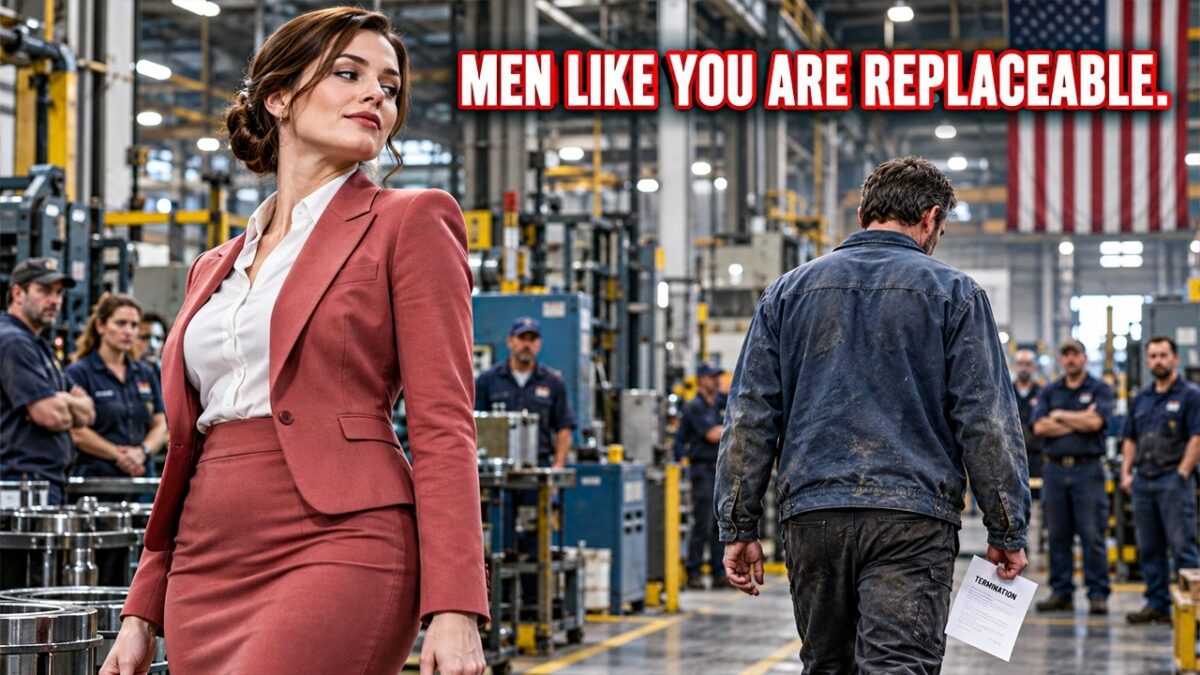
“Take off that uniform.
You’re fired.”
Victoria Ashbourne tossed the termination paper onto the factory floor as nearly 200 workers watched in silence.
Nolan Beckett had been there less than 4 hours.
His only mistake was questioning a machine that could seriously injure someone.
“Men like you are replaceable,” she said, smiling.
Nolan picked up the paper, folded it carefully, and walked out without arguing.
The next morning, Victoria entered the same factory expecting another ordinary shift. Instead, Nolan stood at the front of the assembly hall holding three sealed envelopes.
And the first name he read was hers.
If you believe a person’s worth is never stitched into a uniform, subscribe now and stay with this whole story.
The lot behind Blackridge Precision Components was half frost and half oil stain at 5:40 in the morning, and Nolan back parked his pickup in the back row out of habit, where the night shift never bothered to go.
He had owned the truck for 11 years.
The heater worked if you hit the dash above the glove box, and he hit it twice before shutting the engine off.
In the passenger seat sat a dented metal lunchbox that had belonged to his father and a spiral notebook with a cracked cover.
He took both.
The blue work jacket he wore had been washed so many times the collar had gone soft.
At the turnstile, a security guard named Russell scanned his temporary badge, squinted at the screen, and waved him through without looking up.
The badge listed him as operations support technician, contract 30 days. That was what the paperwork said.
That was what it was supposed to say. Human Resources occupied a glass-walled room near the front entrance, and Evelyn Whitmore was already in it, standing instead of sitting, which Nolan would later understand was how she preferred to talk to anyone who worked past the yellow line.
She held his file out at arms length and read it the way people read a menu in a restaurant they did not like.
“42,” she said.
“We don’t usually bring in men your age for floor support.
The equipment here is heavily digitized now.
A lot of the older guys struggle with the interface and then we spend 6 weeks retraining them.”
“I’ll manage,” Nolan said.
“That’s what they all say.”
She handed back the file without having turned a page.
“Bay three, try to keep up.”
Bay three smelled like cutting fluid and warm metal, a smell Nolan had known since he was 19 years old and too young to be running a lathe unsupervised. Four lines ran parallel under the high ceiling and the ventilation hoods above them rattled on a cycle, 1 2 3, 1 2 3, a rhythm the men below had stopped hearing years ago.
He stood at the entrance for a moment and let the sound settle into him. Then he found the maintenance lead.
Graham Ellis was 57, built like a man who had spent his life kneeling on concrete, with reading glasses pushed up into gray hair that had not been cut recently.
He looked at Nolan’s jacket, his boots, and his hands in that order, and whatever he saw on the hands seemed to settle something.
“You’ve turned a wrench,” Graham said.
“A few.”
“Good.
Half the support hires they send me have never opened a cabinet in their lives.”
He handed over a clipboard.
“Line two is yours this morning.
Walk it, check the guard interlocks, log anything that reads soft.”
They started at the near end. Nolan moved slowly, not because he was unsure, because he was listening.
And somewhere around the fourth station, he stopped walking altogether. The hydraulic press at the center of the bay was running its cycle.
And under the hiss of the ram, there was a second sound.
A faint knocking that arrived a half second late. Like a door closing in another room.
“That one.”
Nolan said.
“The interlocks chattering.”
Graham turned his head. He listened for three full cycles before he answered.
And when he did, his voice had dropped.
“Press 14.
Yeah.”
“She’s been talking for about 2 months.”
“Has anybody answered her?”
“Depends on who you ask.”
Graham took the clipboard back and held it against his chest.
“Officially, that unit was inspected and cleared in August.
Signed off, documented, closed.”
Nolan opened his notebook. The pages were dense with small block printing.
Equipment numbers, service intervals, part codes, a column of dates running down the left margin.
He found the line he wanted without searching for it.
“Serial ending in 417.”
He said.
“Guard interlock replaced in June.
Same assembly flagged twice after that.”
Graham’s eyes moved from the notebook to Nolan’s face and stayed there.
“Where’d you get the history?”
“It’s in the system.”
“Not the part about June, it isn’t.”
Before Nolan could answer, the bay doors the far end opened and a group came through in dress shoes, which is a particular sound on a factory floor.
Sharp and wrong against the concrete. Victoria Ashbourne led them.
She wore a charcoal suit with a pale gray scarf.
And she walked the way a person walks through a building they are showing to someone else. With her chin slightly up and her attention already two stations ahead.
Behind her came Evelyn.
Two supervisors, and a man from purchasing carrying a tablet.
She noticed Nolan because he was the only person in the bay not moving.
He was crouched near the base of press 14 with his hand flat against the frame feeling the cycle through his palm. Excuse me.
Her voice carried easily. She had learned somewhere how to make it do that.
Are you being paid to stare at machinery or to work?
Nolan stood up. He wiped his hand on his pant leg.
The guard interlock on this press is delaying on close, about half a second.
That’s enough for the ram to start before the gate confirms.
And you determined this how? By touching it?
By listening to it.
There was a small sound from the purchasing man that he turned into a cough.
Victoria smiled briefly.
The way a person smiles at a child who has said something that is almost clever.
We have a maintenance department, she said.
We have inspection records.
We have a facility that produces components for one of the largest agricultural equipment manufacturers in North America.
What we do not have is a shortage of opinions.
She was already walking again.
Stay at your station.
Nolan watched the group move down the line.
Then he crouched back down, opened the access panel on the press cabinet, and looked at the inspection tag zip tied to the inside of the door. The tag was clean.
The date was August. The signature line was filled in.
And the assembly behind it was the original one, scored and worn, exactly the part the tag said had been replaced. He stayed down there longer than he needed to because there was a question forming that he did not like the shape of.
A machine that had never been repaired was one kind of problem.
A document saying it had been was another kind entirely, and that one did not belong to maintenance. At 10 minutes past 9:00, Nolan found Graham at the tool crib and asked him to pull the lockout kit for press 14.
“On whose authority?”
Graham said.
“Mine, for 20 minutes.
I want the gate timing on a meter before the shift change.”
Graham rubbed the back of his neck. He looked across the bay toward the mezzanine, where the office windows ran the length of the wall.
“You’ve been here 4 hours.”
“That’s true.”
“And you want to stop a press that’s running ahead of schedule on a day when corporate’s walking the floor?”
“I want to stop a press that’s running,” Nolan said, “with a gate that confirms after the ram starts moving.
Whether anybody’s walking the floor is a separate question.”
Graham was quiet for a moment.
Then he took the kit off the hook and handed it over, and Nolan understood that he had just cost the man something, though he did not yet know how much. They had the padlock on the disconnect and the meter leads clipped when Victoria came down the mezzanine stairs.
She had seen the line stop from above.
The red station light threw a soft color across the bay, and 20 men at the adjacent stations had slowed without meaning to, the way people do when something unusual is happening 50 ft away.
“Who authorized this?”
“I did,” Graham said.
“I asked who authorized it.”
“And I answered you.”
Victoria looked past him at Nolan, who was writing a reading down in his notebook.
“You,” she said, “contract support.
On your first morning, you have decided to shut down a production asset.
“For 19 minutes,” Nolan said, “the gate’s confirming late.
I can show you the numbers.”
“I’m not interested in your numbers.
I’m interested in why a temporary hire believes he has standing to overrule a management team.”
She turned slightly so that her voice reached further than it needed to.
“What is your educational background?
Honestly, I’d like everyone to hear it.”
Nolan closed the notebook. He did not look away from her, but he did not raise his voice either.
And the men nearby had to lean in slightly to catch it.
“I did a machinist apprenticeship out of high school.”
“I finished an industrial engineering program at night when I was 31.”
“At 31?”
She repeated it gently as though she were helping him with the arithmetic.
“A degree that arrives that late doesn’t make you an engineer.
It makes you a man who wanted to be one.”
Evelyn had come down behind her, and she added in the tone of someone contributing to a conversation she had not been invited into, “He’s seasonal floor support who’s decided he’s a consultant.
We get one of these a quarter.”
Something moved through the bay then.
Not a sound exactly, a kind of settling as men turned back toward their stations because there is nothing worse than being the person still watching when it ends badly. Victoria pointed at the floor near the press where a thin film of hydraulic fluid had spread from the base into the walkway.
“There’s oil under that machine.
Since you’re not running your station, you can clean it.
Now, while we’re standing here.”
“That area needs to be barrier off first,” Nolan said.
“And the line beside it needs to be at zero energy.
Right now, line two is still cycling 8 ft from where you want me kneeling.”
“I want it cleaned.”
“Then I’ll barrier it, bring the line down, and clean it, in that order.
You’ll do it in the order I give you.
Graham stepped forward.
He did it slowly, and Nolan saw the cost in him, saw the three years to retirement sitting on the man’s shoulders like a hand.
Miss Ashbourne, he’s right about the clearance.
We had a man catch a sleeve on that conveyor in the spring. I wrote it up.
Did you? She let that sit.
Graham, your team’s overtime has been the highest in this plant for two quarters running.
Your performance bonus is reviewed next month.
I’d hate for you to spend your political capital defending a stranger.
Graham’s jaw worked.
He did not answer. 25 years of knowing exactly when to speak had taught him too well when not to.
Victoria turned back to Nolan with something close to patience.
Do you understand the difference between you and me? I make decisions.
You carry them out.
That’s not an insult.
That’s a structure.
It’s the only reason 430 people get paid on Friday.
I understand it, Nolan said.
I just hope you’re prepared to be responsible for the decisions.
That’s the other half of the structure.
For the first time, her expression changed. Not anger.
Something more careful than anger.
The look of a person who has heard a sentence with more weight in it than the speaker should have been able to lift. She turned to Evelyn without breaking eye contact with him.
Bring me his file, the whole thing.
Now. The write-up was finished before noon.
Evelyn did it at the standing desk in her office with Victoria in the doorway, and she read it aloud when she was done, which was not procedure, but had become her habit.
Failure to follow direct supervisory instruction. Unauthorized interruption of production.
conduct inconsistent with the responsibilities of a contract support position.
Graham had come up with Nolan and he objected before she reached the end of the second line.
Refusing to work inside an unguarded zone isn’t insubordination.
That’s the exact thing the safety program tells him to do.
It’s on a poster in the break room.
The safety program also has a chain of escalation, Evelyn said.
He didn’t use it.
He used me.
I’m the escalation.
You’re the maintenance lead on a shift where a production asset went down without a work order.
She said it mildly, which made it worse. Do you want your name on this conversation, Graham?
Victoria had been looking out the window at the bay below, where line two was running again, and press 14 sat dark and tagged in the middle of it like a tooth that had been pulled.
Don’t write him up, she said.
Write him out.
End of shift is too generous.
Do it now. Nolan had not said anything since they came up the stairs.
He opened his notebook, took out two folded sheets, and set them on the standing desk.
Before you sign that, he said, you should look at this.
It’s the gate timing on press 14 with the readings from this morning and the service history on the interlock assembly.
The part the August inspection says was replaced is still in the cabinet.
I photographed it.
The tag and the part don’t match.
Victoria picked up the pages. She read, or appeared to read, for about 4 seconds.
Then she tore them in half, folded the halves together, tore them again, and dropped them in the waste basket beside the desk.
I have been running industrial facilities since I was 29 years old, she said.
My family has been in this business for three generations.
And a man who was issued a badge this morning is not going to stand in my office and instruct me on how to operate my plant.”
“It’s not instruction,” Nolan said.
“It’s a reading.
It’s a resume.
That’s all it is.
Men like you always have one of these.”
She handed the termination form to Evelyn to sign.
“You want to be seen.
Fine.
You’ve been seen.”
The walk back down to the floor was the part Nolan would think about later, long after the rest of it had been resolved. Not the office, the walk.
Russell from security met them at the bottom of the stairs because someone had radioed ahead, and he looked genuinely unhappy about it.
A heavy man in his 60s who had probably never escorted anyone anywhere he wanted to. Victoria followed.
So did Evelyn with a clipboard.
The bay did not stop working, exactly, but the pace of it changed, the way water changes when something heavy enters it.
“Badge,” Evelyn said.
Nolan unclipped it and handed it over.
“And the jacket.
Company property.”
He looked at her for a moment.
The jacket was his own, bought from a work supply store in Dayton 6 years earlier, and it had no Blackridge logo on it anywhere.
But he understood that saying so would turn this into a different kind of scene, one with raised voices, one that the men watching would remember as a fight instead of as what it actually was.
So he unzipped it, folded it once over his arm, and laid it on the empty chair beside the time clock. Underneath he wore a plain gray shirt with the sleeves rolled.
Victoria said it then, not loudly, but with the whole bay close enough to catch it.
“Men like you are replaceable.
I could fill that badge by 2:00 this afternoon.”
The termination paper was in Evelyn’s hand.
She held it out and it slipped or she let it slip and it landed face up on the concrete between them. Nolan bent down and picked it up.
He read the reason line.
Then he looked at Evelyn and his voice was quiet enough that only the three of them and Graham heard it.
“Are you certain you want the stated cause to be refusal to follow management direction?”
“I’ve written several hundred of these,” Evelyn said.
“I know what I’m doing.
Sign the acknowledgement.”
“I’ll sign that I received it.”
“That’s the same thing.”
“It isn’t.”
He took a pen from his shirt pocket, wrote on the acknowledgement line, “Received only,” and signed beneath it and handed the clipboard back.
Then he folded the termination paper into thirds and put it in his back pocket the way a man puts away a receipt. Nobody said anything.
That was the part the men would describe to their wives that night when they described it at all. Not the firing.
The quiet afterward. 180 people at their stations and every one of them looking at a spot on the floor or at a gauge they had already checked.
Hector Delgado, who ran the second deburring station and had been at Blackridge for 4 years, turned back to his work before Nolan passed him and then was ashamed of it and then thought about his daughter’s braces and did not look up.
That was the honest arithmetic of it. Almost no one in that bay could afford to be brave on behalf of a man they had met at 6:00 in the morning.
Graham walked him out.
He was not asked to and nobody stopped him.
At the door he said, “I should have pushed harder.”
“You said the true thing in front of the person who could cost you for it,” Nolan said.
“In a place like this, that isn’t small.
It didn’t do you any good.
That’s a different measure.”
Nolan stopped at the curb and looked back at the building, the long corrugated flank of it, the stacks, the lot full of cars belonging to people who would be inside it for another 9 hours.
“Can I ask you something?
The August inspections, who signs them?”
Graham hesitated.
“Quality signs the form, but the clearance to close a safety flag without a parts receipt, that needs a management signature.”
“Whose?”
“Depends on the month.”
Graham looked at him a long moment.
“You already knew that, didn’t you?”
Nolan didn’t answer.
He put out his hand and Graham shook it. In the truck, he sat for a while with the engine off.
Then he took out his phone and called a number that was saved without a name.
“It’s me,” he said.
“I need to see you tonight, and I won’t counsel on the call.
It’s worse than the file shows.
They’re not just ignoring the flags.”
He watched a forklift cross the lot in the gray morning light.
“Somebody’s closing them.”
The house was a two-bedroom ranch on the edge of Lindale with a garage that had never held a car, and Paige Beckett had let herself in around 4:00 with a bag of groceries and a community college biology textbook she set on the counter like a brick.
She was 19. She cooked the way her mother had, which was to say badly and with great confidence, and Nolan had never once said so.
“You’re home early,” she said.
“I am.”
“How early?”
“About 8 hours.”
She stopped stirring.
“Dad?”
“It’s all right.”
He hung his keys on the nail by the door.
“It’s complicated and it’s going to stay complicated for about a day, then it won’t be.”
They ate at the counter because the table had a dead laptop and 3 months of mail on it.
Paige talked about a lab partner who kept rounding his measurements, and Nolan listened and asked the right questions in the right places, and somewhere in the middle of it she noticed that he had not picked up his fork in a while.
“You’re doing the thing,” she said, “where you go somewhere.”
“Sorry.”
“Was it bad?”
Nolan turned his glass a quarter turn on the counter.
“There were 180 people in that bay today,” he said.
“Most of them knew the machine was wrong.
One of them said so out loud, and he’s going to pay for it, and he knew he would before he opened his mouth.”
He looked at her.
“It’s not that people there are cowards, it’s that somebody built a place where being right costs more than being quiet.
That’s not an accident.
Somebody built it.”
“And you’re going to unbuild it.”
“I’m going to try to make it cheaper to tell the truth than to keep your head down.
That’s all.
It’s less noble than it sounds.”
His phone rang at 7:30. He took it into the garage out of habit more than privacy and sat on the workbench stool under the fluorescent light with his notebook open on his knee.
Caroline Winslow did not do small talk, which was one of the four or five things Nolan genuinely liked about her. She was the chair of the board at Blackridge Industries, 54 years old, and she had hired him 6 weeks earlier after reading a report from an outside auditor that she had described at the time as the first thing in 2 years that had made sense.
“Dana is on with us,” she said.
“Tell her what happened.”
Dana Ruiz was outside counsel, retained specifically so that nothing in the investigation ran through the company’s own legal department and she listened to all of it without interrupting once.
The badge, the press, the inspection tag that did not match the part behind it, the torn report, the termination form in Nolan’s back pocket.
Say the last part again, she said.
The reason line.
Refusal to follow management direction. She let a human resources director put that in writing over a safety refusal with witnesses.
Dana made a small sound.
Caroline, that document is better than anything we pulled in 6 weeks.
It’s not the case, Nolan said.
It’s one page.
The case is the inspection closures. The case is the inspection closures, Dana agreed, but the page is the picture.
They went through it in order, the way they had every Thursday night since early September. 14 safety flags closed in the last 11 months without a corresponding parts receipt, nine of them on the same production line.
11 complaints submitted through the internal reporting portal with intake timestamps edited after the fact, pushing them outside the response window so that they closed automatically as stale.
Four employees who had filed those complaints and then received performance documentation within 30 days, three of whom no longer worked at Blackridge.
That last pattern is the one that matters, Dana said.
Everything else is mismanagement. That one has a name.
Who signed the closures?
Nolan asked. Ashbourne signed nine.
Whitmore signed the human resources side on every retaliation file we’ve traced.
Papers moved on Dana’s end.
The audit committee reviewed all of it Friday.
Caroline, do you want to tell him or should I?
The board voted Saturday morning,” Caroline said.
“Victoria is removed from her operating role effective immediately, and the contract is terminated for cause under the conduct provision.
Council has reviewed every clause.
Evelyn Whitmore’s termination is separate, and it is her own.
Following instructions is not a defense when you are the one editing the records.”
Nolan was quiet for a moment. Out past the garage door, he could hear Paige running water in the kitchen.
“I want it done in the open,” he said finally.
“Not a memo on Thursday.
Those people watched a man get walked out of the building yesterday for saying a machine was unsafe. If the correction happens behind glass, nothing changes.
They’ll just learn that the people upstairs rotate.
“And the private material?”
Dana said.
“The complaint files have names in them.”
“Nothing with a name in it gets read aloud.
Nothing medical, nothing personal, no investigative detail.
They hear the decision, the role, and the general grounds.
That’s it.
The rest goes to the people it belongs to.
That’s the right line,” Dana said.
“I’ll draft to it tonight.”
“One more thing,” Caroline said.
“Tomorrow, you’re the one who reads them, not me, and not legal.
The board appointed you acting director of operations effective yesterday morning, and the plant is going to meet you under that title, whether they like it or not.”
A pause.
“But there’s a last document I need you to look at before the meeting.
I’m sending it now.
Read it alone.”
Nolan’s phone buzzed against his leg while she was still speaking.
Victoria Ashbourne arrived at 20 minutes past 7:00 on Tuesday with a coffee from the place on Route 10 that made it correctly, and she was in a good mood, which happened less often than people assumed. The previous day had gone the way these days went.
A contractor had tested the boundary, and the boundary had held. She had been doing this for 20 years, and she believed sincerely that the single most expensive thing a plant manager could allow was the idea that instructions were negotiable.
Her grandfather had run a stamping operation in Youngstown with 800 men in it, and he had said that a floor is either yours or it is theirs.
“Did you see how fast line two came back up?”
she said to Evelyn in the elevator.
“11 minutes.
They’ll be careful for a month now.
The second shift already heard about it.”
Evelyn said.
“Good.”
Her assistant was standing when she reached the office, which was the first wrong thing, and the second wrong thing was on her monitor. An all-hands notice for 8:00 in the assembly hall, mandatory for department heads, shift leads, and line representatives, sent from corporate scheduling, not from her.
She called the main number upstairs.
It went to voicemail.
She called Caroline Winslow’s cell, and got four rings and nothing.
“Did you know about this?”
she asked Evelyn.
“No.”
“Find out who booked it.”
Evelyn came back 5 minutes later with her color gone slightly wrong.
“Scheduling says it was entered Saturday by the corporate secretary’s office.”
“Saturday?”
“Yes.”
Victoria stood in her office a moment longer than she needed to. Then she picked up her folder because a person walks into a room differently with a folder, and went down the stairs.
The assembly hall at Blackridge was a converted shipping bay with a low stage at one end, used twice a year for benefits enrollment, and once a year for the holiday raffle. Bay 5 of 8 had held close to 300 people.
The supervisors had taken the folding chairs. Everyone else stood along the walls and in the aisles, still in safety glasses, some with gloves tucked in a back pocket.
And the sound in the room was the sound of people who do not know why they are somewhere.
Graham Ellis stood near the back with his arms folded. He had not slept well.
Victoria saw the front of the room before she saw the man in it.
Caroline Winslow sat at a table on the left with two other board members Victoria recognized from the last annual review. And beside them a woman in her 40s with a laptop open and a folder of her own.
And that was when Victoria’s stomach did something it had not done in years.
Then she looked at the stage. Nolan Beckett stood there in a plain white shirt, the sleeves rolled the same way they had been the day before.
No badge, no jacket.
On the podium in front of him lay three sealed envelopes, squared at the edges.
The room had seen him before.
That was the thing.
Half of Bay 3 was standing in that hall and a murmur went through them that had almost no words in it at all.
Russell.
Victoria’s voice cut across the room.
Remove that man from the building.
He was terminated yesterday.
Russell looked at the floor. Nobody moved.
I said, “Remove him.”
Miss Ashbourne.
Caroline Winslow did not raise her voice.
She simply spoke and the room went quiet for her. Sit down, please.
Caroline, this man falsified.
Sit down. Victoria did not sit.
She stood in the center aisle with her folder against her chest while Caroline rose and turned to the room.
For those who haven’t met me, I’m Caroline Winslow, chair of the board of Blackridge Industries.
By resolution of the board, effective Monday morning, Nolan Beckett is the acting director of operations of this facility. That appointment was approved before he entered this building, and it has been in force since the moment he walked through the gate.
There are silences, and there are silences.
This one had a texture. 300 people recalculating the previous day at the same time.
“This is theater,” Victoria said.
“He came in here under a false badge and let my team manage him under false pretenses.
Caroline, he lied to this organization.”
“The badge was issued by your human resources department under my instruction,” Caroline said.
“It was accurate as to the work he was doing.
He was testing us.”
Nolan spoke for the first time, and he did not use the microphone, and because of that people leaned forward instead of away.
“No, ma’am, I wasn’t testing anyone.”
He put his hand flat on the podium.
“I went to Bay 3 because this plant has 11 months of maintenance records that don’t reconcile with its parts inventory, and paper can’t tell you which one is lying.
A machine can. I went down there to put my hand on the machines.
What happened to me afterward wasn’t the purpose.
It was just information.
You humiliated me in front of my own floor.”
“You never asked me a single question about the press,” Nolan said.
“That’s the part I’d think about.”
Victoria’s hand tightened on the folder.
“You cannot fire me.
You don’t even work here.”
“You’ve got one thing right,” Nolan said.
He picked up the first envelope and broke the seal with his thumb.
“Yesterday, you fired a man you believed worked for you.”
He unfolded the page, looked at her directly, and read her full legal name aloud into a room of 300 people. Victoria Ann Ashborn, chief executive of plant operations, Blackridge Precision Components.
He read evenly, without emphasis, which was somehow far worse than if he had enjoyed it.
By resolution of the Board of Directors of Blackridge Industries, adopted Saturday the 11th, you are removed from all operating authority at this facility, effective immediately, and your employment agreement is terminated for cause.
He let the page rest on the podium.
The stated grounds, as approved by council, are three.
Material breach of the facility’s safety procedures, adverse action taken against employees who raised safety concerns, and failure of management obligation in the certification of equipment inspections.
For a moment, Victoria said nothing at all. Then she laughed, one short breath of it, and looked around the room as though expecting to find someone who agreed with her.
“One contractor,” she said, “one contractor has a bad afternoon, and you unwind 20 years.
It isn’t about yesterday.”
Nolan closed the folder.
“Yesterday was the last item on a list that was already finished.
14 safety flags were closed on this floor in the last 11 months without a parts receipt behind them. Nine of those closures carry your signature.
Press 14 is one of them. Yesterday morning, I opened that cabinet and the part the inspection tag says was replaced in August is still bolted in there, worn.
Equipment paperwork lags every plant in this country. 11 complaints were filed through the internal portal and had their intake times edited after submission so they would expire unanswered, Nolan said.
Four of the people who filed them received performance documentation within a month.
Three of them aren’t here anymore.
That isn’t lag.
Victoria turned to Caroline.
It was the first thing she had done all morning that was not calculated, and that made it the most visible.
Caroline, you’ve known my family for 30 years.
I have, Caroline said. The vote was unanimous, and the finding was prepared by counsel who has never worked for this company.
There’s nothing for me to do here, Victoria.
Nolan picked up the second envelope.
Evelyn Whitmore had been standing to the side of the first row, and she had been doing arithmetic of her own for several minutes, which is why she spoke before he had finished opening it.
Everything I processed came down from her office, she said.
Every one of those files.
I’m an administrator.
I don’t set direction.
Evelyn Whitmore, director of human resources, Nolan read.
By resolution of the board, your employment is terminated for cause, effective immediately. Grounds: participation in retaliatory action against employees who raised safety concerns, and alteration of personnel and complaint records.
That’s not The intake timestamps were edited from an account that is yours, Nolan said.
Four complaint files were reclassified from safety to attendance, which is what moved them out of the response queue.
And in July, you sent a message to three shift supervisors instructing them to route concerns about line two to you directly, instead of through the portal, because, and I’m using the general language counsel approved, the open system was creating a paper trail that complicated the audit.
Evelyn’s mouth moved and then stopped.
There was a particular thing happening to her, which was the slow understanding that the person she had been loyal to could not absorb this on her behalf, had never been able to, and that the choice to be useful to that person had been, all along, a choice she had made with her own hands and her own password.
“I was told the complaints were malicious.”
She said finally.
“I was told they were coming from people trying to protect their overtime.”
“You were told that.”
Nolan agreed.
“You had the files.
You could read them.”
He set the second page down beside the first.
The room was absolutely still now. Somewhere out in the plant a compressor kicked on and nobody turned toward it.
“I want to say the rest of this plainly.”
Nolan said, “Because by tonight there’ll be four versions of it in the parking lot, and I’d rather you have mine.”
“Six weeks ago, the board asked me to look at this facility.
I wasn’t hired to replace anyone.
I was hired because an outside auditor found that the maintenance records and the parts purchasing didn’t reconcile.
And because three customers had sent quality complaints that traced back to the same line.
I spent five weeks on documents with an audit team offsite. Documents will take you about 80% of the way and then they stop because a closed safety flag looks identical on paper whether the machine was repaired or not.
The only way to know is to go stand next to it. So yesterday I came in as floor support with the badge human resources actually issued me and I went to bay three.
I already knew press 14’s history.
I’d read it 11 times.
The thing I did not know was whether the hardware matched the file and who had signed off saying it did.
That’s why I asked the questions I asked.
They weren’t naive.
They were specific, and I’m sorry for the way that must have looked to some of you.
What I did not plan for was being fired by 10:00. He paused.
I’d read four files describing a culture where raising a safety concern ended your shift badly.
I believed those files. But believing a document and watching 180 people look at the floor while it happens to you are two different kinds of knowing.
I’d have been glad to be wrong.
Graham Ellis, standing at the back with his arms still folded, let out a breath he had been holding since August. Victoria had not moved from the center aisle.
She was looking at the third envelope.
“And that one,” she said, “who else?
Walk the whole floor, why don’t you?
Who else is leaving this morning?”
Nolan picked it up and broke the seal.
“Nobody,” he said.
He read it the same way he had read the others, evenly, all the way through. It was an order suspending press 14 and the two upstream stations on line two from service, effective at that hour, pending an independent safety evaluation of the entire line by an outside firm with findings due in 21 days and provided in full to the plant safety committee.
“No one in this building will be asked to run a machine that hasn’t been verified,” he said.
“While line two is down, affected positions will be reassigned to other work or paid at their scheduled rate under the facility standby policy.
That’s decided.
It isn’t a request to anyone upstairs.”
A sound went through the hall that was not applause and not cheering. It was lower than that.
100 people exhaling and saying something to the person next to them, and it lasted about 4 seconds, and then the room was quiet again, waiting.
“You’ve cost this plant its delivery schedule,” Victoria said.
“In 6 weeks, you’ll have cost it the contract, and then 400 people can applaud you on their way out the door.”
“That’s a real risk,” Nolan said.
“I’m going to call them this afternoon and tell them the truth, and it’s going to be an unpleasant call, and I may not win it.”
He looked at her for a moment, and when he spoke again, there was no edge in it at all, which was what made it land.
“You keep saying I made you look foolish.
I didn’t.
I put on the same jacket 400 people here put on every morning.
You decided what that jacket was worth.
All I did was wear it where you could see it.”
Victoria Ashbourne stood very straight.
Then she turned and walked up the center aisle toward the double doors.
At the back of the hall, the same doors Russell had walked Nolan through the previous morning, and the aisle did not widen for her, and nobody stood.
Dana Ruiz met her in the corridor with her transition documents, because that part is always handled privately, and it took 11 minutes, and nobody in the hall saw any of it. What people who tell this story tend to leave out is the next 90 days, because they are not dramatic.
By 10:00 that morning, Nolan was in the conference room off the mezzanine with the shift leads, and the first thing he learned was that 300 people watching a firing does not translate into 300 people believing anything.
“We had a reorganization in the spring of last year,” said a woman named Marisol Tran, who ran the night shift on line four.
“There was a meeting.
There were slides.
There was a new vice president with a plan, and the plan had the word partnership in it.
Eight months later, he was in Indianapolis and we had a hiring freeze.
“That’s fair.”
Nolan said.
“I’m not trying to be difficult.”
“You’re not being difficult.
You’re being accurate.
Keep going.”
Graham was blunter, which Nolan had expected.
He waited until the room thinned out and then said, “You want to know what people are saying out there right now?
Half of them think you’re going to be a hero for 3 weeks and then you’ll find out what the numbers look like and you’ll run the line hot like everybody else.
And the other half think it’s great that she’s gone and they still don’t have the part they need for the coolant pump on line one, which they’ve been asking for since June.
So, what do you need?
“Equipment that doesn’t hurt anybody and a check that doesn’t bounce.”
Graham said.
“Nobody down there needs a speech.
They’ve had speeches.”
“You’re right.”
Nolan said.
“I had one.
I’m not going to give it.”
What he gave instead was a 90-day plan, posted on paper in four places where people actually stood, written in language that did not require a degree, independent certification of every guarded machine in the plant, lying two first, a reporting channel that went to an outside administrator and not to anyone in the building with a published count each month of what came in and what was closed, reinstatement review for the three employees who had been documented out after filing complaints handled by counsel with no conditions attached, a plain rewrite of the escalation policy so that a refusal on safety grounds was recorded as a refusal on safety grounds and nothing else.
The hardest decision came on the fourth day and it did not involve Victoria at all.
Dale Furman, who ran scheduling and had done so for 19 years, laid out what the line two suspension did to the delivery commitment for the agricultural equipment customer that accounted for just under half of Blackridge’s volume.
There was a way to make the quarter. You moved the work to line three, ran it at a rate it had not been validated for, and said nothing to anyone until the evaluation came back clean, which it probably would.
“And if it doesn’t come back clean?”
Nolan asked.
“Then we’re where we are now, except 6 weeks later, and nobody got hurt in the meantime.”
Probably nobody got hurt.
Dale didn’t answer that.
Nolan sat with it for most of a day because it was not a simple choice, and anyone who says it was has never had 430 names on a payroll.
Then he called the customer’s vice president of supply, told him what had been found in the inspection records, told him the line was down, and told him that some of the components delivered in the previous 11 months had come off equipment whose maintenance documentation could not be verified.
He offered to fund a joint review of the affected lots.
The call went badly for about 20 minutes.
Then it went differently.
Three months later, the plant had not been saved, which is a word people use who have never run one.
It had passed an independent safety certification on line two and line four, with findings on both.
It had lost one smaller contract and kept the large one under a supervision agreement that put a customer quality representative in the building 2 days a week, which everyone found irritating and nobody argued with.
Voluntary turnover had dropped by a little under a third.
The coolant pump on line one had been replaced in the second week. Graham Ellis turned down a supervisor title and took a seat on the reconstituted safety committee instead with 4 hours a week of release time and the authority to stop a line in writing, which was the only part he had ever wanted.
Evelyn Whitmore found work at a logistics firm in Columbus.
Victoria Ashbourne did not come back to the industry as far as anyone knew, though her family’s name stayed on a building at a technical college two counties over and Nolan never made a joke about that in anyone’s hearing.
The termination letter stayed in the bottom drawer of his desk under a box of mechanical pencils.
He did not frame it.
Page asked him once why he kept it at all and he said that it reminded him how fast a person can be reduced to a line item by somebody with a printer and that he now had a printer.
In February, a young man named Tobias Reyes, 4 months out of a technical program and still nervous about saying the wrong thing, caught him in the corridor by the tool crib at 6:00 in the morning. Can I ask you something?
You’re the director.
Why are you down here every morning with a meter?
Nolan thought about it because the kid deserved a real answer rather than a smooth one.
Because if I only ever see this place through an office window, he said, then sooner or later, I’ll forget who’s actually holding it together.
And the day I forget that is the day I start making the kind of decisions that put me in a room like the one we were all in back in October.
He went out through the main gate that evening in a blue work jacket, the same one, the collar still soft.
Russell was at the turn style with his thermos and he lifted a hand and the two of them talked for a minute about his granddaughter’s recital.
And then Nolan went to his truck in the back row and hit the dash above the glove box twice before the heater came on. On a Monday, Nolan Beckett was walked out of a factory because a woman decided that a work jacket made him smaller first than she was.
On a Tuesday, he stood in front of the same people and read the decisions that ended her authority there. But the part that mattered was never which name came out of which envelope.
It was that several hundred people finally had somewhere to put the things they had been carrying in silence for years and a reason to believe someone would read them. A title can give a person the right to issue instructions.
It cannot hand them respect and it has never once purchased trust. How someone treats the people who have no power over them will always say more than anything they say in a boardroom.
If this story moved you, subscribe, tell us the moment that stayed with you, and send it to someone else.

