She Accidentally Bid $40,000 on a Date With Boston’s Most Eligible Billionaire – PART 2
========== PART 2 ==========
Then she stood up, took the tiller out of his hand, and said, “Sit down, Mr.Thornton.
Head between your knees.
Look at the horizon.
You can’t sail this.
Watch me.
” She sailed it.
She brought second wind around into the wind, eased the main sheet, and settled the boat onto a long, smooth reach along the coast, with the spray flying off the bow and the sun on the water as easily as breathing. She sailed past the lighthouse on Eastern Point.
She sailed past the breakwater where she used to fish as a girl.
She sailed past her father’s old mooring and lifted one hand in a small salute.
Hugh sat on the deck with his back against the cabin and stared at her as if she’d turned into a mermaid.
Who taught you that? My dad.
He fished out of here for 35 years. Lobster.
He used to say, “A boat’s like a person.
Doesn’t matter how fancy it is.
What matters is whether it’ll hold together in bad weather.
My father said that too, said Hugh slowly. About boats, he started Thornton Marine with one dinghy in his garage.
He looked at the water.
He said it about me, too.
Except he said I wouldn’t.
Molly glanced at him.
I wasn’t a good student, said Hugh.
I was what my father called lazy.
Every report card lazy.
Doesn’t apply himself.
could do better.
He laughed, but it wasn’t a happy sound.
So, I worked very hard to prove I wasn’t.
I built a company.
I built a hundred boats.
But he still never He stopped.
Never what?
Never mind.
He stood up a little unsteadily and came to sit beside her at the tiller, not touching, just close.
Teach me how you did that, the turn.
So she did.
She put his hand on the tiller and her hand over his and showed him how to feel the wind in the sail through the wood.
And they sailed back into Gloucester Harbor together as the sun went down orange and gold over the town with his hand under hers on the tiller and neither of them said very much at all.
On the dock as he tied up the boat, Hugh said without looking at her, “Molly, do you teach the Thursday night class at the library?”
No, that’s Jojo’s class.
I do Tuesdays. She looked at him.
Why?
No reason, said Hugh Thornton, and went very carefully back to tying his knot.
The following Thursday, Jojo came down with the flu. So, at 6:30 in the evening, Molly walked into the little room at the back of the Doorchester Branch Library with its mismatched chairs and its whiteboard and its shelf of easy readers for grown-ups to teach the Thursday night class herself.
There were 11 students. She knew most of them.
Mrs.Alvarez, who was learning so she could read her medicine labels. A young cook named Danny.
Teddy Mensah in his usual chair by the window with his shoe box of letters on his lap. And in the chair beside Teddy in a plain gray sweater with a notebook open in front of him and a pencil in his hand, sat Hugh Thornton.
On the sign-in sheet, in large, careful, copiedl looking letters, he had written his name, H.
Thorne. Molly stopped in the doorway.
Hugh looked up and she saw his face change, not to embarrassment, to something much worse, to the face of a little boy who had just been caught and who expected any second now to hear the word lazy. The whole class went quiet.
Then Teddy Mensah put a big hand on Hugh’s shoulder.
He’s been coming since October, said Teddy quietly.
Week after that party. Sits next to me.
Never misses. He looked at Molly.
Didn’t want you to know.
Miss Finch made us all promise. I almost told you at the book sale.
Couldn’t.
Molly came into the room. She sat down at the front table.
She didn’t look at Hugh.
She opened the lesson book.
She cleared her throat. Good evening, she said.
Let’s start where Jojo left off.
Who’d like to read first?
There was a long pause.
Then Hugh Thornton picked up the book in front of him.
It was a simple book, large print, a collection of short poems chosen for beginning adult readers.
His hand was shaking very slightly.
I’ll go, he said.
It took him four minutes to read eight lines. He went slowly, one word at a time.
Some of them he had to sound out letter by letter, his finger moving under the print. Some of them he got wrong and had to go back.
Twice he stopped completely and pressed his lips together and started again.
The room was absolutely silent. Nobody helped him.
That was the rule in second chapter. You let people finish.
It was a poem by Robert Frost. Nothing gold can stay.
eight short lines about how the first green of spring is really gold and how nothing gold can stay.
When he finished, he put the book down very carefully on the table and the whole room clapped. Teddy Mensah first, his big hands like thunder, then Mrs.Alvarez, then Dany, then all of them.
Molly didn’t clap.
She couldn’t.
She was sitting at the front table with her hand pressed hard over her mouth, trying very much not to cry in front of 11 students.
After class, when the others had gone, he waited for her in the reading room.
The big room at the front of the branch with the tall windows in the old oak tables and the green shaded lamps. The library was closed.
The lights were low.
It was just the two of them among the shelves.
“Dyslexia,” said Hugh.
He was standing by the window with his hands in his pockets. Severe.
They didn’t test for it when I was a boy.
Not in my school. They just called me lazy.
He shrugged. So, I learned to hide it.
I memorize everything. Contracts, blueprints, speeches.
Felix reads me my email. I have a man who reads me the newspaper every morning.
I order what the other person orders.
I’ve built a billion dollar company and I’ve never read a book for pleasure in my life.
Why didn’t you tell me?
Because you’re a librarian, said Hugh.
You spend your whole life with books.
You’re the cleverest person I’ve ever met.
And I’m a man who can’t read a menu.
He looked at her.
I didn’t want you to look at me the way my father did.
How did he look at you?
Like I was the thing that wouldn’t hold together in bad weather.
Molly crossed the reading room. She stopped in front of him.
Hugh, she said.
It was the first time she’d ever used his name.
You walked into a room full of strangers at 38 years old and sat down in a plastic chair next to a bus mechanic and read eight lines of Robert Frost out loud while 11 people watched you get it wrong. Do you have any idea how brave that is?
Do you know how many people I’ve seen walk up to that door and turn around?
Hundreds.
Hundreds. Hugh, you walked in.
He didn’t say anything.
He was looking at her as if nobody had ever said anything like it to him in his whole life. Why?
said Molly softly. Why did you start coming the week after the auction?
Because you said second chapter, said Hugh on the night of the gala.
You said you teach grown-ups to read.
And I thought if she can teach Teddy, maybe she can. He stopped.
I wanted to be able to read your cards, the ones you send me.
I’ve been having Felix read them to me, and I wanted to read them myself.
Molly Finch looked up at him in the low green lamplight of the reading room.
Read me the poem again,” she said.
So he took the book out of his coat pocket, the large print book from class, and opened it and read it again, slower this time, not shaking, one word at a time, looking up at her at the end of every line.
Nature’s first green is gold, her hardest hue to hold.
When he got to the last line, nothing gold can stay, she took the book gently out of his hands and put it on the oak table.
That’s not true, she said.
Some things do.
And she kissed him.
Right there among the stacks in the closed reading room of the Doorchester Branch Library, under a green-shaded lamp, he made a small sound of surprise against her mouth, and then his hands came up to her face very carefully, as if she were a book he’d only just learned how to open.
He kissed her back slowly, and then not slowly at all.
Somewhere above them, the old radiators knocked and hissed.
Somewhere outside, a bus went by on Dorchester Avenue.
Neither of them heard it.
When they finally pulled apart, he rested his forehead against hers and laughed very quietly.
“That’s not on the list,” he said.
“For the Saturdays.”
“It’s Thursday,” said Molly.
“It doesn’t count.”
Over the next 10 days, Molly Finch fell the rest of the way in love with Hugh Thornton and was too happy to notice the clouds coming in. The first cloud was the newspapers.
The Herald had found out about the sailing trip. Someone had taken a photograph from the dock in Gloucester.
Billionaire and bidding librarian set sail, said the headline with a long article underneath wondering whether a woman who earned $51,000 a year really could have bid $40,000 by accident.
One columnist called her the Cinderella of Dorchester. Another called her something much less polite.
Molly wondered briefly who on earth had been standing on a dock in Gloucester in November with a long lens camera.
Then she forgot about it. The second cloud was the money.
The foundation’s lawyers had sent it in writing.
The full $80,000 for second chapter would be released only after the sixth Saturday, not one day before.
The clause had been added the night of the auction at the personal request of the chairman, Harold Peton, and Ruth Delaney had already told the city that the program was saved.
She’d already told the students.
Teddy Mensah had bought a new notebook. The third cloud was a gray car.
Teddy noticed it first.
Teddy noticed cars.
He’d spent 30 years listening to bus engines.
Same gray sedan in the parking lot every Thursday, he told Molly on his way out of class. fellow sits in it the whole two hours.
Got a camera with a long nose on it.
I don’t like it, Miss Finch.
Molly said it was probably someone waiting for his wife. Teddy said nothing, but he wrote the license plate in the back of his new notebook slowly, letter by letter, because he could do that now.
And on the Wednesday before the fifth Saturday, Cresa Peton came to see her.
She was waiting in the staff parking lot at 6:00 when Molly came out into the dark with her bag over her shoulder. She was leaning against a white car in her white fur coat and she was holding a large brown envelope.
I’ll be brief, said Cresa.
You’ll want to see these.
She held out the envelope.
Molly didn’t take it, so Cresa opened it herself and fanned the contents out on the hood of the car under the yellow light of the parking lot lamp.
Photographs taken through a window at night. The window of the little room at the back of the Doorchester Branch Library.
Mrs.Alvarez, Danny, Teddy with his shoe box, and in the chair beside Teddy bent over a large print book with his finger under the line, Hugh Thornton.
There was more. A photocopy of a page from a second chapter workbook.
simple sentences, threeletter words circled, and in the corner in large, careful, copiedlooking letters, Hthornne.
I hired a very good man, said Cresa pleasantly.
He’s been following Hugh since the auction.
I thought there was another woman.
I never dreamed it would be something so much more interesting. She tapped a photograph with one long silver nail.
Did you know that Thornton Marine is about to sign a $2 billion contract with the United States Navy in January?
40 new ships.
Do you think the Navy will hand $2 billion to a man who can’t read the specifications?
Do you think his board will keep him once they know he’s been hiding it for 20 years?
Molly’s mouth had gone completely dry.
What do you want?
The dinner’s on Saturday.
You’ll be there with him, I’m sure.
Afterward, you’ll end it publicly, properly.
No sixth Saturday, no more sailing trips. Cresa began sliding the photographs back into the envelope.
If you do, these stay in my drawer.
If you don’t, they go to the Herald on Monday morning.
She smiled.
And as for your little program, Daddy’s lawyers wrote the clause.
No sixth date, no money.
I’m afraid that’s just the rules, sweetie.
I didn’t make them.
She paused.
Well, I did actually. She opened the car door, then turned back.
I always get what I bid on, Miss Finch, said Cresa Peton.
Always ask anyone. She got into the white car and drove away and left Molly standing alone in the staff parking lot in the dark.
Molly did not sleep that night.
She lay in her bed in Dorchester and stared at the ceiling and thought about a man in a plastic chair reading eight lines of Robert Frost with his hands shaking.
She thought about the word lazy.
She thought about what it would do to him to read that word in the newspaper over his own photograph with four million strangers watching.
By morning, she had decided. She would tell Hugh everything.
On Saturday, at the dinner before dessert, they would face it together.
She didn’t know that Crescent of Peton had planned for that, too.
The fifth Saturday was the library foundation’s winter dinner.
Black tie in the great marble hall again, the same room as the auction.
Hugh asked if she’d go with him as his date.
Not as a lot, as his date. She bought her own dress this time, dark blue from a secondhand shop on Newberry Street.
The most money she’d ever spent on clothes.
When she walked into the hall on Hugh’s arm, three photographers took her picture.
And for once, she didn’t mind.
It was a lovely evening. Molly kept waiting for the right moment to tell him about the parking lot and the envelope, and the right moment kept not coming.
Every time she opened her mouth, someone came over to shake Hugh’s hand.
Across the room at the chairman’s table, Cresa Peton sat beside her father in silver and watched them both all evening like a cat watching two birds.
And Molly noticed something else. Cresa had spent most of the evening at the bar with Barnaby Leads the auctioneer, laughing at his jokes, refilling his glass with her own hands.
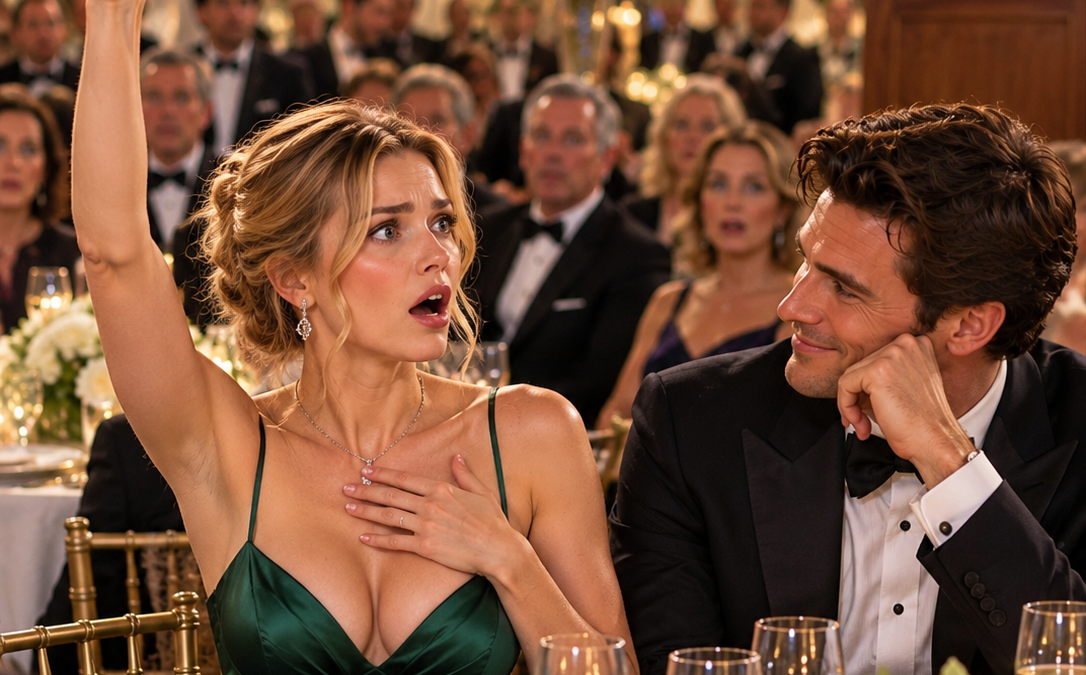
At dessert, Cresa walked Barnaby over to their table herself with her arm through his. He was big and cheerful in his velvet jacket and very pink in the face from the champagne.
Barnaby, darling, said Cresetta sweetly. You were just telling me the funniest story about the night of the auction.
Tell them. Go on.
And she stepped back and folded her arms and waited.
Barnaby clapped Hugh on the shoulder. Thornton, my old friend.
He beamed down at Molly.
And this must be the famous lady in green.
My dear, you’re the best thing that ever happened to my career.
Do you know that clip’s been watched four million times?
4 million?
My agency’s had 19 bookings since October.
He leaned down to Hugh and lowered his voice, but not nearly enough. Best nod of my career, old boy.
I’ll never forget your face.
I’ve been doing this for 20 years, and I’ve never had a man on the block pick his own buyer before.
There was a silence at the table.
Barnaby looked from one face to the other. His own face slowly changed.
“Ah,” he said.
She didn’t know.
Molly put down her spoon.
“Pick his own buyer,” she said.
“Molly,” said Hugh.
“You nodded,” said Molly.
“I saw it that night.
I thought I imagined it. You looked at him and you nodded.
” She turned to Barnaby.
“Mr.leads.
Did you see me wave? Did you think I was bidding?
Barnaby Leeds, who was not a cruel man and who now wished very much that he had stayed at the bar, looked at his shoes. I saw a lady in green waving a paddle at the dessert table, he said quietly.
I’d have let it go.
I looked at Hugh.
He nodded at me.
So, I took it.
He swallowed.
I’m so sorry, my dear.
I thought you were in on it. Molly Finch stood up from the table.
She did it very carefully, the way you stand up when you’re not sure your legs will hold you.
“Excuse me,” she said to nobody in particular, and walked out of the marble hall.
He caught up with her on the front steps of the library in the cold under the great stone archway with the words free to all carved above it.
“Molly, please let me explain.”
“Explain what?”
She turned around. Her eyes were very bright.
that you picked me out of a crowd like a lot at an auction.
You looked at the auctioneer and you nodded and in one second you decided I’d be humiliated on the 11:00 news and that 4 million strangers would watch me say no and that every newspaper in Boston would call me a gold digger and that I’d spend six Saturdays with you because I
couldn’t afford to say no.
Her voice cracked.
You didn’t ask me, Hugh, you bought me.
That’s not what it was.
Then what was it?
I’d seen you before, said Hugh.
That night before the auction, you were at the door handing out programs. Teddy came in in his one good suit to see the library where his class was.
And the man at the entrance tried to turn him away because he didn’t have a ticket.
And you walked over and took Teddy’s arm and walked him in and introduced him to the mayor’s wife as the most important man at the party.
He took a breath.
I watched you do that and then two hours later I was standing on a stage while Crescent of Peton bought me and I looked out and there you were at the back with a paddle in your hand and I thought just once I’d like to spend a Saturday with somebody like that.
So I nodded. It took one second.