She Accidentally Bid $40,000 on a Date With Boston’s Most Eligible Billionaire – PART 3
========== PART 3 ==========
I didn’t think about the cameras or the newspapers or what it would cost you.
I just didn’t want to lose the chance.
And then you didn’t tell me.
Five Saturdays, a sailboat, a poem.
You kissed me in my own library, Hugh.
And all that time, you knew I’d been bought and I didn’t.
I was going to tell you when.
After the sixth Saturday, after the money came through, so I couldn’t walk away.
She shook her head and wiped her face with the back of her glove.
I’m the one person in this whole story who didn’t plan a single thing.
And it turns out I was the only one who didn’t know.
Hugh had no answer. He stood on the steps of the library with his hands at his sides and the snow just beginning, small and dry and silver in the light from the great doors.
Molly took a long breath.
When she spoke again, her voice was steady.
“I’m not coming next Saturday,” she said.
“Molly, the money, the program.”
“I know,” her chin came up.
“The program loses $80,000.
Teddy loses his class.
I’ll find another way.
I’ll write to every foundation in New England.
I’ll hold bake sales.
I’ll stand outside the state house with a sign.
But I’m not going on a date I was bought for.
Not even for second chapter. She turned toward the street.
Teddy taught me something.
You don’t let people read for you.
Not even when it’s hard.
You read it yourself or it’s not really yours.
She walked down the steps into the snow.
She didn’t look back.
She was afraid that if she did, she’d go back.
And there was something else she didn’t say.
Something in her head the whole time she was shouting at him on the steps.
A brown envelope in a white car and a silver nail tapping on a photograph.
If she ended it tonight publicly, the way Cresa wanted, the photographs would stay in a drawer. Hugh would sign his contract.
Nobody would ever write the word lazy over his face.
She was furious with him. She would be furious with him for a long time.
But she loved him too much to let anyone take the last thing he’d been hiding before he was ready to give it up himself.
So she let him think it was only about the nod.
When she got home, she sent a text message to a number she’d never wanted to know.
It said, “Done.
Leave him alone.”
The reply came in under a minute.
Pleasure doing business with you, sweetie. Monday was terrible.
Ruth Delaney didn’t shout.
Ruth never shouted.
She just sat in her little office at the back of the branch with a new letter from the foundation’s lawyers on her desk and her reading glasses on their chain and said, “Oh, Molly” in a voice that was much worse than shouting.
The letter was signed by
Harold Peton chairman.
All foundation money for the Dorchester branch, not just Second Chapter, was frozen, pending an ethics review into the circumstances of the October auction.
The Herald ran a news story on Tuesday. bidding librarian walks out on billionaire.
Was it all a setup?
Someone had told them about the nod.
The article called Molly a clever girl from Gloucester who had found a rich man’s weak spot.
It quoted an unnamed source at the dinner who sounded a great deal like Cresa Peton.
Cresa had kept her promise about the photographs. She had simply found other ways to win.
On Wednesday, Molly told the second chapter students that the program would probably close in January.
She did it standing at the front of the little room with the whiteboard behind her.
She didn’t cry until they’d all gone home.
And on Thursday evening, Teddy Mensah walked out of the Dorchester Branch Library across the parking lot and climbed very slowly into a long black car that had been waiting outside every Thursday since October.
She won’t take my calls, said Hugh Thornton in the back seat.
No, sir, she won’t.
Teddy, I don’t know what to do.
Teddy Mensah sat for a long moment with his shoe box of letters on his knees.
“There’s something you ought to know first,” he said.
“That Peton woman, the blonde one.
I saw her in the staff lot last Wednesday talking to Miss Finch. She had an envelope pictures.
I saw one fall on the ground when she was putting them back.”
He looked at Hugh.
“It was you and me, sir, in class through the window.”
“Hugh went completely still.”
There’s been a gray car out here every Thursday since October, said Teddy, man with a long camera.
I wrote down his plate.
He opened his new notebook to the back page and held it out with the letters printed slowly and carefully. I gave it to Miss Finch on Monday, too.
She’s been at the library till midnight every night this week.
Ruth says she’s looking something up.
Won’t say what.
Hugh stared at the notebook.
She didn’t leave because of the nod, he said slowly.
Not only because of the nod.
She left so they wouldn’t print it.
She left to protect me.
That’s my guess, said Teddy.
Then he took a letter out of the shoe box.
The fourth letter, the one he’d been working on for 6 weeks.
Want to know what this one says?
Said Teddy.
Took me a month and a half. My Lraine wrote it the week before I asked her to marry me.
1972. He unfolded it with his big, careful hands.
She says, “Teddy, you never say anything.
You just do things and hope I’ll notice.”
Well, I notice, but a girl wants to be told. Teddy folded it back up.
52 years I’ve been carrying this letter, and it took me till this year to read it.
She’d been telling me the whole time.
I just couldn’t read it.
Hugh said nothing.
You don’t fix this by doing something and hoping she’ll notice, said Teddy.
You tell her out loud and not where it’s easy.
He opened the car door.
You’ve been reading in a back room for two months with 11 people who love you.
Time to read somewhere it’s hard.
He tapped the shoe box.
And here’s the thing about a secret, sir.
Nobody can use it against you once you’ve said it yourself.
On Friday morning, Hugh walked into Felix’s office at Thornton Marine and closed the door.
I need you to call the library foundation, he said.
I’d like to be added to read aloud night tomorrow, Bates Hall.
Felix looked up from his computer very slowly.
To read, sir.
To read out loud out loud in front of 800 people and the press and the board who always attend because it’s good for the brand.
Felix took off his glasses.
Sir, with respect, you’ve spent 6 years having me read you the lunch menu.
I know the stock will drop. I know that, too.
Felix Brandt looked at his employer for a long moment.
Then he did something he had never done in 6 years.
He stood up, walked around his desk, and shook Hugh Thornton’s hand.
“I’ll call them now,” he said.
“And sir, I’ll be in the front row.
If you get stuck, I won’t help you.”
He cleared his throat.
That’s the rule, isn’t it?
You let people finish.
Every December on the second Saturday, the Boston Public Library holds read aloud night. It happens in Bates Hall, the great reading room on the second floor of the McKim Building on CPPley Square with its enormous barrel vaulted ceiling and its long rows of oak tables and its green shaded lamps stretching away into the distance like the lights of a harbor.
Famous people come to read.
Actors, writers, senators, the mayor.
They each read one page of their favorite book out loud to 800 people and the television cameras and then everyone drinks hot cider and goes home.
That year, the program had one late edition. The name had been printed on a separate slip of paper and tucked into every program at the door.
Final reader, Mr.Hugh Thornton, founder Thornon Marine.
Molly Finch went to read aloud night for a different reason. She had spent every night that week at the library until midnight doing the one thing she was better at than anyone in Boston.
She had looked things up.
She had started with Teddy’s license plate and a public database of licensed private investigators in Massachusetts.
The plate belonged to a man named Joe Kowalsski of Kowalsski Discrete Services, Quincy.
She had found the photograph credit in the Herald under the picture of the sailboat JK. She had sat with Jojo in the branch office and gone through the parking lot camera footage, two months of Thursdays, and found the gray car every single week.
And on one Wednesday night, a white car beside it and a woman in a white fur coat handing something through the window. And then she had done the bravest thing of all.
She had called Joe Kowalsski on the phone.
He was a tired man of 60 with a smoker’s voice.
And when she told him who she was and what second chapter was, and that his photographs were going to be used to shame a man for learning to read, there was a very long silence on the line.
“My mother couldn’t read,” said Joe Kowalsski at last.
Till she was 50.
Church basement in Quincy. Nobody ever knew but me.
Another silence. Lady told me she was checking on a cheating boyfriend.
I’ll send you the invoice, Miss Finch.
It’s got her name on it and the emails.
All of them.
He sent them everything. In a brown envelope, which Molly found rather fitting.
The foundation’s board would all be at read aloud night.
They always were.
The vice chair, Dr.Margaret Osi, a retired judge of 70 who had spent 40 years refusing to be impressed by anyone, would be in the front row.
So at 8:00, Molly Finch stood at the very back of Bates Hall in her one good coat beside Teddy behind 800 people in their best clothes, holding the brown envelope against her chest.
She didn’t know Hugh was going to be there.
Nobody had told her. Teddy had made sure of that.
The mayor read, a famous novelist read. A Red Sox pitcher read badly to great applause.
And then Hugh Thornton walked to the little wooden lectern at the front of Bates Hall under the great vaulted ceiling in front of 800 people and the cameras of three television stations and put a book down on it and did not open it.
He looked out at the room.
He was very pale.
I’m supposed to read a page of my favorite book, he said.
His voice carried low and rough all the way to the back.
I don’t have a favorite book.
I’ve never read one.
Not all the way through.
Not in 38 years. He paused.
I have severe dyslexia.
I’ve hidden it my whole life.
My company doesn’t know.
My board doesn’t know.
My shareholders will find out about 30 seconds from now. And I imagine tomorrow will be a very interesting day for the stock price.
A murmur went through the room.
In the front row, three men in suits looked at each other in horror and two seats along from them beside her father, Cresa Peton, went very white. In October, said Hugh, I started going to a class at the Dorchester Branch Library.
It’s called Second Chapter.
It teaches grown-ups to read.
I sit next to a man named Teddy who’s been learning so he can read his wife’s love letters.
He’s on the fourth one.
He’s faster than me.
Somewhere in the hall, someone laughed kindly. The woman who runs that program is the reason I walked in the door.
Her name is Molly Finch.
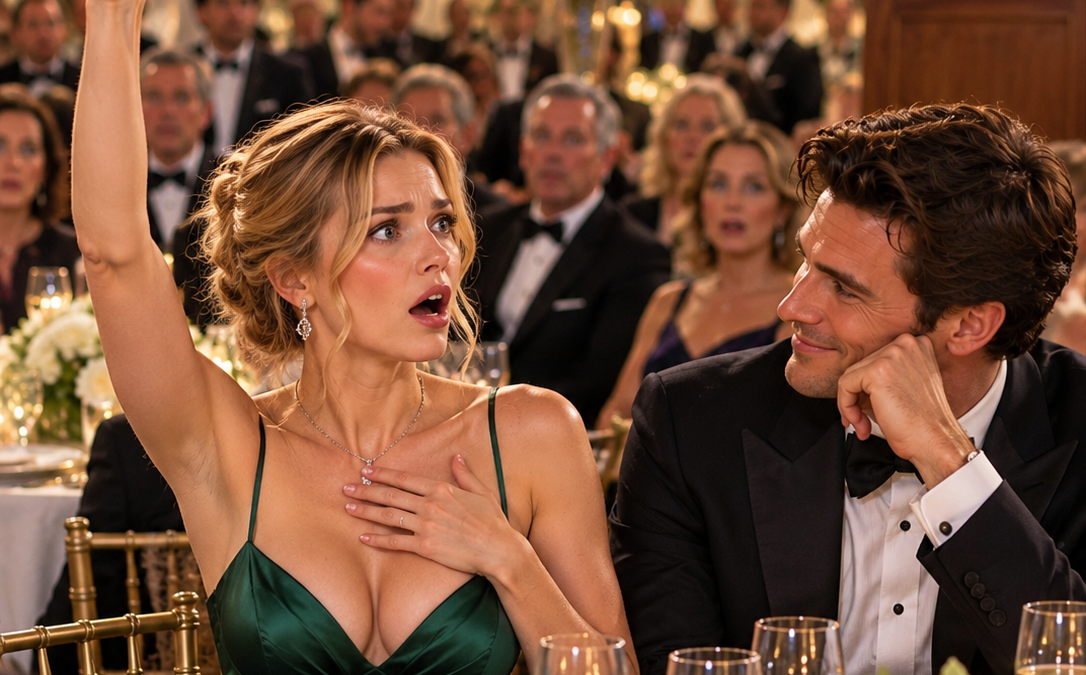
Some of you will know her as the lady in green from the auction.
800 heads began to turn. Molly stood very still at the back of the hall.
“I need to tell you the truth about that night,” said Hugh.
“Because the newspapers have it wrong, and it’s my fault.”
She didn’t bid on me.
She was waving at a friend. The auctioneer looked at me and I nodded and I let him take her wave as a bid.
I did it because I didn’t want to spend six Saturdays with someone who’d bought me and instead I made her the one who looked bought.
I never asked her. I never told her.
She found out at a dinner from someone else and she walked away and she was right, too. He took a breath.
She also walked away from $80,000 for her program.
I thought it was only because of what I’d done.
It wasn’t.
Someone had photographs of me in that class.
Someone told her that if she didn’t leave me, they’d go to the newspapers and the Navy and my board.
So, she left. She let me think she hated me so that nobody would ever print the word lazy under my picture.
He looked out at the room.
Well, I’ve just printed it myself, so there’s nothing left for anybody to sell.
The room was utterly silent now.
So tonight, said Hugh Thornton, the foundation has the full $80,000 with no conditions and an endowment which will keep Second Chapter open for as long as there’s a Doorchester.
That’s done.
It’s signed.
It doesn’t depend on anything.
He looked down at the book on the lectern.
And now I’m going to read you a page.
It’s going to take a while.
I’m sorry.
He opened the book.
It was not a long page. It was a page from a book of poems.
And it took Hugh Thornton six minutes to read it out loud in Bates Hall in front of 800 people and the cameras of three television stations.
He went one word at a time.
He sounded some out.
He got some wrong and went back.
His finger moved under the line twice. He stopped completely and the whole vast room held its breath and waited and nobody helped him because somehow every single person in that hall understood that you let people finish.
Molly stood at the back with her hands pressed together against her mouth and Teddy Mensah’s big hand on her shoulder and watched.
He read eight lines of Robert Frost.
And when he got to the end, he didn’t read the last line.
He stopped. He looked up from the book.
He looked straight down the length of Bates Hall, past the lamps and the long oak tables and the 800 faces to the very back of the room where she was standing. The last line says nothing gold can stay, said Hugh.
Someone I know told me it isn’t true.
I’d like to find out if she was right.
Then he closed the book and stepped away from the lectern and walked off the stage.
For a moment, nobody moved.
And then Teddy Mensah started clapping, big hands like thunder.
And then the whole of Bates Hall was on its feet.
800 people, the mayor and the novelist and the Red Sox pitcher and the three horrified men in suits from Thornton Marine. All of them clapping, clapping, clapping for a man who had just read eight lines of a poem slower than anyone in the history of Read Aloud Night.
Molly Finch was not clapping.
She was walking straight down the center aisle of Bates Hall between the long oak tables past 800 people who were still on their feet with a brown envelope held against her chest. She walked all the way to the front row and stopped in front of a small white-haired woman in a dark suit.
“Dr.Oay,” said Molly.
Her voice shook, but it carried.
“I’m Molly Finch, Dorchester Branch, second chapter.
The foundation froze our funding last Monday pending an ethics review.
I’ve done the review for you.
She held out the envelope.
That’s an invoice from a private investigator named Joe Kowalsski made out to Miss Cresa Peton for photographing an adult reading class through a library window for 2 months.
Those are her emails asking him to find something she could use.
And that’s the camera footage from our parking lot.
She took a breath. The chairman froze our money the week after his daughter lost an auction.
I think the board should know why.
The room had gone quiet again. Very quiet.
Dr.Margaret Oi, retired judge, opened the envelope. She read the first page.
She read the second.
Then she took off her glasses and turned slowly to look along the front row at Harold Peton who had gone the color of old paper and at his daughter beside him in silver who was looking at the floor. Harold said Dr.OC in the voice she had used in court for 40 years.
I think you and I should have a conversation tonight and I think your daughter should go home. Cresa Peton stood up for a moment.
and she looked at Molly and her face was very strange, angry and frightened and something else, something almost like envy.
Then she picked up her white fur coat and walked out of Bates Hall alone down the long center aisle, past 800 people who did not say a single word.
Harold Peton resigned as chairman of the library foundation before the cider was served.
The freeze on the Dorchester branch was lifted by 10:00 that night, and by the time anybody thought to look for her, Molly Finch was gone. He found her on the front steps, not the steps of the Dorchester branch, the great granite steps of the Boston Public Library on CPPley Square, under the three tall arched doorways, with the words carved into the stone above them that she had walked under every day of her working life.
Free to all.
It was snowing properly this time. Big soft flakes coming down slowly in the yellow light from the doors settling on the steps and the stone lions in her hair.
She was sitting on the top step in her winter coat with her hands shaking in her lap now that it was over and she didn’t look up when he came out.
He sat down beside her, not too close. You knew, he said about the photographs.
You let me think you left because of me. I did leave because of you.
Partly I’m still angry about the nod.
I know. And partly said Molly because nobody gets to take that from you.
Not her.
Not anybody.
That’s yours to tell.
When you’re ready, not when Cresa Peton decides.
She wiped her eyes with her glove.
And then you went and told 800 people anyway. You idiot.
I learned it from a librarian, said Hugh.
Teddy says, “Nobody can use a secret against you once you’ve said it yourself.”
He paused.
“The stock’s already down 4%.
Felix has texted me 11 times.
Do you care?”
“No,” said Hugh.
“Not even slightly.
” He looked out at the snow falling on CPPley Square.
“I’ve spent 38 years hiding the one thing about me that was true.
And I spent 6 weeks hiding the one thing I did that was wrong.
I’m finished hiding.
Even if you never speak to me again.
Molly was quiet for a long time.
You should have asked me,” she said finally.
At the auction, you could have just come down off the stage and said, “Would you like to have dinner with me?”
I’d have said no, probably.
I’d have been terrified, but it would have been mine.
“I know you took that away, that one second, the choosing.”
“I know,” said Hugh.
So, I’d like to give it back.
He reached into his coat pocket.
He took out a small rectangle of green cardboard with a wooden handle, a bidding paddle, number 47, bent at one corner, a little faded.
“You left it in my car,” he said.
“After the first Saturday at the bowling alley, I’ve been carrying it around for 2 months.”
He held it out to her.
I’m not asking you to bid on me.
I’m asking you to decide whether there is a seventh Saturday and an eighth and however many come after.
You choose. Not me, not an auctioneer.
Not a nod.
Molly looked at the paddle.
Then she looked at him in the snow on the steps of the library with the light from the doors behind him and the snowflakes catching in his dark, unruly hair.
She took the paddle. She looked at it for a moment, then slowly, deliberately looking straight into his eyes, she raised it high in the air.
“Sold,” whispered Hugh Thornton.
And he kissed her on the steps of the Boston Public Library in the falling snow under the words free to all. Behind them, the great doors opened and people began to stream out of read aloud night into the snow and stopped and stared.
And somebody started clapping again.
And a big gay-haired man in his one good suit stood in the doorway with a shoe box under his arm and smiled and said to nobody in particular, “Told her out loud.”
One year later, on a Saturday night in October, in the Great Marble Hall of the Boston Public Library, the Library Foundation held its annual gala. There were 500 people in evening dress.
There was a string quartet.
There was a camera crew from Channel 5 and there was Barnaby Leadeds in his velvet jacket at the auctioneers’s podium who had been forgiven mostly and who had promised never to take a nod from anyone ever again.
The auction was nearly over. Ladies and gentlemen, boomed Barnaby, the final lot of the night, lot 30, donated by Mr.Hugh Thornton.
He read from the card and his voice softened. every Saturday for the rest of my life, planned by the buyer.
Bidding is open only to one person at the donor’s request, and I’m told the starting price is $1.
The room went quiet.
500 heads turned toward the back of the hall. Molly Finch was standing by the coch, not as staff this time, as a guest in a green dress that was her own and fitted.
Jojo was beside her, holding two cream puffs, crying. Hugh Thornton was on the stage in his black dinner jacket with his hands clasped behind his back, but not like a man waiting to be shot.
Like a man waiting for something he wanted very much. Molly reached into her handbag.
She took out a green paddle number 47 bent at one corner and a little faded.
And very slowly looking straight at him, she raised it into the air.
“$1,” said Molly Finch.
$1 to the lady in green, said Barnaby, and his voice cracked a little.
Going once, going twice.
On the stage, Hugh Thornton looked out over the crowd straight at her, and he nodded.
“Sold,” he said.
He came down off the stage, he walked the whole length of the Great Marble Hall, through 500 people to the coat check at the very back of the room.
And there, in front of the string quartet and the camera crew and Teddy Mensah, who had brought the entire Thursday night class in their best clothes, Hugh Thornton went down on one knee.
He didn’t have a speech.
He didn’t need a card.
He just held up a small velvet box and looked up at her.
“I wrote this down,” he said.
Then I realized I didn’t need to.
“Molly Finch, will you marry me?”
Molly laughed and cried at the same time.
“Yes,” she said.
“Yes, out loud.”
Yes.
And this time when the camera crew from Channel 5 swung around with their lights blazing and pointed their camera straight at the lady in green, she didn’t mind at all.
Second chapter has 200 students now in four branch libraries.
The Thursday night class at Doorchester is taught by a volunteer named Hugh who reads slowly and isn’t ashamed of it and always lets people finish.
Teddy Mensah finished reading all of Lraine’s letters.
There were 31.
On the last page of the last one, she’d written, “I knew you’d get here, Teddy.
Take your time.”
And on the wall of the reading room at the Doorchester Branch Library, in a small wooden frame, hangs a green bidding paddle. Number 47.
Bent at one corner.
Underneath it, on a small brass plate in letters anyone can read, it says, “Free to all.
” If this story made you smile, please subscribe to Soul Stories.
And the next time you see someone at the back of the room, maybe give them a wave.
You never know who’s waving back.
THE END.