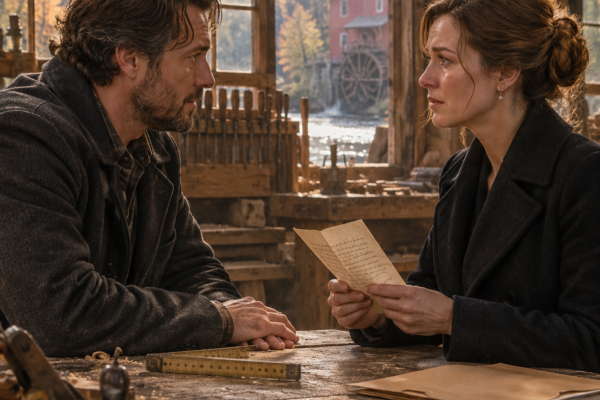
My Assistant Told Mom I Had a Girlfriend. Mom Asked Who—She Took My Hand: “You’re Looking at Her.”
My Assistant Told Mom I Had a Girlfriend. Mom Asked Who—She Took My Hand: “You’re Looking at Her.”
My mother had her phone out and her reading glasses on, which meant she had no plan to leave my office until I gave her a Saturday.
– Her name is Marianne. She teaches at the middle school in Bexley, and Dorothy says she’s lovely, Mom said. So I’m telling her 7:00.
I was opening my mouth to say no for the third time when Cecilia Romano set down the folder she had been carrying and spoke in the same even voice she used to confirm vendor invoices.
– Mrs. Pike, Mr. Pike already has a girlfriend.
Mom turned the full force of her attention on her.
– Does he? Then who is she?
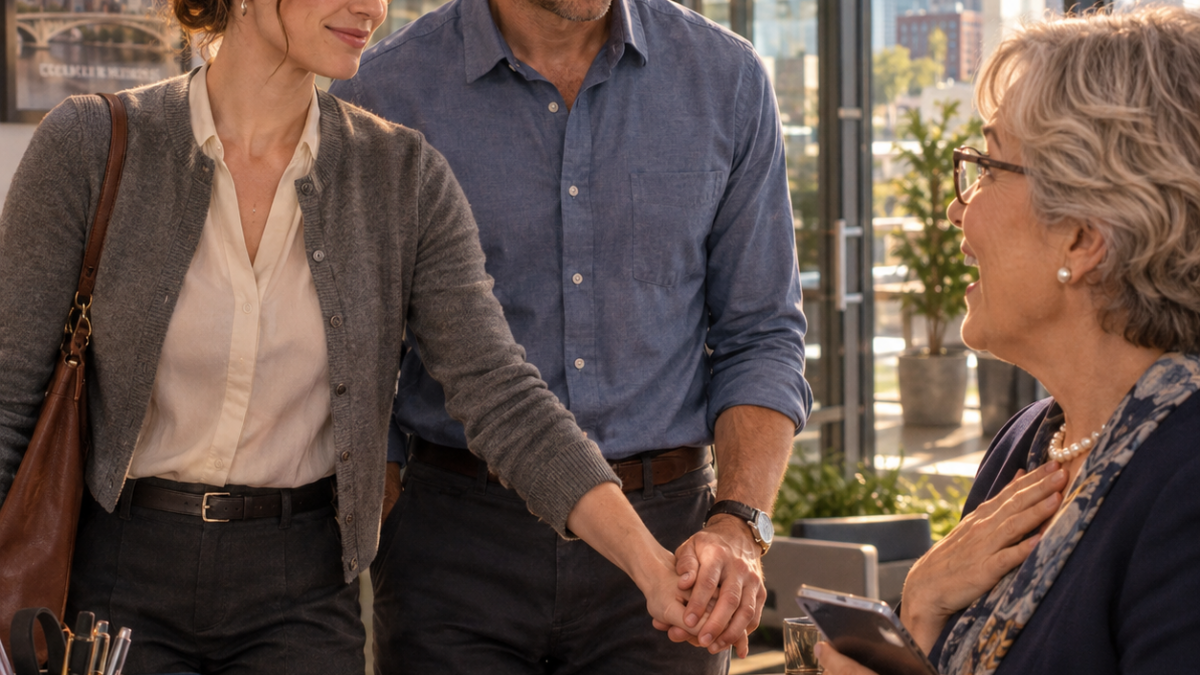
Cecilia crossed the carpet, took my hand in hers, and laced her fingers through mine.
– You’re looking at her.
Her hand was warm and perfectly steady, and she kept her eyes on my mother instead of on me. I am Leonard Pike; I am 39, I own a small commercial design firm in Columbus, and in six years I had never been speechless in my own office. I was now, and the reason was not alarm—it was a plain, inconvenient wish that she meant it, and I understood immediately that the wish was exactly why I could not answer for her.
So I did not confirm the story, and I did not deny it, and I left my hand where she had put it. Mom looked from our joined hands to Cecilia’s face and back again, and I watched months of casseroles and carefully arranged coincidences rearrange themselves in her head.
– Leonard, I have been telling you for a year that you work too hard to meet anyone, and all this time you had her 15 feet from your desk, she said.
– He’s private about it, Cecilia answered, and she said it so smoothly that I almost believed there had been something to keep private.
Mom pressed a hand to her chest, which is what she does when she has decided to be delighted, and I knew the matter was now beyond reach.
– Well, I won’t make him tell it in front of his staff, she said. Cecilia, you’ll come to dinner on Saturday at 6:00, and I’ll make the lasagna.
– Mom, she doesn’t have to, I began, but she held up one finger without looking at me.
– If I’m canceling Marianne, I’m getting a dinner out of it.
– I’d be glad to come, Mrs. Pike, Cecilia said in a tone so calm that I could not tell whether she was being gracious, being kind, or being something else.
Mom thumbed out a quick text to Dorothy right there in front of us, kissed my cheek, squeezed Cecilia’s forearm, and left with the satisfied walk of a woman who has won. The elevator down the hall chimed, and the whole office seemed to exhale. Cecilia let go of my hand the moment the chime sounded, smoothed the front of her gray cardigan, picked the folder up from my desk, and straightened its edges as if the last two minutes had been an ordinary interruption.
– The Hadley proposal needs your signature by 3:00, Mr. Pike, she said. The printer on the second floor is jamming again, so I’d recommend signing the copy on your screen.
It was her usual voice, her usual posture, and her usual careful distance, and the only evidence that anything had happened was that my right hand felt oddly unfinished. I told her to close the door for a second, and she did, though she stayed standing near it with the folder against her chest.
– You don’t owe me dinner, I said. You don’t owe me the girlfriend story either. I’ll call my mother tonight and tell her it was a misunderstanding, and I will take the blame for the confusion because I’m the one who should have stopped her at the door.
Cecilia tilted her head slightly, the way she does when a client sends a revision that contradicts the last revision.
– Mr. Pike, that is the third time you’ve said you’ll take the blame, she said. I wasn’t aware anyone had been accused of anything.
– I just want it clear that whatever you decide, nothing changes here, I said. Your hours, your projects, your standing in this office—none of it depends on what you tell my mother or whether you show up on Saturday.
For a moment, she looked at me with an expression I could not file under any heading I knew, and then it smoothed away into the one she wore for the rest of the staff.
– I understand the terms, thank you, she said. I’d have said the same thing in your place, so I won’t pretend it isn’t a relief to hear it.
She turned the door handle and paused with her back half toward me.
– I said yes to the lasagna, and I haven’t taken it back.
She went out and shut the door behind her, and I heard her heels cross to her desk and the soft click of her keyboard starting up as though nothing had been said. I sat down and looked at the Hadley proposal without reading a word of it. I had given her every possible exit, and she had walked past all of them and kept the one thing that put her at my mother’s table.
What I could not tell was whether she meant to sit there beside me because she wanted to, or simply because she did not want to leave me alone with Judith Pike and a rescheduled blind date. I signed the proposal at 10 minutes to three, and my signature came out crooked.
By nine the next morning, Cecilia had called me Mr. Pike in front of Dev, Paula from accounting, and a courier who had only come to drop off a tube of drawings. She said it with the same flat courtesy she had used for six years, and nobody in the office gave either of us a second glance. Whatever she had told my mother, she clearly did not intend to carry it into the building where I signed people’s paychecks.
The odd part was what happened whenever the room emptied. When I told her the Hadley revisions were due Friday, she spoke without looking up.
– Thursday, Leonard. You moved it yourself and then you forgot you had.
She only used my first name when a door was shut, and I don’t think she noticed she had done it. The formal Cecilia behaved as though Tuesday had never happened, while the dry one kept coming close to admitting it, and I had no idea which of them to believe.
I waited until Thursday at six, after Dev had gone and Paula’s desk lamp was off, and I asked whether she had 10 minutes that had nothing to do with the firm. She glanced at the clock, then at me, and said she could spare 10, which is how Cecilia agrees to nearly anything. We carried two coffees out to the back steps overlooking the loading lot, the closest thing our building has to neutral ground.
I had rehearsed the speech in the car, and it had sounded much better in the car.
– Saturday is still yours to cancel, I said. I can call my mother tonight and tell her it was a misunderstanding, and she’ll be annoyed with me for about a week. Nothing about your job, your hours, or your review in March depends on what you decide. I’m saying it out here so you’ll know I mean it as a person and not as the man who signs your timesheet.
Cecilia turned her cup a quarter turn on the step and watched the delivery truck back slowly toward the dock.
– I didn’t do it to be kind, she said. Your mother kept talking over the word no, and you kept saying it politely, and I got tired of listening to it lose.
It was such an exact and unflattering summary of my last year with Mom that I laughed out loud, and she very nearly smiled.
– But I won’t tell you the hand was nothing, she went on. I took it, and I knew whose it was.
She said that to the loading lot instead of to me, which was probably the only reason I managed to keep my face still.
– What I’d ask is that you not turn one impulsive answer into a settled fact. Your mother will do more than enough of that without help.
I told her I could do that, and I meant it, and then I asked the question I had been carrying around since Tuesday.
– If my mother had never walked in, would you want to see me somewhere that isn’t this building? Not as an act or a favor, just as a Saturday.
It came out clumsier than I wanted, and I could have taken it back, but I didn’t. She took her time, and I respected that more than a quick yes would have earned.
– You’re asking me to answer for a version of myself who never had to think about it, she said. I won’t do that on a set of back steps with my employer sitting next to me.
She said it without any heat, and she looked straight at me when she added the next part.
– Let dinner be dinner, Leonard. When I have something true to tell you that I can stand behind, I’ll tell you.
That was a fairer answer than the question deserved, so I took it. We settled the terms the way we settle a client schedule, with her doing most of the talking and me nodding at the reasonable parts: we would both go, we would both be honest if my mother’s questions ran ahead of the facts, and either of us was free to correct her at any point without checking with the other first.
– No performance, I said. Nobody holds hands under the table, and nobody invents an anniversary.
Cecilia considered this with the gravity she gives a contract.
– I wasn’t planning to invent anything. If she asks how long I’ve known you, I’ll tell her six years, and every word of it will be true.
I was still deciding what to do with that sentence when she stood up, brushed off the back of her slacks, and said she would bring a bottle of wine so she wouldn’t arrive empty-handed. She went back inside to collect her bag, and I stayed on the step until my coffee went cold and the truck had finished unloading. By any measure, we had come out of the conversation with clearer terms than we started with—she had left room to refuse, I had left room to be refused, and neither of us had promised the other anything we didn’t plan to deliver.
What I couldn’t plan for was my mother’s dining room. The easy way Cecilia and I talked to each other had always lived behind a closed office door with a harmless explanation attached to it. On Saturday, it would sit under a good lamp across from a woman who had been ready to call it love since Tuesday morning.
I picked Cecilia up at 6:10 on Saturday outside her building in Clintonville, and she came down the steps carrying a bottle of red wine and wearing a navy dress I had never seen at the office. She buckled her seat belt and set the bottle between her feet.
– You told your mother 6:00 sharp, so you’re driving like it, she said.
I kept to the speed limit all the way to Worthington, and neither of us mentioned the terms we had agreed to on the back steps. When we pulled into my mother’s driveway, the porch light was already on, and the front door was already opening. Mom hugged Cecilia before she had both feet on the walk, took the wine like a trophy, and steered her inside by the elbow.
My hand drifted toward the small of Cecilia’s back out of pure habit, and I put it in my pocket instead because a gesture like that would have been the first line of the performance I had promised not to give. Mom had set the table in the dining room with the good plates, and she took the chair at the head so she could face both of us. The questions started before the salad had been passed—how long Cecilia had lived in Columbus, who her people were, and whether she liked working for me—each asked before the previous answer was finished.
I noticed that Cecilia got about half a sentence out each time, and the half she got out was always graceful and always true.
– Six years, Mrs. Pike, she said when Mom asked how long we had known each other. He’s the only employer I’ve had who reads the whole invoice.
Mom laughed as if that were the most romantic thing she had heard all year, and I understood that anything Cecilia said tonight would be translated into love before it reached the other side of the table. The lasagna came out bubbling, and Mom cut a square from the center and slid it toward my plate the way she has since I was nine. Cecilia reached over very lightly and moved the spatula one inch to the left.
– He’ll want a corner piece, she said. He told me once that the edges are the only reason to bake it in a pan, so he usually lets the middle go to someone else.
Mom stopped with the spatula in the air and asked when exactly I had told her that.
– At a client lunch, a little over two years ago, Cecilia said. The place had a lasagna special, and he complained about it for most of an hour.
I remembered the lunch dimly and the complaint not at all, which meant she had kept a small thing I’d said in passing for two years while I had forgotten I said it. It was too plain a detail to have been invented for the occasion, and that was the part that unsettled me. Mom put the corner piece on my plate with great ceremony and said “Two years” in the voice of a woman who has just solved something, and I could see the whole calendar reorganizing itself in her head.
I put down my fork before she could say it out loud.
– Mom, it doesn’t mean that, I said. Cecilia spoke up in my office because you weren’t listening when I said no to Marianne, and she was being a good friend about it. That wasn’t an announcement that we’ve been together for two years, and I don’t want you telling Dorothy it was.
The dining room went quiet enough that I could hear the refrigerator humming through the kitchen wall. I looked down the table at Cecilia, half expecting her to look embarrassed and half afraid that I had made her sound like a liar in front of someone she was trying to impress. She did not look embarrassed; she set her napkin beside her plate, folded her hands, and spoke to my mother with the same steadiness she had shown in my office.
– He’s right, Mrs. Pike, and I should have been clearer when I said it. I spoke quickly. You were kind enough to take me seriously, and I let the dinner invitation answer a question I hadn’t answered for myself.
Mom started to say something, and Cecilia lifted two fingers from the tablecloth—a small motion that stopped her better than any argument could have.
– But nobody pushed me through your front door tonight. I wanted to come, and I’m glad I did, and this is honestly the best lasagna I’ve had in years.
– So, what exactly are you two? Mom asked, sounding more curious than cross.
– People who know each other well and are sitting at your table because they wanted to be, Cecilia said. Anything past that is ours to work out, and I’d rather we worked it out without a deadline.
I kept my eyes on my plate because I did not trust my face with the way she had said the word “ours.” Mom looked at her for a long moment, and then at me, and I watched her weigh a spectacular daughter-in-law against an honest, slightly inconvenient young woman who had just declined the promotion.
– I canceled Marianne and called Dorothy twice, she said with a little sniff. I suppose I did hear no about as well as the radio does.
Cecilia smiled and said that was the most generous way anyone could have put it. After that, Mom put the spatula down and began asking the ordinary kind of questions about Cecilia’s sister in Dayton and whether she had ever eaten at the Greek place near the Arena District. Cecilia got whole sentences out this time, and I learned that she had lived on a houseboat for one summer in college, which I had somehow never heard.
At the door, Mom wrapped both of us in the same hug and told Cecilia that the invitation stayed open with no performance required.
– Next time, bring him on a day he isn’t being supervised, she said, and I did not argue with her.
The drive back to Clintonville was quiet in a way our office never is. Cecilia held the leftover container in her lap and watched the streetlights go by, and I could not tell whether she was tired or deliberately leaving the silence unfilled. I pulled up at her building, and she thanked me for the ride and said good night—and she used my first name when she said it.
Nothing was left to correct, and nobody was left to impress, and I realized that I had no idea what would be left of us when we weren’t answering to anyone. Cecilia was back at her desk on Monday morning, calling me Mr. Pike in front of Dev and sending me the Hadley revisions with a subject line that said only: Thursday, as discussed. I took that as a sign she meant to keep the two parts of her life on separate floors.
On Wednesday evening, she caught me in the parking lot while I was fumbling for my keys, with her bag on her shoulder and her coat already buttoned.
– Sunday at 1:00. The conservatory at Franklin Park, she said. It isn’t your mother’s idea, and nobody is going to be watching us, so you can stop looking for an exit.
I asked if she wanted me to pick her up, and she said she would meet me at the entrance because she preferred arriving under her own power. I said I would be there, and I was careful not to call it anything since I had no right to name it for her. She gave a short nod that suggested I had passed a test she had not announced, and she walked to her car without looking back.
I got there at 12:40 and spent 20 minutes pretending to read a plaque about orchids. She arrived at exactly 1:00 in a green sweater and jeans, and without the cardigan and the desk, she looked like someone I had known for years and was meeting for the first time. She looked me over from my shoes to my collar.
– You’re standing like you’re about to review a floor plan, she said.
I told her that was the only way I knew how to stand while waiting for someone who was never late, and she said that was a fair answer and a weak excuse in the same sentence. We walked into the glasshouse where the air was thick and warm, and the first thing she did was correct my pronunciation of a plant I had been mispronouncing at dinner parties for a decade. At the office, a correction like that would have gone into a folder and been forgotten by lunch; here, it came with a half-smile and an elbow knocked lightly against mine, and I noticed that I had not once reached for the Hadley account to fill a silence.
We drifted through the palms and the long hall of tropical ferns, trading the same dry remarks we had traded for years over the printer and the vendor calendars—only nothing we said needed a work excuse to cover it. She told me she had hated the lobby plants in our building since the day they were installed, and I admitted I had never watered them because I thought they were fake. She stopped walking and stared at me with real horror.
– Leonard, those are real. I have been watering them every Friday for four years, she said. You thought I was just carrying a cup around the lobby?
I said that I had assumed it was an elaborate way to avoid Paula, and she laughed—a full laugh that echoed off the glass—and she did not seem to mind that people turned to look. We found a bench beside a koi pond, and I decided I had spent enough years answering her in the safe language of deadlines.
– I want to say something plainly, and I’d like you to hear it as exactly what it is, I said. I want to ask you on a date. Not as a favor to my mother, not to keep a story alive—just because I would like to take you to dinner and find out what happens.
Her hands went still in her lap, and I kept going before I lost my nerve.
– But I sign your paycheck, Cecilia. I won’t start something in secret while you report to me, because if it goes badly, you’d be the one carrying the cost. And if it goes well, you would still never be sure whether you had earned your standing or been handed it.
She watched a gold-and-white koi turn slowly beneath the lily pads, and when she answered, her voice was lower than at the office, yet just as even.
– I’m not going to pretend I didn’t hear what you just said, or that I don’t feel the same, she told me. The hand wasn’t an accident, and I’ve been interested in you for longer than I’d like to admit.
She let that sit between us for a second and then lifted her chin.
– But I have to say the rest too, because it matters as much. I’ve been putting money away for two years so I can go into independent operations work, helping small firms run themselves better than they currently do. I started before your mother ever walked into your office, and it is mine. I won’t let it become something I trade, and I won’t let you quietly arrange your life around it either.
I told her I had no intention of asking her to give up anything, and she gave me a look that told me to be careful with that sentence.
– Not now, maybe, she said. But if someday you say you would rather I stay, I will hear it as a price, even if you mean it as a compliment. So let’s not pretend this is simple just because we like each other.
I said that was fair, and that I would rather live with a difficult, honest answer than a convenient one. Neither of us reached for the other’s hand, and I noticed that neither of us moved away either. We sat there while the fish circled under the lilies, and the quiet between us felt more like a decision than a gap.
We walked out through the front gardens and stopped where our cars sat on opposite sides of the lot. The afternoon had gone gray and cold, and she turned up her collar and looked at me for a while without saying anything.
– I want us to understand what we agreed to today, she said. We are not confused, and nobody misunderstood anyone. If we leave this alone, it will be because we chose to, and I would rather that than hiding behind your mother.
I said I understood, and I did, though understanding it did not make the walk to my car any easier. She got into her own car and drove off with a small lift of two fingers from the wheel—exactly the gesture she had used on my mother at the dinner table. I sat in the driver’s seat with the engine off and went over everything we had said.
She had told me the truth, and I had told her mine, and the only thing standing between us was a savings number I had never seen and a date I had no right to ask her to hurry. Somewhere in the city, she was building a future that had nothing to do with me, and she had made me promise not to stand in its way. What I owed her now was proof that I could keep that promise, even if keeping it meant not asking her to choose me yet.
The next five weeks were the most professional of my life, and I did not enjoy a minute of it. Cecilia ran my calendar, the Hadley revisions went out on a Thursday, and the Brant account fell into place two weeks ahead of the date I had promised the client. I stopped finding reasons to stand at her desk at the end of the day, and when we had to be alone in a room with a closed door, I kept the meeting to its agenda and left the minute afterward.
She did the same, and she did not use the dinner or the conservatory to ask for anything, including the long lunch hour Dev assumed she had earned. My mother called twice to ask whether Cecilia was free for another Sunday, and both times I told her gently that she would have to ask Cecilia herself, which she did not, to my surprise. The restraint had a cost, and I paid it in small amounts every day.
The ease we had shown at my mother’s table did not go away just because we stopped putting it on display—it sat in the office with us, in the way she put a coffee on my desk without comment, and in the way I still knew which vendor she would roll her eyes at before she did. One Friday evening, while she watered the lobby plants, I stood at the elevator and very nearly told her what I was thinking, getting as far as her name. She looked up from the watering can, and I said I would see her Monday, spending the drive home wondering whether my silence told her I was being respectful or told her I had changed my mind.
On the first Thursday in April, Cecilia asked whether I had 15 minutes and whether we could use the conference room. She closed the door behind her and put a single sheet of paper on the table, folded once—the way she handed me anything she wanted read carefully.
– This is notice, Mr. Pike, she said. My last day will be Friday, May 16th, which gives you six weeks to find and train someone, and I would like to be the one who writes the transition notes.
I unfolded the page and read it twice because the first time I only saw her signature. She had reached the number in her savings account that she had set for herself two years earlier, and she told me so without apology; her plan had a client list of two small firms in Dayton, and she had already registered the business name. None of it had anything to do with me, and she let me see how carefully she had arranged that.
I did what I would have done for any employee I respected, and it was harder than I expected. I thanked her, and I meant the thanks, and I told her the notice period was more generous than the firm deserved. I asked what she needed from me to make the six weeks useful, whether she wanted to keep the Hadley and Brant accounts through the end or hand them off early, and told her I would post the position that afternoon and that she was welcome to sit in on interviews if she wished, under no obligation.
I did not offer her a raise, a title, a retainer, or a single client. At one point I felt the sentence “Are you sure?” climbing my throat, and I swallowed it because she was plainly sure, and asking would have been a way to make her reassure me.
– Thank you for giving me the dates, I said. Everything on this page is going to be handled the way you wrote it.
She nodded and reached for the door, and I told her there was one more thing that was not part of the meeting.
– I’m going to say this once as myself and not as your employer, I said. After the 16th, you won’t report to me or work for me, and nothing I say will touch your paycheck. When that day is passed, I’d like to ask you to dinner properly, with no mother and no excuse.
Her hand stayed on the door handle, but she did not turn it.
– You don’t owe me an answer, and I’m not asking for one now. If the answer is no, I’ll take it and keep it between us, and I’ll write you the best reference anyone ever wrote, which I was going to do anyway. I just wanted you to know I wasn’t going to wait until the last day and surprise you.
Cecilia took a long time to respond, looking at the folded sheet instead of me.
– You waited until I had given you the date, and you waited until you were sure it couldn’t look like you were bargaining, she said slowly. I noticed that, Leonard.
It was not a yes, and she took care not to let me hear it as one. She opened the door, and the sounds of the office came back in—Dev’s keyboard, the copier, and Paula’s low voice on the phone.
– I’ll have the transition notes to you by the end of next week, Mr. Pike, she said in her office voice, and I thought I saw the corner of her mouth move before she turned.
I went back to my desk and posted the job listing as I had promised, with the salary range and a plain description of the duties she had performed for six years. I wrote half a paragraph about what the firm valued and deleted the half I had written for her. Through the glass I could see her sitting down, pulling her keyboard toward her, and starting on her notes without a glance in my direction.
By the 16th, she would be free to say yes, free to say no, and free to say nothing at all. My mother’s claim could not decide it for her, and neither could six weeks of careful behavior on my part, and I found that I was more afraid of that than I had ever been of the lasagna.
Cecilia’s last day was Friday, May 16th, and she ran it exactly the way she had run the six years before it. The new hire, a quiet woman named Renata Cole, sat at the desk beside hers with a legal pad while Cecilia walked her through the vendor calendar, the Hadley archive, and which printer to avoid. Dev ordered a sheet cake with “Good luck, Cecilia” in blue icing, and Paula cried a little into a paper napkin.
At 4:30 I stood in the break room with everyone else and said what I had written down—that Cecilia had read every invoice that crossed our office, and that was more than I could say for myself. She thanked me and called me Mr. Pike in front of the whole staff with a perfectly straight face for what I assumed was the last time. I shook her hand the way I would have shaken anyone’s, and I let go first.
She carried her box to the elevator at 5:00, and I stayed in my office with the door open and did not follow her. The day belonged to her, and I wanted it to end without anything of mine attached. On Saturday morning my phone buzzed while I was standing at the stove burning toast.
Her message said she no longer had a desk to report from or anyone to call me Mr. Pike in front of, and asked whether I was free Sunday at 11:00 at the coffee place on High Street with the crooked green awning. I read it three times, which is two more than any message she had sent me in six years had ever needed. I typed a single word back, decided it looked like a man trying too hard, and replaced it with a full sentence saying I would be there.
The invitation was hers, arranged on her schedule, and I had said nothing that could have pushed it. I arrived at 10:30 planning to beat her for once and found her already at a table by the window with a cup in front of her and a denim jacket over the back of her chair.
– You’re early, she said, which is two firsts in one week for you, and I’m trying not to read into it.
I sat down across from her and noticed how strange it was to see her without a folder in her hands. She looked relaxed in a way I had only glimpsed in a greenhouse, and she was watching me the way she used to watch a client deciding whether to approve a mockup. I ordered a coffee I did not want, and we talked for a few minutes about Renata’s first week and whether the lobby plants would survive without her—she told me she had left a watering schedule taped inside the supply closet and that I was not to remove it.
I waited until my coffee arrived because I had learned that Cecilia likes the logistics out of the way before the point.
– I said I’d ask once the 16th had passed, so I’m asking, I said. Would you have dinner with me? Just the two of us at a table on whatever night you pick, and if the answer is no, I’ll finish this coffee and still be glad you came.
I did not mention my mother or the office or the afternoon she had taken my hand; I had spent two months making sure nothing like that could lean on her answer, and it seemed foolish to lean on it myself now. My pulse was louder than it had been the day I first signed a lease for the firm. She put her cup down and took her time, the way she had on the back steps, and this time I knew better than to fill the silence.
– Yes, she said. And I’d like to say it in my own words, since for a while I was handing out other people’s.
She turned the cup a quarter turn, which I now understood to be a tell.
– I’ve wanted to have dinner with you for a long time, and I wanted a version where nobody could say it was an accident or a favor. I wanted it to be a plain Saturday that I picked myself.
She told me the plan before I could ask: on Friday she was meeting her first Dayton client in the morning and signing a short lease on a small office that afternoon, and she wanted me to see it. After that, I would buy her dinner at an Italian place called Ettore’s across the street, which she had walked past four times without going in alone. I told her she had planned the entire evening, and she said she had planned it with the care of a woman who had spent six years scheduling mine.
Then I said it was the first time she had called me by my first name in daylight with a window right next to us.
– That’s why I took this table, she said. If anyone ever asks, there are witnesses.
It was a dry line delivered at exactly the angle I had missed for two months, and I laughed loudly enough that the barista looked over. She laughed too, with her hand over her mouth for about a second before she gave up and let it show. We stayed through a second cup and most of a third.
Somewhere in the middle I started to ask what she had meant that March morning in my office—whether it had been a rescue or something she had been waiting to say—and I stopped before the question was finished. She noticed that I stopped.
– You can ask, she said. I might tell you someday, or I might not, and it won’t change Saturday either way.
I realized then that I no longer needed the answer to feel steady. The hand she had taken in front of my mother had been the start of it, yet everything since had been chosen by two people who knew exactly what they were choosing, and that was the part I trusted. On the sidewalk she stopped beside my car, glanced up and down the block, and held her hand out palm up, the way she used to offer me a document to sign.
– Nobody is watching, she said. And nobody is asking who I am.
I took it and laced my fingers through hers just as she had in my office, except that this time neither of us was looking at someone else. She told me she would meet me in Dayton under her own power, and that I could drive her home afterward if she decided to be driven. I said I would be there at whatever time she named; she squeezed my hand once, let go, and walked to her car, and my right hand did not feel unfinished at all.
Cecilia told my mother herself three weeks later over lasagna baked in a pan with the corners left uncut, and Mom claimed credit for the entire thing. We let her keep it since she had earned a small share of it, and she has not tried to set me up with anyone since. I used to think the best thing that could happen to a man was to hear a woman say yes; these days I think it matters more to be sure the yes belongs to her.
I still haven’t asked Cecilia whether that first sentence in my office was a rescue or a wish, because what she said to me on a Sunday morning was better than either. So tell me in the comments: if someone claimed you in front of everyone on impulse, would you want to know right away whether they meant it, or would you rather let them show you over time? If this story kept you company, please like the video and subscribe so you don’t miss the next one.