I Noticed a Man Watching the Night Cashier. She Whispered: “Walk Me Out Like You’re Mine.”
I Noticed a Man Watching the Night Cashier. She Whispered: “Walk Me Out Like You’re Mine.”
I noticed the man before I reached the door of the convenience store on Cleveland Avenue. At 3:00 in the morning, he was the only person in the parking lot who was not moving. He stood by a light pole with his hands in his jacket pockets, and his eyes stayed on the front window.
I carried my coffee and a sleeve of peanut butter crackers to the counter, where Lydia Marshon scanned them without looking at the screen. She leaned an inch closer than the counter had ever required and whispered.
– Walk me out like you’re mine.
A request made that quietly is never a joke on an overnight shift. I’m Calvin Dwire; I dispatch cargo out of the airport, and for most of a year Lydia had been the best part of my drive home. She remembered my order, argued with me about the crossword in the free paper, and never made conversation feel like an obligation.
I kept my face easy and asked in a normal voice whether she wanted an arm, a hand, or just a man walking close. She slid the crackers into a bag and said arm, that I should not look toward the pole, and that I should keep walking if he spoke. When I asked whether I was supposed to say anything myself, her mouth twitched the way it did when I was being literal on purpose.
– Be boring and be mine, she said. You’re already good at one of those.
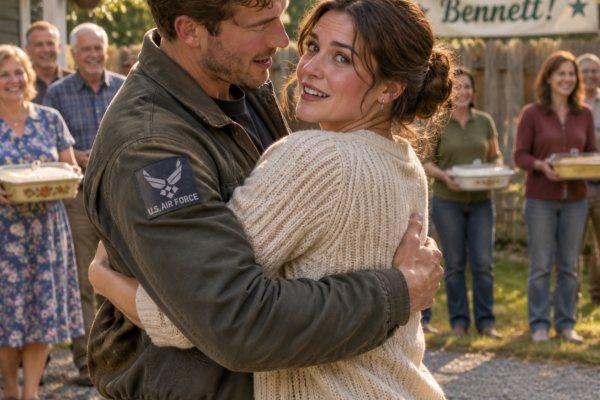
She rang me up, closed her drawer, and called toward the back office that she was clocking out, and a muffled voice answered with a good night. Lydia lifted the hinged section of the counter and shrugged into a canvas jacket, taking the bag from me as if we had done this every night of our lives. Her hand found the crook of my elbow, warm and certain, and I felt how quickly she had decided I would not argue.
We pushed through the door into the cold, and she started talking in a bright, unhurried voice about how I had taken forever to pick out crackers I buy every single night. I answered her the way I would have at the counter because it was the only voice I trusted, telling her that if she were truly my girlfriend, she would know the crackers were not indecision—they were a standing commitment. She laughed, and it sounded real, and she pressed her shoulder into mine hard enough that I nearly lost the rhythm of my own steps.
Her car was a gray Corolla at the far end of the lot under a light that had been dead for weeks. I let her set the pace—when she slowed, I slowed, and when she tipped her head to say something for show, I leaned in as though I had waited all day to hear it. Out of the corner of my eye, I saw the man push away from the pole and take one step toward us.
He never looked at me at all, only at her, and he stopped when I let my gaze meet his for exactly one second. Lydia’s arm tightened around mine without any change in her cheerful voice. At the car, she let go of me just long enough to unlock the door, and I did not touch her or the handle.
I turned so that my back was to the pole and my shoulders sat between him and her, which she had not asked for, and I felt briefly guilty for improvising on a part she had written. She noticed anyway, and her eyes flicked up to mine with a look I could not name.
– Good boyfriend, she said, loud enough to carry across the lot.
She slid into the seat and locked the doors with a click I heard from where I stood. When the window came down a few inches, the brightness had gone out of her voice.
– He’s too far to hear us now, she said. Thank you. You can stop acting.
I told her I had no questions she was obliged to answer—if she wanted to explain later, I would listen, and if she did not, I would still want my crackers. She looked at the steering wheel and back at me, and the woman who handled every awkward customer without blinking suddenly seemed unsure of her own words.
– Are you stopping in after your next shift? she asked.
It sounded nothing like her counter voice and nothing like the performance, and I could not tell which of us it belonged to. I said I stopped in every night, and she said that was what she had assumed, nodding once as she started the engine. I stood in the middle of the lot with my coffee going cold until her taillights turned onto Cleveland Avenue, and the man watched her go and then watched me until I reached my own car.
On the drive home, I replayed every word, and the only part I was sure of was that I would be back at that counter tomorrow night. What I could not settle was what I would say if Lydia leaned across the register again and asked me to be hers for another walk. I did not know whether I would be answering a part she needed played or answering her—and worse, I was not certain she knew either.
The next night, I walked in at 10 after 3, and the only thing in the parking lot besides my car was a delivery van with its hazards blinking. Lydia did not lean across the counter this time. She scanned my crackers and told me in her ordinary register voice that the man had come back around 1:30, stood by the same pole for 20 minutes, and left when a truck pulled up to the pumps.
I asked what she needed from me, and she said nothing tonight—that she was not telling me so I would go looking for him, only so I would not be surprised—and she said it quickly enough that I suspected she had rehearsed it on the slow stretch between customers. I told her I was already surprised because I had never once seen her write down a time, and she held up the receipt tape she had been scribbling on as proof that I was behind. She walked me through what she had done that afternoon before her shift.
Her manager had listened to the whole story, taped a printed description beside the register, and started a log with dates and times in Lydia’s handwriting. Nobody on the night crew was supposed to walk out alone after midnight anymore, and if the man came toward her or stayed near the building, she would call the police line posted on the sheet and keep the doors locked until someone arrived.
– A boyfriend is not a plan, Lydia said, tapping the paper with one finger.
I told her it was a good plan, and that I would be happier as a footnote in it, and she said I was a footnote with excellent snacks. I took my bag and my coffee and went out the door by myself, noticing that I looked at the pole before I looked at my own car.
On Wednesday, she told me between ringing up a man buying lottery tickets and a woman buying cat food that her manager was off Thursday and she would be closing with only the stockroom kid who left at 3:00. She asked me for another walk the way she might have assigned a task, with the date, the time, and the part I was expected to play. It was crisp and sure of itself, and I realized I was watching her hands, which were straightening the gum display for the third time.
I said yes, but I wanted her to know she could change her mind at any point, even halfway across the lot, and that if she said stop, I would stop without taking offense. She stared at me for a second and said that was not in the script. I told her I had never seen a script, only the part where she handed me an arm and a bag of crackers, and she pressed her lips together to keep from smiling.
A coworker at the airport offered that same week to swap shifts so I could clock out an hour earlier and be at her door at closing. It would have been easy and it would have made me feel useful, and I turned him down anyway. If I rearranged my life around her parking lot, I would be handing Lydia a debt she had never agreed to carry and turning a favor she asked for into a job I had given myself, so I stayed on my usual schedule and told myself that if she needed me, she would say so in words I could hear.
Thursday, the man was there again, standing at the edge of the lot with his phone lit up in his hand without looking at the screen once. Lydia checked the sheet by the register, nodded to the stockroom kid on his way out, and took my arm with the same steady grip as before. We walked at a pace that looked unhurried and covered the distance faster than it felt, and I kept my eyes on her face the whole time, the way a man does when he is genuinely interested in what his girlfriend is saying.
The man took a step off the curb and stopped, and Lydia’s thumb pressed once against the inside of my elbow—that was all the signal there was. She texted something on her phone as we reached the Corolla, and when she looked up, she said very pleasantly that the manager had already called in an update and that I could go ahead and look relieved. She unlocked the car, let go of me, and stood with the door open between us, dropping the bright voice as the man turned back toward the road.
Then she gave me an instruction, brisk as ever, that next time I should stop glancing toward the pole because I had looked like a bodyguard at a wedding. I asked whether a bodyguard-looking boyfriend was a violation of the role or only an issue of tone, and what the terms of termination were if I wanted to stop looking at poles altogether. She laughed with her head tipped back, loud and real, and the sound carried across the lot for a second before she caught herself.
The man was gone and no one was near enough to hear, which meant she had given me an instruction for a performance that did not need to continue, and I saw her realize it and not take it back. We stood there with the car door open and the cold coming in, and neither of us said what was obvious—that she had not needed the watcher to want me to stay another minute. I said good night and turned to go.
– Wait, she said.
She was holding the car door like she needed something solid, and she told me she had been wrong about 14 across in last week’s crossword and wanted to say so before I found out some other way. I said that was a lot of ceremony for a crossword, and she said she was getting to it—then asked whether I ever ate breakfast or whether I lived only on crackers and gas station coffee. I told her I ate breakfast about twice a month, usually by accident.
She said she would like to change that, somewhere that was not here, after one of our shifts, with no walk to arrange and no one to be convincing for. I said yes before I had finished deciding to. She got in the car, rolled the window down an inch, and said she would figure out where, and I drove home trying to imagine what the two of us sounded like when no one was watching.
Friday night, Lydia slid my receipt across the counter with writing on the back: Hanratty’s Diner on 4th Street, Saturday, 7:15, and under that in smaller letters, “no arm required.” I read it in the parking lot and looked at the light pole before I looked at my car, which had become a habit I did not approve of. The pole was empty.
On Saturday, I got to Hanratty’s at 10 after 7, having slept almost five hours, and I sat in my truck with the engine off before I realized the problem. There was no walk to arrange and no part to play, and I felt like a man who had shown up to an exam without finding out the subject. Her gray Corolla pulled in at exactly 7:15, and she still had her name tag clipped to her canvas jacket, looking at it when she reached the door as if it had followed her out of the store without permission.
We stopped on the sidewalk with our hands hanging at our sides like two people who had forgotten what they were for. I asked whether holding the door fell inside or outside the role, and she said it fell under basic manners and that I was allowed to have those. Then she unclipped the tag, dropped it into her pocket, and walked in ahead of me.
The hostess put us in a booth by the window, where the morning light was so bright that Lydia squinted and pulled her jacket collar up against it. She opened the menu and started giving instructions in her register voice as though we were still at the counter: I was to order the hash browns, I was not to ask for substitutions, and I was not to look at the egg section because it was a trap. I asked whether the hash browns were a recommendation or a directive, and she said directive, then a recommendation, and then she put the menu down.
– What do you eat when you eat on purpose? she asked.
It was not an instruction, and I think she heard that at the same moment I did. I answered the question exactly as she had asked it, with a full list of what I cook at home and a short explanation of why I never use the oven. She laughed at me twice, which was one more time than she usually gave me across a register, and I noticed she kept asking questions after the laughing was done.
Over coffee, she got most of my life out of me one piece at a time. I told her I spend Saturdays at a friend’s house tiling a bathroom badly because I cannot make a grout line stay straight, and about Sunday dinners with the same three college friends and the fantasy football league that has caused more arguments than any of us will admit. She listened like someone filing away details she intended to use later.
– So, you do have a life, she said.
I told her it was mostly visible in daylight. When I asked about hers, she took out her phone and showed me a spreadsheet with a single bold number at the top: she had $11,400 saved toward a deposit and first month’s rent. She had turned down two roommate offers because she wanted a place with a lock she chose herself and a window facing east.
I asked what the east window was for, and she said it would tell her what time it was without her checking, because nights at the store had made every hour look the same. She added that she did not usually tell people the number, I said I would not repeat it, and she said that was the right answer. The food came, and the hash browns were as good as she had promised.
I had been working up to the next sentence for 20 minutes, and I decided to say it while I still had my fork in my hand.
– I wanted to see you here, I said. It had nothing to do with the lot.
Lydia set down her cup and looked at me for a few seconds, and I watched her decide how much of her answer to give me.
– I’m glad, she said. I picked the booth, you know, and I’m not going to pretend I didn’t.
She said she would not call it a date just because I had been decent to her all week, because if she ever put a name on it, she wanted it to be because she had decided and not because she felt she owed me. I told her that was fair and that I could live in the unnamed category as long as breakfast came with it. She said breakfast came with it and stole a forkful of my hash browns as a down payment.
By the time the check arrived, we had not mentioned the man at the pole once. Lydia asked what I was doing on Tuesday afternoon, and when I said I was off, she said she would sleep four hours and meet me at the Franklin Park Conservatory at 2:00 because she had never been inside and had always meant to go. I wrote my number on a napkin since she had somehow never asked for it, and she typed it into her phone and called it so my pocket buzzed against my leg right there at the table.
Outside, the lot was full of weekend traffic and a delivery driver was stacking boxes onto a hand truck. Lydia reached over and took my hand—not my arm—with no pole and no one to convince. I caught myself checking the parking lot out of habit.
– I’m not looking either, she said.
Her fingers stayed in mine all the way across the asphalt, and the only thing I could tell about it was that it did not feel rehearsed. At the Corolla, she let go and unlocked the door, and when I asked whether that had been an instruction, she said it was not anything yet, got in, and started the engine while I stood there with my hand still warm.
I drove home with the napkin plan in my head and the odd feeling that Tuesday belonged only to the two of us—nobody had pushed us toward it, and nobody was watching to see if we kept it. I did not know what Lydia would reach for when I walked into the store again, with the familiar excuse right there at the register and a plain request so much harder to make. It was easy to arrange a walk for the sake of a stranger, and I was not at all sure she would choose the harder thing.
Tuesday was gray and bitterly cold, and Lydia was already inside the Franklin Park Conservatory when I got there, standing in the Palm House with her coat open and her name tag nowhere in sight. She admitted she had arrived early and circled the lot twice rather than sit in her car looking eager. We drifted through the rooms without an agenda, and she read every plaque aloud in a flat museum-guide voice until I corrected her pronunciation of a Latin name, at which point she informed me that I was not allowed to do that again.
In the desert room, with a docent and a toddler as our only company, she stopped in front of a barrel cactus the size of a beanbag chair and said she would rather tell me something than make me guess.
– I like that you answer the question I actually asked, she said, still looking at the cactus. Most people agree with me so the line keeps moving, and you never have.
I told her that was the nicest thing anyone had said about me in a room full of plants, and she said it was a very low bar. Then I did the thing I had been rehearsing in the parking garage: I said I was tiling a bathroom at my friend’s house on Saturday, that the grout lines would be crooked, and that she was welcome to come and supervise. She said yes before I finished the sentence, and I realized I had asked for something without waiting for her to assign me a part.
On Friday morning, the man was back. I saw him from the road standing by his pole at 20 to 3 with his hood up and his hands deep in his pockets. Lydia did not lean across the counter when I came in—she had the store phone against her shoulder and the log open under her elbow, reading the time and the description to someone on the non-emergency line in a low, even voice.
The second closer, a quiet woman who had started that week, locked the stockroom door from the inside and stood watching the lot over the cooler doors. I picked up crackers I did not need and waited at the end of the counter because I had learned she would tell me what she wanted when she knew. When she hung up, she said a cruiser would pass through in about four minutes and that she was not setting foot outside until it did.
– After that, she said, you can be mine for roughly 50 yards.
The cruiser rolled through the lot slowly with its window down and its spotlight idle, slowing to a crawl beside the pole. The man looked at it, looked at the store, and began to drift toward the road. Lydia waited until the taillights had cleared the pumps before she took my arm with the same sure grip as before.
I played my part and talked about grout, which was the only subject I could produce on demand. She tipped her head back and laughed at a joke that was not very good, asking me loudly whether my friend’s mother would be at the house on Saturday. I told her she would be and that I would be introduced as someone with a girlfriend who supervised, and Lydia said that sounded terrifying in exactly the voice a real girlfriend would use.
Halfway across the lot, we passed behind a box truck parked near the air pump, and the man at the road could no longer see either of us. Lydia did not let go; she kept her hand tucked in the bend of my elbow for another 30 feet, and the only difference was that she had stopped talking. I lowered my voice and asked whether she wanted me to stay beside her right now.
– Of course I do, babe, she said brightly, with her cheerful performance voice fully intact. Keep walking. He’s still looking.
He was not—I had watched the cruiser pace him to the corner and had seen him turn up the street on foot. I told her that he could not see us anymore, and her arm stiffened against mine.
– I know that, she said quieter.
We had reached the Corolla, and the dead light above it was still dead. I told her I would stay beside her for as long as she wanted, with or without anyone watching, and that I would not mind either way—the trouble was that I could no longer tell which invitation I was answering, the one meant for him or the one meant for me. I said it as gently as I could, not wanting her to think I was accusing her of anything, and she looked at the car door instead of at me for a long moment.
– I don’t have a clean answer, she said finally. That first night, it was all about him. Tonight, I told myself it was still about him. And it wasn’t only him.
She took her hand off my arm slowly, like someone setting down a glass that might spill, saying she was not good at asking for something when she had no reason to ask, so she used the reason she had. I told her that was an honest answer and that I would take it, and she let me wait until she had locked the doors before I walked away. She did not mention the parking lot again.
On Saturday morning, a little after 10:00, she turned up at my friend’s house on the east side with two coffees and a rubber grout float she had bought herself. She had worked a closing shift and slept maybe three hours, and she had driven 40 minutes without any watcher or any deadline; I never found out what she had told herself in the car. She spent the afternoon correcting my wrist angle and announcing that my crooked lines had character, while my friend’s mother brought out sandwiches and asked no questions at all.
When the last row of tile was set, Lydia wiped her hands on her jeans and stood back with her head tilted, and I caught myself thinking that this was a thing we had picked with no one to see it. She mentioned it on the porch lightly, the way she gave me every piece of practical news: her manager had ordered a floodlight to replace the dead one over the Corolla, and the new closer schedule would settle by the end of the month, so in two weeks nobody on the night crew would be walking out alone at all.
She said it plainly, and it was good news, and I said so and meant it. Driving home with a stripe of grout across my knuckles, I understood that the walk was the only thing we had ever asked each other for out loud. If it disappeared, one of us would have to ask for something with no excuse attached, and I could not tell which of us would be braver about it.
The floodlight went up on a Monday, and by Tuesday night it had turned the far end of the lot into the brightest patch of Cleveland Avenue. Lydia pointed it out through the front window before I reached the door, like a woman showing off a new car. The man had come back twice since the night of the cruiser, and both times she had stayed inside with the doors locked, reading times from the log to a dispatcher until he drifted off.
Her manager had added a line to the posted sheet saying that nobody left alone after midnight and that anyone leaving could choose who walked out with them, whether a coworker or a friend. The new closer schedule had finally settled, so Lydia would be leaving beside her three nights out of five. I stood at the counter with my crackers and listened to her describe a system that worked, glad about every piece of it.
She waited until the register was quiet before she said the rest, tearing the receipt tape into neat strips—which I had learned was what her hands did when her mouth was working up to something.
– I think the walks should stop being our plan, she said. They were supposed to get me to my car, and lately they’ve been doing a lot of other jobs.
I understood her perfectly, and I was disappointed anyway in a small, specific way I had not expected, because those 50 yards of asphalt had been the best part of my week and I had never once said so. I told her it was her call and that it was the right one, and asked whether I was being let go or only reassigned. She said I was being promoted to customer, and that it came with a standing discount on crackers she was not authorized to give.
The last one happened on Thursday, and it happened because the sheet said it could. The second closer’s ride had come early, and Lydia would not leave through the lot alone while the log was still open. She told me in her plain voice that she was asking me to be the person she chose under the new rule, and that after tonight she was done assigning me things.
The light pole at the edge of the lot was empty, and the only car near the road was a minivan with a child seat in the back. She took my arm anyway, out of habit or out of caution, and I did not ask which. We walked at an ordinary pace with no bright voice and no pet names, neither of us claiming anything for an audience that was not there.
She asked what I thought the 14 across answer would be in Sunday’s crossword, I said I had no idea, and she said she had a theory about it that would take the whole lot to explain. Under the new floodlight, her Corolla looked washed and strangely small. She stopped beside the driver’s door and slid her hand out of the crook of my elbow slowly and on purpose, holding it open for a second as if she wanted me to see she was not gripping anything.
– Thank you, she said. I’m saying it once and I’m not putting it on a tab. You don’t owe me anything for tonight, and I don’t owe you anything for the last two weeks.
I told her I had never been keeping a tab and that if I had, it would have shown the crackers were still ahead. She smiled and it faded into something more careful, and I knew she was waiting to see what I would do with the opening she had made. The cold was sharp enough that I could see my breath, and my heart was beating hard enough that I could feel it in my throat.
I had spent two days working out a version of this that sounded casual, and I could not remember a word of it.
– I want to see you when you’re not working and I’m not playing anyone, I said. That’s the whole thing. You don’t have to answer in a parking lot, and I’m not asking you to.
She did not move at first; she turned her car keys over once in her palm, doing what she always did when someone asked her a direct question—taking it seriously and refusing to rush.
– I’d like to answer it from somewhere I picked, she said. This is where I first needed you, and I don’t want that to be where I tell you what I want.
I said that was fair. She looked up at me with something close to relief, and I understood that I had given her exactly the room she had been hoping I would.
– Goodale Park, she said. Tomorrow at 4:00 by the pond, after I’ve slept. I’ll get there myself.
I said I would be there, and when she asked whether I wanted to know what she was going to say, I told her I figured she would tell me at 4:00. She laughed once quietly without making a joke about it, got into the car, and rolled the window down a few inches as she had that first night—only this time the voice that came through was the same one she used at the register, with nothing bright or borrowed in it.
– Don’t bring crackers, she said.
I told her I would think about it, and she shook her head at me through the glass and drove out onto Cleveland Avenue under a light that finally worked. I walked back across the lot alone and did not look at the pole—I looked at the floodlight instead, at my own car, and at the empty stretch of asphalt where I had spent a dozen nights being somebody’s boyfriend for 50 yards. All of it felt ordinary now, and I knew that was the point.
Tomorrow at 4:00, nobody would be watching us, and no sheet taped to a register would explain why we were standing next to each other. She had picked the place and the hour and left the answer to herself. For the first time since she leaned across the counter, I had absolutely nothing to do except show up.
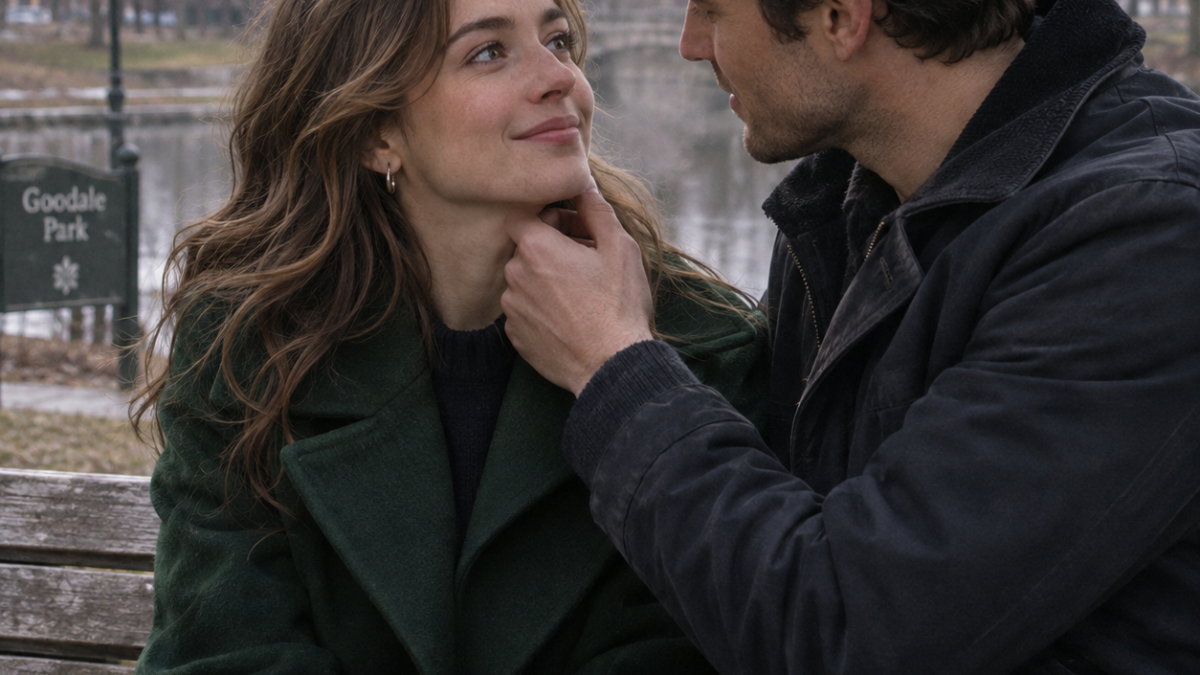
I got to Goodale Park at 10 to 4 and walked the path to the pond twice before I let myself pick a bench. The water was flat and gray, two ducks were arguing over nothing, and I had no pole to watch and no part to learn. It occurred to me that Lydia owed me nothing at all—she had said her thank-you once and refused to put it on a tab, which meant that if she did not come, I had no claim to be disappointed in anything except the weather.
I had left the crackers in my truck after a long argument with myself, and I sat with my hands in my coat pockets, trying to look like a man who had come to feed ducks. At 4:00 the path stayed empty, and at 4:06 a gray Corolla pulled up on the street. She came down the path in a green wool coat I had never seen, with no name tag and no canvas jacket, holding a sleeve of peanut butter crackers out in front of her like a ticket.
– You said you’d think about it, she said. I did the thinking for both of us.
I laughed, and she sat down on the bench with a careful foot of space between us, which was the first time I had noticed how rarely we had left any. She told me she had sat in her car for six minutes, not because she was unsure about coming, but because she wanted to be certain that when she walked down here she was carrying nothing but herself. I said I had spent those six minutes deciding whether a man could be arrested for loitering near ducks, and she said the ducks looked like they had it under control.
She tore the crackers open, did not eat one, and set the sleeve between us on the bench.
– Here’s what I want to say, and I’m going to say it badly, so don’t fix it.
She kept her eyes on the pond for the first sentence and turned to me for the second.
– I wanted you at that counter before anyone stood by a light pole. When he showed up, I told myself I picked you because you answer the question I actually ask, and that part is true. I also picked you because I wanted an excuse to put my arm through yours, and it was easier to hand you a script than to ask.
She took a breath that fogged in the cold.
– I don’t need an escort anymore, Calvin. I want to spend time with you as me, and I’d like it to be the real kind where we both know what it is. I’m asking, not assigning.
I had spent two days preparing for several versions of this, and none of them involved her saying it first and so plainly. I told her yes, and that I had wanted that since a Thursday morning when she laughed with her head back and forgot to take her instruction back. I said I wanted to be the guy she told about the bad customers, the one who got the cracker commentary, and the one whose grout she corrected—that I did not want to be useful to her, I wanted to be hers, and I preferred to be asked about it.
She was quiet for a moment.
– Good, because I’ve also made a plan, and it would be awkward to cancel, she said.
She had a viewing booked on Sunday at 10:00 for a one-bedroom on the north side with a window that faced east, and she wanted me to stand in the room and tell her honestly whether the light was as good as the listing claimed. After that, she wanted to eat at my place where I would cook something that never touched an oven. I said I would be there at 9:40, and she said 9:30 was better because I would be early anyway.
Then there was nothing left to arrange, and we both looked at the foot of bench between us. She slid the cracker sleeve into her pocket and moved the foot to six inches, and it was my turn to decide something without being told. I asked whether she wanted me to kiss her or whether she would rather do it, and she said she had not planned that part and that I should stop reading from a script she did not write.
So I kissed her slowly with my cold hand against her jaw, and she kissed me back as if she had been holding the answer in her pocket all week. When we stopped, she rested her forehead against mine for a second and said the kiss was not the answer to anything—it was only what she wanted to do next. I said that was the better reason, and she said I was catching on.
The east window turned out to be real, and by the first week of December she had a lock she chose herself. We did not talk about the parking lot much after that, yet one night a month later I stopped at the store after my shift and bought crackers I did not need. The floodlight made the lot as bright as noon, and the new closer had already left with her boyfriend.
Lydia clocked out, shrugged into the green coat, and put her bag in my hand without looking up from her keys.
– Walk me out, she said in her ordinary voice, with the register drawer closed behind her and nobody at the window. You’re mine, for the record, and I’m not whispering this time.
She took my hand and not my arm, and I answered that the record was noted. We crossed the asphalt at a pace that suited us, and it was only a short walk to a car neither of us needed to be guarded in. I used to think the best part of that night was that I noticed the man at the pole; these days, I think it was that a woman who could handle anything on her own looked at me across a counter and decided out loud to want company.
I still do not know how much of that first whisper was an act, and I have stopped needing to know because everything after it was chosen on purpose by both of us. Some part of me suspects she would have found a reason to ask me anyway, and I am happy to go on being asked.
So, here is my question for you: when the excuse that brought two people close is finally gone, what would you want the other person to say or do to prove they are staying because they want to? Tell me in the comments, and if this story kept you company through the night shift, like the video and subscribe so you don’t miss the next one.