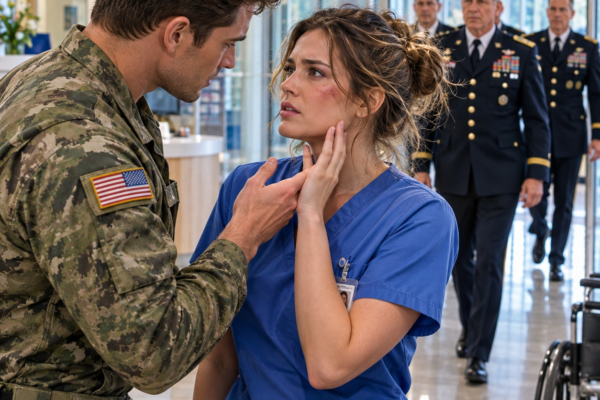
Captain Slapped a Nurse in Public — Then Her Major Rank Ended His Career in Minutes
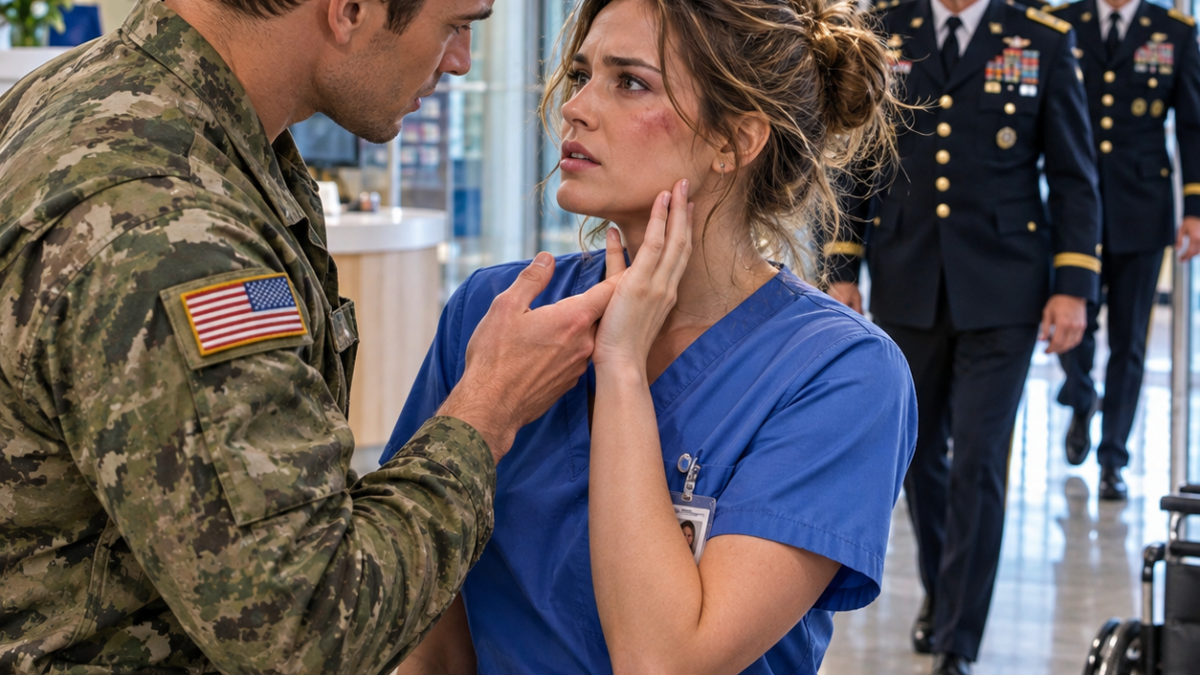
Captain Slapped a Nurse in Public — Then Her Major Rank Ended His Career in Minutes
Youre blocking the service corridor.
Move.
400 people in that cafeteria stopped eating.
The nurse looked at the cart, four feet of clear space between her and it.
She looked back at the captain.
Theres plenty of room, she said. Ill move when Im done.
His hand came across her face before anyone could breathe.
Open palm.
Hard enough that the sound carried to the back wall like something breaking. Her head snapped sideways.
Her orange juice hit the floor. Nobody moved.
Nobody spoke.
She touched the corner of her mouth, looked at the blood on her fingertips, the way a nurse looks at a chart. Then she looked straight at him.
That was a mistake, captain. She picked up her tray and walked out.
Captain Tuck Bryard laughed. Hed been untouchable in that building for four years.
11 complaints.
Not one had ever stuck. He had no idea who hed just hit or what shed spent 18 months building.
The first thing you notice about Graystone Army Medical Center at 6:00 in the morning is the smell. Coffee and antiseptic.
Always in that order.
The coffee comes from the break room on the second floor.
The antiseptic comes from everywhere else.
Together they make something that isnt quite either one.
Something that belongs only to this place, only to this hour. The overnight staff moves through the corridors in a particular kind of silence.
Not the silence of people who have nothing to say. The silence of people who have been awake too long and are saving whats left of themselves for the drive home.
Soren Vale had been on her feet since 7:00 the previous evening.
She had pulled a double shift because the staffing coordinator, a perpetually overwhelmed man named Doug Rice, had looked at her with the specific expression of someone who already knows the answer to the question theyre about to ask. Soren had said yes before he finished asking.
She always did. That was the thing about Soren Vale that most of the staff at Graystone had noticed and filed away without much further thought.
She was reliable.
She showed up when she was needed. She didnt complain about the hours or the patients or the particular brand of institutional chaos that ran through Graystone like a fault line.
The doctors liked her because she anticipated their needs. The patients liked her because she looked at them like they were people, not problems, not case numbers, people.
What nobody at Graystone thought to ask was who she had been before she walked through the front doors 18 months ago.
The resume was real.
The work history was real, but it was also in the careful language of certain government offices incomplete. At 7:10 Soren was in the cafeteria.
She had a tray, scrambled eggs she intended to eat, an orange juice container she probably wasnt going to open.
She was standing at one of the high counters along the far wall because every table was full. She had maybe 14 minutes before she needed to be back in the trauma ward for handoff.
She was reading something on her phone, not messages, not anything social, a dense block of text in a small font.
She scrolled through it with the focused attention of someone studying, not browsing. She didnt look up when Captain Tuck Breard walked into the cafeteria.
Most people looked up when Breard walked into a room. He had cultivated that effect with real precision.
He was 43, broad through the shoulders, the kind of jaw that photographs well, a haircut that was exactly within regulation and somehow still managed to look expensive.
He had been at Graystone for four years.
He ran the facilities administrative division. That meant he controlled schedules, allocations, transfers, the kind of quiet day-to-day authority that doesnt come with dramatic titles, but shapes the life of everyone who works in a building.
He also had a temper he had never learned to manage. 11 formal complaints in four years.
Not one of them had resulted in anything more serious than a brief conversation with Colonel Finn Osler, who had twice been a guest at Breards family home, who had written Briards last two performance reviews. Briard filled his coffee cup at the station near the entrance.
He stood there scanning the room the way he always did, looking for something to correct, someone out of place, some small disorder he could address loudly enough that everyone nearby would register his presence.
He found Soren, not because she was doing anything wrong. She was standing at the counter eating her eggs and reading her phone, still in her scrubs from the overnight shift.
Her dark hair pulled back. She looked tired.
She looked like someone who had been awake too long and was running on eggs and whatever energy was left at the bottom of a 12-hour shift. What she was doing by Briards assessment was standing near the service corridor where a kitchen worker needed to move a cart through to the back.
The cart was about 4 ft to Sorens left. The kitchen worker, a young man named Private Garrett, who had been at Graystone for 3 months and had learned very quickly to be invisible around Captain Briard, was standing behind it with the expression of someone calculating whether the problem in front of him was actually a problem.
Garrett had not flagged anything. The cart was not blocking anything critical.
Briard crossed the cafeteria anyway. The room registered his trajectory the way a room registers the weather changing.
Conversations dropped to a murmur.
Soldiers and staff who were mid-sentence let the sentences go. 400 people adjusted without being told to adjust.
Hey. He stopped 2 ft from Soren and used the voice he used when he wanted to establish that this was a correction, not a conversation.
Youre blocking the service corridor.
Soren looked up from her phone.
She looked at Briard, then at the cart, then at the 4 ft of clear space between her and the cart, then back at Briard.
I dont think I am.
She said, not combatively, just factually.
I didnt ask for your assessment. Move.
She looked at the cart again.
Private Garrett had gone very still. Several soldiers at the nearest tables had stopped eating.
Theres plenty of for the cart, Soren said. Ill move when Im done.
It was the wrong answer, not because it was wrong, but because Briard had issued a command and she had responded with a counter observation.
In the architecture of Briards authority that registered as defiance.
And defiance in front of 400 people was something he had never learned to absorb without escalating. Youll move now, he said and stepped closer.
Soren did not step back. What happened next took less than two seconds.
Briard raised his hand and struck her across the face, open palm, hard enough that the sound carried across the cafeteria like something breaking. Sorens head snapped sideways.
The orange juice container fell off her tray and hit the floor. For three full seconds, nobody in the cafeteria made a sound, not one person.
Soren turned her head back slowly. She touched the corner of her mouth with two fingers.
There was a small cut where her lip had caught the edge of her teeth. She looked at the blood on her fingertips with the detached focus of someone noting a clinical finding.
Then she looked at Briard. He was already stepping back, already shifting his weight into the posture of someone who has just made a decision they intend to defend rather than reconsider.
His expression said challenge me.
Sorens expression said nothing readable at all.
That was a mistake, captain, she said quietly.
She picked up her tray from the counter.
She walked out of the cafeteria through the main doors, past 400 people who were all looking at her.
Not one of whom said a word. Briard refilled his coffee cup.
Private Garrett pushed the cart through the corridor that was now completely clear and did not look back.
The cafeteria started breathing again after she was gone, slowly, the way a room does when something has happened that people dont yet have language for.
Now, before we go any further with what happened next, I want to stop here for a moment because what just happened in that cafeteria, most people who saw it that morning would say it was about a nurse who didnt move fast enough for a captain who wanted her to move. But thats not what it was about.
It was about what happens when someone with unchecked power has operated in a building long enough to believe that nothing they do will ever have consequences. what happens when they are wrong about that, profoundly, irreversibly wrong.
The story that moved through Graystone for the rest of that morning was not complicated, but it was fast.
By 9:00, everyone in the trauma ward had heard a version of it.
By 10:00, the version had reached the administrative wing and the surgical suites.
By 11:30, it had been discussed in every break room on every floor. The through line across all versions was the same.
Briard had hit a nurse in the cafeteria in front of the entire morning shift, and she had walked out without a word.
The reaction split along predictable lines. The junior staff reacted with something between horror and a grim, unsurprised recognition because this was not for them shocking.
This was a more visible, more public version of something that had been happening in smaller rooms for years. The senior staff reacted differently.
Several of them went to find out what had happened from Briards perspective because that was the institutions gravity. It pulled toward rank, toward established authority, toward the version of events that made the least work for people who didnt want to do the work of accountability.
Briards version circulated through the morning via the officers who had his ear. He had addressed a staff member who was creating a safety obstruction.
The staff member had been insubordinate. The incident was being handled through proper channels.
What handled meant specifically was that a formal complaint against Soren Vale for failure to comply with a direct command was being filed that morning. She would likely be suspended pending an internal review.
This was how Briard had handled the previous 11 complaints against him by generating paperwork in the opposite direction before anyone else could generate paperwork in his direction.
It had worked 11 times. He didnt know that this time the paperwork had already been filed in a different office, in a different building, 18 months ago, before Soren Vale ever walked into Greystone Army Medical Center.
we get to what happened in the administrative wing, I want you to understand something about this place, about what had been building here for four years before that morning in the cafeteria, because Briards 11 complaints were not secret.
People who worked at Greystone knew they existed. What they didnt know was that every single one of those complaints had been reviewed and dismissed within the same administrative structure that Briard operated in, overseen by Colonel Fenn Ossler, who had been Briards commanding officer for three of those four years.
What nobody at Greystone had been told was that those same 11 complaints had also been reviewed by a different office, in a different chain of command, and the review had generated a report, and the report had generated a decision, and the decision had been implemented 18 months ago when a woman named Soren Vale submitted a resume for a nursing position at Greystone.
But heres what matters more than any of that.
Heres the part that gets lost in the paperwork and the proceedings and the formal language of institutional accountability. There were real people in this building who had been hurt, not in dramatic ways that make headlines, in quiet, grinding, accumulative ways that are much harder to see and much harder to prove.
Ren Obi had worked at Greystone for six years.
She was a solid nurse, methodical, the kind of person who noticed everything and said very little, the kind of person whose patients always knew their medication schedules and whose handoff notes were never missing a detail. Eight months before that morning in the cafeteria, Ren had raised a concern in a staff meeting, a staffing concern, nothing inflammatory, just an observation delivered carefully about a pattern she had noticed in how overnight shifts were being distributed.
Briard had been in that meeting.
In the four months before that meeting, Ren had worked six weekend In the four months after, she had worked 19.
Nobody told her why.
Nobody explained the change. She just started finding herself scheduled for Saturday mornings and Sunday evenings and holiday coverage in a way that made her personal life quietly, steadily smaller.
She didnt file a complaint.
She had seen what happened to the people who filed complaints.
Flynn Dace had filed a complaint 14 months before the cafeteria.
She had witnessed something specific in the East corridor, an incident involving Briard and a junior medical officer. She had written it down carefully.
She had submitted it through the facilities inspector general office. Three days later, she received a response.
The complaint had been reviewed and found without basis. She had not been interviewed, not once.
Not a single person from the review process had spoken with her.
She had applied for a transfer six months later. It was denied.
So she stayed.
She came in every morning and did her job and tried not to think too much about the fact that she had told the truth and the truth had been filed away somewhere and nothing had come of it.
Six other staff members had filed complaints against Briard in the previous four years. Each of them had been transferred out of the facility within 90 days.
In five of those cases, their performance evaluations had dropped in the cycle immediately following their complaint, despite no documented clinical incidents.
The reviews had all been co-signed by Osler. And then there was Sergeant Ru Tamsin, nine years at Greystone.
He ran the logistics desk in the East Wing. He had the institutional knowledge of someone who had watched three different facility commanders rotate through and had developed over time a reliable read on whether a given day at Greystone was routine or not.
He had noticed things for years, small things, a pattern in who got transferred, a pattern in whose schedules changed after certain meetings, a pattern in which complaints seemed to disappear into the administrative wing and never come out the other He had no language for what he was seeing.
He had no framework to put around it.
What he had was the quiet, persistent knowledge that something in this building was wrong.
And the equally quiet, persistent knowledge that saying so out loud would cost him something he couldnt afford to lose. So he stayed at his logistics desk.
He did his job.
He watched. And on the morning that Tuck Briard hit Soren Vale in the cafeteria, Rue Tamson was one of the 400 people who saw it happen.
He didnt move. He didnt speak.
He stood very still the way the whole room stood still.
But something shifted in him that morning. Some internal accounting that had been running in the background for nine years finally arrived at a number.
Back to Soren.
She spent the next two hours in the trauma ward finishing her handoff notes, making sure the three patients she was transferring to the day shift were properly documented, making sure the day nurse understood every detail. She did this while the left side of her face held a bruise that was already beginning to deepen.
She did this without mentioning the cafeteria to anyone. Ren Obi noticed.
Ren was the kind of person who noticed everything.
She looked at the bruise. She looked at Sorens face.
She said, You should put ice on that.
I will, Soren said. Are you filing a report?
Soren looked at her with an expression that was difficult to read. Something is already in motion, she said.
Dont worry about it.
Ren looked at her for a moment the way people look at someone when theyve said something that seems to mean more than what it means on the surface. Then she looked down at the chart she was holding and didnt ask another question.
At 9:30, Soren went to the nursing break room on the second floor.
She took ice from the small freezer, wrapped it in a paper towel, held it against her face. Then she made a phone call.
Four minutes. Low, even voice, she said, It happened this morning.
Then, Yes, thats on the record.
Then, I understand. Ill be available.
She ended the call, put the ice back in the freezer, went back to work.
At 10:00, Captain Briard appeared in the trauma ward doorway with Holt Garver, who handled personnel matters for the administrative division and a printed form that Soren recognized as a suspension notice before hed said a word. Sinclair.
He used the wrong name first, corrected himself. Vael.
His voice was the carefully modulated version he used when he was performing authority rather than just exercising it.
There were four other people in the trauma ward who could hear this conversation and he knew it. Youre to report to administrative processing at 11:30 for exit paperwork.
Youve been suspended in conduct review. Soren was writing in a chart.
She finished the sentence she was writing before she looked up.
Youre serving a suspension notice in a patient care area, she said. Im informing you of a personnel action.
Theres a patient in bay four who is 12 hours post-op from an abdominal repair. He needs observation every 90 minutes.
Thats not your concern anymore. Soren set her pen down on the nursing station counter.
She looked at Garver, not at Briard. Mr.Garver, she said, please make sure bay four is properly staffed before this transition is completed.
Thats a patient safety issue, not a personnel issue.
Garver looked uncomfortable. He glanced at Briard.
Briard said 11:30.
Soren picked the pen back up.
Ill be there.
She finished her chart notes. She briefed Ren Obi about bay four again specifically.
She showed Ren the last set of vitals and explained why one of the numbers was sitting at the edge of the acceptable range rather than comfortably inside it. She did this with the thoroughness of someone who understood that thoroughness was the only thing standing between that patient and a problem that would be much worse than anything happening in the administrative wing.
Then she went to the locker room, changed out of her scrubs, collected the small bag she kept in her locker, walked to the administrative wing, sat down in the waiting area outside the processing office and waited. She took out her phone and resumed reading the dense block of text she had been reading in the cafeteria.
She wasnt reading nursing journals. Administrative processing at Graystone was in a beige-walled suite on the ground floor of the main building.
rooms connected by an internal corridor that always smelled of recycled air. Garver sat across from Soren at a table, laid out three forms, a suspension action, a formal complaint, an exit procedure checklist.
This isnt permanent, Garver said.
He had the look of a man delivering a message he had been instructed to deliver and doesnt personally believe.
Its pending review. Youll be notified of the timeline.
Whats the basis for the formal complaint? Soren asked.
Garver shuffled the papers.
Insubordination, failure to comply with a direct command, creating a workplace obstruction.
Soren read the complaint form. She read it the way she read chart notes without rushing.
Then she set it back on the table. Id like to note for the record, she said, that Captain Briard physically struck me in the cafeteria this morning in front of approximately 400 personnel.
Thats an assault on a medical staff member.
I want that documented as part of this proceeding. Garver paused.
The captains report indicates Im not asking about the captains report. Im asking whether my statement regarding the assault is being entered into the record.
A long pause. Garver wrote something in the margin of the form.
It will be noted, he said. Thank you.
Soren signed the forms where indicated, received her copy, placed it carefully in the bag she carried. Is there anything else?
Youll need to surrender your facility access badge.
She unclipped it from her collar, set it on the table. She stood, picked up her bag, looked at Garver one more time.
The patient in bay four of the trauma ward, she said, his name is Dale Pruitt. Hes 22 years old.
Please make sure someone is assigned to him. Garver said he would look into it in the tone of a man who hoped that was the last thing hed have to look into for a while.
Soren walked out through the main entrance of Graystone Army Medical Center. She stood in the parking lot for a moment in the October light.
The bruise on her jaw was beginning to settle into something deeper. She looked at the building.
She looked at the security cameras mounted above the main entrance. Two of them, both angled to capture foot traffic in and out.
She put on her jacket, walked to her car. And if anyone was watching from inside, they would have seen a nurse who had been suspended driving away from the facility shed been expelled from.
What they would not have seen was the phone call she made before she even reached the parking lot exit.
What they would not have known was who answered.
There is a hotel 3 miles from Graystone Army Medical Center. It looks like every other mid-range hotel along that stretch of highway.
Beige exterior, a lobby with chairs that are almost comfortable, a breakfast area that closes at 10:00.
Room 214 was not a standard room that night.
The furniture had been rearranged.
The desk pushed against the far wall. A second table brought in from somewhere, positioned parallel to the first.
Two laptops open. A printer that had been running since the previous afternoon.
Inspector Cleary Run stood at the head of the table.
She was in her 50s, compact, direct. The kind of person who is accustomed to being the most significant person in a room without needing the room to know it.
She had been waiting for this phone call for 18 months.
Not this specific call, not this specific morning, but this type of call. The call that would tell her the timeline had accelerated.
The call that would tell her the final piece had landed.
She listened. Then she said, get here when you can.
Soren arrived at the hotel 40 minutes after leaving Graystone.
She had stopped once for coffee because she had been awake for 24 hours and the next several days were going to require everything she had.
She walked into room 214 and set her bag in the corner and stood at the table.
Three other people were in the room. Two investigators she had worked with for the previous 18 months.
And Inspector Run, nobody spoke immediately.
Then Run placed three photographs on the table. The first photograph had been taken in the cafeteria that morning.
The angle was from the upper left corner of the room.
A security camera position that nobody in that building, nobody who ate breakfast there every morning and moved through those corridors every day, had ever thought to consider. The photograph captured the moment with the kind of clarity that well-funded military facilities produce when their systems are functioning correctly.
Briards hand was raised.
Sorens head was already moving.
The body language of 400 people in the surrounding frame was identifiable, frozen, staring, not one of them intervening.
The second photograph was a personnel file cover sheet with a classification marker in the upper right corner. The third photograph was Soren, not the nurse in scrubs, not the woman who had just been suspended from a facility shed worked in for 18 months.
This was a different photograph, taken in a different context entirely.
She was in uniform, full service dress.
The rank insignia on her collar read Major. Run looked at the team.
Major Soren Vale, she said, Institutional Conduct Review Division.
18 months of documentation, 412 individual incidents, 47 witness statements, 11 previously filed complaints cross-referenced with every response and every review record generated by this facility. She picked up the third photograph.
Shes been inside for 18 months, and as of this morning, we have everything we need.
She set the photograph back down. We move at 0800.
One of the investigators asked, What about the suspension?
Briard counter filing. Run almost smiled.
That suspension notice, she said, is the 358th item in a 412 item file. It is also, as of this morning, documented as the incident that preceded the final authorization for this investigation to proceed to formal findings.
She looked at Soren.
He suspended you to protect himself. He didnt know that protecting himself was the last thing he needed to do.
The room was quiet for a moment.
Soren sat down.
She was tired in a way that was past ordinary tiredness. The kind of tired that comes from carrying something for a long time and not putting it down.
She looked at the photographs on the table.
She thought about Ren Obi working 19 weekend shifts without being told why.
She thought about Flynn Dace sitting with a response letter that said her complaint had no basis. She thought about Ru Tamsin standing at his logistics desk for nine years watching something he couldnt name.
She thought about Dale Pruitt in Bay Four, 22 years old, 12 hours post op. She thought about the moment in the cafeteria when she had looked at the blood on her fingertips.
She had prepared for that moment.
She had known in some operational sense that a moment like it would come, that a man like Briard, under enough pressure, would eventually do something visible enough to become the final entry in a file that had been building for 18 months. But preparation is not the same as feeling nothing.
The bruise on her jaw hurt. It had been hurting since the cafeteria.
She had been not thinking about it for three hours. She thought about it now for exactly four seconds.
Then she picked up her notepad and her pen and looked at Inspector Run. Walk me through the morning schedule, she said, because there was work to do and the work was not finished.
It was, in fact, only just beginning.
Thats what nobody on the outside ever fully understands about investigations like this one, about the kind of work that Soren Vale had been doing for the past 18 months inside a building that didnt know she was there. The work is not dramatic, not most of it.
The work is showing up every day for 18 months in a building where people are being hurt in quiet ways and documenting what you see and not intervening, because intervention without documentation doesnt fix anything. It just moves the problem somewhere else.
The work is being the person who hears what nobody else is hearing. Not because youre special, not because youre heroic, but because you were placed there specifically to hear it.
Because someone somewhere reviewed 11 complaint files and looked at the pattern those files created and decided that pattern was not a coincidence. It was a system.
And systems dont get disrupted by individual acts of courage.
They get disrupted by evidence.
Soren Vale was evidence. Everything she had seen and heard and carefully written down over 18 months was evidence.
And tomorrow morning at 0800 that evidence was going to walk back through the front doors of Graystone Army Medical Center. Not as a nurse, as a major.
And everything in that building was about to change.
The morning of the second day started the way most mornings at Graystone started. The 6 oclock shift change happened normally on the surface.
Coffee was made, handoffs occurred.
The overnight staff moved toward the exit with the particular exhaustion of people whose bodies have been awake longer than their minds wanted.
But there were differences.
Small ones, the kind you feel before you can name them.
Captain Tuck Briard was not in his office. He was always in his office by 6:30.
Everyone who had worked at Graystone for more than three months knew this.
His office light was off, his door was closed. His assistant, a young corporal named Metz, was sitting at the desk outside that closed door with the expression of someone who has arrived at work and found that the ground has shifted slightly under their feet.
Colonel Fen Ossler had not sent his morning directive email.
It went out every single day without fail at 6:45. It had gone out every day for the three years Ossler had been at Graystone.
It did not go out that morning. Two members of the administrative division were absent without explanation.
Rutan Singh noticed all of this. He noticed it the way he noticed most things at Graystone.
From his logistics desk in the East Wing, with the patient accumulated attention of someone who has spent nine years learning to read this particular building the way other people read weather. He sat very still for a moment.
Then he called his counterpart in the medical wing.
Have you noticed anything strange today?
He said. A pause on the other end.
Then defined strange.
Things not happening that should be happening.
Another pause. I have.
What do you know? Nothing, Ru said.
Thats the point.
At 8:00 exactly, two people walk through the main entrance of Greystone Army Medical Center.
They wore standard uniforms. No insignia that marked them as affiliated with Greystone or its parent command structure.
They showed credentials to the security desk. The duty officer stood up straighter than he normally stood.
They asked to speak with the facilities chief administrator. They were escorted to the second floor without delay.
Inspector Clea Run walked through the front doors of Greystone Army Medical Center at 8:03. She had been here before, twice.
Both times as part of the preliminary groundwork for this investigation.
Both times under a cover that gave her access to the facilities administrative records without raising any flags in Briards direction. This time there was no cover.
This time she walked in as exactly who she was. Soren was with her.
Not in scrubs.
Not with a nursing badge. She was wearing civilian clothes over a composure that had been building for 18 months toward exactly this moment.
The bruise on her jaw had deepened overnight into something unmistakable, blue purple.
The color of a decision someone else had made that was now permanently part of the record. The staff in the lobby looked at her.
Some of them had heard about the cafeteria.
Most of them had. They looked at her face and then quickly looked away because there are some things that are too direct to hold for long.
Soren did not look away from any of them. She walked through the lobby with Run and the two investigators and she took the elevator to the second floor and she sat down at the conference table in the room that had been arranged for this purpose and she put her notepad in front of her, and she was ready.
The meeting that followed lasted four hours, and by the end of those four hours, Tuck Briard understood that the world he had been operating in for four years no longer existed. Run opened the folder the way someone opens a folder when they dont need to look at whats inside it.
Not for reference, for punctuation.
The small pause before something is said that changes the shape of a room.
She placed three photographs on the table.
Briard looked at them. The first photograph he recognized immediately, the cafeteria that morning.
The angle from the upper left corner that he had never once in four years considered. His hand was raised.
Sorens head was already moving. 400 people visible in the frame, every one of them frozen.
The second photograph was a personnel file cover sheet with a classification marker he had to read twice.
The third was Soren, not the nurse he had watched walk out of the cafeteria. A different photograph entirely.
She was in uniform, full service dress.
The rank on her collar made something happen behind Briards eyes.
A rapid internal recalculation that he was not fast enough to hide. Take as long as you need, Run said.
Briard put the third photograph down.
He looked at the wall above Runs head because he needed a surface that wasnt going to tell him something else about his situation.
Beside him, Ossler had not moved since the meeting began.
He was looking at his hands on the table with the concentrated attention of someone who has decided that stillness is the safest available behavior. Were going to go through several things, Run said.
First, Ill tell you who is in this room and why.
Then well discuss what has been documented over the past 18 months. Then well discuss what happens next.
She looked at Briard. Do you understand the structure of this meeting?
Yes, Briard said. His voice came out correctly.
That surprised him. Run turned towards Soren, who had taken a chair at the far end of the table and was writing in a notepad with the compact, fast handwriting of someone who records things for a living.
You know Nurse Vael, Ron said.
Or rather you know the version of her that has been present at this facility for the past 18 months. Her full name is Soren Vael.
Her rank is Major. She is assigned to the Institutional Conduct Review Division of the Military Medical Oversight Command, which operates independently of the standard facility chain of command.
She paused.
She was placed here to observe and document this facilitys internal conduct practices. Her deployment began following a consolidated review of complaint records originating from Greystone over a four-year period.
The room was very quiet. The ventilation system hummed in a way it usually didnt.
Breard said, shes been here for 18 months.
Yes, as an investigator. As an investigator conducting authorized oversight.
The distinction matters legally, but yes. He looked at Soren.
She was still writing. This morning Breard said and stopped.
This morning you physically assaulted her in front of approximately 400 personnel.
Ron said, yes. Well come back to that.
It goes into the file as both a conduct violation and an assault on a commissioned officer.
But before we get there, I want you to understand the scope of what this investigation has documented. She reached into the folder and produced a document that was dense enough that Breard registered it immediately as a report.
Not a memo, a report. She laid it on the table between them.
18 months of documented observations, she said. 412 individual incidents.
11 previously filed complaints cross-referenced with your responses and the review records generated by this facility. Witness statements from 47 current and former staff members.
She let that sit.
What we have, she said, is not an argument.
Its a record.
And then she went through it methodically, without hurry, with the particular patience of someone who understands that thoroughness is not cruelty, its necessity. The 11 complaints first.
Breard knew those. He had been in the room for each resolution, had participated in the framing of each counternarrative.
What he hadnt known was that each resolution had been documented not just in the facilitys own system, but in a secondary record maintained by Sorens oversight command, complete with timestamps showing how quickly each complaint had been routed to Oslers office and how quickly each investigation had been closed without the person who filed it being interviewed even once. Not a single complainant had been interviewed in 11 cases across four years.
Run placed a chart on the table.
It tracked shift assignments for the nursing staff over a 30-month period.
There were three nurses whose schedules had been consistently restructured after specific dates, dates that correlated exactly with moments when those nurses had raised concerns, not even formal complaints, concerns in staff meetings that Briard had attended.
This is Nurse Obi, Run said, pointing to one of the lines.
 [Tap here for the Next Part ]