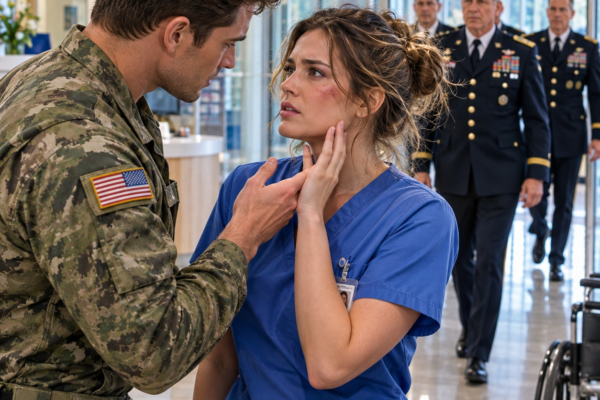
Part 3: Captain Slapped a Nurse in Public — Then Her Major Rank Ended His Career in Minutes
If youd prefer to leave, Id ask you to provide a current contact number and address so we can reach you quickly if needed. He understood what that meant.
Leaving voluntarily meant being traceable the moment he walked out.
Staying voluntarily meant he still had some control over the framing of his presence here.
Neither option was good. One was slightly less bad than the other.
Ill wait, he said.
Thank you, Soren said and opened the door.
Upstairs, Run had spent the 40 minutes of Soren absence on the phone.
She was still on a call when Soren came back in.
One finger raised. Soren sat down and waited and read back through Finchs visitor log entry from 6 days ago while she waited.
When Run ended the call, she sat down across from Soren and put her hands flat on the table in the way she did when what she was about to say needed to be delivered carefully.
We ran a preliminary trace on Briards personal carrier account, she said. Emergency access authorization.
Given the circumstances, it went through in 40 minutes.
Soren waited.
He received a call two nights ago, 11 oclock, 9 from a number that traces to a prepaid phone purchased eight weeks ago. Someone was in contact with him before the cafeteria, Soren said.
theres more.
looked at the table for a moment before continuing. also received a call yesterday morning, 7:48 while we were in the building.
the review was in progress?
the prepaid number?
No, from a number registered to an active officer at the parent command level. Soren heard it land.
She heard what it meant. An active officer called Breard while we were conducting our review, she said.
Yes, that officer knew we were here.
And as of this morning, that officer submitted a leave request yesterday afternoon and has not reported to their duty station. Soren looked at the window, not at anything visible through the glass, just at the surface of it.
The way you look at something when you need a moment to let a new piece of information find its place in what you already know.
Breard had help from inside the system, she said.
It appears so, which means this case is not contained to Greystone. No, Run said, its not.
They sat with that for a moment, not because either of them needed time to understand it, but because some things deserve a moment before you move to the next action.
Finchs lawyer arrived at 3:30. Her name was Harland.
She was compact and efficient and had the particular manner of an attorney who has done this specific kind of work long enough that the choreography of it is completely internal. She spent 20 minutes with Finch before emerging to find Soren in the corridor outside.
My client is willing to provide a voluntary statement, Harland said, limited in scope.
Hes willing to confirm the nature of his professional relationship with Captain Breard and the purpose of todays visit. Whats the limitation?
Hes not going to discuss the content of any communications with third parties without a formal process and a clear immunity framework. Soren thought about the prepaid phone purchased eight weeks ago.
She thought about the officer who had not reported to their duty station. She thought about the architecture of a protection network that had apparently been built around Briard for months before the cafeteria.
I want the statement, she said.
The statement Finch gave was four pages, dictated to Harland, signed at the bottom of each page.
It confirmed that he had served as an informal consultant to Briard over the previous eight months on matters relating to administrative procedures and complaint management within military medical facilities.
It confirmed that todays visit had been arranged in response to Briard, informing him that the facility was undergoing an oversight review.
It said Finch had concerns about the scope and methodology of that review and had come to discuss those concerns with Ossler. It did not name anyone other than Briard and Ossler, but on the fourth page in the second to last paragraph, there was a sentence.
Soren read it three times. It said, my involvement with this matter began following a referral from a senior member of the oversight board under which Major Vales division operates.
She looked up from the document. Harland was watching her with the measured expression of someone who has delivered a piece of information and is now observing where it lands.
A senior member of the oversight board, Soren said.
Thats what the statement says.
Hes saying someone inside my chain of command referred him to Briard.
Hes saying what the statement says, Harland said.
Nothing more and nothing less.
Soren set the document down on the table with the deliberateness of someone who needs both hands free to think clearly.
Someone inside her oversight structure had connected Finch to Briard, someone who knew the review was coming, who understood the authorization process and the timelines and the gaps where influence could be applied without leaving obvious marks, someone who had been close enough to the oversight process, long enough to understand exactly how it could be slowed from the inside. She took the statement upstairs, run read it standing.
She read it twice. The second time her eyes slowed on the fourth page.
Someone in the board structure knew about this review before it was authorized, Run said.
Could have tipped Briard, connected Finch, provided institutional cover from above while we were building the case from below. If the board itself has a compromised member, Soren said, then everything weve built here needs to be reported above the board immediately before any of it can be challenged on the basis of a compromised oversight structure.
Run was already reaching for her phone. The call she made was not one she had made before in this investigation.
The number connected to an office that sat above both her division and Sorens.
The correct escalation point for an investigation that had developed an integrity question inside its own chain of oversight.
She explained the situation in six minutes. The call lasted nine.
When it ended, she stood with the phone at her side for a moment.
Then she turned.
Theyre sending someone tonight. Three to four hours.
Theyre in DC. Soren looked at the time.
4:10 in the afternoon. Keep Finch in the building, she said.
His lawyer will push back.
We have the statement.
Thats grounds for a material witness hold while we verify the referral claim.
File it. The hold was filed at 4:30.
Harland objected in the manner lawyers object when they know the objection wont succeed but are professionally required to make it. Finch was informed that he would be held as a material witness until the incoming team had spoken with him.
He absorbed this with the stillness he had maintained since the parking lot, but the stillness had changed. It required more of him now.
The difference between a man who is managing a situation and a man who is managing how he appears while the situation moves past him. At 5:00, Soren went back to the ground floor meeting room.
Harland had stepped out to make her own calls.
Finch was alone at the table with a cup of coffee that had gone cold. Soren sat across from him.
You gave us something in the statement, she said. I want you to know were taking it seriously.
Finch looked at her. The afternoon had done specific things his face.
The lines in it were more pronounced.
His posture was still correct, but it cost him something now that it hadnt cost him in the parking lot. I gave you what I gave you, he said.
Someone inside the board referred you to Briard, Soren said.
That person knew about this review.
They knew enough about the process to understand how to slow it down. She didnt lean forward.
She didnt need to.
You didnt come to this building today because Briard asked you to. Briard left last night.
You came because someone else told you to. The same person who told Briard to leave.
Finch said nothing.
When we identify who that person is, Soren said, and we will identify them tonight, what youre holding on to right now will matter considerably less than it seems to matter in this moment. The buildings ventilation ran steadily, a sound that had been present in every room of this investigation and would continue long after everyone in this one had gone home.
I have a statement, Finch said.
Anything beyond that goes through council. Soren stood.
She was at the door when he spoke again. I want you to understand something.
She turned. He was looking at the table, not at her.
His voice had lost the performance of ease he had been maintaining since the parking lot.
I was told this was a process issue, he said, an oversight review that had exceeded its mandate. I was told the people running it had a personal stake in the outcome.
He stopped. I was told you had a personal stake in the outcome.
Soren looked at him steadily.
Who told you that?
She said. He didnt answer, but he had said it, and they both understood what it meant.
Someone had constructed a story about this investigation, about Soren, about the review and what it was for and who was driving it and why, a story built specifically to make Finchs involvement seem not just reasonable but justified, necessary even. He had been recruited into a protection network by someone who understood that people like Finch needed to believe they were on the right side of something.
He had been used, not innocently.
He had made choices.
He had traded on relationships and made calls and driven to a military medical facility to manage a situation that was not his to manage.
Those choices had consequences that were his to carry, but he had also been given a false map and asked to navigate by it. I told you the wrong story, didnt I?
He said.
Not remorse exactly, something more honest than remorse.
The specific recognition of a man who has just understood that the ground he thought he was standing on was someone elses construction.
Yes, Soren said.
She went back upstairs. At 7:00 that evening, Briard was located a private residence 38 miles from Graystone.
The property was registered to a man named Garrett Archer. Background assembled in 40 minutes by the investigation team showed Archer and Finch appearing in the same social contexts over 15 years, shared membership in two professional organizations, photographed together at a private event three years prior.
Two MPs and a federal investigator who had arrived ahead of the main DC team made contact at the residence at 7:12. Briard was at the kitchen table of someone elses house.
When the front door opened, he did not stand. He did not reach for anything.
He sat and looked at the people who had come through the door and ran the calculation he had been running his entire professional life.
Variables in, assessment out, decision made.
This time the variables arranged themselves the same way regardless of which direction he worked the problem.
He asked for counsel. He was told counsel would be arranged.
He was told he was being returned to Graystone. He asked one question, is Finch in the building?
The investigator said yes.
Something crossed Briards face that was not relief and not resignation. It was the expression of a man realizing that the person he believed was managing the situation on his behalf had been sitting in the same building as his investigation for the past several hours.
That the network of protection he had trusted was not what he had understood it to be.
He stood, straightened his jacket, went the investigators without saying anything further. He arrived at Graystone at 8:08.
The facility was not running its normal evening atmosphere. The MPs at the entrance were the same ones who had been there since morning.
The lights on the second and third floors were all on.
Two staff members finishing late were in the lobby when Briard came through the main doors.
They stopped.
They went still.
It was the same stillness as the cafeteria three mornings ago, but the quality of it was different.
In the cafeteria, the stillness had been shock. The stillness of people who have just seen something they didnt expect and dont yet have language for.
This stillness was recognition. They knew who this man was and what he had done, and they knew what his being walked through that lobby under escort meant.
They didnt need language for it.
It was already written in the record. Soren received the notification on the third floor.
She stood from the table.
She looked at Ron.
Hes here, she said.
You dont need to be in the room for the processing, Ron said. I know.
She went downstairs anyway, not to the processing room, to the corridor outside it.
She stood there and she waited.
When Briard was walked past under escort, he was 3 ft from her and he saw her and he slowed for a moment before the escorts movement carried him forward.
In those two seconds, he looked at her. The bruise on her jaw had gone through its third full day.
It was darker now, the deep blue purple of serious tissue damage that has committed to the process of healing, but has not yet arrived at the other side of it.
It was painful in the specific way that injuries are painful at the end of a long day when the body runs out of the energy it has been using to compensate and simply reports what is true. Briard looked at it.
His face moved past the versions she had seen before, past the performed authority and the contempt and the rapid tactical calculation.
It arrived somewhere underneath all of that, something she hadnt seen on him before, something that was smaller and quieter than anything he had shown in 4 years in this building. She had thought about this moment.
She had wondered what she would feel when it came. What she felt was not satisfaction.
It was closer to the particular weariness that comes from understanding something fully.
The man in front of her had spent four years choosing himself over the people around him every single time the choice appeared. Not in dramatic moments.
In small daily decisions. In whose complaint got routed where.
In whose schedule was changed after which meeting. In whose performance evaluation reflected what actually happened and whose reflected something more convenient.
Thousands of small decisions accumulating into a system that taught the people inside it that speaking the truth was a mistake they would pay for. He was not a monster.
That would have been easier. He was a man who had learned very early that institutions reward people who protect the institution.
Who had refined that lesson over 20 years until protecting himself and protecting the institution had become indistinguishable in his mind.
Who had convinced himself, probably genuinely, that the people who filed complaints against him were problems to be managed rather than voices to be heard.
People dont usually build systems of harm because they enjoy harm.
They build them because the system makes it easy and the alternatives seem expensive. Understanding that didnt change what he had done.
It didnt reduce what the people he had harmed had experienced.
But it was the truth of what she had spent 18 months looking at. And she had learned over a long time that the truth is always worth looking at directly even when its complicated.
She didnt say anything. He didnt either.
The escort moved him forward. She stood in the corridor until the sound of footsteps had gone around the corner and the hallway was quiet again.
Then she went back upstairs.
Sergeant Roo Tamsin submitted his formal witness statement on the fourth day of the investigation.
Nobody had asked him to. He had shown up at the working room on the third floor at 8:00 in the morning and told the investigator at the door that he had nine years of observations he wanted on the record and asked for the right form to put them on.
He sat at the corner of the table and wrote for two hours, not because his handwriting was slow, because he was being careful, dating things where he could remember the dates, noting where the dates were approximate and why, being specific about what he had directly observed versus what he had inferred from what he observed, making the distinction clearly so that nobody reading it could question whether he knew the difference. When he finished, he had nine pages.
He handed them to one of Runs investigators without comment. The investigator read the first page and then looked up.
How long have you been keeping track of this?
Ruth thought about it honestly. Since I understood what I was looking at, he said.
About four years. Did you ever consider filing a formal complaint yourself?
He was quiet for a moment, not because the question was difficult, because the answer was complicated and he wanted to give it accurately. I thought about it, he said.
I decided it wouldnt go anywhere. A pause.
Id watched 11 complaints go nowhere. I didnt see a reason to believe the 12th would be different.
The investigator nodded, not in judgment, in the acknowledgment of someone who has heard this specific answer many times and understands exactly what it costs a person to say it.
It went somewhere, the investigator said.
Ruth picked up his cap from the table. He turned it in his hands once.
I know, he said.
Thats why Im here. He went back to his logistics desk in the East Wing.
He had work to do.
He always had work to do.
That hadnt changed.
What had changed was something harder to name.
For nine years he had been watching a building that didnt know it was being watched, cataloging things that had no official place to go, carrying the weight of an observation that had no frame around it and no destination and no guarantee that it meant what he thought it meant. He had carried that weight because he didnt know what else to do with it and because setting it down had never felt like a real option.
Now the weight had a destination.
And Ruth Thompson sat at his logistics desk in the east wing and did his work. And when he looked up at the corridor, the looking had a different quality than it had ever had before.
At 8:45 that evening, three people walked through the main entrance of Graystone Army Medical Center.
Agent Miriam Sayers led them. She carried a briefcase that contained, among other things, authorization for access to the oversight boards own internal communication systems.
A level of access that neither Run nor Soren held.
The kind of authorization that requires sign off from people who do not appear on organizational charts that are visible to most of the people inside the organization. Sayers sat down at the table without ceremony.
She looked at the document boxes. She looked at the laptops.
She looked at Soren with the direct evaluating attention of someone who needs to assess quickly and accurately. Tell me where you are, she said.
Soren told her, 11 minutes. Sayers asked four questions during those 11 minutes.
Each one landed in a different gap in the narrative.
Each one required a specific answer. Soren gave specific answers.
She said I dont know twice. She corrected herself once on a date when she realized the date she had given was off by one day, and the difference mattered.
She did not perform confidence she didnt have.
She had learned a long time ago that performed confidence in a briefing is the fastest way to lose the trust of the person being briefed. When she finished, Sayers was quiet.
Then she opened her briefcase and placed a document on the table.
Six months ago, she said, a request was submitted to the oversight board. A request to shorten the authorization window for the Graystone review, to end it early.
Soren looked at the document.
Who submitted it?
Sayers put her finger on the signature line at the bottom of the page.
Soren read the name. She had seen it before.
In the authorization documents for her own deployment 18 months ago. The name that had signed off on sending her to Graystone.
The name that had, according to Finchs statement, also been source of his referral to Briard, the same name.
In both directions simultaneously. She looked up at Sayers.
He authorized my investigation, she said. Yes.
And he submitted a request to end it early six months ago, before Finch came here for his consultation visit.
The request was denied at the board level, which is why you didnt know about it, but the submission is in the record.
Run said quietly from across the table. Whats his name?
Sayers turned the document around so that everyone in the room could read the signature line. Brigadier General Pell Casson.
Nobody spoke for a moment.
The weight of it settled differently on each person at the table, depending on how close they had been to the name before this moment. For Soren, it settled in a specific place.
She thought about the morning 18 months ago when she had sat in a briefing room, when she had sat in a briefing room and been walked through the parameters of this assignment and had looked at the authorization documents and seen Cassons signature at the bottom and understood it as the formal institutional endorsement of the work she was there to do. The signature that said, this is sanctioned, this is supported.
You have the authority to be here.
She had not known that the same signature was also a form of surveillance, that authorizing her deployment gave Casson a direct line of sight into the progress of an investigation he was simultaneously trying to obstruct.
That the hand that had opened the door had been applying pressure to the other side of it the entire time she was inside. Where is Casson right now?
She said. Thats what we need to determine tonight.
Sayers said.
She opened her briefcase again, pulled out a second document and placed it beside the first. His calendar, she said.
Access through the boards internal system 40 minutes ago.
Soren looked at it.
There was a flight booking, not from Virginia, from Phoenix Sky Harbor in Arizona, departing at 6:30 the following morning, Washington D. C.
as the destination. Booked three days ago under Cassons name.
No alias, no alternative routing, not even a different credit card.
Run looked up from the document. Why is he flying out of Phoenix?
Hes been in Arizona since Monday, Sayer said.
Private dinner in Scottsdale Sunday evening.
He had a board meeting in Washington scheduled for next week and planned to fly directly from Arizona.
Both things are normal.
Both things are what a man does when he has nothing to hide. She paused.
Three days ago, he believed he was that man. Soren looked at the flight time.
6:30 in the morning.
It was 9:50 at night.
Hes already at the airport, she said.
He always travels early.
Its in every travel record hes ever filed.
She knew this because she had read his file.
She had read every file connected to this investigation.
That was the work. We have a team en route, Sayer said.
They should reach the terminal within the hour. Soren looked at the window.
The parking lot below was visible in the October night.
The security lights casting flat yellow circles on the asphalt. Two vehicles remained in the visitor spaces.
Everything else was empty.
She thought about Pål Kasson sitting in an airport business class lounge, reading something on a tablet and believing, because he had believed it for seven years without being wrong, that he was the kind of person to whom the rules applied differently.
Not because he was dishonest in some simple way. Because he had spent seven years in a position of oversight and had used that position to protect people who were useful to him and had done it carefully enough that it had never come back to him and had concluded from that absence of consequence that what he was doing was simply how things worked at his level.
That is the specific corruption of oversight positions.
Not the dramatic kind that appears in headlines.
The quiet kind.
The kind that tells itself its just maintaining relationships. Just keeping things stable.
Just understanding how the real world operates as opposed to how the regulations say it should.
It is still corruption.
It still leaves the people at the bottom of the structure absorbing whatever the structure produces.
It still means that Flynn Daye sits with a form letter that says her complaint had no basis, that Ren Obi works 19 weekends without being told why, that Ru Thamsin carries nine years of observations with nowhere to put them. The call came through at 10:23.
Cassian was at the gate, seated in the business class lounge area, reading something on a tablet. His posture was relaxed, the posture of a man who has assessed his situation and given himself permission to stop managing it for the evening.
The two investigators from Sayers team reached him at 10:29. He looked up when they came through the gate door.
He looked at them and he ran the calculation, the same rapid internal accounting that everyone in this chain had been running for the past three days. How much do they know?
What can they prove? What options remain?
The answer arrived in six seconds.
He put the tablet down.
He did not run.
Running was not something men like Cassian did in airports.
They stood up.
They adjusted their jackets.
They reached for the last instrument available to them. Id like to make a call, he said.
You can make it from the vehicle, General, the investigator said.
He was driven back to Greystone Army Medical Center in the same kind of unremarkable government vehicle that had been moving people in and out of this building for three days.
By the time he arrived, it was past midnight. The facility was running on the particular energy of an institution that has stopped pretending.
The night shift staff moved through corridors with the deliberate attention of people who understand that the ground beneath them is in the process of being permanently altered and are choosing carefully where they put their feet. Soren was in the third floor working room.
She had sent Ren home 2 hours ago. Ren had a long drive and the work that remained was Sayers work now.
Sorens presence in the room was no longer operational.
It was something else, the particular combination of unwillingness to leave and inability to fully stop that comes at the end of something you have been inside for a very long time. She had been reading back through the earliest sections of the case file, the first weeks, the first documented incidents.
Her handwriting from 18 months ago looked different from her handwriting now, tighter, more careful, the handwriting of someone who is not yet certain that what they are looking at is what they think it is, whose is still building the framework through which the evidence will eventually make sense. When the message came through that Casson was in the building, she put the file down and looked at the window.
She thought about going downstairs. She recognized the impulse for what it was, not justice, not closure in any simple sense, something more like the desire to be present at the moment when the last piece of a long thing finally lands.
18 months is a long time to carry something. The body wants to witness the end of it.
She sat with the impulse. She did not act on it because there is a difference between work being done and work being watched.
And she had learned over a long time in harder rooms than this one that confusing the two costs you something you dont always notice losing until later. The processing of Casson was Sayers work.
Sorens presence downstairs would not add anything to the record. It would only add something to her experience of the night.
That was not a sufficient reason to go.
She went to the window instead.
The October night outside was clear and cold.
The lights of the surrounding Virginia landscape stretched out in the way that places look at this hour when most of the people inside them have gone to sleep and what remains is just the infrastructure of daily life running quietly in the dark.
She stood there and she thought.
She thought about Ren Obi working 19 weekend shifts without understanding why her life was being made smaller by increments she couldnt see clearly enough to name.
She thought about Flynn Dace writing down what she had witnessed in the East Corridor 14 months ago, writing it carefully and submitting it and waiting and receiving a response that said what she had reported had no basis, and having to decide every morning, after that, whether to keep coming into this building and doing her work, despite knowing what the building had said about her. She thought about Rutam Sen sitting at his logistics desk for nine years with the patient observation of someone who understands that what they are seeing is real, but does not yet know what to do with the knowledge, carrying it day after day, because carrying it was the only option available.
She thought about Dale Pruitt in Bay Four, 22 years old, going home Friday to his family, his mothers cooking, the ordinary resumption of an ordinary life that had been interrupted by surgery and was now incrementally and genuinely healing. She thought about the first morning she had walked into Graystone 18 months ago, parking in the staff lot, carrying a bag and a set of credentials and a resume that was real as far as it went and a version of herself that was also real, but was calibrated for a specific purpose, standing in the lobby and watching the building move around her.
She had thought that first morning with a clarity that had surprised her. This is going to take a long time and some of it is going to be very hard to watch.
She had been right on both counts.
There had been days in the 18 months that the work had required more distance than she had. The day she watched the scheduling change happened to Ren Obi in real time and documented it instead of intervening.
The day Flynn Dace walked past the nursing station with the specific expression of someone who has just received an official response telling them that what they know happened did not happen and is trying to decide whether they can continue to trust their own perception of the world.
On that day, Soren had gone to the break room and sat for 11 minutes and looked at the wall and done the thing you learn to do in this kind of work, which is to hold the cost of the decision clearly in your mind while also holding the reason for the decision, to not pretend that the cost isnt real, to not pretend that the reason makes the cost disappear, to carry both at once and to keep going. She had kept going.
At 1:30 in the morning, Sayer came to the third floor working room. She sat across from Soren and without asking drank the remainder of a cup of coffee that had been cold for at least an hour.
Soren found this unexpectedly companionable. unselfconsciousness of it.
people who have been working for a very long time at the end of a very long day and have moved past the social choreography of such situations into something more direct.
Hes talking, Sayer said.
How much?
Enough. Sayer set the cup down.
The flight booking wasnt only an escape. He had a real meeting in Washington scheduled for next week.
He genuinely believed he was going to be on that plane and in that meeting and that none of what is happening here was going to reach him. He thought he was still outside it, Soren said.
He thought the investigation was contained to this facility, that his involvement was insulated enough to survive whatever scrutiny might eventually move upward.
He knew about Finch.
He arranged Finch.
He did not know the scope of what you had built here over 18 months.
Sayer looked at the document boxes on the table.
Hes been on the board for seven years, she said. The referral to Finch was the third time he intervened in an oversight process.
The other two we are going back to look at now, facilities where he had long-standing relationships. Would you treat them with kindness?
Where certain arrangements were understood between people who had known each other for a long time, even if none of those arrangements were ever committed to paper. Where the oversight process had come to be treated as something to be managed rather than something to be honored.
She said this without particular emotional emphasis.
Not because she didnt have feelings about it, because she had learned in the same way Soren had learned that feelings in this specific kind of work are a resource that needs to be managed or it gets spent at the wrong moments.
The system working the way the system works, Soren said. People at the top build networks, Sayer said.
The networks protect each other. The people at the bottom absorb what the networks produce and the people who are supposed to be watching are sometimes inside the network.
Until someone documents it, Soren said.
Until someone documents it, Sayer said.
They sat in the quiet of the third floor.
Outside, the Virginia night continued to do what nights do. The ventilation system ran steadily.
Somewhere in the building below them, Pell Cassian was being processed through a system he had spent seven years believing he operated from above.
You did good work here, Sayer said, not effusively. The statement of a fact by someone who has looked at the evidence and reached a conclusion.
Soren looked at the window. A lot of people got hurt before the work was done, she said.
Yes, Sayer said. Thats the part that doesnt resolve when the investigation closes.
It was the most honest thing anyone had said to her in the three days since the cafeteria. She received it without deflecting it into something more comfortable.
No, she said. It doesnt.
The formal charges were filed at 9:00 the following morning. Tuck Briard received four, assault on a commissioned officer, abuse of authority, obstruction of a military investigation, conduct unbecoming an officer.
The assault charge was the most immediately visible.
400 witnesses, security footage from an angle nobody in that cafeteria had thought to consider. The sound of it recorded in the memory of everyone who had been in that room on that morning and would be carried by them in ways both conscious and not for the remainder of their time at Greystone and beyond.
But the obstruction charge carried the most weight in the formal record because what Briard had built at Greystone over four years was not simply a culture of fear, though it was that too.
It was something more specific and more insidious. It was a mechanism that turned the act of reporting harm into an experience that produced more harm, that taught people through direct and observable consequence that speaking the truth about what they had witnessed or experienced would cost them something.
Their schedule, their evaluation, their transfer request, their sense of whether their own perception of events could be trusted. A mechanism designed not just to suppress individual complaints but to suppress the instinct to complain.
To reach into the internal lives of the people working in this building and reshape their relationship with their own voice.
That is what the obstruction charge named. Not one incident, a system.
Four years of deliberate sustained effort to ensure that the institutional response to harm was more harm. Fenn Osler received two charges, conduct unbecoming, dereliction of duty.
His co-signing of performance evaluations used to penalize complainants was attached as a supporting exhibit. His role had been different from Briards.
 [Tap here for the Next Part ]