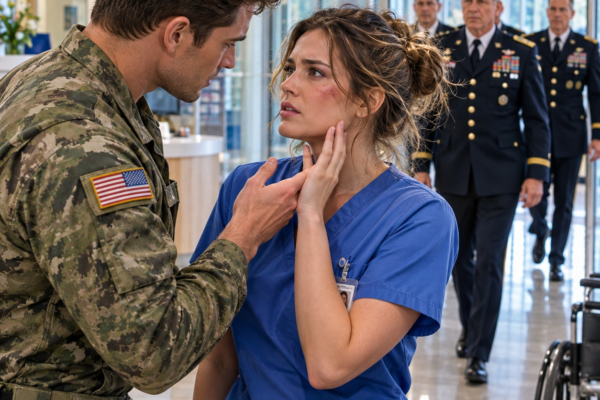
Part 2: Captain Slapped a Nurse in Public — Then Her Major Rank Ended His Career in Minutes
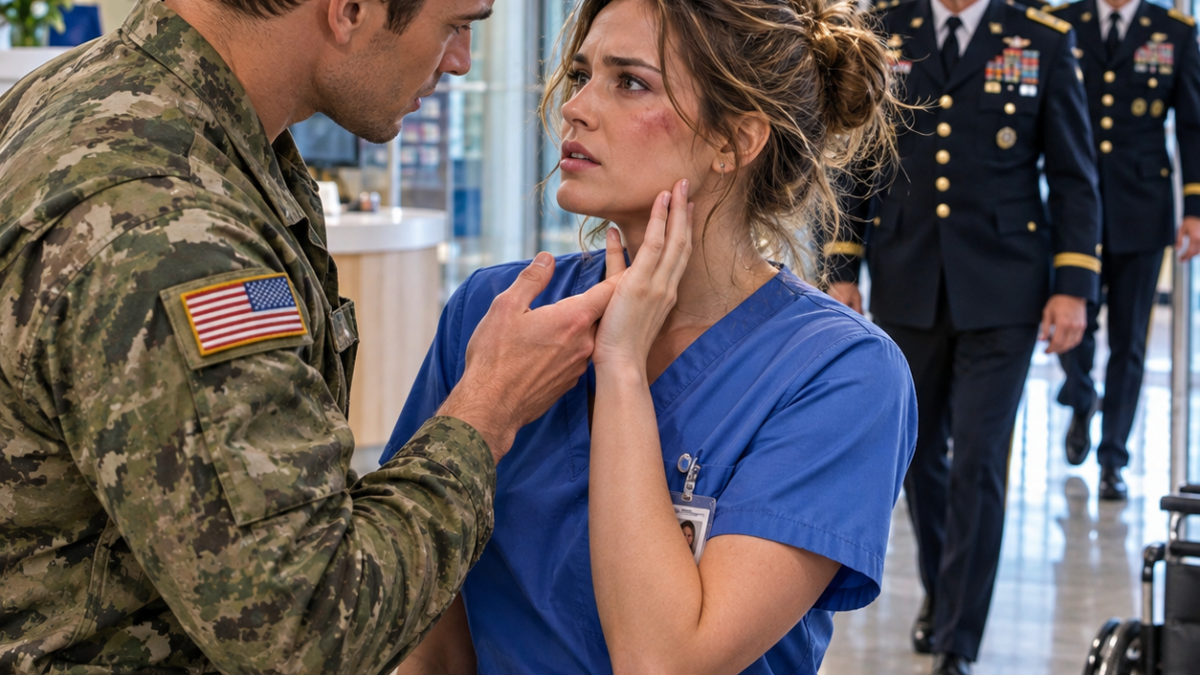
She raised a staffing concern in a meeting eight months ago. In the four months before that meeting, she had six weekend assignments.
In the four months after, she had 19. Briard said nothing.
This is not a coincidence, Run said. We know its not a coincidence because we have the scheduling system access logs.
Several of these adjustments were made manually after hours from a terminal registered to your office. Osler made a sound that wasnt quite a word.
Run looked at him.
Well get to your portion of this shortly, Colonel.
Osler put his hands back on the table and looked at them again. The third category was the evidence suppression.
Two of the 11 complaint files contained witness statements that had not been included in the official investigation records, not redacted, absent. One of those statements came from a staff member who had witnessed a specific incident in the East Corridor involving Briard and a junior medical officer.
That statement had been submitted to the facilitys Inspector General office. It had not appeared anywhere in the IG file.
Where did it go? Soren said.
It was the first time she had spoken since the meeting began, not aimed at Briard. Entered into the record.
Clean, without inflection. The IG file was accessed and modified three times between the submission date and the closure of the investigation, Run said.
Access logs show it was opened from a terminal I registered to the facilities administrative division. Briard looked at the document in front of him.
He said, I want counsel. You are entitled to counsel before any formal charging proceeding, Run said.
This meeting is not a charging proceeding. This is a notification that an investigation has concluded and its findings are being presented to you.
You may request to suspend this meeting and obtain counsel before we continue. That is your right.
A pause. Do you want to exercise it?
Briard looked at the folder. He looked at the three photographs which were still in front of him because nobody had moved them.
He looked at Osler, who was still looking at his hands.
No, he said. Continue.
Now I want to stop again here because something important is happening in this room that the formal language of a conduct review doesnt fully capture.
What is happening is that a system of harm is being named out loud in a room with documentation.
And that matters more than most people realize because the most corrosive thing that institutions like this one do is not the individual acts of harm.
Its the way they make the people who experience that harm doubt themselves, doubt their memory, doubt their judgment, wonder if what happened to them was really as bad as they thought it was, wonder if they somehow brought it on themselves. Ren Obi had spent eight months thinking she was imagining the pattern in her schedule.
She had gone over it in her head hundreds of times, had wondered if she was being paranoid, had wondered if she had done something wrong and just couldnt see what it was.
Flynn Days had spent 14 months living with the official response that her complaint had no basis. Official in writing from the institution itself, telling that what she had witnessed had not, in the judgment of the people reviewing it, risen to the level of something worth pursuing.
The thing that paperwork does to a person is profound. It doesnt just dismiss what happened.
It rewrites their relationship with their own perception of reality. It tells them in the language of authority that what they saw and felt and knew to be true was not sufficient, was not real enough, was not worth the institutions time.
And people internalize that because institutions carry weight, because official responses carry weight, because when the building itself tells you that you are wrong, it takes an extraordinary amount of internal strength to keep believing that you are right. Most people dont have that strength, not indefinitely, not when it costs them schedules and evaluations and the daily experience of working in a place that has quietly decided to make their professional life smaller.
This is why documentation matters.
This is why the work that Soren and Vael had been doing for 18 months matters.
Not because it was dramatic.
It wasnt. It was patient and careful and largely invisible.
It matters because at the end of it there is a record, a record that says this happened, this is what it looked like, these are the names, these are the dates, this is the pattern.
And that record cannot be unsaid. Back to the conference room.
The meeting lasted until late afternoon. By the time Run closed her folder, the second floor of Greystones administrative wing had taken on the quality of a building that is not actually empty even though it should be, lights on in offices where lights shouldnt still be on, a quiet presence in the corridors that had not been there that morning.
Ru Thomsen had gone to his car at the end of his shift, stood in the parking lot for a moment, looked at the lit windows, the MPs at the main entrance who were not the usual evening security complement, drove home, sat at his kitchen table and thought about nine years of small observations arriving at a single point. In the conference room, Run closed the folder.
Were going to give you until tomorrow morning, she said. At 0800, youll meet with the legal team that will be assigned to you.
I would advise you to use the time between now and then thoughtfully.
looked at Ossler.
The same applies to you, Colonel. Ossler nodded.
He was a large man who looked smaller than usual.
Briard stood. He straightened his jacket.
He looked around the room at Run, at the two investigators who had flanked her and said almost nothing for the duration, at the folder, at Soren who was capping her pen and organizing her notepad with the unsentimental efficiency of someone completing a task.
She didnt look at him.
Veil, he said.
She looked up. He seemed to be constructing something, a question or an accusation or something that would perform adequately in the space where a last word should go.
What came out was 18 months. Yes, she said.
Youve been here for 18 months and you let this keep happening.
The room shifted slightly. Soren set her notepad on the table.
She looked at Briard directly.
Ive been here for 18 months documenting what was already happening, she said.
What I was letting happen was my investigation.
Every incident I recorded instead of intervening was a piece of a record that cannot be dismantled.
Every complaint that disappeared into your office is now restored in the official archive.
Every person who was told their statement had no basis now has their name in a file that will be reviewed by people who have no relationship with you.
Her voice didnt rise, but it got denser, heavier, the specific weight of something that has been held for a long time and is finally being put down in the right place.
People were getting hurt before I arrived, she said. They had been getting hurt for 4 years, and every time someone tried to report it, your office made sure nothing came of it.
I was sent here to make sure something came of it.
She picked up her notepad. Something is.
Briard left the conference room.
He walked to the elevator and stood in front of it and waited. And in the silence of the hallway, he could hear faintly from behind the conference room door, the sound of a chair being moved, the low murmur of a conversation beginning again.
He pressed the elevator button a second time.
It didnt come faster. That night, Graystone felt different.
The night shift staff moved through corridors with a different quality of attention. Nurses charting at their stations looked up when footsteps went past.
The MPs at the stairwells had been there long enough to become part of the architecture. Briard was in his quarters under administrative restriction, not arrested, not guarded, just restricted, instructed to remain in the building pending the formal charging process in the morning.
This was the system working the way the system works, slowly, with the procedural caution of institutions that have been sued before and know that every step has to be documented correctly.
It was also, and Soren knew this, a gap. Administrative restriction is not custody.
There is a difference.
She thought about that difference at 9:30 that night while she sat in the facilitys ground floor vending area eating stale crackers and drinking water and trying to let her body remember what it felt like to be still.
Her phone had 34 messages in it, colleagues who had heard about the cafeteria, notes from Runs team. She read them all and answered none of them yet.
Ren Obi found her at 9:45. Ren had pulled a second shift voluntarily because Dale Pruitt had had a minor vital sign irregularity at 6:00 and Ren had decided without being asked that she was going to stay until she was satisfied.
She walked past the vending area on her way back from the east corridor, stopped when she saw Soren.
Ren looked at the bruise on Soren s jaw.
It had deepened over the course of the day into something serious, the deep blue purple of real tissue trauma. You didnt go home, Ren said.
Not yet. Dale Pruitt is stable.
His 9:00 vitals look better than his 6:00 vitals. Soren looked at her.
Thank you for staying. Ren sat down at the table without being invited.
She was a practical woman who made decisions based on available information and didnt require social scaffolding to act on them.
People are saying things, she said, about whats happening on the second floor. People say a lot of things.
Are the things true?
Some of them. Ren looked at the window, at the parking lots outside where the evening had gone dark and two MPs were visible near the entrance, their presence understated but consistent.
The scheduling, Ren said finally.
The weekends, the holidays. I didnt.
She stopped.
I thought I was imagining it.
You werent, Soren said.
Ren absorbed this, said quietly, thats what I thought.
She sat with that for a moment. There is something important in what just happened between these two women.
Ren Obi had been carrying a question for eight months, not a dramatic question, not a crisis, just a small, persistent, undermining question that had been running in the background of every shift shed worked, every weekend shed come in, every time shed looked at her schedule and felt something was wrong but couldnt prove it and couldnt name it.
Am I imagining this? That question is one of the most corrosive things that institutional harm produces.
Its not the harm itself, its the uncertainty that follows, the doubt, the way a person learns to distrust their own perception because the official response to their perception has been silence or dismissal. What Soren said to Ren in that vending area was not complicated.
It was three words. You werent imagining it.
But those three words carried 18 months of documentation behind them. They carried the weight of a record that had been carefully built for exactly this purpose, to give people like Ren Obi back something that had been quietly taken from them, the knowledge that what they saw was real, that what they felt was accurate, that they were not wrong.
That is not a small thing. That is in fact everything.
Ren stood. She started to say something, stopped, recalibrated.
Go home, Soren said.
Youve been here since 6:00 this morning.
Ren picked up her walked toward the exit. Her posture was different than it had been an hour ago, slightly, not dramatically.
The difference between a person who is carrying something to walk and has learned to walk with it and a person who has just been told they can set a part of it down.
The thing about an investigation that has been running for 18 months is that it develops its own weight, its own accumulated momentum, like water deepening a channel. By the morning of the third day, that weight was visible throughout Graystone in ways that people who had not been told anything could nonetheless feel.
At 6:15, a mandatory all staff briefing was announced for 1000 hours in the main assembly hall. Mandatory all staff briefings happen twice a year on schedule.
They happen occasionally in response to emergencies. There had been no emergency overnight.
The announcement did not include an explanation. The facility spent the next 4 hours being audibly and visibly unsettled.
And then at 8:30, something happened that nobody had anticipated.
Something that moved through the facility in 30 minutes with the speed that only genuinely surprising things achieve. A senior administrative officer who had worked at Graystone for 11 years and whose loyalty to the facilitys power structure had been so complete it had become structural walked into the hallway outside her office, sat down on a bench near the water fountain, and did not move for 20 minutes.
People walked past her.
Some of them slowed down.
None of them stopped because she was not the kind of person who sat on benches in hallways.
And when things that dont happen happen, the instinct is to not look directly at them until you understand what youre looking at.
And this was something nobody at Graystone understood yet.
At 8:50, a young lieutenant who had not actually been sick the previous evening but had spent 3 hours in a room on the second floor answering questions came through the main corridor and saw her on the bench, sat down beside her.
How bad?
He said one word. Bad.
She pressed her lips together. The files, they found everything, the originals, the modified versions, the access logs, everything.
She looked at the wall across from them. I told him, she said, and the pronoun had no ambiguity.
I told him that what you do on paper stays on paper. He didnt listen to that in four years, the lieutenant said.
He wasnt going to start.
They sat on the bench together, two people calibrating in real time how much of what they knew was going to need to be said and to whom and in what order. At 10:00 the assembly hall held 400 people, more or less the same count as the cafeteria had held two mornings ago.
Arranged in rows of chairs, the noise in the room was different from the cafeterias normal morning noise, lower in register, less directional, the specific frequency of institutional anxiety. Wren walked to the front of the room with two of her officers.
She did not use a microphone at first, just stood at the front until the room quieted.
And the room quieted quickly because the three people at the front of it looked like the kind of people who were about to say something consequential.
Good morning, Wren said.
Ill keep this brief. An institutional conduct review of this facility has concluded after an 18-month investigation.
The results are being processed through the appropriate command structure. Over the next several days and weeks you will see changes in the administrative leadership of this facility.
Some of those changes will be significant. A sound moved through the room, not a word, a sound, the compressed release of something that had been held for a long time.
I also want to address something directly, Wren continued. If you filed a complaint through this facilitys internal systems and received no response or received a response that did not reflect a genuine review, you will be contacted by our office.
Your complaint will be reviewed. That process begins today.
The sound in the room changed again.
This time it was harder to categorize because it contained things that arent usually in the same sound at the same moment, relief and grief, and something that was almost anger, but wasnt quite, because anger requires a target.
And several of the people in that room were only now beginning to understand who the target should have been all along. In the back corner of the room, Flynn sat with her hands folded in her lap.
She had filed a complaint 14 months ago.
She had received a response that said it had been reviewed and found without basis. She had applied for a transfer six months ago.
It had been denied.
She had stopped talking about what had happened to her because talking about it had produced nothing except the feeling of being louder in a room with no acoustics. She sat with her hands in her lap and listened to Run.
She did not cry. People in this building had learned, most of them over time, to not cry in front of the building.
That habit doesnt break in a morning. But when the briefing ended and the room began to move toward the doors, Flynn stood and turned.
She looked toward the side wall where Soren was standing.
She looked at the bruise on Sorens jaw.
She looked at Sorens face.
She didnt say anything.
She didnt need to. There are moments in a story where words are insufficient, not because the feeling isnt there, but because the feeling is too large for the container of words.
And the only honest thing to do is to stand in the space where the words would go and let the silence carry what language cannot.
Flynn looked at Soren Vale across a room full of people who were just beginning to understand what had been done to them and what was now finally being undone. And Soren looked back.
That was enough. Later that morning, the response came through from command.
It authorized formal charges, a secondary review of Oslos conduct, an interim leadership structure.
What it did not authorize was immediate arrest.
They wanted to do this through the formal proceedings timeline. Briard would remain in the building under administrative restriction pending charges being finalized, 5 to 10 working days, possibly longer.
Run brought this to Soren at 11:45 with an expression that was not quite a problem and not quite its opposite.
Hes in the building for potentially two weeks, Soren said, while the staff who reported him are also in the building.
On restriction, he cant contact them.
He doesnt need to contact them directly, Soren said. He just needs to be in the building.
Thats going to be very hard for some people here.
Ren looked at her. I know.
The system moves the way it moves. I know, Soren said.
She pulled a notepad toward her. Im going to request an expedited timeline in writing.
She was halfway through writing when her phone buzzed.
The message was from Dale Pruitts attending physician, who rarely messaged her directly, who was not supposed to know her investigation role and almost certainly didnt, but who had her contact information from the trauma wards emergency chain.
The message said, Bay four patient deteriorating.
On my way.
Thought you should know.
Soren looked at Ren.
I have to go to the ward, she said, and she was already moving.
She hit the stairwell at a run and was two floors down before she registered that she was no longer operating as an investigator, that the thing driving her down those stairs was older and more immediate than the role she had been performing for 18 months. She pushed through the stairwell door into the trauma ward corridor.
She immediately saw the cluster of staff outside bay four.
She heard before she saw anything else the sound of a monitor alarm, not the steady alarm of a patient in manageable distress, the specific tone of a patient whose numbers have gone somewhere they were not supposed to go. Ren Obi looked up from inside the bay.
Her face said, Im glad youre here and I need you right now and Ill ask questions later. Soren crossed the threshold into bay four and pulled gloves from the dispenser on the wall.
For the next 40 minutes, she was not an investigator.
She was not a major. She was not the person who had spent 18 months building a case against the administrative structure of this building.
She was the person she had been before any of that.
In rooms far more dangerous than this one, making decisions faster than the options could be named, and she was very good at it.
When Dale Pruitt stabilized, genuinely stabilized, when the numbers came back to the ranges a 22-year-olds post-surgical body should occupy, Ren stood at the foot of the bed and looked at Soren across the patient. Where did you learn that?
Ren said.
It wasnt a casual question. She had watched Soren work for 40 minutes.
She had recognized something in the speed, in the sequencing, in the way Soren anticipated what was going to happen 30 seconds before it happened.
Soren pulled her gloves off and dropped them in the waste bin.
She looked at Dale Pruitt.
He was sleeping the heavy, reluctant sleep of someone whose body had just done a great deal of hard work.
He looked in the particular light of Bay 4 at midday, very young.
She looked at Ren.
She was about to answer, about to complete something.
Her phone buzzed.
Run.
Four words.
Come back up now.
And under those four words, a second message that came through 3 seconds later.
Briard is gone. Soren read both messages twice.
In the time it took Ren to register the change in her expression.
I have to go, Soren said. Whats happening?
Ren said.
Stay with him.
She was in the corridor before Ren could form another question.
She hit the stairwell at the same pace shed come down at 40 minutes ago, which was not the pace of someone who had just spent 40 minutes managing a patient crisis. It was something cleaner than adrenaline.
The particular operational clarity that comes from training in environments where the cost of a slow decision is immediate and final. Third floor.
She pushed through the door.
Run was in the corridor outside the working room with one of her investigators. The expression on Runs face was the controlled expression of someone managing something that has gone outside the boundary of the plan.
When?
Soren said. We dont know exactly.
He was confirmed in his quarters at 10 last night.
The 6:00 check found the room empty.
Run walked into the working room. Soren followed.
Two laptops open. A third investigator on a phone call in the corner writing rapidly.
He had a vehicle, Soren said. His personal vehicle is gone from the lot.
The exterior camera on the east lot malfunctioned at 1:45 this morning.
Were getting footage from the street cameras now.
What did he take? His facility issued laptop and phone were left in the office.
Personal devices. We dont have a complete inventory.
His office was locked this morning.
Soren stood at the edge of the table and looked at the document boxes. 18 months of work was in those boxes and none of that was at risk from Briard leaving the building.
The case was built.
The documentation was secure.
What his disappearance could do was complicate the timeline and the timeline was already complicated.
Command has been notified, she said, 30 minutes ago. Theyre authorizing a search.
Given that hes a person of interest in a formal conduct investigation, it went through quickly.
Hes not running, Soren said. Run looked at her.
Hes not the kind of person who runs, Soren said. Hes the kind of person who goes somewhere and makes a call and tries to restructure the situation.
He has contacts outside this facility. People who have been in his orbit for years.
People with interests in keeping him viable. Run was already nodding.
His personal phone records, his contact network. Specifically anyone who co-signed or endorsed any of the complaint resolutions in the past four years.
If Briard thinks he can call in a favor that reshapes this, those are the people hes calling. She looked at the window.
The visitor lot was visible from this angle.
The space where Briards car had been was an empty rectangle of asphalt.
She looked at it for a moment, then looked away. Briards office yielded what offices yield when people leave them in a hurry at 2:00 in the morning.
A coffee mug with dried residue. A desk drawer that had been pulled out and put back at an angle.
A filing cabinet in which the second drawer was not fully closed.
His facility issued phone lay face down on the desk. He had made a deliberate decision to leave it.
He understood it was traceable what he had taken. His personal laptop, a briefcase his assistant confirmed he kept behind the door, a set of hard copy files from the third drawer of the cabinet.
The drawer that the assistant, the corporal named Metz, said he had never seen open.
What was in that drawer?
Soren asked.
Metz looked at his hands.
He had the dazed compliance of someone who has realized very recently that being helpful to the wrong person for long enough makes you adjacent to whatever that person has done.
Personal correspondence files, letters, printouts. He kept hard copies of things he said the system didnt secure properly.
Did you have access to those files?
No.
He kept that drawer locked.
Ive never seen it open. The lock mechanism had not been forced.
It had been opened normally with a key, which meant Briard had his key, which meant the departure had not been fully panicked.
Panicked people forget keys. Was there anything in the past week that was different?
Soren said. His schedule, his calls, his mood.
Metz thought about it carefully. With the visible effort of someone trying very hard to be accurate because accuracy is the only thing he has left to offer.
He had a call on Tuesday that he took outside. His personal phone rang.
I saw it on his desk.
It was a number I didnt recognize.
He went out to the parking lot.
He was on the phone for about 15 minutes. Do you know who called?
Know anything else?
A pause. He asked me to pull the personnel files for two staff members on Wednesday.
Said it was for a routine review.
He gave her the names.
One of them was Flynn Dace. Soren went back to run with this.
Run went quiet in the specific way that means something has just connected to something else and the connection is not good.
He pulled those files before the suspension, Run said. Before the meeting he was already preparing something, which means he suspected something was coming, Soren said, or someone told him something was coming.
The room was quiet with that for a moment.
And then on the fourth morning since the cafeteria at 11:40 something happened that shifted the entire shape of the investigation.
Sorens phone rang.
The MP desk at the facilitys main entrance. Major the duty MP said, you asked to be notified if anything came through the front gate that fell outside normal traffic.
Yes. We have a civilian vehicle in the visitor lot.
Driver gave the name Ward Finch.
Says he has a scheduled meeting with Colonel Osler.
Sorens hand tightened on the phone.
Ward Finch, retired general, private consulting firm. A man who had operated near power for decades and had come to believe that proximity to power was the same as power.
He didnt know Briard was gone. He had come here because he thought he was controlling the situation.
Do not clear the vehicle, Soren said. Her voice came out level, completely level.
Tell the driver to wait.
Ill be down in 4 minutes. She ended the call, looked at run.
Finch is at the front gate.
A pause.
He doesnt know Briard is gone, run said.
No, Soren said.
He came here because he thought everything was still manageable. She was already at the door.
Soren. Runs voice stopped her.
Hes a civilian.
We can detain him for questioning, but we need to do this correctly.
I know how to do this correctly, Soren said.
She went down the stairs at a measured pace this time. Not running, not slow.
The pace of someone who understands that the next 5 minutes require precision and that precision and speed are sometimes opposites. The lobby at the main entrance had a visitor processing desk.
The corporal behind it was doing exactly what Soren had instructed, holding the process at the point of login.
Politely explaining that there was a brief administrative delay.
Through the glass of the main doors, Soren could see the civilian vehicle, a dark sedan, older model, parked at the near end of the row. She crossed to the visitor desk.
Hes in the vehicle, the corporal said quietly.
Declined to come inside, said hed wait. Soren looked through the glass.
She could see the outline of the driver, a man in his 60s, broad through the chest, sitting with the stillness of someone who is used to waiting but is not comfortable with this particular weight.
Get me two MPs, she said. Tell them to be at the side entrance in 90 seconds.
The corporal reached for his radio. Soren looked through the glass again at the man in the sedan.
She thought about what it takes to build a career in proximity to power, how long you have to practice making yourself useful to the right people, how much you have to learn about which favors to trade and when and with whom, how thoroughly you have to believe after enough years of it that you are insulated from the consequences that apply to other people. She pushed through the main doors into the October air.
Finch looked up when she came out. He saw her coming across the visitor lot.
Something moved in his expression, a rapid recalculation, the kind that happens when a person realizes that what is walking toward them is not what they expected.
She reached the vehicle, stood at the drivers side window.
Finch lowered it. Up close, he looked like what he was, a man who had operated near power for a very long time and had confused proximity with ownership.
The confusion was understandable. It had worked for him for decades.
General Finch, she said.
He looked at her face, at the bruise on her jaw, at the expression she was wearing, which was not hostile and not warm.
I have a meeting with Colonel Osler, he said.
Colonel Osler is not available, she said. Im Major Soren Vale, Institutional Conduct Review Division.
Id like to ask you a few questions. His eyes went to the two MPs who had come around from the side of the building, standing at a distance that was neither threatening nor ignorable.
Am I being detained?
He said.
Youre being invited to answer questions voluntarily, she said. If you prefer not to do so voluntarily, we can discuss the alternative.
She held the gesture of the entrance with one hand.
Would you like to come inside?
He looked at her for a long moment, calculating.
How much did she know? What could she prove?
Whether the man he had come here to see was somewhere inside that building. Wheres Breard?
he said.
And there it was.
Soren looked at him with an expression she had worn once before in the past three days, in the cafeteria, when a man had done something that revealed exactly what he was and exactly what he didnt understand about the situation he was in. Thats one of the questions, she said.
And she stepped back from the car door to give him room to get out. Finch got out slowly with the deliberate unhurriedness of a man who understands that how you move in a bad situation communicates something about whether you believe its as bad as it looks.
He looked at Soren.
He looked at the MPs.
He looked at the building.
Then he straightened his jacket and he said, After you, in the tone of a man who is performing cooperation without committing to it. They walked inside and the door closed behind them.
Ward Finch sat across from Soren in the ground floor meeting room, not the conference room on the second floor. That room had a different atmosphere now, the kind that accumulates in a space where serious things have been said and cannot be unsaid.
Soren had chosen this room deliberately. Beige walls, a rectangular table, six chairs, a window looking out onto the inner courtyard where a maintenance crew was working on a drainage pipe.
Something ordinary, something that had nothing to do with any of this. She wanted this conversation to begin somewhere that felt, at least initially, like dialogue.
Finch looked around the room.
He looked at the closed door. He looked at the window.
He was doing what people do when they enter a space they didnt choose and are trying to understand its dimensions before committing to anything inside it. You want to tell me whats happening here, he said.
Not a question, a prompt, the kind a man uses when he wants to appear cooperative while determining how much ground he has already lost. You drove to a military medical facility, Soren said to meet with a senior officer who is currently under administrative review.
Id like to understand what that meeting was for.
Osler is an old colleague. This was a personal visit.
Your visit request was logged through the formal visitor system six days ago, Soren said.
The stated purpose was consultation.
Thats not a personal visit category. A small pause, not long.
Finch was not someone who gave long pauses to things that surprised him. He had spent too many years in rooms where the pause itself communicates weakness.
Professional consultation, he said.
I run a consulting firm.
Sometimes that involves former colleagues.
What was the subject of the consultation?
Personnel management, general operational matters. He settled back slightly.
Im not under any obligation to be more specific than that in a voluntary conversation. Youre right, Soren said.
Youre not. She put her notepad on the table but didnt open it.
I want to ask you about Tuck Briard, she said. Nothing moved in Finchs face.
That was itself information, not the absence of surprise. The absence of the small involuntary adjustment that happens when a name genuinely surprises a person.
His expression didnt shift.
His posture didnt change.
He had been expecting this name and had prepared a response to it before he drove through the front gate. I know Captain Briard professionally, he said.
He served at this facility.
Thats the extent of it.
When did you last speak with him?
Id have to think about that.
Take your time.
He took a moment that was calibrated rather than genuine.
Several weeks ago. A brief call.
What was the subject?
Professional.
He had questions about administrative processes.
I have experience in that area.
Soren looked at him, not with skepticism, with attention, which is different. Skepticism tells a person you dont believe them.
Attention tells a person you are recording everything they say and will return to it later.
Attention is considerably more uncomfortable to sit across from. Captain Briard is not currently in this facility, she said.
He left during the night. Were in the process of locating him.
Something shifted behind Finchs eyes, very small. A contraction he controlled quickly, but it had been there.
I wasnt aware of that, he said. I know Soren said.
She let that sit between them. Finch understood what was underneath it, that she knew he hadnt known, which meant she knew he had come here expecting to find Briard, which meant she knew the visit was not about Osler, which meant the framing he had prepared on the drive over was already compromised before he had fully deployed it.
I think Id like to speak with Council before continuing, he said.
Thats your right, Soren said.
She stood, collected her notepad, moved toward the door. Well need you to remain in the building while we confirm a few things.
Theres a seating area in the lobby.
Can I get you water or coffee? He looked at her.
Am I being detained? Youre being asked to remain voluntarily while we confirm a few procedural items, she said.
 [Tap here for the Next Part ]