I Flirted With Her in the Lobby… Then My Daughter Asked, “Dad, Are You Talking to My Teacher?”

I Flirted With Her in the Lobby… Then My Daughter Asked, “Dad, Are You Talking to My Teacher?”
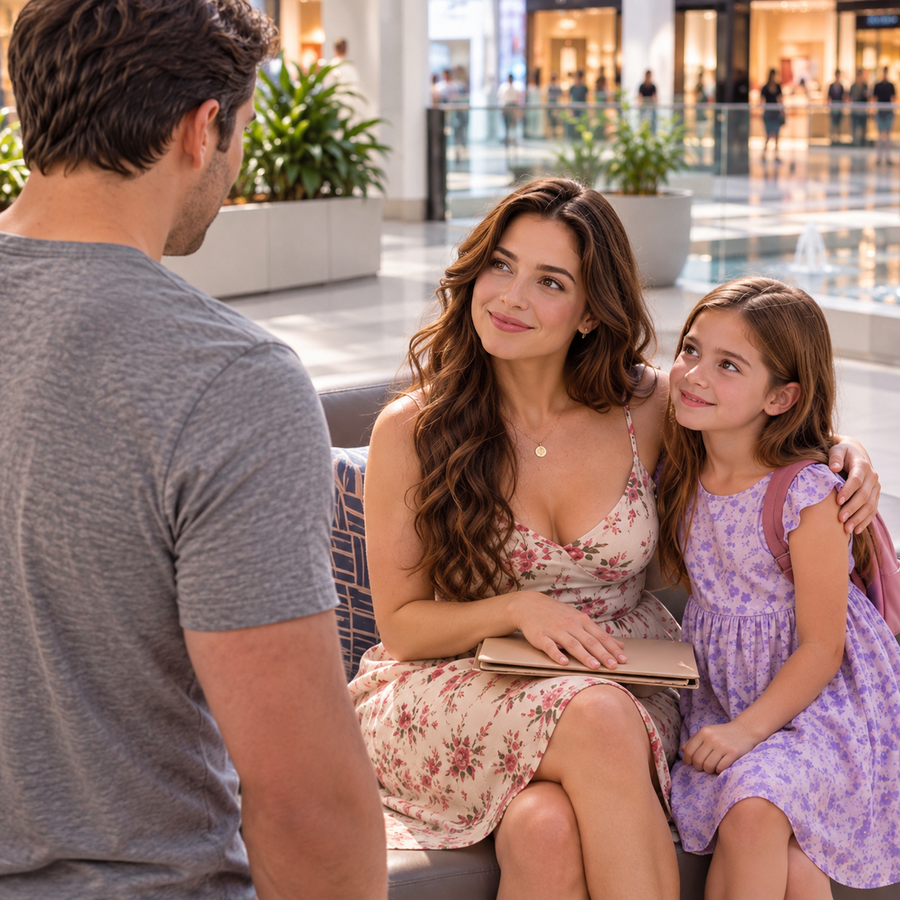
Dad, are you talking to my teacher?
Dad, are you talking to my teacher? My daughter asked as she returned from the restroom.
Cindy slipped an arm around her on the mall sofa. My coffee invitation was still unanswered. That coffee will have to wait, she said, still looking at me.
It was a Saturday afternoon at Prairie Crossing, the kind of mall where the central fountain blurred a hundred separate errands into one steady hum.
I stood beside a wide leather sofa in my usual gray t-shirt and work jeans, trying to process the sudden collision of my personal life and my daughter’s education.
Cindy sat on the sofa in a light floral dress, a beige purse across her lap.
Julie, 8 years old, in a purple dress with her little pink backpack still on, had stepped straight into Cindy’s side.
Cindy’s arm settled lightly around her shoulder.
Both of them were looking up at me. 5 seconds earlier, that would have felt encouraging.
Now, it felt like evidence. 5 minutes earlier, I had just been a guy taking a shot.
I’d walked out of a shoe store waiting for Julie, noticed Cindy sitting there, and realized she was the only person in the entire mall who didn’t look like she was mentally calculating a purchase.
I had walked over, pointed that out, and she had smiled, a quiet, grounded smile. She told me she was enjoying 10 minutes of nobody needing her for anything.
And when I asked if I was ruining it, she said she was willing to share those 10 minutes with me. It was easy.
It was the best conversation I’d had in months.
I had just leaped and asked if she wanted to get a coffee. Then Julie had walked up and dropped a bomb on the whole operation.
“Miss Hinton is teaching us music now,” Julie added, looking up at me, then up at Cindy.
Did you buy shoes, too, Miss Hinton?
The moment needed air, and Julie’s innocent question provided it.
I didn’t stammer or pretend I was just asking for directions to the food court.
I looked at Cindy, acknowledging the shift in gravity.
I didn’t, Cindy answered.
Julie, her voice soft but steady, showing no panic at having a parent suddenly hit on her. I was just resting for a moment.
Your dad and I were just introducing ourselves. Right, I said, catching my rhythm. And I was just offering Miss Hinton a coffee, which apparently will have to wait.
It will, Cindy agreed, her eyes meeting mine. There was a glimmer of amusement there, mixed with a very clear, very necessary boundary. She was at work in a sense the moment my daughter recognized her.
I nodded, gave her a polite smile that belonged to Julie’s father, and steered my daughter toward the exit.
But as we walked out into the Nebraska afternoon, I realized something unusual.
I wasn’t embarrassed.
I was just genuinely disappointed that the conversation had to end.
The question wasn’t who she was anymore.
The question was whether there would ever be a time and place where we could finish what we started. By Monday morning, my life was back to its standard rhythm.
The sand hills of Nebraska don’t offer much room for lingering on missed connections.
I was up at 5 making a turkey and cheese lunchbox for Julie, checking her backpack for the permission slip I had signed in the dark, and getting her to Prairie Bend Elementary before the first bell.
I’m a mason.
I run a small crew, and most of my days are measured in mortar brick counts and whether the Nebraska wind intends to cooperate. That morning, Mark and I met a homeowner at the material yard with two sample panels propped against a workt.
He wanted a decorative herring bone section around an outdoor fireplace, but he also wanted the schedule and labor estimate for a plain running bond. I showed him both samples and gave him the real numbers.
So, the pattern takes longer, he said. Yes.
Could your crew still finish by Tuesday? Not if you want me to tell you the truth today.
Mark looked at the ground so the client wouldn’t see him smile.
The homeowner thought about it, chose the pattern, and accepted the later finish. After he left, Mark helped me strap reclaimed red brick into the truck. You know, some people say yes first and solve the problem later, he said.
Some people enjoy phone calls.
I don’t.
I wanted more of our work to stay local, where a complicated job meant an extra hour at the yard instead of nights away from home. My evenings mattered.
Julie’s mother was still part of her life and had her on alternating weekends, but the school mornings, lunches, pickups, homework, and weekday dinners were usually mine.
The system already worked.
I wasn’t waiting for a woman to walk in and make it work for me.
Over the next two weeks, I saw Cindy only at school. One afternoon, I arrived early enough to catch the end of the third grade music period through the open doors of the multi-purpose room near the front office. Cindy stood beside a loose semicircle of kids, keeping a simple clap and tap pattern moving.
One boy came in late twice and started staring at the floor.
She didn’t stop the room or announce his mistake.
She stepped nearer, marked the next beat once against her own wrist, and gave him a small nod. He caught the entrance on the next round.
By the time the class lined up, he was smiling again. That told me more about her than anything Julie could have reported.
So, I didn’t question my daughter for details.
Whenever Cindy and I crossed paths, I gave her a polite, parent appropriate nod. She returned it with the same measured warmth. She never looked away quickly, but she never lingered either.
Then the regular music teacher returned for maternity leave, and Cindy’s placement ended.
The school boundary was gone, but so was the reason we kept crossing paths. I have a spare room.
A week later, on a Tuesday evening, I ran into her at Prairie Basket, the local grocery store. I was navigating a cart with a slightly wobbly front wheel, while Julie debated the merits of two different brands of fruit snacks.
We turned into the produce aisle and there was Cindy.
She wasn’t in a floral dress this time.
She wore dark jeans and a plain sweater looking at a display of apples. Her basket was light, just a few essentials, enough for maybe 3 days.
“Miss Hinton,” Julie called out, abandoning the fruit snacks to run over.
Cindy turned her face, lighting up with genuine recognition.
“Hi, Julie.
It’s good to see you.
How is the new recorder piece coming along? As they talked, I parked the cart and walked up.
Evening, Cindy, I said.
It was the first time I’d used her first name out loud.
Zachary, she replied. She knew my name, too. Julie reappeared long enough to hold up a red onion.
“Do we need these?”
“Only if you plan to eat them,” I said.
Raw onions and I have agreed to leave each other alone.
Cindy’s mouth curved like she was trying not to laugh.
I glanced at the few things in her basket.
Either you’re going on a diet or you’re going out of town.
She offered a small rofal smile. A bit of both, maybe.
I start a new placement next week at a school over in Carney, but the woman I’ve been housesitting for here in Prairie Bend is coming back early from her trip tomorrow, actually.
So, you have a housing gap? I said, doing the math. Just for about 3 weeks, Cindy said, her tone composed, refusing to make it sound like a tragedy.
I’m looking at a motel out on the highway.
It’s manageable.
Just a lot of driving until the new studio I’m looking at opens up on the first of the month.
I looked at her basket again. Then I looked at Julie, who was currently trying to balance a honey crisp apple on her forehead. I have a spare room, I said.
Cindy stopped looking at the apples and looked at me.
It’s technically a guest room, I continued, keeping my voice entirely practical.
Right now, it’s mostly being used to hold sample boards of veneer, stone, and brick that I don’t want in my garage.
I can clear it out in an hour.
You can use it for the 3 weeks.”
Cindy’s posture shifted slightly.
She didn’t gush with gratitude, and she didn’t refuse just to prove she could manage.
She looked at me the way she had looked at the apples, calmly, as if the decision deserved to be made on purpose. Mr.Wells.
Zachary, I corrected. Zachary, she said quietly.
That is very generous, but I don’t want to impose on your family routine.
You wouldn’t, I said.
You’d have a door.
You close it when you want.
I’m offering a room.
Not asking for a favor. She looked down at Julie, then back to me. Can we speak for a moment, just us?
I nodded and told Julie to go pick exactly one box of fruit snacks and meet me at the end of the aisle. When she was out of earshot, Cindy crossed her arms, loosely holding her ground.
“If I stay,” Cindy said, her voice dropping to a private register.
“I need you to understand something.
I am very fond of Julie, but I cannot be a live-in teacher.
I can’t be the person who manages her homework or babysits when you have a late shift.
When I am off the clock, I need to be off the clock. I have a kid, I said.
I don’t need another mother for her, and I don’t need a nanny.
My routine is handled.
I’m offering you a room so you can sleep and prep for work without living out of a motel on the interstate.
I met her eyes and the coffee invitation is not part of the rent. There is no rent and there are no strings. She studied my face for a long moment, searching for the catch.
Finding none, her shoulders dropped a fraction of an inch. I need to see the room first, she said. Then I want to think tonight.
I’ll call you tomorrow with a decision.
Fair enough. I wrote my number and address on the back of a receipt. After groceries, she followed us home in her own car.
I showed her the guest room, the bathroom across the hall, and the shelf she could use in the kitchen. I did not sell her on any of it.
She opened the bedroom door, closed it again, looked out the window, and asked two practical questions about the morning routine. Then she left to think.
She called at 8 the next morning.
“I’ll take the room,” she said.
The first evening under the same roof was a study and navigation. I had cleared the sample boards out, moving them to the corner of the dining room. Cindy arrived with two suitcases and a long rectangular black case that held an electric keyboard.
For dinner, I set up bread, turkey, cheese, tomatoes, lettuce, and condiments on the kitchen island. Julie was buzzing with energy, explaining which cups were the good ones, and giving Cindy a detailed report on every floorboard that creaked after dark.
The red onion sat in a small bowl at the far end of the counter. I glanced at it, then at Cindy.
You remembered that? The grocery aisle was yesterday, Zachary. Still, she gave me a small smile and went back to building her sandwich.
It was a tiny thing, too ordinary to turn into a moment, which was probably why I felt it. After Julie carried her plate to the small table in the living room, Cindy stayed at the counter with me.
“I meant what I said at the store,” she said about my time.
“I know.
I need time to prepare lessons.
I need to be able to close my door without you wondering if I’m upset.
And some evenings I play for myself, not for school. Your room is yours.
If the door is closed, we leave it closed.”
She nodded, then added, “And I don’t want staying here to turn your coffee invitation into something I owe you.
I don’t want dating to get mixed up with whether I have somewhere to sleep.”
That was fair enough that I didn’t need time to think about it.
Then the coffee waits, I said.
While you’re staying here, we’re not dating.
When you have your own place, if you still want that coffee, you can tell me. Her shoulders loosened. Good.
And Julie is still my job, I said. Homework, dinner rides, all of it. You can be fond of her without being on duty.
That part matters. Cindy glanced toward the sample boards I had moved out of the guest room.
Do clients usually come through here to look at those. Sometimes I can work around it if I know ahead of time. I shook my head.
You shouldn’t have to clear out every time I turn the dining room into a job site.
Mark and I can do sample meetings at the yard while you’re here.
You don’t have to reorganize your business for me.
I’m reorganizing one table.
She considered that, then nodded. All right, then.
We agree. She washed her plate, said good night to Julie, and went into the guest room.
The door clicked shut a few minutes later.
I went back to packing Julie’s lunch for the next day.
The first useful thing I could give Cindy under my roof was not attention. It was the right to be left alone. By the end of the first week, the house had settled into a new kind of normal.
I woke early, handled Julie, and went to work. Cindy left later for her new school in Carney, and came back in the late afternoon. Sometimes we ate together.
Sometimes her door stayed closed until morning. Neither version needed an explanation. On Thursday, Mark came over to the house.
We usually used my dining table to spread out blueprints and estimate sheets. He walked in carrying two heavy boards of veneer stone, dropping them onto the table with a clot.
“Got the new Carthage stone samples,” Mark announced loudly.
I glanced toward the closed door of the guest room. I knew Cindy was in there. I had seen her car in the driveway.
“Grab them,” I told Mark, picking up my own stack of paperwork.
“What?
We always work here. Not today, I said, keeping my voice low.
We’re going to take this to the material yard.
We can use the tailgate of the truck. Mark gave me a confused look, glanced at the closed door, and slowly, right, the teacher. Just grab the boards, Mark.
We moved the operation to the material yard. It was less convenient than spreading everything across my dining table, and the wind kept lifting the corners of the estimate sheets, but the work still got done.
I didn’t blame Cindy for the change, or tell her I had protected her quiet.
The agreement was mine to keep, whether anyone applauded it or not. Two nights later, Julie came into the kitchen holding her recorder and the folded practice sheet from school. Miss Hinton, can you help me with this part?
Cindy had just set down her bag. She looked tired but not guilty.
“Not tonight, Julie.
I’m done teaching for today.”
Julie blinked once and looked at me.
“Bring it here,” I said.
“I can count to four.
We’ll build from there.”
I was not a gifted recorder coach. I was, however, persistent.
By the third attempt, Julie could get through the measure without stopping, and Cindy had disappeared into her room without having to apologize for it. Later, after Julie was asleep, I sat in the living room reviewing an estimate. The house was quiet except for a faint muffled sound from the guest room.
It was music, not a recording, a slow piece on the electric keyboard, quiet enough that I could hear the furnace click between phrases. It sounded nothing like the bright structured exercises Julie had brought home from school. This was not teacher music.
It was Cindy’s.
I stopped working and listened until it ended.
I didn’t knock to praise her or ask what it was.
I just sat there with my estimate open and realized I liked the fact that there was a part of her evening that had nothing to do with my daughter or me. Near the end of the second week on a Tuesday, I came home earlier than usual. The front door was unlocked, so I stepped inside and dropped my keys into the bowl on the console table.
Cindy was in the living room with the keyboard on its Xstand in front of the window. She wore headphones and had one hand suspended over the keys when she heard me.
Then she moved fast. Headphones off, stand folded, keyboard halfway into its black case before I understood what I was watching.
I stopped at the edge of the hall.
You don’t have to pack it because I came home.
She kept one hand on the zipper. I know. I lost track of time.
That’s allowed.
A faint crease appeared between her brows.
I’m used to putting things away before people need the room back.
There wasn’t a dramatic history hidden in the sentence.
It was simply a habit built by short placements, temporary rooms, and other people’s schedules.
The part that got me was how automatic it was. I went to the kitchen, filled the glass from the tap instead of the refrigerator dispenser, and set it beside the sofa.
I had noticed during the first week that she always let cold water sit until it warmed. She looked at the glass. You remembered.
So did you with the onions. That earned a small smile.
I nodded toward the keyboard case. Do you want me out of the room or do you want to finish? Cindy looked at me for a moment.
Then she reopened the case. Sit down. So I did.
She put the keyboard back on the stand and played the piece I had heard through the wall a few nights earlier. No headphones this time.
When she reached the last cord, she let it hang in the room instead of reaching immediately for the case. I like this. I said the piece that too.
I rested my forearms on my knees. I mean the evenings, you here. And I mean you, Cindy.
Not because Julie likes you. Not because the room was empty. Her expression changed.
Not frightened, not pleased. Exactly.
More careful. I like them too, she said.
That’s why I need to know what they feel like when I don’t need this room.
I understood before she continued. The studio I told you about can be ready next Friday, she said.
Right at the end of the 3 weeks.
I’m going to take it.
The answer hurt in a clean, uncomplicated way. It also made sense. Okay.
She waited, maybe expecting me to offer another week or point out some reason the new place was a bad idea.
I didn’t.
If you want another set of eyes before you commit, I can go with you, I said. You tell me what you want me to look at.
Her shoulders eased. The window al cove.
I need to know if the keyboard fits there. I can measure a window al cove.
I know, she said.
That’s why I asked.
The studio was on the second floor of a brick building near downtown Carney. Cindy had already checked the rent, the drive to her new school, the parking, and the lease terms before I ever saw it. What she wanted from me was a tape measure.
The room was simple, worn hardwood, a kitchenet along one wall, a small bathroom, and two tall windows catching the late afternoon light. She walked me straight to the al cove.
That, she said. I measured once, then again, because brick work had trained me not to trust the first number when a second took 10 seconds. 52 in.
My keyboard is 50. Then it fits. She stepped into the empty al cove and looked out the window.
I could see her placing things in her head already. Keyboard here, chair there, books near the wall.
It was her calculation, not mine. What do you think?
She asked after a minute. I think you asked me if the keyboard fits.
She glanced back at me. It fits, I said.
The rest is your call. A slow smile reached her face.
It’s enough, she said.
And it’s mine.
Then that sounds like your answer. Friday was moving day.
Cindy had less stuff than three weeks under the same roof had led me to imagine. Two suitcases, a box of books and lesson folders, and the long black keyboard case. We loaded only what she asked me to lift.
On the porch, Julie watched the last suitcase go into Cindy’s sedan.
“Why do you have to leave?”
she asked.
You didn’t take up that much room.
Cindy opened her mouth, but I answered first because Miss Hinton wants her own place, and we said this room was temporary. Julie frowned. But can she still come here?
If she wants to, I said. That seemed to satisfy the part of the question an 8-year-old actually cared about. Cindy knelt and hugged her.
I loved staying here.
I’ll see you around.
Okay. Okay.
When Cindy stood, her eyes were a little brighter than usual.
“Thank you,” she said to me, “for the room and for keeping it what you said it would be.”
“You’re welcome.
” I wanted to ask whether I would see her tomorrow.
I wanted to ask whether the mall coffee had survived 3 weeks under the same roof, but the agreement mattered most at the exact moment it became inconvenient. So, I closed the trunk.
“Drive safe.”
She left. I stood in the driveway until her car turned out of sight. For the first time, I wondered if I had been so careful not to pressure her that I had also made it easy for her to leave without knowing how much I wanted her to come back.
I could have texted.
I didn’t.
Turning her goodbye into a negotiation would have broken the promise I had just kept. That night, the house felt wrong in small places. No keyboard case by the guest room wall.
No teacher bag on the kitchen hook. No light under the bedroom door after Julie went to sleep.
I sat at the dining table with one estimate and a cup of coffee. I checked my phone once, then put it face down.
Nothing came. Doing the right thing had not bought me an answer. For one night, I had to accept that she might never call.
Saturday morning, my phone buzzed on the kitchen counter. The keyboard fits perfectly by the window. Do you want to come hear how it sounds?
Julie was with her mother for the weekend. I had an estimate due Monday and enough paperwork to fill the afternoon.
I texted back, “Give me an hour.”
When Cindy opened the studio door, she wore jeans and a loose gray sweater. A small rug covered part of the floor. Two plants sat near the window.
The keyboard occupied the al cove without apology. I stepped inside and immediately noticed how empty my hands were. No tool bag, no sample board, no grocery list, nothing to carry, check titan or finish.
Cindy noticed, too. You look uncomfortable.
I’m used to arriving with a reason.
You have one. She pointed to the chair beside the keyboard.
Sit. That was all I sat. She played the piece from my living room.
This time all the way through. The sound was fuller in the small studio. When she finished, I asked what she liked about it.
The middle, she said. It stopped trying to sound impressive. I thought about that, then nodded.
What do you like about masonry? She asked, other than getting paid. It was the kind of question no client had ever asked me.
The end of the day, I said, “Not because I’m done.
because I can see exactly what the crew changed. A wall is higher. A corner is straight.
Something that wasn’t there in the morning is there now.
She listened without turning it into a metaphor about my personality. I appreciated that more than I expected.
Then she told me what she liked about substitute teaching. Not the flexibility, not the schedule.
She liked walking into a class that had already decided a substitute day didn’t count and changing that for 40 minutes.
She liked when kids stopped testing the room long enough to actually make something together. That was the first conversation we had ever had where neither of us was solving a practical problem.
Before I left, Cindy rested one hand on the keyboard. I might bring this to your place sometime, she said.
If there’s an afternoon when all three of us want music around.
Not as a lesson.
I’d like that.
She studied me for a second. And Zachary? Yeah, I have my own place now.
I’m not teaching Julie.
I don’t need anything carried.
I waited. Does the coffee invitation from the mall still stand?
I didn’t make a joke.
I had waited too long to waste the answer. Yes.
Tomorrow afternoon? Yes.
Good, she said. Then tomorrow is a date. The next afternoon, I finished an estimate with Mark at the yard, went home, showered, changed shirts, and drove to prayer crossing alone.
No shopping list, no child waiting outside a restroom. No practical excuse. Cindy was already near the fountain with her beige purse on the bench beside her.
For the first few minutes, we were almost more awkward than we had been as strangers.
We ordered coffee, sat down, and discussed the weather with two people’s worth of unnecessary seriousness.
Then Cindy looked at me over the rim of her cup.
We were better at this when you didn’t know my last name.
I had less information to mishandle. That was the one joke the moment needed.
After that, I put my cup down. I missed you, I said. Her expression softened.
I missed you in the house, but that’s not the part that convinced me.
I rubbed my thumb along the paper seam of the cup.
Julie was at her mother’s last weekend.
The house was quiet anyway. I still kept expecting to hear you in the other room.
That was when I ran out of practical explanations. Cindy looked down at her hands. I missed you too, she said.
But I needed to leave before I trusted that feeling.
I needed to know I would still reach for you when I wasn’t depending on you.
And she met my eyes. I called you. I want to date you.
It was simple enough that it landed harder than a speech. I want to date you, Cindy, I said.
Not to find a teacher for my house. not turn a spare room into a shortcut.
I want dinners with you. I want to know what you play when no one is grading anything.
I want time with you that doesn’t belong to Julie, a school, or a housing problem.
Her eyes shone, but she didn’t look away.
I want that, too. And I want to know Julie as Julie, not as a job I accidentally took home.
I don’t want us to rush into living together because we already know we can share a kitchen.
We won’t.
I’m keeping the studio.
You should. And we go slow with Julie.
Absolutely. The answer sat between us for a moment, calm and solid. When we stood to walk the concourse, I kept my hands to myself.
Cindy took three steps, then reached over and threaded her fingers through mine. That was her answer, too.
We spent the next hour asking questions we should have asked in the first 10 minutes. at the mall. Favorite meals, worst school concerts, the first job I ever quit.
The reason she kept a cheap paper calendar, even though her phone worked fine, none of it was important enough to solve anything. That was what made it feel like a date.
At the parking lot entrance, I stopped. Sunday dinner with Julie.
Yes, as the woman I’m dating, not as her teacher.
Cindy smiled.
I’ll bring the keyboard, she said.
Not luggage. I laughed once. Deal.
The months after that were not a straight line into a wedding. They were ordinary on purpose.
Cindy kept her studio. Some Sundays she came to dinner and played one song after dessert. Some weeks we barely saw each other because her placement changed and my crew had a long job outside town.
We had dates that were good, one that was mostly waiting for a tire shop to finish with her car and a cold Thursday when we argued about whether I was offering help or assuming she wanted it. I apologized.
She told me exactly what she had wanted. The next time I asked first.
Julie adjusted in her own way. She stopped calling Cindy Miss Hinton outside school after a few months, but nobody told her what she should call her instead.
Cindy never turned family evenings into extra music class. If Julie asked for help, sometimes the answer was yes, and sometimes it was not tonight.
One Sunday about 3 months in, Cindy brought the keyboard over after dinner. Julie reached for her recorder, but Cindy smiled.
No lesson tonight.
I’m just playing.
Julie put the recorder away and colored on the rug while Cindy played by the window. I leaned in the kitchen doorway and watched them without interrupting.
About 9 months after our first real date, Cindy’s studio lease came up for renewal.
I did not bring up my spare room. She did.
We sat at her little table while she ran a finger down the renewal notice.
I think I’m ready to talk about living together, she said.
Talk about it or do it. Talk first. So, we talked about money, about Julie, about quiet time, about where lesson planning would happen and where my work samples would not.
A month later, Cindy moved into the house because we had both chosen it. The keyboard went by the living room window in the place she picked. My sample boards stayed at the yard.
4 months before the wedding, after Julie was asleep, the house was quiet except for the refrigerator humming in the kitchen. I asked Cindy to marry me.
She said yes with both hands wrapped around mine. The next morning, Julie saw the ring and hugged us both before breakfast.
16 months after the mall lobby, the weather in the sand hills finally cooperated for a Saturday afternoon. The backyard held three short rows of white chairs with cut grass underfoot and a light breeze moving through the trees.
Mark stood beside me near the simple trellis, wearing a suit that looked more restrictive than any safety harness I had ever put on him.
“You look nervous,” he said.
“I am.”
He seemed disappointed that I had not given him anything funnier. Julie came through the back door first in a light purple dress, carrying the small wooden ring box with both hands.
She took the job so seriously that she barely looked at the people smiling at her. She and Cindy had built their own relationship over the year.
Some days it looked like music, some days like grocery runs, some days like both of them reading at opposite ends of the sofa. Nobody had asked Julie to prove what it meant with a new title.
Then Cindy stepped outside. Her dress was simple white and entirely hers. She walked toward me without hurrying.
The woman I had first met during 10 quiet minutes at a mall now crossed our yard without making herself smaller for anyone. When she reached me, I took her hands.
I choose you. I choose this family.
The ceremony was short. A local judge said the formal words, then nodded to us for the vows.
I had written mine down and left the paper inside. Cindy, I said, I fell in love with you before either of us knew what shape this would take.
Then I watched you choose your own place, and I loved you more for it. I love the life you had before me and the life we have made together.
I promise to listen when you say yes and when you say no. I promise to make this home with you, not around you. And I choose you as my wife.
Her eyes filled, but her voice stayed steady. Zachary, you gave me a room when I needed one, and you let me leave when I was ready. Later, when I came back, you let that be a new choice.
I love the father you are, the man you are when nobody is watching, and the life we have built without turning either of us into a role. I choose you.
I choose this family, and I choose to keep making this home ours. Julie handed us the rings.
I slid Cindy’s ring onto her finger.
She put mine on with a small breath that sounded almost like a laugh. The judge smiled. I pronounce you husband and wife.
I kissed Cindy while our friends and family clapped. Julie waited exactly long enough to be polite before wrapping both arms around us.
An hour later, most of the reception had drifted toward the patio. Mark was losing an argument with a folding chair. Julie had changed from carrying rings to carrying a plate with more frosting than cake.
Cindy stood near the back door talking with one of her co-workers. I went inside and poured two cups of coffee from the pot we had left warming in the kitchen.
When I came back out, Cindy had stepped away from the conversation. I leaned close to ask if she wanted one.
“Julie caught me.”
She looked from me to Cindy, and the grin on her face was pure memory.
“Dad,” she said loud enough for both of us to hear.
“Are you talking to my teacher?”
Cindy started. I looked at my daughter.
This time I’m asking my wife if she wants coffee.
Cindy took the cup from my hand. This time, she said, I can say yes.
A little later, the three of us went inside for a few quiet minutes away from the yard. The living room looked lived in now, in ways it never had when it was only mine.
Cindy’s books shared a shelf with Julie’s board games.
A stack of my work mail sat where it belonged instead of spreading across the table. And by the front window, the electric keyboard rested in the place Cindy had chosen when she moved in, not in its black case, not waiting to be carried somewhere else. Cindy sat at the keyboard and played the piece I had first heard through the guest room wall.
Julie stood nearby with her cake plate, listening instead of asking for a lesson.
I carried Cindy’s coffee over.
She looked up and met my eyes. She shifted on the bench just enough to make room if I wanted it, then kept playing. I set the coffee down, pulled a chair beside my wife, and sat.