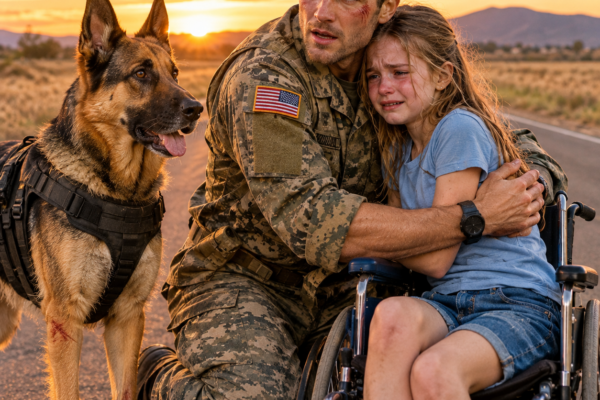
They Took Her Mother—Then a Navy SEAL & K9 Found the Girl’s Key and Exposed the Truth
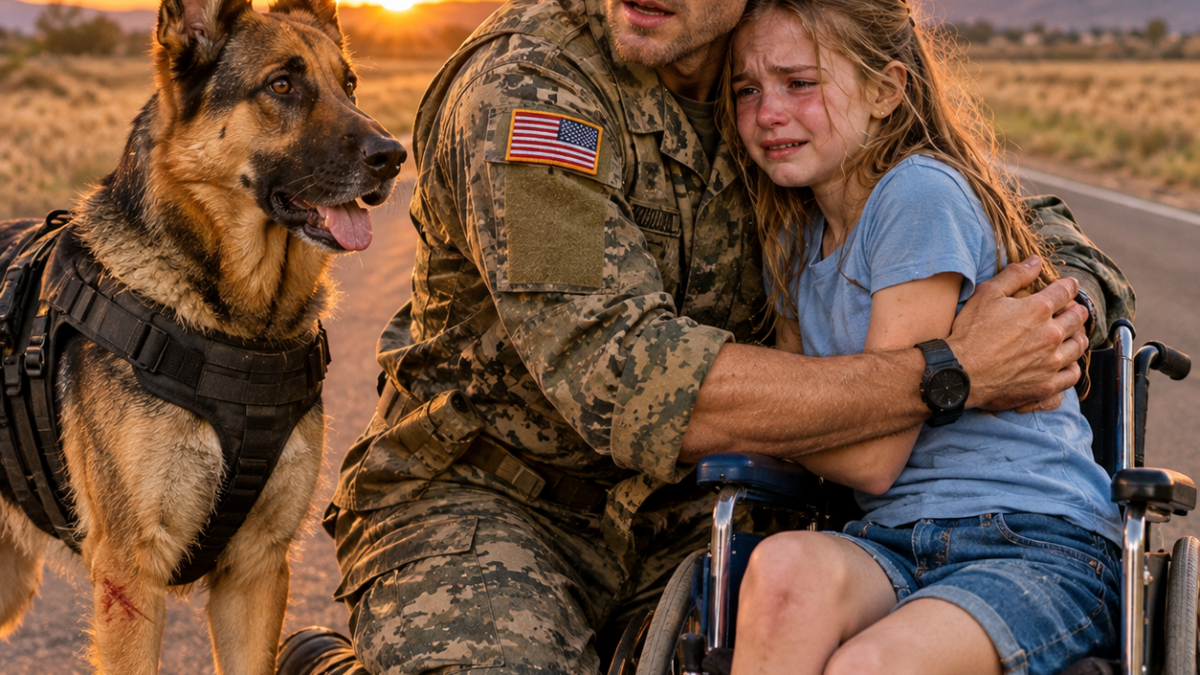
They Took Her Mother—Then a Navy SEAL & K9 Found the Girl’s Key and Exposed the Truth
A wheelchair, a dirt road, a little girl alone in the middle of nowhere, gripping the wheel rim so hard her knuckles had gone white.
That was what Grant Holloway saw when he hit the brakes.
No car, no adult, nothing but cracked asphalt and Colorado sky stretching in every direction, and a 9-year-old girl who looked like shed been rolling for miles.
She had a small silver key pressed against her chest like it was the only thing keeping her alive.
and maybe it was.
If youre new here, subscribe, hit that bell, drop your city in the comments so I can see how far this story travels. You dont want to miss what happens next.
The dog smelled it first.
Ranger was a 9-year-old German Shepherd with a titanium tipped lower canine, a 4-in scar running along his left flank, and the kind of stillness that made people nervous before they understood what he was. Hed served 6 years with naval special warfare before a fragment from an IED in Helman Province caught him in the side during a night raid.
The surgeons repaired what they could.
The rest healed on its own, the way things tend to when they have no other choice. Grant had picked him up from the kennels at Coronado 3 years ago on his last day in uniform.
Theyd been driving together ever since.
The truck was a 2019 F-250 with a cracked dashboard, a CB radio bolted under the console, and 200,000 m on it.
Theyd come through Wyoming 2 days ago, slept at a pull-off outside Laram, and were now cutting south through Fremont County on a route that had no particular purpose beyond putting distance between Grant and a version of himself he didnt want to be anymore. Hed been out of the teams for 14 months.
He hadnt figured out what came next.
He suspected that was fine.
He also suspected it wasnt. Ranger was riding shotgun with his head resting on the window frame when he suddenly lifted it.
Ears forward, muscles rigid. He didnt bark.
He just looked. Grant followed the dogs line of sight through the windshield.
He saw the wheelchair at almost the same moment he registered the girl in it. She was parked, if that was the right word, on a narrow strip of gravel at the shoulder of Colorado Route 9, about 100 yards ahead.
The land around her was flat farming country, split rail fences running into the distance, a line of cottonwoods marking a dry creek bed and a cluster of old farm buildings barely visible through summer haze a couple of miles east. Grant slowed without thinking about it, then stopped.
He sat for a moment looking at her through the glass. She was small.
Couldnt have been nine yet, maybe eight. Her hair was dark brown, pulled into a uneven ponytail that was mostly coming loose, and she was wearing a light blue t-shirt with a small stain near the collar and a pair of denim shorts.
Her hands were on the wheel rims of a manual wheelchair, an older model, wider framed, built for durability rather than speed. Both palms looked red.
Shed been pushing herself for a while.
In her right hand, pressed flat against her thigh, was a small silver key. She was watching the truck.
Grant put it in park and looked at Ranger.
Okay, he said just that. He stepped out slowly, making sure she could see him clearly before he got close.
He didnt move fast.
He kept his hands visible and didnt reach for the radio on his hip.
Hed spent enough time in villages where the wrong body language could change everything in a half second to know that confidence and threat looked nearly identical from a distance.
He stopped about 30 ft away. Hey, he said.
Normal volume. The girls chair shifted back an inch.
Ranger came around the front of the truck and stopped at Grants left side.
He didnt strain or pull. He just stood and looked at the girl the same way he looked at everything, with complete, unhurried attention.
Then he did something Grant hadnt seen him do in months.
He lowered himself flat onto the gravel, stretched his front paws out ahead of him, and waited. It was a posture Ranger used with children in the field.
patient, non-threatening, an invitation rather than an approach.
Somebody had taught him that years ago during a pre-eployment exercise that involved working alongside civilian populations, and hed never forgotten it. The girls hands loosened slightly on the rim.
She looked at the dog for a long moment.
Then she looked at Grant. Is he going to bite me?
No, Grant said.
Hes retired from what army.
She looked at Ranger again. Dogs can be in the army.
Military working dogs.
He did about 6 years. His job was finding things other people missed.
A pause. The wind moved through the cottonwoods.
A truck went by on the highway a/4 mile north, and she watched it until it disappeared.
Then she said quietly, barely audible, Please help my mom. Grant felt something lock into place.
Not urgency exactly, more like the specific kind of focus that came when a situation sharpened into something real.
Where is she?
He asked. The girl raised one hand and pointed east toward the distant farm buildings.
The farm.
Those men came this morning and she told me to go. A pause.
She said, Find the road.
How many men? The girl frowned, thinking.
Three, maybe four.
One stayed outside. Did they have weapons?
Did you see guns? She shook her head.
Not guns, but one of them had a radio like yours. Grant looked east, 2 mi, maybe a little more, across open farmland.
He could see the roof line of what looked like a main house and a larger structure beside it. Barn or equipment shed.
Hard to tell from here. He knelt down to her level.
Whats your name? Ellie.
Okay, Ellie.
My names Grant.
Im going to make a call right now, but first I need you to tell me what happened.
Then you do that.
She looked at him with the kind of measuring cautious look that 9-year-olds arent supposed to know how to do. This one had learned it somewhere.
Everyone who I told before didnt believe me, she said.
Im not everyone. Another long pause.
Rerss tail moved once against the gravel. Ellie reached toward him, fingers tentative, and touched the fur along his ear.
Ranger held completely still. Okay, she said.
Her name was Eleanor Clare Warren, but nobody called her Eleanor except her grandfather, who was gone now. Her mother was Clare Warren.
Her father, Daniel, had died 22 months ago, a tractor accident in the Eastfield on a wet November morning. Hed been trying to clear a drainage ditch before the ground froze.
The rain had made the slope slick. The details after that were brief and final.
Since then, it had been Clare and Ellie on the farm. The property was 412 acres of rangeand and irrigated crop land in a river valley that had belonged to Ellies family for three generations.
Her great-grandfather had broken ground on it in 1961.
Her grandfather had expanded the cattle operation in the 1980s.
Her father had converted 30 acres to alalfa and brought in horses on board to help stabilize the income when cattle prices dropped. It was by any reasonable measure a working farm on the edge of survival which was where most family farms lived permanently generation after generation.
Ellie had been born with spinaabida. Shed had two surgeries before she was four, used a walker through early childhood, and graduated to a wheelchair full-time at 6.
She attended school in Gunnison, 32 mi away, 3 days a week.
On the other days, she worked alongside her mother, which mostly meant she found ways to do the work people assumed she couldnt.
She had strong arms, a precise memory, and she had learned to read adults by the way they looked at her chair instead of her face.
Shed learned that a long time ago.
Grant listened to all of it without interrupting. Hed heard a lot of people talk under pressure.
operators debriefing after hits, witnesses describing ambushes, interpreters relaying accounts from village elders whod watched things happen that shouldnt have been possible.
He knew the difference between a rehearsed account and a real one.
This was real. She put things in my bag, Ellie said before the men got inside.
She came to my room and told me to go out the back and dont let anyone stop me and dont open the pouch until I found someone I could trust. A short pause.
I didnt find anyone for a while. How long were you on the road?
She shrugged with one shoulder.
A long time.
My arms hurt.
Grant looked at the wheelchair pouch clipped to the back of the chair, a black nylon storage bag, zipper closed. He looked at the silver key still in her hand.
Can I look?
he asked.
She hesitated.
You said you trusted me, he said. I said okay.
Thats different. He almost smiled.
Fair enough.
You hold it. Show me.
Ellie unzipped the pouch with her free hand and turned it so Grant could see inside without taking it.
The notebook was spiralbound, letter sized with a red cover that had been bent back on itself and flattened from being stuffed in a tight space.
Beside it were a small stack of papers folded in thirds and two photographs printed on regular paper, the kind you print at home when you dont have time to get them developed properly. Grant didnt take any of it.
He looked. The notebooks cover page was handwritten.
Property records, inspection logs, correspondence.
C. Warren.
Below that, in different ink, hastily added.
If you find this, please call the county sheriff.
Not Hail.
Do you know who Hail is?
Grant asked.
Victor Hail.
Hes the man who keeps coming to talk to my mom about buying the farm.
She said it flatly.
The way children report things theyve overheard and processed without being given context for. Mom doesnt like him.
She says he smiles too much. Grant looked at the photographs.
He couldnt read the papers from this angle, but the photos showed, he was fairly certain, sections of irrigation equipment, fencing, and what looked like a water pump, each with something visibly wrong with it. A cut pipe, a cracked housing with what looked like a tool gouge in the metal, a fence post that had been pulled from the ground and left at an angle.
Not weather damage, not aging, deliberate. He stood up.
Ellie, Im going to make a call right now.
I want you to stay exactly here with Ranger while I walk 20 ft that way and talk on the radio. Okay.
He wont move unless I tell him to.
She looked at Ranger. Okay, she said.
Grant walked to the rear of the truck, keyed the CB, and thought for 3 seconds about who to call. Not dispatch, not yet.
He didnt know the local landscape.
Didnt know who Victor Hail was connected to or how far that connection ran.
not hail on the notebook cover meant Clare Warren had already figured out that Standard Channels had a leak or a loyalty problem or both. He had a number for a retired Marine Master Sergeant named Cal Deacons whod settled in Colorado after his second hip replacement.
Theyd trained together once at Fort Bragg 15 years ago. Grant had pulled Deacons fire team out of a communications dead zone in a canyon outside Kandahar by running exposed to reach a high point and relay their position.
Deacons had bought Grant exactly one beer about it, which was one more acknowledgement than Grant expected.
He punched in the number from memory.
Three rings. Yeah, Cal.
Its Holloway.
A pause that meant recognition, not surprise.
Where are you?
Fremont County, Route 9, south of Gunnison.
Ive got a situation.
He kept it brief. The girl, the farm, the men, the notebook.
He didnt embellish. I need a name.
Trustworthy County law, not connected to local business interests. You know anybody?
Another pause. Longer this time.
Theres a woman under sheriff name of Torres, Reena Torres.
She came up through the state AGs office before she moved to Fremont.
I can make a call.
Do that.
You staying out of it until she gets there.
Grant looked east toward the roof line in the haze. No, he said a beat.
Didnt think so, Cal said and hung up.
That Grant moved Ellie.
He didnt take her back toward the farm.
The neighboring ranch.
Hed seen the mailbox half a mile north, but was a safer option.
Get her behind a door with a phone with adults who had no stake in what was happening 2 miles east. The neighboring family was named Puit.
The wife, Sandra, answered the door with flower on her apron, and the immediate, uncomplicated alarm of someone who understood that a child arriving alone meant something bad had happened to her family.
She had Ellie inside with a glass of water and her husbands hand on the phone to the sheriffs office before Grant had finished the short version of what he knew. Stay here, Grant told Ellie.
She looked at him from the kitchen chair. Her hands were in her lap, the silver key between her fingers.
Youre going to get her, she said. Not a question.
Im going to go look, he said.
Thats the same thing.
He didnt answer that. He turned to Sandra.
Nobody opens that door until either myself or a badge shows up.
Under Sheriff Torres.
Thats the name you want to hear.
Sandra nodded with the kind of precision that meant shed understood and intended to follow it. Grant went back to the truck.
Ranger was already standing at the rear passenger door.
Um, yeah, Grant said, and opened it. As some and opened.
He parked the truck a/4 mile from the farm entrance behind a stand of cottonwoods where it couldnt be seen from the main road or the buildings. He took the radio, a small pair of Steiner binos, and a folding knife that hed carried for so many years, the handle had worn smooth on the left side where his thumb rested.
He didnt have a firearm. Hed left his sidearm locked in the trucks console.
This wasnt that situation yet, and walking toward a civilian property with a weapon drawn was a choice that created more problems than it solved. Hed learned that before he ever pinned on a sealed trident in the long months of training, where the instructors hammered one thing above all else.
Violence is a tool, not a default. Most problems arent nail-shaped.
He moved fast through the field, staying low and using the irrigation BMS as cover. The ground was dry but not baked hard.
Recent irrigation maybe 3 days ago.
The crop was alalfa knee high. Good concealment for Ranger and tolerable for Grant if he went prone.
He didnt go prone. He ran bent quick covering ground the way you did when you were moving fast and didnt want to be seen from windows.
Ranger ran at his heel without a sound. They reached the treeine at the edge of the property and Grant stopped, pressed his back against a cottonwood trunk and brought up the binos.
The main house was a two-story farmhouse with white paint going gray and a covered porch along the front. One vehicle was parked at the side.
A dark blue SUV with a rental agency sticker on the bumper. Expensive trim package.
Out of place.
A man stood near the front corner of the house with a phone pressed to his ear.
Not moving, not working, watching the driveway.
Posted, Grant thought. Loose perimeter.
Probably not trained, but aware. He shifted the binos to the large structure east of the house.
A barn converted to an equipment shed from the looks of it. Corrugated metal roof, sliding doors on the far end.
One of those doors was cracked slightly open. Ranger moved, not toward the house.
He angled left toward the equipment shed, nose low and working.
Grant trusted that entirely. He followed.
They circled wide, keeping the tree line between themselves and the man at the house, and came up on the shed from the north side, where there were no windows.
The corrugated metal was warm from the sun.
Grant pressed his ear against it and heard nothing from inside.
He moved to the corner and looked around. The sliding door on the near end was padlocked from the outside.
Ranger sat down and looked at Grant. He was telling him something was inside.
Grant scanned the perimeter. The watcher at the house still had his back turned and examined the padlock.
Standard hardware store hasp.
The screw heads fastening the hasp to the door frame had been put in with a drill, not a hand screwdriver.
Theyd go in, but theyd come out too with the right leverage. He didnt have a pry bar.
He had a knife and a truck a/4 mile away.
He looked at the again, looked at the door frame. The wood was old, dry, separated slightly from the metal door track by 20 years of settling.
Grant put the flat of his boot against the door frame just below the HA hasp mounting, gripped the H hasp body itself, and applied slow, steady, outward pressure while pushing with his foot.
The screws came out of the drywood with a sound like a small dull pop. He caught the before it could clatter against the door.
He pulled the door back 6 in, slipped inside, and let Ranger follow.
The shed smelled like diesel and old grease and underneath that something else. Ranger was already moving toward the far corner past a disassembled tractor and rows of hand tools hung on pegboards.
Grant rounded a workbench.
Clare Warren was sitting on the floor with her back against the wall and her hands zip tied in front of her attached to a pipe running along the base of the wall. She had a bruise forming along her left cheekbone, and her hair was coming out of its braid, but she was upright, and her eyes were clear, and they went straight to Grant with a kind of assessing direct focus that told him immediately she was her daughters mother.
Wheres Ellie? were the first words out of her mouth.
Safe, Grant said.
Half mile north at the neighbors. She found me on the road.
Clare closed her eyes for one breath, then opened them. She got there.
She got there. He was already looking at the zip ties.
I need something sharp. These ties or the pipe bench behind you, middle drawer, box cutter.
He found it, came back, and cut the zip ties in two quick draws. Clare pulled her hands apart and shook them, wincing.
Her wrists were red and starting to swell.
How many? Grant asked.
Three inside. One outside.
She flexed her fingers.
The one outside is just a driver.
The other three are Hails people. They came for the originals.
Your daughter has the key. Clare looked up sharply.
She got out with the pouch. Everything.
Something crossed Clares face.
Not relief exactly. Something older than relief.
The specific particular exhaustion of someone who has been holding a thing together through pure force of will and has just been told they dont have to hold it alone anymore.
She pressed the back of her hand against her mouth for one second. Then she stood up.
She was was taller than Grant expected, lean with the kind of practical physical competence that came from years of real work.
Her boots were scuffed worn.
She had grease on her left forearm from something that had happened before the men arrived. We need to move before they checked back, she said.
Under Sheriff Torres is on the way.
Clare stopped.
Torres? Okay.
She looked at him.
Who are you? Grant Holloway.
Why did you stop? He considered several answers and settled on the true one.
My dog told me to.
Clare looked at Ranger, who was sitting beside the workbench watching the door. She almost laughed.
Almost.
Okay, she said. Lets go.
They were halfway across the shed when Ranger stopped.
He turned toward the sliding door, not the one theyd come in, the far door on the south end.
His ears went flat. The sound of boots on dry ground and a voice outside closer than it should have been.
Shes not on the road. Somebody found her.
Start the car.
Grant didnt hesitate.
He grabbed Clares arm and pulled her toward the north door, the one theyd entered, moving fast and low between the tractor chassis and the tool racks. Ranger was already ahead of them, silent, pressing himself flat along the base of the wall in the way working dogs learned when silence was the only option that kept everyone alive.
The south door rattled, someone testing it from outside, finding the padlock missing, working it out. Grant got Clare to the north door and put his back against the frame.
He held up two fingers, then pointed at the gap. She understood.
She pressed herself against the wall on the opposite side and didnt ask questions.
He respected that immediately.
He listened.
Two sets of footsteps outside the south door, not one.
Theyd sent two people around, which meant the third was probably still in the house, and the driver was either staying with the vehicle or moving to cover the front. Standard flanking instinct, even in people with no training, block the exits, cut off movement.
The problem was that whoever was running this operation, halespeople, hired hands, fixers, whatever they were, had the same basic idea most civilians had when they tried to control a space.
Cover the obvious doors and wait. What they didnt understand was that covering an exit only worked if you had eyes on it.
If you move fast enough, the coverage turned into a gap.
Grant put one hand on Clares shoulder and pressed down once. Stay.
Then he cracked the north door 2 in and looked through the gap. The cottonwood tree line was 60 ft of open ground away.
Beyond that, the field. Beyond the field, the truck.
The watcher whod been posted at the corner of the house was no longer there. That was bad.
Grant scanned fast.
The man had moved.
He could see him now, coming around the south side of the shed, maybe 40 ft away, phone in hand, walking with the deliberate pace of someone whod been told to check the north exit.
He hadnt seen the door yet. Grant let the door fall back to its closed position, and turned to Clare.
He mouthed, Other way.
She frowned, glanced toward the south door, still rattling, someone working the hasp, and then looked back at him with an expression that said she understood the problem without needing it, explained.
Grant looked at the shed interior. The east wall had a window, single pane, woodframe, shoulder high.
It was the only window in the structure. It was also on the side, facing open pasture land that ran east for a/4 mile before it hit the tree line along the creek bed.
No direct line of sight from the house.
No line of sight from either door.
He pointed at it.
Clare went.
She was fast and quiet about it.
Grant followed, watching both doors and staying low.
Ranger came last, flowing around the workbench like water finding a path. Grant checked the window latch, painted shut along the bottom.
Years of it, he didnt waste time trying to pry it open quietly. He took the box cutter from his pocket, ran the blade hard along the paint seam on three sides, and then pressed the frame in while simultaneously pushing up on the sash.
It ground open with a sound like a drawer that hadnt been pulled in a decade.
Loud.
Not catastrophically loud, but loud.
He heard footsteps on the southside stop. Go, he said.
Clare was through the window frame in 4 seconds, dropping to the ground outside with a thud that she absorbed by bending her knees.
An automatic motion that told him shed taken hard landings before.
Ranger went next, clearing the sill in one fluid motion that didnt look like effort.
Grant went last, pulling the window back down behind him.
They ran, not sprinting, controlled, fast movement across the pasture grass, staying low to use the natural contour of the ground.
The field ran slightly downhill toward the creek, which helped. Grant stayed to Clares left, matching her pace.
She was running through what had to be real pain.
Her wrists were still swollen, and her gate carried the small, tight compensations of someone fighting through it, but she wasnt slowing down.
Ranger ran ahead, stopped once at the top of a slight rise, looked back, and then continued. Behind them, someone shouted from the direction of the shed, then a second voice closer.
Theyd found the open window.
Grant glanced back without breaking stride. He could see one figure at the corner of the shed pointing in their direction, talking into a phone.
Not pursuing, calling it in instead.
That meant Hail, wherever Hail was, was going to know within the next 30 seconds that Clare Warren was no longer in the shed and that someone had helped her out. They reached the creek treeine and dropped below the bank into the shade of the cottonwoods.
Clare went to one knee, breathing hard.
Grant stopped beside her and looked back across the field.
The figure at the shed was still on the phone, not moving.
Theyre not following, Clare said between breaths.
Not yet. Grant was already thinking about why.
Theyre figuring out what to do. They came here to get documents.
They dont have the documents.
Coming after us on foot across open ground is a different problem than leaning on a woman in her own shed. Clare looked at him.
Theyre not your standard property dispute attorneys, she said.
No, he agreed. Theyre not.
She pushed her hair back with both hands, wincing as her wrist flexed.
Then she straightened up and looked east, then north, orienting herself. Even now, rattled and hurting, she was reading the land.
Pruits place is north, she said. Thats where Ellie is.
Clare closed her eyes for a half second.
She opened them. Walk me through the creek bed, she said.
It stays below sight line all the way to the fence line. Ive been walking it since I was six.
Grant looked at Ranger.
Ranger was already facing north along the bank.
Lead out, Grant told him. But the creek bed was dry except for a thin seam of moisture down the center that turned the clay dark brown.
It smelled like iron and old leaves and the particular mineral dryness of a Colorado summer that hadnt had enough rain. Cottonwood roots knuckled out from the banks in tangled formations, and in places the bank was undercut enough that they had to lean away from it to avoid bringing it down on them.
Clare walked without complaint.
She knew every turn. They moved for 11 minutes before the Puit fence line came into view.
A four strand barbed wire fence with cedar posts, old and solid. Grant found a low section and held the top wire down while Clare stepped through.
She returned the favor without being asked. Ranger went under it.
The Pruit House was 200 yd across a moan pasture. The lights in the kitchen were on, which meant the afternoon had darkened more than Grant had realized.
He checked his watch.
5:47 p.m.Theyd been inside the shed for less time than it felt. Sandra Puit met them at the back door before theyd crossed half the distance, moving across the yard fast with the focused energy of someone whod been watching for them from the window.
Shes inside, Sandra said before Clare could speak.
Shes fine.
She had three glasses of water and shes been telling my husband everything. Claires stride didnt change, but something in her shoulders dropped an inch.
Just an inch.
Thank you, she said.
Her voice came out rougher than she probably intended.
Inside the kitchen, Ellie was at the table with a map of the property spread out in front of her.
Doug Puits county assessment map, the kind that showed parcel lines and water rights and easements.
and she was using a red pencil to mark locations while Doug Puit watched with the careful attention of a man who had been listening to a child for the last hour and had sometime in that hour started taking her completely seriously. Ellie looked up when the back door opened.
She saw her mother. She didnt make a sound.
She pressed her mouth shut and her face did the particular private thing that childrens faces do when they are trying very hard not to cry in front of people they dont know.
and she pushed her chair back from the table and Clare crossed the kitchen in four steps and went down to her knees on the lenolium and put both arms around her daughter. Grant stood at the door with his hand on Rangers back.
He looked at Doug Puit, who looked back at him with the kind of expression that required no words. Sandra quietly filled two glasses of water and set them on the counter.
After a moment, Clare straightened up.
Her eyes were wet at the corners, but her jaw was set. I need to see whats in that pouch, she said.
Ellie wiped her face with the back of her hand.
Then she unclipped the pouch from the side of her wheelchair and held it out.
Clare took it and sat down.
She went through it at the kitchen table with Grant standing across from her and the Puit staying deliberately busy at the far end of the counter, close enough to be present, far enough to give space. The notebook was hers.
Shed been keeping it since November of the previous year, she said when the first inspection had come back with findings she knew were wrong.
Irrigation system she had personally maintained flagging as deteriorated beyond repair.
A contamination marker in the east well that didnt match any geology she recognized because shed had the well independently tested 3 months earlier and it had been clean.
I didnt have the language for it at first, Clare said.
She was turning pages carefully, reading her own handwriting with the distance of someone reviewing evidence rather than memory. I thought I was just missing something, being wrong.
I was tired. Id been running this place alone.
Maybe Id let maintenance slip somewhere and didnt remember. She stopped on a page with two columns of dates.
Then the second inspection came back and then the third.
And every time the findings were worse and every time the things flagged as damaged were things I knew Id maintained.
She looked up. So I started photographing everything before the inspectors arrived after they left.
Equipment status, water readings, fence condition. I kept the originals in the locked cabinet and the copies in the pouch.
And the cabinet key, Grant said.
Ellie was quiet beside him, listening. My daughter knows where the spare keys to everything on this property are.
Clare said, She has since she was six.
She memorized the map. She memorized the lock combinations.
She memorized which cabinet has which records.
A pause. Because I thought about what would happen if something happened to me, and I decided she needed to know.
Ellie didnt say anything. She was looking at the map Puit had spread on the table, her red pencil resting across her fingers.
Grant picked up one of the photographs. It showed an irrigation pump with a clear gouge cut through the housing casing, not a stress fracture, not corrosion, a clean cut made with something metal and deliberate.
Who had access to the property?
He asked.
The inspection teams, Clare said it flat.
They were contracted through a regional property assessment firm. Hail was using them.
I found that later.
It took 3 months in a public records request that the county dragged their feet on, but I found it. Thats in the notebook.
Everything is in the notebook.
Grant set the photograph down.
He thought about what hed read on the front cover. Not Hail.
Not a general warning, a specific one. Clare had already done enough work to know that Hails reach extended somewhere into the county structure.
She just didnt know how far or shed have used that particular thread already.
Torres, he said. Under Sheriff Torres.
You know her?
Clare thought for a moment. She came to a county meeting about 6 months ago, water rights hearing.
She didnt say much. I didnt have a reason to pay attention to her.
She came through the state AGs office before Fremont County. Grant said, The person who told me her name has good judgment about people.
If shes connected to anything Hail is running, shes either very deep cover or theres no play left. Clare looked at him.
Thats a lot of trust to put in a person youve never met based on a recommendation from someone else you barely know.
Yeah, Grant said.
It is.
She held his gaze for a moment.
Okay, she said.
Doug Puit cleared his throat from the far end of the counter. That under sheriff, he said.
She called here about 40 minutes ago. Said shes coming from Canyon City.
Said to expect her around 8.
Everyone looked at him.
He shrugged. I was going to mention it.
One. The next two hours were the suspended operational kind of waiting that Grant had learned in the teams.
the hours before a mission launch when everything was staged and checked and ready and the only thing left was time, which was the one thing you couldnt compress. You used it the way you could.
You ate if there was food.
You slept if you could sleep.
You reviewed the plan without obsessing over it.
He ate a plate of Sandras leftover pot roast standing at the counter. It was good.
He told her so. She looked pleased and slightly surprised, the way people did when theyd expected someone to be too distracted to notice.
Ellie ate at the table and eventually fell half asleep in her chair with Rerss head across her lap.
The dog didnt move. Hed found his post and he was keeping it.
Clare sat at the table with the notebook open and worked through it methodically, cross-referencing dates, adding annotations in the margins, and small, precise handwriting. She worked the way people worked when theyd been building something for a long time.
and had finally been given permission to finish it.
Grant moved to the front room window and watched the drive.
At 7:22 p.m., a black county SUV came up the Puit road without lights or siren, moving steady and deliberate.
It stopped at the gate.
The drivers door opened and a woman stepped out, mid-40s, compact and efficient in her movements, wearing civilian clothes with a badge clipped to her belt and a radio on her hip. She stood at the gate for a moment and just looked at the property with the systematic sweeping attention of someone who cataloged space for a living.
Then she looked directly at the front window where Grant was standing.
He stepped back from the glass.
Shes here, he said. Renaore came in without theater.
She sat down at the kitchen table, declined the coffee Sandra offered, and looked at the notebook Clare slid across to her.
She read for 6 minutes without speaking. Nobody filled the silence.
Ranger watched her from his position beside Ellies chair. His ears stayed neutral.
Not alarm, not welcome.
Evaluation.
Torres turned to page. Then another.
She stopped at the double column date list and looked at it for a long time. You documented the pre-insspection and post inspection equipment states.
She said photograph log and written record, both dated and timestamped.
Independent verification on the well testing.
Fremont County Water Lab in March. Certificate of analysis is at the back of the notebook.
Torres turned to the back, found it, read it.
She turned another page. Grant was watching her face.
She read the way investigators read.
 [Tap here for the Next Part ]