I Found Her Stranded at an Abandoned Gas Station… And She Changed My Life
I Found Her Stranded at an Abandoned Gas Station… And She Changed My Life
The first thing Emily Harper ever said to me was, “Before you come any closer, tell me your name and put your driver’s license on the hood where I can see it.”
That was how I knew she was frightened, not helpless. It was a little after 8 on a Friday night in late September.
I was driving home to Marlo, Missouri, with a replacement temperature controller for my pizza oven sitting on the passenger seat of my truck. The restaurant supply warehouse outside Colombia had stayed open 10 extra minutes for me, and I had spent most of the drive wondering whether the old oven was finally trying to tell me it was ready for retirement. Then my headlights swept across the abandoned gas station on County Road 12.
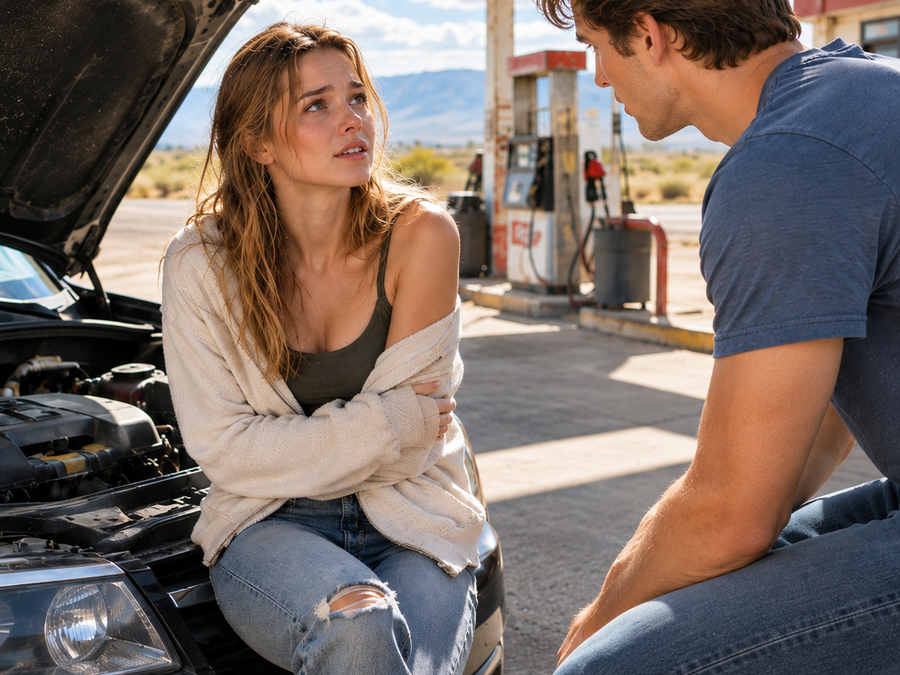
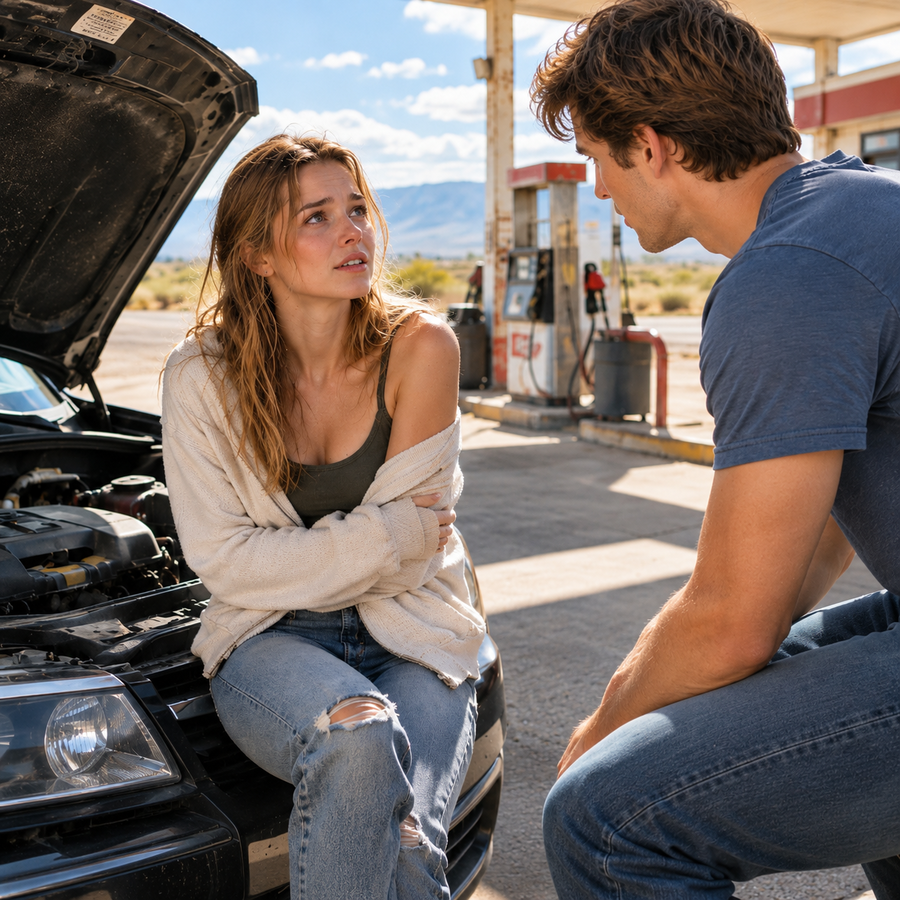
A gray SUV sat beneath the rusted canopy with its hazard lights blinking. The hood was raised.
A woman stood several feet away from the engine, holding her phone in one hand and a small flashlight in the other. I slowed down, pulled onto the cracked pavement, and stopped far enough away that she would not feel trapped.
When I opened my door, she raised the flashlight toward me.
“Stay there, please.”
I did.
“My name is Mark Dalton,” I said.
“I own Dalton’s Pizza in Marlo.
My license is in my wallet.
Put it on the hood of your truck.”
There was nothing unreasonable about the request. A woman alone beside a broken car on a dark rural road had every right to be careful. I placed my license where she could see it, then stepped back.
She approached slowly, keeping several feet between us. She read my name, looked at my face, and handed the license back.
Thank you, she said.
I’m Emily Harper.
Are you hurt? No.
The temperature warning came on about 5 m back. Then I saw steam, so I pulled over and shut the engine off. Good.
Don’t open the radiator cap.
I wasn’t planning to.
Her mouth moved slightly, almost a smile. I know enough about cars to understand when one is telling me to stop touching things. I glanced beneath the SUV.
A small puddle had formed near the front, but I did not crawl under it or pretend I could repair a cooling system with the tools in my truck.
“You’ll need a toe,” I said.
I reached that conclusion about 20 minutes ago. Unfortunately, my phone reached a different conclusion about continuing to participate. She held up the black screen.
I have a charger in the truck. The cable brought her phone back to life, but the signal came and went.
I had two bars on mine, so I called Lawson’s garage in Marlo.
The dispatcher said their driver was finishing another job and could reach us in about 50 minutes. Emily looked at the empty road behind me.
You don’t have to wait.
I know. I mean it. The tow truck has the location.
And you’re standing at a gas station that has been abandoned since before smartphones had decent cameras.
She folded her arms. That is a strangely specific argument.
My father used to stop here when I was a kid. Mr.Hail sold gasoline, fishing worms, and the worst coffee in Missouri.
The place closed about 12 years ago.
So, you’re staying because of nostalgia?
I’m staying because leaving you here alone would bother me all night.
She studied me for a moment, then nodded toward the passenger side of my truck. Can we wait inside?
I’m beginning to regret choosing a blouse instead of a jacket.
I moved the oven part behind the seat and turned on the heater. Emily sat with her purse on her lap and kept her phone plugged into the charger. For the first few minutes, we talked about practical things.
The tow truck, her hotel, Weather Lawson’s garage would be open in the morning.
She was staying at the Maple House in in Marlo, 18 mi away. She worked for a company that planned and renovated public libraries, and she had come to oversee a 4-month project in Riverorton, the next town east of us.
“So, you design libraries?”
I asked.
“I helped decide how the space should work,” she said.
Where people gather. Where children can make noise without driving everyone else insane. Where someone can sit alone without feeling watched.
Architects handle the building. I handle how people live inside it.
That sounds harder than making pizza. Pizza has expectations. Libraries have committees.
I laughed. She turned toward me.
You really own the pizza place for 14 years. Is it good?
I’m legally required to say yes.
That wasn’t convincing.
It’s good enough that people complain when I close for one day.
Better. She asked why I had driven so far for an oven part.
I told her Dalton’s pizza was small enough that every broken machine became my personal emergency.
I still made dough most mornings, worked the oven on busy nights, and delivered large orders when my drivers were overwhelmed.
So, you’re the owner, cook, repair coordinator, and backup delivery man.
That sounds more impressive than it feels. It sounds exhausting.
The comment landed closer to the truth than I expected. I looked through the windshield at the empty highway.
I’m used to it.
Emily did not answer immediately. I had heard that phrase for myself so often that I had stopped questioning it. Being used to something did not mean it was working.
It only meant I had learned how to carry it without making noise. The tow truck arrived 53 minutes after my call. The driver inspected the SUV, pointed out a split hose near the radiator, and secured the vehicle to the flatbed.
He told Emily the garage would evaluate the damage in the morning. She signed the paperwork and watched her car disappear onto the road.
“I can call the inn and ask them to send someone,” she said.
At this hour, the person answering the desk is probably Mrs.Parker, and she stopped driving after dark 3 years ago. You know, everyone in this town, almost everyone. That could either be comforting or terrifying.
It depends on how many secrets you have. She smiled fully for the first time.
I opened the passenger door for her, but before she got in, I said, “There’s something I should ask now so you don’t think the ride comes with hidden conditions.”
Her expression became cautious again.
I’ll take you safely to the inn whether your answer is yes or no.
I continued, “But I like talking to you, and I’d rather not wait for another mechanical failure to see you again.
Have dinner with me tomorrow night.”
Emily looked at the abandoned station, then back at me. You always ask women out beside broken cars only when the conversation is unusually good. And where would this dinner happen?
my pizza place.
After closing, you can inspect the kitchen before deciding whether I’m trustworthy.
She held my gaze for a few seconds. Then she stepped into the truck and fastened her seat belt.
7:30, she said, “But I’m paying for my own pizza, the Maple House, and stood at the edge of downtown, a three-story brick building with white columns and a porch wide enough for six rocking chairs.
Mrs.Parker was still awake behind the front desk, reading a mystery novel with a magnifying glass balanced over the page. She looked at Emily, then at me.
“Cor trouble?”
she asked. Emily blinked.
“How did you know?”
“Mark only brings strangers here when something has gone wrong.”
“That makes me sound less reliable than I am,” I said.
Mrs.Parker closed her book. Last stranger was a salesman whose rental car hit a deer.
The deer walked away. The salesman did not. Emily laughed and some of the tension left her shoulders.
While Mrs.Parker prepared the room key, Emily called Lawson’s garage from the lobby phone and confirmed that they had her SUV.
Then she gave the in her company card and signed the registration form.
I wrote my number on the back of a Dalton’s pizza receipt.
In case the garage calls and you need a ride, I said, “Or in case you decide 7:30 was a terrible idea,” she took the receipt.
“I’ll let you know which one happens first.”
At 9:16 the next morning, my phone buzzed while I was replacing the temperature controller on the oven.
The message read, “The garage says the damaged hose can be replaced today.
Also, I have not changed my mind about dinner. I looked at the screen longer than necessary. My kitchen manager, Rosa Alvarez, noticed.
Either the oven part works, she said. Or someone finally asked you to leave the restaurant. Neither.
She leaned closer, trying to read the message. I turned the phone over. Rosa had worked with me for 11 years and considered privacy a temporary obstacle.
Woman, she asked. I met someone last night.
Where? An abandoned gas station.
She stared at me. Her car broke down.
That explanation helped, but not enough. I told her the short version while we finished installing the new controller.
Rosa listened without interrupting, which was unusual. When I mentioned dinner after closing, she nodded toward the dining room. Then you should go home and change first.
I own clean shirts. You own shirts without tomato sauce.
That is not the same thing. Saturday was steady from lunch until 7. Families filled the booths.
Two youth soccer teams arrived within 10 minutes of each other and one of our delivery drivers called in sick. By the time we locked the front door at 7:15, I smelled like flour with smoke and garlic.
Rosa had been right. I changed in the small office, washed my hands again, and returned to the dining room wearing dark jeans and a blue button-down shirt.
The restaurant looked different without customers. The pendant lights over the booths gave the room a soft amber glow, and the open kitchen still held the warmth of the oven. Emily arrived exactly at 7:30.
She wore a green sweater, black pants, and the same practical shoes she had worn the night before. Her hair was down now, resting against her shoulders. She stopped inside the doorway and looked around.
This is nicer than I expected. That sounded almost insulting. I pictured plastic tablecloths and a man named Tony yelling near a freezer.
We had plastic tablecloths until 2018. Tony retired. She smiled.
So, I was only partly wrong. Her SUV had been repaired that afternoon.
Lawson had replaced the split hose, refilled the coolant, and pressure tested the system before releasing it. She had driven it from the garage to the inn without any warning lights.
I still checked the temperature gauge every 30 seconds. She admitted that is normal after a breakdown. You say that like you have experience.
I own a restaurant. Every machine becomes suspicious after it fails once. I handed her a menu.
She looked at it then at the counter. I said I was paying and I believed you. I rang up a small pizza and a sparkling water.
She paid with her card, accepted the receipt, and placed it carefully in her purse.
“No argument,” she asked.
“You were clear.
That is unexpectedly refreshing. What do you want on it? Mushrooms, roasted peppers, and sausage.
Good choice. You would have said that no matter what I chose, not pineapple.
I like pineapple.”
I put both hands on the counter. We were doing so well.
She laughed again. I prepared the dough while she sat at the counter facing the open kitchen. I did not perform tricks or toss it toward the ceiling.
I stretched it by hand, spread the sauce, and added the toppings she had chosen.
“You really do everything yourself?”
she said.
“Not everything.
Rosa runs the kitchen when I’m gone.
My nephew handles most deliveries, but I still like making the food. Then why did you sound tired when you described it last night?
The question was direct, but not unkind. I slid the pizza into the oven. Because liking something and carrying too much of it can happen at the same time.
Emily rested her elbows on the counter. That may be the most honest thing anyone has ever said about work.
What about you? She looked toward the darkened windows. I like building places where people feel welcome.
I don’t like spending 4 months in a town, learning everyone’s name, and leaving just when it begins to feel familiar.
So, why keep doing it?
Because I’m good at it.
That was not the question. She looked back at me and for a moment I thought I had pushed too far. Then she nodded.
No, she said quietly.
It wasn’t.
The timer sounded. I turned to the oven, lifted the pizza onto a wooden board, and cut it into six slices.
Emily watched the steam rise from the crust.
“That smells unfairly good,” she said.
“Unfair to whom?”
“To every frozen pizza I have defended after a 12-hour workday.
” I carried it to a booth near the front window and brought two plates.
I had made myself a smaller pizza with pepperoni and onions, though I suspected I would spend more time talking than eating. Emily took one bite and closed her eyes.
I waited. She opened them again. All right.
You were not exaggerating. I will accept that as a formal review.
I have notes. Of course you do. The crust is excellent.
The roasted peppers are better than the mushrooms and pineapple would improve it. That last sentence erased your credibility.
She smiled and took another bite. For the next hour, the conversation moved easily.
She told me about libraries she had worked on in Kansas, Iowa, and southern Illinois.
In one town, the children’s section had been squeezed into a narrow basement room because the committee believed children needed less space than adults.
Emily had convinced them to move it upstairs beside the largest windows.
6 months later, she said, “The library director sent me a photo.
Every seat was full. You keep the photo.
It’s framed in my apartment.
So, you do get attached to the work. That is not what I meant.
She looked down at her plate. I know. I did not push her.
Directness was not the same as demanding an answer before someone was ready to give it.
Instead, I told her how Dalton’s pizza had begun.
My father had opened it with 12 tables, a secondhand oven, and a loan my mother had been certain would ruin us.
I had worked there after school, left for college, and returned when my father’s health began to fail.
Did you always plan to take over? Emily asked.
No, I studied accounting. She raised an eyebrow. You left accounting for pizza.
I lasted 11 months in an office. Then my father called and said he needed help for one summer and the summer became 14 years.
Something like that. Do you regret it? I considered the question honestly.
No, but I sometimes regret never deciding what came next. I kept solving the problem in front of me and eventually that became my entire life. Emily folded her napkin.
That sounds familiar. What did you postpone?
A home, she said. Not a house, a home. She explained that her apartment was in St.Louis, but she spent more nights in hotels than in her own bed.
Most of her furniture had been chosen because it was easy to move even though she had lived there for 5 years. I own four coffee mugs, she said.
Three are still in the box they came in. That may be the saddest thing you have told me.
It gets worse. I use the same white one every morning. Then why for optimism?
The word stayed with me. When we finished eating, I cleared the plates and brought out two small dishes of vanilla ice cream with warm cinnamon dough bites. Emily protested that she had not ordered dessert.
This is not part of the date, I said. It is quality control, and you perform this quality control every night only when necessary. She took one bite.
Very responsible. At 9:30, I walked her to her SUV.
The street was quiet except for the low hum of the bakery refrigerator next door.
Emily stopped beside the driver’s door.
I had a good time, she said. So did I. I did not search for a clever line.
I want to see you again. Her expression softened.
I’ll be in Riverton most weekdays until 6:00.
The project starts Monday. I close early on Tuesdays.
Are you asking me out again? Yes. What did you have in mind?
There’s a trail along Miller Lake.
We could walk before sunset, then get dinner somewhere I do not own. She laughed. Tuesday works.
6:30. 6:30. I held out my hand.
She looked at it amused, then shook it. That is a very formal way to end a date.
I thought it was safer than guessing. Emily did not let go immediately.
You could have asked, she said. So I did. May I kiss you?
Her answer came without hesitation. Yes. I stepped closer and kissed her once gently beneath the yellow light above the restaurant door.
When we separated, she still held my hand. That was better than a handshake, she said.
Considerably, she drove back to the inn and I stood on the sidewalk until her tail lights disappeared at the end of Main Street.
Then I went inside, turned off the dining room lights, and found Rose’s handwritten note beside the register.
Do not ruin this by pretending you are too busy. I folded the note and put it in my wallet. Tuesday evening was clear and cool, the kind of early fall weather that made every field look sharper beneath the fading light.
I reached Miller Lake 10 minutes early and found Emily already waiting near the trail entrance. She wore jeans, a navy jacket, and carried two paper cups.
“One is coffee,” she said.
“The other is an apology.”
“For what?”
I stopped at the gas station in Riverortton and bought the only coffee available. After one sip, I understood what your childhood gas station must have served. I accepted the cup and tasted it.
This may be worse. Then the apology is yours.
We walked the two-mile trail around the lake. Emily told me about her first day at the Riverton Library. The building had good bones, but poor use of space.
The children’s section was hidden behind tall shelves.
The computer tables blocked two windows, and the meeting room had only one electrical outlet. The committee wants everything to look modern, she said.
But half the town wants nothing changed. What do you want? A library that still feels familiar, but works better than it did before.
That sounds reasonable. You have never attended a public planning meeting.
She was right. At the far side of the lake, we stopped near a wooden overlook. The water reflected the last orange light from the sky.
Emily leaned against the railing.
I’ve been thinking about what you said Saturday about pineapple, about solving the problem in front of you until it becomes your entire life.
I waited. My company offered me a permanent position in Chicago, she said. I would supervise several project teams instead of moving from town to town.
That sounds like a promotion. It is.
Do you want it? She looked across the lake. I want parts of it.
Better pay, more control over my schedule, an actual office. But but Chicago has never felt like home to me.
And accepting the job would mean admitting that I built my career around being temporary. I understood the fear beneath the words. A decision could close one door even when it opened another.
When do they need an answer? By the end of October. That gives you a month.
You say that like a month is a long time. It is long enough to make a decision carefully, not long enough to avoid one. She gave me a sideways look.
You are very direct. I have been accused of worse. No, I like it.
We finished the trail and drove separately to a small diner outside town. The food was ordinary, but Emily made the evening feel important. She asked questions and listened to the answers.
She noticed when I avoided talking about myself and brought me back without making it feel like an interrogation.
At the end of dinner, I asked whether she wanted to come to Dalton’s on Sunday afternoon.
I have a delivery for the Riverortton Library, I said. 120 boxed lunches for their volunteer cleanup day.
You could supervise my professional approach to sandwiches. I thought you made pizza.
People occasionally demand variety.
I’ll be there.
Sunday morning began at 6:00. Rosa and I prepared sandwiches, salads, fruit cups, and cookies while my nephew Luke labeled the boxes. Emily arrived at 8:30 wearing work clothes and carrying a roll of printed floor plans.
I assumed you would need help, she said. You are a guest.
I am a guest with functioning hands. I gave her a stack of labels.
She worked beside us for nearly 2 hours without trying to take charge. When Rosa explained our system, Emily followed it.
When Luke misplaced 12 vegetarian boxes, she found them beneath the wrong table and reorganized the loading order. Rosa watched her with open approval.
By 10:30, everything was packed into my van.
“You are coming with me?”
I asked. Emily held up the floor plans.
“I have to be there anyway.”
The Riverton Library stood on a corner near the courthouse. A square limestone building from the 1950s.
Volunteers were already carrying boxes of old books into a rented storage trailer. Inside, Emily changed.
At the restaurant, she had been relaxed and teasing. In the library, she became focused and certain.
She knew which shelves could be moved, which walls could not, and why the children’s reading area needed a clear line of sight from the main desk.
She spoke to the volunteers with respect, including the ones who disagreed with her. An older man pointed toward a row of heavy wooden shelves.
“Those have been there since my wife was a girl,” he said.
I don’t see why they need to move.
Emily opened one of her plans. They are staying in the library, she said.
But moving them 6 ft will create enough room for two wheelchair accessible tables near the front window. The man studied the drawing.
My wife uses a wheelchair now. Then I would like her opinion before we finalized the layout.
He nodded slowly. All right.
I watched Emily continue through the room and something became clear to me. She did not simply design places. She made people feel included in decisions that frightened them.
After the lunchboxes had been distributed, I found her in the future children’s section.
She stood near a wall covered with faded murals of trees and animals. The committee wants to paint over this, she said. Do you?
No. I want a local artist to restore it and add new sections painted by children from the elementary school.
That is a good idea. It will also take more time and create three additional meetings. You still want to do it.
Yes, I stepped beside her. You care about this town already. I care about the project.
That is not the same thing. Her eyes moved to mine.
You keep noticing things I would prefer to hide. I could pretend not to.
Please don’t.
I kissed her there beneath a painted owl with one missing eye. The library director walked around the corner, stopped, and immediately turned back.
“I saw nothing,” she called.
Emily covered her face with one hand. I laughed until she started laughing, too.
That afternoon, she helped me unload the empty containers at the restaurant. Before leaving, she stood beside her SUV and looked toward Main Street.
“I understand why you stayed,” she said.
“At the restaurant in this town?”
I glanced at the familiar storefronts, the barber pole that had not worked in years, and Mrs.Parker sweeping the porch of the inn.
“It is not perfect.
No place is.”
“What about you?”
I asked.
“Could you stay anywhere long enough to find out?”
Emily did not answer immediately.
Then she said, “I don’t know yet.”
It was honest and I respected it. But for the first time since meeting her, I felt the distance between four months and forever. Over the next four weeks, Emily and I stopped treating every meeting like an accident we had been lucky enough to repeat.
She came to the restaurant on Thursdays after the library committee meetings. Sometimes she ate at the counter while I worked. Sometimes Rosa handed me my jacket and ordered both of us to leave before I found another task.
I began closing Dalton’s on Monday nights.
The first time I posted the new hours, I stood outside staring at the sign as though I had announced the end of the business. Nothing terrible happened.
Customers adjusted. Rosa accepted more responsibility. Luke learned how to handle the evening inventory without calling me every 10 minutes.
The restaurant remained standing, and for the first time in years, I had one evening each week that did not belong to an oven, a delivery schedule, or a stack of invoices. Emily and I used those evenings well. We cooked in the small kitchen at her apartment in St.Louis.
We attended a high school play in Marlo because one of my employees had a daughter in the cast. She took me to an architecture lecture that I understood only half of and I took her to a county fair where she defeated me at a ring toss game and refused to let me forget it.
At the end of October, she came to Dalton’s after closing and found me repairing a loose hinge on the flower cabinet.
I gave them my answer, she said. I set down the screwdriver. The Chicago job?
She nodded. What did you decide? I turned it down.
I did not celebrate. I did not assume the decision had been made for me. Are you sure?
Yes. She took a seat at the counter.
It was a good position, but it was the wrong life. I would have accepted it because it looked like progress, not because I wanted to live there. What happens now?
My supervisor asked what kind of position I would accept, so I told her. Emily had proposed becoming a regional project lead based in St.Louis. She would supervise library renovations across Missouri and southern Illinois, but she would travel for shorter periods and spend most weeks in one place.
The company had not promised anything yet, but they had agreed to review the position before the Riverton project ended. And if they say no, I asked, then I look for something else. You would leave the company?
I might. There was no panic in her voice.
She had not solved every detail. But she had finally chosen the direction of her own life instead of waiting for a company to choose it for her.
She reached across the counter and took my hand. I need you to understand something.
I didn’t turn down Chicago because I met you.
I nodded. I turned it down because meeting you reminded me that I am allowed to want a life outside my work. That may be the best reason.
And I’m not asking you to change your entire life for me either.
I already changed the restaurant hours. One night it was emotionally significant. She smiled.
Then we are both making progress. The Riverton Library reopened in January.
The restored mural remained on the children’s wall.
Local students had added birds, flowers, and a crooked red fox beside the original trees. The wheelchair accessible tables stood near the front windows, and the old wooden shelves had been moved exactly 6 ft.
At the opening ceremony, the older man, who had questioned Emily’s plan, arrived with his wife.
She rolled her wheelchair to one of the new tables, placed both hands on its surface, and thanked Emily without making a speech. Emily looked at me across the room.
She did not need to say anything. I understood why she had chosen this work.
2 days later, her company approved the regional position. She kept her apartment in St.Louis, and I kept my house in Marlo.
The drive between us took a little over an hour. It was not effortless, but it was manageable. We planned our time instead of pretending distance would disappear simply because we loved each other.
By spring, Rosa had become the official general manager of Dalton’s Pizza.
I still made dough and worked busy weekends, but I stopped treating exhaustion as proof that I cared more than everyone else. Emily helped the Riverton Library create a monthly reading program at the restaurant. On the first Sunday of every month, we pushed two tables together near the window, and a librarian read stories while children ate small pizzas and argued over which book should come next.
One evening, almost a year after we met, Emily and I drove along County Road 12. When we reached the abandoned gas station, she asked me to pull over. The old canopy still leaned slightly toward the road.
The county solar safety light glowed above the cracked pavement. The same light that had made her visible from the highway that first night, we stood beside my truck where her SUV had once been loaded onto the tow vehicle.
Emily looked around. This place is less romantic than I remember.
It smelled like coolant and wet weeds.
And you put your driver’s license on the hood.
You were holding a flashlight like a weapon. It was the only object available.
You also had a tire iron. I liked having options. I smiled and took a small box from my jacket pocket.
Her eyes dropped to it, then returned to my face. I did not kneel.
I was not proposing marriage and I had learned not to turn important moments into something they were not. Inside the box was a key.
What is that? She asked.
My house. She remained silent. So I continued.
I am not asking you to give up your apartment tomorrow. I am not asking you to move before you are ready. I am asking whether you want a key because I want you to have a place in my life that does not depend on visiting hours or a planned weekend.
Emily lifted the key from the box. You rehearsed that several times. It was good.
Is that a yes? She closed her fingers around the key. Yes.
Then she kissed me beneath the county light at the abandoned station where both of us had once believed we were only passing through. I used to think Emily changed my life because she appeared beside a broken car on a road I almost drove past.
That was not the real change. She taught me that staying busy was not the same as moving forward. I reminded her that building places for other people meant very little if she never allowed herself to belong anywhere.
THE END.