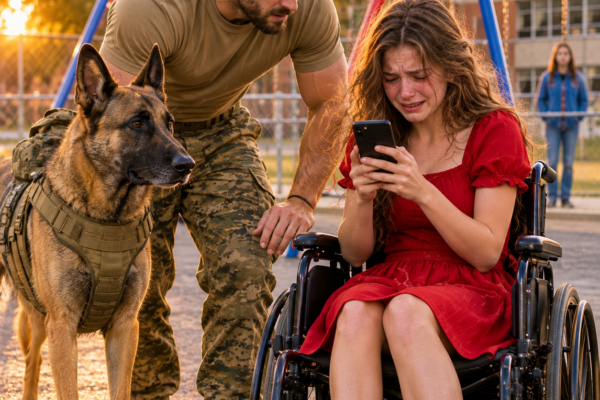
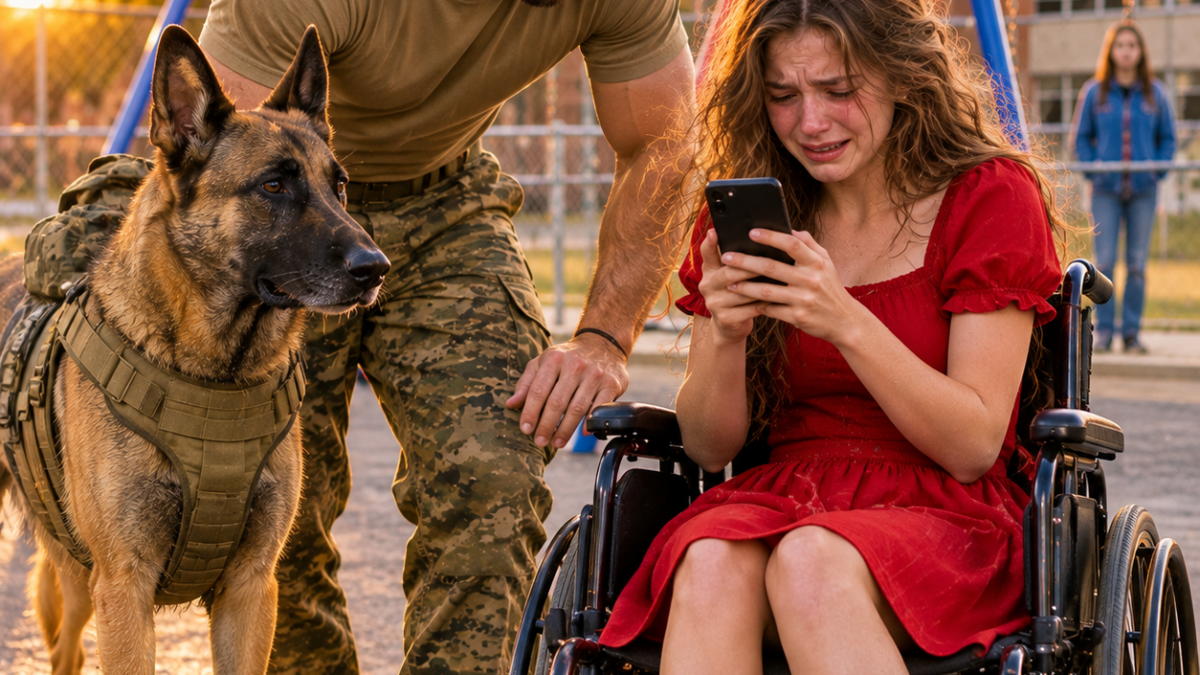
Part 4: Stranger Tried to Lure a Girl—Navy SEAL & K9 Uncovered His Secret List
The secondary buffer fence will I know about the buffer fence, Emma said.
She kept looking at the road.
I want this bed to stay where it is because I dont want to be the person who moved away from the fence because something bad almost happened.
Nobody said anything.
Im going to keep growing tomatoes here, Emma said. Same spot, same bed.
She turned her chair back toward the garden center.
Just put the buffer fence in and make the path better. Fisk looked at Cole.
Cole looked at Fisk. Do what she said, Cole said.
The redesign was completed by mid- November. 2 days after it finished, the first frost hit Millard County, and the garden went dormant in the way of gardens in Nebraska.
Sudden complete, like something making a decision. Emma came to see the finished path on the Saturday after the frost when everything was gray brown and still and she rolled through it twice without saying much and then said it was good and left which was Cole had learned Emmas version of a significant compliment.
The community meeting was Hoopers idea which surprised Cole until Hooper explained it. The four parents who called me, Hooper said they were standing in the school parking lot on a Wednesday afternoon, not a Thursday, which had started to feel like the default day for everything difficult to happen.
Ive spoken to three of them individually since the arrest.
The fourth hasnt returned my calls. The three I spoke to, theyre not bad people.
They were working from incomplete information and they made bad assumptions about whose account to trust.
Emmas account, Cole said.
Yes.
Hooper straightened his tie.
Todays had a small geometric pattern.
Blues and grays. I thought about keeping this quiet.
The school handled it.
The arrest was made. The program continues.
Move on.
He paused.
But Emma is still a student here. Shes going to be a student here for two more years.
And if we dont talk about what happened, about why her warnings werent taken seriously at first, then we just reset to the same default. Cole looked at him.
She deserves better than that, Hooper said. And frankly, so do the other kids who have something to say that adults arent taking seriously.
Cole thought about this. Have you talked to Sandra?
Yesterday, she said, Its Emmas call. And Emma, Hoopers expression shifted slightly.
Emma said, and Im quoting her directly, Tell people what they got wrong.
Thats the useful part. Cole was quiet for a moment.
Set it up, he said. The meeting was a Thursday evening, two weeks later in the school gymnasium.
Hooper had kept the announcement low-key, a community conversation about school safety and the Willow Creek incident, phrased specifically to avoid the kind of framing that turned a community conversation into a public spectacle. Hed expected maybe 60, 70 people.
212 showed up. They filled the folding chairs and stood along the walls and sat on the gymnasium bleachers.
And the noise of them assembling was the noise of a community that had been sitting with something for weeks and needed somewhere to put it. Cole stood near the sidewall with Ranger and watched people find seats and greet each other and not know exactly what they were supposed to be feeling.
Hooper opened it.
He spoke for about 8 minutes, which was the right length. He described the timeline factually, acknowledged the schools failure to respond adequately to Emmas initial report, and said plainly, without softening it, that the decision to characterize Emmas observations as the product of an active imagination had been wrong.
One of the four parents who had called him was sitting in the third row.
Cole had spotted her when she came in, a woman in her 40s, with the specific expression of someone who had been building up to something for 2 weeks and was waiting for the moment to release it.
She raised her hand before Hooper had finished.
I was one of the people who called the school, she said. She stood up, which seemed like something shed decided to do when the moment came.
I told Gerald that I thought this was an overreaction, that a former military man was creating a situation where there wasnt one.
She paused. Id like to say directly and in front of everyone that I was wrong, and Id like to say it in front of Emma because shes the person I was actually wrong about.
She looked across the gym.
Emma was in the front row beside Sandra.
She looked at the woman with the specific directness that Cole had come to recognize as Emmas default mode for receiving difficult things. Full attention, no performance.
Thank you, Emma said. The woman sat down.
There was a moment of silence in the gymnasium that had a particular texture. Not uncomfortable, not exactly comfortable.
Somewhere in the register of 200 people absorbing something true at the same time, Hooper asked if Emma wanted to speak. Emma had told her mother the previous week that she might and she might not, and she wouldnt know until she was there.
Sandra had told Cole this with the expression of someone who was trying to let their child make their own choices and finding it harder than expected.
Emma looked at Hooper. Yeah, she said.
Ill say something. She rolled to the front of the room, which took longer than it would have if the gymnasium had been set up with better aisle spacing, and Cole could see the quality of attention in the room shift during those seconds.
The particular attention that people give when they realize theyve been thinking about someone as a subject and are now waiting to hear them speak.
Emma didnt use notes.
She told Cole she wasnt going to use notes because notes made it feel like a presentation, and this wasnt a presentation.
I started noticing him on Monday, she said. Ive gone over it a lot since then.
Why I noticed what I saw that other people didnt.
And I think the answer is that I noticed things because I have to. When youre in a wheelchair, you spend a lot of time thinking about your environment, where you can go, whos in the way, whats different today than it was yesterday.
She paused. I think most people turn that kind of attention off when they feel safe.
I dont really turn it off. The gymnasium was very quiet.
I told Miss Rener on Tuesday, Emma said.
She didnt dismiss me to be mean. I think she just didnt have a place to put the information.
A kid in a wheelchair noticing a stranger at the fence. That didnt fit the category of something that needed to be urgent.
She looked at the room steadily. But I was right.
And being right when people dont believe you is, she stopped for a moment.
Its lonely. Thats the word for it.
Cole looked at his hands. Im not saying this to make anyone feel bad, Emma said.
Im saying it because there are other kids in this room who notice things and some of them have tried to tell adults something and the adult made the same calculation Miss Rener made that it didnt fit the category.
She looked around the gymnasium. The category needs to be bigger.
Thats what I want people to take from this. She turned her chair and rolled back to the front row.
The applause started before she got there. Not the polite kind, not the kind that fills silences, but the kind that happens when a room has been waiting to do something with what its feeling and someone gave it the shape.
Cole didnt clap. He stood against the wall with his arms crossed and Ranger beside him and watched Emma called her settle back beside her mother and received the rooms response with the same directness shed given everything else, looking at it straight, not deflecting it, not performing gratitude.
Sandra had her hand on Emmas arm.
Neither of them said anything. After the main session, Hooper opened it to general comments and questions, and the room had the productive energy of a community that had moved past the part where it needed to be angry and into the part where it needed to figure out what to change.
People talked about pickup protocols and outdoor supervision and identification practices and communication channels between parents and staff. A woman who turned out to be a retired child psychologist made three specific suggestions about how to handle student reports of concerning behavior that were practical enough that Hooper wrote all three down.
Cole was not asked to speak.
He hadnt expected to be.
That wasnt why he was there. He was there because Emma was there and because four weeks ago she had backed her wheelchair 3 in and said two words to a stranger.
and he wanted to be in the room when her community finally said the things shed needed to hear from the beginning.
Afterward, in the parking lot with people filing out around them, Emma found him near his truck. You didnt clap, she said.
No. Why not?
Cole thought about it. Because clapping felt like the wrong thing, and I couldnt figure out the right thing.
Emma considered this.
Thats an honest answer. You prefer those?
Yeah.
She looked across the parking lot at the people still moving toward their cars, the conversations breaking into smaller groups, a few people stopping to talk to Hooper near the entrance. It was good, the meeting.
She said it like she was still deciding whether it was true. It didnt fix anything that already happened.
No, but it changed something.
Yeah, Cole said it did.
She looked up at him.
What happens now for you?
Cole looked at the question. I keep coming to the garden program twice a month.
Thats not what I mean.
He looked at her. I mean, what are you doing?
Emma said with the particular impatience of someone who has listened to an evasive answer and identified it correctly.
You live here.
You walk ranger. You come to the school twice a month.
She paused. Thats not enough for someone like you.
Cole was quiet for a moment.
Someone like me.
Someone who does things. Emma said, You cant just stop.
He thought about how to answer that honestly.
Im figuring it out, he said finally.
Thats also an honest answer, Emma said less certainly this time. I know.
She turned her chair and then stopped. Cle.
She said it with the quality of someone who has thought about whether to say the next thing and decided, Yes. Yeah, Im going to be okay.
She said it simply, not reassuring him exactly, more like stating a fact she wanted on the record. I know thats what people are wondering, whether Im going to be scared, whether the chair is going to feel like a target now.
She looked at him steadily.
Im going to be okay.
Cole looked at her for a moment. I know, he said, and he did.
Emma rolled back toward the entrance where Sandra was waiting.
She moved through the parking lot the way she moved everywhere, efficient, direct, without making it look like effort, even when it was, and Cole watched her go until the school door closed behind her. Ranger pressed against his leg.
Cole put his hand on the dogs head briefly and then dropped it. He stood in the parking lot for a while after the last cars left.
The gymnasium lights were still on inside, orange, yellow through the high windows, and he could see silhouettes moving around.
Hooper and a few staff members stacking chairs.
The work that happens after the thing everyone attended is over.
He thought about what Emma had asked. What are you doing?
It wasnt a small question.
He left the Navy with a retirement package and a retirement dog and 12 years of operational experience that had exactly zero civilian applications in the standard sense.
Hed been in rural Nebraska for 6 months because property was cheap and quiet and because Patrice had told him about the agricultural therapy program at a time when hed needed to feel useful and not known how to say it.
Hed been half present for 6 months, running the loop past Willow Creek, coming to the program twice a month, sitting on his back porch watching the wheat fields and telling himself he was resting. He hadnt been resting.
Hed been waiting. He just hadnt known what he was waiting for until a dog stopped on a sidewalk.
He drove home on County 14 with the windows down despite the cold because the cold air was useful and he was still working through something. He turned onto his road and pulled into his driveway and sat in the truck for a moment.
Then he got out and went inside and opened his laptop and spent 2 hours on it, which was longer than hed spent on any single task since moving to Nebraska.
He was looking at agricultural therapy programs, their structure, their funding mechanisms, their staffing patterns, the gap that existed in most of them between what the programs attempted and what they actually had the resources to do well.
Hed been in that gap twice a month for 6 months and understood it from the inside.
I was also looking at veteran to civilian transition programs, child safety advocacy organizations, working dog integration programs that placed retired military animals in community settings, not because he had a plan.
He was honest with himself about that.
He had the beginning of a direction, which was different.
At midnight, he closed the laptop and made coffee.
He actually drank this time and sat at the kitchen table with Ranger under his feet, and the notes hed been keeping open on his phone.
He deleted the questions column. Hed answered most of them, and the ones he hadnt werent questions anymore.
He started a new note.
What next?
He sat with the blank page for a while.
Then he wrote, The garden. Start there.
December arrived, and with it the particular stillness of a Nebraska winter, which was a different stillness than any other season. Not the charged stillness of late summer or the waiting stillness of October, but something more complete, like a pause the land was fully committed to.
The garden at Willow Creek was dormant and snowedged, and the secondary buffer fence stood clean and new along the roadside, and the accessible path ran in its new diagonal between beds that were waiting for spring.
Emma had already told Cole which vegetables she was planning for the next season.
tomatoes again, obviously, but also pole beans, which she decided to try because shed read that they were harder, and she wanted to see if she could make them work in the Nebraska climate. Cole had told her hed look into a vertical support system that would work from a seated position without requiring someone to stand to manage the harvest.
Shed said shed already looked it up and sent him three links.
He told her hed seen those and they were wrong for the soil conditions and sent her two different ones.
Shed examined his links for 2 days and then said he was right, which had taken the specific phrasing of, Okay, those are better, which Cole had learned to understand as the Emma Calder equivalent of a standing ovation.
The case against Dennis Carver had moved into the pre-trial phase with the particular methodical weight of a prosecution that was not in a hurry because it didnt need to be.
The DAs office had filed 17 evidentiary exhibits.
The defense had filed a suppression motion on the receipt, argued the chain of custody was compromised, which it was, though the judge would have to decide how much that mattered in context, and the case was scheduled for preliminary hearing in February.
Brier had called Cole once to update him.
Arius called occasionally about procedural things. Cole kept himself informed and kept himself out of the way, which was exactly the right role and harder than it sounded.
Hed started showing up at the school not just on Thursdays, but on other days as well.
Tuesdays sometimes when the indoor portion of the agricultural program ran in the schools small greenhouse space, and occasionally on Fridays when the programs occupational therapist, who was Patrices replacement for the semester, needed a second set of hands setting up adaptive equipment.
Nobody had officially asked him to do this. He just started doing it, and nobody had told him to stop.
Hooper, to his credit, had simply gotten out of the way.
Patrice, to her less credit but equal usefulness, had told Cole he was becoming a fixture and that fixtures were good and that he should stop pretending he wasnt attached to the school and the people in it. Cole had said he wasnt pretending anything.
Patrice had given him the look she gave when she considered a conversation effectively one. On the last Thursday before winter break, the school held its agricultural program end of semester gathering in the gymnasium.
The students whod been part of the garden brought in the things theyd preserved from the fall harvest, jarred tomatoes and dried herbs, and the last of the squash that had been stored in the schools small root seller.
And there was a table with mismatched chairs and food that the parents brought.
And the noise of it was the comfortable noise of people who had figured out how to be in a room together. Emma was at the end of the table nearest the gymnasium door, which Cole recognized as her default position, the accessible spot, the one with the most exit options, the one shed identified without being told because she always identified those things.
She had a jar of tomatoes on the table in front of her that shed grown and processed herself.
And she was explaining to a younger student, a boy of maybe eight, just starting the program, how to read whether a tomato was ready to harvest. You dont squeeze it, she was saying.
You look at it. Color first, then the stem end.
If the stem end is still hard, its not ready. Even if the color looks right.
The boy was looking at the jar, not at Emma. How do you know all this?
He asked. I paid attention, Emma said.
Cole was near the gymnasium entrance with Ranger, who had become the programs unofficial greeter and was managing the role with the dignity appropriate to a retired military professional. He watched Emma explain about the tomatoes and thought about the parallel of it.
The same attention shed turned on a man in a gray cap applied now to the soil color of a Cherokee purple tomato in a Nebraska root seller. The same calibrated observation, the same patience with the details that other people glossed over.
The world was full of people who watched without seeing.
Emma Calder was not one of them. Sandra appeared at Coles elbow with two cups of coffee from the table.
Shes going to run this program in 2 years, Sandra said. Im just telling you.
Shes going to tell them everything thats wrong with the design, Cole said. And shell be right.
That, too.
Sandra looked at her daughter for a moment. She sleeps fine still.
She said it quietly like she was checking something she checked regularly.
I keep waiting for it to land differently for her to wake up scared. She might, Cole said at some point.
I know, but she hasnt.
Sandra wrapped both hands around the coffee cup.
She said something to me last week that I keep thinking about. I asked if she was still thinking about what happened a lot.
She said she said she thinks about what she did right more than what almost happened.
She paused.
I dont know how she got to that at 11 years old.
She knows she did everything right. Cole said its easier to live with something when you know you did everything right.
Sandra looked at him sidelong.
and when you dont.
Cole thought about that about the things in his service years that hed done right and the things he hadnt and the particular weight distribution of carrying both. Thats harder, he said.
But you still get to decide what you do with the next thing.
Sandra held that for a moment. Then she said, Patrice told me youre looking into starting something here, some kind of expanded program.
Patrice talks too much. Patrice talks exactly the right amount.
Sandra looked at him.
Is it true?
Cole looked across the gymnasium at the table of students and parents and jarred tomatoes and mismatched chairs and Hooper in the corner talking to the occupational therapist with his legal pad in his hand. And he thought about the blank page on his phone that still said the garden.
Start there. Working on it, he said.
Sandra nodded.
She took her coffee and went back to the table. Ranger pressed against Coles leg in the automatic way he did when hed finished scanning a room and determined it was safe, which was the highest assessment he offered.
Cole looked down at him, gray muzzle, mismatched ears, the particular self-possession of an animal who had never had an unearned opinion in his life. Yeah, Cole said quietly.
Me, too.
Across the room, Emma had finished explaining about the tomatoes.
The younger boy was holding the jar now, looking at it seriously, and Emma was watching him with the patient attention of someone who understands that you cant rush the moment when another person decides to start paying attention. Cole stood at the gymnasium door and let the warmth of the room settle around him, the noise of it, the mismatched chairs and the coffee that was slightly too bitter, and the early winter dark outside the high windows and Ranger at his heel.
and Emma called her in a wheelchair at the head of a table, explaining what she knew to someone younger who needed to hear it.
Some things were not fixed. The court case was months away.
The four parents who had been wrong about Emma would mostly go on without saying so publicly. Ms.Rener had transferred to another school before the semester ended, which was the path of least discomfort, which was very human and very disappointing in equal measure.
The security review sat in a binder on Hoopers shelf, and some of its recommendations would be implemented, and some wouldnt. The world wasnt clean, but the garden was still here, and Emma was in it, and the boy with the jar was looking at it the way Emma had told him to look.
Color first, then the stem end. His 8-year-old brow furrowed with the concentration of someone learning how to see what theyd been looking at all along.
That was something.
That was Cole thought actually quite a lot. Outside the Nebraska winter sat on the wheat fields in the particular silence of a thing that had decided to stay a while.
Inside 200 people ate bad food and talked about tomatoes and didnt know they were exactly where they needed to be.
Ranger exhaled and closed his eyes. Cole kept his open.
The world doesnt ask you to be fearless.
It asks you to say two words to the right stranger and trust that being heard is not the same as being lucky. It is the thing you earned by refusing to go quiet.