“She’s Nobody,” the Crowd Sneered—A Navy SEAL’s K9 Knew the Truth Before Anyone Else
“She’s Nobody,” the Crowd Sneered—A Navy SEAL’s K9 Knew the Truth Before Anyone Else
The dog stopped first. 11 years of combat instinct, two tours in Helmand province, one military working dog that had never once disobeyed a command.
And tonight, on a frozen sidewalk in Gray Haven, Oregon, Rex planted all four paws and refused to move.
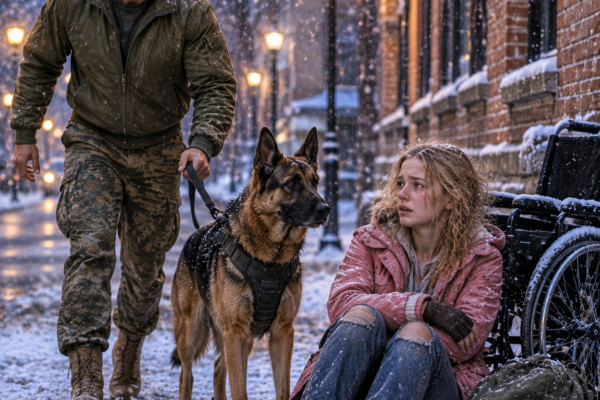
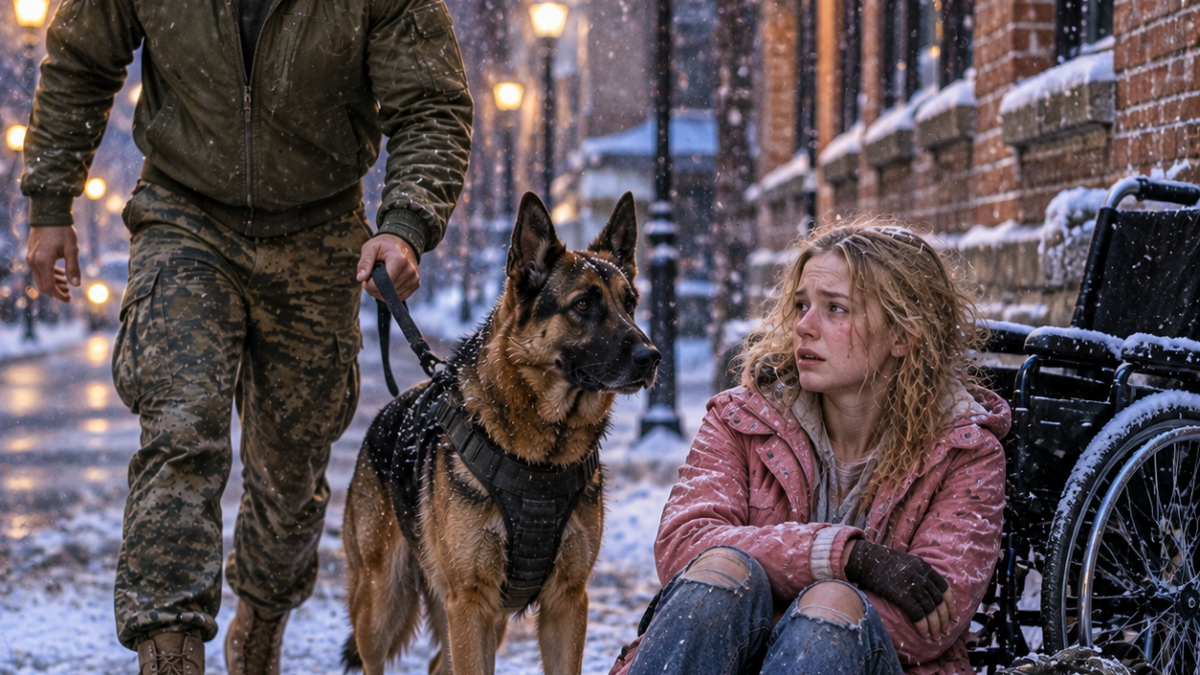
Ahead, beneath a stuttering street lamp throwing sick yellow light across packed snow, sat a young woman in a battered wheelchair.
Coat three sizes too big, hands gripping the wheels instead of reaching out, no cup, no sign.
Not begging, just existing, like someone who had long since stopped expecting the world to notice her.
Then she started humming. And Sergeant First Class Daniel Maddox, 12 years removed from the worst night of his life, felt the sound hit him like a round to the chest.
He knew that lullaby.
He had sung it himself once, a long time ago, to someone he believed was gone.
The cold in Gray Haven had a particular quality that set it apart from the cold.
Daniel Maddox had known in other places.
It wasnt the dry crystalline freeze of the Afghan Highlands, where the air turned so thin it could crack your lips in under a minute, and the darkness came down absolute.
It wasnt the wet cold of Fort Bragg winters, where rain soaked through three layers and turned your bones into iron bars.
Gray Haven cold was coastal, heavy, oceanic.
It pressed against you like something alive, finding every gap in your jacket, every inch of exposed skin, and settling in to stay. Ice formed on window sills, but didnt sparkle.
Snow fell, but turned gray before it hit the ground.
Daniel had been living here for 14 months. He chosen it for the same reason he chose most things, because no one he knew lived here, and the rent on a two-bedroom above a hardware store was low enough that his disability stipend covered it without drama.
He didnt need much.
He had Rex. He had his routine.
0530 awake, coffee, Rexs morning feed, 1 hour of PT in the small backyard, push-ups, pull-ups on the bar hed bolted between two fence posts, sprints along the alley when the weather allowed. Then a walk.
Always a walk.
Rex needed the movement, and if Daniel was being honest with himself, an activity he engaged in only occasionally and without pleasure, he needed it, too.
Movement kept the thoughts from pooling.
Tonights walk was later than usual. Hed spent the afternoon at the VA satellite clinic 3 miles east, sitting in a plastic chair for 2 hours to collect a prescription that could have been called in, while a wall-mounted television ran cable news on mute with closed captions full of errors.
He hadnt said anything. Hed waited, collected the paper bag, driven home, fed Rex, and then laced up because the walls of the apartment had started feeling like the walls of somewhere else.
Somewhere smaller. And motion was the only cure hed found that didnt come in a bottle.
It was 9:47 p.m.The Harbor District was empty.
Storefronts dark except for a bakery that kept its display lights on overnight, and a 24-hour laundromat whose windows sweated condensation against the cold.
Daniel walked with Rex on a short leash, not because Rex needed it, but because it was habit. Tight perimeter, controlled radius, no surprises.
Rex was a Belgian Malinois, 8 years old, 62 lb of lean muscle and scar tissue, one torn ear from a wire obstacle course in Kandahar that had never fully healed.
Hed been retired from service the same month Daniel had. Same reason, almost.
Theyd both taken enough. Rex had a working dogs bearing even off duty, scanning, assessing, never fully at rest.
He moved with purpose, and his purpose usually aligned exactly with Daniels until the moment it didnt. They were two blocks from the harbor, cutting through a side street that smelled of salt and diesel and old fish when Rex slowed.
Daniel felt it through the leash before he registered it consciously.
A subtle resistance, a change in tension. He glanced down.
Rex had dropped his pace to half speed, head swiveling left toward a shallow doorway alcove adjacent to what had once been a seafood restaurant and was now a boarded storefront.
Beyond it, where the alcove opened onto the main pedestrian walk, the stuttering street lamp.
And beneath it, the wheelchair.
It was old.
The chrome on the push handles had oxidized to a dull gray, and one of the footrests had been replaced with something improvised, a flat bar of metal bolted at an approximate angle.
The woman sitting in it looked to be in her mid-20s, though the cold had a way of adding years to a face that spent too much time in it.
She wore a heavy army surplus coat, not actual military, the knockoff kind sold at thrift stores, with the collar pulled up to her jaw. Her hair was dark, loose, gathered partially under a knit cap that was coming undone at one side.
Her hands rested on the wheel rims, not propelling, not requesting anything from the empty street, just gripping.
She wasnt looking at Daniel. She wasnt looking at anything in particular.
Her eyes were slightly down and to the right, the unfocused gaze of someone who had been sitting in one place long enough that seeing had stopped seeming necessary. Rex stopped completely.
Rex, heel.
The dog didnt move. His ears were up, fully forward, the alert posture Daniel recognized from deployment.
The exact attitude Rex assumed when hed identified something significant that the humans around him hadnt processed yet. It wasnt a threat response.
Rexs hackles werent raised. His stance wasnt aggressive.
He was simply fixed, oriented, certain.
Rex. Quieter this time, without the command inflection.
What are you doing, buddy? The dogs tail moved once, slowly, and then was still again.
He took one step toward the woman.
Daniel pulled the leash taut.
Rex accepted the resistance, but didnt retreat.
He simply held his position, leaning slightly forward against the tension, steady as cable under load. That was when the woman started humming.
It was quiet, under the wind off the harbor, under the distant sounds of the laundromats industrial dryers cycling, under the low moan of a foghorn somewhere past the breakwater. It was barely audible.
A thread of melody, fragile and incomplete, the way a person hums something when theyre not aware theyre doing it.
Some song that lives in the body rather than the mind.
Daniels brain processed it approximately 3 seconds before the rest of him did.
The melody.
The interval between the first and second phrases. The slight flattening of the third note.
The way the fourth resolved upward instead of down.
An idiosyncratic variation, specific, not generic. Hed heard that lullaby once before.
Sung it, actually. In a hospital room.
To a child too young to understand the words, but old enough to need the sound. His daughter had been 2 years old.
The thought arrived without announcement and hit without mercy.
He stood on the frozen sidewalk with Rexs leash in his hand and felt something he didnt have clean language for.
Not grief, not hope, not recognition, but some compound of all three that had no name because it shouldnt have been possible.
Dont. The internal voice was flat and experienced.
You do not do this. You have done this before.
Every time it costs you. He breathed out through his nose.
The cold air burned slightly.
Rex hadnt moved.
The woman looked up.
She didnt look startled, more like someone emerging slowly from somewhere far away, registering the presence of another person the way you register a change in temperature. Her eyes found Daniel first, then dropped to Rex, and something shifted in her expression.
Not fear. Something closer to puzzlement, and beneath it, so faint he might have imagined it, recognition.
The reflexive kind that the conscious mind cant explain.
Rex made a sound. Not a bark, not a whine, a low sustained vocalization that Daniel had no category for in 12 years of working with the animal.
Something between greeting and mourning. Your dog okay?
She asked. Her voice was rougher than he expected.
Not from illness, from disuse, the particular quality of someone who didnt speak to many people and whose vocal cords reflected it. Yeah, Daniel said.
Hes He doesnt usually stop like this. Hes looking at me like he knows me.
I noticed. She looked back at Rex.
Rex looked at her.
The street lamp flickered twice, went steady. Hes beautiful, she said.
The word came out smaller than the others, like it had slipped through a gap. Daniel studied her in the inadequate light.
The coat was too large, the knit cap unraveling, the wheelchair worn past the point of dignity.
But her eyes were alert, genuinely alert.
The eyes of someone whose mind was running clean, even if the circumstances around her were not. There was intelligence in the way she tracked Rex, the way she was simultaneously watching Daniels hands, his posture, calculating exits and threat levels, the way people do when theyve had to do it long enough that it becomes automatic.
She was cold.
She had been here a while.
When did you last eat?
He asked.
A pause. The pause that wasnt an answer, but was.
Im not looking for charity. She said, not defensive, matter-of-fact.
I know. Im asking when you last ate.
Another pause, shorter this time. This morning.
He looked down the street.
The cafe on the corner, Mariners, the one with the yellow awning he passed every morning, kept late hours for the fishing crews who worked through the night, open till 1:00 a.m.Hed been there enough times that the night cook knew his order without asking. Theres a place two blocks down, hot food.
Its warm inside.
He paused. Im not offering out of pity.
My dog stopped walking and hes the most stubborn animal Ive ever served with. Feels like I owe him an explanation at minimum.
Something moved at the corner of her mouth, not quite a smile, but in the same vicinity.
Served with?
She said. Marine, retired.
The dog, too?
Also retired. She looked at Rex again.
Rex, still watching her with that impossible calm, took another small step and sat down directly at the edge of her wheelchairs reach, not pushing contact, just making it available. She hesitated.
Then she reached out and placed her hand on top of his head, and Rex closed his eyes like a dog in a painting of something peaceful. Okay.
She said quietly.
Two blocks. Her name, she told him, was Maya.
Maya Wren. She said it the way people say something theyve repeated enough times that the words have lost their texture, informational rather than identifying, the verbal equivalent of a form filled out.
She navigated the wheelchair with the efficiency of long practice, working the rims with a grip that had built calluses Daniel noticed when she set her coffee cup down on the table at Mariners, and he saw her hands in the overhead light for the first time.
The right hand was slightly more developed than the left, the dominant pushing hand.
Shed been in that chair long enough for her body to reconfigure itself around it. The night cook, a heavy-set man named Gary, who communicated mostly in head nods, brought two coffees and a menu without being asked.
Daniel ordered the clam chowder for himself and asked Maya what she wanted.
She studied the menu with the focus of someone doing math.
The grilled cheese, she said, please.
Gary disappeared.
Rex sat between their chairs on the floor, upright and alert, but relaxed in the way he got when he determined a space was safe.
How long have you been out here?
Daniel asked. In Gray Haven?
About 3 weeks. She wrapped both hands around the coffee mug and didnt drink it yet.
Just took the warmth.
It was warmer than where I was coming from. Where was that?
Portland for a while.
Before that, Medford. I move around when I can.
She said it without self-pity, the way someone describes logistics.
The chair makes that complicated.
The chair makes everything complicated. Flat, practiced.
But you figure out whats accessible and whats not.
Gray Haven has that ramp system along the harbor walk. Thats actually thats unusually good for a town this size.
He noticed shed shifted to the infrastructure rather than herself.
He recognized the technique.
He used it constantly.
What happened? he asked.
If thats not You dont have to answer that. She was quiet for a moment, turning the mug slowly.
Accident.
About 12 years ago.
I was young. I dont remember much of it.
She paused.
River.
Thats all Ive got.
Cold water.
I woke up in a hospital and had a different life than the one I started with.
The words hung over the table.
12 years ago, river, cold water. Woke up.
Daniel kept his face still.
It was a skill hed developed in interrogation training and refined over two deployments.
The ability to present a surface of total neutrality while the interior processed at full speed.
He was very good at it.
Hed been less good at it in the parking lot of the VA clinic that afternoon.
When a man in the waiting room had made a comment that deserved a response, Daniel had chosen not to give. But in general, he was good at it.
He was using every bit of that skill right now. You dont have any family?
he asked. Not that I know of.
She said it clean.
No inflection of grief or anger.
Just a factual gap in the record.
The accident, whatever happened? I didnt have ID.
Nobody reported anyone matching my description missing in the county where they found me. I aged out of foster care.
A small shrug. I manage.
Gary returned with the chowder and the grilled cheese.
Maya looked at the sandwich for a moment before she picked it up.
And something about the way she looked at it, with the suspended gratitude of someone who didnt take food for granted, landed somewhere below Daniels ribs and stayed. That lullaby.
he said.
She looked up. The one you were humming outside.
Where did you learn it?
Something shifted in her eyes. Careful.
I dont know.
I just I hum it sometimes. Its been in my head as long as I can remember.
She set the sandwich down.
Why?
Its unusual, the melody. Most people wouldnt know it.
You recognized it. I did.
She studied him the way shed studied the menu, with focus, with precision, doing the calculation behind her eyes. How?
My daughter used to fall asleep to it. Daniel said.
The sentence arrived in the space between them and didnt leave. Mayas hands had stilled on the table.
Rex on the floor raised his head. Im not saying anything.
Daniel said carefully, because it needed to be said before either of them could react to what hadnt been said.
Im just telling you why the song stopped me. He picked up his spoon.
Eat your food. Its going to get cold.
After a long moment, she picked up the sandwich.
They ate in silence, but it was a different kind of silence than the one that had been on the street. Charged, full of mass, the the kind of silence that has weight.
Halfway through his chowder, he noticed the bracelet. It was on her left wrist, half hidden by the sleeve of the oversized coat.
A simple thing. Thin cord, faded to something between blue and gray, strung with small beads of varied colors.
Handmade.
Old.
The kind of thing a child makes, or that gets made for a child.
She didnt take it off when she ate.
She didnt adjust it. It was simply part of her, the way a scar is part of a person.
He did not say anything about it.
He memorized it instead, with the same careful attention hed once applied to terrain features and rooftop silhouettes.
And when they were done eating, and hed paid over her protest, and shed told him she had a spot she was heading back to, and hed told her there was a transitional shelter on Clement Street run by a retired Navy corpsman named Briggs, who didnt require paperwork to get in out of the cold, and shed written down the address without committing to anything. He walked Rex the long way home through the harbor district in the freezing coastal air, with the lullaby running on repeat behind his eyes, and the image of that bracelet burned into the back of his brain.
At 11:30 p.m., he sat at his kitchen table and opened his laptop and typed a name into the search bar. A name that had been there the whole time, in the sealed room in his mind where he kept things he couldnt process and couldnt let go of.
Emma Maddox. Missing child, 2012.
Tillamook County, Oregon.
The first result came back in 0. 4 seconds.
The case file was public record. Hed read it 47 times in the first 2 years, then stopped because the 48th time felt like it was going to be the time it killed something essential in him.
He knew every line.
He knew the date, January 14th, 2012. He knew the water temperature of the Tillamook River that day.
He knew that the search had lasted 11 days before the county called it. He knew that nobody had ever been recovered.
He knew that the official notation in the final file read, presumed deceased.
Case closed.
He knew because he had lived with it for 12 years like a nail through the center of his chest that presumed and confirmed were not the same word. He stared at the screen.
Rex, from his bed in the corner of the kitchen, watched him.
Outside the snow had started again, fine and deliberate, covering the city of Gray Haven in something that looked, from the window, almost like forgiveness.
Daniel Maddox closed the laptop.
Then he opened it again.
Then he picked up his phone and dialed a number he hadnt dialed in 3 years.
A retired investigator named Paulson whod worked cold cases for the Multnomah County Sheriff and owed Daniel a favor from a situation in 2019 that neither of them ever discussed in specifics.
The phone rang four times. Its 2:00 in the morning, Danny.
Paulson answered. I know.
I need you to pull a case for me.
A pause.
And I need you to look for something that was never in it. Silence on the other end.
Then, This personal? Daniel looked at the window at the snow coming down at the faint reflection of his own face in the dark glass older than it should be, harder than it needed to be, looking like a man standing at the edge of something he had no business approaching.
Yeah.
he said.
As personal as it gets.
Paulson called back at 6:14 a.m.Daniel hadnt slept. Hed done what he did when sleep wasnt available.
Hed made the apartment useful.
Dishes cleaned, Rex fed and watered. A second pot of coffee started before the first was finished.
Hed pulled out the single cardboard box he kept on the high shelf of the bedroom closet, the one he hadnt opened in over 2 years, and sat with it on the kitchen table without lifting the lid.
Just sat with it. The way you sit with something that has too much mass to be moved, but that you cant stop being near.
The box contained 14 items. He knew them by inventory without looking.
One photograph. One report from Tillamook County Search and Rescue.
One page torn from a hospital admissions form.
One childs drawing, crayon on construction paper, that a 2-year-old had pressed into his hand the morning before the accident like it was a gift.
Like shed known something. He hadnt opened the box.
When the phone rang, he picked it up before the first ring finished. Talk to me, he said.
Paulsons voice had the texture of a man whod been up most of the night running searches. He was 61, retired, ran a small security consulting firm out of Beaverton, and had a particular institutional access that came from 30 years of county law enforcement relationships.
The kind of access that wasnt official anymore, but wasnt fully gone either. He knew which clerks picked up the phone at what hours.
He knew which database terminals had supervisors who looked the other way.
The Maddox case, Paulson said.
Emma Maddox, DOB March 3rd, 2010.
Listed missing January 14th, 2012. Tillamook County.
Case closed November 2012.
Presumed deceased.
No recovered remains.
A pause.
You know all this? What dont I know?
There was a hospital intake 31 days after the case closed. Paulson let that sit for a moment.
Nehalem Valley Hospital. Unidentified female juvenile.
Approximate age 2 to 4 years. Brought in by a fisherman who found her on the Tillamook riverbank.
Hypothermic, unresponsive. No ID, no missing persons report matched at intake.
Daniels hand tightened around the phone.
The case was already closed, Paulson continued.
Nobody cross-referenced it.
The intake report went to ODHS, Oregon DHS, and entered the foster system. The child had sustained injuries consistent with water trauma and a significant fall or impact, spinal.
She was paralyzed below the mid-thoracic level.
A pause.
Permanent.
The kitchen was very quiet. The coffee maker had finished its cycle and clicked off.
Rex was watching Daniel from the corner.
They gave her a name, Paulson said. What name?
Maya. Maya Wren.
Wren was the surname of the foster family that took first placement.
Another pause, and this one was different, careful, deliberate. The pause of a man choosing how to carry something fragile.
Danny, I need you to tell me whats going on.
Not yet. Daniel, I need one more thing, the bracelet.
Was there any property documented at intake, jewelry, clothing, anything on her person when they found her? He heard Paulson breathing.
Keyboard sounds in the background.
One item, Paulson said finally, described as a handmade cord bracelet with colored beads, left wrist. Notes say she wouldnt allow removal.
Staff documented it as a comfort object and left it. Daniel set the phone down on the table without ending the call.
He sat with his hands flat on the wood surface and breathed in through his nose and out through his mouth, the way they taught him in a stress inoculation course at Lejeune 15 years ago.
And for approximately 45 seconds, he did only that.
Breathed, while something enormous and tectonic shifted in his chest. He picked the phone back up.
Paulson.
Still here. Thank you.
Danny, listen to me. Whatever youre thinking right now, you need to slow down.
You need a DNA confirmation before you do anything with this. You hear me?
You go in there with 12 years of grief and no confirmation, and you could devastate that kid. You could devastate yourself.
I know. Do you?
Yeah, Daniel said. I do.
He meant it. He also meant that he was going to the shelter on Clement Street the moment it opened at 8:00 a.m.because he had not slept and could not sleep, and the only thing in the world that mattered right now was making sure she was somewhere warm.
The Clement Street shelter occupied the ground floor of a former textile warehouse that a retired Navy Corpsman named Earl Briggs had spent 7 years converting into something functional. It wasnt pretty.
The floors were original concrete, smoothed but not finished, and the overhead lighting was institutional fluorescent that made everyone look slightly ill. But it was clean, and it was warm, and Briggs ran it with a quiet competence that came from having served in environments where resources were limited, and the margin for disorder was zero.
Briggs was 54, built like a man whod been lifting serious weight since his 20s, and had recently switched to maintenance mode with a gray beard he kept trimmed and a habit of reading glasses.
He was perpetually losing and finding in unexpected locations. Hed served as a Navy Corpsman for 20 years, including two combat deployments embedded with Marine units, which was the basis of his and Daniels familiarity.
They werent close. Theyd met at a veterans resource event 3 years earlier and exchanged numbers in the way that people sometimes do when they recognize in each other a similar mode of operating.
Theyd had coffee twice.
When Daniel walked in at 8:07 a.m., Briggs was behind the intake desk doing paperwork and had a pair of reading glasses pushed up on his forehead. Maddox, he said without looking up.
Did a woman come in last night? Wheelchair, dark hair, young, mid-20s.
Briggs looked up then.
He had the evaluative gaze of a corpsman, the habit of rapid physical assessment that never fully turned off. He looked at Daniel the way he might look at a patient presenting ambiguous symptoms.
Why? I told her about this place last night.
I wanted to make sure she got in okay. Briggs held the look for another beat, then nodded toward the far end of the room, past the rows of cots separated by portable fabric dividers.
She came in around midnight, took some convincing from the overnight volunteer, but shes here. Daniel exhaled something hed been holding since 6:14 a.m.She sleeping?
Was, as of 20 minutes ago. Briggs set down his pen.
Danny, you want to tell me what your interest is here? Not yet.
Thats becoming a pattern this morning. I know.
Im sorry. Daniel leaned against the intake desk.
He looked like what he was, a man who hadnt slept, who was running on coffee and adrenaline, and something raw-er than both.
Can you make sure she has what she needs?
Food, any resources, whatever she whatever the chair requires.
Ill cover it.
Briggs studied him.
She have a name?
Maya Wren.
Something about the way Daniel said it, the particular weight he put on the two syllables, or maybe just the sum of what his face was doing, made Briggs go still for a moment. Maddox, he said carefully.
I know, Daniel said.
I know.
Im being careful. He left before Briggs could ask the next question.
The Tillamook County Records Office opened at 9:00.
It was a 2-hour drive south on 101, through coastal towns that looked simultaneously picturesque and economically exhausted, past fishing operations and tourist infrastructure that existed in uneasy proximity. Daniel drove it in 1 hour and 48 minutes with Rex in the backseat and the heater running on high because the morning had dropped another 3° overnight and frost was crawling up the inside corners of the car windows.
He had not called ahead.
He preferred arriving. The records office was staffed by two people, a young man at the front desk who looked like he was 3 weeks into the job and a woman in her 50s visible through a glass partition in the back who had the bearing of someone whod been there long enough to have institutional authority without an official title.
Daniel bypassed the young man and knocked on the partition. The woman looked up.
Her nameplate said Dorothea Vance. I need access to case documentation from 2012, he said, missing persons and a cross-reference with a hospital intake from the same period.
Public records request forms are at the front desk, she said. Processing is 7 to 10 business days.
I understand that. Im also a party to the case.
He placed his retired military ID on the ledge of the partition.
My daughter is the subject of the missing persons file.
Emma Maddox, January 2012.
Dorothea Vance looked at the ID, then she looked at him.
The full assessment, the kind that takes in the whole picture. The exhaustion, the stillness, the quality of a man who had traveled a significant distance this morning on insufficient sleep for a reason he believed was worth it.
She slid the ID back. Have a seat, she said.
Itll be about 40 minutes. It was 32.
She brought him a folder herself rather than sending the young man and set it on the table in the waiting area and didnt comment on the fact that hed had Rex with him the entire time without anyone asking about the dog.
He read for 40 minutes. Most of it he knew.
The search timeline, the weather conditions, the the depth measurements taken during recovery operations.
Hed been present for some of it and had read the rest so many times that the words had the quality of things memorized, present but not fully processed each time, like a recited text.
What he hadnt read before was the addendum.
It had been filed eight months after the case closed by a junior investigator named Hartwell, who had apparently been doing a routine records audit and flagged an anomaly, a hospital intake in Nehalem that matched the general parameters of the Maddox case close enough to warrant notation. The notation recommended cross-referencing.
The cross-referencing had been assigned and never completed because Hartwell had transferred to a different county 3 weeks after filing the addendum and the next investigator on the case rotation hadnt followed through and the case was closed and nobody had ever connected the thread. The notation was four paragraphs.
It described an unidentified female juvenile recovered from the Tillamook River approximately 31 days after Emma Maddox had been declared presumed deceased with a spinal injury consistent with high-impact water trauma. It described a handmade bracelet on the childs left wrist.
It described the foster placement. It gave a name.
Maya Wren.
Daniel closed the folder and sat with his hands folded on top of it and looked at the far wall of the Tillamook County Records Office waiting room, which had a framed photograph of the Oregon coastline and a rack of public information pamphlets about coastal erosion and evacuation routes.
The junior investigator had seen it, written it down, filed it correctly, and then left, and the thread had simply hung there for 12 years connected to nothing while a little girl who couldnt remember her name grew up through the foster system in a wheelchair with a bracelet she wouldnt let anyone remove.
He thanked Dorothea Vance, who gave him a look that contained an entire conversation she wasnt going to have in a records office, and drove north. He stopped at a pharmacy in Tillamook and bought a DNA collection kit, the over-the-counter kind, two cheek swabs in a prepaid mail envelope.
Results in 5 to 7 business days from an accredited lab.
He drove the rest of the way back to Grayhaven with it on the passenger seat and didnt look at it. It was 1:30 p.m.when he got back to Clement Street.
Maya was in the common area at the far end of the room at a table near the windows with a book open in front of her that she wasnt reading.
She was looking out the window at the snow, which had started again in a fine persistent curtain, and Rex spotted her before Daniel did. The same immediate full-body orientation hed shown the night before, the ears forward, the focused calm.
She looked up when they were 10 ft away. You came back, she said.
I said I would.
People say things. He pulled out the chair across from her and sat.
Rex went directly to her side and she let her hand drop to his head without breaking eye contact with Daniel, the gesture already easy, already habitual as if the dog had been hers for years.
Howd you sleep? Daniel asked.
Better than outside. A pause.
The overnight guy, Marcus, he set up a charging station for the chair. I didnt ask him to.
Thats Briggs.
He runs the place. He checked on me twice.
Didnt say anything, just looked in.
She turned the page of the book she hadnt been reading. People dont usually do that.
Daniel rested his forearms on the table. Outside the snow came down.
The fluorescent lights gave everything a flat, slightly unreal quality, like a scene in a film with too much post-production.
Maya, he said, I need to tell you something and I need you to hear it as information, not as anything else.
Not as pressure, not as a conclusion, just something I found out that you deserve to know. She went still.
The hand on Rexs head didnt move, but the quality of the stillness changed. That sounds like a setup, she said.
Its not.
I promise you its not. He breathed.
Yesterday, after I got home, I made some calls about the lullaby. About some things that that I couldnt explain and needed to at least look at.
What kind of calls? I have a contact who has access to county records.
I asked him to pull a case Ive been connected to for a long time.
He paused.
And then this morning I drove to Tillamook County and read the file myself. She closed the book.
There was a missing persons case, Daniel said, keeping his voice level, keeping it factual, giving her the facts the way you give coordinates, clean, accurate, without editorial. A child, January 2012.
The case was closed after 11 days, presumed deceased, no body recovered. He held her eyes.
31 days after the case closed, an unidentified female juvenile was found on the Tillamook Riverbank, approximately the right age. Spinal injury consistent with water trauma.
She had no ID.
Nobody claimed her. He stopped.
She had a handmade cord bracelet on her left wrist.
The intake staff documented it as a comfort object. The color had left Mayas face in a gradual withdrawal, like water pulled back before a wave.
Her hand, on Rexs head, had curled slightly. Youre saying uh she started.
Im not saying anything confirmed. Im saying there is a documented connection between a case Ive been carrying for 12 years and the information you gave me last night.
River, cold water, age, the bracelet.
He kept his voice even. And the lullaby.
The table was between them, and it suddenly felt like the most relevant object in the room, something to keep space between what hed said and what it meant. Youre saying you think Im She stopped again.
Im saying I found documentation that is consistent with the possibility. And Im saying that I wont do anything with it that you dont want me to do.
There is a DNA test.
Its accurate.
Its non-invasive. It goes to an accredited lab.
He put the pharmacy bag on the table between them, not pushing it forward, just placing it in the neutral space. Thats your decision, not mine.
Maya looked at the bag.
She looked at it for a long time. Rex hadnt moved.
He sat pressed lightly against the side of her wheelchair with the patience of an animal that understood, on some frequency below language, that this was a moment that required stillness.
The case, she said finally, her voice lower than before. Whose?
Who was the child? Daniel held her gaze.
Mine, he said.
My daughter. Her name was Emma.
The sound that came out of Maya Wren was small and involuntary, and immediately suppressed. A single expelled breath that contained something she wasnt ready to name.
She pressed her lips together, her jaw set. She was doing the same thing Daniel had been doing for the last 14 hours, running the information through the rational system, trying to find the exit, the flaw, the point where it stopped making sense.
She looked at the bracelet on her wrist, the faded blue-gray cord, the small varied beads. Ive had this as long as I can remember, she said.
They tried to take it once, in the second foster placement. I I fought them.
Her mouth was tight. I was 7 years old, and I fought them.
I know. You made it, she said.
It wasnt a question. My wife did.
She made one for each of us.
A family thing.
He stopped.
Maya, Im not asking you to feel anything right now.
Im not asking you to be anything. I found information, and you had a right to know it, and now you know it.
 [Tap here for the Next Part ]