The Feared Mafia Boss Saw His Face On A Little Boy’s Birthday Cake, Then He Learned The Truth!
The Feared Mafia Boss Saw His Face On A Little Boy’s Birthday Cake, Then He Learned The Truth!

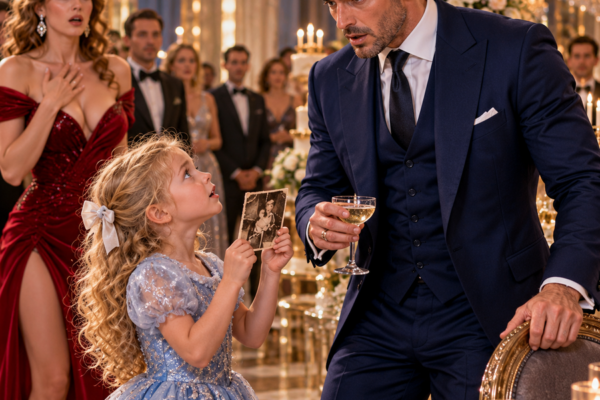
This is my daddy.
Who is this child?
The bell above the door of Sugar and Soul Bakery chimed softly as Dante Castellano stepped inside.
And for the first time in 15 years, the most feared mafia boss on the East Coast was about to be undone by a child’s drawing.
had not wanted to come.
He had wanted to send one of his men.
But his Lieutenant Gino’s daughter was turning seven that evening.
The specialty bakery Gino had used for years had closed down, and this little Brooklyn shop had been the only place that answered the phone on a Sunday morning.
Dante had agreed to pick up the cake himself only because he happened to be driving back from a meeting in the neighborhood and because truthfully he had been restless lately in a way he could not explain. His two bodyguards, Marco and Santino, followed him inside and immediately positioned themselves near the windows, scanning the small room the way they scanned every room, looking for exits, threats, anything out of place.
The bakery smelled like butter and vanilla and something warmer, something Dante could not name.
The walls were painted a soft cream color.
Handwritten chalkboards listed the day’s pastries in looping, careful handwriting.
A small chalkboard near the register read, Today’s Special, Lemon Cardamom Scones, because you deserve something new.
There were no customers. There was no one behind the counter.
Just the soft hum of a refrigerator and the faint sound of someone humming in the back kitchen, a tune Dante did not recognize but that sounded strangely familiar in a way that made his chest tighten for reasons he could not explain. Marco
cleared his throat and called out that they were here for a pickup.
The humming stopped. There was a pause, then footsteps.
But before anyone came out, Dante’s eyes drifted to the glass display counter in the middle of the room where several finished cakes sat waiting for pickup, each one labeled with a small handwritten card.
One cake in particular stopped him. It was a round, two-tier cake covered in bright blue frosting, decorated with carefully piped cartoon rocket ships and tiny white stars.
In the very center of the top tier, piped in white icing with the slightly uneven care of something made by hand rather machine was a child’s drawing of a man.
The man wore a dark suit. The man had dark hair and serious eyes.
The man had Dante’s face.
Above the drawing in cheerful blue letters were the words, Happy Birthday from Daddy. I love you, Leo.
Dante did not move. He did not breathe.
The world inside the little bakery narrowed down to the glass counter and the cake and the face he had never drawn on a cake he had never ordered for a child he had never met.
Marco noticed first.
He had worked for Dante for 11 years and he had seen his boss frozen in exactly two situations before this one, both of them involving assassination attempts.
Marco’s hand drifted toward the weapon under his jacket.
Santino followed his gaze, saw the cake, and went completely still.
Neither of them understood what they were looking at, but they understood that something was deeply, catastrophically wrong, and the only person who seemed to know what it was had not said a single word.
Then she walked out of the back kitchen. She was wearing a white apron dusted with flour.
Her dark hair was pulled back into a loose bun, strands escaping around her face.
She was holding a piping bag filled with pale pink frosting in one hand and a damp towel in the other. She was humming again softly before she looked up and saw who was standing in her bakery.
The piping bag slipped from her fingers and hit the tile floor with a soft, wet sound.
Pink frosting spread across the white tile.
She did not reach to pick it up.
Her hand remained frozen in the empty air where the piping bag had been. Her lips parted.
The color drained from her face in a way Dante had seen only in people who were about to faint or die.
She whispered one word, and it was not the word of a stranger meeting a customer. It was the word of someone looking at a ghost.
Leo.
Dante’s voice when he found it was quiet, dangerous in a way that made Marco and Santino both take an involuntary step forward.
Who is Leo? Mariana Reyes did not answer.
She could not.
Her mouth opened and closed.
Her hand came up to her chest, pressed against it as if she were trying to hold her own heart in place.
Dante took one slow step toward the counter.
His eyes moved from her face to the cake and back to her face.
years of silence stood between them.
Six years of unanswered questions.
Six years of a man who had searched three continents for a woman he had believed was simply a quiet pastry chef.
A woman who had vanished without a note, without a reason, without a trace.
A woman he had eventually forced himself to stop thinking about because thinking about her had been the one thing he could not control in a life built on control. And now she was standing in front of him, and there was a cake with his face on it, and the cake said the word Daddy.
Mariana.
His voice was softer than anyone in his organization had ever heard it. Who is Leo?
She took a small step backward. Her back hit the glass case.
She closed her eyes for a long moment, and when she opened them, there were tears sitting at the edges of her lashes, not falling, just waiting. Dante, she said quietly, you have to leave.
He did not move. Please, I am begging you.
Just take the cake you came for and go. I will send the other one later.
Please. Dante looked at the cake with his face on it.
Then he looked at the small handwritten card beside it, the one that read Leo, sixth birthday. Then he looked back at her, and in his eyes was something no one in his organization had ever seen in 15 years of running the Castellano family.
Not anger, not calculation, something raw.
Something that looked impossibly like fear.
How old did you say? He began.
And his voice broke in the middle of the sentence in a way that made Marco turn his face toward the window out of something like respect. Mariana did not have to answer.
The card answered for her. Six.
Six years old.
Six years since she had disappeared from Bella Vita, from Manhattan, from his life. Six years and nine months, if you counted carefully.
Dante did the math the way he did everything else, with cold precision, and the number landed in his chest like a bullet.
He is mine, he said.
It was not a question.
Mariana finally let one of the tears fall.
She did not wipe it away. Dante, please.
But before either of them could say another word, the little bell above the door chimed again.
A small voice, bright and breathless and full of the pure, uncomplicated joy of a child who has been waiting all week for this exact moment, called out from the doorway.
Mommy, mommy, Miss Elena said I could walk down from her apartment early so I could see my cake before my party. Did you finish the rocket ships?
Did you?
Mariana’s entire body locked.
Dante turned his head slowly, so slowly toward the door. Marco and Santino both went perfectly still.
And there, standing in the doorway of Sugar and Soul Bakery in a navy blue sweater and little sneakers with stars on them, was a six-year-old boy with dark curls and serious brown eyes that Dante recognized because he had seen those exact eyes every morning of his own life in the mirror. The boy did not see his mother at first.
He was staring up at the tall man in the dark suit. He tilted his head the way children do when they are sorting through a puzzle.
He looked at Dante, then he looked at the cake in the display case, then he looked at Dante again.
His small forehead wrinkled. Mommy, he said slowly, his voice full of wonder, that man looks like Daddy.
The silence that filled the bakery in that moment was the loudest silence Dante Castellano had ever heard in his life. Mariana made a small sound, somewhere between a sob and a whisper.
Marco looked at Santino.
Santino looked at the floor. And Leo, six years old today, walked past the frozen adults and the dropped frosting and the man in the dark suit right up to the counter where his birthday cake was waiting and pressed his small hands against the glass.
Mommy, he said, looking at the cake, then back over his shoulder at Dante with the terrifying, unguarded honesty only children possess. Did Daddy come home for my birthday?
Before we find out what Dante Castellano says to the son he never knew he had, if this story is pulling you in, do me a quick favor.
Hit that like button, subscribe to the channel, and drop a comment telling me what city you’re watching from tonight.
I love seeing where this family is from around the world.
Now, let’s go back six years because the real story starts the night a quiet pastry chef pulled an unconscious man out of a burning kitchen and caught the eye of a man who would change her life forever.
Six years earlier, on a cold Thursday night in October, Mariana Reyes was 24 years old and standing in the pastry station of Bellavita, the most exclusive Italian restaurant in Manhattan, piping delicate chocolate curls onto a tiramisu that was going out to a table she would never
see. She had been working at Bellavita for seven months.
She had taken the job because the pay was enough to let her finish the last two semesters of culinary school at night, and because the head pastry chef, a terrifying French woman named Odette, had told her during the interview that she had quote the quietest hands I have seen in 20 years, which Mariana later learned was the highest compliment Odette had ever given anyone. Mariana did not know that Bellavita was quietly owned by the Castellano family.
She did not know that the men in dark suits who ate in the private room at the back of the restaurant were not businessmen. She did not know that the generous tips that showed up in her envelope each week were far more generous than any pastry chef in Manhattan had any business receiving.
She did not ask questions. She needed the money.
Her mother had died the year before, leaving behind nothing but hospital bills and a small wooden rosary that Mariana kept in her apron pocket, and asking questions was a luxury Mariana Reyes had never been able to afford. That night, the kitchen caught fire at exactly 9:47.
A line cook named Raphael had left a pan of oil too long on a flame while plating a pasta dish, and when the oil finally caught, it caught the way oil fires catch, with a sudden hungry roar that made every person in the kitchen look up at the same time.
The flames jumped from the pan to the exhaust hood, then into the ventilation, and within 30 seconds the entire back half of the kitchen was choked with thick black smoke. People screamed.
The head chef was shouting about the insurance paperwork. Raphael was frozen with the pan still in his hand.
Two servers were trapped near the dish pit, blocked from the exit by a fallen rack of sauté pans. And a 19-year-old bus boy named Miguel had been standing directly under the exhaust hood when it ignited, and he had gone down hard, hitting his head on the steel prep table on the way to the floor.
Nobody was moving to help him.
The kitchen was full of trained professionals, and for seven long seconds every one of them was frozen. Mariana was not frozen.
Mariana had grown up in a neighborhood where fires were things that happened, and panic was a thing you did not have time for.
She set down her piping bag. She grabbed the fire extinguisher from the wall.
She pointed it at the base of the flames, the way her father, who had been a fireman before he died, had taught her when she was eight years old.
She shouted at the two trapped servers to crawl low along the floor and out through the walk-in cooler.
She kicked the fallen rack out of the way with her foot.
Then she dropped the extinguisher, grabbed the unconscious bus boy by the collar of his uniform, and dragged him backward through the smoke, out the kitchen’s back door, into the alley, into the cold October air, where she rolled him onto his side and checked his pulse the way the free CPR class at the community center had taught her three years ago.
She saved six lives that night.
The fire department arrived four minutes later and said if she had waited another minute, the ventilation system would have gone, and the entire back of the restaurant would have collapsed.
Miguel woke up in the alley with Mariana’s apron folded under his head and her hand on his shoulder, and the first thing he saw was her face, smudged with soot, telling him he was going to be all right.
The restaurant was closed for two weeks for repairs.
The newspapers wrote about the fire but never mentioned Mariana by name because the restaurant’s lawyers very carefully made sure no employees were quoted.
Odette came to the hospital where they had briefly taken Mariana for smoke inhalation, kissed her on both cheeks and told her that she had cost the restaurant $12,000 in damage and saved it from 3 million in lawsuits, and that she was therefore to take a full month of paid leave during which she would receive a bonus of $5,000, and that if
she ever told anyone Odette had cried in the hospital hallway, Odette would deny it with her last breath. But one person who had been in the restaurant that night had noticed Mariana very carefully.
In the private room at the back of Bella Vita, a man named Dante Castellano had been in the middle of a difficult dinner meeting with two cousins from the Chicago branch of the family when the smoke had started drifting under the door. His security detail had moved immediately to extract him through a service exit that most of the staff did not even know existed.
On the way out, passing through the chaos of the kitchen, Dante had seen something he had never seen before in his entire life.
He had seen a small woman in a flower-dusted apron, not shouting, not panicking, methodically putting out a fire while trained line cooks stood paralyzed behind her. He had seen her drag a man twice her size out through a wall of smoke.
He had seen her kneel over that man in an alley in the rain and bring him back from somewhere very far away. Dante Castellano had spent his entire adult life surrounded by men who were paid handsomely to be brave, and he had almost never seen genuine courage.
He saw it that night. He asked his head of security as they drove away from the burning restaurant who she was.
The answer came back an hour later, just the pastry girl, Mariana, no last name provided.
When the restaurant reopened two weeks later, Dante Castellano began coming to dinner every Thursday night. He had never had a standing reservation anywhere in his life.
He had one now.
He always sat in the private room.
He always ordered the full tasting menu, and he always, always asked that the dessert course be plated and brought out personally by the pastry chef who had made it.
Mariana thought this was strange.
She thought it was stranger still when on the third Thursday, the man in the dark suit asked her to sit down for a moment and explained the inspiration behind the dessert she had just set in front of him. She explained nervously that it was a riff on a traditional Mexican dessert her grandmother used to make and that she had changed the spices to fit an Italian palate.
He listened the way no one had ever listened to her in her life. He asked her follow-up questions.
He asked her what her favorite thing to bake was when no one was telling her what to make. He asked her what she wanted to do when she finished culinary school.
By the end of that night, Mariana had talked to him for 40 minutes and he had not touched his dessert and he had told her his name was Dante Rossi and she had believed him because he did not look like a man who would lie.
The Thursday dinners became something else over the next 3 months. After the restaurant closed each night, Dante would wait for her by the back door.
They would walk sometimes for an hour, sometimes until the sky started turning gray.
He did not touch her. He did not try to.
He asked her about her mother, about her father, about the little apartment in Queens where she lived alone, about the dreams she had not told anyone in years because there had been no one to tell them to.
She asked him about his family and he told her carefully edited pieces of truth, the way a man tells a woman things when he is trying very hard not to lie but cannot afford to tell her everything. He told her his father had died when he was young.
He told her he worked in his family’s business.
He told her his mother had been the only person in the world who had ever truly known him and she had died when he was 26 and he had not been the same man since. Mariana understood that part.
Her own mother had been dead for 16 months and she had not been the same woman since either. On the night of their 11th walk, he kissed her for the first time standing under a streetlight on a quiet street in the West Village and Mariana Reyes, who had been alone her entire adult life, let herself believe for the first time in a very long time that she was not going to have to be alone anymore.
She found out who he really was 3 weeks later. She had stopped at a bodega on the way to work to buy coffee.
The newspaper was sitting in a stack by the register. The headline was large and black and impossible to misread.
Federal Indictment Unsealed as Reputed Castellano Crime Boss. Below the headline was a photograph of the man she had kissed under a street light.
The man who had asked her what she wanted to be when she grew up. The man whose last name was not Rossi.
Mariana stood in the bodega for a full minute without breathing.
She paid for her coffee. She walked out onto the sidewalk.
She made it exactly half a block before she had to sit down on a bench because her legs had stopped working.
And it was sitting on that bench with the newspaper in her lap and her hands shaking and the cold autumn wind cutting through her coat that she realized her period was 11 days late. She did not confront him.
She did not call him. She did not give him the chance to explain or to lie again or to tell her that it would be all right because she already knew that no matter what he said, nothing about this would ever be all right.
She knew what happened to the wives of men in his world. She knew what happened to their children.
She had read enough newspapers to know that the one thing more dangerous than being Dante Castellano’s enemy was being someone Dante Castellano loved.
So Mariana Reyes did the only thing a woman in her position could do. She packed one suitcase.
She emptied her bank account.
She called Odette and quit her job over the phone offering no explanation. And Odette who had been in this world long enough to recognize the sound of a woman running for her life asked no questions and wired her an extra $3,000 before the end of the day.
Mariana took a bus to Brooklyn.
She rented a tiny apartment above a dry cleaner under her mother’s maiden name.
She never called him. She never wrote.
She disappeared the way only a woman with no family and no roots can disappear, which is completely. And she did not look back because looking back was a luxury she could not afford.
Not anymore. Not with the small quiet miracle already growing inside her.
The one she had already decided she would name Leo because it meant lion.
And her son was going to need to be brave in a world his father’s name could get him killed.
The first year was the hardest year of Mariana’s life, and she had already thought her hardest year was behind her.
She gave birth to Leo in a public hospital in Brooklyn on a snowy night in June, which was impossible because June was not supposed to have snow, but that was the kind of year it had been, a year that broke rules and did not apologize. There was no one in the waiting room.
There was no one to call when the contractions started at 2:00 in the morning.
She took a cab to the hospital alone.
She labored for 16 hours alone, and when the nurse finally placed a small, wrinkled, screaming baby on her chest, Mariana looked down at the tiny face and saw, with a clarity that took her breath away, that he had his father’s eyes.
She cried then, not from pain, not from exhaustion, but from the sudden, overwhelming understanding that she was holding the only person in the world she would ever love more than she had loved the man she had run from.
She named him Leo Raphael Reyes, Leo for lion, Raphael for the lion cook whose carelessness had brought her into Bella Vita’s kitchen on the night everything had started, because without that fire there would be no Dante, and without Dante there would be no Leo.
And Mariana had decided somewhere in those 16 hours of labor that she was not going to resent any part of the chain of accidents that had led to this small, warm miracle sleeping against her collarbone. She brought him home to the apartment above the dry cleaner, and for the first 6 months of his life she did not sleep more than 3 hours at a time.
She worked from home, baking wedding cakes and custom desserts for a small online business she had started under her new name, taking orders through a website she had built herself on a borrowed laptop.
She delivered the cakes by subway, carrying them in insulated boxes with Leo strapped to her chest in a sling.
She counted every dollar.
She cried in the shower so he would not hear her.
She learned to function on coffee and willpower and the sheer, stubborn refusal to let her son grow up thinking his had ever been less than whole.
By the time Leo was 18 months old, her small business had enough regular clients that she could rent the bottom floor of a building three blocks away and open a real bakery.
She named it Sugar and Soul because her mother used to say that was what every good kitchen needed, sugar for the mouth and soul for the hands. The grand opening was on a Saturday.
Six people came.
By the end of the first year, she had a line out the door every Saturday morning and a part-time employee named Elena and a small apartment above the bakery where Leo had his own tiny bedroom painted the color of the summer sky.
Leo was a serious child. He had been serious from the moment he was born.
He watched the world the way other children watched television with complete, uninterrupted attention, like he was trying to figure out how everything worked and would be tested on it later.
He talked early. He read early.
By the time he was four, he was reading the chalkboard menu to customers who came into the bakery, sounding out the long words like cardamom and pistachio with the slow, careful concentration of a tiny professor. Customers adored him.
Elena called him the little mayor of Sugar and Soul because he greeted every regular by name and remembered what they had ordered the last time they came in.
It was also Mariana sometimes thought with a tightness in her chest, almost unnervingly like his father. He had the same way of going completely still when he was thinking.
He had the same habit of listening more than he spoke. He had the same quiet, steady way of moving through a room that made adults instinctively lower their voices when he entered it.
Mariana would catch glimpses of Dante in him a dozen times a day, and every time it was like a small knife sliding between her ribs, and every time she would smile and kiss the top of her son’s head and remind herself that she had made the right choice, the only choice, the choice that had kept him safe.
The question started when Leo was three. He had come home from the little daycare where Mariana sent him two mornings a week, and he had climbed into her lap in the back of the bakery, and he had asked her, in the matter of fact way he asked everything, why all the other children had daddies and he did not.
Mariana had been ready for the question for three years, and she still was not ready. She had held him against her chest, and she had told him the story she had prepared, the story she had rehearsed in the mirror a hundred times, so that her voice would not shake.
She had told him that his daddy was a very good man who loved him very much, but who lived very far away and who could not come visit, not because he did not want to, but because sometimes the world kept people apart even when they loved each other.
Leo had considered this for a long time, the way he considered everything. Then he had asked if his daddy knew about him, and Mariana, who had promised herself she would never lie to her son more than she absolutely had to, had hesitated for just one second too long before she said yes.
Leo never asked again directly, but from that day forward, every birthday when Mariana asked him what he wanted on his cake, he gave her the same answer.
He wanted a picture of his daddy. At first she tried to talk him out of it.
She suggested dinosaurs.
She suggested superheroes.
She suggested rocket ships, which he loved more than anything else in the world. But Leo would just shake his head, patient and immovable, and say that he wanted a picture of his daddy, please, because then on his birthday it would feel like his daddy was there.
The first year when he was four, she had tried to paint a generic face, a kind-looking man with brown hair. Leo had looked at the cake for a long time, and then had looked at her and had said very quietly that the man did not look right.
Mariana had asked him what his daddy looked like, and Leo, who had never seen a single photograph of his father in his life, who had never been shown a single image, had described him. He had said his daddy had dark hair.
He had said his daddy had serious eyes, the kind of eyes that looked like they were always thinking about something important.
He had said his daddy wore a dark suit because in Leo’s imagination all important men wore dark suits.
He had said his daddy had a small crease between his eyebrows that only went away when he smiled. Mariana had sat on the kitchen floor that night after Leo had gone to bed, and she had cried the way she had not let herself cry in four years because her son had just described the man she had run from with a precision that was not possible, that was not fair, that felt like proof of something she did not have a name for.
So the next year when Leo turned five, Mariana had done something she had promised herself she would never do. She had sat down with her son and she had let him draw a picture of his daddy, just the two of them at the kitchen table with crayons and construction paper.
And Leo had drawn a man in a dark suit with serious eyes and a small crease between his eyebrows. And Mariana had taken that drawing to the bakery the next morning and she had piped it in icing onto the top of his birthday cake.
Leo had cried when he saw it.
Not sad crying, the other kind.
He had thrown his small arms around her neck and he had whispered that it was the best cake in the whole world and that now his daddy was really there for his birthday. And Mariana had held him and had not let him see her face because her face was doing something she did not want her son to have to understand yet.
From that year forward, the daddy cake was tradition. Every year Leo drew his father and every year Mariana piped the drawing in icing and every year the man on the cake looked a little more exactly, impossibly, precisely like the man Mariana had loved for three months and had run from for six years.
If this story is touching your heart, take one second to show some love, hit that like button, subscribe to the channel if you haven’t yet, and drop a comment telling me what city you’re watching from tonight.
I read every single one and it means the world.
Now let’s go back to that bakery because Dante Castellano is still standing in front of the son he never knew he had and the little boy has just asked the one question no one in that room is ready to answer.
The morning of Leo’s sixth birthday, Mariana had been up since 4:30 in the morning.
She had baked the cake from scratch, two layers of vanilla sponge soaked in simple syrup and filled with vanilla bean buttercream because Leo did not like chocolate cake, which was the one thing about him that was not like his father.
She had tinted the frosting the exact shade of blue that Leo had told her was the color of outer space.
She had piped the rocket ships and the stars, and she had taken Leo’s drawing, the one he had made for her the night before at the kitchen table, and she had been in the middle of piping it onto the top of the cake when she had heard the bell above the door chime.
She had thought it was the pickup for the other cake, the one going to a client in Park Slope.
She had thought she had plenty of time. She had thought that this day, this ordinary beautiful birthday for her serious little lion of a son, was going to go exactly the way the last five had gone.
She had been wrong about everything.
Dante Castellano did not answer his son’s question in that first moment.
He could not. The man who had negotiated with federal prosecutors without blinking, who had faced down rival bosses across tables set with loaded guns, who had buried both of his parents and 12 of his closest men and had never once lost his composure in public, stood in the middle of Sugar and Soul Bakery and discovered that he had no idea how to answer a six-year-old boy asking if his daddy had come home for his birthday.
He looked at Mariana.
Mariana looked back at him with an expression that was half pleading and half warning, an expression that said, do not do this, not here, not now, not like this. Dante understood.
Whatever was happening in this bakery was too large for a six-year-old’s birthday morning.
And if there was one thing Dante had learned in the last five minutes of his life, it was that the woman standing behind that counter had spent six years making sure her son’s world was a safe and happy place, and he was not going to be the
man who broke that world open in a single careless sentence.
He knelt down slowly.
He had never knelt for anyone in his adult life.
He knelt now on the tile floor of a small Brooklyn bakery in a $3,000 suit so that his eyes were level with his son’s eyes for the very first time.
Leo did not back away.
Leo tilted his head and studied him with the same patient, serious attention he gave to everything else in the world. Dante cleared his throat.
His voice, when it came out, was softer than Marco had ever heard it.
I am not your daddy, buddy, he said carefully. But I think I look a little bit like him.
I came in to pick up a cake, and I saw yours, and I stopped to look at it because it is a very beautiful cake. Your mommy is very talented.
Leo considered this.
Then Leo reached out with one small hand and touched Dante’s face, right at the small crease between his eyebrows, the crease that had been in every drawing Leo had ever made of his father.
You have the same face, Leo said simply. In my drawing.
The same. Dante did not move.
He let the small hand rest against his skin. He felt something inside his chest crack open in a way he did not have a word for.
Maybe your daddy and I just look alike, he said quietly.
Sometimes that happens.
Leo nodded slowly, like he was filing the information away to think about later. Then he turned around and went back to pressing his nose against the glass of the display case, admiring the rocket ships on his cake, the way only a six-year-old on his birthday morning can admire anything.
Mariana let out a breath she had not realized she had been holding. Dante stood up slowly.
He looked at her. She looked at him.
Neither of them said a word. He walked over to the counter.
He picked up the cake he had come for, the one in the box labeled Gino, and he nodded at Marco and Santino, who followed him to the door in silence. At the door, he stopped.
He turned back.
He looked at Leo one more time. Leo was already chattering to his mother about whether the stars on the cake were real stars or just pretend stars.
And Mariana was answering him in the soft, steady voice of a woman who had been answering his questions for six years. Dante watched them for exactly three seconds.
Then he walked out of the bakery, and he got into the car, and he told his driver to go, and he did not speak a single word for the entire 40 minute ride back to Manhattan.
Marco and Santino exchanged glances in the front seat and did not ask.
In 11 years of working for Dante Castellano, they had learned when not to ask. That night, Dante sat alone in the penthouse he had owned for 10 years and had never once called home.
He did not turn on the lights.
He sat in the dark in a leather chair by the window watching the city and he did not move for 3 hours.
He had canceled every meeting on his calendar for the next week.
He had told his consigliere Vito that he was not to be disturbed.
He had turned off his phone.
On the small marble table beside his chair sat a single sugar cookie shaped like a star wrapped in a napkin that said sugar and soul in looping handwriting.
Leo had given it to him as he was walking out.
Mariana had not seen. Leo had just run over and pressed the cookie into his hand and had told him with the gravity of a 6 year old delivering an important diplomatic message that his mommy said cookies made lost people feel better and that the man in the dark suit had looked a little bit lost.
Dante had taken the
cookie and he had put it in his pocket. He had not been able to eat it.
He did not know if he would ever be able to eat it. It was the single most valuable object he had ever been given and he could not bring himself to unwrap it.
Vito came at midnight.
He did not knock. He had a key which was a privilege exactly four people on earth had and he used it only when he knew without being told that his boss was somewhere he should not be alone.
He walked into the dark penthouse. He saw Dante by the window.
He walked over and sat down in the chair across from him without a word. Vito was 71 years old.
He had served Dante’s father for 30 years before he had served Dante and he had rocked Dante to sleep as a baby and he was the only person alive who was permitted to tell Dante the truth without consequences.
He waited. Dante did not speak for a long time.
Finally, without looking away from the window, he said five words. I have a son, Vito.
Vito closed his eyes.
He had suspected something like this for 6 years ever since the quiet pastry chef had vanished from Bella Vita, and Dante had spent two years looking for her, and then had stopped looking in a way that had felt more like grief than surrender. He did not say I told you so.
He did not say anything at all for a long moment. Finally, he said very gently, what is his name?
Dante’s voice caught.
Leo. His name is Leo.
He turned six today. He gave me a cookie because he thought I looked lost.
Vito put his head in his hands.
For a long minute, the only sound in the penthouse was the distant hum of the city, 40 stories down.
Dante, Vito said finally, listen to me. I am going to say something to you that you are not going to want to hear, and I am going to say it because I have loved you since you were three days old, and because there is no one else on this earth who will say it to you.
Dante did not move.
Vito continued. That boy is the single greatest weakness you have ever had in your life.
You have spent 15 years making sure you had no weaknesses, no wife, no children, no one.
You did this because you knew what would happen if your enemies ever found a pressure point, and you built an empire that cannot be bent because there is nothing in it soft enough to bend. And now, tonight, there is a six-year-old boy in Brooklyn who could unmake everything you have built with one phone call to the wrong person.
Dante was silent. Vito leaned forward.
If anyone finds out that boy is yours, he will not live to see his seventh birthday, neither will his mother.
You know this.
I know this. You know what the Barones would do with that information.
You know what the Russos would do.
You know what your own cousins in Chicago would do if they thought you had become sentimental.
Dante closed his eyes.
I know.
Vito’s voice was softer now, almost pleading.
The best thing you can do for that child, Dante, the most loving thing you can do is to walk away from him, pay for his life from a distance, make sure he has everything, and never ever let anyone know he exists. Dante did not answer for a long time.
When he finally spoke, his voice was quieter than Vito had ever heard it. He touched my face, Vito.
He touched my face and he said I had the same face as the one in his drawings. He has never seen me.
He has never seen a picture of me. And he has been drawing my face on his birthday cake every year of his life.
Vito did not know what to say to that. He did not try.
But what neither of them knew, what neither of them could have known, was that two blocks from Sugar and Soul Bakery that afternoon, a black sedan with tinted windows had been parked across the street.
Inside the sedan, a man named Nico Barone had been doing what he had been doing every day for the last three weeks, which was following Dante Castellano and waiting for him to make a mistake. Nico was 28 years old.
He was the youngest nephew of Salvatore Barone, head of the Barone crime family, which had been at a cold war with the Castellanos for almost four years. Salvatore had promised a very large sum of money to whichever of his nephews could find a way to hurt Dante Castellano.
And Nico had been trying to earn that money for three straight weeks, and he had been failing. Dante did not go to restaurants where he could be reached.
Dante did not have a girlfriend. Dante did not have a family.
Dante was, as everyone in both families knew, untouchable precisely because he had nothing to lose until that Sunday morning when Nico had watched Dante Castellano walk into a small Brooklyn bakery alone with only two bodyguards and had watched him walk out 20 minutes later carrying a cake with an expression on his face that Nico had never seen on
any member of the Castiliano family in his entire life. An expression that had looked impossibly like shock.
Nico had rolled down his window just enough to lift his phone and take a photograph of the bakery, a photograph of the sign above the door, a photograph of the woman visible through the front window wiping tears off her face, a photograph of the small boy in the navy blue sweater who had run to her side and had wrapped his small arms around her waist. Nico had looked at the photographs on his phone a long time, and then, slowly, Nico Barone had smiled.
He had driven back to his uncle’s house in Staten Island that evening, and he had laid the photographs out on the kitchen table in front of Salvatore Barone, and he had said five words that would set in motion everything that was about to happen.
Uncle, we found his weakness.
Dante did not walk away.
He tried.
For three days after that birthday morning, he sat in his penthouse, and he told himself that Vito was right, that the loving thing, the only thing, was to disappear from that bakery and let the woman and the boy keep the quiet, safe life she had built. He told himself this at breakfast.
He told himself this at lunch.
He told himself this at midnight, sitting in the same chair by the window with the unopened sugar cookie still on the marble table beside him.
On the fourth day, at exactly 3:15 in the afternoon, Dante Castellano walked into Sugar and Soul Bakery with a small wrapped box under his arm. Mariana looked up from the register.
She did not say anything.
She did not ask why he was there.
She did not ask what was in the box. She just looked at him with eyes that were tired in a way he had not seen on her face six years ago, and she nodded once, very small, and she went back to counting change for the customer in front of her.
Dante sat down at the small corner table by the window. He ordered a coffee he did not drink.
At 3:30, the bell above the door chimed, and Leo walked in from kindergarten. And when Leo saw Dante sitting at the corner table, he stopped in the middle of the floor, and his whole small face lit up.
The lost man came back.
He announced to the entire bakery, and he ran over to the corner table without asking anyone’s permission, and he climbed into the chair across from Dante like he had been doing it his whole life.
That was how it started. Dante did not move in.
He did not announce himself.
He did not tell Leo the truth because Mariana had asked him quietly on the second afternoon, after Leo had gone upstairs for his bath, to let her be the one to decide when that conversation happened, and Dante had agreed because he understood that she had earned the
right to make that decision, and he had not.
So instead he came every afternoon at 3:15 for three weeks.
He ordered coffee. He did not drink.
He sat at the same table, and every day Leo came home from kindergarten and climbed into the chair across from him and told him about his day, about the frog they were studying in science class, about the girl named Priya who shared her raisins with him at snack time, about the book his mother was reading to him at night, a book about a boy who found a dragon in his backyard. Dante listened to every
word.
He asked questions.
He remembered the names of Leo’s classmates and used them the next day.
He learned that Leo was afraid of thunderstorms and that his favorite food was his mother’s grilled cheese with tomato soup and that he wanted to be an astronaut when he grew up because astronauts got to see the whole earth from far away.
And when you could see something from far away, Leo explained very seriously, you could understand it better than when you were standing inside it.
Mariana watched from behind the counter. She did not know what she was watching.
She did not know what to call it.
She only knew that her son, who had been serious his whole life, was laughing in a way she had never heard him laugh before and that the man she had run from six years ago was sitting across from her child with an expression on his face that she had seen on exactly one other person in her entire life and
that person had been her own father the night before he died, looking at her across the kitchen table like she was the only thing in the world that mattered.
On the 14th afternoon, after Leo had gone upstairs, Dante stayed behind.
Mariana locked the front door and flipped the sign to closed and came and sat down across from him at the little corner table. She did not speak for a long time.
Finally she said very quietly, what are you doing, Dante?
He looked at his hands.
I don’t know, he said honestly.
I am trying to figure out how to be a person who deserves to sit at that table with him.
Mariana’s eyes filled with tears.
She did not let them fall. You cannot stay, she said.
You know you cannot stay.
The moment anyone finds out. Dante looked up at her.
I know. Then why?
Because I have missed six years, Mariana. I have missed six birthdays.
I have missed the first time he walked, the first time he spoke, the first time he read a book out loud.
I have missed everything, and I know I do not deserve another day.
But I am asking you to let me have a few more before I do the right thing, before I disappear.
Please, just let me have a few more afternoons. Mariana put her face in her hands.
For the first time in six years, she let another human being see her cry. What neither of them knew was that Nico Barone had been watching Sugar and Soul Bakery for 21 days.
He had taken photographs of Dante Castellano walking in and walking out. He had taken photographs of the woman behind the counter.
He had taken photographs of the small boy in the navy blue sweater who ran to the corner table every afternoon at 3:30 and climbed into the chair across from the most feared mafia boss on the East Coast.
On the 22nd day, Nico brought the photographs to his uncle Salvatore, and Salvatore Barone looked at the picture of the little boy for a long time, and then he looked up at his nephew, and he smiled the smile of a man who has spent four years looking for a knife and has finally found one. Tuesday, Salvatore said quietly.
Take him on Tuesday. It happened at 3:22 on a Tuesday afternoon.
Mariana was in the back of the bakery decorating a wedding cake for a Saturday delivery.
Elena was at the register. Leo was at the corner table drawing a picture of a rocket ship for Dante, who was not there yet because Dante had been held up in a meeting across town and had texted Mariana that he would be 20 minutes late.
The bell above the door chimed.
Two men walked in. They did not order anything.
Elena looked up and knew immediately, the way women always know that something was wrong. She reached for her phone under the counter.
The first man reached across and put his hand over hers.
Don’t, he said quietly.
The second man walked straight to the corner table where Leo was drawing. He crouched down and he smiled the kind of smile that adults who do not like children use when they are pretending to like children.
Hey buddy, he said, your dad sent us to pick you up. He has a big surprise for you.
Come on, let’s go.
Leo looked up from his drawing. Leo looked at the man for a long moment with his serious brown eyes.
Then Leo did the thing that saved his own life. He opened his mouth and he screamed for his mother at the top of his lungs.
Mariana came out of the kitchen holding a palette knife still wet with buttercream.
She took in the scene in half a second.
The two men, the one reaching for her son and something inside her, the same thing that had put out a kitchen fire six years ago, the same thing that had pulled an unconscious bus boy through a wall of smoke took over.
She threw herself across the bakery and put her body between her son and the men and she raised the palette knife and she said in a voice she did not recognize as her own. You touch him and I will put this through your throat.
The man laughed. He actually laughed.
Lady, he said, you have no idea who you are dealing with.
No, said a voice from the doorway.
You don’t.
Dante Castellano was standing in the open door of Sugar and Soul Bakery with a small wrapped present in his hand, a toy telescope he had bought at a shop on his way over because Leo had told him two days ago that he wanted to see stars. The present dropped to the floor.
What happened next took 11 seconds. Marco and Santino, who had been quietly stationed across the street every afternoon for three weeks without Mariana ever knowing, came through the door behind Dante faster than either of the intruders could react.
Nobody died in the bakery that day.
But the two men who had come to take Leo Reyes left in a way they would remember for the rest of their lives and the rest of their lives, as it turned out, would not be very long. When it was over, Mariana was on the floor holding Leo so tightly against her chest that he could barely breathe, and she was sobbing in a way she had not let herself sob in six years.
And Leo was crying too, but he was also with one small hand patting her hair the way she patted his when he had a nightmare, whispering that it was okay, mommy, it was okay.
The lost man came.
Dante walked slowly across the bakery. He knelt down on the tile floor beside them.
He did not touch them.
He just knelt there and looked at his son and his son’s mother and understood for the first time in his entire life what it was to have something worth losing.
Leo peeked out from his mother’s shoulder.
He looked at Dante. His small face was wet with tears, but his eyes were steady, the way they had always been, serious and patient and far too old for a six-year-old.
Mister, he said quietly, you saved us.
Dante’s voice when he found it was barely a whisper.
I will always save you, Leo.
I promise for the rest of my life.
Leo studied him for a long moment with those dark, serious eyes, and then Leo asked the question that had been living inside him for six birthdays, the question he had never asked his mother out loud, the question he had only ever
asked in drawings. Mister, he said, are you my daddy?
The bakery was perfectly silent. Mariana looked at Dante.
She was crying so hard she could not speak, but she gave him the smallest nod. Dante looked back at his son.
Yes, Leo, he said, I am.
Leo did not jump into his arms.
Leo did not cry.
Leo reached out one small hand and touched Dante’s face right at the small crease between his eyebrows, the crease that had been in every drawing.
And Leo said very softly, I knew.
I always knew.
You have the same eyes as me. The war that followed happened quietly.
Within 48 hours, the Barone family lost three businesses, two federal indictments appeared against Salvatore for crimes the FBI had been trying to prove for a decade, and Nico Barone disappeared in a way that the Barone family understood and did not speak about. But that was not the ending that mattered.
The ending that mattered happened six months later on a quiet night in the kitchen above Sugar and Soul Bakery when Mariana came downstairs at midnight and found Dante Castellano, the most feared mafia boss on the East Coast, standing in her kitchen in a flour-covered apron trying very badly to pipe a rocket ship onto a practice cake.
She leaned against the doorway and watched him for a long moment.
What are you doing? she asked.
He did not look up from the cake.
Leo’s birthday is in two weeks, he said.
I want to make the cake this year.
Mariana crossed the kitchen slowly.
She stood behind him.
She put her arms around his waist and rested her cheek against his back.
Dante, she said quietly.
Yes, he drew your face on his birthday cake every year of his life.
He had never seen you. How did he know what you looked like?
Dante was quiet for a long time. Then he turned around in her arms and looked down at her and he said something she would remember for the rest of her life.
Maybe, he said softly.
Some people find each other even when the whole world is trying to keep them apart. He kissed her then for the first time in six years.
From the top of the stairs a small voice said, Finally.
They both looked up. Leo was sitting on the top step in his rocket ship pajamas, grinning like he had been waiting his whole life for exactly this moment, which in a way he had, because the most dangerous man in America had discovered the one truth no empire could ever teach him.
A throne was just a chair. A
fortune was just numbers.
A name that made grown men tremble was just a sound in the air.
But a small hand in yours pressed against the crease between your eyebrows, a small voice telling you that you had the same eyes, a cake with your face on it made by a child who had never seen you and had loved you anyway.
That was the only power that had ever mattered. And Dante Castellano, who had spent his whole life being feared, finally came home to a small bakery in Brooklyn and learned at last how to be loved.
If this story moved you tonight, please do three quick things before you go.