Part 1| Kidnappers Took a Billionaire Daughter—Single Dad Stopped Them in 6 Seconds, Then His Past Came Out
Part 1| Kidnappers Took a Billionaire Daughter—Single Dad Stopped Them in 6 Seconds, Then His Past Came Out

The man was eating a sandwich. That is the part nobody could explain afterward.
That in the middle of everything, the screaming, the tires jumping the curb, the black SUV with its doors already open, there was a man in a faded work jacket sitting on the hood of an old truck eating a turkey sandwich, watching the street the way people watch things when they are not supposed to be watching anything at all.
The little girl’s name was Lena.
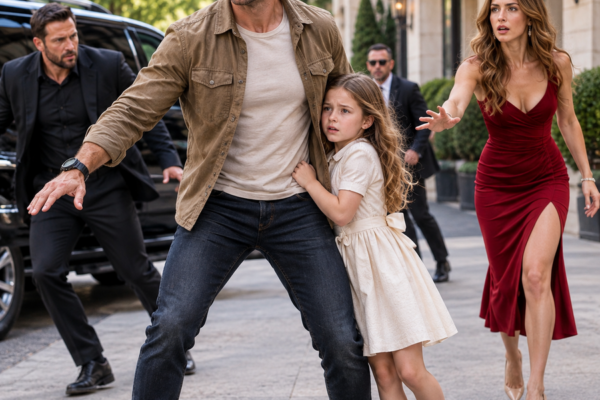
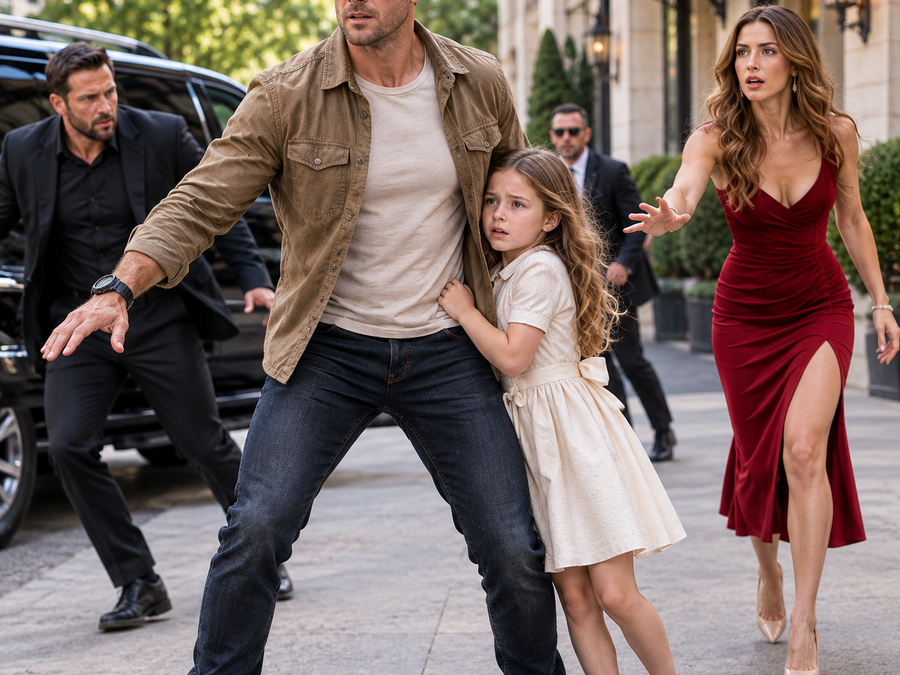
She was 7 years old and she had paint on her fingers from the art class she had just left and she was saying mama when the first man grabbed her arm. Her mother was 20 ft away.
20 ft. The distance a person could cross in 4 seconds if nothing was in the way.
Everything was in the way.
The security driver was already on the ground.
Two more men were moving with the kind of precision that does not happen by accident.
That only exists when someone has run the same sequence in their head a 100 times before they run it in the street. The SUV door was open.
A child’s feet were leaving the ground.
Vivian Cross, 30 years old, founder of a billion dollar company, a woman who had spent years believing that enough money could build a wall, a wall around every person she loved and discovered in that moment that she was completely powerless. She could not move.
She could not speak.
She could only watch her daughter’s hand reaching back toward her, fingers spread, searching for something to hold.
And then the man in the faded jacket put down his sandwich. He did not run.
He did not shout. He did not look around for someone else to handle it.
He just stood up. And the way he stood up was different from the way anyone else on that street was standing.
There was no hesitation in it, no calculation that you could see.
just a body that had been somewhere like this before, many times in places that did not have names on any map most people would ever read, and that remembered exactly what to do before the mind finished deciding. 6 seconds later, Lena was safe.
The SUV was gone, and the quiet life that Ethan Cole had spent 5 years building out of silence and school lunches, and the smell of engine oil was over.
He just didn’t know it yet.
If you have ever loved someone so much that you would walk into the fire without thinking the story is for you, subscribe to this channel, hit the like button, and drop a comment telling me your city and your country. I want to see how far the story reaches.
Now, let’s go back to where it really started.
The marina smelled like rust, diesel, and saltwater that had been sitting in the same place too long.
Ethan Cole had worked there for 3 years, and most mornings he still had to remind himself.
He had chosen this, the quiet, the sameness, the days that ended exactly where they started.
He pulled a corroded bolt from the engine housing of a 40-foot sloop called patience, which he had always found funny because the owner had none and dropped it into a coffee can.
The metal rang out sharply against the other scraps he had collected that morning, and he paused, listened to the sound fade, then went back to work. That was how Ethan spent most of his time now, listening to things fade.
He was 37 years old and looked about 43. Not because he was falling apart.
His hands were still steady and his body still moved the way it had always moved with a certain economy that his co-workers sometimes noticed and then forgot about. He looked older than he was because of something behind his eyes, a permanent kind of watchfulness, like a man who had learned to read rooms before he entered them and exits before he needed them.
His daughter Maya had once asked him why he always sat with his back to the wall at restaurants. He had told her it was so.
He could see the menu specials on the chalkboard across the room. She was eight and she had believed him mostly and he had been grateful for that.
Maya was the only part of his life that didn’t feel like a compromise.
everything else.
The apartment with the leaking bathroom faucet, the secondhand truck that needed a new alternator, the faded jacket he wore because it was warm, and he had never gotten around to buying another one.
All of that was fine. None of it mattered the way she mattered.
His wife, Clare, had been gone for 4 years.
Ethan did not talk about that, not to his co-workers, not to the few neighbors who asked questions when he first moved in. Not to anyone.
He had packed that grief into a very small space inside himself and locked it in a place that didn’t open by accident.
He had learned that in the Navy. He had learned a lot of things in the Navy.
By 10:30 that morning, he had finished the sloop’s engine housing, noted the remaining corrosion along the starboard fitting in the work log, and washed his hands twice before the smell of diesels stopped being the first thing his fingers touched.
He clocked out for lunch early.
The Marina supervisor was the kind of man who didn’t notice details, which Ethan had decided was either a virtue or a problem, depending on the day, and drove across the hill to the Hardroveve Art Center, where Maya had an afternoon workshop.
The Hardrove was a private children’s facility, slightly too expensive for his budget, and something he had been quietly paying for in installments since September.
Maya had a gift for drawing.
She had gotten it from Clare, who used to sketch faces on the backs of grocery lists during phone calls, unconsciously, the way some people doodled. He had found one of those grocery lists in the pocket of an old coat 6 months after the funeral, and had stood in the kitchen for a long time before putting it back.
He parked across the street from the center in a loading zone with 30 minutes on the meter, which was longer than he needed.
The October rain had been falling lightly all day, the kind that wasn’t heavy enough to justify an umbrella, but wet enough to make everything uncomfortable.
The street was quiet in the way that Seattle streets got quiet in the afternoon.
Most people already inside.
The traffic thinned out between the lunch rush and the school day pickup.
Ethan sat on the hood of his truck and ate his sandwich turkey and mustard on rye, the same thing he had eaten for lunch three days a week for the last year and a half because it was simple and because Maya liked the way he made them and because some habits were just deficient and watched the street the way he always watched things without appearing to watch them. Across from the art center, there was a coffee shop with a fogged window.
A parking attendance booth that was empty, a black SUV, dark glass, parked in a 20-minute zone for the last 45 minutes, engine running.
Ethan ate his sandwich.
He did not look at the SUV directly. He did not look away from it either.
Vivien Cross arrived at 1:47 p.m.in a silver sedan with a security driver named Ror, who had worked with her for 11 months and who she trusted because he was thorough and quiet and did not ask her personal questions.
She was picking up Lena early the afternoon board meeting had been moved, which meant she had an unexpected window of 2 hours, and she had decided on impulse to take Lena for ice cream before the day closed in again.
Lena was seven and she talked constantly and she had her father’s eyes which Vivienne had once loved and now simply accepted the way you accepted certain permanent things.
She stood on the sidewalk in front of the center and waited while Ror went inside to retrieve Lena from the workshop coordinator the way they always did it.
Protocol signed out accounted for nothing left to chance. Viven was on her phone not looking at the street.
She never saw the second vehicle come around the corner.
She heard Lena before she saw her the familiar bright burst of her daughter’s voice saying, “Mama.”
As the cent’s front door opened, and she was already smiling when she finally looked up and saw that Ror had stopped walking.
He was standing very still. A man in a dark jacket stood behind him with something pressed to his back.
The air left Viven’s body in one moment completely, and she could not get it back.
Everything happened at once after that. the way extreme events always happen, not in sequence, but in a single collapse of time that she would spend years afterward trying to sort into an order that made sense.
The black SUV jumped the curb.
A second man came from the direction of the coffee shop, moving fast. A third appeared from the alley beside the center.
Lena was lifted off her feet.
Viven moved toward her daughter, and something a hand and arm, the edge of the SUV’s open door, stopped her.
She couldn’t determine later whether it had been deliberate or whether she had simply run into something in the chaos.
It didn’t matter.
What mattered was that Lena was 2 yards away, reaching for her, and Viven could not close the distance.
She screamed her daughter’s name.
No one around her was moving. People were frozen on the sidewalk, halfway to their cars, pressed against the wall of the coffee shop.
A woman in a red coat had dropped her groceries. A man in his 60s had backed against a mailbox and was yelling something into his phone.
The second man had Lena’s arm.
The third man held the SUV door open.
Ror was down. And then something happened on the other side of the street.
Ethan dropped his sandwich wrapper into his truck bed, slid off the hood, and crossed the street at a pace that was fast enough to cover ground and controlled enough not to telegraph where he was going.
He had 6 seconds.
He knew it without calculating at the SUV’s positioning.
the third man’s angle, the likely trajectory once the door closed.
He had assessed every variable in the 4 seconds between the vehicle jumping the curb and the moment he started moving. He did not run directly at them.
He cut at an angle, approaching from the blind side of the open door, and the first thing he did was not what a reasonable person would do. He grabbed the door, not the kidnapper, not Lena the door, and swung it hard against the man standing beside it.
The man buckled sideways.
The second man turned at the sound, and Ethan was already inside his reach, close enough that distance became useless, trapping the wrist of his weapon hand against his own forearm and driving an elbow into the man’s collarbone.
It was not a clean hit.
The man’s shoulder caught Ethan’s jaw, and he tasted copper, and then Lena was falling because the grip on her arm had broken, and Ethan caught her with his left hand.
not smoothly. She hit his forearm first and cried out, but she was down and he pulled her behind the concrete planter at the front of the art center and put his body between her and the SUV.
The driver accelerated. The third man scrambled for the open door.
The first was still getting up. Ethan held Lena against the planter and did not move.
He calculated the angle, the geometry, the risk of the first man getting to his feet and still being a threat versus the probability that the driver’s priority was extraction rather than confrontation.
Extraction one. The SUV roared away.
The whole thing had taken 6 seconds from the moment Ethan stepped off the curb.
His jaw was throbbing and his left palm had a long scrape where Lena’s elbow had caught it.
and he was breathing through his nose in a controlled way that had nothing to do with calmness and everything to do with keeping himself functional. Lena was crying, not screaming, which he noted with a specific kind of relief.
She was scared, but she was tracking. She was present.
She was not in shock.
“You’re okay,” he said.
His voice came out rougher than he intended.
“You’re okay.
I’ve got you.”
She did not believe him yet, but she stopped trying to pull away, which was enough.
Viven reached them in seconds, sliding onto the wet pavement on her knees without appearing to notice, pulling Lena into her arms so hard that Lena made a small sound of surprise. Viven was shaking.
Her hands, her shoulders, the breath that came out of her in a long, jagged exhale, she was shaking.
The way people shook when the body finally communicated what the mind had been refusing to process. Lena, Lena, look at me.
Are you hurt? Look at me.
Mama, that man ran really fast. Lena said.
Vivien laughed. It was not a funny laugh.
It was the kind of laugh that happens when the alternative is something worse.
She held Lena’s face in both hands, checked her, found her hold, pulled her in again, and then she looked up at Ethan.
He was already on his feet, not watching them, watching the street. He was checking rooftops, checking parked vehicles, checking the reflection in the coffee shop window and the alley beside the art center and the direction the SUV had gone.
He moved his attention through the scene in a pattern that had nothing improvised about it.
“Who are you?”
Vivien said, “Ethan Cole.”
He glanced at her briefly.
“You need to get inside.”
“Is there another exit from this building?”
“What?”
“Another way out, a back door, a loading bay, a service entrance.
Something that isn’t this street.”
Viven stared at him.
“There’s a yes.
There’s a service entrance on the east side, I think.
I don’t know if it’s Get Lena inside now.
Call your security team and tell them do not send more cars to this address until they’ve confirmed the route is clean.
He was already looking toward the alley. Do you have someone you trust inside the building?
The coordinator, Mrs.Albbright. Go to her.
Lock the door you came through and do not open it for anyone who doesn’t say your daughter’s name first.
Who are you?
Viven said again, but differently this time. Ethan finally looked at her directly.
He had a cut on his jaw that was still bleeding a little and a look in his eyes that she would think about for weeks afterward. Not cold exactly, more like distant, like someone behind a window, close enough to see out, but not touching the glass.
Maintenance tech, he said.
My daughter has a class in there, too.
He looked down at Lena, who had turned in Viven’s arms to look at him.
There was a long smear of blood on his palm where he had caught her. You okay, kid?
Lena considered this with the gravity that seven-year-olds brought to important questions.
“My arm hurts a little,” she said.
“You’ll have a bruise tomorrow,” he said.
“It won’t be that bad.”
“He said it like someone who knew what bruises were supposed to look like when they healed.”
And Lena nodded as if that were reassuring. And somehow it was.
The police arrived 11 minutes later. Ror had a dislocated shoulder and a laceration on his skull that needed stitching, but he was conscious and talking when the ambulance came.
The parking attendant, who had been on a coffee break and returned to find his booth surrounded by police tape, gave a statement describing a black SUV and three men in dark jackets, none of which helped much.
One officer interviewed Ethan for 8 minutes. Ethan answered every question accurately and completely and offered nothing beyond what was asked.
A detective arrived and interviewed him again.
Ethan answered those questions the same way.
A woman from Viven’s security team arrived and asked if they could speak further at a private location.
Ethan told her he needed to collect his daughter.
He retrieved Maya from the workshop she had heard the sirens and been kept inside with the other children. And she came out holding a drawing she had been working on.
A bird in a tree, the tree leaning sideways like all of Maya’s trees always did.
And he took her hand and walked her to the truck.
Dad, she said, “Yeah, there were police cars.”
“Yeah, there were.
Are you okay?
You have blood on your hand.
I’m okay, Maya bird.
She looked at the drawing, then at him, then back at the drawing. Do you need a bandage?
I’ll clean it at home.
She reached into her backpack and produced a small plastic box.
Inside were three superhero bandages, the kind with cartoon characters on them, which she kept because she had learned from specific experience that her father was unlikely to carry his own. She handed him the one with the star on it.
That’s your best one, he said.
I know, she said matterof factly.
You need it more than I do today. Ethan looked at his daughter for a moment, her seriousness, her quiet practicality, the way she had gotten that from both of them and made it entirely her own, and something moved in his chest that he did not name.
He took the bandage. He let her put it on.
They drove home in the light Seattle rain, and Maya told him about the bird she had been drawing.
And he listened, and the whole drive, he kept the rear view mirror in his peripheral vision and checked every intersection without letting her see him do it.
Because the black SUV had been parked there for 45 minutes before it moved.
That meant someone had known Lena’s schedule.
That meant this had not been random.
And that meant somewhere in the back of Ethan’s mind, in the part that never fully went quiet, something was already beginning to work.
The apartment on Delridge Way was not much, but Ethan had never needed it to be.
Two bedrooms, one bathroom, a kitchen with a window that looked out onto the brick wall of the building next door.
Maya had covered her bedroom wall with drawings birds mostly, but also horses, a few attempts at portraits, one ambitious cityscape that had taken her three weekends, and which Ethan had framed with a piece of trim wood he found in the marina’s scrap pile.
His own room had a bed, a dresser, and a photograph of Clare on the nightstand that he had not moved in 4 years, because moving it had always felt like the kind of decision you couldn’t take back.
He cleaned the scrape on his palm over the bathroom sink that night after Maya went to bed.
It was not deep, just long, and it stung in a way that was more annoying than painful. He pressed damp cloth against it and stood looking at himself in the mirror for a while, the way you did after a day that had gone sideways.
His jaw had swollen slightly where the kidnapper’s shoulder had caught it.
Not badly.
He had taken worse from a sparring partner in Coronado on a Tuesday afternoon with nothing at stake, but it achd in a low, steady way that reminded him he was 37 and not 26, and that the body kept its own accounting whether you paid attention to the ledger or not. He turned off the bathroom light and sat at the kitchen table with a glass of water and his phone.
There were two missed calls from a number he didn’t recognize and a voicemail that turned out to be a detective named Carver from the Seattle PD asking him to come in for a follow-up interview at his earliest convenience.
There was also a text from a number with a 2066 area code that’s said only Mr.Cole.
This is Vivian Cross. I would like to speak with you.
Please call me at your convenience.
I understand if you’d rather not.
He read the text twice.
Then he set the phone face down on the table and finished his water. He had known in some part of himself that the day was not finished.
Days like that one never finished cleanly. They left threads, and threads had a way of pulling.
He called Detective Carver in the morning, went in at 9:00, and spent an hour answering questions that were thorough, professional, and ultimately circular in the way that early stage investigations always were.
when the perpetrators had fled cleanly and the witnesses had conflicting impressions of the sequence of events. Carver was a compact, careful woman in her mid-40s who took notes in a small spiral notebook and had the particular stillness of someone who had learned to wait out silences.
She asked Ethan three different questions about his military background in three different ways. And Ethan answered all through the same way.
He had served.
He had been discharged honorably.
He was not in active duty and had not been for several years.
She did not ask which branch. He did not volunteer it.
When he left the precinct, the silver sedan was parked across the street. Not the same one from the day before.
That one would still be in police impound, but a different one. Same model, same color.
The window came down and the driver, a large man with a careful posture that marked him as former military or current security, said nothing. Just looked at him.
The back window came down a moment later. Vivien Cross looked less composed than she had the previous afternoon.
She was in a dark coat that looked expensive, and she had the specific kind of tiredness around her eyes that came from a night spent mostly awake, the mind refusing to let the body fully down into sleep.
Her hair was pulled back, not styled. She was holding a paper coffee cup with both hands like it was the only warm thing in the car.
I was going to call, Ethan said. I know, she said.
I’m not very patient.
A pause.
May I buy you coffee somewhere that isn’t the street?
He looked at the driver who was looking at the middle distance with professional neutrality.
Sure, Ethan said. The coffee shop she chose was not the kind of place Vivien Cross normally occupied, which he suspected was deliberate.
It was a neighborhood diner two blocks from the precinct with laminate tabletops and a coffee machine that had been running since approximately 1987 and showed it.
A woman named Deb brought them mugs without asking, refilled them without being asked, and left them alone with the efficiency of someone who had long ago stopped being curious about other people’s conversations.
Viven wrapped both hands around her mug and looked at him across the table for a long moment before she spoke.
“I had my team look into you last night,” she said.
“It was not an apology.
It was not an accusation either. It was just a fact delivered directly, which he found he preferred to the alternative.
I figured you would, he said. They found very little, which is itself unusual for someone your age.
I’m not on social media.
It’s more than that.
She set down her mug. There are gaps.
The kind of gaps that don’t happen by accident.
Ethan drank his coffee. It was bad coffee burnt, slightly bitter, and it was exactly what he needed.
What do you want to know?
I want to know how a marina maintenance technician dismantled an armed kidnapping in 6 seconds.
She said it without drama, factually. the way a person stated a problem they needed solved.
“I got lucky,” Ethan said.
“No,” she said.
“You didn’t.”
She pulled out her phone and turned the screen toward him. It was a still frame from a security camera across the street, the coffee shop camera.
It looked like showing him midmovement. He was between two men, his weight distributed in a way that was not accidental and not lucky.
His arm position precise, the angle of his body deliberately creating a shield with his own frame. My head of security spent 20 years in federal protection.
He watched this footage for 40 minutes last night and then he called me and said, “Whoever that man is, he’s not a marina tech.”
Ethan looked at the photograph for a moment.
Then he looked out the window at the gray Seattle morning.
“Former Navy,” he said.
“I’ve been out for 5 years.
She waited.”
“Special warfare,” he said.
“Another wait.”
“She was good at waiting,” he noted.
“Better than most people.
She did not fill silences the way uncomfortable people did, rushing words in to cover the empty suits.
She let it sit and breathed through it and let him make his own decision about what to put there.
I spent 11 years doing things that don’t make good dinner conversation, he said.
Hostage recovery was part of it.
That’s why yesterday looked the way it looked.
It wasn’t luck.
It was just pattern recognition.
I’ve been in situations like that.
My body remembered before my brain caught up. Viven nodded slowly.
Why didn’t you say that to the police?
Because they didn’t need it and it wasn’t relevant to their investigation.
He picked up his mug.
And because I’d prefer that part of my history stay quiet because of Maya.
He looked at her. My team found her.
Viven said not unkindly. Public school enrollment records.
The arts center registration.
She’s in your name.
A brief pause.
She’s a beautiful kid.
The coordinator said she’s very serious about her drawings.
She is, he said carefully.
I’m not threatening you, Mister Cole.
I’m explaining why I know her name so you understand what I know and what I don’t and where the line is.
Viven met his eyes steadily.
I have a 7-year-old, too.
I understand what it means to want to keep that line very clear. Ethan studied her for a moment.
He was good at reading people better than most, for reasons that had been trained into him at significant expense to the federal government, and what he read in Viven Cross was not manipulation. It was something more straightforward and more honest than that.
It was exhaustion and fear that had not yet finished metabolizing and the particular control of someone who had decided that the only way through a terrible thing was to meet it directly. He respected that.
He did not say so.
What do you actually want? He said.
Viven looked down at her coffee, then back at him.
I want to understand what happened yesterday. My security team is telling me it was opportunistic, that someone identified Lena as a target and took advantage of a moment when security was thinner than usual.
She paused.
I don’t believe them.
Why not?
Because the timing was too precise. Ror changed the pickup time at my request 2 hours before we arrived.
That information was in my calendar. My private calendar.
Her jaw tightened slightly.
Someone who could access my private calendar is not an opportunist.
Ethan set down his mug.
He had reached the same conclusion the night before, sitting at his kitchen table in the quiet after Maya went to sleep, running through the sequence the way he used to run through operation debriefs, looking for the gaps, the inconsistencies, the things that didn’t fit.
The timing had been too clean.
The personnel had been too coordinated. Someone had run surveillance on that location.
And the 45 minutes the SUV had been parked, there was not reconnaissance.
It was waiting waiting for a specific signal. Your security team, he said.
How many people had access to your calendar?
My assistant, my security director, and my chief operating officer, and me. Anyone else?
IT department, admin stiff who might have system access.
She shook her head.
I have a separate encrypted calendar for personal appointments. Three people have the access code, and you trust all three.
I’ve trusted all three for years.
She said it with a certainty that he recognized as the kind that had not yet been tested.
But yes, that might need to change, he said quietly. She looked at him for a long moment.
Will you help me?
I’m not in that business anymore.
I know you’ve made that clear.
She did not push it.
She simply looked at him across the laminate table in the bad coffee diner and said, “I just wanted you to understand what I’m dealing with, what Lena is dealing with.”
A pause.
and to thank you properly, which I didn’t get to do yesterday because I was barely functional.
He nodded once. You can thank me by taking the police detective seriously, he said.
And by varying Lena’s schedule for the next few weeks.
Different times, different routes, never the same pattern twice. My security team already.
I know what your security team already, he said. Do it anyway.
The people who took that SUV around the block and drove away clean are not finished. They walked away from a failed operation.
They’ll reassess and try again.
He picked up his coffee.
That’s what I would do.
Vivien Cross looked at him for a long moment, and something shifted in her expression that was not quite fear and not quite respect. It was more complicated than either one.
All right, she said.
He should have left it there. He knew that even at the time, he had given her practical advice and declined involvement, and that should have been the end of it.
He had a job and a daughter and a life that he had spent 5 years very deliberately constructing out of the wreckage of what came before it.
And inserting himself into Viven Cross’s problem was the opposite of everything that construction was built on.
But three things happened in the next 72 hours that made leaving it alone impossible. The first was the car.
It appeared the day after his diner meeting with Viven.
a dark blue sedan, not a color that stood out, parked on the far end of his block when he left for work in the morning and gone when he returned in the afternoon, but back again at 7:00 in the evening in a slightly different spot, as if someone had moved it once and then thought
better of moving it again.
Ethan walked past it on his way back from the corner store without looking at it and noted the partial plate and the antenna configuration and the way the windows had aftermarket tint that was about four degrees darker than legal limit. He came home, made dinner, helped Maya with a worksheet about state capitals, and waited.
At 10:15, the car moved again.
He watched it from his kitchen window, standing at an angle in the dark, so the street light didn’t catch his face.
He went to bed and did not sleep much.
The second thing happened two mornings later.
He came home after dropping Maya at school to find his apartment door unlocked, not broken, unlocked.
The deadbolt was in the open position, and he was certain, with the particular certainty of someone who checked things like deadbolts, the same way other people checked their reflections in passing windows, that he had locked it
when he left.
He stood in the doorway for 30 seconds before going in.
Nothing was visibly disturbed.
Nothing was missing his laptop, the small amount of cash he kept in the kitchen drawer, Ma’s tablet on the coffee table, all of it exactly where it belonged.
But Ethan moved through the apartment the way he had been trained to move through spaces that might be compromised.
And what he found was the kind of disorder that only existed if you were looking for it.
A book on his shelf shifted 2 in from where he kept it. The coffee can under the kitchen sink where he kept a key to his truck and $50 he had never touched opened.
The drawer in his bedroom nightstand pulled out 1 in farther than its usual position.
Someone had searched his apartment carefully, professionally, but not carefully enough. He sat on the edge of his bed for a while after that.
They had not stolen anything because they were not there to steal. They were there to understand who they were dealing with, to find out whether the man who had interrupted their operation on a wet Tuesday afternoon was a liability or a loose end.
The third thing was the text message.
It came from a number that resolved to nothing when he tried to trace it a burner, obviously, and it said, “Walk away, Cole.
This doesn’t concern you anymore.”
He read it standing at his kitchen counter.
He read it again.
Then he called Vivian Cross.
She answered on the second ring, which told him she had been waiting for his call or was already awake at 6:00 in the morning for other reasons.
Her voice was controlled, but with something underneath it that was not.
“They’re watching me,” he said without preamble.
searched my apartment 2 days ago.
I’ve had a tale since Tuesday, and I got a message this morning telling me to walk away.
A silence. Ethan, she said it was the first time she had used his first name.
This tells me two things, he continued, keeping his voice even because he needed it to be even, and he needed her to hear the evenness and understand it was not indifference.
One, whoever organized that kidnapping has resources and patience.
This is not a graband- run operation.
They planned it.
They had backup surveillance in place and when it failed, they didn’t scatter.
They repositioned. He moved to the window and looked out at the street.
The dark sedan was not there this morning, which was almost more concerning than if it had been.
Two, they know I saw enough to be a problem.
They don’t know who I am yet, not fully.
If they did, the message would have been different. What would it have said?
Viven asked.
It wouldn’t have said anything, he said.
Another silence. What do you want to do?
she said.
And that was the question that mattered, wasn’t it?
What did he want to do? He had spent 5 years very carefully not wanting to do things like this.
He had built a life around the absence of this particular kind of wanting.
Had filled that absence with oil changes and school pickup and turkey and mustard sandwiches and a little girl’s drawings of burns of birds with sideways trees.
And it had been enough.
It had been a good life, a quiet life, the kind of life that didn’t carry a body count.
Tell me about your security director, he said. Grant Holloway, she said, and the way she said it slightly too quickly, slightly too automatic, told him she had been waiting for someone to ask this specific question.
He’s been with Crosswell for 6 years.
Former FBI, 2 years in private sector before he came to me.
His background checks out clean.
What’s he like?
Not his resume.
What’s he like?
She paused.
Precise.
Loyal.
I’ve always thought he runs a tight operation.
A longer pause.
He was the one who told me the kidnapping was likely opportunistic. Right away, within a few hours of it happening, Ethan said nothing.
“You think that’s significant?”
Vivian said, “I think it’s a fast conclusion for a professional to reach about an operation that involved three coordinated personnels, a surveillance vehicle, and advanced knowledge of your daughter’s schedule.”
He kept his voice neutral.
I
could be wrong.
She was quiet for a moment on the other end of the line. He could hear her breathing.
I don’t want you to be wrong, she said finally.
Cuz the alternative is she stopped.
I know, he said.
What do I do? Ethan turned from the window and sat at the kitchen table.
In the bedroom, he could hear Maya beginning to stir. She woke up slowly in stages, first rolling over, first a sound that was half word and half sigh, then the creek of her mattress as she sat up.
He had 20 minutes before she was fully awake, and came out looking for breakfast.
He had told himself this morning over and over that he was just going to make her eggs and drive her to school and go to work. Start keeping information siloed, he said.
Don’t tell all three of your trusted people the same things at the same time.
Vary what you share and when.
He paused.
If someone leaks, you’ll be able to narrow down the source.
That’s Yes.
That’s very cold-blooded of you.
Yes, he agreed. It is.
Will you? She stopped herself.
Started again.
I’m not going to ask you to do something you don’t want to do.
good, but I would feel better knowing you were, I don’t know, informed if you were willing.
He looked toward Maya’s bedroom door.
He thought about the dark sedan on his block.
He thought about the drawer on his nightstand pulled one inch too far.
He thought about the text that said, “Walk away,” which was the kind of message sent to people.
They were not yet certain about, which meant there was still time, which meant the window was still open, which meant that if he was going to do something, doing it now mattered.
Tell me everything you know about Cwell’s cyber security platform.
He said the one that’s actually worth something.
The one someone would go to all this trouble for. He heard her exhale.
Not relief. Exactly.
More like the sound of someone putting down a weight they had been carrying for 2 days.
It’s called Prism.
She said it’s an encrypted threat intelligence system.
Government grade.
We’ve been developing it for 4 years and we’re 6 weeks from a federal contract signing that’s worth approximately 1.
4 4 billion.
Ethan said nothing, which means Vivien continued that someone who could hold Lena over my head had leverage to to make you delay the contract, he said. Or hand over access credentials.
Or both.
Yes.
He looked at the ceiling for a moment. All right, he said.
All right. What?
Maya’s door opened and she appeared in the hallway in her pajamas with her hair still flattened from sleep on one side, squinting at the morning light.
She saw him at the table and came and sat across from him and rested her chin on her arms and looked at him with the uncomplicated trust that children had in the morning before the day had done anything to them yet.
“Eggs,” he said to her, covering the phone briefly.
“Scrambled,” she said.
“With cheese.”
“Give me a minute,” he said.
He put the phone back to his ear.
“Tell Holloway you’ve arranged additional external security consultation,” he said quietly.
“Don’t tell him who.
Watch his reaction.
And if his reaction is wrong, Vivien said, “Then we’ll know,” Ethan said, “and we’ll go from there.
” He hung up the phone and stood up to start the eggs.
He found the good pan, the small one, the one Clare had bought at a garage sale in 2016, and which still made better scrambled eggs than any pan that should reasonably perform better, and cracked four eggs into the bowl, and watched Maya draw a horse on the back of her worksheet at the kitchen table, tongue between her teeth entirely absorbed.
He whisked the eggs. He was not happy about what he had agreed to.
He was not excited by it, was not energized by it the way some men in his former life had been energized by problems like this. He felt something quieter and less satisfying, a kind of grim necessity, the same feeling that made you fix a leak in a roof in the rain.
Because if you didn’t fix it now, it was going to be a much bigger problem in a month.
He poured the eggs into the pan, the thing that he kept coming back to.
as he scraped the eggs across the heat and shredded the cheese and found the plates and poured Maya her orange juice and did all the ordinary morning things that composed most of his life.
Now the thing he kept coming back to was the 45 minutes. The SUV had been parked outside the Harrove Art Center for 45 minutes before Viven arrived.
Ror had changed the pickup time 2 hours before they got there, which meant that someone had relayed the updated schedule within two within that 2-hour window, and the surveillance team had been in position within 45 minutes of receiving it.
That was fast.
That was organizational. That was not a criminal network improvising.
That was someone’s inside Viven’s world with a direct line to the peoples outside it.
And Ethan had been sitting on the hood of his truck eating a turkey sandwich and he had noticed the SUV and he had not done anything yet because he had not had enough information and he was no longer in the business of acting on partial information.
The question that kept him awake was simple. What if he had looked at his phone instead?
What if he had been 3 minutes earlier or 5 minutes later or parked on the other side of the street? He knew the answer.
He had known the answer since Tuesday.
He set the eggs in front of Maya and sat across from her and drank his coffee, and she ate without looking up from her worksheet horse. And the morning was quiet and ordinary, and exactly what he had built his life to be.
But the threads were already pulling, and Ethan Cole had never in his life been the kind of man who could leave a thread alone once it started. That was the problem with the things that got trained into you.
You could put them in a box, seal the box, put the box in a closet, and never open the door.
But the things didn’t stop being true.
They just waited.
And when the moment came that actually needed them, not the moment you manufactured, not the exercise, not the drill, when the actual moment came and the actual stakes were in front of you, the box came open on its own.
He rinsed his mug in the sink.
Outside on the street below, a dark sedan rolled slowly past the building.
Ethan watched it go. He dried his hands.
He had promised himself that Maya would never see the man he used to be.
He still meant to keep that promise.
He just needed to figure out how to keep it while also making sure there was still a safe street outside their building for her to walk down in the morning.
“Dad,” Mia said.
He looked at her.
“You burnt yours,” she said, pointing at the pan.
“He looked at the pan.
A thin curl of smoke was rising from where he’d left the last of the eggs too long.”
“I did,” he said.
“He scraped them out anyway and ate them standing at the counter.
They were not good. He ate them anyway because that was the kind of mourning it was and because some days you just dealt with what you had and moved forward.
That had always been in the end the only skill he was truly certain of. Viven did what Ethan told her to do.
She did not tell Holloway who the external security consultant was.
She told him only that she had arranged additional oversight, that it was her decision, and that she expected his full cooperation.
She watched his face while she said it.
She had been watching faces across boardroom tables for a decade, and she had developed a particular fluency in the small tells that people thought they hid and mostly didn’t.
Holloway’s reaction was not wrong exactly.
It was composed, professional, the response of a man who had spent years in federal work and understood the protocol of accepting direction without argument. But there was something in the half second before the composure settled, a flicker, a calculation.
She called Ethan that evening and described it like he was deciding something.
She said, “Not surprised.
More like adjusting.”
“Okay,” Ethan said.
“That’s bad, isn’t it?
It might be nothing.
Some people just don’t like surprises in their professional territory.”
A pause. But yes, it might be bad.
She had already started the information silo that morning.
She told Holloway that Lena’s schedule for the following week would remain unchanged school, the pediatrician on Wednesday, a play date Thursday afternoon.
She told her seat, a careful woman named Sandra Reyes, who had been with Crosswell from the beginning and whose loyalty Viven trusted in the way you trusted a structural wall, a different version.
Lena’s schedule was being significantly altered.
No details yet, she told her assistant, a 26-year-old named Dev, who handled her calendar and her coffee and approximately 60% of her logistical existence.
A third version, Lena was staying home from school Monday and Tuesday. Then she waited.
She did not have to wait long.
On Monday morning, Ethan called her from a number she didn’t recognize.
The pediatrician’s office.
He said someone called ahead this morning asking about Wednesday’s appointment.
Said they were from your security team, wanting to confirm the address and the parking situation. Viven sat very still in her office chair.
I told you not to confirm anything to anyone external.
Ethan said, “I know the only version of Lena’s schedule that included the Wednesday pediatrician was the one you gave Holloway.
The silence between them was long.
How do you know about the pediatrician’s office?”
She said, “I called them first,” he said.
“I asked them to log any unusual inquiries.
” She did not ask how he had known which pediatrician.
She had stopped asking how he knew things.
He seemed to know them the way experienced people knew things, not through any single piece of information, but through the accumulated habit of noticing, which was not a skill so much as a practice, and one that most people gave up on by their mid30s when life got complicated enough that noticing everything became too exhausting.
What do I do? She said, nothing yet.
You act exactly the same as you always act around him. Can you do that?
She thought about it honestly.
Yes, she said.
I’ve been managing my face in difficult rooms for a long time.
Good.
Another pause.
There’s something else I need to tell you.
His voice had shifted slightly. Not much.
He was not a man who communicated through dramatic tonal changes, but enough that she straightened in her chair.
What?
I’ve been going through what you sent me about Prism, the architecture documents, the contract timeline, the access credential structure.
He had asked for those files 3 days ago and she had sent them through an encrypted channel he had specified, not Crosswell’s standard system.
There’s a secondary data pathway built into the system.
A back door that’s impossible, our engineering team.
It was installed at the infrastructure level, not the application level, he said.
Your engineering team wouldn’t necessarily see it.