Part 1| A Billionaire Sneered at a Single Dad Ex-SEAL—Seconds Later, He Hotwired Her Ferrari to Save Her
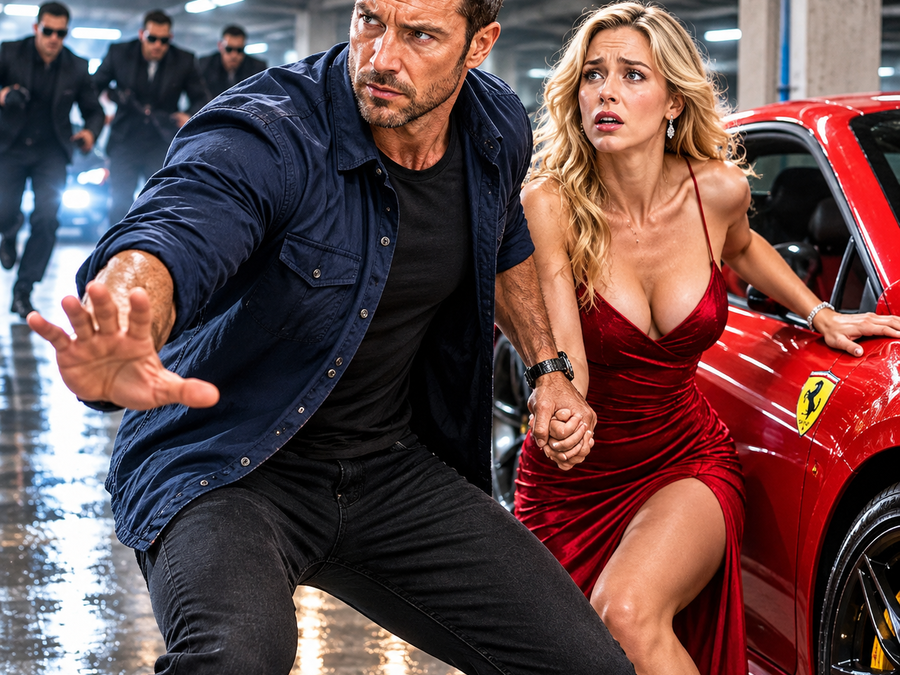
Part 1| A Billionaire Sneered at a Single Dad Ex-SEAL—Seconds Later, He Hotwired Her Ferrari to Save Her
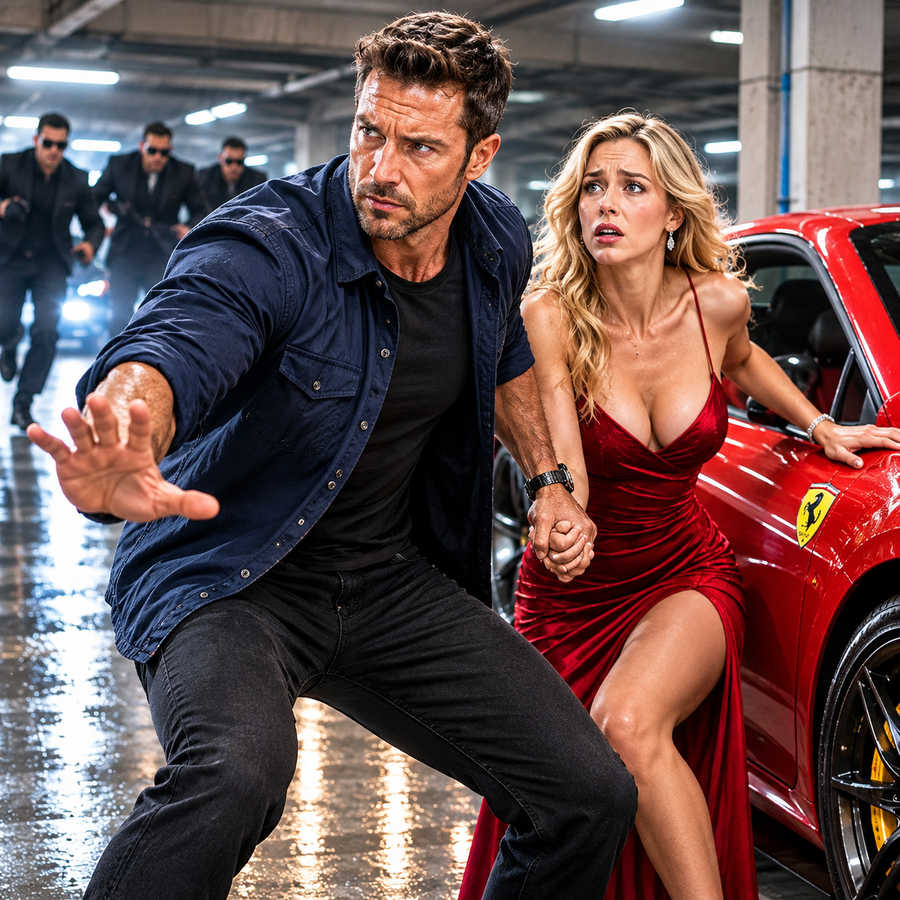
She laughed at him, stood there in her tailored blazer, surrounded by half a million dollars worth of Italian engineering, and laughed at the grease stained man who had just told her not to drive her own car.
He wasn’t angry, didn’t raise his voice, just looked at her with eyes that had seen things she couldn’t imagine, and said quietly, “Someone inside your company wants you dead.
That car is how they plan to do it.”
She drove it anyway.
And 40 seconds later, the lights went out, the exits locked, and three masked men stepped out of the dark.
That was the moment Camille Sterling learned that the most dangerous man in the room doesn’t always wear a suit.
If this kind of story is what you’ve been looking for, the kind that keeps you up at night, hit subscribe right now and follow along until the very end.
Every week, I bring you stories like this one. gripping edgeofyour seat narratives about ordinary people caught in extraordinary situations.
Tap the like button and drop a comment below telling me what city and country you’re watching from.
I want to see exactly how far this story travels.
Now, let’s go back to the beginning because to understand what happened in that garage, you have to understand the man nobody bothered to look at twice.
The February windoff Lake Michigan had a particular personality.
It didn’t just blow, it pushed like it had somewhere to be and you were in the way.
Rhett Callahan felt it every morning when he stepped out of his house at 6:15 to start his truck. And he had long ago stopped being bothered by it.
Cold was just cold.
He’d been colder.
The house was a modest two-story in Elmhurst, the kind of neighborhood where people shoveled their own driveways and nodded to each other across chainlink fences without ever learning each other’s last names.
It wasn’t a beautiful house.
The gutters needed replacing. The driveway had a crack running through it that got a little longer every winter, and the kitchen still had the avocado colored tile that the previous owners had installed sometime around 1987.
Rhett had meant to rip it out eventually.
He never got around to it. There were always more important things.
That morning, like every weekday morning, he made Sophie’s lunch first.
Peanut butter and honey on wheat, the crust cut off.
Because Sophie was 8 years old, and 8-year-olds have opinions about crusts, he packed a small bag of pretzels, an apple, and a juice box.
Then he wrote the same thing on the napkin he folded into the corner of her lunchbox that he always wrote.
“You’re my favorite part of the day.”
It had started as a silly thing and become a ritual, the way most important things do. He woke Sophie at 7:00, sat with her through breakfast while she talked about something that happened at school involving a hamster and a misunderstanding that she described with enormous dramatic energy.
Rhett listened and asked questions and ate his toast and thought she was the most interesting person he had ever met in his life.
He dropped her at school at 7:50, watched until she disappeared through the front doors, then drove to Callahan Automotive on the other side of town.
The shop had been open for 4 years.
It wasn’t a glamorous business.
Three bays, two full-time employees.
Marcus, who was 26 and had hands like a surgeon, and Donna, who handled scheduling and had a gift for making angry customers feel like they’d overreacted.
Rhett mostly worked. He liked the work.
There was something deeply satisfying about a problem that had a physical solution, where you could reach in with your hands and find what was wrong and fix it. Not everything in life was like that.
He had just finished a break job on a Chevy Tahoe when Donna knocked on the doorframe of the bay. Job came in through the corporate account, she said.
Veyron Dynamics.
They want someone to look at a Ferrari prototype. Some kind of intermittent starting issue.
She paused.
They were very specific. They want you personally.
Rhett wiped his hands on a shop rag.
How’d they even get this number?
Apparently, you did work for one of their engineers about 2 years ago.
Guy named Preston.
He recommended you. Donna held out the paperwork.
They’re sending a transport.
Car gets here at noon.
When the enclosed trailer arrived, Rhett understood immediately why they’d requested someone with his particular background.
The Ferrari wasn’t a production model.
It was handbuilt, roughly a third of the components custom engineered with an electrical system that had been modified in ways that most mechanics would look at for 5 minutes and then politely decline. The transport team was polite but nervous.
They kept checking a laminated card of handling instructions. Rhett circled the car slowly before touching it.
This was a habit from a different part of his life, one he’d never managed to lose completely.
You look first.
You look for what doesn’t belong.
Has anyone else worked on this since the issue started?
He asked the transport team.
We were told the Veyron technicians ran diagnostics, found nothing. Did they go hands-on or just plug in their readers?
The two men exchanged a look.
I don’t know.
Rhett pulled on a fresh pair of gloves.
He spent the first hour doing nothing but looking, running his fingers along the undercarriage, examining seams and panel edges, and the narrow channels where the bodywork met the frame.
He checked the biometric ignition housing, the control interface, the routing of the electrical harness.
He did it methodically and without hurrying, the way a man does when he’s learned that impatience gets people killed.
The intermittent starting problem turned out to be real, caused by a micro fracture in the ignition module’s mounting bracket that was just large enough to cause a ground fault under thermal expansion.
That was a legitimate defect, probably from manufacturing.
He could fix that in 2 hours.
But that wasn’t what made him stop.
He was deep in the driver side control architecture when he found the first anomaly. A small device, no larger than a thick matchbook, spliced into the datab bus with connectors that match the factory spec almost perfectly.
Almost.
The connector housing was genuine Veyron sourced. The device inside it was not.
Rhett set down his tools.
He stood up slowly and looked at the car for a long moment.
Then he went back under and spent another 40 minutes looking for everything else that didn’t belong.
He found two more things.
a secondary transmitter tucked inside the rear chassis cavity, accessible only if you knew exactly where to look.
And in the security camera covering the garage bay, a lens coating that should have been optically clear, but had been replaced with something that functioned as a privacy screen at certain angles, effectively blinding the camera’s view of the driver’s side.
Someone had spent a lot of time on this car, someone who knew it very well. He was still processing this when the door from the main office opened and Camille Sterling walked in.
He recognized her from the news, though she looked different in person, younger somehow, and more compact with sharp eyes that moved around a room.
The way people move their eyes when they’re used to being watched and have learned to watch back.
She was 30 years old and had been on the cover of three business magazines in the past year.
She’d built Veyron Dynamics from a 16p person startup into a company worth somewhere north of $4 billion.
And she wore that success the way some people wear expensive watches. Casually, but deliberately.
She was already talking when she came through the door.
Preston tells me you’re the best he’s ever seen with modified electrics.
I’m hoping that means you found our starting issue and have something useful to tell me.
She stopped at a professional distance from the car and looked at Red.
You’re Callahan?
Yeah. She glanced at the shop rag in his hand, then at the old Carheart jacket he was wearing, then at the parking lot outside through the bay window where his pickup was visible.
It was a brief look, but he caught it.
People always thought they were more subtle about it than they were.
So, what are we working with?
There’s a fault in the ignition mount, Rhett said.
That’s causing your starting issue.
I can have that fixed by end of business.
Good.
That’s what I needed to hear.
She started to pull out her phone.
That’s not everything, though.
Camille looked up. Rhett held her gaze.
Miss Sterling, your car has been modified. Someone installed a data tap on your primary control bus.
There’s a second transmitter in the rear chassis, and your garage security camera has been physically altered so it doesn’t record the driver’s side during startup.
The room was quiet.
Camille’s expression didn’t change dramatically.
She had a face that was used to not changing dramatically. But something shifted in her eyes, the sharpest thing there.
That’s a very serious claim, she said.
Yes.
Veyron security team ran diagnostics 2 days ago.
Software diagnostics wouldn’t catch it.
What I found was physically installed.
You’d have to get hands on the car to see it.
She was quiet for another few seconds.
Then she looked at the Ferrari, then back at him.
You’re telling me someone bugged my prototype?
I’m telling you someone did more than that.
The data tap isn’t passive.
The transmitter isn’t for tracking.
The way they’re configured together, Rhett paused, choosing his words carefully.
Someone can talk to your car’s electronic control system remotely.
They can issue commands to it.
What kind of commands? Braking, steering, the drive by wire throttle.
He let that settle.
Miss Sterling, I’d strongly recommend you don’t drive this car until we know who installed this and why.
Camille looked at him for a long time, and he could see exactly what was happening behind those sharp eyes, because he’d seen it before in people who wielded authority and were suddenly being told something they didn’t want to hear by someone who wasn’t on their org chart.
She was deciding whether to take him seriously. She decided not to.
“Mr.Callahan, she said, and her voice had a particular kind of precision that came from a decade of boardrooms.
I appreciate the thorough inspection. Please document what you found and send it to our security chief.
Fix the ignition issue and I’ll have my team evaluate your report.
She put her phone away.
I need the car back at the Veyron facility this afternoon. I have a demonstration for investors at 4.
I’m asking you not to drive it, and I’m asking you to fix what I hired you to fix.
The words weren’t cruel.
They were simply final. The way that certain kinds of authority speaks.
Not out of malice, but out of absolute confidence that it doesn’t need to argue.
Rhett held her gaze a second longer.
“Okay,” he said.
“Then let me be real clear about something before you go.
Whoever set this up knows your schedule, knows this car, and had access to the facility where it was stored.
This isn’t theft.
This is a targeting operation.”
He set the shop rag down on the workbench.
I don’t know what they want from you, but the people I’ve seen use equipment like this.
What I found in that car isn’t built for stealing.
It’s built for controlling.
And you need to think carefully about who in your organization has that level of access and that kind of motive.
Camille looked at him and for a second, just a second, something crossed her face that wasn’t authority, something more careful.
Then it was gone.
I’ll pass that along, she said.
Thank you for your time. She left.
The transport crew loaded the Ferrari and left 40 minutes later. Rhett watched the trailer pull out of the lot and stood in the empty bay for a while without moving.
Marcus leaned against the door frame.
She didn’t listen.
No.
You going to call somebody?
Rhett considered this.
He didn’t have anybody left to call.
That part of his life was gone, and the people connected to it had either moved on or didn’t owe him anything.
He was a mechanic in Elmherst with a daughter and a cracked driveway and a box of classified memories he kept nailed shut.
I’m going to follow up, he said.
She didn’t seem like she wanted followup.
Probably not.
He picked up his tools.
Doesn’t change anything.
He reached Veyron Dynamics main facility just after 3.
He used the name of the engineer, Preston, who had originally referred him to get through the lobby. And a junior security tech who seemed to mistake him for an approved vendor, walked him through to the executive garage level without incident.
It wasn’t sophisticated, but most security fails at the human level, not the technical one.
Red had known that for a long time.
He found the Ferrari already parked in the underground bay.
He found the camera blind spots that had been built into the facility’s security layout.
He found two things that hadn’t been there when the car left his shop, which meant someone had accessed it during transport or had additional components waiting to be installed at this end.
He was still trying to reach Camille’s assistant by phone when the lights in the underground garage went completely black.
Not a flicker, not a blown fuse. Every light in the space cut simultaneously, which meant the circuit breakers had been thrown manually or the system had been commanded remotely.
And either way, it was intentional. And either way, it meant the timeline had just moved up.
Rhett heard the sound of the vehicle entrance behind him cycling closed and locking. Then he heard footsteps from three different directions.
And somewhere across the darkened garage, he heard Camille Sterling’s voice, sharp, controlled, trying not to sound alarmed, saying, “What’s happening?
Why are the and then a brief cut off sound that was her security detail realizing too late that they were outnumbered and outpositioned and this had been planned down to the second.
Rhett had been in a
lot of dark rooms in his life.
He knew what it felt like when violence was about to reorganize itself around a single point of intention.
He moved toward Camille’s voice, not because anyone had asked him to, not because it was his job, because someone had just proven him right.
and proving him right had put a 30-year-old woman in the center of something she couldn’t survive without help.
He had left the part of his life that handled situations like this locked in a box marked finished.
He told himself that story for 7 years in the dark of the Veyron garage with three sets of footsteps closing in and Camille’s voice going quiet in a way that meant someone had a hand over her mouth.
Rhett Callahan finally admitted the box had never been as locked as he’d pretended.
He moved fast and completely without sound, and the night had just gotten very dangerous for the people who thought they had the upper hand.
The first attacker came from Rhett’s left, and he was fast.
Fast enough that a different kind of man would have taken the hit and lost the initiative in the first 3 seconds.
But Rhett wasn’t a different kind of man, and the dark wasn’t a disadvantage for someone who’d spent two years of his life running night operations, where light discipline meant the difference between coming home and not.
He slipped the grab, got his
forearm across the man’s throat, and put him down against the concrete floor without making enough noise to matter.
He didn’t stop moving.
The second one was coming in from the direction of the Ferrari, using the car as cover, which was smart tactically, except that it told Red exactly where he was without him knowing it.
You don’t use a car as cover unless you’re approaching from that angle.
And you don’t approach from that angle unless you’re hurting a target toward the far wall.
That’s what they were doing.
They were hurting Camille toward the far wall where the vehicle entrance had locked and the concrete gave them a clean corner to work with.
Rhett changed direction.
He went wide around the Ferrari’s nose, got behind the second man before the man had any reason to look for him, and ended that problem quickly and quietly.
He could hear Camille now more clearly.
She was somewhere near the rear of the garage, and she wasn’t screaming, which was either a very good sign or a very bad one.
People who’d never been in real danger screamed.
People who’d been grabbed by someone strong enough to make noise a liability went quiet instead.
He pushed toward the sound of her breathing and the shuffling of feet.
He found her against the far wall, exactly where he’d expected.
One man had her by the arm.
A second stood 6 ft back, covering the angle, and this one was holding something that Rhett recognized by its silhouette, even in the near total dark. a compact stun baton which told him immediately that whoever sent these men had instructed them to bring Camille in without visible injury.
They needed her conscious and undamaged.
That was useful information.
He took the man with the stun baton first because the man holding Camille’s arm had both hands occupied and couldn’t react without releasing her.
Rhett hit the baton man twice decisively and the baton clattered across the floor. Then he stepped in close to the one holding Camille, got leverage, and applied it.
The whole thing, from first contact to this moment, had taken under 90 seconds.
Camille stood against the wall, breathing hard.
In the darkness, Rhett could only see the outline of her, but the quality of her silence had changed.
It wasn’t the quiet of someone being controlled anymore.
It was the quiet of someone reccalibrating extremely fast.
“Calahan,” she said.
Her voice was steadier than it had any right to be. Yeah, you came back.
Tried to tell you earlier.
He wasn’t being unkind.
It was just true. How many were there?
Three down here.
I don’t know what’s above us.
He was already scanning, listening, reading the shape of the space the way you learn to when you’ve done enough of this.
The garage had three levels.
The sounds he was hearing from the floor above them were organized. People moving with purpose, not panic.
your security detail.
Where?
Two of them were at the elevator. Someone cut the comms right before the lights went out.
She paused.
I think they’re down.
I heard.
She stopped herself.
I think they’re down.
Rhett believed her. Your phone jammed.
I’ve tried three times.
He tried his own. Nothing.
A flat, unmodulated block that pressed against every frequency and swallowed it.
Professional equipment.
the kind of thing that didn’t come from an electronics hobbyist.
He thought fast.
The exits were locked, which meant electronic locks on a system that had just been commanded remotely, which meant someone had administrative access to the building’s infrastructure.
They’d had it ready.
This hadn’t been improvised tonight.
This had been staged for tonight, which meant the timeline was fixed, which meant there was a vehicle outside already, probably running probably less than 30 seconds from the main vehicle entrance when it reopened.
They weren’t going to walk out of this garage, but maybe they could drive out.
The Ferrari, he said. What about it?
I need 60 seconds with it.
Can you move? She pushed off the wall.
Yes.
Stay close and stay quiet.
If I stop, you stop.
She didn’t argue.
He noted that without comment and moved back toward the car.
The Ferrari was exactly where he’d left it.
And what Rhett needed wasn’t under the hood.
It was inside the access panel on the driver’s side door pillar where the car’s central control module interfaced with the biometric ignition.
Under normal circumstances, that module would require Camille’s registered biometric signature to authorize startup.
But Rhett had spent the afternoon with this car’s architecture in his hands.
And he knew that the module had a service override protocol buried three menus deep in the diagnostic system, accessible only if you knew the exact sequence and had the right hardware interface.
He had the right hardware.
It was in his jacket pocket because he’d grabbed it from the shop before coming here.
And he’d grabbed it because some part of his brain that never fully stopped doing threat assessment had said.
Bring it without fully explaining why.
He got the panel open and plugged in. What are you doing?
Camille said behind him close and quiet.
Getting us out of here.
The ignition needs my I know what it needs.
Give me a second. He found the override menu.
His fingers moved through the sequence from memory, which was faster than thinking about it. The car responded, not with the full startup sequence, but with a standby authorization that would let him trigger the engine manually once he was in the seat.
“Okay,” he said.
“Get in.
” “You’re not even Camille.”
He said her name without thinking about the familiarity of it.
“There are people upstairs who are going to figure out in the next 2 minutes that their ground team is down.
When they do, they’re going to come down here with more than stun batons.
Get in the car. She got in the car.
The Ferrari started on the first try, and in an enclosed concrete garage, the sound of that engine coming alive was enormous. A low, violent thunder that bounced off every surface and announced exactly where they were to everyone in the building.
Rhett wasn’t worried about announcing their position anymore.
Stealth was over.
Now it was about speed and angle and knowing the geometry of the space better than the people trying to stop them. He pulled out of the parking position and brought the car around to face the vehicle ramp.
The ramp curved up and to the left, and at the top of it were the main vehicle entrance doors, which were closed and locked, heavy steel reinforced doors on a motorized track, the kind that took 8 seconds to open fully once commanded.
At the top of the ramp, visible in the Ferrari’s headlights, a black SUV had been positioned sideways across the exit.
It was a deliberate block.
Somebody had driven it there during the confusion.
“Hold on,” Rhett said.
“To what?”
“Anything.”
He didn’t go straight at the SUV.
He went at the left side wall of the ramp, pushed the Ferrari up along the concrete with about 4 in of clearance on the driver’s side, used the angle to cut around the front corner of the SUV where there was a gap the driver had miscalculated by roughly 3 ft and
scraped through it with a sound like the car was being peeled open.
The Ferrari’s passenger mirror exploded off.
Camille made a sound that wasn’t quite a scream, but they were through.
The vehicle doors at street level were still closed and Rhett had about half a second to make a decision. He made it by hitting the commercial emergency release toggle on the door control panel.
A red switch behind a plastic cover that building codes required on motorized vehicle doors above a certain weight. And the doors began to open.
Not fast.
8 seconds, exactly as he’d calculated.
He had to slow down to let them open wide enough. And for those four seconds, he sat at the top of the ramp with the Ferrari idling and the sound of boots on stairs behind them.
“They’re coming,” Camille said.
She was turned around in the seat, watching the ramp.
“I know, Callahan.”
And 4 seconds.
It was actually closer to three.
He pulled forward the instant there was clearance for the car’s roof line, and they came out onto the street in a hard right turn that laid the tires sideways across two lanes of asphalt.
The city swallowed them.
For a minute, neither of them said anything.
Rhett was reading the mirrors, reading the traffic, reading the angles of the streets, and processing the grid pattern of the neighborhood for routes that allowed speed without predictability.
He ran two lights that he probably shouldn’t have run, and made three turns that doubled back on the general direction twice before he was satisfied they weren’t being tailed directly.
“There’s a motorcycle,” Camille said.
He’d already seen it.
black, no plates visible, sitting three cars back and matching every turn with too much precision to be coincidence.
“Yeah,” he said.
“What do we do?”
He thought about the service tunnel he’d noticed on his way into the Veyron facility, a maintenance access road that ran under the block between the main building and the parking structure, used for utility vehicles, lit by fluorescents, and too narrow for a car much wider than a midsize sedan.
A Ferrari was going to fit with about 12 in on either side.
A motorcycle would fit fine, but a motorcycle following a Ferrari through an enclosed tunnel with one entrance and one exit had nowhere to go if the Ferrari stopped in the middle of it. And a tunnel that was served by a rolling gate on the far end.
A gate that Rhett had seen in the closed position on his way in, which meant it was normally shut, which meant it was on a keyed or coded system, was a trap for the person who didn’t know the code.
Rhett happened to know the code because it was written on a laminated card that the transport driver had left on the passenger seat of the Ferrari when they delivered it that morning, covering the access codes for the Veyron facilities service entrances.
The card was still tucked in the driver’s door pocket.
He went for the tunnel. The motorcycle followed them in.
At the far gate, Rhett killed the headlights and braked hard, bringing the Ferrari to a stop in the dark.
He had the gate code entered in 4 seconds. The gate began to roll.
The motorcycle behind them was breaking hard.
He could hear the tires. And by the time the rider realized what was happening, Rhett had pulled through the gate and watched in the rear view mirror as it rolled shut behind them with a heavy metallic clank.
On the other side, in the cold air of the service lot, Rhett finally let his hands relax on the wheel. He sat there for a moment, just a moment.
Then Camille said, “Who are you?”
He’d been expecting that question, hadn’t decided yet how much to answer it.
I told you this morning, he said.
Mechanic.
Mechanics don’t do what you just did in there.
Sometimes they do. Callahan.
She turned in the seat to look at him directly. In the dim light from a distant sodium lamp, her face was composed, but stripped of the boardroom polish.
She looked her age, maybe younger, and there was something in her eyes that was closer to real than anything he’d seen from her since she walked into his shop.
I want to know who you are.
Actually, he looked at the gate behind them, thought about his answer, decided it had to be enough of the truth to be functional.
Before this, he said, gesturing vaguely at the situation around them.
I was in the military, special operations. I ran extractions, getting people out of situations where conventional options were gone.
He paused.
Vehicles were a specialty.
So were ambushes. He looked at her.
I’ve been a mechanic for 7 years.
That part’s true, too.
Two special operations. You mean Navy Seal?
The word sat between them for a second.
Why’d you leave?
She asked.
He looked at the windshield.
I was blamed for something that wasn’t my fault.
Two men died. I was told it was my failure.
I left. He said it flatly without the weight he usually pressed down around those sentences.
There wasn’t time for weight right now.
That’s the short version.
and the long version. Not tonight.
She accepted that, which told him she was smart enough to know what to push on and when.
He moved on.
We need to get the car off the street, the tracking device I found this morning. There may be others, and I need to talk to your security chief.
Who do you trust inside Veyron?
Camille was quiet for a moment, and the quality of that quiet was different from her earlier silences. She was actually thinking, not performing.
Tessa Monroe, security chief.
She’s been with me since the beginning.
Then something crossed her face.
She would have been the one to receive the report I told you to send this afternoon. I never sent it.
Why not?
Because I decided it was better to come in person and be wrong than to send a report and be right. He started the car again.
I need an address for Tessa Monroe.
Somewhere off-rid, not her office, not your building, somewhere she can meet us in the next hour.
Camille pulled out her phone, still jammed, useless for calls, and then seemed to realize something.
She reached into the inner pocket of her blazer and produced a slim secondary device, a basic model with no smart features, the kind that used a different carrier and a different frequency range.
I have a second line.
Old habit.
She almost looked embarrassed by it.
My last head of security told me to always carry one. Smart advice, Rhett said.
I thought he was being paranoid. She made the call.
Tessa Monroe answered on the second ring, and from what Rhett could hear of Camille’s side of the conversation, Tessa was already aware that something had happened at the facility.
The regular security team had triggered an emergency protocol, but she didn’t know the details, and she didn’t know that Camille was safe.
When Camille told her she was safe, there was a sound from Tessa’s end that wasn’t professional at all.
It was the sound of someone who cared beyond their job description. They agreed on a location.
Camille gave Rhett the address without explaining what it was, and he drove.
The building turned out to be an industrial laundry service in Bridgeport, a business Tessa apparently owned a quiet stake in, the kind of asset that didn’t show up easily in a standard background search.
Tessa Monroe was already there when they arrived. She was 44 with closecropped silver hair and the kind of posture that came from years of carrying tension without letting it show.
She looked at the Ferrari at the missing passenger mirror and the long scrape along the right side. And she looked at Camille, checking her over with quick practiced eyes.
“Are you hurt?”
“No,” Camille said.
“Are you sure?”
“Because you look, I said I’m not hurt, Tessa.”
Tessa let it go and turned to Rhett.
Her look was appraising in a different way than Camille’s had been.
Less about category, more about capability.
You’re Callahan.
Yeah. I pulled your file when Camille first mentioned you after you filed that.
She paused.
After you apparently tried to flag the vehicle issue, I didn’t file anything.
I called the main line and couldn’t get through to anyone with authority.
Tessa’s jaw tightened slightly.
Someone should have flagged that up the chain.
Someone didn’t.
We can talk about why later.
He looked around the laundry space.
Concrete floor, industrial equipment, a back office through a glass window.
Three exits he’d already counted.
Right now, I need to work on the car.
There were devices I found this morning that I didn’t get a chance to remove, and I think there may be something I missed.
He was right.
When he got inside the Ferrari’s rear chassis cavity with a proper work light, he found a third device that he hadn’t detected during his earlier examination, not because he’d been careless, but because it was positioned differently from what he’d been looking for.
The first two devices had been about tracking and control. This one was about communication.
It was a narrowband transmitter tuned to a specific frequency designed to receive a signal and log a confirmation. The kind of equipment you used when you needed to know remotely that something was in a specific place at a specific time.
Rhett sat back on his heels and looked at it for a long moment.
He’d seen equipment like this before.
Not often, not in civilian life, but in his last operational year, he’d seen a version of this technology in connection with the network that the team had been working against in the final months before everything fell apart.
The form factor was different, the frequency range was different, but the design logic was identical.
Whoever built this had either been trained by the same people who built the version he’d encountered 7 years ago, or they were the same people.
He kept his face neutral. He removed the device carefully and set it aside, then looked at it for a long time while the women talked in the office behind the glass.
He heard Tessa’s voice low and steady.
We need to know who had access to the car between the time it left your mechanic’s shop and the time it arrived at the facility.
That’s a very short window, Camille said.
Which means it wasn’t random.
Someone was waiting for that window.
Someone who knew the transport schedule, knew the route, knew how long the window would be.
That’s insider information.
Yes, Tessa said.
It is.
Rhett set the device down on the concrete floor and stood up.
He walked to the office doorway.
Both women looked at him.
You’re right that it’s insider information, he said.
But it goes further than that.
The transport codes, the facility access, the timing, that’s operational knowledge.
That’s executive level knowledge.
He paused.
And these devices?
He nodded back toward the car.
They didn’t come from a supplier you’d find through normal channels.
Someone in your organization has a relationship with people who build this kind of equipment specifically.
He looked at Camille.
This isn’t corporate espionage.
Someone isn’t trying to steal your technology.
They’re trying to take you.
Why? Camille said, if they wanted to ransom me, not ransom.
He thought about how to say the next part.
the vehicle control technology that Veyron is developing, the driveby wire system you’re building for the next generation executive transport platform.
You watched her face. If someone had that technology and had the access codes and encryption keys, they could interface with any vehicle running that platform and command it remotely.
Braking, steering, acceleration, ignition from anywhere.
Camille was very still.
How do you know what we’re developing?
She said quietly.
I know what problems that cars control architecture was designed to solve.
I spent a day inside it. He shook his head.
I’m not accusing you of anything.
I’m telling you what someone else wants, and taking you alive is the fastest way to get it because the encryption keys are probably biometric locked, and a biometric lock requires the actual person.
The room was quiet for a moment. Tessa was looking at him with an expression that had moved past appraising into something more complicated.
You said you did extractions seal. Yeah.
When I left 7 years ago, she nodded slowly, not like she was accepting that and moving on, like she was filing it in a mental folder and intended to come back to it.
Can you help us find who’s behind this?
Rhett looked at the third device sitting on the concrete floor. He thought about the design logic he recognized in it.
He thought about a compromised mission in a country he wasn’t allowed to name officially.
Two men who didn’t come home and seven years of carrying a blame that had started to feel like skin.
He thought about Sophie’s lunch in the refrigerator at home.
The napkin that said, “You’re my favorite part of the day.
” The avocado tile in the kitchen he’d never gotten around to ripping out.
Yeah, he said, “I can help.”
He said it simply without drama because it wasn’t a dramatic decision.
It was just the only decision that made sense once you’d seen what was inside that car and recognized where it came from.
The past has a way of not staying past.
He’d spent 7 years trying to outrun something that had apparently been patient enough to find him in a machine shop in Elmherst.
So, no, running wasn’t a real option anymore.
He understood that.
Now there’s a server, he said.
Somewhere inside Veyron’s infrastructure, there’s a master record of everyone who accessed that vehicle in the past 30 days.
badge swipes, elevator logs, camera feeds, maintenance requests.
We need to get into it before whoever arranged tonight figures out that their ground team failed and moves to cover their tracks. He looked at Tessa.
How fast can you get us access?
Depends on who I can trust.
Then start with who you’d bet your life on because that’s essentially what we’re doing.
Tessa picked up her phone.
Outside, the February cold pressed against the building’s high windows.
And somewhere across the city, in a house in Elmherst, an 8-year-old girl was asleep with no idea that her father was standing in an industrial laundry in Bridgeport, holding a piece of equipment that connected the worst night of his past to whatever was coming next, and telling himself that this time he was going to find out where it all began. Tessa worked the phone for 40 minutes while Rhett sat on an overturned plastic crate near the Ferrari.
And Camille paced the length of the laundry floor in a way that told him she was the kind of person who processed stress by moving through it rather than sitting with it.
He didn’t say anything about the pacing.
He understood it.
He’d known soldiers who couldn’t stop moving after a firefight, not because they were afraid, but because their bodies hadn’t yet received the message that the immediate danger was over.
He called Marcus from the secondary phone Tessa had loaned him.
Marcus picked up on the second ring, sounding like he’d been awake.
“You okay?”
Marcus said immediately.
“I’m fine.
Listen, I need you to do something.”
He gave Marcus instructions about the shop, locking up the diagnostic files from the Ferrari’s morning inspection and backing them to the encrypted drive he kept in the bottom drawer of his desk.
“Don’t talk to anyone about the car.
If anyone comes to the shop asking about it, call me on this number and don’t answer their questions.
Someone already called. Marcus said about an hour ago.
Said they were from Veyron’s legal department.
Asked if you’d kept any records of the inspection.
Rhett was quiet for half a second.
What did you tell them?
That you handle all the paperwork and they’d have to talk to you.
Good.
That’s exactly right.
He paused. Marcus, lock the shop.
Go home.
Is this serious?
Yeah, it is. He thought about how much to say.
I’ll explain when I can.
Just go home. He hung up and sat with the phone in his hand for a moment.
Then he called a second number, the one he kept in his actual memory, never written down, that connected to a woman named Diane Chu, who had been his team’s intelligence liaison for the last 2 years of his service, and who now worked in a capacity he’d never asked her to specify precisely because not
knowing was simpler.
He’d used her exactly once in 7 years to help him verify that a man who showed up at Sophie’s school claiming to be a family friend was nobody he needed to worry about.
She’d called back in 4 hours with a complete answer.
She picked up now on the third ring, which meant she wasn’t asleep, which meant either she kept odd hours or she’d been expecting something.
Callahan, she said, no greeting, no surprise.
Diane, you’re calling on an unfamiliar number.
Borrowed phone. Uh, I need something checked.
A transmitter design.
I’ll describe it to you.
I need to know if it matches anything in your system connected to an organized criminal network with ties to black market military tech, specifically vehicle control systems. There was a pause.
How current is this tonight?
Current.
Another pause longer.
Send me a photograph of the device. Same number.
I don’t have a way to He looked across the laundry room.
Tessa was off her phone and watching him. Actually, give me 2 minutes.
Tessa had a tablet with a camera.
She took the photograph herself, precise and professional, three angles with a scale reference.
Rhett sent it to Diane.
I’ll call you back, Diane said, and the line went quiet.
Tessa settled on a crate across from him. Old contact.
Intelligent side of my old unit.
She’s careful and she’s fast.
Can she be trusted? More than most people I know.
Tessa considered this.
Then I got through to two of my people inside the building, people I’ve known for years and would bet on.
They were able to pull the server logs for vehicle access over the past 45 days before someone, and they don’t know who, locked them out of the system remotely.
She pulled out a folded printout that someone had apparently managed to photograph with a phone and transmit to her.
Eight people had executive level access to the Ferrari’s location, maintenance schedule, and transport documentation.
Over the past two weeks, only two of those eight access the transport records specifically.
She paused.
One of them was me and the other one.
She handed him this print out.
The name at the top of the access log was Grant Hollis.
Rhett didn’t recognize it.
He looked up at Tessa.
Camille’s VP, Tessa said.
chief operations officer for the past 3 years.
He oversees the vehicle development division, which gives him direct administrative access to the prototype program.
He’s been with her since Veyron had 40 employees.
She stopped.
He was one of the people who recommended her hire me.
The weight of that landed visibly on her. Not devastation.
Tessa Monroe was too composed for visible devastation, but a tightening around her eyes that said she understood exactly what this meant and was already recalculating a lot of things backward through time.
Camille had stopped pacing.
She was standing very still near the office doorway, and she’d heard everything.
“Grant,” she said.
Not a question, not really shock either, more like the flat, hollow sound a word makes when something you half suspected but refuse to believe finally forces itself into being.
His access pattern is consistent. Tessa said he pulled the transport records the night before the car went to your shop.
He accessed the facility entrance codes at 11 p.m.that same night, which is 3 hours after the building normally empties out. She folded the print out.
He also made three calls in the past week to a routing number that my contact says comes back to a shell company registered in the Cayman Islands.
He used his personal cell and apparently thought the volume would hide in the noise.
It didn’t, Rhett said.
No, Tessa said it didn’t.
Camille walked slowly across the floor and sat down on a stack of folded canvas laundry bags. She sat there with her hands on her knees and looked at nothing specific for about 10 seconds.
Then she looked up.
I trusted him.
I trusted him with everything. The prototype program, the encryption keys, the investor presentations.
She stopped.
He was at my mother’s funeral.
Nobody said anything to fill that space.
There wasn’t anything useful to say, and both Rhett and Tessa seemed to understand it.
After a moment, Camille straightened.
“What does he want?”
“You said this isn’t ransom.
” “He wants the vehicle control technology,” Rhett said.
“Specifically, the biometric encryption keys that govern the system.
With those, the buyer can interface with any vehicle running Veyron’s platform.
That’s the product he’s selling.”
He looked at her directly.
“You’re not the ransom, you’re the key.”
Something moved through Camille’s expression.
Not fear, something colder than fear, more deliberate, understanding.
Maybe the particular kind of understanding that arrives when you realize you’ve been valued precisely for what you can unlock rather than who you are.
He’s already in communication with a buyer.
She said almost certainly. Tonight was probably the delivery attempt.
When it failed, he’ll know he has a limited window before the logs get pulled and his name comes up.
Rhett checked the time. It was 2:17 in the morning.
He’ll either run or he’ll try to reset.
If he’s smart, he runs, but if the buyer is putting pressure on him, his borrowed phone vibrated.
He answered it.
Diane said, “The device you photographed matches a design framework we’ve tracked to a procurement network operating under four different corporate identities.
The network has been active for at least 9 years.
They specialize in adapting military-grade vehicle control technology for civilian criminal applications, specifically targeting executive transport systems, armored convoys, and highsecurity vehicles.
She paused.
Callahan, “The earliest record we have for this network’s active operations is 8 years ago.
Their first documented acquisition involved electronic warfare equipment from a military procurement contract that was abruptly terminated under irregular circumstances.
Rhett held the phone very still against his ear.
“What contract?”
he said.
His voice came out flat and controlled and gave away nothing. A SEAL team logistics contract.
The equipment was listed as lost or destroyed in an operational failure. Another pause, brief but deliberate.
The failure that was attributed to a navigation and vehicle control malfunction.
The incident that resulted in two fatalities.
The fluorescent lights in the laundry hummed.
Somewhere in the building, a machine cycled through a timer sequence with a soft mechanical click.
Yeah, Rhett said the network that bought that equipment.
They’ve been using it as the basis for their development program ever since.
The device in your photograph is a fourth generation descendant of the technology that was listed as destroyed in that operational report. She said it carefully, giving him time.
The operational report that you were blamed for falsifying.
He breathed in, out, let his chest settle. Diane, he said, can you document this?
I can document enough of it to make an inquiry very difficult to ignore.
I’m going to need federal channels, not military ones.
The military record on this incident has been managed. But financial records on the shell company side are less protected, and the device itself is physical evidence.
She paused. Do you have custody of the device?
It’s in front of me.
Don’t lose it.
I’m going to make some calls.
You’ll hear from me or you won’t.
But either way, preserve the device.
A brief silence.
Callahan, I’m sorry it took this long for this to find daylight.
He didn’t answer that, just thanked her and hung up.
He sat for a moment. Just a moment.
Then he told Tessa and Camille what Diane had said. He told it straight without editorializing.
The way you tell something when you’ve been waiting seven years for the information to exist and you’re still not entirely sure you’re allowed to feel relieved.
Camille listened without interrupting.
When he finished, she said, “The equipment that was stolen from your operation, that was the foundation of what this network built, and now they want to add our vehicle control system on top of it.”
Yeah.
So, the people who destroyed your team, they’re the same people Grant is selling to.
They’re connected to them.
Whether it’s the same individuals after 9 years, I don’t know.
The network is the same. She looked at him.
And you’ve been carrying the blame for that for seven years.
He didn’t answer, which was its own kind of answer.
We need to access Veyron’s master server, Tessa said, pulling the conversation back to the practical, because that was who she was, and it was what they needed.
The server holds all the encryption key records, the prototype communications, and more more importantly for our purposes, the documentation trail for every modification made to the Ferrari.
If we can pull those records and cross- reference them with Grant’s access logs, we can prove he installed those devices.
That’s the kind of evidence that holds up.
Where is the server? Rhett said.
Testing facility, separate building from the main headquarters about 4 miles north.
It’s a controlled environment.
The server itself is behind biometric security. Tessa looked at Camille.
My biometric.
Camille said, I set it up that way deliberately so that access always required me personally. Rhett thought about this.
Grant knows that.
Yes, which means if he needs to cover his tracks, delete logs, remove evidence, he can’t do it remotely.
He needs you physically present.
The three of them understood at the same moment where this was going.
“He’s going to make a move on the testing facility,” Tessa said.
“Whether he plans to use Camille voluntarily or otherwise.
He’ll try otherwise.”
Rhett said he doesn’t have time for voluntary now.
And if his buyer is telling him the delivery window is closing, he stood up.
We need to get to that server before he does, and we need to get there in a way that assumes he’s already positioned people there.
I have two people I trust inside the security rotation at that facility, Tessa said.
One of them is on shift tonight. Can they clear us an entry point without advertising it to the rest of the staff?
If if I ask them right.
Yes. Then ask them right.
He picked up the transmitter device from the floor and wrapped it carefully in a piece of clean shop rag he’d brought from his jacket pocket.
Camille, when we get to that server, I need you to access the encryption key records and package them for transmission, not to Veyron’s internal system, to an external address that Diane is going to give us.
Can you do that?
How long will it take?
Depends on the file size. The key records alone are substantial.
15, 20 minutes minimum.
Then I need 20 minutes. He looked at her steadily.
I’ll make sure you have it.
Camille looked at him. There was something in her face that had been absent when she walked into his shop that morning.
An absence of condescension, maybe, or more accurately, the presence of something that replaced it. Not gratitude exactly, something more sober.
She’d spent the last 6 hours being saved by a man she’d dismissed with a glance, and she was smart enough to have been doing the accounting on that the entire time.
“Okay,” she said.
“Let’s go.
” They took Tessa’s car, a dark gray Volvo that attracted no particular attention, and arrived at the Veyron testing facility at 10 3 in the morning.
The building was a converted industrial structure, four stories, mostly dark at this hour, except for the security station on the ground floor and the equipment lighting on the third floor testing deck.
Tessa’s contact inside had left a service entrance on the east side unlocked and had contrived a reason to redirect the camera covering that entrance to a diagnostic reboot cycle that would last approximately 12 minutes.
12 minutes to get inside and deep enough that the camera coming back online wouldn’t matter.
They they made it in 9. The interior of the building smelled like machine oil and climate controlled air.
The particular cold and chemical smell of a space that was maintained for equipment rather than people. Tessa led them through the service corridors without hesitation, moving with the quiet competence of someone who had mapped every building she was responsible for and kept the map current.
They took the stairs rather than the elevator and came out on the third floor where the server room occupied the northeast corner behind a heavy door with a biometric panel.
Camille pressed her palm to the panel. The door opened and Rhett walked in behind her, scanned the room out of pure reflex habit, and stopped.
The server room was exactly what it should have been.
Racks of equipment, blinking indicators, a workstation in the corner with a flat monitor, a controlled temperature that raised the fine hairs on your forearms.
All of it was right, except for the box under the workstation table that had no cable connections and no indicator lights and sat in the specific posture of something placed rather than installed.
He touched Camille’s arm.
She stopped. He pointed.
She looked at the box and her face went carefully neutral.
What is that?
I don’t know yet, he said quietly.
Go to the workstation.
Start pulling the records.
Don’t stop.
Callahan.
Start pulling the records.
He crouched down and looked at the box without touching it.
The casing was non-standard. The seams had the faint irregularity of a fabricated housing rather than a manufactured one.
There were two points of contact on the bottom face.
contact triggers, the kind that completed a circuit when the device was picked up or when a secondary command was received.
He recognized the design logic.
He’d seen it once in a different country, in a different life, and the two men who’d been closest to a device like this had not survived the experience.
Behind him, he heard Camille begin working at the keyboard.
He heard Tessa positioning herself near the door, watchful and quiet. He heard the building doing what buildings do at 3:00 in the morning.
settling, humming, conducting the small mechanical business of maintaining itself. And then he heard something else, a sound from the floor below that was too deliberate to be a building sound.
Footsteps with a purpose, more than one set, moving toward the stairwell. Tessa heard it, too.
She turned from the doorway and looked at him.
Her expression said what neither of them needed to say out loud. Grant Hollis was already here.
He’d known about the server.
He’d known they’d come for it, probably because someone inside the building’s security rotation had reported the entry, or because he’d had the facility under surveillance and had seen them arrive, or simply because he was smarter than they’d given him credit for and had anticipated this move the same way they’d anticipated his.
“Whatever the reason, he was in the building and he had people with him and they were coming up the stairs.”
Rhett stood up from the device on the floor.
“How much time do you need?”
he said to Camille.
“I just started.”
How much time?
She looked at the progress indicator on the screen. 6 minutes minimum.
Probably 8. 8 minutes against what was coming up those stairs was not a conversation Rhett wanted to have inside this room.
The server room was a dead end.
One entrance, no windows, equipment blocking most of the floor space.
Standing and fighting in here would end badly regardless of how good he was.
He needed to buy her 8 minutes from somewhere else. He looked around the floor of the testing facility through the narrow window in the server room door, the wide open testing deck where prototype vehicles were run through their paces during daylight hours.
The deck was mostly dark, lit only by the safety lighting along the walls.
But in the nearest bay, partially covered by a canvas tarp, sat a prototype, another Ferrari variant earlier in development than the one they’d driven tonight.
rougher around the edges, probably not fully systems integrated, but it was a vehicle and it was on the testing deck and the testing deck had a vehicle exit. Rhett made his decision in about 2 seconds.
Tessa, he said, I need you in here with her.
Lock this door once I’m out.
Don’t open it for anyone until she’s done transmitting.
He looked at Camille.
You transmit to Diane’s address.
You don’t stop.
You don’t open this door.
However loud it gets out there, you don’t stop.
Camille looked up from the screen.