Part 1| Ex-Navy SEAL Single Dad Saved the CEO’s Son—Then 6 SUVs Came for Him
Part 1| Ex-Navy SEAL Single Dad Saved the CEO’s Son—Then 6 SUVs Came for Him
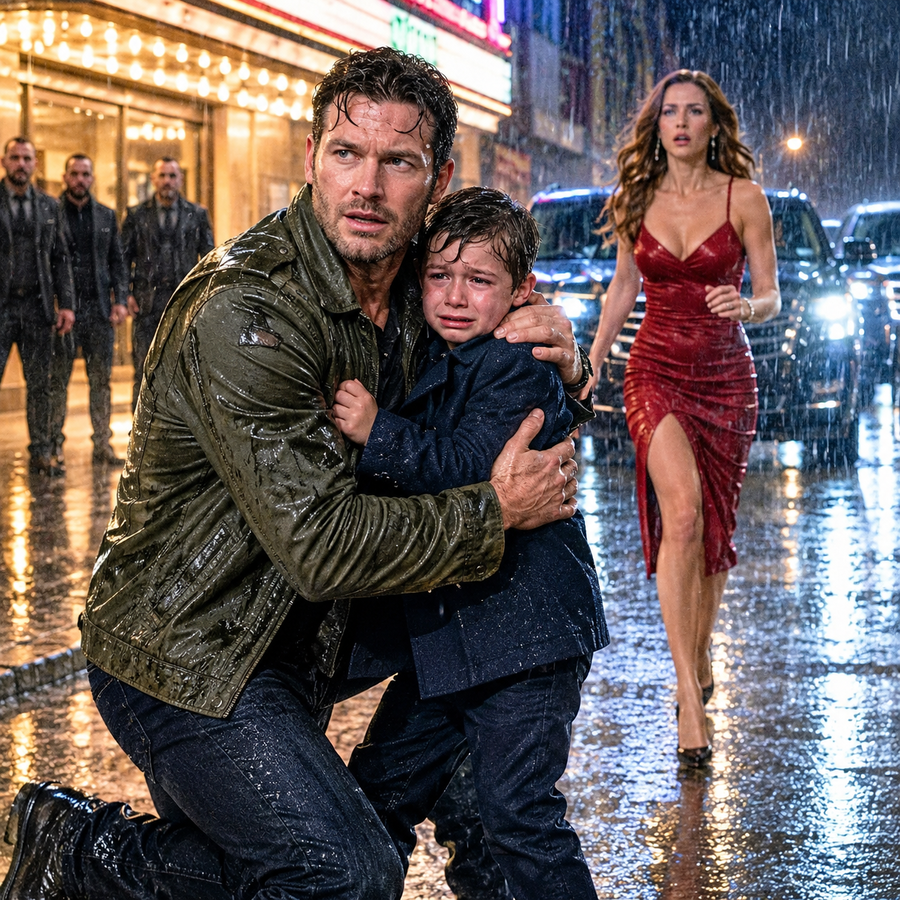
I didn’t think he just moved.
One second, Ethan Ror was holding his seven-year-old daughter’s hand outside a movie theater on a freezing Friday night.
The next, he was crossing a rainslick alley toward three men who were not asking the woman and her child for directions.
He took a bullet doing it, and he didn’t regret a single second.
But what happened the following morning?
Six black SUVs pulling up to his crumbling apartment building and the woman stepping out of the lead vehicle.
That was the moment Ethan Ror’s quiet life ended for good.
If stories like this one hit different for you, the kind that remind you what ordinary people are actually capable of, then subscribe to this channel and follow along until the very end.
Every week we bring you cinematic stories of courage, sacrifice, and the kind of human truth that doesn’t make the evening news.
Hit the like button and drop a comment telling me what city and country you’re watching from.
I want to see exactly how far this story travels.
Now, let’s get into it.
The movie had not been Ethan’s idea.
Maisie had picked it. Some animated thing about a fox who builds a boat and sails to the end of the world.
And she had been talking about it for 3 weeks.
Every Tuesday when he packed her lunch, she’d slip a handfolded orange paper crane into her own backpack and say the same thing, “Only X more days, Dad.”
He’d lost count somewhere around 12.
So on that particular Friday in late November, with the temperature in Grey Haven dropping fast and the streets already shining with cold rain, Ethan Ror did what he always did.
He showed up.
He bought the popcorn she wanted, the large, which he knew they wouldn’t finish, and he sat in the dark theater for 2 hours watching a cartoon fox do something improbable.
And he was genuinely fine with all of it. That was the thing about Ethan that most people who knew him casually would never have guessed.
He didn’t resent the smallness of his current life.
Not really.
He’d had a different life before, one with a different kind of weight to it, and he’d made his peace with the trade.
The Navy had given him 10 years, and he’d given the Navy everything he had.
Then Maisy’s mother left when Maisie was 14 months old, and Ethan came home for good and figured out what being a father actually meant when there was nobody else in the apartment to share the load.
He was 38 now. He worked electrical repair contracts for the city, inspections, panel upgrades, emergency calls when something shorted out in a school or a municipal building.
The pay was steady. The hours were manageable.
He’d gotten good at packing lunches and terrible at keeping house plants alive.
Nobody at his daughter’s school knew what he’d done for a decade.
He didn’t bring it up.
It wasn’t false modesty.
It was more that the man he’d been in the military felt like a different person, someone who’d lived at a different pitch, and he didn’t particularly want to perform that version of himself at school pickup.
He was just Maisy’s dad, which was enough most of the time.
They came out of the theater around 9:15. Maisie still buzzing, replaying her favorite scene with her hands as they walked.
The rain had picked up while they were inside.
It wasn’t the heavy kind, just just a persistent cold drizzle that got into your collar and stayed there.
The part where he went back for the turtle, Maisie was saying that was my favorite part.
He didn’t have to do that.
No, Ethan agreed.
He didn’t.
But he did anyway. Yeah.
She looked up at him. Would you do that?
go back for someone even if you didn’t have to.
Ethan glanced down at her. The question was innocent.
She was seven. She was still processing the movie, but it landed somewhere specific in his chest.
Depends on the turtle, he said. Maisie laughed and grabbed his hand tighter.
They were cutting through the side street behind the theater because it shaved 4 minutes off the walk to the parking garage.
And Ethan knew every shortcut in this part of the city.
He’d been walking these blocks for 3 years.
He knew which doorways stayed dry in the rain and which drain covers had been half loose since last winter. He knew this alley, which is why the three men registered immediately.
Not because they were doing anything obvious.
Not yet.
They were positioned naturally enough too near a parked delivery van, one slightly further along the lane.
But Ethan had spent a decade reading environments for threat signatures the way other people read menus. And something in the geometry of it was wrong.
the spacing between them, the way the one near the wall was watching the far end of the alley rather than whatever he appeared to be doing with his phone, the slight forward lean of the one nearest the van. A woman was walking toward them from the opposite direction.
Mid-30s, well-dressed, a dark coat, good shoes, not dressed for this kind of weather in this kind of alley.
She had a child with her, a little boy, maybe five or six, holding her hand and working to keep up with her pace. She was moving quickly.
Her head was down.
She looked like someone who’d made a wrong turn and was now committed to it.
Ethan slowed. His brain ran the calculation in about 1 and 1/2 seconds.
And the answer was not good.
He crouched to Maisy’s level and his voice came out completely level, completely calm.
Baby, you see that doorway back there?
The green one? Yeah.
Go stand in it right now.
Don’t move until I come get you.
She looked at him.
She was seven, but she was also his daughter, and she had seen his face enough times to know the difference between ordinary dad Sirius and the other kind.
She went without argument. Ethan stood and moved.
He didn’t run.
Running would have telegraphed the approach and given them time to adjust. He walked fast, angling across the lane, putting himself between the woman and the man closest to the van before any of the three had fully processed that they had a problem.
Hey.
He said it to the nearest one.
Not loud, almost friendly.
The man turned and in the half second of confusion, Ethan put him into the wall with one controlled move, enough to take him out of the equation without anything broken.
The second one came off the van fast, faster than Ethan expected, and they went sideways together into the side of the delivery vehicle with enough force that the metal rang.
The woman had stopped. She was pulling the boy behind her, trying to back up, but the third man had moved to cut her off.
“Don’t,” Ethan said.
He said it like a fact.
The third man didn’t listen.
He had something in his jacket.
He was going for it. And Ethan was already crossing the distance when the shot came.
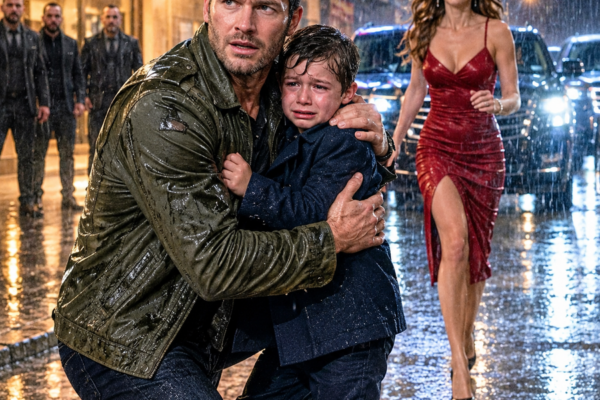
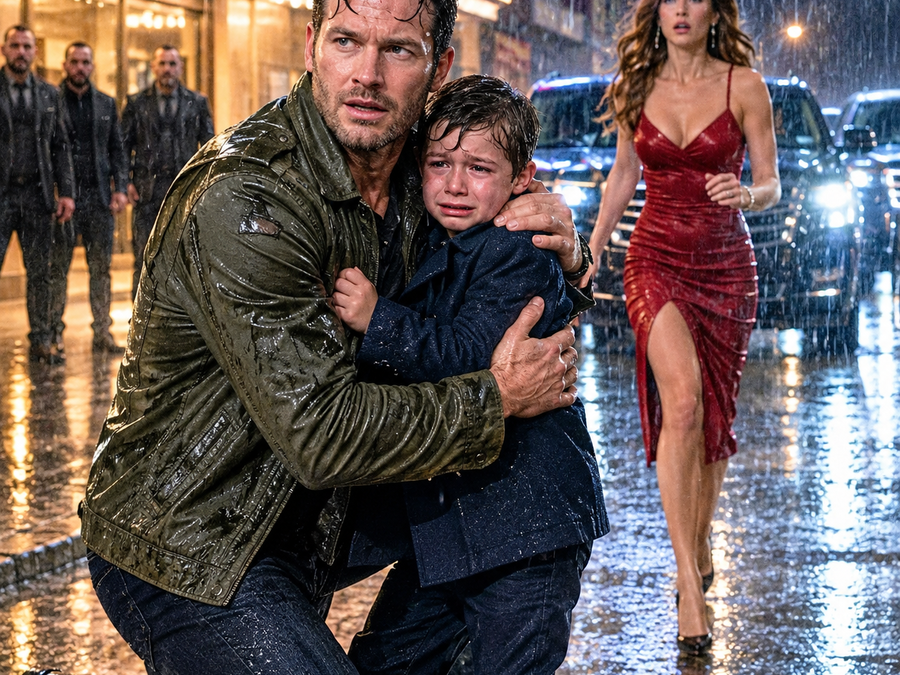
Later, he would not be entirely sure of the sequence. What he knew was the sound, then the burn in his left shoulder, then the boy was in his arms because Ethan had gotten between him and the shooter on instinct, and he was down on one knee on the wet pavement with the kid pressed against his chest and the rain coming down around them.
The alley erupted. Security from the theater had heard the shot.
Someone was shouting into a radio. The third man ran.
The other two were not in any condition to run.
Ethan looked down at the boy in his arms. The kid was maybe six, dark-haired, eyes enormous, rigid with shock.
He was breathing in short, fast pulls, not yet crying, past crying, the way children get when they’ve moved through fear into something deeper.
Hey.
Ethan’s voice was quiet.
His shoulder was burning badly now, and his left arm wasn’t cooperating the way he wanted it to.
Hey, look at me. The boy looked at him.
You’re safe, kid.
He held the boy’s eyes and said it again.
You’re safe.
Nothing’s going to happen to you.
Something in the boy’s face came loose, the rigid set of his jaw, the held breath.
He pressed his face into Ethan’s jacket and finally cried.
Ethan sat there on the wet pavement holding someone else’s son while his shoulder bled into his coat.
The next several hours were the predictable kind of chaos. Paramedics, police, the hospital.
The bullet had caught the outer edge of his left shoulder, missed everything it might have destroyed, which was luck he didn’t allow himself to examine too closely.
He needed surgery to extract the fragment and ended up spending the night.
Maisie, who had stayed in the green doorway exactly as he told her to, was brought to the hospital by one of the responding officers and fell asleep in the chair beside his bed somewhere around midnight, her head on a folded hospital blanket, one paper crane she’d had in her pocket, resting on the edge of his nightstand.
Ethan lay there in the dark and soon stared at the ceiling and tried to feel something other than tired.
He didn’t know the woman’s name.
He hadn’t spoken to her after the shooting.
She’d been pulled into a separate police interview while the paramedics were still working on him.
And by the time anyone thought to connect them, the immediate crisis had overtaken the social logistics.
He knew she’d asked about him.
One of the officers mentioned it.
He wasn’t thinking about her.
He was thinking about Maisie.
Specifically, he was thinking about the fact that he’d told her to go stand in a doorway and she’d done it.
And he hadn’t actually had a plan beyond that.
And if the sequence of events had gone even slightly differently, he stopped that thought where it was. She was asleep 3 ft away.
That was the actual outcome.
He made himself focus on that.
I was discharged the following morning. His shoulder was in a stabilizing brace, and the pain was the dull, grinding kind that was going to be with him for a while.
He knew that particular feeling from experience.
He’d borrowed a change of clothes from the lost and found bag the hospital kept, which was humbling in its own specific way.
Maisie held his good hand in the elevator.
“Does it hurt?”
she asked. some.
You’re not going to say how much?
Nope. She accepted this with the equinimity of a child who had learned which questions her father would actually answer.
They came through the hospital’s main entrance into the pale gray winter morning, and Ethan stopped because parked along the hospital’s curved dropoff drive stretching from the entrance back toward the street were six black SUVs, identical tinted windows, running despite being stationary.
not hospital vehicles, not police.
The spacing between them was precise in a way that spoke of planning.
Several men in dark coats stood at intervals nearby, not hospital security.
Ethan’s first clear thought was, “This is not going to be simple.”
His second thought was that Maisie was looking at them with wide eyes and was about to say something, so he squeezed her hand once.
She looked up at him.
He shook his head slightly.
She stayed quiet.
The lead vehicle’s rear door opened.
The woman from the alley stepped out. In the rain the night before, in the chaos and the dark, Ethan had registered her only in fragments.
The coat, the pale face, the voice that was controlled even under enormous duress.
In daylight, in relative calm, she was more clearly visible.
She was younger than he’d estimated, maybe 30, 31.
Dark hair pulled back.
the kind of compose that wasn’t natural, but had been built through a lot of practice.
She was wearing different clothes now.
She’d had time to go home that she hadn’t, but there was something unresolved in her expression.
Not grief exactly, not relief exactly, something that looked like the aftermath of a decision. She walked toward them directly.
Mr.Ror, she said.
Ethan didn’t say anything for a moment.
He was processing the fact that she knew his name.
You know who I am, he said.
It wasn’t a question.
I do. She stopped a few feet away.
Her eyes went briefly to Maisie, and something in her face shifted. Not softened exactly, but something.
I’m Vivien Hollstead.
Noah is my son.
He’s He’s safe.
He’s home.
The last two words came out with an effort that she controlled quickly.
“Good,” Ethan said.
An awkward beat passed. She seemed to be recalibrating.
He suspected that Vivien Hallstead was not often in situations where the other person didn’t know who she was.
I wanted to come here personally, she said to thank you.
You didn’t need six trucks for that.
A brief pause.
No, she admitted I didn’t.
Something shifted in her expression.
A flicker of what might have been self-consciousness gone fast. I also came because there are things you need to know, she said.
Things about last night that aren’t coincidental and things about your family that you may not know.
My family.
Your grandfather.
Vivien said, “Arthur Ror.”
The name landed strangely.
He hadn’t heard it said aloud by a stranger, by anyone outside his grandmother’s careful conversations in a very long time.
Maisie tugged his sleeve.
“Dad, who’s Arthur Ror?”
Ethan looked down at his daughter’s upturned face, then back at Vivian Hall.
Stead standing in the gray winter light with six vehicles behind her and answers he hadn’t known he was missing.
“My grandfather,” he said quietly.
“He died before I was born.”
Vivian held his gaze.
“I know,” she said.
“I was there.”
The wind moved through the dropoff lane and Ethan Ror standing outside a hospital on a cold November morning with a hole in his shoulder and his daughter’s hand in his and a stranger who knew his grandfather’s name understood for the first time that whatever had happened in that alley was not finished.
It had barely started.
They didn’t talk there.
Not with Maisie present, not in a hospital driveway.
Not with the cold working into his shoulder and the lingering unreality of the last 12 hours.
Ethan got Maisie into the back seat of the nearest SUV when Viven offered because the practical alternative was calling a cab while his arm was in a brace and his daughter hadn’t eaten since the movie Popcorn and practicality generally won over pride.
The drive to his apartment took 11 minutes.
He sat in the front because he didn’t want to be looked after and stared at the city moving past the window and tried to order what he knew.
Arthur Ror, his grandfather, dead before Ethan was born. An electrical worker.
That part Ethan knew and always figured was why the trade had come naturally to him.
His grandmother had spoken of Arthur the way old grief gets carried, carefully in small amounts, never all at once. A woman who had been a child 30 years ago claimed to have been there when Arthur died.
He turned that over slowly.
behind him.
Maisie had fallen asleep against the door within four minutes of the vehicle moving.
Practical child. She ran on the same principle he did.
If there’s nothing actionable to do right now, rest.
He glanced in the side mirror and caught Vivien watching him from the second vehicle, following close behind. He looked away.
At the apartment, he put Maisie down in her bed and stood in the doorway for a moment.
The paper crane from the hospital nightstand was still in his shirt pocket.
He set it on her dresser. Then he went to the kitchen and stood with his good hand braced against the counter and let the shoulder hurt for a minute without managing it.
He had a bad feeling and not about his shoulder.
The bad feeling was this.
Something was about to change.
He’d had that feeling before in other places and it had always been right.
He took a breath, straightened up, and went to answer the door.
Vivien Hallstead did not look like someone who made requests.
She looked like someone who issued them and then waited with professional patience while other people caught up.
Ethan had met the type before.
In the military, there were officers who carried authority like a physical trait, something structural rather than performed. Viven had that quality, but it was rougher around the edges than she probably wanted it to be this morning.
The composure was real, but it had been worked for. You could see the seams if you looked.
She was standing in his kitchen, which was a strange thing to witness. The kitchen was small and not particularly clean.
There were Maisy’s drawings held to the refrigerator with mismatched magnets, a stack of unopened mail on the counter that Ethan kept meaning to deal with, a coffee mug he’d rinsed, but not washed, sitting in the dish rack.
It was an honest room. It told the truth about who lived here.
Viven stood in it like someone trying not to let the space make her feel anything and not entirely succeeding.
One of her security people, a broad-shouldered man named Garrett, who had the flat, careful eyes of someone with a professional past similar to Ethan’s, had taken up a position near the apartment door without being asked.
Ethan had noted it and let it go.
He understood the logic.
He would have done the same. He set a mug of coffee on the table in front of her.
He hadn’t asked how she took it because he was out of milk and there was no point in the question.
She wrapped both hands around it and didn’t drink.
Tell me about my grandfather,” Ethan said.
He sat across from her.
His shoulder was a persistent fire under the brace, and he’d taken two of the prescribed painkillers, which meant he could function, but wasn’t enjoying himself.
Viven looked at him.
“How much do you actually know about him?”
she asked.
“About what happened?”
“Not much.
He died in a fire before I was born.
My grandmother didn’t talk about it in detail.
I know he was an electrician. I know it was a building fire somewhere in the city.
He paused.
I know she never completely recovered from it.
She wasn’t the kind of person who showed that, but I knew.
Vivien nodded slowly, her hands tightened around the mug.
The Brierwood Children’s Residence, she said.
It was an assisted residential facility for children who’d been removed from unsafe homes.
It operated in the Callaway district.
The building’s gone now.
They rebuilt the block in the ’90s, but in October of 1987, it was still the original structure, old wiring, the kind of electrical work that should have been replaced 15 years earlier.
She stopped.
The fire started in the east wing around 11 at night.
Most of the children were asleep.
Ethan said nothing.
He watched her face. I was 8 years old, Vivian said.
I had been at Brierwood for about 7 months at that point. She said it.
The way people say things they’ve had a long time to practice saying, flat and factual, the emotion not gone, but compressed somewhere deeper than the words.
I don’t remember everything about that night clearly.
I remember the smoke before I remember the fire.
I remember the hallway being very dark and I remember a man carrying me. She looked at the table.
He carried me out through a section of hallway that was already it was bad. He was talking to me the whole time, telling me to keep my face down to stay calm.
His voice was completely steady.
I remember thinking he must not be scared and that made me less scared. A pause.
He was scared.
He must have been.
But I was eight and I needed to believe he wasn’t.
And he understood that without me saying it.
Ethan’s chest had gone tight.
He went back in.
He said three times. Vivien finally looked up.
He carried out four children, including me. The fourth time, the section of roof that had been compromised came down.
She said it without inflection. They recovered his body 2 days later.
The apartment was very quiet. Somewhere down the hall, Maisie shifted in her sleep and the old building creaked.
The official incident report listed him as a maintenance contractor working on an adjacent property who rendered assistance at the scene.
Viven said, “That’s that’s what it said.
Rendered assistance.
His name was in there once as a footnote. Her jaw tightened.
There was supposed to be a review, a formal recognition of what he’d done.
It kept getting deferred.
The facility had liability issues they were managing.
There was administrative turnover.
And eventually, it just it fell through the cracks. Nobody came back to it.
Ethan put his good arm on the table and looked at his own hand for a moment. He had grown up knowing almost nothing about Arthur Ror.
A photograph on his grandmother’s bureau.
A lean man with a level gaze, maybe 40, squinting slightly in the sun.
Her careful limited sentences. He was a good man.
He cared about people. He would have loved you.
She never said more than that.
And Ethan had understood early that asking more was a way of reopening something that didn’t fully close.
What he had not understood, what nobody had ever told him, was that his grandfather had died carrying children out of a burning building.
Four of them.
Three times he went back in, and the fourth time the building came down on him. Ethan breathed.
“How long have you known my name?”
he asked.
“I hired a research firm to trace Arthur Ror’s family about 4 years ago.”
Vivian said, “It took longer than I expected.
Your grandmother had passed and your father had moved several times.
It took them a while to get to you. She hesitated.
I knew your name and general location for about 8 months.
I was trying to determine the right way to make contact.
Whether to do it through an intermediary or directly or she stopped herself.
I was overthinking it. And then someone tried to take your son, Ethan said.
And then someone tried to take my son.
She set the mug down.
And the man who stopped it was Arthur Ror’s grandson.
The coincidence of it was almost too geometric to sit with. Ethan had never believed in fate.
The military burned that kind of thinking out of you early because fate was a concept that didn’t survive contact with the randomness of how things actually went wrong.
But this was hard to file as simple coincidence. This had an architecture to it.
I didn’t say any of that.
He said, “Tell me about Noah.”
Vivian’s expression changed.
The professional composure loosened in a specific way that only happened when people talked about their children.
Something behind the eyes went different.
“He’s six,” she said.
“He’s,” She paused.
And for the first time since she’d walked into his apartment, she seemed not to know exactly what word she wanted.
“He’s okay.
He’s home.
He hasn’t said much about last night yet.
He will eventually.
He processes things slowly.”
A beat. He asked about you.
What did he ask?
He said, “Is the man okay?”
The one who held on to me. She said it precisely like she had committed it to memory.
I told him you were going to be fine. Good.
He also said she stopped and something crossed her face that she controlled quickly. He said you talked to him, that your voice was calm.
He said it helped.
Ethan didn’t know what to do with that, so he moved forward.
What’s the actual situation with the kidnapping?
Vivien straightened slightly.
This was ground she was more comfortable on.
Holstead Technologies is in the middle of a contested acquisition process.
She said, “I founded the company 11 years ago.
We build infrastructure security systems, digital architecture for utilities, transit networks, emergency services.
In the last 18 months, several major investment groups have been pushing for a takeover.
I’ve been blocking it.
” She said that last part with a specific flatness.
The men in that alley last night were not random.
Noah was a target. The intention was leverage.
Someone ordered the kidnapping of your son to force you to give up your company.
Ethan said, “Yes, that’s an extreme move.
There’s a lot of money involved.
” She said it without any particular feeling, which was its own kind of feeling.
Federal investigators have been looking at a financial irregularities case connected to two of the investment groups for several months.
I’ve been cooperating with that investigation.
Some of the people I’ve been cooperating against apparently decided that waiting out the legal process was less attractive than a more direct approach.
Ethan thought about the three men in the alley, the precision of their positioning, the way the third one had gone for the weapon without much hesitation.
That wasn’t amateur work.
They hired professionals, he said first partially. The two you the two who were detained appear to be local contracted help.
The third who fled.
Investigators believe he’s connected to a private security firm with documented ties to one of the investment groups.
She paused. You walked into something that was planned in some detail.
They had been watching my schedule for weeks. He absorbed this.
The shot.
He said that wasn’t supposed to happen.
No. Based on what the investigators have told me, the plan was a clean extraction.
Get Noah away from me before my security arrived. Use him as pressure.
Shooting anyone, especially in a public adjacent location, was a deviation.
It drew attention they didn’t want.
A pause. You were not supposed to be there.
I know.
If you hadn’t been, she stopped.
Don’t.
Don’t.
Ethan said not unkindly.
She nodded once. She understood.
They sat for a moment in the particular silence that exists when two adults both know the sentence that didn’t get finished and have agreed not to finish it.
Then Viven said, “There’s something else.”
He waited.
“The online commentary about last night.”
She said it carefully.
“I don’t know how much you’ve seen.
” Ethan had not in fact seen any of it.
He’d been in a hospital bed and then in transit and then in his kitchen.
He hadn’t looked at his phone beyond the three texts from his coworker who’d seen the news and wanted to know if he was alive.
“Tell me,” he said.
The initial coverage was, “There was some positive attention.
A bystander filmed part of the incident from a window overlooking the alley.
The video circulated fairly widely overnight.”
She set her phone on the table, screen down.
Then several accounts began pushing a different narrative.
That the incident was staged.
that you’re a private security contractor working for me, that the entire thing was orchestrated for publicity purposes to generate public sympathy during the acquisition dispute.
Ethan stared at her. That you paid me, he said flatly.
Or that we were previously acquainted and arranged it together. She met his eyes.
The narrative has a certain logic to it from the outside. a decorated veteran, a high-profile CEO, her child narrowly saved.
Six company vehicles at the hospital the next morning.
You brought six vehicles to a hospital. I have a security protocol.
I followed it. You see how that looks?
Yes, she said.
I do now.
He leaned back in his chair. The shoulder protested.
He let it. How many people are running with this story?
Enough. She picked up the phone, turned it over, set it down again.
It’s the kind of thing that spreads because it’s more interesting than the truth.
Cynical explanations for decent behavior are they get traction.
It doesn’t matter to me what strangers on the internet think.
Ethan said, “I know.
I’ve had worse things said about me by people whose opinions actually counted.
I know that, too.
So, what I’m hearing is that you’re concerned about it for your own no,” she said.
And her voice was sharper than it had been. Not angry exactly, but correcting.
I’m telling you because you have a daughter in a school in this city, and the story has your name in it, and because you deserve to know the landscape, she paused.
I don’t need you to manage my reputation.
I have people for that.
I’m telling you because it’s your name.
He held her gaze for a moment. Fair enough, he said.
They sat with that.
Outside the kitchen window, the gray morning had given way to a flat winter light that wasn’t quite sun and wasn’t quite cloud.
Grey Haven was doing what it did in November, committing to nothing. Ethan refilled his own coffee, which had gone cold.
He didn’t offer her more because she still hadn’t touched hers.
“Your grandfather,” Vivian said, she said it differently now, quieter, and with something that had been building since she walked in.
I want to tell you something and I want you to hear it directly before you hear it any other way.
He sat back down.
I am not.
This is not charity, she said.
And it’s not guilt.
I’ve spent a lot of years sorting through what I feel about what Arthur Ror did.
And I’ve been careful about that because those things, guilt, obligation, they’re easy to mistake for something more honest.
She met his eyes.
What I feel is that a man died doing something extraordinary and the world didn’t notice and I did and I’ve been carrying that since I was 8 years old.
Ethan didn’t say anything.
I looked for his family because I wanted them to know, she said, not because I could fix it or because knowing would undo anything, just because it seemed wrong that they didn’t.
The refrigerator hummed.
One of Maisy’s drawings, a house with a large orange sun, shifted slightly in the air from the heating vent.
He had a pocket watch, Ethan said. Vivien looked at him.
My grandmother mentioned it once. She said he carried it everywhere.
She never found it after.
She just assumed it was lost in the fire. He paused.
She didn’t say much about it, but the way she said it told me it mattered.
Viven was quiet for a long moment.
I need to show you something, she said. Not today.
You need to rest.
And there’s a secure location where the records are kept.
But I want you to see it.
She paused. All of it.
The official reports, the survivor testimony, the documents I collected over the years.
A beat.
And one other thing.
What other thing?
She didn’t answer that directly.
She said, “Will you come?”
Ethan studied her face.
The thing he’d clocked early about Vivien Hallstead, the built composure, the controlled affect was still there.
But there was something underneath it that he hadn’t fully identified yet.
Not manipulation.
Something more like urgency that had been living in her for a long time and was now very close to the surface.
Yeah, he said, I’ll come.
She nodded once, picked up the untouched mug, and this time actually drank from it. He almost said something about the coffee being bad.
He decided against it. 3 days later, when Ethan finally looked at his phone in any sustained way, he understood what Viven had meant about the narrative.
The video from the alley, 47 seconds, shot from above at an angle that captured most of the central action, had over 2 million views. The comments were a split that he recognized from his time watching how information moved online.
a loud minority who decided the cynical version was correct and a quieter majority who were mostly just watching.
He could manage that. Strangers had thought worse of him.
What he hadn’t anticipated was Maisie coming home from school on the fourth day and not saying anything.
She was a talker.
She had been since she learned to string words together, a running commentary on everything she observed, questions about how things worked, unprompted opinions on food she hadn’t tried.
The quiet was wrong.
He let it go through dinner.
He made pasta because it was the thing he could do one-armed without dropping anything.
And Maisie ate without her usual editorial on whether he’d put enough cheese on it, which told him everything.
After dinner, she sat at the table working on a paper crane.
She’d been doing it since she was 5.
Her first grade teacher had shown the class, and something about the method had gotten into Maisie specifically.
She would fold them when she was working through something.
Ethan had learned to read her emotional state partly by the rate and precision of her folding. Tonight she was working slowly, getting it wrong and smoothing it out and starting again.
He cleared the table around her and said, “You want to tell me what happened at school?”
A pause.
She kept her eyes on the paper. Some kid said you made up the thing with the boy.
She said to be on TV.
Ethan sat down.
And what did you say? I said that was stupid.
A pause.
Miss Cardardoza heard me say stupid and I had to apologize. Okay, I apologized but I was still right.
You were?
Ethan said.
She looked up at him then. She had his eyes not the color but the quality.
The way they went direct.
Did you know the lady before? She asked.
No. For real.
Maisie.
No.
I’d never seen her before that night.
She held his gaze for a second, checking it. Then she looked back at the crane.
Caleb Oronoko said his dad said you were lying.
She said, “Okay, I told him his dad was wrong.
You could have just not engaged with it.
He said it to my face, Dad.”
Ethan breathed.
“Yeah, okay, fair.”
She worked the paper for a moment.
One of the folds wasn’t right, and she made a small sound of frustration.
“Why do people say things like that?”
she asked about people they don’t know.
He thought about how to answer this in a way that was honest without being cynical in a way she wasn’t ready for.
She was seven, but she was also his kid and she’d always responded better to a straight answer than a managed one.
Because the truth is sometimes boring, he said.
And because people are more comfortable with a world where nobody does anything for free.
It’s easier to believe that than to believe someone just He paused.
Just moved.
Maisie thought about that.
That’s sad.
Sad. she said.
“Yeah, a little.”
She finally got the fold right, and the crane’s wings took their shape.
She held it up to inspect it, turned it once, set it down on the table.
“I know you didn’t make it up,” she said.
“I was there.”
Ethan looked at his daughter. She said it the way only a seven-year-old could, factual, unadorned, slightly impatient with the whole conversation for requiring stating what was obvious.
“I know you were,” he said.
She pushed the finished crane across the table to him.
This one’s for your shoulder, she said.
I read online that they help. He picked it up.
Thank you.
You have to keep it, she said. Seriously.
It doesn’t work if you lose it.
I won’t lose it.
You lost the blue one I made for your keys.
That was He stopped.
That’s true.
But I won’t lose this one.
She seemed to accept this with the provisional trust that characterized most of her dealings with him. Then she slid off her chair and went to brush her teeth.
The conversation apparently closed.
Ethan sat at the table and held the small orange crane and let himself feel the thing he’d been not feeling since the hospital.
The low, hard anger of watching his daughter come home quiet from school.
The specific grinding unfairness of it. Not to him, he could carry his own reputation, but to her.
Seven years old and defending her father’s honesty to classmates because strangers on the internet had decided a more interesting story was more likely than the boring true one.
He set the crane carefully on the window sill.
Then he texted Vivien, “When can I come see the records?”
Her reply came back in 4 minutes.
“Tomorrow, if you can,” he typed, “I’ll be there.”
He looked at the crane on the window sill for another moment.
Orange, slightly asymmetrical, one wing marginally higher than the other, the way Maisy’s always were.
Then he went to check that his daughter had actually brushed her teeth and not just run the water for 30 seconds, which was her preferred approach to oral hygiene when she thought she could get away with it. She had not brushed her teeth.
He stood in the bathroom doorway. Maisie, I was going to.
You were standing here looking at yourself in the mirror.
I was thinking, “Think while you brush.”
She made the face, the one that communicated that this was a profound injustice, and picked up the toothbrush.
He leaned against the doorframe and watched her and felt underneath the anger and the shoulder pain and the complicated weight of everything Vivien had told him, the specific steadiness that his daughter reliably produced in him, the way she made the next thing obvious. Tomorrow he would go look at the records.
He would find out who his grandfather had actually been.
And then he wasn’t entirely sure, but that part would sort itself out.
Tonight he made sure his kid brushed her teeth.
That was the next thing. So that was the thing he did.
The archive was not what Ethan had expected.
He wasn’t sure what he had expected exactly.
Some corporate storage room, maybe.
Filing cabinets and banker’s boxes stacked under fluorescent light.
What Viven had built was something more deliberate than that.
It occupied a climate controlled room on the 14th floor of a building in Grey Haven’s financial district, accessed through a private elevator that required a key card and a six-digit code.
The room itself was long and narrow, the walls lined with organized document files, each labeled and dated.
A central table ran the length of the space, its surface clear, except for three archival boxes already set out.
Ethan stood in the doorway for a moment before walking in. Viven was already there.
She was standing at the far end of the table with her arms crossed, not defensively, just the way people stand when they’ve been waiting and don’t want to look like they’ve been waiting.
She had a legal pad near her right hand with several lines of handwriting on it.
She’d been working while she waited.
“Thank you for coming,” she said.
“You don’t have to keep thanking me,” Ethan said.
“I know.”
A pause. old habit.
His shoulder was better than it had been 2 days ago. Not good.
The surgery site was still tight, and there was a specific wrong angle that produced a sharp reminder of itself, but better. He dropped the sling this morning because it made him feel managed in a way he disliked.
His doctor had expressed an opinion about this.
Ethan had listened to the opinion and then done what he intended to do anyway.
He walked to the table and looked at the first box.
Can I?
That’s why you’re here, Vivien said.
He opened it.
The first thing on top was a photograph, black and white, clearly from the late8s based on the print quality and the slight warping at the edges. It showed the exterior of a large building, brick, institutional, a row of windows along each floor.
below the image in type text on a label affixed to the back.
Brierwood Children’s Residents, Callaway District, Grey Haven, photographed 1984.
He set it down carefully and looked at the next item.
The official incident report was 32 pages long. City fire marshal letterhead.
The date at the top was October 19th, 1987.
He didn’t read every word, and he read the way he’d learned to read reports in the military, scanning for the specific and skipping the procedural.
He found Arthur’s name on page 11, one paragraph.
Arthur James Ror, 43, independent electrical contractor, was present at the site of the adjacent utility work and entered the structure during the emergency. Mr.Ror rendered assistance to multiple occupants before the structural collapse of the east-wing roof on the fourth rescue attempt.
Mr.Ror did not survive. One paragraph.
43 years old. Ethan had not known the age.
He set the report down and looked at the wall for a moment without seeing it.
There were supposed to be formal proceedings. Viven said she was watching him but not hovering.
She’d positioned herself at a slight remove, giving him room.
The facilities director submitted a request to the city for a commendation.
It’s in the second box.
I have the original correspondence.
The request was acknowledged, assigned to a committee, and then deferred when the facility became subject to a liability review related to the building’s fire code violations.
She paused.
The commenation review was never reopened. The liability case ran for 4 years, and by the time it concluded, the original request had been effectively buried in the administrative record.
Someone let it die. Ethan said nobody actively killed it.
That’s almost worse in a way.
It just lost momentum.
There was nobody whose job it was to push it forward and so it didn’t go anywhere.
He went back to the box and worked through it methodically. There were survivor testimonies, handwritten statements from children who had been at Brierwood that night, collected in the weeks and months after the fire as part of the liability proceedings.
Several of them mentioned the man who carried them out.
They didn’t know his name.
They described him in the way children describe things. The man with the gray jacket.
The man who talked to me.
The man who didn’t stop.
One statement written in the careful block letters of a child said simply, “He came back every time.
I counted.”
Ethan read that one twice.
He moved to the second box.
Vivien’s own research was organized in a way that reflected how her mind worked chronologically cross-referenced with typed summary sheets at the front of each section.
She’d been thorough, more than thorough.
She’d tracked down former Brierwood staff, city officials who’d been involved in the liability case, the descendant of the facility director who’d submitted the original commenation request.
She had newspaper clippings from the original coverage.
The fire had made the local news, but Arthur’s name hadn’t appeared in any of them.
The coverage focused on the building, the children’s safety, the fire marshall’s investigation.
The man who had gone in four times was a footnote in the administrative record and invisible in the press. I was most of the way through the second box when he found the envelope.
It was a plain white envelope sealed with his grandmother’s full name written on the front and handwriting he didn’t recognize.
Margaret Elaine Ror.
The address underneath was his grandmother’s old house on Ferris Street, the one she’d sold in 2003.
The postmark was from 1991, four years after the fire. He looked up at Vivian.
“It was returned undelivered,” she said.
“The address was slightly wrong, a transposed number.
It came back to the sender. The sender was the facility director.
He’d written to your grandmother directly.”
She paused.
“I found it in the estate records of the director’s family.
When I tracked down his son, he gave it to me. It had never been opened.
Ethan held the envelope.
He turned it over once.
“Have you read it?”
“No,” Vivian said.
“I have not.”
He set it on the table in front of him and looked at it for a long moment. The envelope was slightly yellowed at the edges.
His grandmother’s name in someone else’s handwriting, a letter that had spent 35 years unread because a number had been transposed.
He opened it. The letter was two pages handwritten on official facility stationery.
The director’s name was printed at the top.
Gerald Morrow, director, Brierwood Children’s Residence.
Dear Mrs.Ror, it began.
I am writing to you directly because the formal commendation process has stalled in a way I can no longer control, and I could not allow more time to pass without telling you personally what your husband did on the night of October 19th.
Ethan read the letter slowly.
Gerald Morrow had been at the scene.
he’d seen Arthur go in the first time and come out with a child and then go in again.
He wrote that he had shouted at Arthur to stop, that the building was coming down, that it wasn’t safe, and that Arthur had looked at him and said something Morrow had remembered for 4 years before putting it in this letter.
He’d said, “There are still kids in there.”
And then he’d gone back in.
Morrow described watching Arthur come out the second time, then the third. He described the sequence with the specificity of someone who had replayed it many times.
He wrote, “I want you to know that he was not reckless.
He was not unaware of the danger. He knew exactly what he was walking into each time.
He made a clear choice four times.
That is what I need you to understand.”
He chose. The second page was shorter.
It addressed the commenation process, expressed Morrow’s frustration with the bureaucratic stalling, and promised that he would continue to push for recognition.
At the bottom, a handwritten postcript.
He saved 11 children that night.
Mrs.Ror, the official count is nine because two were recovered by other responders who arrived later, and the records became confused in the chaos.
But I was there.
11.
I want you to know the real number. Ethan reached the end of the letter.
He set it down on the table. He put his hand flat on the table beside it and looked at the far wall of the archive room and let himself sit with what he just read without trying to process it too quickly.
11 children four times into a burning building.
A man who was 43 years old and working a routine job on an adjacent site and who had looked at a burning building full of children and decided that was not a thing he could walk away from.
The thing that got him, the thing that was going to stay with him was the sentence Morrow had heard.
There are still kids in there. Not heroic, not dramatic, completely flat, just a statement of fact and a reason that was self-evident, apparently to the man making it.
Ethan understood that. He understood it in his bones.
He had said something similar in an alley 6 days ago, except what he’d said was simpler.
He hadn’t said anything.
He just moved.
The same instinct, a different generation, the same understanding that when something is in front of you that you can do something about. The question of whether to do it is not actually a question.
He picked up the letter again, folded it carefully along its original creases, and put it back in the envelope.
Thank you, he said.
He didn’t look up immediately.
Ethan.
Vivien’s voice had changed lower and with a care to it that she’d been managing all morning.
There’s one more thing.
He looked up.
She crossed to the third box, the smallest one, which she hadn’t opened yet, and lifted the lid.
Inside, resting in a bed of archival tissue paper, was a pocket watch, silver, tarnished to a dark gray at the edges, a simple face behind scratched glass, Roman numerals, a small nick on the casing near the winding stem.
The hands had stopped.
At 11:42, Ethan stood very still.
It was recovered from the site during the structural clearance, Vivien said quietly. It was logged as found property in the liability case records.
It was never returned because nobody came looking for it.
Nobody knew to look. She paused.
I found it 3 years ago in a storage facility where the case evidence had been archived.
I had it authenticated.
Another pause. It belonged to Arthur Ror.
His initials are engraved on the back.
Ethan reached into the box and picked it up.
It was heavier than he’d expected, solid in the palm.
He turned it over and read the engraving on the back casing.
AJR, three initials, clean, simple cuts in the silver, the kind of engraving that was done to last. His grandmother had described this watch, not in detail.
She’d mentioned it once carefully, the way she mentioned everything about Arthur carefully.
She’d said he kept it in his left breast pocket, that he’d pull it out to check the time and always put it back in the same deliberate way, like it was worth treating gently.
She had spent 37 years not knowing where it was.
She had died not knowing.
He stood there holding his grandfather’s pocket watch and let the full weight of that land on him.
Not the grand version, not the story of sacrifice and legacy.
Those things were real, but they were large, and he couldn’t feel large things clearly.
What he felt clearly was the small version.
His grandmother alone with her grief for 37 years, carrying the loss of a man she had not been allowed to publicly mourn or publicly honor, and not knowing that somewhere in a city storage facility, the thing he’d kept in his breast pocket was sitting in a box unclaimed because the administrative record had lost track of it.
He closed his hand around the watch. Viven did not say anything.
She understood, apparently, that this was not a moment for words. He stood there for a while.
Then he set the watch carefully back in the tissue paper and he straightened up and he turned to face Viven.
“What do you need from me?”
he asked.
His voice came out level.
“Not because he didn’t feel anything.
He felt a considerable amount, but because he’d had a lot of practice at level.”
Viven looked at him.
“I want to go public with the records,” she said.
“The full archive, Arthur’s story correctly told with the documentation to back it up.
I want to submit a formal petition to the city for postumous recognition.
There’s a process.
It just requires advocacy to restart it.
She paused.
And I’d like your permission and your participation, not as a story attached to what happened in the alley separately.
His story told on its own terms. And if the two things get linked by the press, they will get linked, she said honestly.
I can’t prevent that.
But I can control the framing.
I can make sure the coverage leads with Arthur, not with you. He thought about it.
He thought about his grandmother, the careful sentences, the photograph on the bureau, the grief she’d carried that nobody had ever publicly acknowledged because the man it was for had died without anyone putting his name on anything.
Yeah, he said. Okay.
Viven exhaled, not dramatically, just slightly, like something she’d been holding had eased.
There’s one more thing I need to tell you, she said.
And this one is going to complicate your week. Ethan almost managed a dry sound.
Go ahead.
The federal investigation into the investment group’s financial irregularities has widened, she said.
The investigators briefed me yesterday.
Two of the three men from the alley have given statements. The man who fled was apprehended in Delmore County on Thursday night.
She picked up the legal pad from the table.
The picture they’re building is more organized than I initially understood.
The kidnapping wasn’t an improvised pressure tactic.
It was part of a structured campaign that’s been running for 8 months.
Ethan waited.
It goes further inside my company than I knew.
She said, “There’s a senior executive head of corporate communications, man named Darren Solless, who has been connected to the investigation.
He’s been on leave since Thursday.”
She paused.
He also contacted you. Ethan went still.
The email, he said 4 days ago, he had received an email from a Hallstead Technologies address.
He’d assumed it was from Viven’s communications team, Standard Crisis Management Outreach, given that his name was public.
The email had been brief and professional.
It had said essentially that H Hallstead Technologies wanted to thank him for his actions and was also hoping to address any concerns he had about the ongoing press coverage and that it would be in everyone’s best interest for him to limit direct contact
with Miss Hollstead while the company’s legal situation was active.
He had read it and then not responded and then not thought about it much because it had read like standard liability management. That was Solless, he said.
Yes.
He was trying to keep me away from you.
Yes.
To limit the chance that we’d connect and specifically that I’d share what I knew about the investigation before he could, before arrangements could be made.
She said the last part with a careful flatness that told him she was choosing words deliberately. He knew about the archive.
He knew I’d been looking for Arthur’s family, and he knew that you showing up in that alley was he knew it had created an opening between us that he needed to close.
Ethan let that sit for a moment.
The email had read like liability management because it was meant to.
It was the kind of thing that would sound innocuous to anyone who read it without context.
Limit direct contact legal situation active best interests and the kind of thing that would make a person just reasonable enough about self-interest slow down and consider pulling back.
He had not pulled back.
Not because he’d seen through it, but because Maisie had come home quiet from school that same day.
And after that conversation, all he’d been able to think about was getting into this archive and understanding his grandfather.
The email had gone to the bottom of his thinking.
“He’s being investigated as part of the conspiracy,” Ethan asked.
“He facilitated the targeting operation,” Vivian said.
“He had access to my schedule, Noah’s school routine, my security protocols.
He was feeding information.”
She said it without any perceptible emotion, which Ethan suspected cost her something. I hired him 4 years ago.
He ran my communications department for 4 years.
I’m sorry.
She looked slightly surprised that he’d said it.
“Thank you,” she said.
And this time it didn’t sound like a habit.
They stood on opposite sides of the table in the archive room with all of Arthur Ror’s documents between them and the particular uncomfortable silence that comes when two people have shared more than they expected to and aren’t yet sure what to do with the new weight of it.
Then Vivien said, “The investigators are going to want a full statement from you about the email and about the alley itself.
You’ve already given one to the police, but the federal case is I’ll give them whatever they need.”
Ethan said it may make the connection between us more public.
The media will likely I know you’re not worried about that.
He thought about it honestly.
I’m worried about Maisie.
He said, “Not for myself.
If there’s more coverage and it comes back to her school again, that’s I’d like to get ahead of that.
Vivian nodded.
I can have someone speak with the school administration directly.
Not spin, just facts and the documented record so there’s something accurate for them to work from if parents ask questions.
I can do that myself, Ethan said.
I don’t need someone to speak for me.
I know you don’t.
She paused. It was an offer, not an implication.
Fair. he said.
Same word she’d used.
He noticed.
She noticed.
He picked up the watch envelope from the table. Sit.
It wasn’t the watch which Vivien had returned to its box, but the letter Gerald Morrow’s letter to his grandmother.
Can I take this? It belongs to your family, Vivien said.
He folded it carefully and put it in his jacket pocket.
They began putting the archive boxes back in order, working from opposite ends of the table.
It was the kind of task that people do in silence when they’ve been through something together and don’t yet have the vocabulary for it.
He handed her document folders and she filed them.
She handed him the incident report and he set it in its proper position in the first box.
When the table was clear, Vivien said, “There’s something else I’ve been thinking about.
Separate from all of this.”
He looked at her.
“It’s not the right moment,” she said.
“But I want you to know I have something I’d like to discuss.
when things are less when there’s more air.
Okay, he said. She nodded once.
They rode the private elevator down to the lobby in a silence that was not uncomfortable.
The lobby’s revolving door pushed them out into the cold and Greyhaven’s midm morninging noise came at them immediately.
Traffic, a jackhammer somewhere two blocks north, a delivery truck backing up with its warning beep.
Garrett was outside with the vehicle.
He opened the rear door without commentary.
Ethan stopped on the sidewalk.
Vivien. She turned.
Arr’s pocket watch.
He said, I’d like to have it.
When this is over, when everything is settled. It was always going to go to you, she said.
That was never a question. He nodded once.
Then he looked at the street, at the city moving around them, at nothing in particular. He was thinking about his grandfather, about a man who was 43 years old, working a routine job, who had looked at a burning building and heard the only question that mattered to him and decided the answer was yes.
He was thinking about the fact that he’d never known that story and that his grandmother had died not knowing her husband’s name was anywhere except in her own careful memory.
He was thinking about Maisie at school right now, probably telling someone something the way she always told things, direct, slightly impatient with any version of the story that wasn’t accurate.
He was thinking about an alley and a child pressed against his chest and rain.
I’ll be in touch about the investigator, he said.
I’ll send you the contact information this afternoon.
He turned and walked to where he’d parked his truck three blocks east because he hadn’t wanted to arrive in one of Viven’s vehicles again.
Once was enough for the neighbors curiosity. The day was cold and flat and going about its business the way days do.
A woman was walking a dog that wasn’t cooperating.
Two men in work vests were arguing in a friendly way about something involving a permit.
A kid in a red coat was eating something while waiting for a bus and dropping half of it.
Ethan walked past all of it with his grandfather’s letter in his pocket and his hand closed around nothing and the stopped hands of a silver watch somewhere behind him on the 14th floor.
And he thought about what it meant to find out this late what someone you’d come from had actually been made of.
It didn’t change who Ethan was.
He knew that much.
Your history wasn’t a blueprint.
It didn’t dictate anything.
But knowing it, knowing the real version, not the administrative footnote, but the four trips and the burning roof, and there are still kids in there, that settled something, like a gear finding its tooth. He got to his truck and sat behind the wheel without starting it for a minute.
His phone buzzed.
A text from the school.
Maisie had apparently won something called the Tuesday Estimation Challenge involving a jar of marbles and was very pleased about it, per the teacher’s note.
The teacher added that Maisie had suggested the prize should be extra recess and had made a logical argument for it that was and the teacher’s word here was difficult to refute.
Ethan read the message twice.
He started the truck. He had a statement to prepare for federal investigators, a school administration to call, and a shoulder that needed ICE.
He had a daughter who was currently negotiating for extra recess and had apparently inherited some version of his gift for reading a situation and identifying the best available leverage.
He had a grandfather who had gone back in four times. He had work to do.
He pulled into traffic. The federal investigators were thorough in the particular way that federal investigators always were.
Unhurried, methodical, asking the same question four different ways across two separate interviews to see if the answers varied.
Ethan had been through enough debrief processes in his military career to recognize the rhythm of it, and he sat through both sessions with the same patient cooperiveness he’d brought to every debrief he’d ever attended.
He told them about the email from Darren Solless.
He told them about the alley, again, in the level sequential detail they wanted.
He answered the questions he could answer and said plainly when he couldn’t.