Billionaire Checked His Cameras While Away—Then Broke Down Seeing His Maid Help His Daughter Walk Again
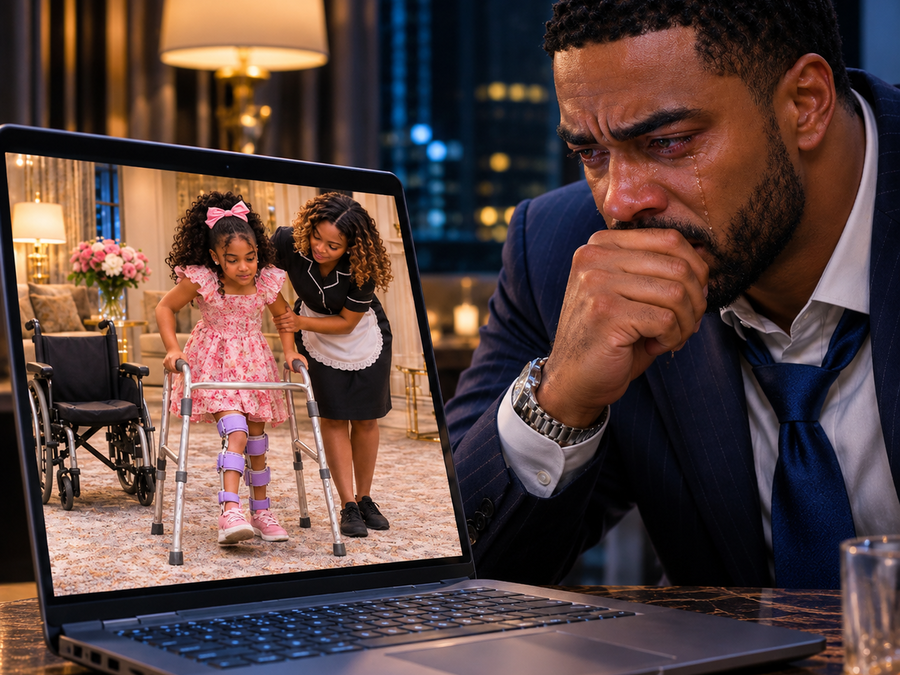
Billionaire Checked His Cameras While Away—Then Broke Down Seeing His Maid Help His Daughter Walk Again
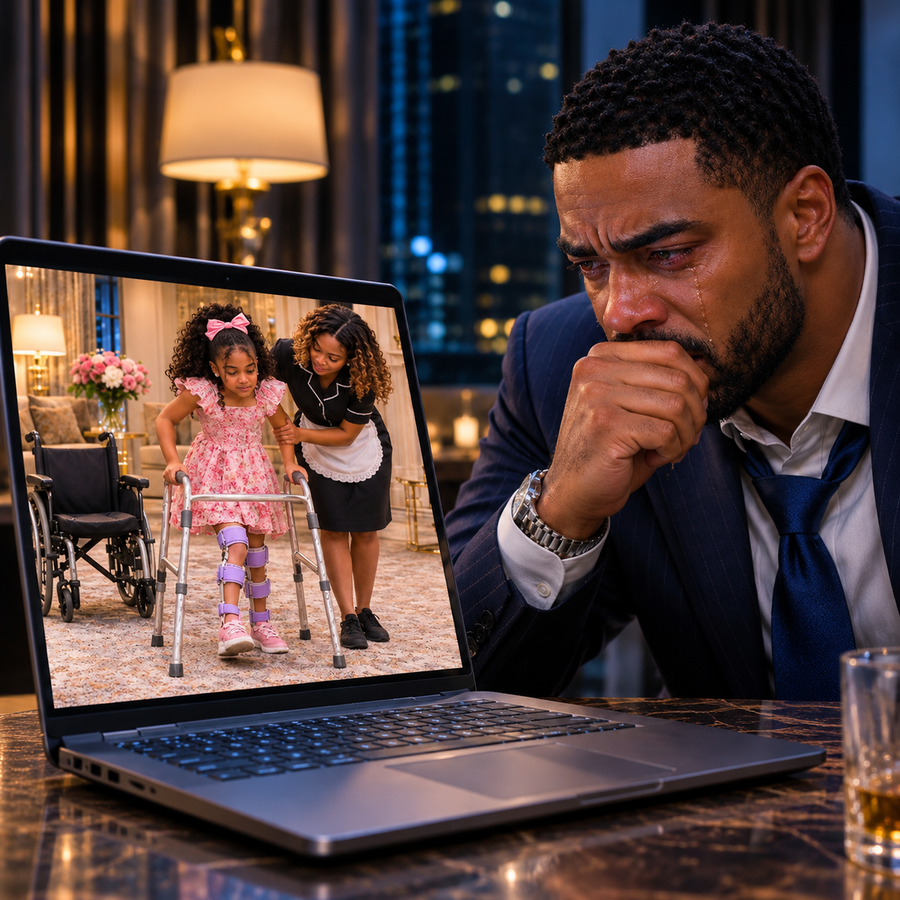
The first thing Ashton Sinclair noticed when he opened the security application on his phone was the sound of laughter.
It was faint, almost swallowed by the soft background noise coming from the speakers, but it was unmistakably the laughter of a child.
For a moment, he simply stared at the screen.
He was sitting in the back of his black Mercedes, somewhere between the airport and the hotel where he was supposed to attend an important business meeting. His assistant, Dominic, sat across from him reviewing the schedule for the next three days. Outside, the city moved in a blur of traffic lights, glass buildings, and hurried pedestrians.
Ashton had opened the cameras out of habit. He did it whenever he traveled, especially when he was away from his eight-year-old daughter, Imani. He liked to check that she was comfortable, that the staff were taking care of her, and that nothing unusual was happening in the house.
Usually, he saw her sitting in the living room, reading a book, watching television, or looking out toward the garden from her wheelchair.
But today, the image on his phone was different.
Imani was standing.
Not sitting in her wheelchair. Not leaning against the sofa. Standing.
A woman was beside her, holding her hands gently. Ashton recognized the woman as Lauren, the new maid he had hired several weeks earlier.
His heart began to pound.
“Wait. What?” he whispered.
Dominic looked up. “Sir?”
Ashton barely heard him.
On the screen, Imani’s knees trembled. Her face was tense with concentration, and her fingers were wrapped tightly around Lauren’s hands.
“I’m scared,” Imani said.
“I know, sweetheart,” Lauren answered. “We don’t have to do anything you’re not comfortable with. We can stop whenever you want.”
“No. I want to try. Just please don’t move away.”
“I’m right here. You’re not alone.”
Ashton leaned closer to his phone.
For three years, he had dreamed of seeing his daughter stand again. For three years, he had watched her struggle through surgeries, medical appointments, rehabilitation sessions, and disappointments that no child should ever have to endure.
And now, in the middle of an ordinary afternoon, she was trying to take a step.
But what happened next made his hands begin to shake.
“Okay,” Imani whispered. “I think I can do it.”
Lauren adjusted her position, following the instructions they had previously discussed with Imani’s rehabilitation team.
“Take your time.”
Imani shifted her weight.
Her body trembled. Her expression tightened. For a moment, Ashton thought she might fall.
Then one foot moved.
It was small. Barely more than a careful shift forward.
But it was a step.
Imani looked down in disbelief.
“Oh my God,” Lauren whispered.
“Did you see that?” Imani asked, her voice suddenly filled with excitement. “Did you see that?”
“I saw it.”
“I did it! I really did it!”
Lauren smiled, her eyes shining.
Imani laughed, then looked toward the door as if she expected someone to appear.
“Don’t tell Daddy yet.”
“Why not, sweetheart?”
“Because I want him to see it himself. I want him to know I didn’t give up.”
Ashton stopped breathing for a moment.
His daughter wanted to surprise him.
She wanted him to know she had not given up.
But the happiness on her face was mixed with something else. Something that Ashton had failed to recognize for far too long.
She was afraid of disappointing him.
He watched the recording again, then again, unable to look away.
“Sir?” Dominic asked carefully. “Is everything all right?”
Ashton locked his phone.
“No,” he said quietly. “I need to go home.”
“But the meeting—”
“Cancel it.”
“Sir, the investors are already—”
“I said cancel it.”
Dominic fell silent.
Ashton turned toward the window, but his mind was no longer on the city outside.
It was back in his mansion, in the garden where his daughter used to run, and in the living room where a little girl had just taken a step while trying desperately to make her father happy.
For the first time in years, Ashton began to wonder whether he had been protecting his daughter or simply protecting himself from the pain of watching her struggle.
Three years earlier, Ashton Sinclair had been a different man.
He was known in business circles as a decisive, ambitious billionaire who had built his company through discipline, careful planning, and an almost unreasonable refusal to accept failure. He had investments in real estate, technology, and international logistics. His name appeared in financial magazines, and his company employed thousands of people.
But none of those achievements mattered as much as his daughter.
Imani had been the center of his world since the day she was born.
Her mother, Eleanor, had died when Imani was only four. After that loss, Ashton had devoted himself to raising his daughter. He tried to make sure she never felt alone. He attended school events whenever his schedule allowed, read bedtime stories, and took her to the garden on weekends.
Imani loved the outdoors.
She loved flowers, butterflies, and especially the large oak tree at the far end of their garden. She used to race Ashton toward it, laughing whenever he pretended to lose.
“You’re cheating!” she would shout.
“How can I cheat in a race?” Ashton would ask.
“You take bigger steps!”
“That’s called having an advantage.”
“That’s called cheating!”
He would scoop her into his arms and carry her back toward the house while she laughed.
Those were the memories Ashton held closest to his heart.
Then came the accident.
It happened on a rainy afternoon when Ashton was away attending a business conference. Imani had been riding in the family car with her driver when another vehicle lost control on the wet road.
The collision was severe.
The driver survived with minor injuries, but Imani suffered serious damage to her lower spine. She was rushed to the hospital, where doctors worked for hours to stabilize her.
Ashton received the call while sitting in a conference room.
He remembered the sound of the voice on the other end. He remembered dropping his pen. He remembered leaving the meeting without saying a word.
Most of all, he remembered the hospital corridor.
The bright lights. The smell of antiseptic. The doctors speaking in careful, measured sentences.
When he finally entered his daughter’s room, Imani was lying in bed with tubes and monitors around her.
Her eyes opened when she heard his voice.
“Daddy?”
“I’m here, princess.”
“Why can’t I move my legs?”
Ashton took her hand.
“You’re going to be okay, sweetheart.”
“Can I get up?”
“Not right now. The doctors need to help you first.”
“Will I walk again?”
He wanted to tell her yes.
He wanted to promise that she would run through the garden by the end of the month, that she would return to school, and that everything would go back to normal.
Instead, he held her hand and said the only thing he could think of.
“Everything is going to be okay.”
But he could not control what happened next.
The doctors explained that Imani had suffered a serious spinal injury. They could not predict how much movement she would recover. Rehabilitation might help her regain strength and independence, but there was no guarantee she would ever walk without assistance.
The first months were difficult.
Imani worked hard during therapy. She followed instructions, completed exercises, and celebrated every small improvement. Some days she could move her legs more than others. Sometimes she felt stronger. Other times, she became frustrated when her body did not respond the way she wanted.
Ashton attended as many sessions as he could.
He watched her struggle, and every time she cried, something inside him broke.
He began to associate hope with disappointment.
Whenever Imani made progress, he allowed himself to believe things might improve. But when the progress slowed or disappeared, he found himself reliving the fear of the accident.
Eventually, he became afraid of letting her hope.
He thought that if he could convince her to stop expecting to walk again, he could protect her from future heartbreak.
He never realized that he was also teaching her to hide her dreams.
By the time Lauren joined the household, Ashton had already established strict instructions for everyone involved in Imani’s care.
No one was to make promises about recovery.
No one was to encourage unrealistic expectations.
No one was to push Imani beyond the rehabilitation plan approved by her medical team.
He wanted his daughter to enjoy childhood as much as possible without constantly measuring herself against what she had lost.
His intentions were loving, but his fear had made him controlling.
Lauren did not know all of that when she first arrived.
She was twenty-eight years old and had been looking for stable employment after putting her university education on hold. She had once dreamed of becoming an early childhood educator, but financial difficulties had forced her to leave school before completing her degree.
She accepted the position at the Sinclair mansion because it offered a steady income and a chance to support herself.
On her first morning, Simone, the house manager, showed her around.
“This is Imani’s room,” Simone explained. “She has everything she needs here. Her schedule is important, and we try to keep things consistent.”
Lauren nodded.
“Of course.”
“Mr. Sinclair is very protective of her.”
“I understand.”
Simone paused before continuing.
“He has been through a great deal. We all have. The accident changed this household.”
Lauren glanced toward the garden.
Through the tall windows, she could see a large oak tree standing near the stone pathway.
“Does she like spending time outside?”
“She used to spend nearly every afternoon out there.”
“Used to?”
Simone’s expression softened.
“She still likes the garden, but things are different now.”
Lauren did not ask more questions.
She understood that some stories needed to be told when people were ready.
The following morning, she met Imani.
The little girl was sitting in her wheelchair near the window, drawing in a notebook. Her dark hair was tied into two neat braids, and a collection of colored pencils lay across her lap.
“Good morning, princess,” Lauren said.
Imani looked up.
“Are you the new maid?”
“Yes. My name is Lauren.”
“Are you going to stay?”
“I hope so.”
“People sometimes leave.”
Lauren took a moment before answering.
“Sometimes they do. But I’m here today.”
Imani considered that response.
“That’s a boring answer.”
Lauren smiled.
“Then I’ll try to give you a more exciting one tomorrow.”
That made Imani laugh.
It was a small laugh, but Lauren noticed how quickly it disappeared when she looked toward the hallway.
Her father was approaching.
“Good morning, sweetheart.”
“Morning, Daddy.”
Ashton bent down and kissed her forehead.
“What are we looking at?”
“The garden.”
“Anything interesting out there?”
“The flowers are blooming again.”
“They certainly are.”
Imani turned her attention back to the window.
“Daddy, do you remember when I used to race you to the big tree?”
“Of course I remember.”
“You always cheated.”
“Excuse me? I never cheated.”
“You took bigger steps because your legs were longer.”
“That’s called having an advantage.”
“That’s called cheating.”
Ashton smiled, but the expression faded slightly when she mentioned the past.
“You sound exactly like your mother when you argue.”
Imani looked at him.
“Daddy?”
“Yes, baby?”
“Do you think I’ll ever run again?”
Ashton went still.
He had hoped the question would not return so soon.
“Imani…”
“I know. Nobody knows.”
“Sweetheart, we’ve talked about this.”
“I just wanted to ask. But I can still try, can’t I?”
“Your doctors have explained that recovery is uncertain.”
“I know what they said.”
“And we’ve had some very difficult months.”
“I’m not afraid of trying, Daddy.”
He reached for her hand.
“I know you’re brave.”
“Then why does everybody act like I’m made of glass?”
Ashton did not know what to say.
He wanted to explain that he was afraid of seeing her hurt. He wanted her to understand that every time she fell short of a goal, he felt as though the accident had happened all over again.
But those were adult feelings, and Imani was only eight.
“Because I love you more than anything in this world,” he finally said.
“I love you too.”
“Then promise me something. Don’t spend every day thinking about what you used to do. There are so many wonderful things we can still do together.”
“Like what?”
“Anything you want.”
“Can we go outside when it rains?”
Ashton looked toward the garden.
“We can watch it from the porch.”
“That’s not the same thing.”
Before he could respond, Simone appeared at the doorway.
“Mr. Sinclair, may I have a word?”
“Of course.”
Ashton stepped into the hallway with her.
“I don’t want anyone encouraging Imani to believe she’s going to walk again,” he said in a low voice. “Every time she gets excited, every time she thinks something is going to change, we end up back where we started.”
“She still talks about it, sir.”
“That’s exactly the problem.”
“She has made some progress.”
“And she’s had setbacks. You know how hard those were on her.”
Simone nodded.
“I understand.”
“Her care team has already given us guidance. Nobody in this house should be making promises or pushing her beyond it. I want her to enjoy being a child.”
“Understood.”
“Make sure the new maid understands.”
“I’ll speak with Lauren.”
“Thank you.”
That afternoon, Lauren found Imani sitting near the window with a drawing in front of her.
“That’s a beautiful picture,” Lauren said.
“It’s not finished.”
“What are you drawing?”
“Me.”
“I can see that. And what’s happening here?”
“I’m running in the rain.”
Lauren studied the picture.
The little girl in the drawing was wearing a yellow dress, her arms stretched out, and her hair flying behind her. Around her were flowers, trees, and several puddles.
“You must really love the rain.”
“I used to jump in every puddle.”
“Every single one?”
“Even the muddy ones.”
“Your father must have loved cleaning those shoes.”
Imani smiled.
“He used to jump with me.”
“That sounds like a wonderful memory.”
“It was. Before the accident.”
Lauren sat down beside her.
“Would you like to tell me about it?”
Imani hesitated, then nodded.
“I remember the hospital. I remember Daddy holding my hand. He kept saying everything would be okay.”
“He must have been very frightened.”
“He cried when he thought I was sleeping.”
“Sometimes grown-ups cry too.”
“He doesn’t laugh much anymore.”
Lauren looked at the little girl.
“Imani, can I tell you something?”
“What?”
“Your father loves you very much.”
“I know.”
“And none of this is your responsibility to fix.”
Imani looked down at the drawing.
“I know that too.”
“Do you?”
The little girl did not answer.
After a moment, she turned toward Lauren.
“Can you keep a secret?”
“That depends on the secret.”
“I still want to learn to walk again.”
Lauren’s expression softened.
“Oh, sweetheart.”
“Everybody thinks I’ve given up, but I haven’t.”
“Have you told your father?”
“Every time I try, he gets sad. I don’t want him to worry. I want him to be surprised.”
“Surprised?”
“Imagine he comes home and sees me taking steps.”
Lauren smiled gently.
“That would certainly surprise him.”
“Will you help me?”
Lauren took a slow breath.
She understood the importance of the moment, but she also knew that helping Imani could not mean ignoring medical advice.
“Walking practice is something we have to be careful with,” she explained. “I can’t promise what your body will be able to do, and I can’t teach you exercises that aren’t part of your care plan.”
“I still have the things they taught me before Daddy told everybody to stop talking about walking.”
“The activities your rehabilitation team showed you?”
“Yes. The ones Simone used to help me with.”
“Then we’ll make sure we’re following those instructions. We won’t do anything that isn’t safe for you.”
“So you’ll help?”
“I’ll help you talk about what you want, and I’ll support you with the things you’ve already been taught. But we can’t keep something from your father if it affects your safety.”
Imani looked disappointed.
“Can the surprise part still be a secret?”
“We can keep the surprise in mind. But I won’t lie about your health or hide anything important from your father.”
Imani thought about it.
“Deal.”
“Deal.”
Lauren spoke with Simone that afternoon. Together, they reviewed the rehabilitation instructions Imani’s care team had previously provided. They made sure they understood which activities were appropriate and which ones required professional supervision.
Lauren did not attempt to become Imani’s therapist. She did not introduce new exercises or encourage her to push through pain. She simply offered encouragement, companionship, and a safe environment for the activities already approved by the professionals responsible for her care.
The first practice session was difficult.
Imani was nervous, and Lauren could see how much effort it took for her to even consider trying.
“Everything stays within the plan,” Lauren reminded her. “If you’re uncomfortable or tired, we stop.”
“Absolutely,” Imani answered.
“Well, Miss Surprise, there’s no rushing. How are you feeling?”
“Nervous.”
“That’s okay.”
“What if I can’t do it?”
“Then we learn what today feels like. Nothing more.”
“That’s not a very exciting answer.”
“I have exciting answers too.”
“Like what?”
“I once made pancakes that looked exactly like a dinosaur.”
Imani stared at her.
“That’s not possible.”
“It was a very strange dinosaur.”
For the first time that afternoon, Imani laughed.
Lauren smiled.
“There she is. The girl with the biggest laugh in this mansion.”
“I’m still scared.”
“You can tell me if you want to stop.”
“Not yet.”
Lauren stayed close, following the agreed instructions and allowing Imani to decide when she was ready.
The attempt was brief.
It was also exhausting.
When Imani finally settled back into her wheelchair, she looked disappointed.
“This is harder than I remember.”
“Then we can finish for today.”
“But I wanted to do more.”
“Wanting something doesn’t mean you have to accomplish it all at once.”
“Can we try another day?”
“If you’re comfortable and it’s still within your plan, yes.”
“Promise you won’t laugh if I’m slow?”
Lauren placed a hand over her heart.
“Imani Sinclair, the only thing I’ll ever laugh at is your terrible dinosaur impression.”
“My dinosaur impression is amazing.”
“Absolutely terrifying.”
Imani roared dramatically, and Lauren laughed with her.
For a little while, the mansion felt different.
It sounded like a home again.
Over the next several days, Lauren and Imani developed a routine. They spent time drawing, reading, playing word games, and talking about things that had nothing to do with the accident.
Sometimes they reviewed the activities from Imani’s rehabilitation plan. Sometimes they simply sat in the garden and watched the butterflies.
Lauren learned that Imani loved stories about explorers and animals. She was fascinated by space and wanted to visit a planetarium. She also had a habit of asking questions that were difficult to answer.
One afternoon, while Lauren was arranging books on a shelf, Imani asked why she worked in the mansion.
“Because I needed a job,” Lauren replied.
“That’s a boring answer.”
“It’s also the truth.”
“Didn’t you want to do something else?”
Lauren paused.
“I wanted to finish college.”
“What did you want to study?”
“Early childhood education.”
“You wanted to be a teacher?”
“I still do.”
“Then why don’t you?”
“Life became a little complicated.”
“Like a math problem?”
“Worse. A math problem with bills.”
Imani laughed.
“I hate math problems with letters.”
“Me too.”
“What if you went back to school?”
Lauren smiled.
“Maybe one day.”
“Dreams can take longer than we expect, right?”
“That’s true.”
“Like my walking?”
“In some ways, yes. But your future doesn’t depend on walking, Imani.”
“I know. I just miss it.”
“You’re allowed to miss it.”
Imani thought about that.
“Then maybe we can both keep trying.”
“Maybe we can.”
“I’ll be your student when you’re a teacher.”
“You might be a little too old for my class by then.”
“I’ll pretend to be younger.”
“You’re already eight.”
“Fine. I’ll be your assistant.”
“Now that sounds like a plan.”
The conversations made Lauren realize that Imani was not simply trying to recover a physical ability.
She was trying to recover a sense of control over her own life.
She wanted to make choices, set goals, and feel that the people around her believed she was capable of more than simply accepting what had happened.
But Lauren also noticed that Imani’s mood changed whenever Ashton entered the room.
The little girl would become quieter. She would avoid mentioning her rehabilitation goals and quickly change the subject if her father asked what she had been doing.
Ashton was not unkind.
He was affectionate, attentive, and generous. He bought Imani beautiful clothes, expensive toys, and books from around the world. He arranged the best medical care available and made sure she never lacked anything.
Yet his fear had created an invisible boundary around her.
He wanted her to be happy, but he was uncomfortable whenever she expressed a hope that reminded him of the accident.
One evening, Ashton found a drawing on the table.
It showed Imani running toward the large oak tree.
He picked it up.
“Did Imani leave this here?” he asked Lauren.
“Yes, sir. She wanted you to see it.”
“She’s drawn herself running.”
“She talks about the garden a lot.”
Ashton studied the picture.
“Has she been asking you about walking?”
“She’s been telling me about things she hopes to do.”
He looked at her.
“Lauren, I need you to understand something.”
“I’m listening, sir.”
“My daughter has already been through more than most adults could handle.”
“I understand.”
“You weren’t here when the accident happened.”
“No, sir.”
“You didn’t see her in that hospital. You didn’t hear her asking why she couldn’t get out of bed.”
Lauren remained silent.
“I promised her everything would be okay,” Ashton continued. “I promised things I couldn’t control.”
“That must have been difficult.”
“Every time we thought she was improving, something changed. She would get excited, and then she would be devastated.”
“She still has hopes of her own, sir.”
Ashton looked up sharply.
“What did you say?”
“I only mean that Imani talks about the things she misses.”
“I know what she misses.”
“Of course, sir.”
“Then please don’t encourage expectations nobody can guarantee.”
“I won’t promise her anything I can’t know.”
“Good.”
Lauren left the room, but the conversation stayed with her.
She wondered whether Ashton understood how much his daughter was hiding from him.
Meanwhile, Imani continued working within her rehabilitation plan.
There were days when she felt encouraged and days when she felt discouraged. Some mornings she was energetic, and other mornings she barely wanted to get out of bed.
Lauren tried not to make every small achievement into a celebration. She wanted Imani to understand that her worth was not measured by the number of steps she could take.
But the first time Imani managed a little more than she had expected, both of them were overwhelmed.
“Lauren, are you watching?”
“I’m watching.”
“Don’t look away.”
“I wouldn’t dream of it.”
Imani concentrated, following the movements she had practiced with her rehabilitation team.
Then she managed another small step.
Her face lit up.
“I did it!”
“You certainly did.”
“Again.”
Lauren smiled.
“How are you feeling?”
“Happy. Does happy count?”
“Happy definitely counts.”
“I haven’t felt this happy in forever.”
“Then let’s enjoy it.”
“Can we write it down?”
“Write what down?”
“Everything I can do, so when Daddy comes home, I can show him.”
Lauren considered the idea.
“A progress journal?”
“A surprise journal.”
“That sounds wonderful.”
“The first page should say, ‘Imani didn’t give up.'”
Lauren smiled.
“How about, ‘Imani kept trying, even on the hard days’?”
“That’s too many words. Write this: Today was a good day.”
Lauren wrote it down and drew a small sun beside the sentence.
“Done.”
“You’re terrible at drawing.”
“I warned you.”
“Today is going to be even better.”
“You sound very confident.”
“Yesterday was amazing. Today will be amazinger.”
“Amazinger?”
“It’s a word now.”
For several days, the journal became their favorite activity.
Imani filled it with short sentences, drawings, and little notes about what she had learned.
One page described the sound of rain hitting the windows. Another showed the large oak tree in the garden. There were also pages about her dinosaur pancakes, Lauren’s terrible drawing skills, and the day she managed to complete an activity that had once seemed impossible.
But progress did not happen in a straight line.
One afternoon, Imani became frustrated when she could not repeat something she had managed the previous day.
“Wait. What’s wrong?” Lauren asked.
“I could do this yesterday.”
“Some days feel different.”
“No. I did it. You saw me.”
“I know you did.”
“Then why can’t I do it now?”
“You seem tired. Let’s take a break.”
“I don’t want a break.”
“Imani…”
“I want to do it!”
Lauren lowered her voice.
“I hear you. But we shouldn’t keep going when you’re exhausted.”
“Everybody always tells me to stop!”
“I’m not telling you to give up.”
“That’s what Daddy says too. He says not to worry. He says not to think about it. Everybody keeps telling me what I shouldn’t do!”
Lauren felt her heart tighten.
“I’m sorry you’re feeling unheard.”
“I thought I was getting better.”
“You’ve made progress, Imani. One difficult day doesn’t erase that.”
“What if it was just luck?”
“We don’t know what tomorrow will bring.”
“That’s what everybody says!”
Imani’s eyes filled with tears.
“You made me believe I could surprise Daddy.”
Lauren moved closer.
“I never wanted you to feel that you had to accomplish anything for him.”
“But I wanted him to be proud.”
“He can be proud of you right now.”
“You don’t understand!”
“Maybe I don’t understand everything, but I want to listen.”
“I don’t want you to listen anymore. I don’t want to practice. I don’t want the journal. I don’t want any of it!”
Lauren remained still.
“And I don’t want you helping me anymore.”
“I understand.”
“Please leave me alone.”
Lauren nodded.
“All right. I’ll give you some space. Simone is nearby if you need anything.”
She left the room quietly.
Outside, Lauren stood in the hallway for a moment, trying to collect herself.
She had wanted to help Imani feel hopeful, but now she worried that the little girl had begun to associate every practice session with the pressure to succeed.
She did not want to become another person who made Imani feel that she had to prove something.
That evening, Simone found Lauren sitting quietly in the kitchen.
“You’ve been unusually quiet today,” Simone observed.
“Imani doesn’t want to speak to me.”
“What happened?”
“She had a difficult afternoon. She couldn’t repeat something she managed before, and she took it very hard.”
Simone sighed.
“That little girl has been through a lot.”
“I know. I think I made a mistake.”
“What mistake?”
“I celebrated every little improvement. I thought I was helping her believe in herself. But maybe she thought I was promising that everything would get better.”
“Did you promise that?”
“No.”
“Then don’t punish yourself for something you didn’t say.”
Lauren looked down at her hands.
“She trusted me, Simone.”
“She still might. Children sometimes need space when they’re disappointed.”
“Mr. Sinclair warned me.”
“Mr. Sinclair is frightened.”
“He’s her father.”
“Yes. And sometimes frightened parents forget that children have feelings they can’t control for them.”
Lauren remained silent.
“What should I do?” she asked.
“Stop trying to find the perfect thing to say. Be there when she’s ready to talk.”
Later that night, Ashton visited his daughter’s room.
He had noticed that Imani was unusually quiet.
“Simone says you’ve been quiet today.”
“I’m tired.”
“Did something happen?”
“No.”
“You know you can tell me anything.”
“Anything?”
“Anything in the world.”
“Even if it makes you sad?”
“Of course.”
Imani looked at him for a long moment.
“Daddy, do you ever wish things were different?”
Ashton sat beside her.
“Every day.”
“Me too.”
“Sweetheart…”
“I miss how we used to play.”
“We can still play.”
“But you always look worried.”
“I’m just trying to take care of you.”
“I know.”
He brushed a strand of hair away from her forehead.
“You’re everything to me.”
“Then why do you look so sad whenever I talk about walking?”
Ashton felt the question strike deeper than he expected.
“Because I don’t want you to get hurt again.”
“But I already got hurt, Daddy. I can’t change what happened.”
“I know.”
“I just want you to stop being scared of everything.”
He stared at his daughter.
For three years, he had believed his fear was something he needed to hide from her. He thought that by avoiding difficult conversations, he could spare her from the weight of his emotions.
But she had noticed everything.
She had noticed the way he changed the subject, the way his smile disappeared, and the way he became tense whenever she talked about the future.
“I’ll try, sweetheart.”
“Promise?”
“I’ll do my best.”
Imani nodded.
Ashton kissed her forehead and remained beside her until she fell asleep.
The next afternoon, Lauren knocked gently on Imani’s door.
“May I come in?”
“You’re already here.”
“That’s true.”
Lauren sat down near the window.
“Simone says you’ve been quiet.”
“I’m tired.”
“Would you like me to leave?”
Imani shook her head.
After a moment, she reached for a photograph on her bedside table.
“That’s me before the accident.”
Lauren looked at it.
A little girl was running through a garden sprinkler, her arms raised, her face bright with laughter.
“You look very happy.”
“Daddy took it.”
“That sounds like a wonderful memory.”
“I was running through the sprinklers.”
“That looks like fun.”
“I miss that girl.”
Lauren looked at her carefully.
“What do you miss about her?”
“She could run wherever she wanted.”
Lauren took a moment before answering.
“You still have that wonderful imagination, Imani. And that enormous laugh.”
“But I can’t do everything she did.”
“I know. And it’s okay to be sad about that.”
Imani turned toward her.
“Do you still think I can walk again?”
Lauren did not pretend to know the answer.
“I don’t know exactly what will happen. Nobody can promise that.”
“Then why did you help me?”
“Because you asked me to listen. Because your goals matter. And because I didn’t want you to feel alone.”
“What if I never walk without my chair?”
Lauren looked directly at her.
“Then you’ll still be Imani. You’ll still be smart and funny and brave. And we’ll still find wonderful things for you to do.”
“Even playing in the rain?”
“Absolutely. There are different ways to enjoy the rain.”
“But I still want to keep trying.”
“Then that deserves to be heard too.”
Imani looked down at the photograph.
“I don’t want to do it just for Daddy anymore.”
“What do you want to do it for?”
“For me.”
Lauren smiled.
“That’s a good reason.”
“Can we keep my journal?”
“Of course.”
Imani opened it and turned to the last page.
She picked up a pencil and wrote slowly.
“A bad day doesn’t mean the story is over.”
Lauren read the sentence and nodded.
“I like that very much.”
For the first time since their argument, Imani smiled.
A few days later, Ashton announced that he would be traveling for three days.
He had a series of meetings with international partners, and the trip had been planned for months. Normally, he would have gone without hesitation. But after his conversation with Imani, he found himself reluctant to leave.
“Three days?” Imani asked.
“That’s all.”
“You said two yesterday.”
“The meeting schedule changed.”
“Business people are always changing things.”
“That’s unfortunately true.”
“Will you call me?”
“Every night.”
“And no working during our calls?”
“No working.”
“Pinky promise?”
“Pinky promise.”
She held out her little finger, and he wrapped his around it.
“Daddy?”
“Yes, princess?”
“I have something to show you when you get back.”
“A drawing?”
“Better.”
“A painting?”
“Better.”
“A million dollars?”
“Daddy!”
He laughed.
“All right. I’ll wait for my surprise.”
“You have to promise not to cry.”
“Why would I cry?”
“Just promise.”
“I can’t promise that without knowing what it is.”
“Fine. But no ugly crying.”
Ashton kissed her forehead.
“I love you.”
“I love you more.”
“Impossible.”
“Possible.”
When Ashton left, Imani watched his car disappear down the driveway.
Lauren joined her near the window.
“Do you think he’ll be surprised?” Imani asked.
“I think he will be.”
“Do you think he’ll be proud?”
“I think he’ll be proud of how hard you’ve worked.”
“Even if I still need my wheelchair?”
“Of course.”
Imani smiled.
“Good.”
“Why good?”
“Sweetheart, you don’t have to make your father happy by walking.”
“I know. But I miss laughing with him.”
Lauren understood.
“Then maybe the best surprise is telling him that.”
Imani considered the idea.
“Maybe.”
The next few days were carefully planned.
Lauren made sure Imani had plenty of rest and followed the rehabilitation instructions. Simone checked in regularly, and the household staff knew that Imani’s activities were not to be changed without proper guidance.
There were no dramatic challenges, no attempts to force a breakthrough, and no promises about what might happen.
There were simply small moments.
A morning when Imani felt strong.
An afternoon when she preferred to read.
A day when she was disappointed.
And another day when she surprised herself.
Three days after Ashton left, Lauren stood beside Imani in the family room.
“Are you ready?”
“I think so.”
“Remember, this isn’t a test.”
“I know.”
“You can stop whenever you want.”
“I know that too.”
Imani looked at Lauren.
“Lauren?”
“Yes?”
“I did it.”
Lauren smiled.
“You did.”
“I really did it.”
“I saw you.”
Imani’s eyes filled with tears.
“I was so scared after that bad day.”
“I know.”
“I thought I’d never feel happy about trying again.”
“And how do you feel now?”
“Like I want to laugh and cry at the same time.”
Lauren smiled.
“I know that feeling.”
Imani laughed softly.
“Don’t tell Daddy yet.”
“I know you want to surprise him.”
“I want to see his face.”
“Then let’s make sure he understands how much this means to you.”
“Do you think he’ll be proud?”
“I think he’ll be proud of how hard you’ve worked.”
“Even if I still need my wheelchair?”
“Of course, sweetheart.”
“Good.”
Lauren noticed how tired she looked.
“You’ve had a long day. Go get some sleep.”
“I’m going to check on Imani first,” Lauren said after helping her settle comfortably.
Simone nodded.
“All right.”
Later that evening, Ashton was sitting in his hotel room, reviewing the last documents for the following day’s meeting.
His phone rang.
It was Simone.
“How is Imani?” he asked immediately.
“She’s doing well, sir.”
“Did she eat dinner?”
“Most of it.”
“Did she take her medication?”
“Yes, sir.”
“Good.”
Simone paused.
“Mr. Sinclair, you should try to get some rest.”
“I will.”
“You’ve called several times today.”
“I know.”
“She is safe. We’re all here.”
Ashton rubbed his forehead.
“Thank you, Simone.”
After ending the call, he opened the security application.
He wanted to see his daughter before going to sleep.
“Let’s see what my princess is doing,” he murmured.
The camera showed Imani in the family room with Lauren.
At first, Ashton smiled.
Then he noticed something unusual.
Imani was standing.
His body went rigid.
“What are they doing?”
He turned up the volume.
“Are you ready?” Lauren asked.
“I think so.”
“Remember, you can stop whenever you want.”
“I know.”
Imani shifted her weight.
Lauren stood close, ready to support her if needed.
Then Imani moved one foot forward.
And another.
The movement was slow, careful, and unsteady, but it was real.
Ashton brought a hand to his mouth.
His daughter was taking steps.
He watched her face.
She was smiling.
Not the polite smile she sometimes gave him when she wanted him to stop worrying. Not the small expression she used when adults praised her for being brave.
This was genuine happiness.
“Daddy is going to be so surprised,” Imani said.
Lauren laughed softly.
“Do you think Daddy will cry?”
“Maybe a little.”
“I hope they’re happy tears.”
“They are, sweetheart.”
Imani looked toward the camera’s direction, unaware that her father was watching.
“I just want him to know I’m still trying.”
Ashton felt tears gathering in his eyes.
Then he heard Lauren say something that changed the way he understood everything.
“He needs to know how you feel, Imani.”
“I don’t want him to be scared anymore.”
Ashton lowered his phone.
For several seconds, he could not move.
He had spent three years believing he was the one who needed to be strong. He had believed that if he controlled every detail, prevented every disappointment, and stopped his daughter from hoping too much, he could protect her.
But while he had been trying to protect her from sadness, she had been trying to protect him.
She had hidden her dreams because she did not want to make him worry.
She had wanted to walk because she wanted to surprise him.
She had measured her own happiness against the expression on his face.
And he had never noticed.
He replayed another recording.
This time, he saw the difficult afternoon.
He watched Imani become frustrated when she could not repeat an earlier achievement. He heard her say that she had wanted her father to be proud.
Then he heard Lauren answer that Ashton was already proud of her.
Ashton closed his eyes.
“Oh, sweetheart,” he whispered. “You thought you had to earn that?”
His assistant called a few minutes later.
“Sir, did you get the revised contract?”
Ashton barely registered the question.
“Dominic, I need you to handle tomorrow’s meeting.”
“What happened?”
“I need to go home.”
“Is Imani okay?”
“She’s okay.”
“Then what’s wrong?”
Ashton looked at the paused image on his phone.
“I’ve spent so long being afraid of losing what she used to have that I forgot what she still has.”
Dominic was quiet.
“Sir?”
“My daughter. She’s been trying to tell me something for weeks, and I wasn’t listening.”
“Then go home and listen.”
Ashton nodded, even though Dominic could not see him.
“That’s exactly what I’m going to do.”
He booked the earliest flight available.
The following morning, the mansion was unusually quiet when Ashton arrived.
He did not announce himself.
He simply walked through the front entrance, handed his coat to a staff member, and headed toward the family room.
Imani was sitting in her wheelchair near the window.
When she saw him, her face lit up.
“Daddy!”
Ashton dropped to one knee and opened his arms.
“Hello, princess.”
“You’re home!”
“I couldn’t wait another day.”
“What about your meetings?”
“They can wait.”
“Really?”
“Really.”
She reached for him, and he hugged her tightly.
For a moment, neither of them spoke.
Then Ashton pulled back and looked into her eyes.
“Imani, I need to tell you something.”
“Am I in trouble?”
“No, sweetheart. Not at all.”
“Then why do you look like that?”
“Because I owe you an apology.”
“An apology?”
“I know you’ve been wanting to continue working toward walking.”
Imani’s expression changed.
“Daddy…”
“Lauren didn’t tell me. I saw you on the security cameras.”
“You saw?”
“I did.”
She looked down.
“Are you angry?”
“No, baby. I’m not angry.”
“But you said nobody should help me.”
“I said a lot of things because I was frightened.”
“Frightened of what?”
“Of seeing you disappointed again. Of watching you try so hard and then feeling like I couldn’t do anything to make things better.”
Imani looked at him.
“Daddy, you don’t have to make everything better. Sometimes I just want you to listen.”
Ashton felt his throat tighten.
“You’re right.”
“I wanted to surprise you.”
“You did surprise me.”
“Did you see my steps?”
“Every one of them.”
Imani smiled.
“I had a bad day too.”
“I know. I saw that.”
“I thought you’d be disappointed.”
Ashton shook his head.
“Imani, look at me.”
She lifted her eyes.
“There is nothing you have to do to make me proud to be your father.”
“Even if I never walk without my wheelchair?”
“Even then.”
He took her hands.
“You’re my daughter. I love who you are, not what your legs can do.”
Imani began to cry.
“I missed you, Daddy.”
Ashton pulled her into another hug.
“I missed you too, princess.”
“Even when I was right here?”
He closed his eyes.
“Even when I was right here.”
Lauren appeared in the doorway.
“Mr. Sinclair, I understand if you’re upset.”
Ashton looked toward her.
“Lauren, sit down.”
“I’d rather stand, sir.”
“All right.”
He took a breath.
“I know you were asked not to raise Imani’s expectations.”
“I was, sir.”
“She asked you to help her.”
“She did. I should have spoken to you more openly about her wishes.”
“Yes. We should have been communicating about her care.”
Lauren looked down.
“I never wanted to put her at risk. We stayed with the activities she’d already been taught, and Simone checked the instructions with me.”
“I’m glad you took that seriously.”
“I wanted her to feel heard.”
Ashton nodded.
“I understand that now.”
He glanced at his daughter.
“I saw the footage. Not just today. I saw the day she became discouraged.”
Lauren remained quiet.
“She thought I would be disappointed in her.”
“She loves you very much.”
“I know. But I made her feel as though my happiness depended on her recovery.”
“I don’t think you meant to.”
“No. But I still need to change.”
He looked directly at Lauren.
“Thank you for listening to her.”
“She’s a wonderful child.”
“She is.”
“I didn’t do anything extraordinary, Mr. Sinclair.”
“You gave her space to tell you what she wanted. I hadn’t been doing that.”
Lauren’s expression softened.
“She needed someone to hear her.”
“And now I intend to be one of those people.”
Imani reached for her journal.
“Daddy?”
“Yes, princess?”
“Are you going to tell me to stop trying again?”
“No. We’re going to talk with your rehabilitation team about your goals and make a plan together.”
“Together?”
“You, me, and the people helping you.”
“And Lauren?”
Ashton smiled.
“And Lauren, if you want her there.”
“I want that.”
“Then that’s what we’ll do.”
Imani looked toward the garden.
“Daddy, do you think I’ll run again?”
Ashton knew how much the question meant.
He could have given her the answer she wanted. He could have promised that she would one day race him to the oak tree.
But he had learned that love was not about making promises he could not control.
“I don’t know, sweetheart.”
Imani nodded.
“That’s okay.”
“But I do know something.”
“What?”
“Whatever happens, we’re going to make wonderful memories together.”
“Even in the rain?”
“Especially in the rain.”
Imani suddenly looked toward the window.
“Daddy, it’s raining.”
Ashton followed her gaze.
Rain was falling softly over the garden. The leaves of the oak tree glistened, and little drops gathered on the flowers near the stone pathway.
“Can we go outside?” she asked.
Ashton looked at Lauren, then back at his daughter.
“We can enjoy it safely right here to start.”
He wheeled her toward the covered porch, where the fresh air drifted in.
Imani stretched out her hand.
A raindrop landed on her palm.
“Look! I can feel the raindrop.”
“Is it everything you remembered?” Ashton asked.
“It’s even better.”
“Why?”
She turned toward him.
“Because you’re laughing again.”
Ashton realized he was smiling.
“I suppose I am.”
“I missed that sound.”
“So did I.”
For the first time in a long while, the mansion sounded like a home again.
The weeks that followed brought changes to the Sinclair household.
Ashton arranged a meeting with Imani’s rehabilitation team. He explained what he had seen, what Imani had been trying to communicate, and how the family’s fear had affected her emotional well-being.
The specialists reviewed her progress and discussed appropriate goals with her.
They made it clear that recovery remained uncertain. There would be no guarantees, and the family would need to remain patient.
But Imani was allowed to express what she wanted.
She was encouraged to participate in decisions about her care, to ask questions, and to celebrate improvements without feeling that she had to achieve a particular outcome.
Ashton attended more appointments.
He also began spending less time on his phone when he was with her.
At first, it was difficult.
His business had always demanded his attention. There were contracts to review, executives to meet, and decisions that affected thousands of employees.
But he began setting aside protected time for his daughter.
He stopped answering emails during dinner.
He no longer took calls in the middle of their evening conversations.
And every night, he asked her about something other than her rehabilitation.
Sometimes she told him about a book.
Sometimes she talked about school.
Sometimes she complained about Lauren’s terrible drawings.
And sometimes she simply wanted to sit beside him without saying anything.
Ashton learned that being present was more important than constantly trying to solve problems.
One afternoon, he found Lauren in the library, organizing a stack of children’s books.
“Lauren, may I speak with you?”
“Of course, sir.”
“I’ve been thinking about something.”
She waited.
“Simone told me you wanted to finish college.”
Lauren looked surprised.
“Yes, sir. I did.”
“She said you were studying early childhood education.”
“That’s right.”
“Why did you stop?”
Lauren hesitated.
“My family had some financial difficulties. I needed to work, and I couldn’t afford to continue at the time.”
“Do you still want to become a teacher?”
“Very much.”
Ashton nodded.
“I’d like to help you return to school.”
Lauren looked at him carefully.
“Mr. Sinclair, I appreciate that, but I don’t want you to feel obligated.”
“I’m not doing it out of obligation.”
He paused.
“You’ve worked hard in this house. More importantly, you’ve helped my daughter find her voice again. I know that doesn’t mean I owe you anything, but I also know you deserve the opportunity to pursue your own dreams.”
Lauren’s eyes filled with tears.
“I don’t know what to say.”
“You don’t have to decide right now. I’ve arranged a scholarship through our family foundation. If you choose to accept it, it can help cover your education.”
Lauren looked down, struggling to find the right words.
“Thank you, Mr. Sinclair. This means more than you know.”
Imani appeared at the doorway.
“Does this mean Lauren gets to be a teacher?”
Ashton smiled.
“It means she might finally finish her degree.”
“I’ll pretend to be five.”
Lauren laughed.
“You’d make a terrible five-year-old.”
“Daddy!”
Ashton raised his hands.
“Don’t involve me. I’m staying out of this.”
The three of them laughed together.
It was a small moment, but it marked the beginning of something new.
Lauren accepted the scholarship and enrolled in classes that would allow her to continue working while studying. Ashton made sure her schedule could accommodate her education, and Simone helped arrange the household responsibilities.
Imani was delighted.
She immediately announced that she would be Lauren’s first student.
“You have to teach me something every day,” she insisted.
“Every day?”
“Yes.”
“What if I have homework?”
“Then I’ll help you.”
“You’re eight.”
“I’m very intelligent.”
“That is true,” Lauren admitted.
As the months passed, the journal grew thicker.
Imani continued recording her experiences. Some entries described rehabilitation milestones. Others described ordinary moments.
One page read:
Today I watched a butterfly land on the flower near the porch.
Another said:
Today I was tired, and I stopped when I needed to. That was okay.
There were also pages about the day Ashton learned to make pancakes and accidentally burned the first batch.
Imani insisted on drawing a dinosaur beside the entry.
One afternoon, Ashton found the journal on the coffee table.
“So this is the famous journal?”
Imani looked up.
“Yep.”
“May I read it?”
“Only the last page.”
“All right.”
Ashton opened it.
The latest entry was written in careful handwriting.
Today Daddy came home early.
He turned the page.
Today he listened to me.
Then he reached the final line.
And today I learned that even when I have a hard day, I am still enough.
Ashton stopped reading.
He looked at his daughter.
“You certainly are, sweetheart.”
Imani smiled.
“Daddy?”
“Yes?”
“Can I tell you another secret?”
“Always.”
“I still want to run through the garden someday.”
Ashton sat beside her.
“Then we’ll keep listening to what you want, and we’ll take things one day at a time.”
“And if I can’t?”
“Then we’ll find other ways to race to that big tree.”
“I’ll still beat you.”
“Oh, really? You sound very confident.”
“That’s because you cheat.”
Ashton laughed.
“I do not cheat.”
“You have longer legs.”
“Here we go again.”
Their laughter filled the room.
Lauren stood nearby, watching them with a quiet smile.
She had once believed that helping Imani meant encouraging her to keep trying. Now she understood that it also meant helping her recognize that she did not need to earn love through progress.
And Ashton had learned something just as important.
He could not protect his daughter from every disappointment.
He could not control the future or promise that every dream would come true.
But he could make sure she never faced uncertainty alone.
He could listen.
He could encourage her.
He could celebrate her victories without making them conditions for happiness.
And he could love her exactly as she was.
As time passed, Lauren became an increasingly important part of the family.
Ashton admired her patience, her kindness, and the way she treated Imani as a child with her own thoughts and ambitions rather than someone who needed to be constantly protected.
He also enjoyed talking with her.
Their conversations began with practical matters about the household and gradually became longer. They discussed books, education, childhood memories, and the challenges of balancing work with personal dreams.
Lauren never tried to replace Imani’s mother.
She understood that Eleanor would always have a place in the family’s history.
Instead, she offered something different: a steady presence, genuine affection, and the ability to listen without judgment.
Ashton found himself smiling more often.
Imani noticed.
One evening, while Lauren was helping her choose a book, Imani looked toward her father.
“Daddy?”
“Yes, princess?”
“Do you like Lauren?”
Ashton glanced at Lauren.
“Of course I do.”
“I mean, do you smile when she walks into the room?”
Lauren tried to hide her amusement.
Ashton raised an eyebrow.
“You’ve been watching me?”
“You smile a lot when she’s here.”
“She’s someone very special.”
Imani considered that answer.
“Sometimes I wish she could be my mom too.”
The room became quiet.
Ashton looked at his daughter.
“That’s something Lauren would have a say in, sweetheart.”
“I know. I just wanted you to know.”
He kissed her forehead.
“Take your time, princess.”
He did not rush the conversation or make promises.
He understood that any future relationship would need to grow naturally, with respect for Imani’s feelings and for the memory of the mother she had lost.
Months later, Ashton and Lauren began spending time together outside the responsibilities of the mansion.
They went for dinner after Lauren’s classes. Sometimes they walked through the garden after Imani had gone to bed. They talked about their hopes and the mistakes they had made.
Their relationship developed slowly.
Neither wanted to confuse Imani or make her feel that she had to accept something before she was ready.
But Imani was observant.
She noticed the way Ashton looked at Lauren.
She noticed the way Lauren laughed at his jokes, even when they were not particularly funny.
And she noticed that her father seemed happier.
One evening, she asked Lauren a question.
“Do you like my daddy?”
Lauren smiled.
“Yes, I do.”
“Like a friend?”
Lauren considered the little girl’s expression.
“More than a friend.”
Imani nodded as if she had already known the answer.
“Good.”
“Good?”
“He’s been lonely.”
Lauren’s smile softened.
“Your father loves you very much.”
“I know. But sometimes grown-ups need someone too.”
Lauren reached for her hand.
“You’re very thoughtful, Imani.”
“I’m eight. I’m almost an expert.”
Lauren laughed.
“Almost?”
“Well, I still have a lot to learn.”
And she did.
So did Ashton.
Their family continued to grow, not because anyone had forgotten the past, but because they had learned to make room for the future.
One year after Lauren first joined the household, Ashton asked her to marry him.
He did not arrange an extravagant public proposal or invite the press. Instead, he chose a quiet evening in the garden, beneath the oak tree that had once been the finish line of his races with Imani.
Lauren was standing near the flowers when Ashton approached.
“I’ve been thinking about something,” he said.
“That sounds serious.”
“It is.”
She smiled.
“Should I be worried?”
“Not at all.”
He took her hands.
“You came into this house as an employee. But somewhere along the way, you became someone I trust, someone I admire, and someone I cannot imagine living without.”
Lauren’s eyes began to shine.
“You’re a wonderful father, Ashton. Even when you don’t believe it.”
“I’m still learning.”
“Me too.”
He took a small ring from his pocket.
“I don’t want you to feel that you have to become someone else for us. I don’t want you to give up your education or your dreams. I want us to build a life where all three of us can keep becoming who we’re meant to be.”
He looked into her eyes.
“Will you marry me?”
Lauren covered her mouth.
“Yes.”
Ashton smiled with relief.
“Yes?”
“Yes, Ashton.”
He slipped the ring onto her finger and embraced her.
From the porch, a familiar voice interrupted them.
“Finally!”
They turned.
Imani was sitting in her wheelchair, smiling from ear to ear.
Ashton laughed.
“How long have you been there?”
“Long enough.”
“How much did you hear?”
“Everything.”
Lauren blushed.
Imani looked at the ring.
“Does this mean I get to help choose the wedding cake?”
“Of course,” Ashton answered.
“Then I approve.”
The wedding was held several months later in the mansion’s garden.
It was a small ceremony attended by close friends, family members, and the people who had supported them through the difficult years.
Imani wore a beautiful pale blue dress. Her hair was decorated with small flowers, and the journal she had kept for so long rested on a table near the entrance.
Before the ceremony began, Ashton knelt beside her.
“Are you ready, princess?”
She looked at the garden.
The flowers were blooming. The oak tree stood tall at the far end of the lawn, and the afternoon sunlight touched the stone pathway.
“Yes.”
“Are you sure?”
“Daddy, I’ve been waiting three years for this wedding. You can wait ten more seconds.”
Ashton laughed.
“Fair enough.”
He offered his hand.
“We can wait as long as you need.”
Imani took it.
Then she looked at Lauren.
“Are you ready?”
Lauren smiled.
“I am.”
Imani glanced between them.
“Good. Now you can both stop pretending you only like each other a little.”
Everyone laughed.
During the ceremony, Ashton held Lauren’s hand and promised to build a life based on honesty, patience, and respect.
Lauren promised to love him and to honor the family they were creating together.
When the ceremony ended, Imani rolled forward to embrace them both.
She looked up at Lauren.
“Can I call you Mom now?”
Lauren knelt beside her.
“If that’s what you want.”
“It is.”
Lauren hugged her tightly.
“Then yes, sweetheart.”
Imani closed her eyes.
For the first time in years, the word felt possible.
Not because she had forgotten Eleanor, but because she had discovered that loving someone new did not mean losing the love that came before.
That evening, after the guests had left and the garden had grown quiet, Ashton found Imani sitting on the porch.
The rain had started again.
He moved his chair beside hers.
“What’s on your mind?”
“Nothing.”
“That sounds suspicious.”
She laughed.
“Daddy?”
“Yes?”
“Do you remember the day you saw me standing on the cameras?”
Ashton nodded.
“I remember every second.”
“Were you scared?”
“Yes.”
“Were you happy?”
“More than I can explain.”
“Did you think I would walk again?”
He considered the question.
“I didn’t know what would happen. I still don’t.”
Imani looked toward the garden.
“That’s okay.”
Ashton placed an arm around her shoulders.
“I was wrong about something, princess.”
“What?”
“I thought protecting you meant making sure you never felt disappointed. I thought if I stopped you from hoping too much, I could keep you from getting hurt.”
“That didn’t work.”
“No, it didn’t.”
“You know what I think?”
“What?”
“I think you were scared because you love me.”
Ashton smiled sadly.
“That’s true.”
“But you don’t have to be scared all the time.”
He kissed the top of her head.
“I’ll try to remember that.”
A raindrop landed on the porch railing.
Then another.
Imani stretched out her hand and let the rain touch her fingers.
“Daddy?”
“Yes, princess?”
“Do you think we’ll ever race to the big tree again?”
Ashton looked toward the oak tree.
“I hope so.”
“And if we don’t?”
“Then we’ll find another way to race.”
She smiled.
“You’re still going to lose.”
“That sounds familiar.”
“Because you cheat.”
“I do not cheat.”
“You have longer legs.”
Ashton laughed.
The sound carried into the garden.
And for a moment, he could almost see the little girl she had been before the accident, running through the grass and laughing as she called him a cheater.
But then he looked down and saw the little girl beside him.
She was different now.
She had faced things no child should have to face. She had learned patience, disappointment, and courage. She had discovered that a difficult day did not erase the progress of the days before it.
And she had taught her father something he had needed to learn.
Love was not the ability to control every outcome.
It was the willingness to stay beside someone when the outcome was uncertain.
It was listening when they spoke, believing their feelings mattered, and reminding them that they were enough even when their dreams remained unfinished.
Ashton had spent years watching his daughter through cameras, checking that she was safe and that everything was under control.
But the most important moments had happened when he stopped watching from a distance and came home to be present.
He had seen her take a step.
He had seen her fall into discouragement.
He had seen her rise again.
But the greatest change had not been in her legs.
It had been in the hearts of the people who loved her.
And as the rain continued falling over the garden, the Sinclair family sat together beneath the shelter of the porch, laughing, talking, and making plans for another day.
Imani still had dreams.
Lauren still had classes to finish.
Ashton still had a business to run.
Their lives were not suddenly perfect, and the future remained uncertain.
But they no longer believed that uncertainty was something they had to fear.
They would face it together.
Because Imani had finally learned that she did not need to walk to make her father proud.
And Ashton had finally learned that his daughter did not need to be protected from every dream.
She needed to know that whatever happened, he would be there.
Every step.
Every setback.
Every ordinary day.
And every time the rain came.
THE END.