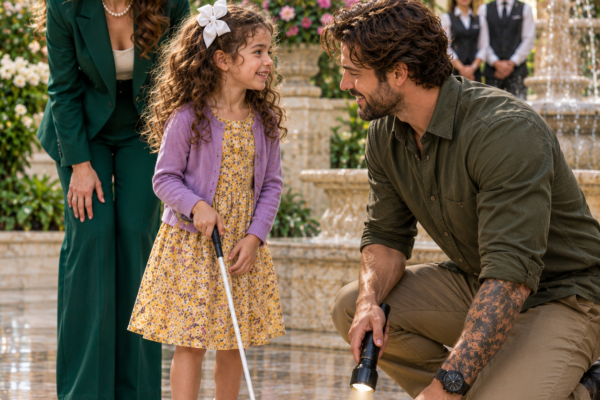
Part 4: She Fired the Ex-SEAL Janitor for Shining a Light at Her Blind Daughter—Then Everything Changed!
Mia watched everything with the direct interest she brought to most things. Ethan sat with his arms crossed in the way he sat when he was in a public space and had chosen to be at ease rather than at attention, which was a distinction shed learned to see in him.
Then Lily walked out.
She came from the left wing with her cane, which she navigated with the particular economy shed developed over years, no wasted movement, no hesitation, just the clean straight line of someone who knew where she was going. She was wearing a dress that she had chosen herself, dark blue, because Lily made her own clothing decisions and had done so since she was sick.
Her hair was pulled back.
She looked, Victoria thought, entirely like herself.
She found the piano bench.
She sat. She was still for a moment.
Victorica was aware in a peripheral way that the auditorium had gone quiet in the way audiences go quiet when they sense something.
She was not aware in any processed sense of anything other than her daughter sitting at the piano bench. Lilly placed her hands.
She began to play. It was a piece Victoria didnt recognize.
She had asked Lilly once what it was, and Lilly had said shed worked it out herself from a melody shed heard on the radio, and then added to until it became its own thing. So, it was Lillys entirely.
The melody was simple, and the harmony was richer than youd expect from a child who was teaching herself by ear, and it had something in it that was hard to name a quality of moving toward something, of reaching without arriving at anything that felt resolved until the very last phrase when it settled quietly into something that was not quite an ending and not quite a beginning, but the specific complicated space between. It lasted 2 minutes and 20 seconds.
Victoria counted without meaning to.
Old habit. When it ended, the auditorium was quiet for a moment, one of those pauses that is not silent so much as held breath, and then the applause came properly and warmly, and Lilly sat at the piano bench with her hands in her lap for a moment before she stood.
And then, in the stage lights bright from above and slightly warmer at the front, a wash of amber white that fell across the first two rows of the audience, Lilly turned her face toward the third row, not looking, not in any clinical sense, but turning, orienting, the way she had turned toward the light in the music room 14 months ago, the way she had tracked the arc in the therapy room in the ninth week.
A movement that was the preserved pathway, doing what it could with what it had, finding the warm of the stage front and the silhouette of the people sitting in it.
She turned toward where Victoria was sitting. Mom, she said.
Her voice was uncertain in a way it almost never was. Not frightened, but tentative, like someone reaching their hand out in the dark and not being sure what theyll find.
Victoria stood.
Im here, she said. The words came out steady.
She didnt know how. Lilys face changed.
Not a dramatic change, not a flood of visible emotion, not the face of someone in a movie discovering something, just a quiet real change, a settling, the look of someone who has found what they were reaching for. I can see the light, she said.
She said it plainly as a fact, the way she said most things. And then after a pause, I can see where you are.
Victoria stepped past the row of seats and walked to the edge of the stage.
She was not going to cry in the auditorium, and she did not cry in the auditorium, she held it, which took some effort because the thing in her chest was large and real and pressing.
She reached up and put her hand on the edge of the stage, close to where Lily was standing.
Lily crouched down and put her hand over her mothers. The auditorium had gone quiet again.
Mia in the third row said nothing.
She had the particular stillness of a child who understands that something important is happening and that the correct response is to let it happen. Ethan Siss said nothing either.
He watched Victoria and Lily, and on his face was an expression that he wasnt managing, that hed let exist without architecture, which was not something he did often.
It was the expression of someone watching the end of something theyd started and understanding the distance between that beginning and this moment and feeling the weight of it without needing to name it. After the concert, in the corridor outside the auditorium, while other families collected children and jackets and programs, the four of them stood together in the way that people stand when they have arrived at a moment that is too significant for normal behavior and too private for any kind of ceremony.
Lily had her cane and was standing straight, and Mia was standing next to her in a way that had already become their particular posture with each other, close but not touching, a specific proximity that children establish when theyve decided theyre friends.
Victoria looked at Ethan.
He was watching the girls, and then he turned and looked at her.
And they were standing close the way they had stood at the community event in June, close in the way things shift toward when they have been moving in a direction for a long time. I fired you.
She said. She said it because it needed to be said between them.
The real version of it. Standing here now after everything.
You did, he said.
In front of people. In front of a lot of people, he agreed.
And you didnt argue.
No.
Why not? He looked at her for a moment.
Because I knew Id done it wrong. The method was wrong, even if the observation was right.
I was in a room alone with your child doing something you hadnt authorized, and I hadnt explained to anyone. The fact that my intention was fine didnt make the situation fine.
He paused.
You were right to react the way you did. You were working with incomplete information, and you protected your daughter.
Thats what you were supposed to do.
Victoria absorbed this.
I was afraid, she said. Thats what it was.
Underneath the anger. She hadnt said this out loud before.
Eight years of being afraid for her, and someone walks into a dim room with a flashlight, and everything Id been holding just she stopped.
It came out as anger because I didnt have anywhere else to put it.
I know, he said. I should have listened first.
Yes, he said.
But you came back after 12 hours. Still counts, he said.
The corridor had thinned out.
Most of the other families had moved toward the exit.
Mia had apparently said something to Lily that was funny, and Lily was laughing a real laugh.
The unguarded kind that didnt come out very often.
Victoria watched her daughter laugh.
She said she knew she could trust you, Victoria said. That night in the music room.
She said he was being nice. That was before I came in, she told me later.
She looked at him. Shes never said that about a stranger, not once.
Shes perceptive, he said.
She couldnt see your face.
Doesnt matter, he said. You can hear when someone means it.
The lights in the corridor flickered once in the way of old school buildings that had been promised electrical updates for years.
In the flicker, something moved in Victorias face, not much, but something, and she didnt try to close it back. Id like to have dinner, she said.
The four of us. Next week, maybe.
Not a work conversation. Just dinner.
He looked at her. Yeah, he said, we can do that.
Mia can pick the restaurant if she has opinions. She has opinions about everything, he said.
Shes been lobbying for this specific Italian place for 2 months. Then the Italian place, Victoria said.
He almost smiled, the specific almost smile.
Okay.
Lily and Mia had migrated toward them and were now standing with the easy ownership of children who have decided the adult conversation has gone on long enough and its time to reassert their presence. Can we go?
Mia said, Im hungry. Were going, Ethan said.
Can Lily come? For food?
Lily turned toward her mother with that orientation not quite seeing, but finding the preserved pathway doing its particular and irreplaceable work.
Victoria looked at her daughter, at her daughters face turned toward her.
Yes, she said, were all going.
The Clearwater Vision Foundation opened formally the following February on a cold, clear morning with a small ceremony in the school gymnasium where its first partnership program had been running for 3 months.
It was not a glamorous event.
There were folding chairs and a microphone that kept cutting out and coffee from the schools regular machine, which was thin and slightly burnt.
53 people attended, teachers, clinic staff, parents from the communities the program had already reached, two pediatricians who had started using the foundations screening referral system, and a school principal from a district 2 hours away who had heard about the program and driven down specifically to see it. Victoria spoke first briefly.
She said what she always said when she had to say something in public, the truth without ornamentation, without performance. Then Ethan spoke.
He was a different kind of speaker than she was, less polished, more direct, with the specific cadence of someone who had spent years saying important things in high-stakes situations where the language mattered, but the language wasnt the point. He talked about what the program was trying to do.
He talked about the children theyd already referred. He talked without naming anyone about a girl in a school corridor and a moment that almost didnt happen.
And he said, The goal is to build a system where that moment doesnt have to be accidental. Nobody in the room knew he was talking about Lily.
Victoria knew. She stood against the back wall and listened and thought about a gray uniform and a flashlight and a dim music room and the look on his face when hed been forced to walk away from something unfinished.
Finished now. Not perfectly.
Not with every thread resolved.
But finished in the only way things that matter actually finish through the long im- perfect accumulation of days and decisions and the willingness to keep moving toward the thing you could see was right even when nobody else was looking.
After Ethan Lily spoke, this had been her idea.
Victoria had not suggested it. Lily had said, approximately 10 days before the ceremony, that she wanted to say something and Victoria had said, Okay.
And Lily had spent several evenings composing what she wanted to say in the way she composed things internally, thoroughly, not writing it down because writing it down wasnt how she worked.
She stood at the microphone with her cane and her dark blue dress, the same one from the concert, because she had decided it was the right dress for important occasions. And she stood straight in front of 53 strangers and said, I want to say something about what it feels like to have someone look at you carefully.
She paused, not from nerves but from intention. Most of my life people looked at my eyes and saw what was wrong with them.
Thats not a criticism. Thats just what happens when something is different.
People look at the difference.
They look at what isnt working.
Another pause.
One person looked at my eyes and saw something else.
He wasnt looking for what was wrong. He was looking at what was there.
And what was there turned out to be more than anyone knew. The gymnasium was completely quiet.
The microphone wasnt cutting out anymore. I cant see properly, she said.
I want to be honest about that because I think you should know it. The therapy helped and I can see some things I couldnt see before, light, contrast, where people are standing.
But its not fixed.
Its not going to be fixed.
What changed is not that the problem went away.
What changed is that someone refused to look at me the way Id already been looked at, and because of that, the problem got smaller. She stopped, and when she continued her voice was the same even, direct, entirely Lily.
Thats what I want this foundation to do. Not fix everyone.
Just look more carefully.
Look at whats there. She stepped back from the microphone.
The applause was the kind that comes from people who havent been handed a speech who havent been handed a speech, but have been given something true, and who are responding to the truth rather than the performance of it.
Victoria at the back wall did not clap.
She stood with her hands at her sides and felt the thing in her chest that had been pressing since the night of the concert.
And she let it press, and she did not try to contain it or categorize it or manage it into a form she could act on. She just let it be what it was.
Which was gratitude, and grief, a little for the years of looking and not finding, for the specialist reports and the flat results and all the mornings shed sat across from doctors who had no new information and had driven home in silence. And under both of those, something else.
Something that had started in a dim music room when a man had looked at her daughter the way you look at something you refuse to believe is finished. Hope was too simple a word for it.
Relief was closer. The specific deep tissue relief of someone who has been carrying something at maximum capacity for a very long time and has finally finally been permitted to set some of it down.
Ethan came to stand beside her during the applause. He didnt say anything.
He stood there, which was its own kind of language.
After a moment she said, She didnt tell me any of that.
She probably knew youd overthink it, he said. Victoria was quiet.
Shes right, she said.
I would have.
He turned to look at her. She turned to look at him.
The applause was dying down, and Lily was navigating back to her seat with Mia rising to meet her, and around them the gymnasium was returning to its ordinary February morning self with coffee cups and folding chairs and people beginning to talk. Dinners on me tonight, he he Not the Italian place.
Somewhere you pick. I dont have a place, she said.
I dont do restaurants. Then we find one, he said.
Mia can provide opinions along the way. Shell have opinions about a restaurant shes never been to?
Shell have opinions about the name, he said.
She once refused to go somewhere called the Happy Fork. Said it sounded dishonest.
Victoria pressed her lips together.
Thats Thats actually a reasonable critique.
I know, he said. Shes eight and shes already better at this than most adults.
She gets that from her father, Victoria said.
She said it looking at him directly and she didnt try to make it into a joke and he heard it the way she intended it, not as deflection, just as the true thing said plainly.
He held her gaze for a moment.
Okay, he said quietly. Just that.
It was enough.
Here is what Victoria Ashford learned in the year that began with a flashlight in a dim room and ended with her daughter standing at a microphone in a school gymnasium, that the thing you control most tightly is often the thing youre most afraid to look at directly. That fear, when it has no outlet, becomes authority, becomes the voice that fires first and listens later, that builds walls in the shape of competence.
She had spent eight years being excellent at managing Lilys situation and the managing had become so consuming that she had stopped being able to sit quietly in the uncertainty of it. She had turned fear into motion and the motion had served her daughter well in many ways and had blinded her to things in others.
She did not conclude from this that she had been wrong to fight.
She had been right to fight. The fighting had gotten Lily to seven specialists and a research grant and a school with excellent staff ratios.
The fighting mattered, but fighting and seeing are different muscles and she had built one at the expense of the other and it had taken a man with no power and no platform and no reason to get involved to show her what shed stopped being able to see.
That was the thing about power, real power, the kind she had accumulated over a decade of building her company.
It created a specific blindness. The more resources you had, the more people brought you filtered information, softened conclusions, answers that were shaped by what they thought you wanted to hear.
Nobody walked into her office and said, I think youre missing something. Nobody except a man who had nothing to gain and everything to lose, and who had done it anyway, quietly, in a school corridor.
Because he had been trained to see and he could not unsee.
She thought about his sister Sophie and the 30% of vision lost to a diagnosis that was assumed to be unchangeable. She thought about all the children who were Sophie, who had something that looked like an answer when it was actually only part of one, and whose families moved on because the story had been told, and who needed someone to refuse the story.
That was what the foundation was for, not miracles, not the exceptional case, the ordinary systematic work of looking more carefully at the children who had already been looked at and found lacking. The work of building a structure so that the noticing didnt depend on a single man in a single hallway on a single afternoon.
Ethan understood this in a way that came from something she couldnt duplicate from the years in special warfare that had ground observational precision into him. Yes, but also from Sophie, from the specific grief of watching someone lose something that didnt have to be lost.
He carried that grief without letting it become a story about himself, and she respected that profoundly.
He was not a man who used his own pain as credentials. He just worked, and the work was shaped by everything hed been through in ways that didnt need to be announced.
She thought about Lily at the microphone. He was looking at what was there.
She thought about standing in that corridor outside the music room, watching Ethans back as he walked away, hearing those seven words, Please dont stop looking for the answer.
She had thought it was arrogance.
She had been wrong.
It was the opposite of arrogance.
It was an act of faith in someone elses capacity to keep going, offered without sick expectation of return from a man who was already walking out the door. That was the thing about compassion that was easy to miss.
When you had enough money to solve most things with money, it didnt wait for the right conditions. It didnt calculate its odds.
It just looked and saw and acted on what it found. Even when the acting meant writing four pages of precise observations on your own time and sending them to a woman who had fired you in front of witnesses and whose gratitude was not guaranteed.
Lily had said, Sometimes you just need someone who refuses to stop looking for the light. Victoria would spend the rest of her life trying to build something that made that refusal systematic.
She knew she would never fully succeed. Systems dont love.
Systems dont look the way Ethan had looked. But systems could reduce the distance between the children who needed to be seen and the people who were willing to see them.
And reducing that distance was worth everything.
She was clear on that. She was also clear in the quieter, more private understanding that she didnt put into mission statements or speeches that something had happened to her personally over the course of this year that had nothing to do with foundations or therapy protocols or professional outcomes.
She had let someone in.
Not in the way you let people in when you hire them or pay them or need something from them.
In the other way.
The harder way.
The way that required you to sit in the kitchen with cold coffee and call someone you didnt have a category for because Lily had said something about how you walk and you wanted to tell someone about it. That was still unfinished in the way that real things are always unfinished.
Ethan was careful and she was careful and they were both, for different reasons, people who had learned to be slow about the things that mattered. She didnt think that was a problem.
She thought it was honest. She thought you earned the right to take things slowly when youd both been through enough to know what it meant to get them wrong.
They would figure it out.
They would figure it out the way theyd figured out the foundation and the argument about staffing and me as Italian restaurant campaign incrementally, with friction, with honesty when it was uncomfortable, and with a bedrock certainty that the other person was not going to tell you what you wanted to hear when the truth was something else.
That was a rarer thing than love, maybe. Or maybe it was the thing love needed before it could be trusted.
She didnt know.
She was learning. Outside the school gymnasium, in the cold clear February morning, Lily stood in the thin winter sunlight with Mia beside her.
Both of them ignoring the cold the way children ignore it. And Lily had her face tilted slightly toward the sky, not looking at it.
Not in any complete sense, but aware of it. Aware of the light and the direction of it and the warmth that was barely there, but was nevertheless there.
She was not healed. She would not be healed.
Her eyes would never do what most peoples eyes did, and she would live in a world that was built for people who saw fully.
And that would be difficult in ways that no foundation could entirely address.
But she could find her mother in a lit room.
She could follow a light across its arc.
She could stand in February sun and feel it on her face, and know with some part of her that had been silent for years and was now, however faintly, speaking know that it was there.
That was not everything, but it was more than it had been.
And Ethan Cole, who was standing a few feet away drinking bad coffee from a thin paper cup and listening to Mia explain with great confidence why the name theyd given the new program was less good than the name she had suggested, had given them that.
Not out of obligation, not for credit.
Just because hed looked and seen and refused to let what hed seen go unspoken.
In a world full of people who had learned to look away from things that were too complicated or too costly or too uncertain, he had looked directly. And that, in the end, was the whole story.
That was all it had ever been.