My Sister’s Best Friend Needed a Male Model… Then My Sister Pointed at Me
My Sister’s Best Friend Needed a Male Model… Then My Sister Pointed at Me
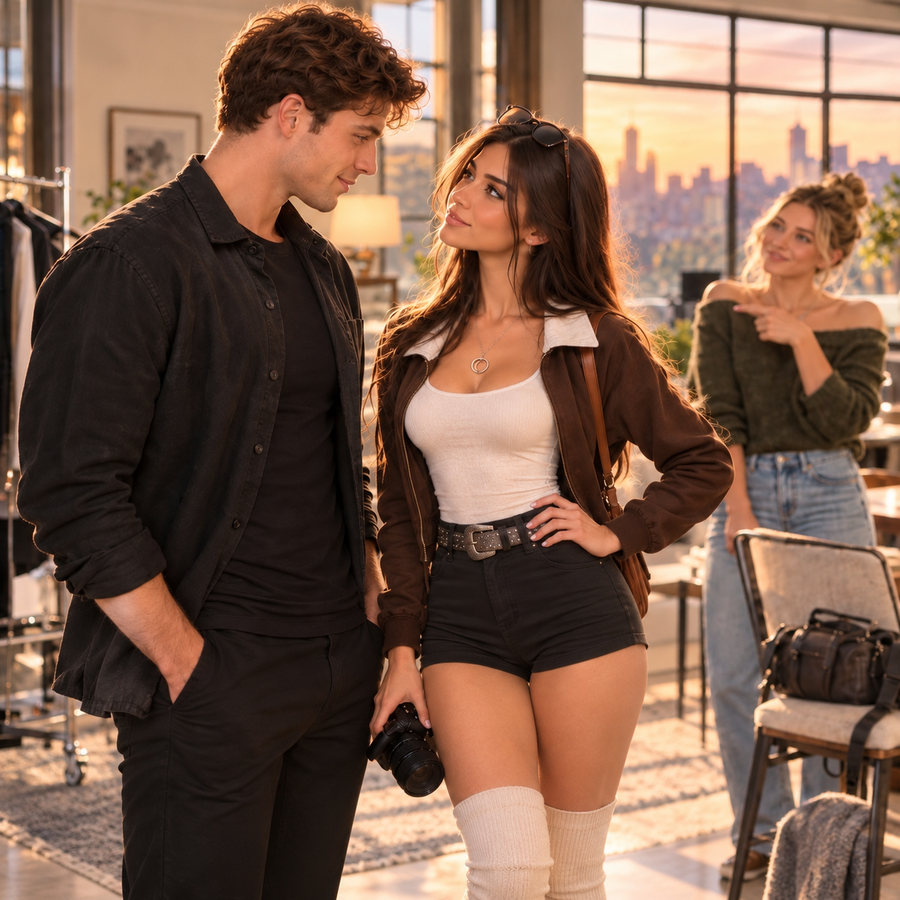
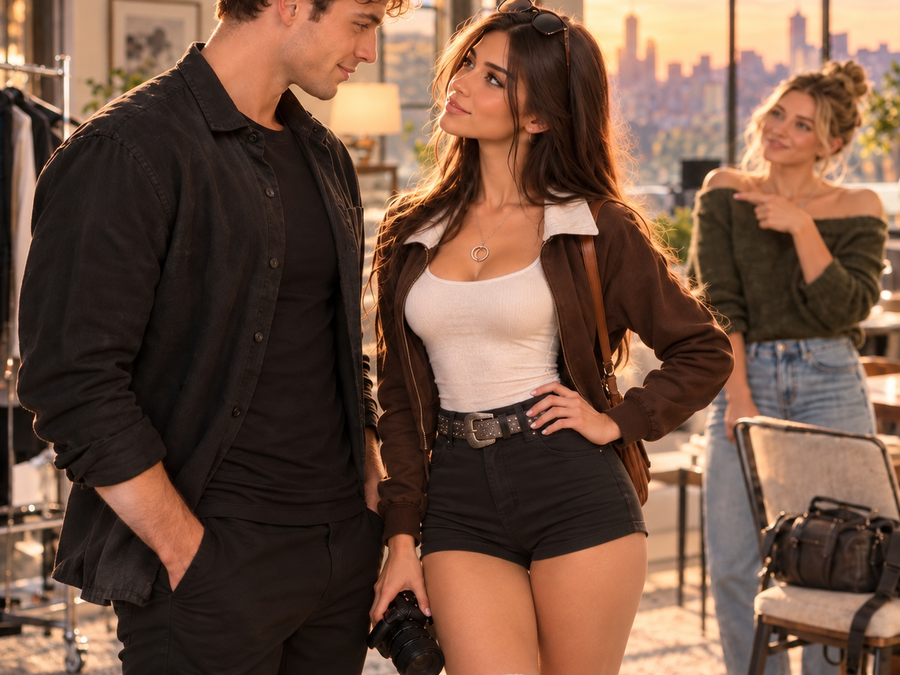
The first time Nora Callahan looked at me like I was something she might put in front of a camera.
I was standing in my sister’s kitchen trying to open a jar of pasta sauce.
She came through the front door without knocking, which was normal for Nora, dropped a camera bag onto one of the dining chairs, and announced to Olivia that she was officially doomed. My younger sister barely looked up from her laptop.
What happened now? Norah pushed both hands through her hair and said the male model for her portfolio project had canceled less than 48 hours before her first proper shoot.
She needed someone tall enough to balance the compositions, comfortable enough in front of a camera not to look terrified and available for at least a test session that evening. Olivia listened to the whole list, glanced toward me, and pointed with absolutely no hesitation. Use Theo.
I actually looked behind me because that was how little I expected to be involved. Nora did the same thing, then realized Olivia was pointing directly at me.
My name is Theo Mercer, and at 30, I had been blamed for plenty of things by my sister, but never for resembling a fashion model.
I was wearing gray joggers and a fitted black t-shirt after getting home from the gym, and Norah’s expression changed from amusement to something more analytical.
She tilted her head slightly, not checking me out exactly, but evaluating me in a way that somehow felt more invasive.
“Theo,” she said.
Olivia nodded.
He’s tall.
He photographs fine, and he owes me for eating my leftovers yesterday. I told her that last part had nothing to do with photography. Norah ignored me and walked two steps closer, turned sideways.
No, that made Olivia laugh. Norah lifted both palms.
I’m serious, just for a second.
I had known her for almost 3 years as my sister’s best friend, which meant I knew several versions of Nora already.
The loud one who arrived with takeout at 10 at night. The competitive one who turned board games into legal disputes. And the polished one who occasionally showed up after a modeling job looking like she had stepped out of an advertisement.
I had never met this version. This Norah was focused enough to forget she was supposed to be embarrassed about inspecting me.
You have the right proportions, she said finally. And your shoulders would work with the jacket. I looked at Olivia.
The jacket? My sister gave me a sweet smile. Congratulations.
you have a new career. I should have refused. I had patients scheduled early the next morning.
I knew nothing about modeling, and I had no interest in spending an evening being told what to do with my hands while my sister laughed at me.
But Norah’s panic was real beneath the jokes.
Her project was part of a portfolio she had been building for months, and the canceled model had left her with locations, clothing, and equipment already booked. So, I told her I would give her 1 hour for a test.
Nora immediately corrected me. 45 minutes. I raised an eyebrow.
You just negotiated against yourself. She picked up her camera bag.
I’m trying not to scare off my emergency talent, Olivia called after us.
That she deserved 10% for discovering me. Norah answered.
You discovered your own brother. And for some reason, that was the moment the whole thing started feeling slightly ridiculous.
Norah used the empty wall beside Olivia’s back windows for the test because the late afternoon light was good enough that she did not need her full studio setup.
She handed me a dark overshirt from the garment bag she had brought, moved a dining chair out of frame, and became completely different the moment the camera was in her hands. The frantic woman from 10 minutes earlier disappeared.
Her voice got calm and precise.
Don’t pose yet.
Just stand normally, I did. She took two frames, frowned, then pointed slightly to my left.
Shift your weight. Relax your shoulders.
You look like you’re waiting for someone to accuse you of tax fraud.
I told her that was because she had spent 15 minutes evaluating my bone structure without consent. Norah smiled behind the camera.
Good. Keep that expression. That was the first moment I understood why she was good at what she did.
She did not just tell people where to stand. She watched until something real happened, then caught it before the person could put their face back together.
Every time I tried to give her what I thought a model was supposed to look like, she lowered the camera and told me to stop trying so hard.
When I got annoyed with her for saying it the fourth time, she took three quick shots and said, “There, that.”
I walked over to see the screen. The photograph did not look like the stiff version of me I had expected.
It looked relaxed, sharp, and strangely natural. Norah glanced from the image to me.
“You’re irritatingly usable.”
I told her, “That might be the worst compliment I had ever received.
It’s not a compliment.
Don’t get confident.”
Olivia lasted about 20 minutes before losing interest and going upstairs, which should have made the test less awkward. Instead, I became more aware of Nora.
Without my sister there filling the room, there was nothing between Norah’s instructions and my reaction to them.
She asked me to look past the camera, then at the camera, then slightly to her right. When she stepped closer to straighten the edge of the overshirt, she stopped halfway and asked permission before touching it.
I nodded and she quickly adjusted the fabric near my shoulder before stepping back again. It was a small thing, professional and completely reasonable, but the care she took not to assume made me look at her differently. She noticed.
What? I said nothing. Norah narrowed her eyes.
Don’t give me that mysterious older brother thing.
I need your face normal. This is my normal face.
That’s unfortunate.
By the end of the 45 minutes, we had stopped pretending the session was a disaster rescue. Norah sat on the edge of the dining table, scrolling through the images while I stood beside her, and she grew quieter with every few frames.
I assumed that meant something had gone wrong until she turned the screen toward me. There were shots that looked like actual campaign images, not because I suddenly knew what I was doing, but because Norah knew exactly when to catch the moments between instructions. These are better than what I had planned, she said.
That got my attention. Norah rarely undersold herself, so hearing uncertainty in her voice was unusual. Because of me, I asked.
She gave me a look.
Let’s not ruin this by making you unbearable.
Then she looked at the images again and added, “But yes, partly.”
I told her she had her emergency replacement. Then Norah did not answer immediately. She zoomed in on one photograph, backed out, compared it to another, and finally set the camera on the table.
That’s the problem.
I waited. She explained that the original plan had been a small series with one controlled studio session.
But these test shots suggested something better, a connected set of images with different locations and styling, almost like fragments from the same relationship rather than unrelated fashion portraits. She started talking faster as the idea took shape, describing an outdoor sequence, a cleaner editorial look, and another setup she could shoot near downtown.
Then she stopped herself and looked at me carefully. I know you said one test.
I reminded her that I had technically said 1 hour. Right.
She drew in a breath. How attached are you to having free evenings this week?
That was the moment I should have remembered Nora was simply my sister’s friend and I was simply helping with a project.
Instead, I looked at the excitement she was trying unsuccessfully to hide and realized I wanted to see what she could make if I said yes. More inconveniently, I wanted to see what she looked like when she got that focused again.
How many evenings? I asked. Her smile appeared immediately.
Potentially several. That sounds deliberately vague.
It’s creatively flexible.
I laughed and Norah reached for her camera again as if my answer had already been decided.
So, you’ll do it?
I told her I would need actual dates before committing to anything. She nodded far too enthusiastically.
Fine, I’ll send you a schedule tonight.
Then she added almost casually.
And Theo, don’t shave or do anything weird before the next shoot.
I stared at her. Norah grinned. Continuity.
Norah sent me the schedule at 11:43 that night, which told me two things. First, she had not been exaggerating when she said several evenings. Second, she had apparently decided sleep was an optional part of being creative.
The message included three possible shoot windows, two location ideas, and a note that said she could work around my clinic hours because, in her words, “I’m not getting fired by a physical therapist before I even finish the project.”
I told her I was not her employer. She replied that I still had the voice of someone who might prescribe stretches as punishment.
By the time we agreed on Wednesday evening for the first full session, I had learned that Norah planned like a person trying to disguise chaos as confidence.
She had everything labeled, timed, and backed up, yet somehow still managed to arrive at Olivia’s house, carrying one shoe in her hand and asking if anybody had seen the other one.
The first proper shoot was at a small rented studio downtown, and I expected something more glamorous than what I found. The room had white walls, two paper backdrops, several lights, garment racks, and enough cables on the floor to make me professionally uncomfortable. Nora arrived before me this time, already dressed in black trousers and a fitted cream top, her hair pulled back while she adjusted a light stand.
She looked up when I walked in and gave me a quick once over that was noticeably less subtle than the first time.
“Good,” she said.
I asked what was good.
“You followed instructions.”
I looked down at the dark jeans and plain shirt she had told me to wear. I dressed myself. Should we celebrate?
Norah tossed me a garment bag.
Save the confidence for when you learn how not to stand like somebody’s security detail.
The session started easily because she gave me things to do instead of asking me to perform. Walk toward the mark, turn while adjusting the cuff, sit, then look up when she called my name.
Norah had figured out quickly that I looked better in motion than when I tried to hold a pose. So, she built around that instead of forcing me into something unnatural. I appreciated that more than I expected.
In my work, people usually moved better when you stopped demanding a perfect position and gave them a reason to reach it naturally. I mentioned that once while she was checking her settings, and she looked at me like I had unexpectedly spoken her language.
Exactly, she said. If I tell someone to look confident, they give me confidence face.
If I give them something to do, sometimes I get the real thing. I asked if that meant she had been manipulating me.
Directing, she corrected. Manipulating costs extra.
The problem started when Norah stepped into the frame. Her project was supposed to show paired styling rather than just a male subject, which I had somehow missed when I agreed to help. She set the camera on a tripod, connected it to a remote trigger, and explained that she only needed a few test images of us together to check proportions.
Nothing dramatic, she said, which should have warned me. For the first setup, we stood several feet apart, both angled toward the camera.
Easy enough. Then she checked the monitor and shook her head.
Two separate. She moved closer by half a step. Still looks like two strangers waiting for an elevator.
I told her we basically were two people waiting for instructions. Nora ignored that, moved closer again, and reached for my forearm to place it differently.
“Relax your hand,” I looked at her.
“It is relaxed,” Theo, “Your fingers look like you’re about to sign a legal document.”
I laughed, which apparently solved whatever she was trying to fix because Nora immediately triggered three frames.
“There,” she said.
“That’s better.”
She stayed beside me while checking the screen, shoulder nearly touching mine, and I could see why she had wanted paired images. Alone, I looked competent enough. With Norah beside me, the photographs had context.
She was expressive where I was restrained, sharper in her angles, quicker in her reactions. The contrast worked.
She saw it, too. Okay, she murmured.
That’s useful.
I told her she said that about me like I was an adjustable tripod. Tripods complain less.
Tripods can’t drive you home.
Norah glanced at me, smiled, and said, “See, useful.”
After that, the teasing became part of the process, whether either of us intended it or not. Norah would tell me to look at her instead of the camera, then accuse me of looking too serious.
I would tell her to give better instructions.
She would tell me normal people understood the phrase, “Look interested.”
At one point, she stood directly in front of me, adjusted the collar of the jacket she had put me in, then stepped back and frowned.
“Something’s off.”
I asked if she wanted a new model after all.
“No, unfortunately, you’re working.”
She reached up again, fixed the collar a second time, and this time, her fingers paused for half a second longer than necessary. I noticed because she noticed.
Norah immediately stepped back and lifted the camera.
“Don’t move.”
Her voice had lost some of its teasing. I stayed where I was.
The image she took then became one of her favorites from the whole evening. She showed it to me later after we had finished the main setups and were sitting on the studio floor with takeout containers between us.
I was not smiling in the picture, but there was something less guarded in my expression than I remembered feeling. Nora had caught me looking just to the side of the lens, right where she had been standing.
That one, she said, tapping the screen.
Doesn’t look posed.
I told her it probably was not. She looked up.
What were you thinking about? I took a drink instead of answering immediately.
You told me not to move. Norah gave me a flat look.
That is the most Theo answer possible. I asked what that meant. You answer exactly enough to avoid technically refusing the question.
I pointed at her food. Eat before you start profiling me. Norah smiled but did as she was told.
And for several minutes, we talked about the project instead. She told me she was tired of portfolio work that looked expensive but said nothing.
She wanted this series to feel like two people had a life outside the frame, even if the viewer never learned what that life was. That was more ambitious than I had assumed when Olivia first pointed at me in the kitchen.
I told Norah so. She looked genuinely surprised. You thought I just wanted attractive people in nice clothes?
I said that had been a reasonable interpretation. Rude. Then after a moment, she admitted that plenty of people probably thought the same thing because modeling made the work look superficial from the outside.
What mattered to her was the part underneath, deciding why someone stood where they stood, what they were hiding, who they were looking at, and what the image made a stranger imagine had happened 5 minutes earlier. That conversation changed something for me more than the physical closeness had. Nora had always been easy to notice.
She was beautiful, social, stylish, and usually the most energetic person in whatever room Olivia had dragged her into. But sitting on a studio floor listening to her explain why she rejected perfectly good photographs because they felt empty made her harder to categorize. She cared about the work with an intensity I had never seen because I had never bothered to ask.
I realized I had been guilty of doing exactly what she probably hated. Seeing the polished result and assuming the person behind it was equally simple. Norah caught me watching her and pointed her fork at me.
What? I told her I had underestimated how serious she was about this. Instead of being offended, she considered that and nodded.
Fair. I make it look easy on purpose. We finished late enough that I drove her home rather than let her haul two equipment bags across town on a ride share.
The next few sessions developed their own rhythm after that. Norah would send me clothing instructions that sounded absurd until I saw how they photographed.
I would meet her at a location and quietly fix whatever practical problem she had ignored while thinking about composition. She learned I hated standing around without a purpose.
So, she gave me tasks. I learned she forgot to eat when she was concentrating.
So, I started bringing enough food for two without commenting on it. None of it felt dramatic. That was probably why it became dangerous so gradually.
By the second week, I was no longer asking Olivia whether Norah needed anything before a shoot. Norah was texting me directly, and I was answering because I wanted to.
Daniel Kesler, her instructor, was the one who gave that routine a longer life than either of us expected. Norah called me after a portfolio review, sounding pleased and irritated at the same time. Daniel liked the images, especially the ones where we appeared together, but he thought the series needed more continuity.
He said it looks like there’s a relationship happening between frames.
she told me. And now he wants me to actually build around that.
I leaned back at my kitchen counter. A relationship.
Norah went quiet for just long enough to make the word heavier than it needed to be. Then she recovered.
A visual relationship. Mercer.
Try to survive. I asked what that meant for me.
It means, she said carefully. The next set has to feel closer, more familiar, less like two models who met 10 minutes ago.
I should have told her to find someone with actual experience. Instead, I asked when she wanted to shoot.
Norah exhaled in a way that sounded suspiciously relieved.
Saturday afternoon, then she added, “And though,” I waited.
“This one’s going to require you to trust me a little more.”
I looked around my empty kitchen, even though there was nobody there to see my expression.
“That sounds ominous,” Norah laughed softly.
“Good.
Keep that energy.
I can use it.”
Saturday started with Nora telling me not to make anything weird, which was impressive considering she was the one who had spent 2 days warning me that the shoot would require more trust. She had rented a bright apartmentstyle studio instead of the plain photo space from before with a couch, kitchen counter, tall windows, and enough carefully selected furniture to make the place look lived in without belonging to anyone.
Her concept was simple on paper. Two people who knew each other well enough that closeness looked automatic. No obvious posing, she said while checking the camera.
I want it to feel like we’ve been around each other long enough to forget somebody’s watching.
I looked at her. That seems like a strange instruction to give somebody while pointing a camera at him. Norah smiled.
See that? Keep being difficult. The first setups were harmless.
She photographed me at the counter while she moved through the edge of the frame, then used the timer so we could sit on opposite ends of the couch with enough space between us to keep things professional. The problem was that every version looked exactly like what it was. Two people carefully avoiding each other.
Norah checked the monitor, sighed, and said, “We look divorced.”
I told her that seemed like a story, too.
Not the one I’m trying to tell.
She walked back toward me and sat closer this time, one leg folded beneath her, then pointed at my arm.
“Put that behind me.
” I rested it along the back of the couch.
Norah looked at the monitor again, still cautious. You asked for natural.
Natural people don’t leave 12 in of diplomatic territory between them.
I laughed and she immediately moved closer before I could think about it. Her shoulder settled lightly against my side and she reached for the remote trigger without looking at me.
Don’t perform, she said.
I asked what I was supposed to do instead. Norah turned her head.
Look at me like you actually know me. That should have been easy. I had known her for years.
I knew how she took coffee, how fast she talked when nervous, how she rearranged equipment when she was trying not to admit something mattered, and how she pressed her lips together before rejecting a photo she wanted to like. The problem was that once I thought about all of that, the way I looked at her stopped being useful as acting. Norah noticed almost immediately.
Her expression changed. Not dramatically, just enough that the teasing disappeared from her eyes. She triggered the camera once, then again, but neither of us moved.
For several seconds, the room became too quiet, and I became aware of every point where we were touching. Norah looked down first.
“Okay,” she said, reaching for the camera.
“That might be enough.”
Her voice had gone professional in a hurry, which told me the moment had affected her, too. When she checked the images, she did not joke.
She just stared at one frame longer than the others and quietly said, “That’s the one.”
I stood beside her to look. The photograph was not dramatic.
We were sitting on a couch, my arms stretched behind her, her face turned toward mine, but there was something in it I could not explain away as styling. Norah looked comfortable and uncertain at the same time, and I looked like I had forgotten the camera existed.
“You’re going to use that?”
I asked, she nodded.
“Probably?”
I said. It looked a little personal. Norah glanced at me.
“That’s the point of the project.”
“Is it?”
I asked. She held my gaze for a second too long, then picked up the camera and told me we needed another setup.
The rest of the shoot did not get easier. Norah kept asking for familiarity because that was what Daniel wanted the series to communicate.
But every time we stopped trying to manufacture it, the photographs improved. She had me stand behind her while she adjusted a necklace in a mirror.
And the best frame came when she caught my reflection watching her rather than looking where she had told me. She asked me to hand her a coffee mug during another sequence.
and instead of posing afterward, we started arguing about whether she had stolen mine. She laughed, I reached for it, and she triggered the camera with her free hand. Later, when we reviewed everything, those accidental moments were better than the planned ones.
Norah looked pleased about that and increasingly uncomfortable with what it implied. Olivia made things worse that evening when we brought some of the equipment back to her place. She was sitting at the kitchen island, eating cereal directly from the box, and asked to see what we had made.
Norah showed her a few safe frames first, which immediately told me she knew exactly which ones were not safe. Olivia took the tablet anyway and kept swiping until she reached the couch image.
Her eyebrows went up. Wow. Norah grabbed for the screen.
It’s for the project.
Olivia held it out of reach.
I didn’t say anything.
Your face did. My sister looked at me, then at Nora, and smiled in a way I had known since childhood. You two look very convincing.
I told her to finish her cereal.
“See,” Olivia said to Nora, defensive already.
Nobody made a serious issue of it, and I was grateful for that. Olivia liked Nora too much to make her uncomfortable, and she knew me well enough not to push when I stopped laughing. But the comment stayed with me because it was the first time somebody outside the project had looked at what Norah and I were doing and seen something that resembled a real couple.
Apparently, Norah had the same problem. For the next few days, she became more careful around Olivia while becoming less careful around me when we were alone. We went looking for jackets for the next setup and somehow spent an hour arguing about which color looked less like I was attending a corporate retreat.
She made me try on six versions, rejected five, then bought the first one anyway. By the time we walked out, neither of us remembered to pretend the afternoon had been purely about work. The strange thing was that I started liking those ordinary hours more than the shoots themselves.
On camera, there was always an explanation for the way Nora watched me. Off camera, there was not.
She texted me pictures of locations and then sent another message 10 minutes later asking what I was cooking. I helped her carry frames into the studio and ended up sitting with her on the floor while she reorganized the entire sequence because she hated the emotional order.
Once after we finished scouting a rooftop location, we stayed there until sunset talking about nothing related to photography. When Norah finally checked the time, she looked surprised enough that I knew she had lost track of it, too.
Daniel’s next review brought everything back into focus.
Norah called me afterward and asked if I could meet her at the studio because she needed another pair of eyes on the sequence. When I arrived, she had printed 20 photographs and taped them across the wall.
She explained that Daniel liked the progression, but thought she was still avoiding the most important question. Which is, I asked. Norah folded her arms.
what the relationship is supposed to be. I looked at the wall.
The early photos showed distance. The later ones did not.
Whatever story she had started with, it had clearly changed while we were making it. I walked closer to the prince and stopped in front of the couch image from Saturday. So, what is it?
Norah asked what I meant, but she knew. I pointed toward the photographs.
You keep saying there’s a story between these people.
What story are you actually telling? For once, she did not have a teasing answer ready.
She looked from the wall to me, opened her mouth, then closed it again.
After a few seconds, she said, “I’m still figuring that out.”
The problem was that by then, I was no longer sure she was talking only about the photographs. For the next 3 days, Norah became extremely organized around me. That was how I knew something was wrong.
Her messages stopped containing unnecessary jokes. The shoot notes became cleaner.
She sent exact times, exact locations, exact wardrobe instructions, and no comments about whether I looked like a divorced architect in one jacket or a suspiciously expensive waiter in another. If I asked a question, she answered it.
If I made a joke, she reacted with a polite little smile and moved on. It was efficient.
It was also nothing like us. By Thursday evening, standing beneath the lights in the downtown studio while Norah adjusted the camera for the third time without actually needing to, I had finally had enough.
“Did I do something?”
She kept her eyes on the settings.
“No,” I waited.
That answer would work better if you looked at me. She lowered the camera slowly.
“Theo, I’m just trying to finish the project.”
I told her I knew that, but we had been trying to finish the project for weeks and somehow managed to speak like human beings during most of it.
Norah’s mouth tightened.
Maybe we got a little too comfortable. There it was. I leaned against the edge of the backdrop stand and asked what that meant.
She glanced toward the prince laid across a nearby table. Daniel thinks the series is becoming too dependent on one emotional idea. I need to make sure the work still stands up without that.
I understood the professional words. What I did not understand was why she was saying them like they explained everything. Without what?
I asked. Norah looked at me then, and for a second, the careful version of her disappeared.
Without us looking like we’re about to forget, there’s a camera in the room.
I almost smiled because that was the first honest thing she had said to me all week. Instead, I asked the more important question. Is that what you want?
Norah frowned. What? For it to stop looking that way?
She looked down at the camera in her hands. I want to know I can control the project. I nodded once.
That wasn’t my question.
Her eyes lifted again, sharper now. You always do that.
Do what?
Make me answer the thing I’m trying very hard not to answer.
I told her that was probably why she had spent the last week giving me instructions instead of having conversations. Norah laughed once, but there was no humor in it.
You think this is easy for me because I’m the one behind the camera.
It’s not.
I’m supposed to know what I’m making.
Lately, I look at the pictures and I can’t tell where the concept ends and where I start being stupid.
That stopped me. Norah rarely called herself stupid, even as a joke. I crossed my arms and asked what she thought she was being stupid about.
She looked at me like the answer should have been obvious. You?
The word landed between us without any protection around it. She immediately started talking again, as if leaving it alone for even a second would make it worse.
She said I had been generous with my time, that Olivia had put me into the project in the first place, that I had a habit of being helpful without attaching meaning to it, and that she was not interested in becoming the friend who confused access with interest.
I listened until she finished, then asked, “Do you really think that’s what I’m doing here?”
Norah’s shoulders dropped slightly.
I don’t know.
That’s the problem.
I could have told her everything then. Part of me wanted to.
Instead, I asked something simpler. Do you still want me in this project?
Norah looked frustrated. Of course I do.
As the model, she opened her mouth, then stopped. That hesitation hurt more than I expected, mostly because I understood it. She was trying to separate something that had stopped being separable.
So, I nodded and picked up the jacket she had given me earlier. Okay.
Norah’s eyes narrowed.
Okay. What? I told her that if she needed the work to become less personal, I could give her that.
I would finish what I had committed to, follow her direction, and stop making it harder for her to figure out what belonged in the photographs and what did not. Her expression changed immediately.
Theo, I didn’t ask you to disappear, I said.
I knew.
I’m not disappearing.
I’m just not going to keep leaning into something you’re trying to step away from.
The rest of that shoot was technically excellent and emotionally dead. Norah directed me from behind the camera. I hit the marks, changed jackets, followed lighting adjustments, and gave her exactly what she asked for.
No arguments, no dry comments, no moments where she captured me reacting to her because I was not giving myself permission to react when she stepped in for the paired frames. We positioned ourselves correctly, left the right amount of space, and looked like two competent adults who had never shared a couch, stayed on a rooftop too long, or spent an hour choosing a jacket neither of us needed.
Norah took 12 frames and checked the monitor. Her face fell almost immediately.
They’re clean, she said.
I looked at the images. She was right.
They were polished, balanced, and completely forgettable. Neither of us said that aloud. Norah packed the camera in silence while I coiled one of the extension cables.
Before I left, she thanked me for coming. I hated that sentence more than anything she had said all evening because it sounded like something she would say to a hired model. I told her she was welcome and walked out before I could make things messier.
She did not text me that night. She did not text the next morning either. That should have been easy.
We had simply returned to the safe version of the arrangement she apparently wanted. Instead, I spent Friday realizing how much of my week had quietly reorganized itself around conversations with Nora that supposedly had nothing to do with the project. Olivia noticed because Olivia noticed everything involving her refrigerator and most things involving people she loved.
I stopped by her house Saturday afternoon to return a charger Nora had left in my car, and my sister took one look at it in my hand and asked why I was giving it to her instead of Nora. I told her Nora would get it eventually. Olivia studied my face for a moment.
Did you two have a fight? No. That sounded convincing.
I put the charger on the counter and told her not to get involved. To her credit, she did not ask for details.
She just shrugged and said Norah had been in the spare room half the previous night re-editing the project because she hated the new set. I looked at her before I could stop myself. Olivia noticed that too.
I’m not matchmaking, she said.
I’m telling you why she drank my expensive coffee at midnight.
That information did not solve anything, but it explained enough. Norah had wanted control and discovered that control was not the same thing as honesty. The next afternoon, she finally messaged me and asked if I could come to the studio.
No explanation. I stared at the screen for several seconds before agreeing.
When I arrived, the new polished photographs were gone from the main wall. In their place were the earlier images, the ones where I was laughing despite myself. The couch frame, the reflection shot, the stupid coffee argument, all the moments Norah had been trying to separate from whatever was happening between us.
She was standing beneath them with both hands in the pockets of her jeans.
“I tried to fix it,” she said before I could ask.
“I know,” Norah shook her head.
“No, I mean I tried to make it safer, cleaner, less,” she gestured vaguely between us.
“This?”
I asked how that had gone. She gave me a tired smile.
“You saw it.
” Then she stepped closer, and for the first time in days, she was looking directly at me instead of through a lens or around a question.
I don’t want the safe version, Theo.
I stayed quiet because I needed her to finish this one herself. Norah swallowed, glanced once at the wall of photographs, then back at me. I want one final shoot.
No pretending the chemistry is just good direction.
No trying to flatten it because I’m scared of what it says.
I want to finish the project, honestly. She paused and her voice softened.
And after that, I think you and I need to stop pretending we don’t know what the other part is.
The final shoot happened the following evening, and for once, Norah arrived without a detailed shot list. She had booked the apartment studio again, but most of the equipment stayed in its cases.
One camera, one light near the windows, two outfits each, and a page in her notebook with maybe six ideas written across it. I looked at the page and asked if she had forgotten the rest.
Norah shook her head. I think the rest was the problem. She handed me a dark sweater and pointed toward the changing room, but the old authority in her voice was mixed with nerves now.
When I came back, she was standing beside the camera, checking the light, even though I could tell from across the room that it was already fine. You said honest, I reminded her.
Norah glanced at me.
I know you’re adjusting a light that hasn’t moved in 10 minutes.
She stared at the stand, then laughed under her breath. I hate that you notice things.
We started simply. Norah photographed me by the windows, but instead of directing every angle, she gave me a place to stand and waited.
When nothing happened, she started talking to me from behind the camera about the first day at Olivia’s house, specifically about how ridiculous I had looked when my sister pointed at me.
I told her I had looked confused because two women had suddenly decided my evening belonged to them.
“You looked offended,” she said.
“You told me to turn sideways,” Norah laughed.
And I looked toward her instead of the lens. The shutter clicked.
After that, she stopped giving me poses almost completely. She asked questions, argued with my answers, deliberately annoyed me, and photographed whatever happened next. When she stepped into the frame, she left the camera on its timer, and did the same thing from the other side.
We sat at the kitchen counter, moved to the couch, stood near the windows, and let the camera catch us between whatever we thought we were supposed to be doing. At one point, Nora stood beside me while we reviewed a set, and our shoulders touched.
Neither of us moved away. The screen showed us laughing at something I barely remembered, saying her hand resting naturally against my arm while I looked at her instead of the camera.
Nora enlarged the image and stayed quiet.
That’s going in, I said.
She nodded. Definitely.
I watched her face instead of the photograph. Is that because it fits the project or because you like it?
Norah turned toward me. both. There was no teasing in the answer.
That felt more intimate than anything we had staged over the previous weeks.
She set the camera down and added, “I think I’ve been trying to make the project explain something so I wouldn’t have to.
I told her she did not need a portfolio to explain anything to me.
” Norah leaned back against the table.
Then you explained something. I knew immediately what she meant, and this time I did not hide inside a joke.
I told her I had agreed to the first test because she was Olivia’s friend and she needed help.
I agreed to the second shoot because I liked watching her work. Somewhere after that, the reasons changed.
I started checking my schedule before she even asked. I started looking forward to badly written wardrobe instructions and equipment problems she could absolutely have solved herself. I stayed late because I wanted the extra hour with her.
And when you pulled back, I said, I hated it enough to realize I’d been pretending this was still just a favor long after it stopped being one.
Norah watched me without interrupting. I took a breath and finished the part that actually mattered.
I’m here because I want you, Nora, not the project, not the excuse to be around you.
You. She looked down for a second, smiling in a way I had never seen her smile for a camera. That is annoyingly clear.
I told her she had complained about vague answers often enough that I had finally improved. Norah pushed away from the table and stepped closer.
I started this project needing somebody who looked right beside me.
She said, “Then I kept changing the concept because every time I photographed you, I wanted the next picture to feel more like what was actually happening.
” She admitted that by the couch shoot, she had known exactly why the photographs felt different.
What scared her was not that the chemistry might be imaginary. It was that it probably was not.
And once she admitted that, she could no longer pretend she had complete control over the project or over herself.
Then she looked up at me and said, “I don’t need another male model, Theo.
I need to know whether you’re asking me out when we leave this room.”
I laughed because after weeks of her directing everything, somehow she had managed to make me responsible for this part. I reached for her hand. Yes.
Norah raised an eyebrow.
“Yes, what?
Dinner? A date with me?
Tomorrow night?”
She smiled. better.
I told her 7:30. She immediately said 7:00 because she hated eating late and I reminded her she was negotiating my invitation.
Creative flexibility, she said. I pulled her slightly closer, and the joking faded on its own. I gave her enough time to change her mind before I kissed her, but Norah closed the last bit of distance herself.
It was not dramatic or perfectly framed.
The camera was sitting several feet away, switched off, and for the first time since she had walked into Olivia’s kitchen needing a model, neither of us cared what the moment looked like.
Norah finished the project 3 days later. Daniel approved the final sequence with only minor changes, and I went with her when she presented it, although I stayed in the back and let the work belong to her. The series began with distance and slowly moved toward familiarity, but Norah never turned it into a literal love story.
She did not need to. The progression was there in the way the subjects stopped performing for each other. Afterward, while everyone else was still discussing the photographs, she walked over, took my hand without checking who might notice, and asked where I was taking her to dinner.
That small action meant more to me than seeing my face printed across half the room because there was no assignment behind it and no camera turning it into something else. We kept dating after the portfolio was finished, which meant Norah eventually had to find other models, and I happily returned to having no idea what to do in front of a camera.
She still photographed me occasionally, usually when I was not prepared for it, and claimed those were the only pictures of me worth keeping. The funny part was that Olivia had been right before either of us understood why. Norah had come looking for a male model.
My sister had pointed at me, and somehow being chosen for the frame forced us to notice everything that had been sitting outside it. Looking back, I do not think the project made us fall for each other.
It just removed all the convenient distance that had allowed me to call Norah, my sister’s friend, and allowed her to call me Olivia’s older brother.
THE END.