The “Ordinary Mechanic” Was Actually a Legendary Flight Expert!
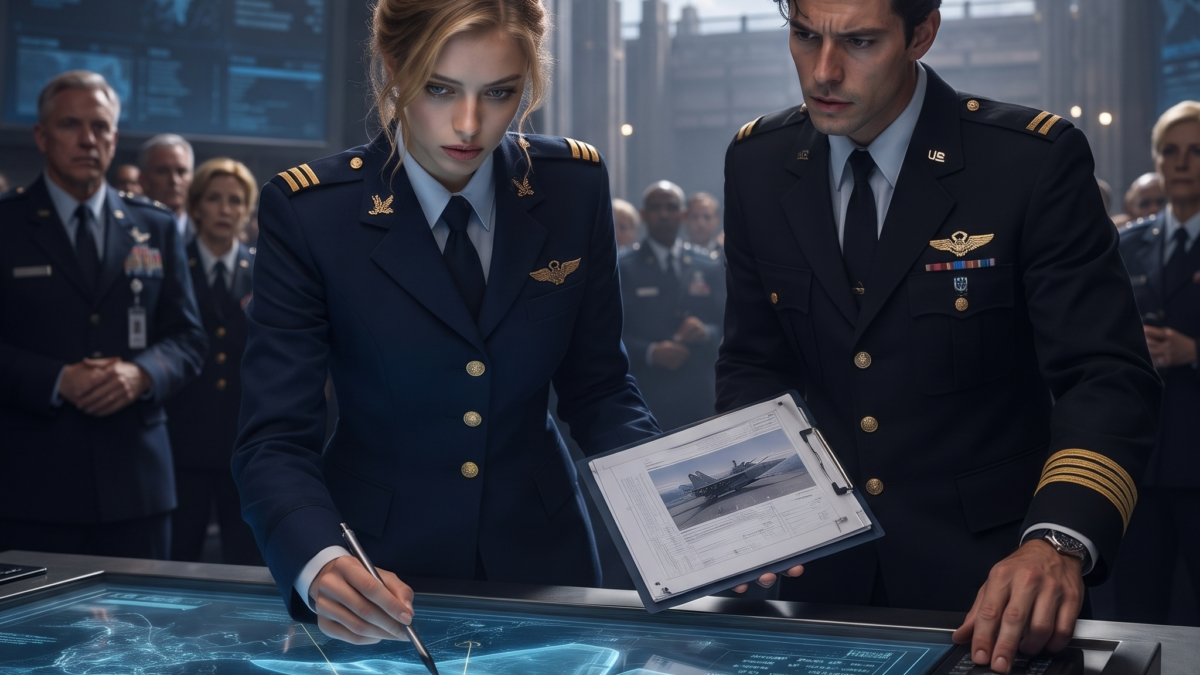
THE LAST PERSON THEY TRUSTED
The first thing I noticed about Miles Grant was that he was still wearing the watch I had given him.
The second was that he had not recognized me.
He stood in the middle of the maintenance hangar at Baker Aviation, immaculate in his captain’s uniform, with his dark hair combed back and the silver wings on his chest catching the overhead lights. Around him, ground crew members moved equipment into position while a flight dispatcher hurried over with a stack of documents.
Miles barely glanced at them. He was looking at his phone, smiling at something on the screen, completely unaware that the woman crouched beside the left landing gear was the same woman he had once promised to marry.
I had changed my hair, put on a maintenance uniform, and traded the privileges of a test pilot for a toolbox. More importantly, I had stopped introducing myself by the titles that used to open every door in the aviation industry.
For three days, I had been Eileen Walker, a newly hired maintenance technician assigned to Baker Aviation’s operational safety review.
To Miles, I was nobody.
That was exactly how I wanted it.
I had not returned to the airline to settle an old score. I had returned because I had spent five years watching one preventable accident after another become a collection of statistics, apologies, and carefully worded corporate statements. Every time an aircraft developed a fault, somebody had to decide whether the problem was serious enough to delay a flight. Too often, that decision was made by people who feared a late departure more than they feared what could happen in the sky.
I wanted to see what happened when nobody knew who I was and nobody expected me to challenge them.
My first inspection had already uncovered several maintenance records that had been closed without proper supporting documentation. The second had revealed a recurring pressure fluctuation in an aircraft scheduled for a morning departure. I had submitted both findings through the proper channels.
Now, on my third day, I was assigned to inspect the aircraft operating Flight GA217.
Its departure was scheduled in two hours.
The aircraft was a wide-body passenger jet carrying 186 passengers and eight crew members. The maintenance log showed an unresolved pressure decay associated with a high-pressure hydraulic fitting in the left main landing gear well. The inspection had been initiated by the previous shift, but the final maintenance release remained pending.
I was examining the fitting when the dispatcher came rushing through the hangar.
A moment later, a man in a captain’s uniform rounded the corner, carrying a leather flight case and a thick bundle of papers. He was moving quickly, looking at his phone rather than where he was going.
His shoulder struck mine.
My tools scattered across the floor.
The flight documents slipped from his hand and landed in a messy pile beside my boots.
He stopped, looked down at the papers, and then at me.
There was no apology. His expression suggested that I had somehow inconvenienced him by occupying the space where he had decided to walk.
I recognized him immediately.
Miles Grant.
He looked older than he had when I last saw him, but not wiser. The same confidence remained in his posture, the same effortless assumption that everyone around him existed to make his life easier.
I bent to retrieve my tools.
He ordered me to collect his documents and take them to the cockpit at Gate A17. He added that I had ten minutes.
I told him he had knocked them down and could pick them up himself.
His face changed.
Perhaps he was accustomed to being obeyed. Perhaps he believed a maintenance technician could be intimidated by a captain’s uniform. Either way, he took my refusal as a personal insult.
He reminded me that he was in command of the flight and that obstructing flight preparation could lead to a formal complaint.
I looked at the watch on his wrist.
I had bought it for him on the day he completed his first major international flight assignment. Back then, he had been a promising young first officer who talked about becoming the kind of captain passengers could trust. I had believed him.
The watch was still beautiful.
The man wearing it was not.
I told him my name was Eileen Walker. Then I returned to the maintenance panel.
Miles studied me for another moment. Recognition flickered briefly in his expression, but he dismissed it as quickly as it appeared.
He had always preferred his own assumptions to inconvenient facts.
He told me to stop playing games and finish the job. If the papers did not reach the cockpit in ten minutes, he would report me.
I did not answer.
Instead, I pointed to the open maintenance record.
The aircraft was not cleared for release.
Miles glanced at the paperwork and brushed it aside. He had flown for twelve years, he said, with more than eight thousand hours in the air and a flawless safety record. He knew the aircraft. He knew its systems. He knew how to recognize a genuine problem.
I asked whether he had personally reviewed the pressure decay figures.
He said the maintenance department had already handled the matter.
That was not true.
The record showed a pressure loss above the permitted release threshold, and the rate had been increasing during the previous inspection cycle. A high-pressure fitting with a developing crack could deteriorate rapidly once the system was subjected to the loads associated with takeoff, gear retraction, and climb.
At cruise altitude, the loss of hydraulic pressure could compromise several essential control and landing functions.
The problem was not merely that the aircraft might experience a warning light.
The problem was that the system could fail when the crew had the least room to recover.
I told Miles the aircraft could not fly until the fitting had been properly inspected and the fault resolved.
He stared at me as though I had insulted him.
Then he laughed.
He asked whether a new technician with three days of experience intended to teach a captain with twelve years in the cockpit how to do his job.
Someone behind him made a quiet remark about my personal interest in his flight.
Another employee, a woman from the operations team named Nora, looked uncomfortable. She had been standing near the maintenance desk and had clearly heard the exchange.
Miles noticed her expression and seized on it.
He explained that I was his former girlfriend and that our breakup had not been easy. According to him, I had taken a maintenance position just to remain near him. My safety objections, he suggested, were nothing more than an attempt to force him to pay attention.
The accusation was so absurd that, for a moment, I almost laughed.
I had spent years flying experimental aircraft through conditions most commercial pilots would never encounter. I had helped investigate structural failures, examined emergency procedures, and worked with manufacturers to improve systems that had nearly cost people their lives.
Now, because I wore a ground crew uniform, a man who had once asked me to review his flight simulator performance believed I was incapable of understanding a maintenance log.
I told him the breakup was irrelevant.
The pressure decay was not.
I refused to sign the release.
Miles threatened to file a complaint with Helen Baker, the airline’s chief executive and head of operations oversight. He demanded that I apologize in front of the crew and leave the restricted maintenance area.
I refused again.
He then turned toward the maintenance control station and ordered the electronic release to be completed.
I warned him that no one had the right to erase an unresolved safety fault simply to protect a departure schedule.
The threat finally reached someone with authority.
Helen Baker joined the discussion over the operations channel. She asked why the aircraft had not been cleared and why a disagreement had escalated into a formal complaint.
Miles spoke first.
He described me as a disruptive employee who was deliberately delaying the flight. He emphasized his spotless record and said I had been harassing him since our breakup.
I explained the actual problem.
The left main gear hydraulic connector was leaking. The pressure decay rate had exceeded the release limit. The fault had not been properly investigated, and the maintenance tag remained open.
Helen did not immediately take my side. She was responsible for an airline whose schedules, financial performance, and reputation depended on hundreds of people making thousands of decisions every day. I understood the pressure she was under.
But I also knew that an airline’s schedule was not worth a single passenger’s life.
Helen asked Miles why he was insisting on departure when the maintenance record was still pending review.
He answered that he knew the aircraft and had confidence in his crew.
Then he asked that I be removed from the maintenance area.
The maintenance control manager electronically cleared the fault shortly afterward. Dispatch signed off, and the flight was placed back on schedule.
I watched the status change on the screen.
A red warning became a green release.
Nothing mechanical had changed.
The leak was still there.
I requested the complete maintenance history and asked that the release be held until a qualified inspector could examine the connector. My request was refused. The operations manager warned me that canceling the flight would disrupt the day’s schedule and damage the airline’s on-time performance figures.
The manager also made it clear that I was close to losing my job.
I looked at the pressure readings again.
The decay rate had almost doubled.
I issued another warning through the emergency operations channel. This time, I included the projected failure window. Based on the trend, the left hydraulic system could become unreliable shortly after takeoff.
My warning was transmitted to the cockpit.
Miles responded by demanding that my access be revoked.
He also posted a public statement accusing me of using company communication systems to harass him. His version of events spread quickly among employees who had never seen the maintenance record. Some supported him because he was a popular captain. Others simply preferred the comfort of believing that an experienced pilot could not make such an obvious mistake.
Security arrived and ordered me to leave the restricted operations area.
I refused to abandon the unresolved fault without recording another formal safety objection.
The pressure readings were no longer a minor discrepancy. The leak was worsening under repeated system cycling, and the left hydraulic circuit was approaching a dangerous threshold.
I requested an emergency hold.
The manager refused.
At that point, I used the emergency alert procedure available to personnel who identified an imminent threat to an aircraft. My action triggered an airport-level review, and the tower received a request to intercept the aircraft before it entered the departure sequence.
For several minutes, it appeared that the operation might finally stop.
Then the electronic release was confirmed again.
The airline’s operations desk informed the tower that maintenance control had cleared the problem and that the previous grounding request had been withdrawn.
I watched the aircraft begin taxiing.
Through the operations window, I could see its enormous wings moving slowly beneath the terminal lights. Passengers inside would have been fastening their seat belts, arranging their bags, and checking the time. Some were probably looking forward to seeing their families. Others were beginning business trips or returning home after weeks away.
None of them knew that an unresolved hydraulic leak lay beneath the aircraft.
I tried to reach the cockpit once more.
Miles cut the channel.
The aircraft continued toward the runway.
I had done everything available to me within the ordinary maintenance chain. Every warning had been recorded. Every request had been documented. The people responsible for the release had chosen to proceed.
Now I could only hope the aircraft would remain on the ground.
It did not.
The tower cleared GA217 for departure.
The engines increased in pitch. The aircraft accelerated down the runway, gathering speed until it lifted into the night.
For a brief moment, nothing appeared wrong.
Then the left hydraulic pressure began to fall.
The warning came from the aircraft’s monitoring system, not from my imagination. The pressure continued to drop as the gear retracted and the system came under load.
Miles dismissed the first indication as a sensor fault.
The backup controls activated, temporarily compensating for the pressure loss. In the cockpit, the instruments returned to normal-looking values. The pilots believed the problem had passed.
It had not.
The backup system was compensating for a failure that was still progressing.
I watched the live telemetry and felt the cold certainty that comes when a worst-case possibility becomes a measurable event.
The leak had not stopped. It had become worse.
Within minutes, the aircraft began losing reliable control of its left-side hydraulic functions.
The operations room descended into confusion. Some staff members were demanding that the cockpit receive technical guidance. Others insisted that the aircraft should continue its planned route and return to the main airport.
The captain still refused to listen to me.
I was told to remove my headset. Security was waiting to escort me out.
I stayed.
Then the aircraft’s left-side control response deteriorated.
The first officer, Cole Harris, reported that the controls were becoming increasingly difficult to manage. The backup pump was running, but the pressure was not recovering. The crew requested technical assistance from the ground.
For the first time, the cockpit sounded frightened.
I asked to be connected.
The operations manager refused. Miles had specifically ordered that I be removed from the emergency channel.
I reminded them that the aircraft was now experiencing the exact failure I had warned about before departure.
The manager told me that my qualifications did not include commanding a flight from the ground.
That was technically correct.
I was not the captain. I could not take control of the aircraft. But I could analyze the systems, assess the failure, and provide technical guidance through the established emergency chain.
I asked them to relay my instructions.
They refused.
The aircraft was now descending toward the airport with limited control authority. Its crew attempted to stabilize the situation using the remaining systems, but the failures were spreading.
The standard return route would take them over a densely populated section of the city. Weather conditions were also deteriorating. A developing wind-shear event had formed along the usual approach corridor.
I studied the available weather data, the aircraft’s position, and the remaining control capability.
The pilots could not make a normal approach.
They needed to stay away from the city and avoid the developing wind shear. The only reasonable option was to turn toward the coast, where the airspace was less congested and the crew would have more room to manage the descent.
I instructed Nora, the operations trainee, to relay an immediate course correction.
She hesitated.
She was still young enough to believe that authority and competence were usually the same thing. She knew Miles had been the airline’s celebrated captain for years, and she knew I was officially assigned to maintenance. Telling an active aircraft to change course was a serious responsibility.
I told her I would accept responsibility for the technical recommendation.
Nora finally transmitted it.
The aircraft began turning.
A moment later, the weather radar showed the wind shear intensifying along the standard return path. The aircraft would have entered it at an extremely vulnerable point in the descent.
The turn had helped them avoid a potentially catastrophic encounter.
That should have ended the argument.
Instead, Miles claimed he had identified the weather anomaly himself.
He announced that the flight crew had made the successful decision and thanked ground control for its support. He did not mention my warning or Nora’s transmission.
I was not interested in credit.
I needed them to survive the next five minutes.
The backup control circuits began failing. The aircraft was losing its remaining hydraulic support, and the crew’s attempts to restore the normal systems were unsuccessful.
The flight’s altitude dropped steadily.
Miles wanted to return to the main airport. I told him a normal runway approach was no longer possible. The aircraft did not have enough control authority to maintain the required flight path, and a sharp turn could impose stresses the damaged system could not tolerate.
He argued that the main runway was the only realistic option.
I knew he was wrong.
There was an old coastal runway on the edge of the airport’s property, closed for maintenance and rarely used. It was shorter than the main runway, lacked the normal approach lighting, and had construction equipment positioned near one end.
Under ordinary circumstances, no airline would choose it.
But ordinary circumstances had disappeared.
The aircraft had lost its primary hydraulic system. The backup system was failing. Its approach speed, remaining fuel, and limited control response meant that even reaching a proper runway might be impossible.
The coastal strip offered one advantage: its orientation and surrounding terrain gave us a narrow corridor in which the crew could use the coastal air movement to help manage the final approach.
I proposed an emergency landing there.
Helen Baker authorized the emergency response command and instructed the operations team to support the landing plan.
Miles objected. The runway was closed. Its approach was difficult even for a fully functioning aircraft. The possibility of a successful landing seemed almost nonexistent.
I told him that a conventional landing was no longer an option.
He eventually followed the instructions.
I guided the crew through the descent, telling them when to adjust their thrust and how to avoid putting unnecessary stress on the remaining control surfaces. The aircraft was flying with an increasingly narrow margin. A sudden correction could tear apart the damaged system.
The ground team cleared the coastal runway.
A row of construction vehicles and excavators had to be moved. The runway lights were not fully operational, and the normal guidance equipment was unavailable.
The crew could not rely on the instruments they used for a standard approach.
They had to trust the remaining flight data and the instructions coming from the ground.
Just as we began to establish the landing approach, a former aviation standards consultant named Thomas arrived at the operations center.
He had been brought in as an emergency adviser. He wore the confidence of a man who expected a room to fall silent whenever he entered it.
Thomas immediately challenged my plan.
He insisted that the main airport was the only acceptable destination and claimed that his experience with flight simulations made him better suited to direct the recovery.
The operations manager, eager to find someone with a more impressive title, gave Thomas access to the emergency technical channel.
I warned them that the aircraft’s right-side hydraulic system was already under severe strain. A sharp turn toward the main runway could cause a stall or structural failure. We needed to preserve the remaining control authority, not spend it on a maneuver the aircraft could no longer perform.
Thomas dismissed the warning.
He instructed the crew to return to the main airport.
Miles listened.
That was the moment I understood how dangerous the situation had become. He had ignored a clear maintenance warning before departure, dismissed my assessment during the initial failure, and now intended to follow an adviser who had never examined the aircraft’s actual condition.
The crew attempted to turn back.
The aircraft shuddered.
The right-side controls began responding erratically, and the wings dropped toward the city.
I ordered Miles to stop the turn and level the aircraft as much as the remaining control would allow. Nora relayed the command. This time, the cockpit followed it.
Thomas continued arguing over the channel, but his instructions were no longer being followed.
We were losing altitude quickly.
The crew had to accept that the main airport was beyond reach.
I returned them to the coastal approach.
The aircraft’s left engine began showing signs of damage, while the right engine was still providing usable thrust. The crew was terrified of losing the remaining power source. I instructed them to reduce the load on the damaged side and preserve the thrust needed to maintain a controlled descent.
There was another problem.
The aircraft’s avionics had been upgraded the previous year with an emergency data-link system that could transmit heading compensation from the ground. The feature was rarely used and had been included primarily for extreme situations in which normal flight-control assistance became unavailable.
I had helped design and validate that system.
The manual described a narrow operating procedure that allowed ground control to upload temporary heading corrections to a backup guidance function. It was not a substitute for hydraulic control, and it could not fly the aircraft on its own. But it could temporarily stabilize the heading long enough for the crew to perform a necessary action.
I instructed Nora to locate the emergency response procedure and activate the data-link terminal.
The system came online.
Thomas immediately tried to take over the parameters.
He had extensive simulation experience, but he had never worked with the actual system under emergency conditions. He entered a standard compensation value that was completely wrong for the aircraft’s current configuration.
The aircraft began drifting away from the approach path.
I saw the error in the telemetry almost immediately. The value needed to account for the loss of lift on the left side and the asymmetrical thrust condition. A positive correction would push the aircraft farther off track and increase the danger of a wing drop.
I ordered the correction to be reversed.
Thomas refused to accept the instruction. He argued that his calculations were based on standard flight parameters.
The problem was that the aircraft was no longer operating under standard conditions.
I told the operations team to stop his input.
By then, the aircraft had already begun drifting toward a reef beyond the coastal approach area. The emergency system was still active, but the control surfaces were locked in a temporary configuration, and the hydraulic pressure continued to fall.
The aircraft had less than a minute of useful stabilization remaining.
I ordered the remaining guidance function to be reset and used the stored control data to bring the heading back toward the coast.
The aircraft leveled briefly.
Inside the operations room, people began celebrating.
Thomas claimed that his correction had saved the aircraft. Miles agreed, promising to credit him in the official report. The operations manager praised his expertise and ordered security to remove me from the emergency station.
I ignored them.
The pressure gauge was still falling.
The temporary stabilization was not a recovery. It was a brief pause before the next failure.
I warned the crew that the remaining hydraulic pressure would soon reach zero. Once that happened, the aircraft would lose the ability to maintain lateral control.
Thomas called it unnecessary alarm.
A few seconds later, the aircraft began rolling.
The right wing dropped. The pilots attempted to correct it, but the controls responded too slowly. Miles pulled against the failing system, making the roll worse.
I told him to stop applying manual correction.
He ignored me.
The aircraft’s nose dipped toward the water. Structural warnings appeared across the telemetry, and the remaining control response deteriorated with every second.
The crew finally understood that Thomas’s solution had not fixed anything.
He had used the remaining pressure to force a temporary heading lock. The aircraft had looked stable because the system was holding a position it could no longer sustain.
Now the pressure was gone.
The plane was rolling toward the sea.
Miles was screaming for help.
I had heard him speak with arrogance for years, but I had never heard him sound this frightened. The captain who had insisted that his experience made him untouchable was now begging the ground to tell him what to do.
I instructed him to release the controls and stop fighting the aircraft.
He asked whether I was certain.
I told him there was no time left for another argument.
For the first time since the aircraft had departed, he obeyed.
I reviewed the flight state, the remaining engine response, the direction of the wind, and the position of the coastal runway. The aircraft was too low to return to the normal airport and too damaged to perform a standard approach.
The only possibility was an emergency landing on the closed cargo strip.
It was several kilometers away.
The runway had no working approach lights and was partially obstructed by construction equipment. Its surface was narrow, and the surrounding terrain offered almost no margin for error.
But it faced the prevailing wind.
That gave us a chance to use the wind to reduce the aircraft’s sideways drift during the final turn.
I told Nora to clear the runway and move the remaining equipment. She contacted the ground crew, who began shifting the vehicles and excavators away from the landing path.
I instructed the cockpit to keep the aircraft low and avoid a sharp climb. Its damaged wings could not withstand a sudden change in load.
Miles was barely able to maintain his composure.
The first officer kept asking whether they would survive.
I could not promise that.
I could only give them the next instruction.
As the aircraft descended toward the coastline, the damaged left engine began to overheat. Its performance was becoming unstable. If the fuel supply remained open, the fire could spread and compromise the entire wing.
I ordered the crew to isolate the left engine.
Cole hesitated. Losing an engine would leave them with only one source of thrust.
I explained that the left engine was no longer a reliable source of power. It was a threat to the aircraft itself.
They shut it down.
The plane rolled sharply but began to stabilize once the remaining thrust was adjusted. The aircraft was now descending toward the cargo runway with one engine, no functioning hydraulic system, and almost no conventional control authority.
The final approach was going to be unlike anything the flight crew had trained for.
I used the remaining airspeed and wind data to guide them toward the runway extension. The crosswind was pushing the aircraft away from the center line. I instructed Miles to increase the right engine’s thrust enough to compensate for the drift, then reduce it as the aircraft aligned with the approach path.
The runway appeared ahead.
For a moment, the crew thought they had made it.
Then Miles reported that the aircraft had no usable speed brakes.
Without them, the landing speed would be dangerously high. Even if the aircraft touched down, it could overshoot the runway and strike the water beyond the far end.
I had one last option.
The cargo runway was equipped with a heavy emergency arrester system designed for aircraft used in freight operations. Its purpose was to absorb kinetic energy when an aircraft could not stop through ordinary braking.
It had only recently completed a series of high-load tests.
The system had been designed for heavier aircraft than GA217, but its use on a passenger airliner had never been validated under an actual emergency landing. If it failed, the aircraft could break apart as the arrester engaged.
The crew needed to understand the risk.
I reviewed the test data again.
The hydraulic damping accumulators had been charged after the most recent test. Their stored pressure was still within the operating window. The system could absorb a significant portion of the aircraft’s impact energy.
It was not safe.
Nothing about the landing was safe.
But it was the only option that offered a reasonable chance of stopping before the runway ended.
I ordered the ground crew to activate the arrester system.
The aircraft descended toward the runway.
Miles was struggling to keep the nose aligned. The damaged controls were responding unevenly, and the remaining engine was operating close to its limits.
I counted down the final seconds.
The main gear touched the runway.
The aircraft was still moving too fast.
The arrester engaged.
A violent force traveled through the fuselage. The cabin shook as the system absorbed the aircraft’s momentum. The landing gear flexed, and the wings shuddered under the sudden deceleration.
For one terrible second, I thought the system had failed.
Then the aircraft slowed.
The massive airliner stopped before reaching the end of the strip.
There was silence in the operations room.
I stared at the telemetry, waiting for another warning.
None came.
The aircraft was on the ground.
All 194 people were alive.
I leaned against the console, aware that my hands were trembling. I had kept them steady throughout the emergency, but now that the danger had passed, the strain caught up with me.
I asked Nora to confirm the cabin status.
She received word that the passengers were safe. The flight crew had begun the evacuation assessment, and emergency vehicles were approaching the aircraft.
For the first time that night, I allowed myself to breathe.
I had not saved the aircraft alone. Ground staff had cleared the runway, dispatch had provided the necessary data, and the flight crew had followed the final instructions. But without the warnings, the technical analysis, and the emergency landing plan, there would have been no survivors to congratulate.
I asked the operations team to seal the aircraft and preserve every maintenance record, communication log, and flight data file.
No one was to alter a thing.
The most important part of the investigation had not yet begun.
By the time I reached the airport’s secure debriefing area, Miles had already found his confidence again.
He was standing beside Cole Harris, speaking to a group of company representatives and airport personnel. His uniform was rumpled, and there was a visible mark on his forehead, but he looked more concerned about the cameras than his injuries.
He was telling everyone that he had made the emergency landing decision.
Cole supported his version.
According to them, the flight crew had taken control of the emergency, identified the coastal runway, and executed a difficult landing through skill and teamwork.
Thomas had already begun describing his contribution to the recovery. He claimed that his technical intervention had stabilized the aircraft and made the successful landing possible.
I listened from the back of the room.
They were rewriting the entire event before the aircraft had even been inspected.
The first report would determine how the airline presented the incident to the public. If Miles and Cole controlled that report, they could portray the emergency as a successful demonstration of cockpit leadership. The initial maintenance fault would become a minor issue. The warnings would be described as unnecessary interference. The emergency channel restriction would disappear into a paragraph about communication difficulties.
And the people who had forced the aircraft into the air would become heroes.
I had seen this happen before.
The language of an incident report could conceal almost anything if the people writing it were more concerned with protecting reputations than finding the truth.
Nora approached me and quietly confirmed that she had preserved copies of the emergency transmissions and system logs. I asked her to make duplicate backups and provide them directly to the independent investigation team.
She also told me that Miles and Cole had already given statements to the airport’s public relations office.
I was not surprised.
I asked her to leave the public discussion alone and focus on preserving the evidence.
Then I went to the aircraft.
The inspection team was beginning its initial assessment. The left hydraulic fitting showed clear signs of leakage, and the surrounding area contained evidence of the pressure loss that had triggered the original warning. The damaged system had suffered far more extensive deterioration during the flight.
I photographed the relevant components, recorded the condition of the fitting, and compared the physical damage with the maintenance history.
The evidence was consistent.
The aircraft had been released with an unresolved hydraulic fault.
The crew had been warned.
The aircraft had taken off anyway.
I also requested the flight data recorder, cockpit voice recorder, ATC communications, and OCC emergency channel recordings. The NTSB team would eventually take responsibility for the formal analysis, but the airline was obligated to preserve its internal records and provide them without alteration.
Miles appeared near the aircraft entrance before I finished.
He looked at the inspection team, then at me.
His expression was somewhere between anger and embarrassment.
He reminded me that I had no authority to make technical decisions about the aircraft after the landing. He described my emergency instructions as unauthorized interference and claimed I had forced the crew into a dangerous approach.
I told him that the recorders would show exactly what happened.
He said ground mechanics were not allowed to command aircraft.
I agreed that ground maintenance personnel could not casually assume cockpit authority.
But the question was not whether anyone could issue arbitrary instructions. The question was whether the person providing emergency technical guidance had the qualifications and authorization required by the applicable response plan.
Miles did not want to discuss that distinction.
He accused me of being obsessed with him. He said the entire incident had begun because I could not accept our breakup.
I looked at him for a long moment.
The last thing I felt for him was not affection or anger.
It was disappointment.
He had once been a good pilot. He had worked hard, studied carefully, and treated every new qualification as something he needed to earn. I had watched him grow into the job and had believed that the responsibility would make him a better man.
Instead, success had convinced him that he was incapable of being wrong.
I told him the investigation would determine what happened.
Then I returned to the inspection.
The official inquiry began the following morning.
Helen Baker arrived with the airline’s legal team and senior operations managers. She had spent the night reviewing the initial reports and was furious about the condition of the records.
The duty maintenance manager had electronically cleared a safety fault without a proper supporting inspection. The operations manager had withdrawn a grounding request after the aircraft had already begun taxiing. The OCC duty officer had restricted emergency channel access during an active in-flight failure.
These were not minor administrative mistakes.
The investigation had to determine whether the decisions were negligent, deliberate, or both.
Helen asked Miles and Cole to explain their actions.
Miles insisted that the fault had been cleared by maintenance control and that he had relied on the approved release. He said that his flight experience had helped him recognize that the initial pressure warning was likely a sensor problem.
When asked why he had continued after receiving repeated warnings from the ground, he blamed my personal history with him.
He argued that I had used the emergency channel to harass him and had deliberately created panic.
Cole repeated much of the same account. He said the crew had worked under extreme pressure and that the successful landing was proof of their competence.
Thomas tried to defend his technical intervention. He argued that the aircraft’s heading had stabilized after he entered the correction parameters, and that his actions had helped prevent a crash.
I was not invited to speak immediately.
Helen wanted the investigation team to establish the timeline before anyone made further claims. She also wanted to avoid a confrontation in which personalities could distract from the data.
That was sensible.
I sat beside Nora and watched the evidence appear on the main display.
The maintenance record showed the unresolved hydraulic fault.
The release timestamp showed when maintenance control had cleared it.
The operations communications showed that the grounding request had been withdrawn.
The aircraft telemetry showed the pressure loss after departure.
Then the cockpit and emergency channel recordings were played.
The first recording captured my warning before takeoff.
It also captured Miles’s response.
He had been told that the aircraft could lose hydraulic control shortly after departure. He had been given the location of the leak, the pressure data, and the reason the fault could not be ignored.
The recording ended with him demanding that I be removed from the emergency channel.
The next recording captured the aircraft’s initial failure.
The crew had requested technical assistance. The ground team had attempted to connect me, but the cockpit channel had been restricted.
The recordings showed the sequence of events that followed: the loss of hydraulic pressure, the failed backup pump, the weather warning, the diversion toward the coast, Thomas’s incorrect guidance, and the eventual collapse of the control systems.
They also captured the final landing instructions.
The technical language was difficult for the public relations staff to follow, but the investigators understood it.
The commands were precise.
The flight data matched the instructions.
The aircraft’s response matched the predicted behavior.
The recordings showed that Miles and Cole had repeatedly rejected the guidance before following it when no other option remained.
When the aircraft finally stopped, Cole had claimed responsibility for the approach.
The evidence left little room for interpretation.
Miles still tried to argue that the ground instructions had been suggestions, not commands. He insisted that the final decisions belonged to the captain.
That was partly true, but it did not absolve him of responsibility.
A captain had authority over the flight, but that authority carried a duty to consider credible safety information. It did not give him the right to disregard a known mechanical hazard simply to protect a departure record.
The investigation moved on to my qualifications.
The company had hired me as a maintenance technician under an operational safety review arrangement. My personnel file did not list my aviation qualifications in the ordinary employee summary. That had been intentional.
I had been working undercover to evaluate maintenance procedures and identify the ways in which frontline employees were pressured to ignore hazards.
The airline’s investigators knew there was a reason for the unusual arrangement, but the cockpit crew had not been given my full background.
Miles seized on that omission.
He accused me of impersonating a qualified flight professional and illegally taking control of emergency communications.
He demanded that I be removed from the airport and reported to the Federal Aviation Administration.
For the first time that morning, I stood.
I handed the investigation team my credentials.
My FAA Airline Transport Pilot License was current. My B767 type rating was valid. My test pilot certification remained active, and my authorization as a chief flight technical consultant for Baker Aviation’s emergency response program had been renewed.
The black credential card that accompanied my authorization was not an ordinary pilot license. It was a specialized company and manufacturer credential that verified my role in the emergency response chain.
Miles looked at it with disbelief.
He had never seen one before.
He immediately called it a fake.
I asked the investigators to verify the credentials through the official FAA records and the manufacturer’s secure authorization system.
The verification was completed.
My qualifications were valid.
The investigation team then confirmed that my access to the emergency response channel had been authorized under the company’s crisis procedures. The technical intervention was within the scope of my credentials.
I had not been pretending to be an aircraft mechanic with no flight experience.
I had been a test pilot working undercover as one.
The room grew quiet.
Miles looked as though he had forgotten how to speak.
Helen stood beside the display and explained the arrangement.
She had personally recruited me after reviewing the airline’s safety performance. She wanted someone with deep flight experience to examine the operational problems that senior managers rarely saw. My assignment was to work among maintenance staff, observe the pressure placed on them, and identify dangerous gaps between official procedures and actual practice.
I had agreed on one condition.
My findings would not be softened to protect anyone’s position.
The investigation had now established that I had acted within my authorization and that the safety warnings were supported by physical evidence and flight data.
Helen ordered the company to preserve all relevant records and suspended Miles, Cole, and the operations duty manager pending the regulatory review.
Miles protested.
He reminded Helen that he was one of the airline’s most experienced captains. He had flown thousands of hours without an accident and had built a reputation as a dependable pilot.
Helen told him that a good record was not a lifetime exemption from accountability.
She explained that his decisions would be examined by the FAA and the NTSB. The airline would not use his history to excuse the actions of that night.
Cole was also suspended for falsifying his account of the landing and publicly claiming credit for decisions he had not made.
Thomas’s role was referred for separate review. His use of the emergency data-link system had contributed to the loss of control authority, and his attempt to override the technical response had to be examined independently.
The maintenance and operations managers who had cleared the aircraft and withdrawn the grounding request were also placed under investigation.
I did not celebrate.
A successful landing did not make the failures acceptable. The passengers had survived, but the airline had come dangerously close to losing 194 people because too many employees had treated safety as an obstacle to performance.
That was what mattered.
The story spread through the aviation industry over the next several days.
At first, the public heard that GA217 had suffered a serious technical malfunction and completed an emergency landing at a coastal airport facility. The airline praised the flight crew and thanked the airport emergency teams.
The initial statement did not identify the person who had directed the recovery.
Then the recordings began circulating among investigators and journalists.
The recordings revealed Miles’s repeated refusal to accept the warning, his demand to cut off my communications, and his eventual pleas for help when the aircraft became uncontrollable.
The maintenance records showed that the flight had been released despite an unresolved fault.
The flight data confirmed that the course changes and emergency landing plan had come from the ground.
Cole’s public account fell apart when the cockpit recordings showed that he had not been the one providing the technical instructions.
The airline withdrew its original statement and issued a corrected account.
I refused the invitations to appear on television.
I did not want to become a public hero, and I had no interest in turning a near-disaster into a personal brand.
The passengers deserved an honest account. The airline’s employees deserved a workplace where safety concerns could be raised without fear. The investigation deserved complete records and unfiltered testimony.
That was enough.
Meanwhile, the FAA began reviewing Miles’s qualifications.
His record was no longer limited to the incident involving GA217. The investigators examined earlier reports, including previous complaints about his treatment of maintenance staff and several cases in which he had pressured dispatch and operations employees to maintain schedules despite unresolved technical concerns.
Some of the reports had been closed as administrative disagreements.
Together, they suggested a pattern.
Miles had learned that his reputation could protect him from scrutiny. People trusted the captain who never missed a schedule and never admitted uncertainty. He had gradually started using that trust as leverage.
The investigation also revealed that Cole had assisted him in changing the wording of the incident report before the public release. The two men had coordinated their statements, hoping to present themselves as the crew members responsible for the recovery.
They had expected the ground recordings to remain inaccessible.
They had expected me to remain anonymous.
Both assumptions were wrong.
Nora, meanwhile, had become one of the key witnesses.
She had saved the emergency transmissions, backed up the telemetry, and confirmed the instructions she had relayed to the cockpit. Her role in the incident was thoroughly documented.
Some employees accused her of supporting me because of her family connections.
They had no idea who she was.
Nora had been working in the operations department as part of a rotational training program. She was learning the airline from the ground up, just as Helen had once intended. Her mother was Helen Baker, the company’s chief executive and controlling shareholder.
Helen had kept Nora’s identity private because she wanted her to understand the organization without the protection that came from being the owner’s daughter.
When the truth became public, several people tried to use it to dismiss Nora’s testimony.
Helen refused to let them.
She made it clear that Nora had not participated in the investigation’s conclusions. Her evidence had been independently verified against the recordings and system logs.
Family connections could not change the pressure readings.
They could not alter the maintenance record.
And they could not make Miles’s voice disappear from the cockpit recording.
The investigation continued.
Three weeks later, I received an invitation from the independent aviation qualification review board.
It concerned the reinstatement of pilot certificates and type ratings for candidates whose conduct had raised serious safety concerns.
Miles and Cole were both on the list.
The review would include technical reconstruction, emergency response simulations, procedural assessments, and an examination of their decisions during the GA217 incident.
The board asked me to serve as the chief technical examiner.
I initially declined.
I had no desire to spend another day dealing with Miles. The investigation had already established the essential facts, and the FAA would make its own licensing decisions.
But the board explained that the review involved unusual system failures and emergency procedures that ordinary examiners were not qualified to assess.
They needed someone who understood the aircraft, the emergency systems, and the decisions made during the incident.
They needed someone who could distinguish a pilot who made a difficult but reasonable judgment from a pilot who ignored information because his pride would not allow him to admit he was wrong.
I accepted.
The appointment was confirmed, and the technical review was scheduled for the following week.
Helen informed me that the board wanted the assessment to be independent and that she would not interfere with the process.
I agreed.
I also insisted that two independent FAA inspectors supervise the final certification decisions. My technical findings could be submitted as part of the evaluation, but the official licensing actions had to remain in the hands of the appropriate authorities.
That was how the system was supposed to work.
A few days later, Nora invited me to dinner.
She had been beside me during the emergency, preserving the records and relaying instructions when others refused to help. She had also stayed after the incident to support the investigation, even though it would have been easier to remain silent and avoid becoming part of the story.
I appreciated that.
I also liked her company.
We had begun spending time together outside work, and the conversations came easily. There was no pressure to impress each other. She did not care about my old titles, my test-flight record, or the stories people were beginning to tell about me.
She was interested in how I thought.
That meant more than any award.
Before our dinner, we stopped at the airport to collect a few personal items. I had arranged a small charter flight for the evening, using a high-performance aircraft provided to me under a long-term manufacturer test program.
It was not a gift from the Baker family.
It was not a company perk.
I had been assigned to the platform months before my return to the airline, and the manufacturer’s records showed me as the authorized pilot in charge.
Miles happened to be at the airport.
He was accompanied by Cole, who was still trying to arrange a review appointment. Both men looked at the aircraft with interest.
Miles immediately assumed it had been arranged through Helen.
He began making remarks about how quickly I had moved from a maintenance uniform to the privileges of the aviation elite. Cole joined in, suggesting that my association with Nora had opened doors that would otherwise have remained closed.
I ignored them.
Miles then announced that he had secured a sponsor who would help him obtain access to a high-performance test aircraft for his upcoming review.
He seemed proud of the arrangement.
An airport technician approached and asked me to confirm my identity before the aircraft could be released.
I completed the authentication.
The system displayed my name as the registered pilot in charge.
Miles stared at the screen.
He asked how I had been assigned a platform of that class.
I told him the manufacturer had trusted me with it under a long-term contract.
He said Helen must have arranged the assignment through the Baker family.
Nora corrected him.
My aircraft contract had existed before she had met me.
Miles did not believe her.
He was still convinced that everything I had accomplished was the result of personal connections. It was easier for him to believe that than to accept the possibility that the woman he had dismissed as a low-level mechanic had spent years working at a level he could never reach.
I completed the flight plan and release procedures.
As we walked toward the aircraft, Miles called after me. He said that once he passed his qualification review, he would return to international routes. He suggested that my position as an examiner was temporary and that the industry would eventually remember who the real professionals were.
I did not answer.
The aircraft was already ready for departure.
Nora climbed aboard, and we took off.
The sun was low over the horizon, turning the water beyond the airport into a long sheet of copper light. The cabin was quiet. For the first time in weeks, I was not listening to an emergency channel or watching a pressure gauge.
I was simply flying.
After we landed, Nora asked whether I ever missed the days when I was known throughout the industry.
I thought about the question.
Five years earlier, I had been famous for surviving a dual-engine fire and a complete hydraulic failure at altitude. The incident had become one of the most discussed emergency recoveries in the industry. I had been invited to interviews, award ceremonies, and conferences.
I had declined most of them.
The experience had changed the way I viewed aviation.
The public remembered the aircraft that returned safely. They remembered the pilot who had kept a damaged plane in the air. They remembered the dramatic rescue.
But few people thought about the maintenance engineer who had identified the hidden fault months earlier, the technician who had reported the damaged component, or the inspection team that had found the same problem during a routine check.
The last line of defense was not always the person in the cockpit.
Sometimes it was the person standing beneath the wing with a flashlight and a checklist, refusing to sign a form that everyone else wanted completed.
I told Nora I did not miss the attention.
I missed the days when everyone understood why the work mattered.
She said she thought I had found a way to make it matter again.
I hoped she was right.
The qualification review began three days later.
The candidates arrived early, dressed in formal uniforms and carrying their records. The atmosphere was tense. Several experienced pilots had been waiting for the opportunity to regain their type ratings, and everyone knew the review board had a strict policy.
A single serious failure in the emergency assessment could result in disqualification and referral for further licensing action.
Miles and Cole arrived together.
They looked more confident than they had during the investigation. Miles had regained some of his composure, and Cole seemed convinced that the review would provide a way to repair his reputation.
They had obtained a special exemption from the preliminary screening rounds.
The committee had decided that candidates involved in an exceptional in-flight emergency could proceed directly to the final technical evaluation when the circumstances justified an advanced assessment.
Miles interpreted the decision as proof that the board considered him a special candidate.
He told the other pilots that experienced captains should not have to waste time proving themselves through basic exercises.
Cole agreed.
I watched them from the observation area.
Their confidence was familiar.
The review center had strict security procedures. Every candidate was required to verify identity, submit relevant certifications, and follow the assigned schedule. Miles and Cole tried to treat those requirements as obstacles designed for less experienced pilots.
When a staff member asked them to wait for their examiner, Miles complained that he had already passed the preliminary requirements and should be allowed to begin.
The staff member reminded him that the review board had the authority to evaluate every aspect of his professional conduct.
He dismissed the warning.
By the time they entered the final assessment room, their attitude had become openly disrespectful.
They did not know who the chief technical examiner was.
My identity had been withheld until the candidates entered the room to prevent outside pressure on the review process.
Miles walked in first.
He was still speaking when he saw me seated behind the examination table.
His expression collapsed.
Cole stopped beside him.
For several seconds, neither man moved.
I had changed out of my maintenance uniform and was wearing the formal examiner’s jacket. My credentials were displayed beside the official review documents.
Miles finally spoke.
He demanded to know what I was doing there.
I told him the examination was about to begin.
He laughed and accused me of using Nora’s family connections to obtain an appointment. He said a former maintenance technician had no right to assess professional pilots.
I reminded him that the review board had already verified my qualifications.
He refused to accept that.
He challenged my authority and demanded that the committee replace me with an examiner whose judgment he respected.
I asked him to submit his objection formally.
He did not.
Instead, he continued insulting me.
The review director warned him that his conduct was being recorded and that disrespect toward the examiner could affect the assessment.
Miles said he was not afraid of a recording.
I opened the first file.
It contained his pre-departure decisions.
The review began with the hydraulic fault.
I asked him to explain why he had accepted the electronic release despite the unresolved maintenance tag and the pressure decay warning.
He repeated the explanation he had given during the investigation. Maintenance control had cleared the aircraft. He had trusted the release, and his own experience had given him no reason to suspect an immediate failure.
I displayed the recorded warning.
His own voice filled the room.
He had been told precisely where the leak was, why the pressure loss was dangerous, and how the system could fail after takeoff.
He had not merely accepted an electronic release.
He had demanded that the maintenance warning be removed.
I asked him to explain the difference.
He said the conversation was incomplete and that the ground technician had exaggerated the danger.
I showed him the maintenance data and the physical inspection report.
The numbers matched the warning.
He then blamed the pressure failure on an unexpected mechanical event.
I asked whether the aircraft’s condition had been unexpected.
He could not provide a credible answer.
The next file covered his actions during the emergency.
We examined the aircraft’s loss of hydraulic control, the backup system failure, and the weather conditions during the return.
I asked why he had attempted to return over the city after the standard route had become unsafe.
He claimed that the main airport offered a longer runway and better equipment.
The aircraft data showed that it no longer had the control authority to make the required turn safely.
The simulation displayed what would have happened had he continued.
The aircraft entered the wind-shear zone, lost additional lift, and struck the ground before reaching the airport boundary.
The room remained silent as the simulation ended.
I moved to the next recording.
It showed the cockpit receiving a technical warning about the left engine and the remaining hydraulic system.
Miles had ignored the advice to avoid a sharp turn.
The crew had followed Thomas’s guidance and entered the wrong heading correction into the emergency data-link system.
The resulting drift brought the aircraft toward the reef.
The flight data showed that the temporary stabilization had drained the remaining hydraulic pressure and contributed to the final loss of control.
I asked Miles to explain his reliance on Thomas’s instructions.
He said Thomas was an aviation standards consultant and had extensive experience.
I asked whether Thomas had been qualified to operate the particular emergency data-link system.
Miles said he believed so.
I displayed the authorization list.
Thomas had not been approved to direct that system’s parameters.
Miles had given him access anyway.
I then displayed the instructions from the emergency response manual and the correction that should have been entered.
The technical details made it clear that the mistake had not been unavoidable.
The aircraft was already in a critical condition, but the wrong correction had pushed it further away from the safe approach.
Miles became angry.
He accused me of building the entire review around a personal grudge.
I told him that the review was based on the flight data, not my opinion of him.
The final section concerned the emergency landing.
I asked Miles to describe who had identified the cargo runway and developed the plan to use the arrester system.
He claimed the flight crew had made the final decision.
I played the communication recording.
My voice came through the speakers, guiding the aircraft’s descent, ordering the engine isolation, and calculating the remaining approach options.
The recording included Miles asking for instructions and following the countdown.
The technical analysis showed that the flight crew had not made the decisive landing calculations.
They had executed them.
The distinction mattered.
A captain’s responsibility did not disappear because someone on the ground provided guidance. Miles had still operated the aircraft, and his crew had carried out the final maneuvers. But the evidence showed that the recovery plan had come from the technical response station.
Miles had later claimed credit for the plan.
That claim was false.
I asked whether he wished to amend his statement.
He said he would not recant.
I marked the response.
The review director confirmed that the technical assessment had failed the required standard. The FAA inspector reviewed the evidence and signed the disqualification recommendation.
Miles stood up abruptly.
He accused me of abusing my position and said he would appeal.
The inspector informed him that he had the right to pursue the formal appeal process, but his technical review had been failed and the FAA would determine the next licensing action.
Miles continued shouting as staff members escorted him from the examination room.
Cole remained.
He looked pale.
He had been hoping that his cooperation during the investigation would help him recover his flight status. He had submitted messages showing that Miles had directed him to support the revised account.
I reviewed those messages.
They showed that Cole had known the aircraft had an unresolved fault before departure. They also showed that he had participated in changing the incident report and had agreed to publicly claim credit for the landing.
Cole tried to explain that he had only followed the captain’s instructions.
I asked whether he had also been following instructions when he spoke to the media and claimed that he had personally identified the emergency runway.
He said he had been under pressure.
I asked whether he had been under pressure when he denied my warnings during the flight.
He had no answer.
Then I asked whether he would accept responsibility for helping conceal the safety failure.
He looked toward the review director.
He said he had cooperated with the investigation and supplied the messages voluntarily.
The records showed that he had submitted only the messages he believed would protect him. The complete communication history revealed that he had been aware of the plan to shift responsibility and had participated in it.
I informed him that the evidence he had submitted did not erase his own actions.
The technical review was completed.
Cole failed.
The FAA inspector confirmed that the recommendation would be included in the licensing review.
He began pleading for another chance.
I did not grant one.
A pilot’s certificate was not a reward for loyalty, nor was it something that could be restored through a convincing apology. It represented the trust passengers placed in the people controlling an aircraft.
Cole had shown that he could not be trusted to protect that responsibility.
The review board issued its formal findings.
Miles was disqualified from the assessment, with his certificate status referred for further regulatory action. Cole received the same result for his role in concealing the incident and making false statements.
The findings were also transmitted to the airline and the relevant aviation authorities.
Neither man would be returning to the cockpit while the proceedings remained unresolved.
After the review, I remained in the examination room while the staff collected the files.
The room was finally quiet.
I thought about the night of GA217.
The plane had been damaged. The cockpit had been overwhelmed. The ground team had been divided between people who wanted to save the flight and people who wanted to protect the schedule.
The aircraft had survived because several individuals had refused to accept the convenient explanation.
I did not consider that a personal victory.
There had been too many moments when the result could have been different. If the aircraft had entered the wind shear, if the backup system had failed a few seconds earlier, if the construction crew had not cleared the runway, or if the arrester system had not been ready, the ending could have been terrible.
The airline needed to learn from those failures.
I submitted my technical findings and recommended a broader review of maintenance-release procedures, emergency communication access, and the pressure placed on frontline employees to maintain departure schedules.
I also recommended that safety alerts be automatically preserved and forwarded to an independent operations authority whenever a flight was dispatched with an unresolved maintenance discrepancy.
Helen approved the review.
She asked me whether I would return to the company as chief safety consultant.
I thanked her but declined the public-facing position.
I preferred working closer to the aircraft and the people who maintained them. I wanted the authority to stop an unsafe departure without having to explain myself to someone who cared more about punctuality than passenger safety.
Helen understood.
She offered to give me whatever resources I needed.
I told her the resources were less important than the willingness to listen.
She agreed.
The airline began revising its safety procedures. Every maintenance warning would be subject to independent review before a flight could be cleared. Emergency communication access would remain available to qualified personnel during a declared aircraft crisis. Any attempt to suppress an alert would be recorded automatically.
The company also began auditing old maintenance releases to identify unresolved faults that might have been closed prematurely.
The changes were not dramatic.
They would not make headlines.
But that was the point.
Aviation safety rarely depended on one heroic act. It depended on thousands of ordinary decisions made correctly, especially when nobody was watching.
Several days later, I received the final notification from the review board.
My appointment as chief technical examiner had been formally confirmed for future emergency qualification reviews.
I saved the document and returned to the hangar.
The aircraft from GA217 had been moved into a secure inspection facility. Its hydraulic system was being examined, and the recorders were in the custody of the independent investigators.
The maintenance staff had returned to their normal shifts.
Some looked at me differently now. A few were embarrassed by how they had treated me. Others seemed relieved that someone had finally taken their concerns seriously.
I told them nothing needed to change between us.
They were still mechanics, technicians, and inspectors doing work that mattered. I was still someone who believed a checklist should be completed properly and that a warning should mean something.
The maintenance supervisor asked whether I would consider returning to the hangar permanently.
I said I already had.
My title did not change the work I intended to do.
Nora arrived later that afternoon.
She had finished her operations rotation and was heading to the administrative building. She asked whether I was ready to leave.
I locked the maintenance cabinet and joined her.
At the exit, we passed the display showing the airline’s latest departure performance figures. The numbers had improved slightly, but the company had also canceled several flights while additional inspections were completed.
Some managers were unhappy.
Helen had accepted the cancellations.
For once, the company had chosen to lose a little money rather than take an unnecessary risk.
I looked at the departures board.
Every aircraft listed there would carry people who expected to reach their destination safely. They would never know how many inspections had been completed before the flight, how many defects had been corrected, or how many maintenance workers had refused to sign a release until the problem was resolved.
They did not need to know.
They only needed to arrive.
Nora asked whether I was thinking about the passengers from GA217.
I said I was thinking about the next flight.
She smiled.
We walked outside together.
The evening air was cool, and the airport was busy with arriving aircraft. Their landing lights crossed the darkening sky one by one. The sound of engines rolled across the runway, steady and distant.
I had once believed that being a great pilot meant being able to keep an aircraft in the air under impossible conditions.
I no longer believed that was the whole truth.
Sometimes the greatest act of aviation safety was refusing to let an aircraft take off.
Sometimes it was speaking when everyone else wanted silence.
And sometimes it meant accepting that the person standing beneath the wing, covered in grease and holding a maintenance log, might be the only one in the room who understood what was about to happen.
I had spent years being known as a test pilot.
For a while, I had tried to disappear behind a mechanic’s uniform.
Now I understood that neither title mattered.
The work mattered.
The lives mattered.
And no flight record, no executive bonus, no captain’s reputation was worth more than bringing every passenger home alive.
Nora took my hand as we crossed the parking area.
Beyond the fence, another aircraft began its takeoff roll.
I watched it lift into the night, its wings catching the last of the runway lights.
This time, I knew the maintenance records were complete.
This time, the people responsible had done their jobs.
And that was the kind of ending I wanted.