They Threatened His Daughter—So the God of War Broke His Final Seal
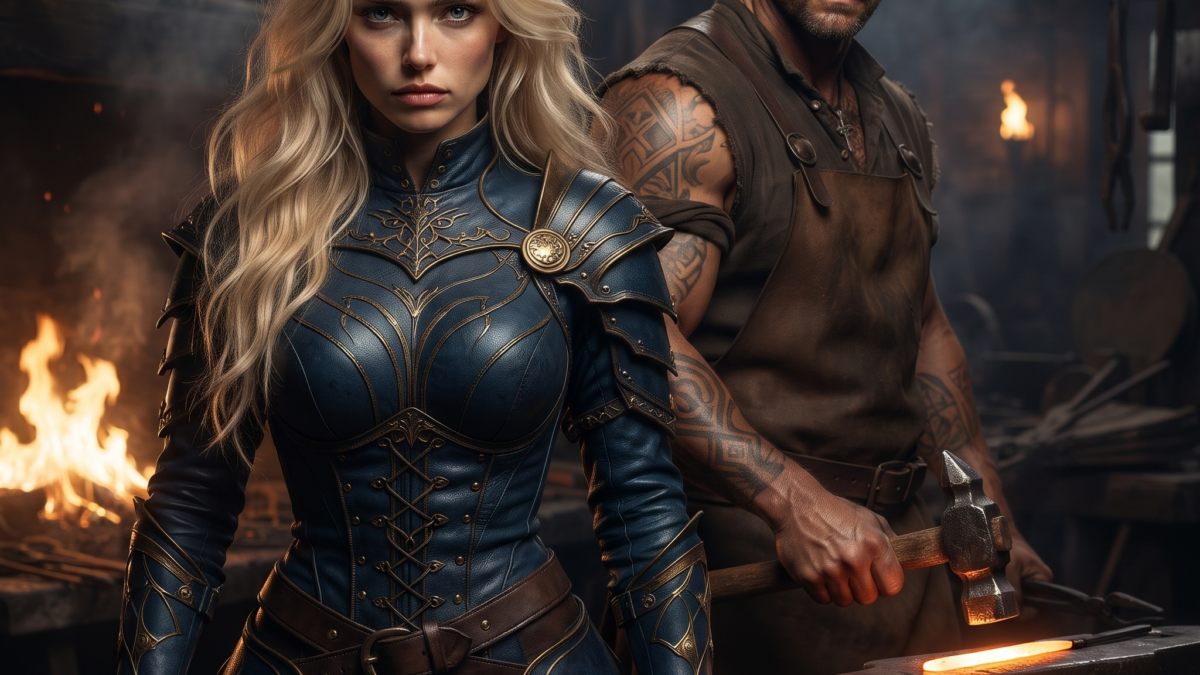
THE BLACKSMITH WHO WAS ONCE THE GOD OF WAR
I remember the smell of burning earth more clearly than I remember the battle.
Even now, sixteen years later, I can close my eyes and feel the heat rolling across the shattered plain. The sky was a bruised red, the mountains had split beneath the weight of divine weapons, and the dead were scattered so thickly that there was nowhere left to place one’s feet without stepping on a fallen warrior.
I had fought for three days without rest.
By the end, there was scarcely a creature in the Nine Realms willing to stand against me. Giants had fled into the frozen wastes. The armies of the Vanir had withdrawn. Even the Aesir, who once considered themselves untouchable, had begun to speak my name with caution.
They called me Ragnvald.
The God of War.
I had believed that title meant I was strong enough to protect everything I loved.
Then I saw the giant.
She stood among the ruins, towering above the broken warriors, her body twisted by dark magic. Lightning crawled across her skin. Her eyes, once blue as the winter sea, had become two burning wounds.
I knew that face.
I knew the shape of her shoulders, the curve of her mouth, even the little silver ornament woven into her hair.
It was Sigrid.
My wife.
I shouted her name and ran toward her, but she swung a hand large enough to crush a fortress. The shock threw me across the battlefield. My armor cracked against a stone pillar, and blood filled my mouth.
I struggled to rise.
“Sigrid! It’s me!”
She answered with a roar.
The magic controlling her was beyond anything I had encountered. It had swollen her body, corrupted her mind, and turned the woman I loved into a weapon. I tried to reach her, but each step brought another devastating blow.
I could have destroyed the giant.
I could have split her skull with my sword and ended the battle.
But every time I raised my weapon, I saw the woman who had once fallen asleep beside me with her hand resting on my chest.
I hesitated.
That hesitation nearly killed me.
At last, my sword cut through the corrupted magic. The giant collapsed, and the red light vanished from the sky. When I reached her, Sigrid was already falling.
Her enormous body shrank beneath my hands. The scales disappeared. The dark wounds faded. She returned to her human form, fragile and pale, with blood spreading beneath her.
I caught her before she struck the ground.
“Sigrid?”
She opened her eyes.
For a moment, there was no battlefield, no gods, no armies. There was only my wife, looking up at me with the same gentle expression she had worn on the day we first met.
“Ragnvald.”
I pressed my hand against her wound.
“No. Stay with me. I’ll find whoever did this. I’ll tear apart every realm until I find the one responsible.”
She lifted a trembling hand and touched my cheek.
“Don’t.”
“Who did this to you? Who turned you into that thing? Tell me their name.”
“Promise me something.”
“Anything.”
“Don’t avenge me.”
I stared at her.
She could barely breathe, yet she was still trying to save me from myself.
“Listen to me,” she whispered. “You’ve spent your life fighting. Every victory has taken something from you. Every enemy has become another reason to keep killing. I don’t want you to spend eternity hunting the people who hurt me.”
“I can bring you back.”
“No.”
“I can find a way. There are spells in Asgard, powers beneath the World Tree. I’ll make Odin open the gates of the dead. I’ll—”
“Ragnvald.”
Her voice was gentle, but it stopped me more effectively than any command.
“Let my death mean something. Stop being a monster of war. Our child needs a father, not a weapon.”
I looked toward the distant ridge.
Our daughter was safe, far from the fighting. Sigrid had insisted that she be raised away from the armies and the gods, where she could grow without the burden of my name.
“Raise her well,” Sigrid whispered. “Let her choose her own life. Don’t make her carry our wars.”
My throat tightened.
“I promise.”
“Live as a mortal, my love. Just for her.”
Her hand slipped from my cheek.
I held her as the last warmth left her body.
Then the battlefield went silent.
I did not remember crying. I remembered only that I could no longer hear anything, not even the distant cries of the wounded.
For the first time in my existence, I wished I had never been powerful enough to win.
I buried Sigrid beneath a hill overlooking the sea. I placed her sword beside her, gathered the pieces of her broken necklace, and made one final oath.
I drove my divine blade into the earth.
The sword carried the authority of my name. With it, I sealed my own power, binding it beneath the World Tree for sixteen years, until our daughter had reached adulthood.
The gods would no longer have the God of War to summon.
There would be no more battles fought in my name.
No more Ragnarok.
No more Ragnvald.
From that day forward, I would be Val, a blacksmith living among ordinary people.
And I would raise my daughter.
I thought keeping that promise would be the hardest thing I ever did.
I was wrong.
Sixteen years later, I was arguing with a hammer.
The hammer, being a hammer, refused to defend itself.
It lay on my workbench beside a pile of ruined horseshoes, a half-finished sword, and three pieces of iron that had stubbornly refused to become anything useful.
I looked at the work.
Then I looked at the hammer.
“One day,” I told it, “I’m going to make something that doesn’t embarrass me.”
My old friend Hammer Steel laughed from the doorway.
“You’ve been saying that for years.”
“And one day it will be true.”
Hammer Steel was a broad, gray-bearded smith who had helped me build the forge when I first arrived in Tarsa. He knew more about metal than most royal craftsmen and considerably more about drinking than was good for him. He was also one of the few people who knew that I had not always been called Val.
He had never asked me to explain the name I had abandoned.
That was why I trusted him.
He picked up the horseshoe.
“Your work is getting worse.”
“Your eyesight is getting worse.”
“My eyesight is fine.”
“Then perhaps your judgment is.”
He threw the horseshoe at me. I caught it without looking.
Hammer Steel shook his head.
“Still doing that.”
“Doing what?”
“Catching things before they hit you. You ought to stop. It makes people suspicious.”
I put the horseshoe down.
Beyond the forge, the village was beginning to wake. Smoke rose from the houses, merchants opened their stalls, and children chased one another through the narrow streets. I had lived in Tarsa for sixteen years, long enough to become part of its landscape.
People knew me as the quiet blacksmith who could repair almost any weapon but seemed incapable of making a decent sword of his own.
That reputation was useful.
It kept people from asking too many questions.
It also made my daughter furious.
Runa appeared at the forge entrance carrying a practice sword.
She was sixteen, tall, and already stronger than most of the young warriors in the training yard. Her dark hair was tied behind her head, and the silver necklace around her neck rested against her collarbone.
It was the only thing she had left from her mother.
“Father.”
I looked at the sword.
“That edge is too thin.”
“It’s a training weapon.”
“It’s still badly balanced.”
“Can you stop criticizing everything I hold?”
“Only when you stop bringing me badly made weapons.”
She rolled her eyes.
Hammer Steel quietly moved toward the rear door. He knew better than to remain present when the two of us started arguing.
Runa placed the sword on the workbench.
“Gunnar says I’m ready for the selection trials.”
“Gunnar says many things.”
“He knows what he’s talking about.”
“He knows how to swing a sword. That isn’t the same as knowing what happens after someone swings one at you.”
“You’re always doing this.”
“Doing what?”
“Trying to keep me away from the warriors.”
I returned to my work.
“Because I don’t want you fighting.”
“Everyone else gets to choose their future. Why can’t I?”
“You can choose whatever future you like.”
“Then I choose to become a warrior.”
I looked at her.
“Training is meant to help you protect yourself, not send you looking for a battlefield.”
“I don’t want to hide behind a forge for the rest of my life.”
I put down the hammer.
“Runa.”
She pulled the necklace from beneath her collar.
“Do you know what this is?”
“Your mother’s necklace.”
“I know that. What I mean is, do you remember what happened to her?”
The question hung between us.
I had heard it before, though never spoken so sharply.
Runa had grown up with questions about the mother she barely remembered. I had told her Sigrid had died during a distant conflict, and that I had not been able to save her. It was true, but incomplete.
She had never accepted it.
“You never found the person who killed her,” she said. “You never avenged her. You won’t even tell me what happened.”
I looked at the necklace.
Its chain had broken several times. I had repaired it whenever I could, though the central pendant remained cracked. I had been unable to restore the faint magical trace hidden in the metal.
“Your mother wanted you to live an ordinary life.”
“Don’t use her name to silence me.”
“That’s not what I’m doing.”
“Then tell me the truth.”
I had no answer I could give her.
She took a step back.
“All you do is hide here. You work with Hammer Steel, you avoid the training yard, and you pretend none of it happened.”
“Runa, you don’t understand.”
“You’re right. I don’t. Because you’ve never let me.”
She picked up the practice sword.
“I have never looked down on you for being a blacksmith. But I can’t respect the way you live.”
The words struck deeper than she knew.
She turned toward the entrance.
“The real reason I want to become a warrior isn’t glory. It’s revenge. I want to find my mother’s killer.”
“Runa, you will have the truth one day.”
“When?”
“I’ll find it myself.”
“Then why haven’t you?”
She left before I could answer.
Hammer Steel remained in the doorway, his expression unusually serious.
“She’s not wrong to ask.”
“I know.”
“She has her mother’s stubbornness.”
“And her mother’s courage.”
“Then perhaps you should tell her.”
I looked at him.
“Not yet.”
Hammer Steel sighed.
“You’re still afraid of what the truth will do to her.”
I turned back to the forge.
“I am afraid of what the truth will do to all of us.”
Gunnar had become Tarsa’s most celebrated warrior.
He was strong, handsome, and skilled enough to make ordinary soldiers feel inadequate simply by entering the training yard. The king had decorated him more times than I could remember, and young fighters treated him as if he were a living legend.
He also had a talent for making other people feel small.
Runa admired him.
That was unfortunate.
When she entered the yard, Gunnar was demonstrating a sword technique to a group of recruits. He moved with practiced confidence, striking his training partner’s blade aside and placing his own weapon against the man’s chest.
The recruits applauded.
Gunnar looked up and noticed Runa.
“Come here.”
She approached.
“Your progress has been impressive,” he said. “Your mother’s talent clearly runs through you. With the right training, you could become one of the greatest warriors in Tarsa.”
Runa smiled.
I stood at the edge of the yard, holding a broken sword I had been asked to inspect.
Gunnar’s expression shifted when he noticed me.
“Val. Come to collect your daughter’s toys?”
“I’m here to collect the sword you damaged.”
He handed it over.
“Your weapons are the reason I keep losing.”
I examined the blade.
It had been bent by poor technique and an impatient strike.
“The steel is fine. Your grip is wrong.”
A few recruits laughed.
Gunnar’s face darkened.
“You should worry about your forge instead of telling warriors how to fight.”
I returned the sword.
“Then stop bringing broken weapons into it.”
Runa stepped between us.
“Father, please.”
Gunnar gave her a reassuring smile.
“Don’t worry. I won’t hurt him.”
He turned toward the recruits.
“Runa’s future isn’t in the forge. Her mother’s strength deserves to be recognized. She should stand among the warriors.”
I looked at my daughter.
“Your mother wanted you to have a choice.”
“Then stop choosing for me.”
She walked away.
Gunnar watched her go.
“Poor girl. Such talent, trapped behind the work of a blacksmith.”
I said nothing.
He leaned closer.
“Have you ever seen a battlefield, Val? Have you ever killed a man?”
I met his eyes.
“Yes.”
He laughed.
“You’re a terrible liar.”
Then he returned to his students.
I collected the damaged sword and went back to the forge.
That evening, Runa did not speak to me.
The following morning, a royal messenger arrived.
The King of Caledonia had crossed the border with a diplomatic delegation and a force of several thousand soldiers. He had brought a challenge: three champions from each city-state would fight in a ceremonial duel.
Three jewels would be placed before the contestants.
The first side to win two of the three contests would decide the fate of the losing city-state.
If Tarsa lost, it would become a vassal of Caledonia.
The king accepted.
The contest was scheduled for noon.
Tarsa’s palace filled with officers, nobles, and visiting warriors. The atmosphere was tense. The king, Magnus, understood that the duel was more than entertainment. Caledonia had spent years building its military strength, and its alliance with Antal had created a serious threat to the border.
Three thousand Tarsan soldiers were already being held near the frontier.
If the duel failed, they would be used as leverage.
King Magnus summoned his chosen champions.
Gunnar stood at the front.
Enar, the king’s son, stood beside him. He had been trained as a warrior from childhood and was known for his strength, though he lacked experience against powerful opponents.
Runa stood behind them.
The king looked at her.
“You’re certain?”
“I’m certain.”
I watched from the rear of the hall.
Runa had already made up her mind.
She had no intention of remaining at home.
“She’s only sixteen,” I said.
Gunnar turned.
“Her age doesn’t matter. She’s a warrior of Tarsa.”
“She’s my daughter.”
“Then perhaps you should be proud of her instead of hiding her.”
King Magnus raised a hand.
“Enough. Runa has earned her place through training. If she wishes to fight, she may.”
I looked at my daughter.
She nodded.
I wanted to take the sword from her hand and carry her out of the palace.
Instead, I remembered Sigrid’s final request.
Let her choose her own life.
I stepped back.
“Be careful.”
Runa frowned.
“That’s all?”
“It’s the only advice worth giving before a fight.”
She turned away.
I watched her walk toward the arena.
For the first time in sixteen years, I felt the old battlefield rising inside me.
The arena had been built outside the city walls. Thousands of people filled the surrounding terraces, and banners from both sides snapped in the wind.
The Caledonian king arrived with his warriors.
His first champion was a massive fighter named Hrold, whose reputation had spread through the borderlands. The second was a young prince who had defeated several northern raiders. The third remained hidden beneath a dark cloak.
Before the contest began, I noticed two ravens circling above the arena.
They were not ordinary birds.
Their eyes carried the faint glow of old magic.
Hugin and Munin.
Odin’s messengers.
I felt something cold settle in my chest.
The gods had begun interfering in a mortal conflict.
I looked toward the third Caledonian fighter.
The figure raised his head.
For an instant, I saw the familiar shape of his face.
Balder.
Odin’s son.
I knew him well enough to recognize him, despite the disguise.
My thoughts raced.
If Balder had come to the mortal arena, the contest was not merely a political dispute. Someone was using Tarsa and Caledonia as pieces in a larger game.
Runa had already entered the arena.
The first duel began.
Hrold’s champion charged her with a heavy axe.
Runa waited until the last moment, stepped inside the swing, and used her shorter weapon to strike the man’s arm. He dropped the axe. She followed with a thrust that forced him to the ground.
The crowd roared.
Runa looked toward the Tarsan stands.
For the first time that day, she smiled.
Then Balder entered.
He removed his cloak.
The arena went quiet.
Even the Caledonians seemed uneasy.
He was beautiful in the way the gods often were, but his beauty carried something unnatural. Nothing about him suggested age, fatigue, or fear.
Runa approached.
Balder looked at her with amusement.
“Did Tarsa really send a girl to face me?”
“I came to win.”
He laughed.
“I’ll let you strike first.”
Runa attacked.
Her sword passed through his shoulder.
There was no blood.
Balder looked down at the blade, then at her.
“That was disappointing.”
He struck her once.
She flew across the arena and hit the ground.
I stepped forward.
Gunnar grabbed my shoulder.
“Stay out of it.”
I removed his hand.
“Don’t touch me.”
Runa struggled to stand.
Balder approached her.
I saw the divine protection around him. Frigga had blessed her son so that no weapon forged by the ordinary things of creation could harm him.
Almost no weapon.
There was one exception.
Mistletoe.
I looked toward the edge of the arena, where the training equipment had been placed.
“Runa!” I shouted. “The wooden arrows!”
She turned.
“What?”
“Use the mistletoe arrows. They’re his weakness!”
Balder’s expression changed.
He looked toward me.
For the first time, the god seemed surprised.
Runa seized a wooden arrow from the practice rack. It had been made from mistletoe, though no one in Tarsa remembered why such a material had been included among the training equipment.
She drew the bow.
Balder moved to intercept her.
The arrow struck his chest.
The divine light flickered.
Then he fell.
The arena erupted.
A god had died.
Runa stood motionless, still holding the bow.
I watched the ravens rise into the sky.
The consequences would reach far beyond this contest.
King Magnus declared Runa the victor.
The first jewel had been won.
But the Caledonian king was not prepared to accept defeat.
He stood and announced that the three duels would no longer decide the fate of Tarsa’s army alone. He had secured the support of Antal and would now demand the surrender of the entire city-state.
Three thousand Tarsan soldiers were still being held near the border. If Magnus refused, they would be executed.
The royal hall erupted in protest.
The king’s face hardened.
“We will not abandon our people.”
The Caledonian king smiled.
“Then fight.”
He raised his hand.
A second warrior stepped forward.
The air around her seemed to grow colder.
I recognized her immediately.
Brynn Hild.
A Valkyrie.
She had come to collect the souls of fallen warriors, but the presence of Balder’s corpse had changed the purpose of her visit.
The gods were watching.
The duel was no longer a contest between city-states.
It was a trap.
I turned toward Runa.
She was already bleeding from the first fight.
“Don’t go back into the arena.”
She shook her head.
“I can fight.”
“You can barely stand.”
“I won the jewel.”
“And you’ve done enough.”
She looked at me with anger.
“Don’t start again.”
Before I could answer, the second opponent entered.
The battle began.
Runa fought with everything she had, but Brynn was stronger. The Valkyrie’s movements were unnervingly fast, and every strike seemed to carry the weight of a falling weapon.
Runa managed to cut her arm.
Then Brynn struck her across the chest.
My daughter fell.
Gunnar stepped forward.
He had been injured in an earlier exchange, but he insisted on fighting.
The king ordered him to hold back.
Gunnar refused.
The second jewel was lost.
Then Enar was defeated.
Tarsa had no one left capable of fighting.
The Caledonian king announced his final terms.
If Tarsa refused to surrender, the entire city would be destroyed. Not a single person would be spared.
The royal hall filled with fear.
Some soldiers demanded that Magnus surrender immediately. Others shouted that they would rather die than submit.
A nobleman knelt before the king.
“Your Majesty, our people cannot survive another battle.”
Magnus stared at the floor.
Then he looked toward Runa.
His eyes settled on her injuries.
I knew what he was thinking.
If the next contest went badly, there would be no way to protect her.
I stepped forward.
“I will fight.”
The room turned toward me.
For a moment, nobody spoke.
Then Gunnar laughed.
“You’re joking.”
I ignored him.
King Magnus looked at me.
“Val, you’re a blacksmith.”
“I know what I am.”
“You have never trained with the royal warriors.”
“That’s true.”
“You cannot possibly expect me to send you into a duel against a divine champion.”
I looked at Runa.
“Then let me fight for my daughter.”
She stared at me.
“Father, no.”
I knelt beside her.
“All these years, I kept backing down. I let people mock me, and I let them use my silence against you. I thought I was protecting you by hiding the past.”
I touched the blood on her sleeve.
“But I have been wrong about one thing. Protecting you does not mean teaching you to be afraid.”
She looked at me.
“Are you sure?”
“No. But I’ll do it anyway.”
Gunnar shook his head.
“You’re going to get everyone killed.”
I turned toward him.
“Then watch closely.”
My first opponent was Freyr, king of the elves.
He entered the arena carrying a sword surrounded by green light. The air seemed to bend around him, and flowers grew from the cracks in the stone where his feet touched the ground.
The crowd whispered.
“The Vanir god.”
“The king of the elves.”
“Gunnar cannot win against him.”
Gunnar stepped forward before I could enter.
He had decided to fight on Tarsa’s behalf.
The battle lasted less than a minute.
Freyr struck him aside and broke his weapon. Gunnar hit the ground hard enough to crack the stone.
I walked into the arena.
Freyr looked at me.
“Who are you?”
“Val.”
“That is not a name.”
“It’s the one I use.”
He studied my hands.
“Blacksmith’s hands.”
“Yes.”
He smiled.
“Then let me make your death quick.”
I raised my fists.
The fight began.
Freyr moved faster than most mortals could follow. His sword carried the power of the Vanir, and every strike sent waves of force through the arena.
But I had fought him before.
Long before he became a king, I had crossed blades with him in the war between the Aesir and Vanir. I knew his habits, his preferred angles, and the weakness in his left shoulder.
I did not need my full divine power.
I needed only the strength necessary to stop him.
I stepped through his first attack, turned his blade aside, and struck his chest.
The ground shook.
Freyr fell to one knee.
The sword slipped from his hand.
The second jewel belonged to Tarsa.
The crowd erupted.
Runa stared at me.
For the first time, she looked at me as though she were seeing someone she had never known.
Gunnar struggled to rise.
“This is impossible.”
I looked toward him.
“You should stop trying to fight people who are stronger than you.”
He glared at me.
I returned to my place beside Runa.
The king of Tarsa had won.
But the war was far from over.
The third opponent arrived after sunset.
He wore dark armor and carried a hammer that made the air tremble with each step.
I recognized the weapon immediately.
Mjolnir.
Thor.
The strongest warrior among Odin’s sons.
The gods had finally stopped pretending that this was a mortal conflict.
Thor looked toward the king.
“Your city-state has caused enough trouble. I will end this myself.”
Magnus stepped forward.
“Then fight me.”
He was once a demigod, but age and old injuries had weakened him. I could see the pain in his posture.
Thor laughed.
“You should surrender. Your people may survive if you do.”
Magnus raised his sword.
“I would rather die standing.”
Thor struck him.
The king crashed against the arena wall.
Runa ran forward, but I caught her arm.
“Stay back.”
“Father!”
“He’s not finished.”
Thor approached the fallen king.
“Who else?”
A few warriors stepped forward, then stopped.
Gunnar looked toward the exit.
I saw the fear in his face.
“Your Majesty,” he said, “we should surrender.”
Magnus lifted his head.
“Not while I still breathe.”
Thor turned toward me.
“And you, blacksmith? Are you finally ready to fight?”
I stepped forward.
“Yes.”
He looked at my hands.
“Then die.”
I raised my fists.
The first exchange shook the arena.
Thor’s hammer came down like a falling mountain. I moved beneath it and struck him across the ribs.
He staggered.
The crowd gasped.
Thor stared at me.
Then he smiled.
“Interesting.”
His body changed.
The armor expanded, his muscles swelled, and the divine power inside him surged. Lightning spread across the sky.
He had taken his giant form.
I felt the old seal in my body strain.
My strength remained bound, but the fight had begun to awaken it.
“Ragnvald,” Thor said, “I remember you.”
I looked at him.
“Then you should know better.”
He swung the hammer.
I blocked it with my forearm.
The impact sent me sliding across the arena, but I remained standing.
Runa shouted my name.
I looked toward her.
“Stay behind me.”
Thor laughed.
“You’re weaker than I remember.”
“Perhaps.”
I moved again.
This time, my strike landed beneath his ribs.
Thor roared.
His hammer slipped from his hand and struck the ground.
The arena shook.
He looked at me with genuine anger.
“Who are you?”
I said nothing.
He charged.
I caught his arm and twisted it, then drove my fist into his chest.
The giant fell.
For several seconds, the arena was silent.
Then the crowd erupted.
Tarsa had won.
But I knew the battle had only exposed the truth.
Thor had carried wounds that did not belong to an ordinary warrior. His body had been altered by something beyond divine healing.
And beneath the armor, I sensed the same corruption that had once consumed Sigrid.
Someone had been changing the gods.
Someone had been preparing them for something.
The Valkyrie Brynn appeared above the arena.
Her wings stretched across the fading sky.
“The contest is concluded,” she announced. “Tarsa has won.”
The crowd began celebrating.
Then she continued.
“But the death of Balder cannot go unanswered. His mother, Frigga, will demand justice. And Thor’s defeat has angered the Dawn Crusade.”
A murmur passed through the arena.
The Dawn Crusade had emerged in the Nine Realms over the previous few years. It claimed to be an alliance of the strongest warriors, created to prepare for Ragnarok.
Its leader was said to be the former God of War.
I had heard the stories.
The organization had recruited gods, giants, elves, and undead champions. Entire city-states had submitted to its influence.
I knew nothing about its true leadership.
Or so I believed.
Brynn looked at me.
“Your victories have drawn the attention of powerful enemies. If you wish to save Tarsa, you must enter the Divine Arena in Asgard. Odin is searching for warriors who can face the prophecy of Ragnarok.”
“What happens if I refuse?”
“Then the wrath of the gods will fall upon this city.”
I looked toward the dead and wounded.
I had promised Sigrid I would never return to war.
But I had also promised to protect our daughter.
“Before I agree,” I said, “tell me what happened to my wife’s soul.”
Brynn’s expression changed.
“Sigrid?”
“You know her name.”
The Valkyrie looked toward the sky.
“Fragments of her soul were carried to Asgard. Some were taken to the underworld. Others were consumed by divine beings.”
I felt the air grow cold around me.
“Who took them?”
“Only the winner of the Divine Arena may receive the All-Seeing Eye. With it, you may discover where the fragments remain.”
I looked at Runa.
Then toward the road leading north.
“Then I will enter the arena.”
We left Tarsa several days later.
Runa traveled beside me, carrying her mother’s necklace. Hammer Steel had repaired the damaged clasp and strengthened the chain, though the central pendant remained broken.
Before we left, King Magnus offered me his throne.
He had lost his son and been injured in the duel. He believed Tarsa needed a new leader capable of surviving the coming conflict.
I refused.
“I am not a king.”
“You saved my people.”
“I did what was necessary.”
“Then allow me to reward you.”
“Let the people choose their next ruler. They deserve someone who wants the throne, not someone who only wants to leave it behind.”
Gunnar was furious.
He had expected the king to appoint him as heir. When Magnus rejected him, he accused the court of favoring a blacksmith.
I watched him carefully.
There was a difference between ambition and entitlement.
Gunnar had never learned it.
“You’re throwing away the crown for a man who has spent sixteen years hiding in a forge,” he said.
Magnus looked at him.
“That man fought when you were too afraid to stand.”
Gunnar’s face reddened.
“Everything I did was to protect Tarsa!”
“Then why did you try to surrender when the battle became difficult?”
Gunnar had no answer.
Magnus removed his royal insignia and handed it to the council.
“The throne will be decided after the crisis has passed.”
Gunnar stormed out.
Runa watched him go.
“Will he come back?”
“Probably.”
“Will he become an enemy?”
“That depends on what he chooses.”
We left Tarsa before dawn.
The road to Asgard crossed the Endless Sea, where the great serpent Jörmungandr was said to sleep beneath the waves.
No ship had crossed it safely in generations.
Three longboats and a hundred warriors had vanished the previous week.
Runa looked over the water.
“How are we supposed to cross?”
I examined the shoreline.
“With a boat.”
She looked at the old wood and rusty scrap I had gathered.
“That?”
“Yes.”
“Father, it’s barely a boat.”
“It’s a very modest boat.”
She laughed despite herself.
We spent the next several hours assembling it.
When the villagers saw what I was building, they began to gather.
One man shook his head.
“A blacksmith thinks he can cross the Endless Sea with rotten wood and scrap metal?”
I hammered another plank into place.
“Yes.”
“Then you’ll be eaten before you’ve finished your first cup of tea.”
I looked toward the water.
“A cup of tea is enough time to kill Jörmungandr.”
Runa smiled.
“With you here, Father, I’m not afraid.”
I looked at her.
I hoped she would still feel that way when she learned the truth about her mother.
The serpent appeared just after midnight.
At first, we thought it was a moving island.
Then the water rose.
A colossal head emerged from the sea, its eyes glowing like two moons beneath the waves.
Jörmungandr opened its mouth.
The boat shook as the current pulled us toward it.
Runa reached for her sword.
I caught her wrist.
“Wait.”
The serpent lunged.
I moved the boat toward its left side, guiding it past the first row of teeth. The creature struck the water, sending a wall of waves over the deck.
Runa grabbed the railing.
“Father!”
“Look at its scales.”
She followed my gaze.
“The seventh scale from the head?”
“Yes. There’s a gap.”
The serpent turned.
I calculated the movement of its body and the direction of the current. Then I guided the boat toward the opening.
“Now!”
Runa drove her blade into the gap.
The serpent roared.
The boat was swallowed.
We plunged into darkness.
The world became water, crushing pressure, and the sound of the serpent’s enormous heart beating somewhere in the distance.
Runa held on to the boat.
I pulled her close as the creature’s throat tightened around us.
Then I drew a blade from beneath my coat.
The steel was old.
It had been forged in Asgard and carried in the final war before I sealed my power.
I cut through the serpent’s inner flesh.
The creature convulsed.
I struck again.
Then again.
The pressure around us broke.
A beam of moonlight appeared above.
I drove my sword upward.
The serpent’s body split.
We burst through its side and fell into the sea.
For a long moment, I could not hear anything.
Then I heard Runa coughing.
“Father?”
I pulled her toward me.
“I’m here.”
She stared at the remains of the serpent.
“You killed it.”
“We killed it.”
She looked at the blade in my hand.
The weapon was glowing.
“Where did you get that?”
I examined the twin hilts emerging from the serpent’s ruined scales.
The Flaming Blades.
My old weapons.
They had been swallowed by Jörmungandr sixteen years earlier, after Sigrid had carried them across the battlefield to reach me.
I had never understood how they had disappeared.
Now I knew.
The serpent’s body had preserved their magic.
I pulled the blades free.
The twin weapons glowed with the light of my former power.
Runa stared.
“Are those yours?”
“Once.”
A faint voice sounded from within the serpent’s dying memory.
“Ragnvald.”
I turned.
A vision appeared in the water.
Sigrid.
She was younger, carrying the same necklace Runa wore.
She stood beside the serpent, holding the twin blades.
“Let me pass,” she said to the creature. “My husband is on the battlefield. I have to bring him these weapons.”
The memory faded.
Runa touched my arm.
“That was Mother.”
I nodded.
She looked toward the empty sea.
“She came here?”
“Yes.”
“To save you?”
I closed my eyes.
“Yes.”
For the first time, Runa understood that her mother’s death had been connected to the war I had tried to leave behind.
We continued toward Asgard.
The Rainbow Bridge stretched across the sky like a river of burning color.
At its far end stood Asgard, guarded by Heimdall and the armies of the Aesir.
Runa stared at the flames.
“The stories said ordinary people would burn if they tried to cross.”
“They were correct.”
“Then how do we get through?”
I stepped onto the bridge.
The flames bent away from my feet.
Runa watched, stunned.
The heat did not touch us.
We crossed without incident.
At the far end, a group of warriors blocked the entrance.
Their leader laughed when he saw me.
“Another mortal seeking the Divine Arena?”
“I’m here to compete.”
“You’re a blacksmith.”
“That’s what I’ve been told.”
He gestured toward a stone plate used to test divine power.
“Place your hand on it. If it fails to register, you’ll be turned away.”
Several warriors gathered to watch.
Runa moved beside me.
“Don’t let them mock you.”
I placed my palm on the stone.
For a moment, nothing happened.
Then the entire plate lit up.
The light spread through the surrounding pillars, and ancient runes appeared across the bridge.
The guards stepped backward.
One of them dropped his spear.
“That level of divine power…”
The senior warrior bowed.
“Please forgive us. You may pass.”
Runa looked at me.
“Father, who are you?”
I smiled faintly.
“Still your father.”
She shook her head.
“That’s not what I meant.”
I looked toward the city beyond the bridge.
“You’ll understand soon.”
Asgard had changed.
The streets were crowded with warriors from every realm. Giants stood beside elves. Undead champions moved through the markets, and strange creatures carried weapons forged from materials I had never seen.
The old city had once been a place of beauty and order.
Now it felt like an army camp built around a marketplace.
The Dawn Crusade banners were everywhere.
Their soldiers occupied the main roads. Their recruiters promised power to anyone willing to join. Their influence had spread so far that even the palace guards appeared reluctant to challenge them.
Runa noticed the banners.
“They’re everywhere.”
“Yes.”
“Are they really as powerful as people say?”
“Power is not the same as strength.”
We entered the Divine Arena registration hall.
A familiar face stood near the entrance.
Gunnar.
He had been badly wounded during the battle in Tarsa, but the Dawn Crusade had apparently restored him. His arms carried new markings, and a strange fire burned beneath his skin.
When he saw us, he laughed.
“Val. I didn’t expect you to be foolish enough to follow us.”
Runa glared at him.
“You joined the Dawn Crusade?”
“Of course. They gave me power that Tarsa could never provide.”
“You betrayed your city.”
Gunnar smiled.
“Your city? Tarsa is a forgotten little settlement. The Dawn Crusade will rule the Nine Realms.”
I examined the markings on his arms.
The power was not his own.
It had been forced into him through a process that altered the body.
“Where did you get that strength?”
He grinned.
“From the God of War.”
Runa snorted.
“The real God of War would never make you look like that.”
Gunnar’s face darkened.
“Watch your mouth.”
I put a hand on Runa’s shoulder.
“Let’s go.”
He called after us.
“Your father is still a blacksmith. That will never change.”
I did not look back.
But I had begun to understand what the Dawn Crusade was doing.
It was not simply recruiting warriors.
It was changing them.
And I suspected the process had begun with my wife.
The preliminary Divine Arena matches began the next morning.
Gunnar challenged me almost immediately.
He wanted to prove that the power granted by the Dawn Crusade had made him superior.
He entered the arena with his arms wrapped in dark metal.
“I sacrificed both arms to the fire giants,” he announced. “My strength has increased a hundredfold. Even gods will struggle against me.”
I looked at his hands.
The dark energy was unstable.
“You didn’t gain strength. You borrowed it.”
He laughed.
“Then come and take it away.”
The match began.
Gunnar moved faster than before. His first strike shattered the stone beneath my feet.
I stepped aside and struck his chest.
He staggered.
Then his arm caught fire.
The flames spread across the arena.
He charged again.
I blocked his attack and felt the borrowed power moving through his body. It was not natural. Something else was controlling the energy, forcing it through his muscles and bones.
I could have ended the fight immediately.
Instead, I wanted answers.
“Tell me about the Dawn Crusade.”
Gunnar laughed.
“You want to know?”
“Yes.”
He launched another attack.
I caught his fist.
“Who is its leader?”
His expression changed.
Then a voice came from the upper gallery.
“That will be enough.”
The arena fell silent.
A figure appeared above the stands, dressed in armor bearing the emblem of the Dawn Crusade.
The crowd began whispering.
“The former God of War.”
“He’s alive.”
“The leader of the Dawn Crusade.”
I stared at the figure.
The armor was familiar.
The stance was familiar.
Even the faint distortion around his body carried the signature of my old divine power.
But something was wrong.
The man was using my name.
He was not me.
The figure looked toward me.
“Ragnvald.”
I felt the seal inside my body tighten.
“Who are you?”
He smiled.
“Someone who has been waiting for you.”
Then he disappeared.
Gunnar began laughing.
“You see? The God of War has returned. You can’t fight him.”
I released his arm.
“Then he should stop hiding behind other people.”
I struck once.
Gunnar fell.
The borrowed power flickered.
I stepped away.
The judges declared the match complete.
But I had gained something more important than a victory.
The Dawn Crusade’s leader knew who I was.
And he had been expecting me.
That night, Runa and I returned to our quarters.
She was quiet.
I repaired the broken necklace while she sat beside the window.
“Father?”
“Yes?”
“Why does that man look like you?”
I worked the metal wire through the pendant.
“Because someone has been using my name.”
“Are you the God of War?”
I did not answer immediately.
She waited.
I finally placed the necklace on the table.
“Yes.”
Runa stared at me.
The silence was almost painful.
“The God of War?”
“Yes.”
“The one from the old stories?”
“Yes.”
“Why didn’t you tell me?”
“Because your mother asked me to raise you as a mortal. I wanted you to have a life without gods, wars, or prophecies.”
Runa looked down at her hands.
“All those years, I thought you were weak.”
“I know.”
“I thought you were ashamed of fighting.”
“I was ashamed of what fighting had made me.”
She touched the necklace.
“Then why did you hide your power?”
“Because I killed your mother.”
Her face changed.
I explained as much as I could.
I told her about the giant on the battlefield, about the magic that had altered Sigrid, and about the final moment when I had struck her down without understanding what had been done to her.
I did not tell her everything.
Not yet.
Runa listened without interrupting.
When I finished, she stood and walked toward the door.
“You’re lying.”
“Runa—”
“I don’t believe you.”
She left.
I watched the door close.
I had spent sixteen years protecting her from a truth that had been waiting for her all along.
The next morning, Runa was taken.
A group of Dawn Crusade soldiers entered our quarters before sunrise. They incapacitated the guards, seized the necklace, and carried her through a portal.
I reached the room seconds too late.
The only thing left was a broken piece of furniture and a message written on the wall.
Win the advancement round.
A second message appeared beneath it.
Your daughter will be returned if you survive.
I crushed the stone table with one hand.
For sixteen years, I had feared losing Runa.
Now the war had found her.
I contacted the arena authorities.
The officials refused to intervene. They said the Dawn Crusade had the right to challenge any contestant and that the matter was outside their jurisdiction.
I went directly to the leader.
He appeared in a vision above the arena.
“Your daughter is alive.”
“Where?”
“That depends on your performance.”
“Let her go.”
“Win tomorrow’s advancement round, and I will return her.”
I stared at him.
“Touch her, and I will tear you apart.”
He smiled.
“You are weaker than you remember.”
“Then perhaps you should keep talking.”
His image vanished.
I stood alone in the arena.
The seal had weakened, but I had only regained a fraction of my former power.
I could not afford to waste time.
Runa woke in a chamber beneath the Dawn Crusade’s fortress.
The walls were covered with runes.
A woman stood nearby.
Frigga.
The Queen of Asgard.
She wore a pale robe, and her face was as beautiful as the old stories described. But her eyes held something cruel.
“You’ve awakened your divine power,” Frigga said.
Runa pulled against the restraints.
“Where is my father?”
“Far away.”
“Release me.”
“That depends on what you wish to know.”
Frigga raised a hand.
A light appeared above Runa’s head.
The All-Seeing Eye.
It revealed memories.
Runa saw the battlefield sixteen years earlier.
She saw the giant.
She saw her father raising his sword.
Then she saw him strike her mother.
The memory ended with Sigrid falling into his arms.
Runa screamed.
“No!”
Frigga lowered her hand.
“Now you understand.”
Runa’s eyes filled with tears.
“My father killed her.”
“He did.”
“Why?”
“Because he was always the God of War. A creature who understood killing better than love.”
Runa shook her head.
“You’re lying.”
“Look into the memory again.”
Frigga showed her the scene a second time.
Runa watched her father strike.
She did not see the enchantment. She did not see the magic that had turned Sigrid into a giant. She saw only the weapon entering her mother’s body.
The truth had been hidden inside the image.
And the lie had been carefully prepared.
Runa’s divine power awakened.
Her restraints shattered.
Frigga smiled.
“Excellent.”
I found the entrance to the Underworld through the repaired necklace.
The pendant had been broken, but Sigrid’s remaining magical trace was still inside it. I could feel her soul fragment pulling me toward a passage beneath the World Tree.
I entered alone.
The Underworld was a place of silence and endless gray.
No wind moved through its fields. The trees had no leaves, and the rivers carried memories instead of water.
At the edge of a dark valley, I found her.
Sigrid stood beside a pale tree.
She looked almost exactly as she had on the day we married.
I stopped.
For a moment, I could not move.
“Sigrid.”
She turned.
“Ragnvald.”
I approached slowly.
“Have you been here all this time?”
“My soul is broken. The gods took pieces of it to strengthen themselves. This is all that remains.”
I touched her face.
She was cold.
“Then I’ll bring them back.”
She shook her head.
“First, you must save Runa.”
“She’s being used against me.”
“I know.”
“Frigga showed her the memory.”
Sigrid closed her eyes.
“She doesn’t understand.”
“Then tell me what happened.”
She took my hands.
“Ragnvald, I was not killed by a giant.”
I stared at her.
“What?”
“Loki and Frigga changed me. They used magic to make me appear monstrous. They wanted you to believe I had become a threat to the Nine Realms.”
I could barely breathe.
“Why?”
“Odin feared your power. You had become stronger than any god, and the prophecy of Ragnarok spoke of a warrior who would challenge his rule. He believed you were the one who would bring the end.”
“Then he sent them after you?”
“He wanted you to destroy your own divine power. If you killed me while I was transformed, he knew the grief would break you.”
The truth settled over me like a mountain.
I had spent sixteen years blaming myself.
Odin had known exactly what he was doing.
“He made me kill you.”
“He created the circumstances. Loki performed the transformation. Frigga helped conceal it. But you were never the monster they wanted you to believe you were.”
I lowered my head.
“I should have known.”
“You loved me. They used that love against you.”
I pressed her hand against my face.
“I’m going to bring you home.”
She smiled sadly.
“Do not promise what you cannot yet do.”
“I’ve found the necklace. I’ve found you.”
“Then find the other fragments. The gods consumed them to increase their power. Every one of them must be recovered.”
I looked toward the dark horizon.
“Who has them?”
“Some are in Asgard. Some are held by the Dawn Crusade. The rest are hidden beneath the World Tree.”
She began to fade.
I held her tighter.
“No. Not yet.”
“Ragnvald, listen to me. Runa must know the truth.”
“I’ll tell her.”
“Don’t let them turn her against you.”
“I won’t.”
Sigrid touched my chest.
“Your heart is stronger than your sword.”
Then she disappeared.
When I returned to Asgard, Runa was waiting for me.
Her eyes were filled with anger.
“Don’t come closer.”
“Runa.”
“You killed her.”
“No.”
“I saw it.”
“You saw a memory designed to deceive you.”
“Frigga showed me everything.”
“Then Frigga showed you what she wanted you to see.”
Runa raised her hand.
Divine power gathered around her fingers.
I did not move.
“If killing me will make you feel better,” I said, “then do it.”
She stared.
“Don’t pretend to be a loving father.”
“I’m not pretending.”
“You lied to me for sixteen years.”
“I did.”
“You let me believe you were weak.”
“I did.”
“You let me hate you.”
I swallowed.
“That was my failure.”
She looked at me with tears in her eyes.
“Then why shouldn’t I kill you?”
I lowered my head.
“Because the man who killed your mother is still alive. And he isn’t standing in front of you.”
Runa’s power trembled.
I reached into my coat and took out the repaired necklace.
“Your mother told me what happened.”
She looked at it.
I showed her the remaining memory contained within the pendant. This time, I let the magic unfold completely.
Runa saw Loki and Frigga transforming Sigrid. She saw Odin watching from a distance. She saw the giant attacking me, controlled by enchantments that distorted her movements and her voice.
She saw the moment I struck.
She also saw Sigrid return to her human form in my arms.
And she heard her mother’s final request.
Do not avenge me.
Raise our child.
Runa fell to her knees.
“Mother.”
I knelt beside her.
She struck my chest with both hands.
“Why didn’t you tell me?”
“I was afraid.”
“Of me?”
“Of losing you.”
She began crying.
“I hated you.”
“I know.”
“I thought you didn’t care.”
“I cared too much.”
She buried her face against my shoulder.
I held her.
For sixteen years, I had feared that one day she would look at me and see only the man who had failed to save her mother.
Now she finally knew the truth.
And she was still my daughter.
We left the Underworld together.
The Dawn Crusade had already begun gathering its strongest warriors for the final rounds of the Divine Arena.
Loki stood at the center of the registration hall, welcoming new recruits.
He wore a silver mask and carried a staff covered in runes.
When he saw Runa, his smile widened.
“How touching. The family has reunited.”
Runa raised her sword.
“You’re the one who helped kill my mother.”
Loki laughed.
“Your mother was a troublesome woman. She could have lived if she had simply accepted the arrangement.”
I stepped forward.
“Enough.”
Loki studied me.
“Ragnvald. It has been a long time.”
“You’ve been using my name.”
“I have been preserving your legacy.”
“No. You’ve been stealing it.”
He gestured toward the arena.
“The Nine Realms need a new God of War. Odin intends to create one. The Dawn Crusade is gathering the strongest bodies and the greatest powers to build a warrior capable of fighting Ragnarok.”
I looked at the strange markings on the soldiers.
The stitching magic.
Now I understood.
They were not simply strengthening their recruits.
They were assembling them.
Loki smiled.
“Every warrior who joins us becomes part of something greater. Their bodies, their souls, their memories. We are creating an ultimate God of War.”
“You are turning them into parts.”
“Parts of a perfect being.”
I stepped closer.
“You’re no better than a butcher.”
Loki’s expression darkened.
“Then perhaps you should enter the final arena and see what becomes of you.”
He raised his staff.
The doors behind him opened.
A line of stitched warriors appeared.
Their bodies carried fragments of different gods and giants. One had the arms of a fire giant. Another possessed the legs of an elf and the head of an undead king. They moved like creatures assembled by someone who understood anatomy but had never understood life.
Runa gripped her sword.
I placed a hand on her shoulder.
“Not yet.”
Loki smiled.
“Tomorrow, the final battle begins.”
The Divine Arena was filled beyond capacity.
Warriors from every realm had gathered. Some had come for glory. Others had been promised power. Many had been forced to fight because the Dawn Crusade controlled their homes.
At the center of the arena stood Odin.
The Father of the Gods wore a black cloak and carried the spear Gungnir.
He looked toward the gathered warriors.
“Fimbulwinter has begun. The prophecy of Ragnarok threatens every realm. We must choose a new God of War capable of defeating the coming darkness.”
His voice was powerful enough to carry through the entire arena.
“Those who prove their strength will join the Dawn Crusade and help save creation.”
The crowd applauded.
I stood near the entrance with Runa.
She looked toward Odin.
“Is he really the one who ordered Mother’s death?”
“Yes.”
“Then why is everyone cheering?”
“Because he has spent centuries making them believe he is their protector.”
Odin’s gaze swept across the arena.
Then it stopped on me.
For a moment, the world seemed to go still.
He smiled.
“Ragnvald. You finally came home.”
I stepped forward.
“Stop pretending to be me.”
The crowd fell silent.
Odin raised an eyebrow.
“What did you say?”
I removed the cloak from my shoulders.
The twin Flaming Blades appeared in my hands.
“I said the performance is over.”
Some of the older gods recognized the weapons.
Whispers spread through the arena.
“Those are the God of War’s blades.”
“But the God of War is the leader of the Dawn Crusade.”
“Then who is this?”
Odin stepped forward.
“An impostor.”
I looked at him.
“Is that what you told them?”
He raised his spear.
“Tomorrow, everyone will understand.”
The final battle began at noon.
Odin stood at one end of the arena.
I stood at the other.
Between us, the strongest warriors of the Nine Realms waited for the outcome.
Runa stood behind me.
I turned toward her.
“Stay with the others.”
“No.”
“Runa—”
“I won’t leave you.”
I looked at her.
She had inherited Sigrid’s courage, and perhaps too much of my stubbornness.
I wanted to order her to stay out of danger.
But I had spent sixteen years trying to make choices for her.
I would not make another.
“Then stay close.”
She nodded.
Odin raised his hand.
The arena changed.
The ground split open, revealing a vast chamber beneath the stone. Chains emerged from the darkness, dragging enormous bodies into view.
The stitched Jotun.
Its torso was formed from the bodies of dead warriors. One arm carried Thor’s hammer. The other was covered in giant scales and twisting phantom limbs. Its chest glowed with stolen divine energy.
I recognized fragments of the fallen gods.
Balder.
Thor.
Freyr.
Countless others.
Odin had been collecting warriors from every realm, turning their remains into the foundation of a creature he believed could defeat Ragnarok.
The monster rose.
Its roar shook the arena.
Odin spread his arms.
“Behold the ultimate God of War!”
The crowd began to panic.
Runa looked sick.
“You did this?”
Odin smiled.
“I did what was necessary.”
“You murdered them.”
“I gave them purpose.”
I raised my blades.
“You turned the people of the Nine Realms into building material.”
“They would have died in Ragnarok anyway.”
“Then you should have given them the chance to fight for themselves.”
Odin’s expression hardened.
“Enough. You have interfered with my plans for sixteen years. Today, you will become the final pieces of my creation.”
The stitched Jotun attacked.
Its first strike shattered the arena wall.
I pushed Runa away and met the monster head-on.
The force of the impact sent me sliding across the stone.
My seal was nearly broken, but my power had not fully returned.
Odin knew it.
He laughed.
“You’re weaker than you were sixteen years ago.”
I looked at the monster.
“Perhaps.”
It swung Thor’s hammer.
I dodged, then cut through one of the phantom limbs.
The creature roared.
More arms emerged from its back.
The stitched Jotun was not a single warrior. It was a collection of powers, each fighting for control of the same body.
I had to find the center.
The source that held them together.
Odin continued feeding energy into the creature.
Runa fought the smaller monsters surrounding us. Her divine power had awakened, and she moved with a speed I had not seen before.
But she was still young.
She could not hold them off forever.
I needed to end the battle.
The stitched Jotun struck again.
This time, I allowed the hammer to hit my sword.
The collision sent a shockwave through the arena.
My arms shook.
Then the old seal cracked.
I felt the first true surge of divine power return.
The sky darkened.
The ground trembled.
The crowd fell silent.
Odin’s smile faded.
“Impossible.”
I stepped forward.
“You wanted to create a new God of War.”
I raised my blades.
“There is only one.”
Odin unleashed the full strength of his stolen power.
The stitched Jotun grew larger, its body expanding as the souls inside it screamed. The creature’s attacks became faster, more violent, and increasingly unstable.
I cut through its left arm.
It regenerated.
I destroyed the right shoulder.
A new limb appeared.
The monster was consuming the fragments of the warriors inside it, using their remaining life force to repair its body.
Then Odin appeared behind me.
Gungnir pierced my side.
I fell to one knee.
Runa screamed.
“Father!”
Odin approached.
“Your power is impressive. But you are still a man who can be wounded.”
He pulled the spear free.
Blood spread across my armor.
Runa rushed toward him.
I raised a hand.
“Stay back.”
Odin smiled.
“She is the perfect final component. Young divine blood, strong and uncorrupted. Her heart will stabilize the entire creature.”
He reached toward her.
I stood.
The pain in my side was real.
So was the fear.
For sixteen years, I had tried to escape war. I had sealed my power, abandoned my title, and built a quiet life around a forge.
But I had never stopped being the man who loved his family.
I looked at Odin.
“You will not touch her.”
He laughed.
“You cannot protect everyone.”
“Perhaps not.”
I raised the twin blades.
“But I can protect her.”
The old divine power surged through me.
The arena lights went out.
Then the sky opened.
The God of War had returned.
I attacked.
The first strike broke Gungnir.
The second shattered the stitched Jotun’s chest.
Odin was forced backward.
He tried to summon the souls trapped inside the monster, but the fragments began resisting his control. The warriors he had stolen were not dead in the way he believed.
Their souls remembered who they had been.
They remembered their names.
And they remembered the man standing before them.
The stitched Jotun collapsed.
A thousand voices rose through the arena.
I used the Flaming Blades to sever the bindings connecting the stolen souls.
The creature began to fall apart.
Odin screamed.
“Stop! You will destroy everything!”
“You already did.”
I cut through the final chain.
The remaining fragments of divine power burst into the air.
Among them, I felt something familiar.
A piece of Sigrid’s soul.
It drifted toward me like a small light.
I reached for it.
Then Odin appeared in front of me.
“Not yet.”
He struck me with a wave of divine force.
I crashed into the ground.
Runa ran toward me.
Odin reached for the soul fragment.
I rose and intercepted him.
For the first time, he looked afraid.
He had expected to face a wounded blacksmith.
Instead, he was fighting the man he had spent sixteen years trying to erase.
The final battle took us beyond the arena.
We fought beneath the branches of the World Tree, where the roots reached into every realm.
Odin’s power was vast, but it was built from stolen pieces. Every time I struck him, the stolen energy shifted and failed to respond as he expected.
I had once believed the gods were untouchable.
Now I understood that their power was no different from anyone else’s.
It could be taken.
It could be broken.
And it could be used to protect or destroy.
Odin raised his hand.
A vision appeared.
Sigrid stood before me.
She looked exactly as she had on the day she died.
“Ragnvald.”
I stopped.
Odin smiled.
“Do you still love her?”
“Yes.”
“Then come to her.”
Sigrid reached toward me.
I felt my heart tighten.
For sixteen years, I had wanted to see her again.
I had wanted to hold her, apologize, and bring her home.
The vision moved closer.
Then I noticed something.
Sigrid’s eyes were wrong.
The real Sigrid had always looked at me with warmth, even when she was angry.
This figure looked at me with hunger.
“Ragnvald,” it whispered. “Come.”
I closed my eyes.
“If you cannot see, you cannot be deceived.”
I turned my face away.
The illusion shattered.
The woman before me was not Sigrid.
It was Loki.
He had been hiding behind her appearance.
I drove one blade through his chest.
His disguise disappeared.
Loki screamed.
“You destroyed everything!”
“No. You tried to.”
I pulled the blade free.
“Sixteen years ago, you turned my wife into a giant and made me believe she was my enemy.”
He fell to his knees.
Odin looked away.
Loki laughed weakly.
“It was Odin’s plan. He wanted your power sealed. He wanted you broken. I merely carried out the work.”
I turned toward Odin.
“Did you kill her?”
Odin raised his chin.
“I did what was necessary to protect the Nine Realms.”
“You turned her into a monster.”
“I made you destroy your own divine power.”
“You murdered the woman I loved.”
Odin’s expression hardened.
“Your strength had surpassed the gods. The prophecy said you would bring about Ragnarok. I could not allow that.”
“So you created the very catastrophe you claimed to prevent.”
He raised Gungnir.
“I will not be judged by a mortal.”
I looked at him.
“Then face me as a god.”
Odin attacked with everything he had left.
The stolen souls erupted from his body, forming a storm of divine energy.
I met him beneath the World Tree.
The roots shook.
The Nine Realms seemed to tremble with every strike.
Odin was older, more experienced, and possessed knowledge accumulated across countless ages. But his strength depended on the fragments he had stolen.
I had my own power.
And I had something he could never understand.
I had spent sixteen years living without it.
I knew what it meant to be ordinary. I knew what it meant to raise a child, work with my hands, and wake each morning without needing someone to fear me.
Odin had never learned how to live without power.
That was why he could not imagine a world without domination.
I struck his spear aside.
Then I drove the Flaming Blades into the ground.
The old seal broke completely.
My divine power returned.
The light spread across the roots of the World Tree, reaching into every realm.
The stolen souls began to separate.
The pieces of Sigrid’s spirit gathered around me.
I felt her presence.
Not a vision.
Not an illusion.
Her soul.
Odin staggered.
“Impossible.”
I looked at him.
“You wanted to create a new God of War.”
I raised my hand.
“You should have remembered the old one.”
The final strike shattered his armor.
Odin fell.
The Father of the Gods lay beneath the roots, his divine power broken.
He looked up at me.
“I am Odin.”
I lowered my weapon.
“And I am Ragnvald.”
He reached for Gungnir.
I stepped on the shaft.
“You are no longer the father of anyone.”
With one final blow, I ended his rule.
The sky above Asgard began to clear.
The war of the gods was over.
Runa approached me.
Her face was wet with tears.
“Father.”
I turned.
She looked at the soul fragments gathering in the light.
“Is that Mother?”
I nodded.
“Yes.”
The fragments moved toward the repaired necklace.
The pendant shone.
For a brief moment, Sigrid stood between us.
She looked at Runa.
“My little girl.”
Runa ran forward.
“Mother!”
Sigrid embraced her.
I stood behind them, unable to move.
Sixteen years of grief had left me with no words.
Sigrid looked at me.
“You kept your promise.”
I nodded.
“I tried.”
“You raised her well.”
Runa clung to her.
“Don’t leave again.”
Sigrid touched her daughter’s face.
“I will always be with you.”
The light began to fade.
I stepped forward.
“Can you come home?”
She looked at me.
“Not yet.”
I understood.
Her soul was still incomplete. Some fragments had been returned, but others remained scattered across the Nine Realms.
I would have to find them.
But the gods who had consumed them were no longer beyond reach.
I held her hand for a final moment.
“I’ll find the rest.”
She smiled.
“I know.”
Then she disappeared.
Runa stood beside me.
We watched the light fade beneath the World Tree.
For the first time in sixteen years, I did not feel alone.
The Nine Realms began to rebuild.
The Dawn Crusade collapsed when its leadership was exposed. The warriors who had been transformed against their will were freed from the stitching magic. Some returned to their homes. Others chose to remain with the new alliance formed after Odin’s defeat.
Tarsa received its independence and retained King Magnus as its ruler.
Gunnar was stripped of his stolen power and sent away from the city. He had to live with the knowledge that the strength he had borrowed had never truly belonged to him.
I did not seek his death.
He had been foolish, arrogant, and afraid.
But he was still a man who could choose what to become next.
Asgard was placed under a council of the surviving gods and representatives from the other realms. No single ruler would again hold absolute authority over them.
The Valkyries were given control of the soul records, and every stolen fragment was entered into a registry.
I asked them to search for Sigrid.
They agreed.
Runa returned to Tarsa with me.
She no longer carried the same anger toward the world, though I could see that the truth had changed her. She trained with the royal warriors, but she also spent time in the forge.
One morning, I found her repairing a blade.
She held it awkwardly.
I smiled.
“Your grip is wrong.”
She looked at me.
“Of course it is.”
“Your mother had better hands.”
“Then teach me.”
I moved beside her.
We worked together until the sun was high.
She had inherited Sigrid’s courage and my stubbornness. I suspected she would become a better warrior than I had ever been.
But I hoped she would also learn when not to fight.
Several months later, I returned to the hill overlooking the sea.
The same place where I had buried Sigrid sixteen years earlier.
The grass had grown thick around the stone. I had repaired the inscription and placed her sword beneath the old tree.
Runa stood beside me.
She laid the repaired necklace on the stone.
“Do you think we’ll find all of her?”
“Yes.”
“How long will it take?”
“I don’t know.”
She leaned against my shoulder.
“Then we’ll keep looking.”
I looked toward the horizon.
For sixteen years, I had lived as a mortal because I believed my power was the source of every tragedy. I had thought that if I abandoned the sword, the wars would leave us alone.
I had been wrong.
Power was not the curse.
The curse was believing that strength gave someone the right to decide another person’s life.
Odin had believed it. Loki had believed it. The Dawn Crusade had built an empire around it.
I had once believed it, too.
Not anymore.
I placed my hand on Runa’s shoulder.
“Your mother wanted us to live.”
“Then let’s live.”
I smiled.
We stood there until the wind began to rise.
That evening, I returned to the forge.
Hammer Steel was waiting beside the furnace.
“You’re late.”
“I had somewhere to be.”
He glanced at the weapons on my back.
“Are those the old blades?”
“Yes.”
“Does that mean you’re going back to war?”
I looked at the forge.
Then at my daughter, who had followed me inside.
“No.”
I placed the twin blades on the wall.
“The world has enough warriors.”
I picked up my hammer.
“I’m going back to work.”
Hammer Steel laughed.
“Then perhaps you can finally make a decent sword.”
I examined the unfinished blade on the bench.
“Let’s not get ambitious.”
Runa laughed.
For the first time in a very long time, the forge felt like a home rather than a hiding place.
The God of War had returned.
But I was no longer interested in being worshipped, feared, or remembered as a legend.
I was a father.
A husband waiting for his wife.
And a blacksmith who finally understood what his strength was meant to protect.