Single Dad Saved 19 Hostages—Then an Agent Said, “He Was a SEAL Commander”
Single Dad Saved 19 Hostages—Then an Agent Said, “He Was a SEAL Commander”
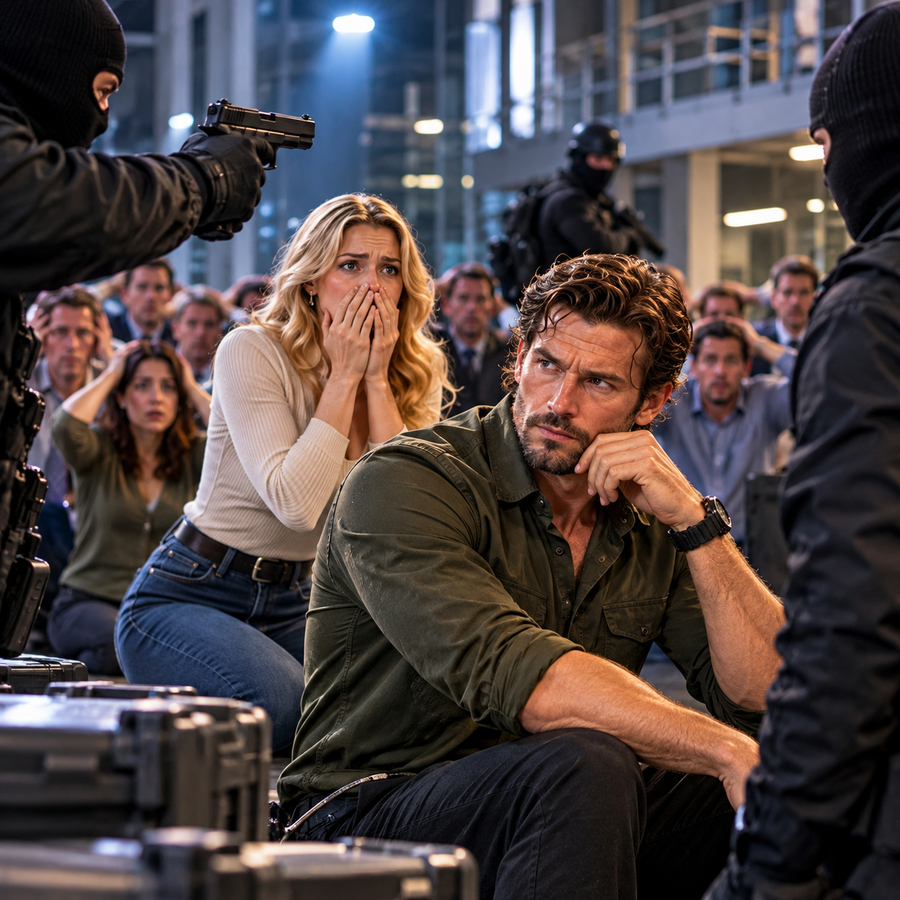
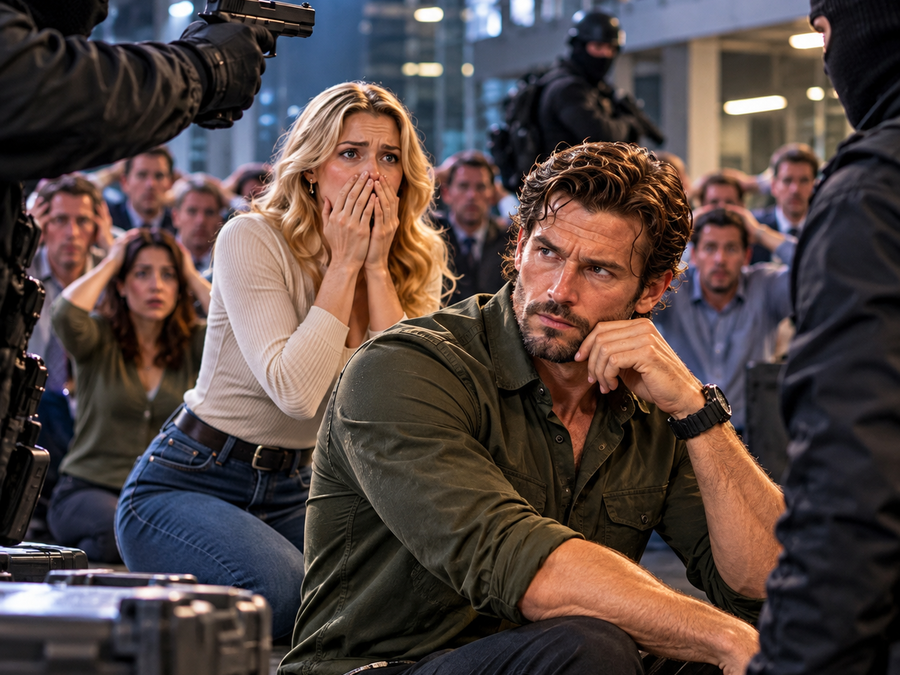
Three masked men had just locked the accounting floor when every person in the room began to panic.
Every person except Ethan Vale.
The single father stayed seated at the last desk in the row and his eyes never went to the dull metal pistol in the nearest man’s hand.
They went to that man’s shoes, his watch, and the distance between his shoulder and the stairwell door.
That stillness was exactly what made Claire Holloway scream that Ethan had to be working with them. Every face in the room turned toward him.
He did not defend himself.
He only said very softly, “Don’t make them change the plan.”
And the leader heard him.
If you like stories where an ordinary person hides a past nobody ever suspected, subscribe and stay with this one. Because what Ethan Vale is about to do does not begin with strength.
It begins with the things he notices long before anyone else in the room does.
The morning had started the way nearly every morning started in the small gray house on Wilder Street. With the smell of burnt toast and the sound of a 12-year-old girl arguing that cereal counted as a hot breakfast if you poured warm milk on it.
Ethan Vale scraped the black edges off two slices, buttered them anyway, and set them down in front of his daughter without a word. Sadie ate them.
He checked her backpack for the math worksheet she swore she had packed, found it under the couch, and slid it into the front pocket. At 7:41 she was walking through the school gate and he watched until she was inside the doors the way he always did.
He parked in the same spot every morning, level two, the space closest to the stairwell rather than the elevator bank, and he had never once explained that choice to anyone who asked.
He noticed as he pulled in that the maintenance van on level one had a temporary tag that had been temporary for 11 weeks.
He noticed that the south camera in the garage was aimed 3° higher than it had been in the spring so that it caught the ceiling pipes and missed the ramp. Then he locked the car, took the stairs, and stopped thinking about any of it.
Inside the building, he was, by every visible measure, the least interesting man on the fourth floor.
He wore the same three jackets in rotation, drank his coffee black because sugar made the afternoon slower, and kept a photograph of his daughter taped to the side of his monitor where clients could not see it.
His desk sat in the corner where two hallways met, which meant he could see both the main doors and the fire exit without turning his head. And nobody had ever asked why he had traded away a window seat to get there.
He left at 5:40 every day, not 5:39 and not 5:45, because dinner was at 6:15 and a 12-year-old deserved a father who showed up when he said he would.
Miles Ketter, 29 and incapable of silence, sat close enough to make Ethan his personal project. He called him the sleepy dad, the bunker guy, the man who probably had a year of canned peaches in his basement.
And Ethan absorbed all of it with the patient half smile of someone who had been called far worse by far harder men.
Claire Holloway, senior accountant, found him harder to laugh off. She believed that people who told you nothing were usually hiding something, and she said so at lunch more than once.
Victoria Blackwell, chief financial officer, had walked past his desk perhaps 200 times in 4 years and had never once used his name because Victoria had built an entire career on the belief that she could read a person in 9 seconds, and Ethan had registered as nothing. That Thursday gave him three small things, and he turned each of them over and set each of them down.
A delivery truck had backed into the loading dock at 10 past 11, which was wrong because the contracted carrier came Tuesdays and Fridays and never after 10:00 in the morning. The hallway camera outside the server corridor had been nudged so that its cone of vision ended a foot short of the door handle.
And a man in a charcoal windbreaker had crossed the lobby twice hours apart, unhurried both times. Any of those things was nothing.
A truck gets rescheduled. A camera gets bumped by a cleaning cart.
A man forgets which floor his dentist is on.
The last meeting of the day was called for 4:30 on the accounting floor because the final transaction ledgers could only be reached from the terminals on that level. 19 people filed into the long room with its glass wall and its bad carpet, and Victoria Blackwell arrived at 4:35 in a slate suit with the air of a woman who had come to apply pressure in person.
She wanted the reconciliation report signed tonight. Claire pushed back on two line items and was overruled.
Miles made a joke that landed on nobody. An older analyst named Walter Prime coughed into his sleeve and adjusted his glasses.
Ethan finished his portion at 5:28, closed his laptop, and calculated that if the elevator behaved, he could be home with 11 minutes to spare.
He was reaching for his jacket when the floor went dark in a way that lights alone do not go dark.
The monitors died first, then the hum of the ventilation, then the soft electronic breath of the building itself, and the emergency panels flickered up a second later in that sick amber that makes every face look ill. Claire pulled out her phone and found no signal at all, which was strange because the fourth floor had never had a dead zone.
Ethan did not move because his buddy had already gone quiet in a way he had not felt in 6 years, and his ears had already found the sound underneath the confusion.
The double click of the stairwell door being propped, not opened. Then the main doors swung wide, and three men in dark blue maintenance coveralls walked in with flashlights, and Ethan knew in less than 2 seconds that not one of them had ever fixed anything in this building.
It was the boots. Maintenance men at Blackridge wore soft-soled shoes because the tile on the executive floors scuffed, and these men wore lug soles with the tread still sharp.
It was the way they came through the doorway.
First man left, second man right, third man holding the threshold.
A wedge formation that no plumber has ever needed. The lead man was tall, maybe 38, with a close beard and a calm that Ethan recognized instantly because he had spent years cultivating the same thing in himself.
He raised one hand and the room stopped breathing.
“Phones on the table.”
He said.
“Nobody gets hurt if nobody gets creative.”
They worked fast and clean. One of them collected 19 phones into a canvas bag and set the bag on the floor by the door, which was a professional choice, not a greedy one.
The third stood at the fire exit with his back to the crash bar.
Everyone was told to sit on the floor along the inside wall, away from the windows.
And most of them did it so quickly they knocked chairs over.
Ethan sat, too, unhurried, choosing the end of the line nearest the supply cabinet, and he did not once raise his eyes above chest height on any of the three men. Looking at faces got you remembered.
Looking at hands kept you alive. The leader crouched in front of the row of employees with his forearms on his knees, the posture of a man settling in for a conversation.
“I’m going to ask one question.”
He said.
“And I’d like the shortest true answer anybody has.”
He let that sit.
“Where is the server that holds the third quarter transaction records?”
Nobody spoke. Walter Prime made a small sound and Ethan, keeping his face absolutely still, understood that the entire evening had just become something far more dangerous than a robbery.
Because men who wanted cash left when they had cash and men who wanted records did not leave until the records were gone or until somebody could no longer say where they were. So he began to work.
Three men visible and the sound of a fourth somewhere past the corridor door, faint and rhythmic, the noise of hands on a keyboard. The leader was right-handed but wore his radio on the right hip, which meant he expected to draw with his left and talk with his right, an unusual and deliberate arrangement.
The man by the fire exit had a tremor in his thumb and kept clearing his throat.
He was the newest and therefore the most likely to do something stupid. Ethan filed them in order of threat.
The leader, the sweeper, the man at the door.
Then he began counting seconds between the leader’s glances at his watch because a man who checks the time has a deadline and a deadline was a lever.
Claire Holloway saw none of that.
Claire saw a room of 19 terrified people and one man sitting against the wall with his hands loose on his knees and his breathing slow and the wrongness of it crawled up her spine. She had been shaking so hard that her teeth clicked and Ethan Vale, the quietest man in the department, looked less like a hostage than like someone waiting for a bus.
Then the leader walked the length of the row patting jacket pockets checking each person for a second device and when he reached Ethan he paused for half a breath, looked at him and moved on without touching him at all.
Claire’s mind did what frightened minds do.
It took two facts and welded them into a story because a story, even a terrible one, is easier to hold than chaos.
“Why isn’t he scared?”
she said and her voice came out far louder than she meant it to. Heads turned.
“Why isn’t he scared and why didn’t you check him?”
The words were out and there was no pulling them back.
“You know them?
You know them, don’t you?”
The room went so quiet that the amber light seemed to buzz. The leader stopped walking.
He turned around slowly and for the first time that evening he looked genuinely interested in something. Victoria Blackwell, who had been silent for 6 minutes out of sheer disbelief, found her voice and aimed it where she always aimed it, at whoever was weakest.
“He knows this building better than the fire marshal,” she said.
“He knows which exits are chained.
He told facilities about the west stairwell in March.”
Her tone had the certainty of a woman who had never been wrong out loud. 19 pairs of eyes settled on the man in the corner.
Ethan understood with a clarity that felt almost restful that he could not explain himself without dismantling the only life his daughter had ever known. So, he did not explain.
He looked at the floor between his shoes and he said the only sentence that mattered, pitched low and flat and entirely without heat.
Don’t make them change the plan.
Claire blinked.
Miles turned his head.
It sounded to everyone who heard it exactly like a man giving instructions to accomplices and Claire’s face went white with the horror of being right.
But Ethan had not been talking to the men in coveralls. He had been talking to the 19 people beside him and he had been telling them the truest thing he knew about hostage situations, which was that a plan in motion is survivable and a plan derailed is not.
The leader crossed the room and crouched down in front of him, close enough that Ethan could see the burn scar along the left thumb and the cheap dye job on the beard. Say that again, the man said.
Ethan raised his eyes, no higher than the collarbone.
If you’ve got a plan, run it, he said.
20 panicking people is a worse problem for you than for me.
Keep them calm, take what you came for and walk out. Nobody in this room can stop you.
Don’t give anyone a reason to try.
Something happened behind the leader’s eyes then, a recalculation.
They did not describe his operational risk back to him in complete sentences. He studied the man in front of him, the squared shoulders that had not slumped, the hands resting palm down instead of clenched, the left foot tucked back under the chair line in a position that would let him rise without using his hands.
He noted that Ethan had chosen the seat with the cabinet on one side hard cover and that his eyes had never once gone to the pistol.
Garrett, he said almost to himself the way a man introduces himself to an equal by accident.
Dale, he said over his shoulder. This one gets his own babysitter.
The man with the tremor in his thumb came over and stood 4 ft from Ethan with a barrel pointed at the carpet, and Claire made a small broken sound because she had just done that, and a part of her already knew it.
He looked at Dale’s stance, at the way the younger man’s weight settled back on his heels, at the 8 in of slack he kept letting the muzzle drift, and he made a small correction to the list in his head.
Dale had moved from third to first.
Frightened men with guns were always first.
From that point forward, Ethan stopped watching the robbery and started reading the room the way he had once read a compound through a scope for 11 hours without moving. The keyboard sounds from the corridor were steady and two-fingered, a man searching rather than a man retrieving.
That made four.
A radio on Garrett’s hip clicked twice, and twice again from the direction of the elevator lobby, and once from somewhere farther off, maybe the loading dock, maybe outside.
That meant five, and at least one of them was not in the building at all.
Garrett had used the freight elevator code without hesitating, and he had known the second-floor guard would be on his rounds at 5:15. No crew learned that from a floor plan.
Somebody inside Blackridge had handed these men the building.
He began doing the only work available to him, which was small and invisible and mattered enormously.
When Claire’s breathing climbed toward a scream, he tapped a rhythm on the floor beside her, four counts in, four counts out, until she matched it without knowing she was matching it.
He got Walter Prying turned so that the older man’s back was against the wall instead of the glass.
He moved half an inch at a time over 11 minutes until his own body sat between Dale and the largest cluster of people.
Not one of those movements would have looked like anything on camera.
Victoria Blackwell would not be managed.
She had spent her entire adult life in rooms where the loudest certainty won, and she stood up with her arms crossed and informed Garrett that the police were already outside, that the building’s silent alarm had tripped the instant the power failed, and that he had perhaps 4 minutes to decide how the rest of his life was going to look.
Ethan closed his eyes for a quarter of a second.
Garrett did not get angry. He smiled, and it was a tired, almost sympathetic smile, the smile of a man being told something he had solved 2 weeks earlier.
“The alarm didn’t trip,” he said.
“So was the redundancy.
Sit down, ma’am.
” For Ethan, that single sentence finished the picture.
Alarm panels at Blackridge were on a monitored circuit that reported its own silence within 90 seconds.
Taking one off the board required credentials, a service window, and a work order signed by an officer of the company.
This was not a break-in. This was a door being held open from the inside.
He glanced at Victoria as she lowered herself stiffly back to the floor, and he watched her face do something he had not expected, which was to go from outrage to a kind Garrett walked over to her and crouched the way he had crouched in front of Ethan.
“I need the encrypted archive,” he said.
“Third quarter.
Off-ledger routing, the subaccounts, the whole tree.
” Victoria said, with real and obvious honesty, that she did not have full administrative rights to that archive and never had, that it required dual authorization, that she was the chief financial officer and not a systems engineer.
Garrett nodded as though she had confirmed something.
Then he said quietly, without any particular malice, “Your brother does.
” The room did not understand.
Victoria did. The color went out of her face in a single wave, and 19 people watched the most controlled woman any of them had ever worked for stop being able to hold her own hands still.
Across the room, Miles Ketter was having a smaller revelation and an equally important one. He had been staring at Ethan for 10 minutes out of pure resentful fear, waiting for proof that Claire had been right, and instead he had noticed something strange.
Ethan’s monitor, dead and black, was angled just slightly toward him, and in its glassy surface you could see the whole width of the room.
Ethan’s head never turned, but his eyes moved constantly tracking the reflection of Dale behind him, of Garrett at the far wall, of the corridor door.
He was not sitting still because he was calm.
He was sitting still because sitting still was the best possible position from which to watch everything. And he had chosen that desk, Miles realized with a lurch, four years ago.
Miles leaned an inch closer and spoke without moving his lips, the way he had in high school detention.
“What did you do?”
he whispered, “before Blackridge.”
Dale shifted his feet. Somewhere down the corridor the two-fingered typing stopped and started again.
Ethan did not turn his head, and when he finally answered, his voice was so low that Miles had to reconstruct half of it afterward from memory.
“A job I don’t want to go back to,” he said.
By 6:15 the mood in the room had curdled, and Ethan felt it the way a sailor feels a pressure drop.
Garrett had gone into the corridor twice and come back with his jaw tighter each time. The archive was not where it was supposed to be.
Whatever the fourth man had been pulling off the server, it was incomplete, a directory of empty shells, a tree with the fruit already taken. He stopped in front of Victoria Blackwell.
“You moved it,” he said.
Victoria said nothing, which was the worst answer available.
Claire, meanwhile, was coming apart in a quieter direction.
Twice in the last 30 minutes Dale had taken a step toward the group, and Ethan had somehow been standing in the way.
Not blocking, just present, just there absorbing the man’s attention with a shift of his shoulders.
When Walter had needed to move his leg, it was Ethan who had asked permission in a voice so unthreatening that Dale had granted it without thinking.
Every single thing the accomplice she had invented would never do, this man kept doing. She stared at the floor and felt shame rise in her throat like something spoiled.
Then Walter Prine started to fail. He was 63.
He had been sitting on a hard floor for 90 minutes and terror had done what terror does to an older heart. His breath went fast and shallow and then stopped fitting into his chest at all.
He clawed at his collar.
His lips took on a grayish tint and his eyes went wide and animal. Dale stepped back and said to leave him, that he was faking, that everybody needed to stay down and his voice had climbed a full octave from where it had been at the start of the night.
Two people began to cry.
The whole room tipped toward the edge.
Ethan moved before anyone could decide to stop him, but he moved slowly with both palms above narrating every I’m going to sit next to him, he said.
I’m not standing up.
I’m not going near you.
Watch my hands.
He knelt at Walter’s side, put one hand flat on the man’s sternum and the other on his own and made him copy the rhythm.
In for four, hold for two, out for six. He told him to name four objects he could see and Walter between gasps named a chair, a stapler, a coffee cup, a fire alarm.
He kept the older man’s eyes on his own face away from Dale, away from the pistol and in 90 seconds the color came back into Walter’s mouth.
The room exhaled with him. Garrett had watched the entire thing from 8 ft away without moving.
When it was over he came and stood above Ethan and his voice had genuine curiosity in it now. Where does an accountant learn that?
Ethan did not answer. He settled Walter back against the wall, checked his pulse at the wrist with two fingers and returned to his own spot as though the question had been about the weather.
That non-answer told Garrett more than any sentence could have.
He began to watch Ethan the way Ethan had been watching him. He noted that the man never let his back face the door fully, that when he sat he kept one heel drawn in, that his hands stayed open and low and away from his own center line, that his eyes tracked the muzzle and not the face.
He noted the absence of tells that everyone else in the room had in abundance. No fidgeting, no bargaining, no eye contact begging for mercy.
Army, Garrett said.
Silence.
Marine, silence. He crouched down again and this time he spoke so quietly that only the two of them and Miles 4 ft away could hear it.
Seal.
Ethan’s face did not change, but something in his shoulders went a half degree more still the way water goes flat before a wave.
And Garrett saw it and knew.
What Garrett did not know, could not have known, was the rest of it.
That the man sitting on the floor in a department store jacket had once been a lieutenant commander. That he had carried a team through 11 day deployments.
That there were men alive on three continents who would have driven all night if he had called.
Because he never called, he had not spoken to any of them in 6 years. Not since a night in a dry riverbed where the intelligence had been wrong by 4 hours and 100 m.
And he had made the call to pull back. It had been the right call.
Every review said so. Every officer said so.
The mathematics of it were unarguable.
But Caleb Roe had gone back for a radio that turned out to be nothing.
And Caleb Roe had not come out.
And Ethan Vale had spent every day since carrying the arithmetic of a decision that was correct and still cost a man with two kids and a laugh that carried across a whole hangar. He had handed in his papers 11 weeks later.
He had promised himself standing in a hospital hallway holding a newborn while his wife slept that Sadie’s life would never be organized around violence.
Sadie was at Mrs.Aldean’s house right now with a math worksheet and a pizza she had been promised.
She would start looking at the clock around 7:00. She would not be scared until 8:00.
And 19 people in this room who did not know that the quietest man in accounting had ever done anything more dangerous than reconcile a ledger were now depending entirely on whether he was willing to break the only promise he had
ever kept.
He was still turning that over when Garrett’s earpiece leaked.
It happened for less than 2 seconds, a burst of tinny sound when the man leaned down to pick up a dropped flashlight and the piece came loose from his ear.
And Ethan was the only one close enough and quiet enough to catch the words.
A man’s voice, older, clipped, accustomed to giving orders and having them obeyed.
Blackwell says leave no copy behind. Garrett pushed the earpiece back in and straightened and he did not realize what had gotten out.
Ethan sat with it.
The voice had not been a hired coordinator in a van on 9th Street. The voice had been comfortable, unhurried.
The voice of a man who was not sweating and under it. Faintly, Ethan had heard the double chime of an executive elevator arriving.
That chime existed on exactly one floor of this building. Whoever was directing this was not outside the perimeter waiting for a call.
He was upstairs, three levels above their heads, sitting in an office with a view of the river. The last pieces came together over the next 20 minutes and Ethan assembled them without a single note.
The three consulting entities from the June reconciliation.
The routing codes Garrett kept reciting, which were not account numbers but internal transfer references, the kind that only appeared in a reconciliation worksheet and never on a bank statement.
The fact that the crew wanted not to copy the archive but to erase it, which no thief ever wanted because stolen data had value and destroyed data had only one purpose, which was protection.
This was not a heist, it was a cleanup. He also understood, finally, why Victoria Blackwell had gone gray.
When Garrett read off a reference string ending in 441, she flinched half a second before anyone could have processed the numbers.
And a person only flinches early at a thing they already know. Ethan spoke to her for the first time all evening from 6 feet away, so quietly that Dale only saw lips move.
“You found it,” he said, “months ago, and you didn’t report it.”
Victoria’s mouth opened and closed.
Then, with the strange relief of a person setting down something heavy, she told him.
She had noticed the irregularities in February, transfers to three entities that provided nothing, invoiced nothing, and existed only as mailing addresses.
She had traced them for 6 weeks.
They led to Preston, her older brother, the man who had held her hand at their father’s funeral and told her the family name was the only asset that never depreciated.
She had frozen. Reporting him meant regulators, headlines, a collapse in valuation, 400 employees, and the end of 91 years of a name she had been raised to protect like a religion.
So, she had done the coward’s compromise.
She had made a copy of everything and told no one, and she had convinced herself that holding the evidence was the same as acting on it.
Ethan’s stomach went cold because he knew where it was.
8:15 that morning, Victoria had come down with a hard-shelled case and handed it to her assistant, Nora, who had put it away and gone to a dentist appointment at 4:00.
It was the second drawer of the credenza behind the printer station, 8 m from where Garrett was standing, and it contained a black encrypted drive in a gray foam cutout.
The moment those men opened that drawer, every person in this room stopped being a complication and started being a witness. The math was that simple and that bad.
He made his decision then quietly, between one breath and the next, the way he had made every decision that had ever mattered. But, he did not make it as a man who intended to fight four armed professionals alone, because that was how people died in movies and nowhere else.
He made it as a team leader with four assets and 80 seconds of planning time, and he started passing instructions in fragments under cover of a coughing fit, a dropped pen, a request to move a chair. Miles first, because Miles was closest to the lighting controller behind the unmarked access door beside the copier.
Cycling it would throw the entire level into a strobing dark for roughly 12 seconds.
Miles, who had never in his life been asked to do something that mattered, listened to the whispered instruction twice and then nodded with his whole body.
Claire, second.
When the lights went, she was to get every person on their feet and moving toward the northeast fire door. Not running, hands on the shoulder of the person ahead, no voices.
Victoria, third, and her job was the hardest one. Keep Garrett talking, keep his eyes on her face, and do not stop no matter what she heard behind her.
And you?
Claire whispered.
She was looking straight at him now, and her eyes were red and furious and ashamed all at once.
That’s four people and three of them are terrified.
Do you actually think you can do this?
Ethan looked back at her for a moment, and something almost like warmth moved across his face.
“No,” he said.
“I think we can.
” It was, she would say later, the first moment she understood what kind of man she had accused.
Not because he was capable.
Because he had answered in the plural. They needed 90 more seconds.
They got 40.
Fourth man came out of the corridor, frustrated and empty-handed, walked past the printer station, and stopped in front of the credenza. He put his hand on the second drawer and pulled.
Ethan was already moving, and what he did first was not heroic in any way that would look good in a photograph. He knocked over a tray.
It was an accident in every visible respect.
A man shifting his weight, an elbow catching the edge of a wire basket full of quarterly filings, and then 400 pages of paper sliding across the carpet with a sound like a wave breaking. Every head in the room turned toward the noise, including the man at the credenza, who let the drawer slide shut against his hip.
Two like that, two seconds, was a country. Victoria Blackwell chose that instant to do the bravest thing she had ever done, which was to stand up and start an argument.
She told Garrett she would give him the routing tree, all of it right now if he told her who hired him. And she said it with so much of her old imperious contempt that he turned his whole body toward her.
She was buying seconds with the only currency she had left.
And Miles Ketter, 29 years old, who had spent 4 years calling a war veteran the sleepy dad, crawled 11 ft on his stomach to a beige access door and cycled the emergency lighting controller exactly the way he had been told. The floor went black, then flickered, then began to strobe in long amber pulses, light and dark, light and dark.
And in that broken rhythm, the human eye cannot hold a target or judge a distance.
For the 19 people on the carpet, it was terror.
For the four men in coveralls, it was chaos.
For Ethan Vale, it was, God help him, something close to home. What came back was not rage.
That was the part nobody who had never done it understood. What came back was a flat, cold, total focus.
A narrowing of the world into a list with an order to it, and a body that had done this 10,000 times moving before the thinking part had finished forming words. He did not try to take all four.
He took the first one off the board by taking away what made him a threat to a room of civilians, which was not his weapon, but his ability to coordinate.
Two steps in the dark, a hand on the radio at Dale’s belt, a turn of the younger man’s wrist that ended with the pistol pointed at the ceiling and then at nothing.
And Dale on the floor with the breath knocked out of him and no way to call anyone. The second, he simply removed.
The man at the fire door came toward the noise, and Ethan let him come, used the strobe to disappear against the dark side of a column, and then put him through the northeast stairwell door and let the fire rating do the rest.
That door locked from the stair side, and a 2-hour fire barrier does not care how strong you are.
The third, he did not touch at all.
He knocked a chair into the aisle and killed the strobe controller’s rhythm with a second cycle, and the man abandoned a perfectly good corner of the room in order to find better ground, which was precisely the point because the corner he abandoned was the one covering the exit route.
Every movement served one goal, and it was not victory.
It was a hallway with 19 people in it.
“Now,” Ethan said, not loudly, and Claire Holloway found out what she was made of.
She got Walter up. She got the crying analyst from payroll up.
She put hands on shoulders down the line like a kindergarten field trip, and she walked them through the dark toward the northeast door while Miles held it open with his back and counted heads out loud in a shaking voice. 16, 17, 18.
Victoria would not go.
She was 6 ft from the credenza, and she was still arguing.
And when Ethan reached her, she pulled her arm back and said the drive was the only thing that would ever put her brother in a courtroom, that without it this had all been for nothing, that she had to take it. Ethan closed his hand around her elbow and turned her toward the door in one motion that broke no discussion.
“Data can be recovered,” he said.
“People can’t.”
She went.
Garrett came at him in the file room.
He had backed Ethan into it by moving along the wall, and he was the last one standing, and he was smart enough to know that the narrow space between two rows of shelving took away angles and reach. He was younger.
He was heavier. He had fought for money on four continents, but he had also spent the last 2 minutes losing his crew in the dark.
And he came in with anger where his discipline should have been, and Ethan had been reading his shoulders for 2 hours.
It was short. It was not cinematic.
There were no speeches, and nothing spun through the air.
Ethan gave ground twice because giving ground in a corridor costs nothing. Let the bigger man commit.
Moved inside the arc where a swing has no power, and used a shelf upright and 40 years of gravity to take the fight to the floor.
It ended with Garrett’s wrist locked at an angle wrists do not go, and the pistol, which had been empty of its magazine since the second time Ethan had passed behind him, skittering across the tile.
Who were Garrett said into the floor with real bewilderment.
Ethan let him up because holding him meant standing in this room while 19 people stood in the stairwell.
Today, he said, “I’m the guy from accounting.”
Garrett ran. Ethan let him, and that was choice that told you everything about the man.
Every instinct built into him over 9 years said pursue, finish, control the threat. Instead, he turned and walked back out into the strobing dark, checked the room corner by corner, found a temp named Rosa curled under a desk who had never made it into the line, and carried her out to the stairwell himself.
Then he counted, 19.
He counted again.
The first officers were coming up the west stairs by then, and Ethan handed off the floor with the clipped, useless-sounding precision of a man who had done exactly this before. Four hostiles secured on floor four.
One locked in the northeast stair.
One unaccounted for.
One moving up.
Because he had seen it in the last half second before he turned to check the room, Garrett had not gone down.
He had gone up, and there was only one thing on the upper floors worth going to.
Ethan took the east stairs three at a time, and he did not do it because he wanted to catch Garrett. He did it because he had put the pieces together at the stairwell door, and understood what was about to happen in an executive office with no witnesses.
Garrett Voss had been hired to erase a record. Garrett Voss had failed, and a man like Preston Blackwell did not pay for failure.
He reassigned it. Somewhere in the paperwork of this evening, there was already a story in which four armed intruders had broken into Blackridge Capital, and Garrett had just realized that he was not the contractor in that story.
He was the explanation.
Ethan called the location in as he climbed, precisely floor and stairwell and estimated time because he had no intention of solving this himself. Then he came out onto the seventh floor into a silence so complete it felt staged.
A single office at the end of the corridor glowed and its door was open and Preston Blackwell was standing behind his desk in a full suit with his tie still knotted at 7:50 on a Thursday night in a building whose power had been out for 2 and 1/2 hours, Garrett was already there. He stood in the middle of
the room with his coveralls open at the throat and blood on his knuckles and he was not shouting.
That was the frightening part.
“The archive wasn’t on the server.”
He said, “You knew that.”
Preston to his credit or his damnation did not flinch.
He spoke the way he probably spoke to junior partners with a kind of weary distaste and told Garrett that he had been hired to complete a task and had not completed it and that men who failed do not get to make demands. Ethan stopped in the doorway and did the only thing that mattered which was nothing at all.
He stayed visible, hands open, and let two guilty men talk because every sentence they spoke was a minute closer to a stairwell full of federal agents and a minute further from anyone getting shot. Garrett laid it out with the bitter clarity of a man who has just seen his own ending.
Preston had been moving money out of Blackridge for 6 years through shells he controlled, somewhere north of $40 million.
Victoria had traced it in the spring. And in the version of the night Preston had already drafted, the crew had come for the acquisition data, the board had been victimized, and every irregularity in 6 years of ledgers would be attributed to an intrusion by men who would conveniently be in custody or dead.
“You were never going to pay me.”
Garrett said said.
Preston saw Ethan in the doorway then and he did what men like him always do which is reach for the story that makes the room his.
He said loudly, for the benefit of whoever was coming down the hall, that this man was a dangerous former operator who had escalated a containable situation, that he had assaulted people, that Blackridge could not be held responsible for a violent veteran in its accounting department.
It died in about 90 seconds because Claire Holloway and Miles Keter and 17 other people were at that moment standing on the sidewalk describing over and over a man who had knelt on the floor to keep Walter Prying breathing and had put himself between a gun and a row of co-workers for 2 hours.
The tactical team came through the corridor in a wedge. Garrett Voss, who understood better than anyone in the building what a closed perimeter meant, put his hands flat on his head and went down to his knees without being told twice.
Preston Blackwell was still talking when they cuffed him.
The drive came out of the second drawer of the credenza at 11:40 that night and the forensic image of its contents would, over the following 11 months, put a 91-year-old family name in a federal indictment. Ethan was sitting on a stair with a blanket he had not asked for when it happened.
A federal agent came down the line checking names, got to him, looked at the tablet in her hand, looked again, and then said, in a completely different voice, “Lieutenant Commander Vail.”
The stairwell went quiet. Claire, who had come back in with a medic, stopped walking.
Miles said, “What?”
out loud to nobody.
Victoria Blackwell, standing four steps up with her suit jacket gone and her hands still trembling, stared at the man whose name she had not bothered to learn in 4 years and understood that he had once commanded the kind of teams most people only knew from films.
Ethan did not answer the question.
He stood up, let the blanket fall onto the step, and asked the only thing he had wanted to know since 6:00.
“Is everyone out?”
he said.
“All 19?”
The agent, after a beat, said yes.
He nodded once and asked if he could go home.
The investigation swallowed Blackridge Capital Services for most of the following year. Preston Blackwell was charged with wire fraud, money laundering, conspiracy, and obstruction, and his attorney spent eight months trying and failing to characterize a hired intrusion crew as an unrelated event.
The building changed its locks, its badge system, and its alarm vendor, and the parking garage got four new cameras aimed at the ramp instead of the ceiling. Victoria Blackwell resigned as chief financial officer in the second week of the inquiry, and she did not fight it because there was nothing to fight.
She had found the fraud in February, and she had sat on it until October, and 400 people had gone to work every day inside a company she knew was being hollowed out.
She was not a villain, and she was never charged, and the copy she had made in secret became the spine of the government’s case.
She testified for 3 days and did not once try to make herself look better than she was. But she had learned at 46 the price of protecting a name instead of the people who worked under it, and she paid it.
She never returned to finance.
Claire Holloway came to find Ethan on a Tuesday 11 days after in the break room of a temporary office on the other side of the river.
She had rehearsed an apology for a week, and none of it came out in order. She said that she had been so frightened she could not think, and that her mind had gone looking for something to hold on to, and that it had grabbed the only person in the room who was not screaming and called him a monster.
Then she ran out of words and stood there with her hands at her sides waiting. Ethan poured her a cup of coffee she had not asked for and pushed it across the counter.
“When people are scared,” he said, “they need an answer fast.
Fast answers are usually wrong ones.”
He said it without any edge at all, the way a man states a thing he has known for a long time.
“You got everyone to that door in the dark.
That’s what I’ll remember.”
Claire cried a little, and he let her.
And then they talked about nothing for 10 minutes, which was its own kind of forgiveness.
Miles had a different question, and he asked it a month later over bad sandwiches. He wanted to know why a former team leader, a man with a record like that, could walk into private security consulting, federal work, anything, and instead he had spent 4 years reconciling sub-ledgers in a beige office and being teased by a guy 9
years younger than him.
“Why accounting?”
Miles said.
“Honestly, why this?”
Ethan thought about it long enough that Miles assumed he would not answer.
Then he said that for almost a decade every decision he made had a chance of meaning somebody did not come home, and that a person can carry that for a certain number of years and not one year more. He said that at 5:40 every day he closed a laptop, and nothing he had done that day would follow him into his kitchen, and that this was not a small thing, it was the entire thing.
“Not everyone who served wants to keep living like a soldier,” he said.
“Sometimes the thing they want most is to be ordinary.
” Sadie looked up at the flashing lights, then at her father, then at the pizza.
“You worked late again,” she said in the tone of a girl who has decided to be generous about it.
Ethan looked back at the building for a second, at the dark windows of the fourth floor, at the stairwell door propped open with a fire extinguisher. Then he sat down on the wall beside her and took the box.
“Yeah,” he said.
“Lot of paperwork today.”
They walked home.
Behind them, Claire Holloway stood at the edge of the barricade and watched them go, a tall, quiet man and a 12-year-old girl arguing about whether pepperoni counted as a vegetable, and she finally understood the thing she had gotten wrong at 6:00 that evening.
Ethan Vale had never been calm because he did not know how to be afraid.
He had been calm because he knew better than anyone else in that room exactly what fear can talk a person into doing. Maybe the most remarkable thing about Ethan Vale was not the past he carried, but the fact that he never needed it to prove who he was.
They doubted him for the simple crime of reacting differently than they did, and in the end that difference was what carried every one of them out of a dark room alive. We know so little about the people who sit beside us every day, about the battles they have already fought, the losses they do not name, and the reasons they choose to live quietly.
Before you decide who someone is because they did not panic the way you did, give them one more moment.