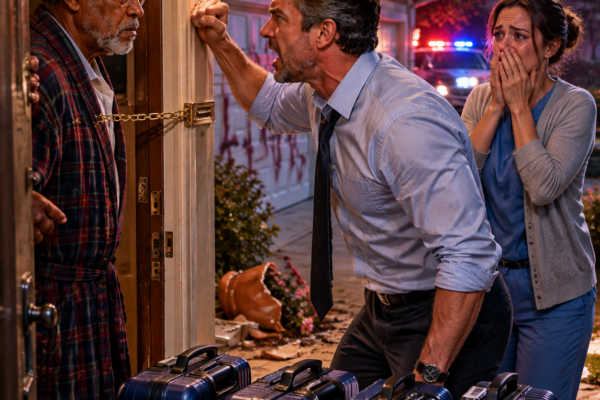
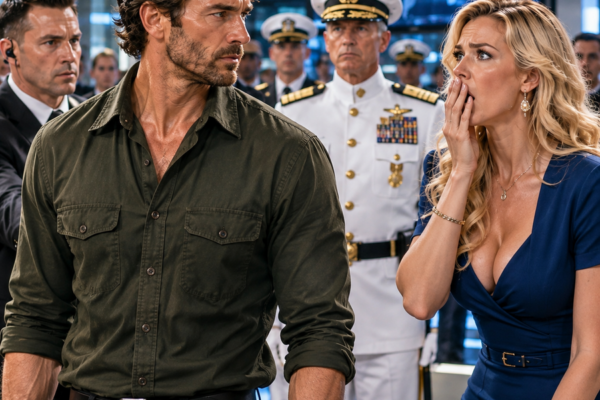
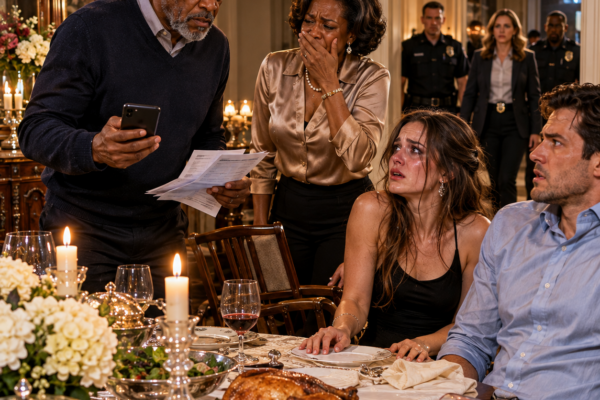
The CEO Laughed at Her Single Dad Driver—Until the President Called Him “Ghost One”
The CEO Laughed at Her Single Dad Driver—Until the President Called Him “Ghost One”
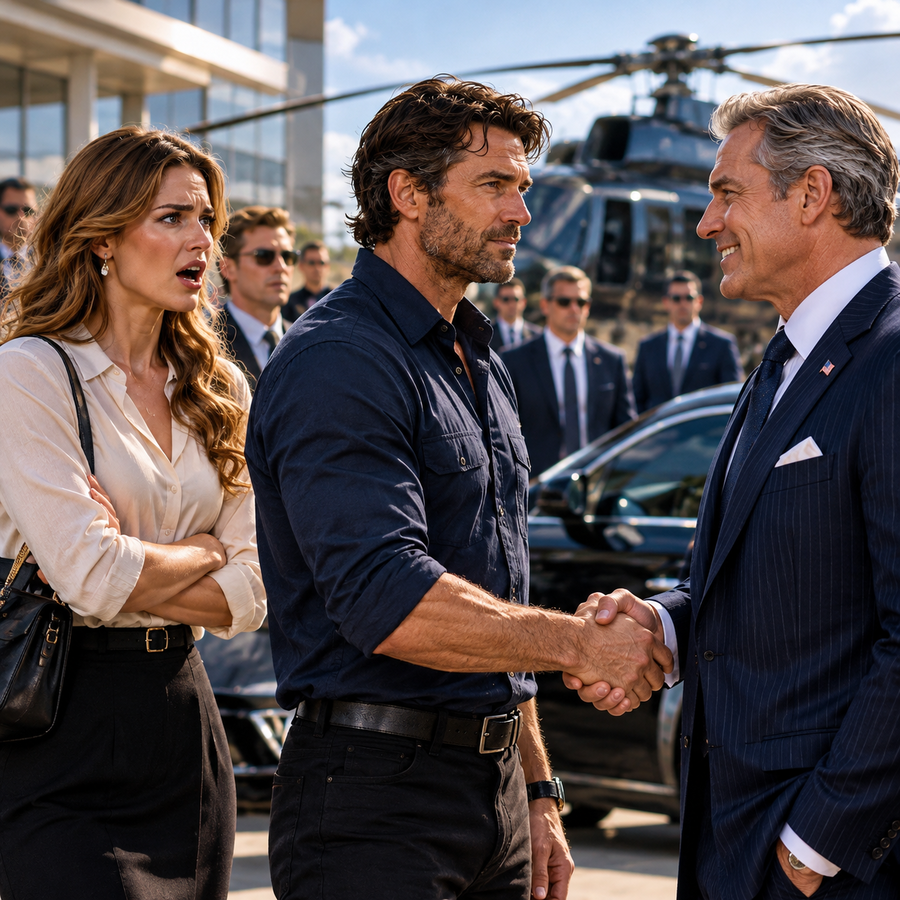
Everyone believed Mason Cross was nothing more than a quiet, middle-aged driver, a man who opened car doors and said little else.
Even Evelyn Hart, the powerful young chief executive he worked for, scolded him openly in front of her whole staff, reminding him more than once that he was only a driver and should never forget his place.
But when the motorcade rolled through the gates of the Air Force base, hundreds of soldiers snapped to attention as one.
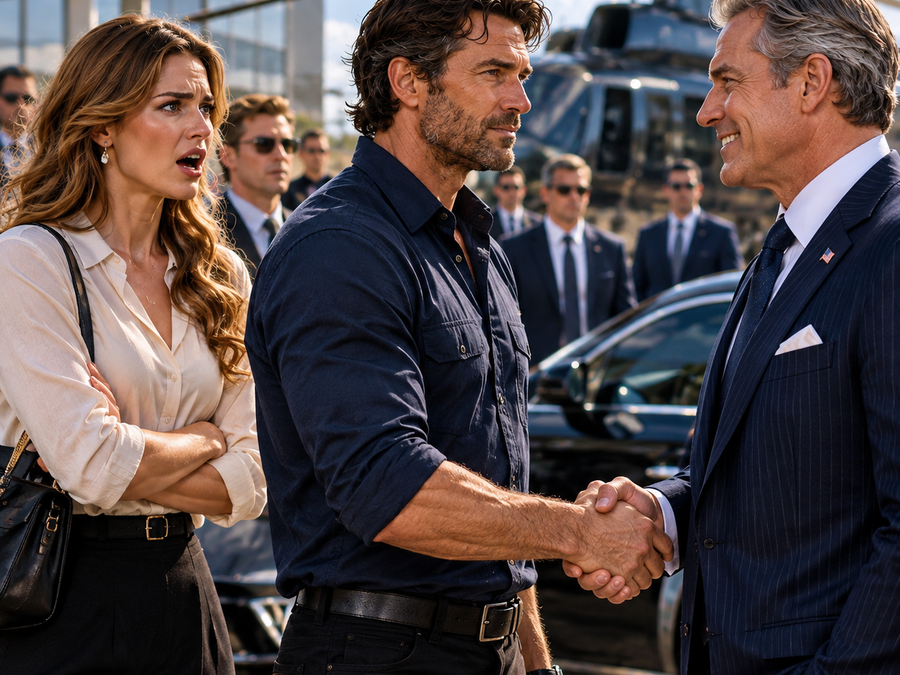
The presidential helicopter touched down in a storm of dust and the president of the country walked past every executive in that convoy straight toward the driver, gripped his hand, and spoke six words that silenced the entire base.
Welcome back.
Ghost One. In that frozen moment, Evelyn Hart understood that she had spent months insulting a living legend.
Mason Cross was 38 years old, and to anyone who glanced at him, he seemed almost deliberately unremarkable. He wore plain button shirts, dark slacks that had been pressed too many times to count, and a pair of scuffed leather shoes that had clearly walked more miles than most people drove in a year.
He arrived at Hart Global Logistics every morning at exactly 5:45, parked the black sedan in the same spot beneath the same oak tree, and waited without complaint until he was needed.
He rarely spoke unless spoken to. He never joined the office gossip near the coffee machine, never lingered by the elevators to make small talk, and never once asked for anything beyond what his job required.
To the receptionists and junior staff, he was simply a fixture of the building, as unremarkable as the potted plants in the lobby or the elevator music that nobody actually listened to. Nobody asked where he had come from.
Nobody asked what he had done before this job. He was, in the eyes of nearly everyone at Hart Global, invisible.
He lived alone in a modest rented house on the quiet edge of town, a place with a small garden he tended on weekends and a single framed photograph on the mantel that nobody from the office had ever seen. He kept his past folded away as carefully as his shirts, ironed and put out of sight, never mentioned, never explained.
When co-workers occasionally asked, out of politeness rather than genuine curiosity, whether he had always worked as a driver, he would simply say that he had done many things before this job and leave it there, offering nothing
further. And most people were too consumed by their own concerns to press him for more.
Evelyn Hart was 36, sharp-featured, and carried herself with the practiced confidence of someone who had clawed her way to the top of a family empire and intended never to be seen as anything less than its rightful ruler.
She had inherited the company from her father only 3 years earlier and in that short time she had doubled its logistics contracts, expanded into two new continents, and developed a reputation for being brilliant, decisive, and utterly without patience for weakness.
She believed, with the kind of certainty that only comes from never having been proven wrong, that a person’s position in life was a mirror of their competence.
Executives sat in boardrooms because they had earned it. Drivers sat behind steering wheels because that was the extent of what they could offer.
It was not cruelty, exactly, that drove her behavior toward Mason.
It was something colder, an assumption so deeply rooted that she never thought to question it.
On the morning the story truly begins, Evelyn stood outside the glass doors of Hart Global’s headquarters, tapping the toe of her heel against the pavement while Mason came around to open the rear door of the sedan.
He was perhaps 3 seconds slower than usual, having paused to check that a loose stone had not scratched the paint, and those 3 seconds were enough to spark her irritation.
“Driving is the entire job,” she said, sliding into the backseat without waiting for his hand.
“There is no reason it should take this long.”
One of her junior managers, a young man named Grant Foster, who had learned early that laughing at Evelyn’s jokes was the fastest path to a promotion, chuckled as he climbed in beside her.
“He has probably never set foot inside a real boardroom in his life,” Grant said, loud enough for Mason to hear through the open door.
“Some men are built for the wheel and nothing else.”
Mason said nothing.
He simply closed the door with the same careful precision he brought to everything, walked around to the driver’s seat, and pulled the car smoothly onto the road.
If the words had landed anywhere inside him, his face did not show it.
He merely checked his mirrors, adjusted the temperature at Evelyn’s request without being asked twice, and drove.
By the end of that week, the pattern had become so consistent that even the newer employees at Hart Global had absorbed it without needing an explanation. Mason Cross was the driver.
He existed at the edges of every meeting, every trip, every crisis, and he was expected to remain exactly there, at the edges, saying nothing, wanting nothing, and certainly never being noticed. The convoy that would soon carry Evelyn and her senior staff toward the air force base for a major defense contract negotiation was assembling that very afternoon, and nobody in the company imagined that the trip would end with the ground shifting beneath every assumption they had ever made about the
man behind the wheel.
The drive to the base was scheduled to take just under 3 hours, winding through farmland, and eventually along a restricted military corridor that few civilian vehicles were ever permitted to use.
Evelyn had insisted on being in the lead car, flanked by two additional vehicles carrying her legal team and a handful of junior executives eager to prove themselves during the negotiation.
From the moment the convoy pulled out of the city, she treated Mason less like a professional and more like an extension of the car itself, something to be directed rather than addressed.
“Take the north route,” she said without looking up from her tablet.
“It will save time.
The south route is faster today.”
Mason replied evenly.
“There is a checkpoint delay on the north road this week.”
“I did not ask for your opinion on the route.”
Evelyn said.
“I gave you an instruction.”
He adjusted the wheel without another word and took the north road exactly as she demanded. 20 minutes later, they sat motionless behind a line of military transport trucks, the very checkpoint delay he had mentioned, stretching the wait to nearly 40 minutes.
Evelyn said nothing about her mistake. She simply drummed her fingers against the armrest and blamed the delay on poor planning by someone else entirely.
Paige Whitfield checked her watch for what must have been the 10th time in 10 minutes, sighing loudly enough for the entire car to hear.
“At this rate, we will walk into that base looking like we cannot manage our own schedule,” she said, glancing pointedly at the back of Mason’s head as though the delay were somehow a personal failure on his part.
Rather than the direct result of the route Evelyn had insisted upon. Mason kept his eyes forward, watching the line of trucks ahead with the same patient attention he gave to everything.
He did not point out that he had warned them.
He did not sigh, did not shift in his seat, did not offer the smallest gesture that might have been read as frustration.
He simply waited, engine idling, hands resting lightly on the wheel, until the convoy of trucks finally began to move and the road opened again in front of them. Grant leaned forward slightly, addressing Mason directly for the first time that morning.
“Next time maybe flash your credentials at the gate.
” He said with a short laugh, glancing sideways at Paige for approval.
“Might speed things along.”
Mason offered no response beyond a faint, unreadable expression that might have been amusement, or might have been something far more complicated, and the car rolled forward into the widening afternoon light.
Further along the highway, as the convoy merged back into open road, Mason noticed something in the far distance that made his posture change almost imperceptibly.
“There is military transport ahead, moving faster than usual.”
he said.
“It might be worth slowing our pace.”
“That is not your concern.”
Evelyn snapped, barely glancing up.
“Just drive, and let the people in this car handle decisions that matter.”
From the backseat, one of the junior lawyers, a woman named Paige Whitfield, leaned toward her colleague and murmured just loud enough to be heard.
“Listen to him, acting like some kind of tactical advisor.
Next he will tell us how to negotiate the contract, too.”
The others in the car laughed quietly, and Mason’s jaw tightened for the briefest instant before settling back into its usual calm.
He said nothing further.
He merely eased the car’s speed down exactly the amount he had recommended, without asking permission this time, and continued driving with the same steady hands that had, unknown to anyone in that vehicle, once guided far more dangerous machines through far more
dangerous places.
It was during this stretch of silence that anyone paying close attention might have noticed something unusual about the man behind the wheel.
He never once checked a map, though the roads beyond the checkpoint were poorly marked and rarely traveled by civilians.
He seemed to know, with an unnerving precision, exactly when a checkpoint would appear, exactly which lanes would be congested, and exactly how fast military vehicles moved through this particular stretch of countryside. He watched the mirrors, not the way a nervous driver watches for hazards, but the way a soldier watches for threats, scanning in patterns, checking blind spots at intervals that seemed almost rehearsed.
None of the passengers noticed.
They were too absorbed in contracts, in complaints about the delay, in idle jokes about the man doing all the actual work of getting them where they needed to go. By the time the convoy reached the outer perimeter of the Air Force base, the sun had begun its slow descent toward the horizon, casting long shadows across the checkpoint gate.
Evelyn straightened her jacket, reviewed her notes one final time, and prepared herself for what she believed would be the most important negotiation of her career. She had no idea that the true center of attention that day would not be her at all.
The gate itself was an imposing structure of reinforced steel and concrete, manned by soldiers whose faces betrayed nothing as the convoy approached. Mason slowed the car and rolled down his window as a young sergeant stepped forward to check identification.
The sergeant leaned down, glanced at the paperwork Evelyn’s assistant handed through the window, and then, almost as an afterthought, looked past the paperwork directly at the driver.
What happened next confused everyone in the car.
The sergeant’s eyes widened slightly.
He straightened his back, took half a step away from the vehicle, and rendered a salute so crisp and immediate that it seemed almost involuntary, as though his body had reacted before his mind fully processed what he was seeing.
He held the salute for a long moment, his gaze fixed on Mason with an intensity that had nothing to do with routine procedure.
Mason offered only a small, controlled nod in return, the kind of gesture a man might give when he wanted to acknowledge something without inviting further conversation. Evelyn frowned from the backseat.
What was that about?
She asked, mostly to herself.
Probably a mistake, Grant offered, though his voice carried less certainty than before.
Maybe he thought Mason was someone else. Nobody had a better explanation, so the convoy proceeded through the gate and into the base itself, though the sergeant remained standing at the checkpoint for several seconds after they passed, watching the black sedan disappear down the access road with an expression that mixed disbelief and something close to reverence.
Inside the
base, the strangeness only deepened as the convoy rolled toward the administrative building where the negotiation was set to take place. A colonel emerged from a nearby hangar, clearly intending to greet the visiting delegation.
His eyes swept over Evelyn and her team with polite but distant professionalism. The kind reserved for important civilians who required careful handling but little genuine interest.
Then his gaze landed on Mason, who had stepped out to open the rear door, and the colonel froze mid-stride.
He took several steps toward the sedan, his mouth opening as though he intended to speak, perhaps even to embrace the man he was looking at.
Mason gave the smallest shake of his head, almost invisible unless someone was watching closely, and the colonel stopped himself, swallowing whatever words had risen in his throat.
Instead, he simply nodded once, deeply, the kind of nod that carried more meaning than any sentence could have.
They must know each other, Evelyn muttered, though the thought struck her as almost absurd even as she said it. A base colonel and her driver, acquainted somehow, in some way that clearly ran deeper than a passing professional courtesy.
As the group moved through the base toward the conference building, more strange moments accumulated.
A group of younger officers walking past paused mid-conversation when they noticed Mason, their eyes following him with unmistakable respect, though none of them said a word.
An older maintenance worker crossing the tarmac stopped entirely, removed his cap, and pressed it against his chest for a brief moment before continuing on his way.
Nobody explained anything.
Nobody offered a single word of clarification. The atmosphere around Mason had shifted from ordinary to something charged with unspoken history.
And Evelyn found herself increasingly unsettled by a mystery she could not begin to name.
She was still turning the strange encounters over in her mind when an announcement crackled across the base’s public address system, informing all personnel that the presidential helicopter would be landing within the hour for an unscheduled visit tied to matters of national security.
Evelyn’s irritation at the disruption to her carefully planned negotiation was quickly overtaken by a different feeling entirely.
A creeping unease she could not quite place, though she told herself it was simply the natural nervousness of being in proximity to such power.
The base seemed to hold its breath in the final minutes before the helicopter’s arrival.
Soldiers formed neat lines along the tarmac.
Officers straightened their uniforms and checked their posture one final time. Even the wind seemed to still, as though the entire installation understood the weight of what was about to happen.
Evelyn and her team were ushered toward a designated viewing area near the edge of the runway, close enough to witness the arrival, but far enough to remain appropriately deferential. Mason stood slightly apart from the group, as he always did.
His hands folded in front of him. His expression unreadable.
The helicopter appeared first as a distant speck against the darkening sky, then grew larger with startling speed, its blades cutting the air with a deep, rhythmic thunder that vibrated through the ground itself. Dust and loose gravel swirled upward as it descended onto the tarmac, and for a long moment nothing existed except the roar of the engines and the storm of wind pressing against every person standing nearby.
When the blades finally slowed and the door of the helicopter swung open, the president of the country stepped out, flanked by two security officers who scanned the crowd with practiced efficiency.
He was a tall man in his 60s, silver-haired, carrying himself with the calm authority of someone who had weathered decades of crisis and emerged each time more certain of his purpose.
He paused at the base of the helicopter steps, surveying the assembled crowd, and every soldier on that tarmac snapped to full attention.
A wave of motion rippling outward like a current through water.
Evelyn straightened instinctively, smoothing the front of her jacket, preparing herself for the moment she had been anticipating for weeks, the moment when the most powerful man in the country would acknowledge her company’s contribution to national defense logistics.
She took half a step forward, ready to extend her hand, but the president did not look at her at all. His eyes swept across the crowd and locked instead onto a figure standing quietly near the edge of the group, a man in a plain button shirt and dark slacks who had spent the entire journey being dismissed, overlooked, and reduced to nothing more than a set of capable hands on a steering wheel.
The president’s expression shifted in an instant, transforming from formal composure into something raw and deeply personal, an emotion too large to fully contain.
He walked past the executives, past the assistants, past the entire delegation that had traveled hundreds of miles specifically to secure his attention, and he did not stop until he stood directly in front of Mason Cross.
For a moment, nobody moved.
The wind had died down enough that the silence felt almost physical, pressing against every person on that tarmac.
Then the president reached out and gripped Mason’s hand with both of his own, holding it the way a man holds something he never expected to touch again.
His eyes glistened and when he finally spoke, his voice carried across the stunned silence with unmistakable clarity.
“Welcome back, Ghost One.
” The words landed like a detonation.
Every soldier within earshot straightened further, if such a thing were even possible.
A ripple of astonished murmurs spread through the ranks, quickly silenced by the discipline that held them in place. Evelyn stood frozen, her outstretched hand slowly lowering as she tried and failed to process what she had just witnessed.
Grant Foster’s mouth hung open.
Page Whitfield looked from the president to Mason and back again, as though searching for some logical explanation that refused to present itself. A general standing near the helicopter stepped forward, his weathered face breaking into a wide, genuine smile, the kind rarely seen on someone who had spent a career maintaining strict composure.
He approached Mason and extended his hand as well, shaking it firmly before turning to address the stunned officers gathered nearby.
“Stand at attention for this man,” the general called out.
His voice carrying easily across the tarmac.
“You are looking at someone very few of you were ever meant to know existed.”
The soldiers, already rigid with discipline, somehow straightened even further. Their salutes crisp and unified, a wall of respect directed entirely at the quiet driver who had spent the last several hours being mocked in the back of his own car.
Evelyn felt something cold settle in her stomach as she watched the scene unfold.
“Who exactly?”
she finally managed to ask, though her voice came out smaller than she intended, “is Ghost One?”
Nobody answered her immediately. The president was still speaking quietly with Mason.
Their exchange too low for anyone else to hear.
Their body language carrying the weight of shared history that stretched back years, perhaps decades. It was the general who eventually turned toward Evelyn, studying her with an expression that mixed curiosity and something close to disapproval, as though he had already guessed something about how she had treated the man standing before them.
“Ghost One,” the general said slowly, “was the designation of a special operations commander whose existence was classified at the highest level for the better part of 15 years.
He led a unit responsible for some of the most dangerous rescue and counterterrorism operations this country has ever conducted.
Hostage extractions in conditions most soldiers would consider un survivable. Operations to prevent large-scale attacks before they ever reached the public eye.
On one occasion, an extraction of a foreign head of state whose government had collapsed overnight.
Pulled to safety through hostile territory with minutes to spare.
There was a winter operation,” the general continued, his eyes distant as though replaying the memory himself, “in which a passenger airliner was held on a remote runway by a group demanding the release of prisoners from three different countries.
Every diplomatic channel had failed.
Every negotiator had been dismissed or threatened.
Ghost One led a small team through nearly 2 miles of frozen terrain under cover of darkness, boarded that aircraft without a single shot fired before the final assault, and secured the release of every passenger without a single civilian casualty. Nobody outside a small circle of command ever learned his name.
The official reports credited an unnamed joint task force.
And that was the end of it, as far as history is concerned.
Evelyn found herself struggling to reconcile the picture forming in her mind with the man she had spent months ordering around like a piece of furniture.
He carried bags. He waited in parking garages for hours in the rain.
He never once mentioned any of this, she said quietly.
Almost to herself.
That was precisely the point, the general replied.
Men like him do not want the story told.
They want the people they saved to live ordinary lives without ever having to think about the price that made those lives possible. Evelyn felt her throat tighten.
That cannot be him, she said. Though even as the words left her mouth, she understood how hollow they sounded given everything she had just witnessed.
He drives a car. He opens doors.
He waits outside buildings for hours without complaint.
The general’s expression did not soften.
That is precisely who he chose to become, he said.
There are no photographs of Ghost One in any official record. No name was ever released, even within the units he commanded.
Only a handful of people ever saw his face without a mask or night vision equipment. He built a reputation as a man who could not be found, could not be photographed, and could not be stopped.
And then one day, he simply walked away from all of it and asked never to be recognized again. Evelyn turned to look at Mason, who stood a short distance away, still speaking quietly with the president.
His posture is calm and unassuming as it had been every single day she had known him. It was almost impossible to reconcile the two images, the silent driver who accepted her insults without protest, and the shadow commander whose name alone had apparently been enough to command absolute respect from soldiers across the entire base.
Why? She finally asked, her voice barely above a whisper.
Why would someone like that choose to disappear into a job like this?
The general’s gaze softened slightly, though the weight in his voice remained.
That, he said, is a story only the president can properly tell, and only if Mason allows it.
As if summoned by the words themselves, the president turned from his private conversation with Mason and addressed the gathered crowd, his voice carrying the practiced clarity of a man accustomed to speaking before nations, though today his tone carried something more intimate, something closer to grief mixed with gratitude. Many years ago, he began, before I held this office, I served as an ambassador in a region that had fallen into chaos following a sudden coup.
My convoy was ambushed on a mountain road, cut off from any hope of reinforcement. Surrounded by forces that intended to use my capture as leverage against this entire nation.
It was well past midnight when the first shots struck the lead vehicle, and within minutes, our three cars had been forced off the road and pinned against a rock wall with nowhere left to run.
I remember believing, with complete certainty, that I would not survive until sunrise.
The unit sent to extract me was led by a young commander who refused to accept the mission as a lost cause, even when every indicator suggested exactly that. Command had already begun preparing a statement in case the operation failed.
The commander ignored those preparations entirely, informing his superiors only that his team was moving forward and would not be turning back regardless of the odds presented to him on paper.
He paused, his eyes finding Mason once more. That commander split his forces to create a diversion, drawing enemy fire directly toward himself while the rest of his team moved me to safety through a route considered impassable.
He was hit twice during that diversion. He continued regardless.
By the time reinforcements arrived, he had held that position alone for nearly 40 minutes against forces that outnumbered him more than 10 to 1, buying enough time for every civilian in that convoy, myself included, to reach safety. A heavy silence settled over the tarmac as the president continued.
His voice thickening with emotion he no longer bothered to hide. When it was over, he lost more than half the men under his command that day, friends he had trained beside for years.
He was offered the highest honors this nation can bestow. He refused every single one.
He asked only that his name never be spoken publicly, that no photograph ever be taken of his face, and that he be allowed to leave that life behind entirely. Evelyn felt her stomach twist as the president turned fully toward her.
His expression neither cruel nor accusing, but carrying an unmistakable weight all the same. This nation owes this man a debt that can never fully be repaid, he said.
And yet he has spent years asking for nothing more than to be left alone quietly, to raise his family, to work an honest job without anyone ever knowing what he sacrificed to make that ordinary life possible for the rest of us. Mason, who had remained silent through the entire account, finally spoke.
His voice steady despite the enormity of what had just been revealed.
I only did what needed to be done, he said simply.
The men who did not come home deserve far more recognition than I ever will. I was simply the one who survived.
The president shook his head slowly. You were the reason any of us survived at all, he said quietly.
That is not something a man forgets, no matter how many years pass.
Evelyn stood at the edge of the crowd. Every insult she had ever hurled at Mason replaying through her mind with sickening clarity.
She remembered telling him that driving was the entire extent of his purpose. She remembered mocking his silence, assuming it meant emptiness rather than restraint.
She remembered Grant’s careless jokes about boardrooms, jokes she had never once corrected, jokes she had sometimes even encouraged with her own dismissive laughter.
Each memory landed like a physical blow.
And for the first time in longer than she could remember, Evelyn Hart found herself utterly without words. Around her, the reaction among her own staff mirrored her stunned silence.
Paige Whitfield stared at the ground, her earlier remark about tactical advisers echoing uncomfortably in her memory. Grant Foster had gone pale, his usual confidence entirely drained from his posture.
None of them dared to meet Mason’s eyes, as though eye contact alone might somehow reveal the full weight of their earlier disrespect.
It was Mason himself who eventually broke the tension, turning toward the president with a small, tired smile.
“I would prefer we continue with the business at hand,” he said quietly.
“These people traveled a long way for an important negotiation.
It would be a shame to let today become about anything other than that.
” The president studied him for a long moment, clearly recognizing the deflection for what it was, then nodded with obvious reluctance.
“As you wish,” he said.
“Though I suspect the people standing here will find it difficult to think about anything else for quite some time.”
The negotiation proceeded, though Evelyn could barely focus on the contracts and figures that had consumed her thoughts for weeks leading up to this trip. Every few minutes her eyes drifted toward Mason, who had quietly retreated to his usual position near the vehicles, waiting with the same patient stillness he always carried, as though the events of the past hour had changed nothing about how he intended to conduct himself.
When the meetings finally concluded and the sun had fully set behind the distant hangers, Evelyn found herself standing alone near the sedan, watching Mason perform his usual routine of checking tire pressure and wiping down the windows before the
drive home. She approached slowly, unsure exactly what she intended to say, only certain that silence was no longer an option.
“Could we speak privately?”
she asked, her voice smaller than she had ever heard it come out of her own mouth.
Mason straightened, studying her for a moment before nodding.
“Of course,” he said.
They walked a short distance from the vehicles, away from the ears of her staff, until they stood alone beneath the glow of a single floodlight illuminating the edge of the parking area.
Evelyn opened her mouth several times before any words actually emerged. And when they finally did, they came out raw and unpolished.
Nothing like the carefully constructed speeches she usually delivered in boardrooms.
“I judged you the moment I met you,” she said.
“I decided who you were based on the seat you sat in and the uniform you wore, and I never once considered that I might be wrong.
I said things to you that I would never have tolerated someone saying to me, and I told myself it did not matter because you were simply the driver.
I was wrong.
I was cruel, and I was wrong.
And I do not know how to undo months of treating you like you were beneath basic decency.”
Mason listened without interrupting, his expression calm but not cold. When she finally finished, he was quiet for a long moment before responding.
“Everyone makes mistakes in how they see other people,” he said.
“Most people never get the chance to see clearly because the truth rarely announces itself the way it did today.
What matters is not the mistake itself, but what a person chooses to become after they recognize it.
Evelyn felt her eyes sting, an unfamiliar sensation for a woman who had built her entire public identity around unshakable composure.
“I do not know how to make this right,” she admitted.
“You already started,” Mason said simply.
“That is more than most people ever manage.”
The following morning, before the convoy departed the base, Evelyn made a decision that surprised everyone who witnessed it, including herself. She gathered her entire delegation near the vehicles and, without any prepared remarks or careful staging, spoke openly in front of the assembled group.
“I owe an apology,” she said, her voice carrying clearly across the quiet morning air.
Not just to Mason, but to every one of you who followed my example without question.
I built a culture where a man’s worth was measured by his title, and I allowed that culture to justify unkindness.
That was wrong, and it will not continue.
” She turned to face Mason directly, her posture stripped of the usual authority she carried into every room.
“I am sorry,” she said simply.
“There is no version of those words large enough to cover what I owe you, but I am offering them anyway, and I intend to prove through my actions that I mean them.
” The parking area fell into a hush different from the shocked silence of the previous afternoon, something quieter and more genuine, the sound of people witnessing an honest reckoning rather than a performance.
Mason regarded her for a long moment before responding.
“Anyone can make a mistake,” he said, his voice carrying easily across the small crowd.
“What defines a person is not the mistake itself, but the choice they make afterward about who they intend to become.”
A ripple of quiet applause spread through the group, tentative at first, then growing more genuine as the weight of the moment settled over everyone present. Even the general, who had come to see the delegation off, nodded with evident approval from where he stood near the hangar entrance, his earlier disapproval of Evelyn now tempered by something closer to respect for the way she had handled the aftermath of her own
mistake.
Grant stepped forward next, his usual confident bravado nowhere to be found.
“I made jokes at your expense more times than I can count,” he said, looking directly at Mason for what felt like the first time in months.
“I told myself it was harmless, that it did not really matter, because you never seemed bothered.
That was a convenient excuse, and I am ashamed of it now.”
Paige followed with her own quiet admission, her voice unsteady in a way that suggested the words had been building inside her since the previous afternoon.
“I called you a tactical advisor as an insult,” she said.
“I understand now that I was closer to the truth than I ever imagined, and further from decency than I would like to admit.
” Mason listened to each apology without interrupting, his expression neither cold nor triumphant, simply patient.
The same quality that had carried him through every difficult moment in his life before this one.
When the last voice fell silent, he looked around at the group gathered before him and offered a small nod of acknowledgement.
“Words matter,” he said, “but what you do with the people around you from this point forward will matter far more.”
The months that followed brought changes to Hart Global Logistics that few employees could have anticipated.
Evelyn Hart, the executive once known primarily for her sharp tongue and unforgiving standards, began greeting the building’s security staff by name each morning.
She started eating lunch in the same break room used by warehouse employees, rather than having meals delivered privately to her office. She made a habit of personally thanking every driver who worked for the company, not with empty gestures, but with genuine attention to the details of their lives, their families, the small burdens that had previously gone entirely unnoticed by leadership.
The shift did not happen overnight.
And it was not without its awkward moments.
Longtime employees who had grown accustomed to Evelyn’s brusque manner sometimes struggled to trust the change, wondering aloud whether it would fade once the memory of that day at the Air Force base grew distant.
But Evelyn proved consistent in ways that eventually silenced even the most skeptical voices.
She implemented new policies giving warehouse staff more input into scheduling decisions. She established a program allowing any employee, regardless of position, to bring concerns directly to leadership without fear of dismissal.
Productivity across the company climbed steadily, not because employees feared consequences, but because they finally felt seen.
When curious colleagues occasionally asked what had prompted such a dramatic transformation in her leadership style, Evelyn would simply smile and say that she had learned an important lesson about the difference between a person’s job and a person’s worth.
She never revealed the details of what had happened at the base, understanding instinctively that the story belonged to Mason and not to her. That sharing it without his consent would only repeat the same mistake she had spent months trying to correct.
Grant Foster, who had once made a habit of laughing loudest at every joke aimed at Mason, found himself transformed in quieter, more private ways.
He began arriving early enough to help the loading crew when shipments ran behind schedule, something he would never have considered doing a year earlier.
He stopped assuming that a person’s title told him anything meaningful about their character.
And he made a point, whenever a new hire joined the company of telling them plainly that everyone at Hart Global deserved to be treated with the same basic respect regardless of the badge they wore or the seat they occupied. He never explained exactly why he had changed so thoroughly, but those who had witnessed the scene at the Air Force Base understood well enough.
Paige Whitfield eventually left her position in the legal department to start a small consulting practice focused on workplace culture telling close friends that the day she watched a driver receive a hero’s welcome from the president himself had rearranged something fundamental in how she viewed the people she worked alongside every day.
She often said without ever naming names that the most important lesson of her career had come not from a courtroom or a boardroom, but from a parking lot beside a runway. The company itself began to reflect these smaller individual transformations in measurable ways.
Turnover among warehouse staff dropped by nearly half within the first year. Customer complaints declined as morale improved across every level of the organization.
Industry publications took notice occasionally running short profiles praising Hart Global’s unusual culture of mutual respect though none of them ever uncovered the true story behind the shift and Evelyn made certain it stayed that way.
As for Mason Cross life continued much as it always had. At least on the surface.
He still arrived at exactly 5:45 each morning. He still parked the same sedan beneath the same oak tree.
He still wore plain shirts and dark slacks.
Still opened doors with the same quiet precision.
Still said little unless directly addressed. The only visible difference was the way people around him had begun to treat him with a warmth and respect that had been entirely absent before that day at the base.
Nearly a year after the events at the Air Force Base a new employee joined the company, a young man fresh out of university who had heard fragments of the story through office rumor, but had never gotten a clear account of what actually happened.
During a quiet afternoon while waiting for Evelyn to finish a meeting, he found himself alone with Mason near the parking garage and worked up the courage to ask the question that had clearly been on his mind for weeks.
“Why do you still do this job?”
the young man asked.
“After everything you apparently did, after everyone finding out who you really are, why keep driving a car for a living?”
Mason considered the question for a moment, leaning against the sedan with the same easy calm he brought to everything.
“If everyone insisted on
standing in the spotlight,” he finally said, “there would be nobody left to quietly keep things running.
Someone has to be willing to do the work that nobody notices, so that everyone else can build something worth noticing.”
The young man nodded slowly, clearly turning the words over in his mind, though it would take him years to fully understand their weight.
He hesitated, then asked one more question, the one he had truly wanted to ask from the beginning.
“Do you ever regret it?”
he said quietly, “walking away from all of that, from the recognition, from being someone the whole country would have celebrated if they had known your name.”
Mason looked out toward the horizon for a long moment before answering, his gaze settling somewhere far beyond the parking garage, somewhere only he could see.
“I think about the men who never came home far more often than I think about the recognition I gave up.”
he finally said, “Every quiet morning I get to spend doing something as simple as driving a car and going home to my own bed is a morning they never had the chance to see.
I do not regret choosing an ordinary life.
I consider it the greatest honor I have left to give them.”
That evening, as the sun dipped low over the city and painted the sky in soft amber tones, Mason guided the familiar black sedan out of the company parking lot one final time for the day.
The same unhurried motion he had performed thousands of times before.
The car moved steadily down the street and disappeared around a distant corner.
Carrying with it a man who had once commanded soldiers through the most dangerous corners of the earth and who had ultimately chosen, of his own free will, a quieter kind of purpose entirely.
Medals and titles can certainly write a person into the history books.
But it is humility, chosen freely, and carried without complaint, that writes a person into the memory of everyone who is fortunate enough to witness it.
Nobody should ever measure another person’s worth by the title they hold, the clothes they wear, or the position they occupy in a room because true character reveals itself not in moments of recognition, but in how a person treats others when no recognition is expected at all.