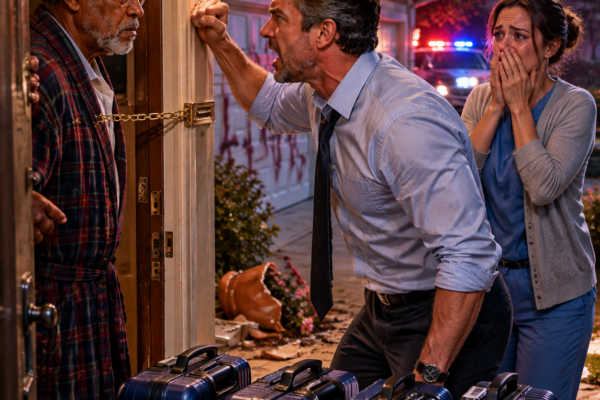
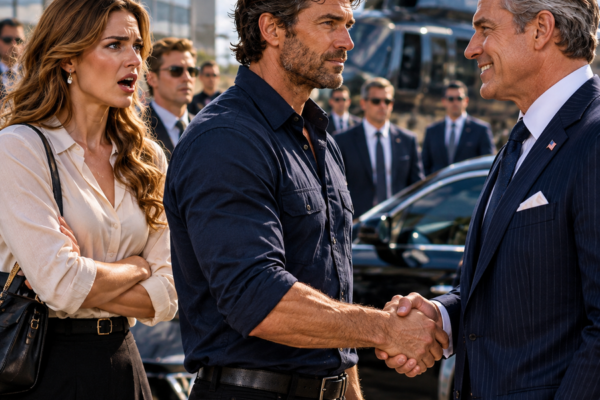
The CEO Thought the Single Dad Was Nobody—Until the Navy Called His Name in Front of Everyone
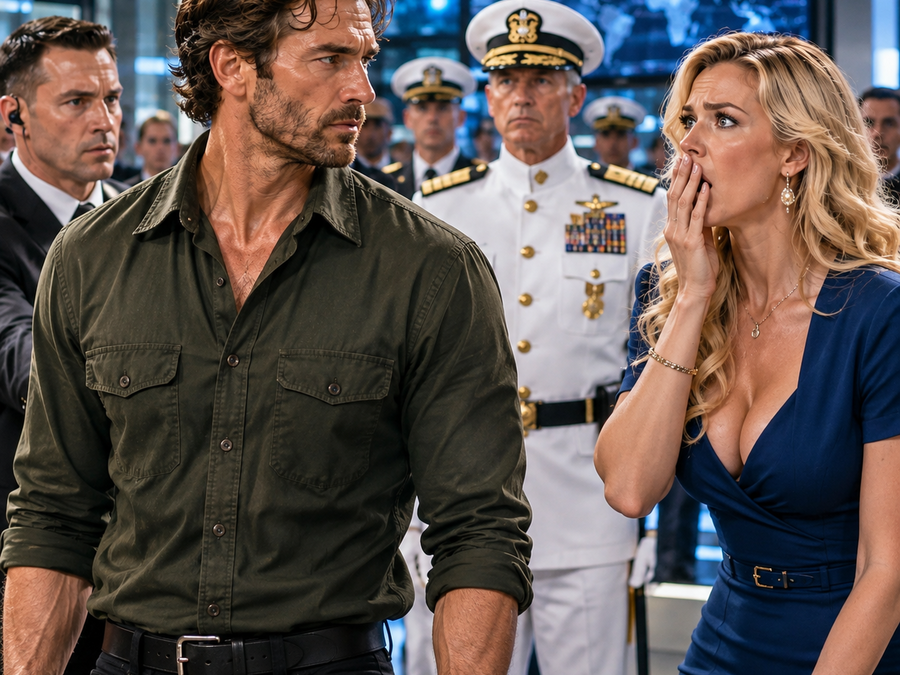
The CEO Thought the Single Dad Was Nobody—Until the Navy Called His Name in Front of Everyone
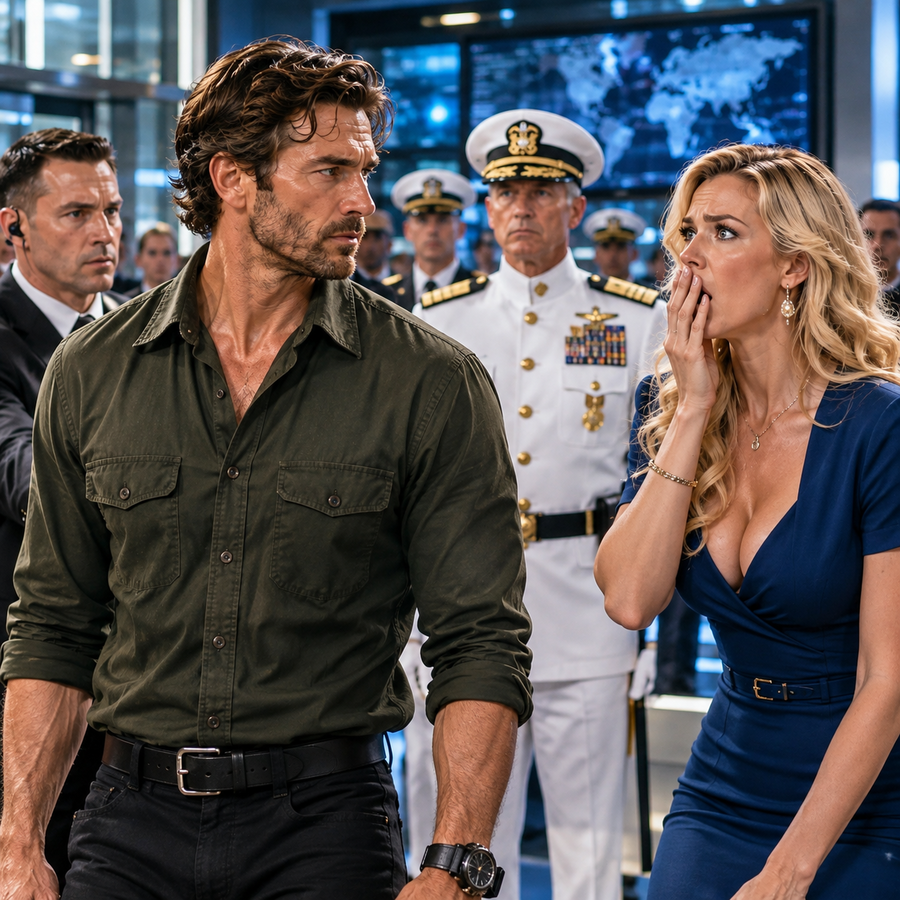
The most important defense showcase of the year began with a shout that silenced an entire hall. Escort him out right now.
Those four words came from Viven Sterling, chief executive of Helix Dynamics, and she said them while pointing at a man in a faded gray jacket standing near the control console.
No one in that room understood why the maintenance worker did not argue, did not raise his voice, did not even blink.
He simply nodded once and walked toward the exit with the calm of a man who had survived far worse rooms than this one. 3 minutes later, every screen in the control center locked at once.
Radar simulations froze mid- render. Access panels flashed red, and through the front doors, a formation of United States Navy officers arrived precisely on schedule, led by a man whose uniform carried more silver than anyone in that building had ever seen up close.
The admiral scanned the room, then asked a single question that turned Vivien Sterling’s face the color of the walls behind her.
Where is Commander Kalen Mercer?
The hall went completely silent. Helix Dynamics occupied four floors of glass and steel on the edge of the technology corridor.
And on that particular morning, every one of those floors buzzed with attention that had been building for 11 months.
The company was hours away from finalizing a defense contract worth several billion dollars.
A system meant to integrate combat data across an entire fleet, and every executive in the building understood that a single visible flaw during the demonstration could end the deal before lunch.
Viven Sterling walked the corridors like a woman inspecting a battlefield before the first shots were fired. She checked seating charts twice.
She checked the lighting angles for the cameras.
She checked the temperature of the server room three separate times because she had read somewhere that overheating caused more system failures than any software bug ever could.
She was 38 years old, sharp enough to have built a 9-f figureure company from a garage lease, and proud enough that she rarely asked anyone twice for anything. In her mind, competence had a uniform, and it did not look like a gray maintenance jacket with a coffee stain on the sleeve.
Down in the control room, away from the cameras and the catering tables, Kalen Mercer worked in near silence. He was 41 years old, quiet in the way that unsettles people who are used to filling every room with noise.
And he moved through the wiring panels like someone reading a familiar book rather than solving a stranger’s puzzle.
He wore the same jacket he always wore. The one that had survived a dozen winters and two different careers, and nobody walking past him gave him a second look.
He was a contract technician hired through a staffing agency for 90 days at a time.
The kind of employee whose name appears on a spreadsheet but rarely on anyone’s memory.
He found a synchronization error buried three layers deep in the combat interface. The kind of flaw that would not show up during a routine test, but would absolutely surface the moment real command data hit the system under pressure.
He walked it calmly to the lead systems engineer.
A younger man named Derek Hollis, who had been with the company for 6 years and wore his badge like a medal.
Derek barely looked at the tablet Ken held out.
Contract staff do not touch core systems, he said loud enough for two junior engineers nearby to hear and laugh under their breath. We appreciate initiative, but this is not your lane.
Ken did not argue.
He simply nodded, set the tablet down, and walked back toward the console to finish the task he had actually been assigned. But the error nagged at him the way a dripping faucet nags at a man trying to sleep because he understood exactly what that flaw would do.
The instant live radar data compressed against a locked buffer. He was standing near the console again, running one more check out of habit rather than instruction when Vivian Sterling walked into the room flanked by two assistants and a photographer.
her capturing footage for the afternoon press release. She saw a man in a stained jacket standing far too close to equipment that cost more than most houses.
And she assumed the worst kind of story instantly.
The story where an underpaid contractor decides to tinker with something above his authorization simply because no one is watching. She did not ask what he was doing.
She did not check the access logs on her tablet which would have shown his credentials were valid for exactly this workstation.
She simply pointed and said the four words that would echo through every floor of the building by the end of the day. Escort him out right now.
Two security guards appeared within seconds, moving with the practiced speed of men who had done this before for far less serious offenses.
Ken looked at Viven for exactly one second, long enough for anyone paying attention to notice the flicker of something unreadable cross his face, something that was not anger and was not fear, but resembled quiet disappointment instead. He reached into his jacket pocket, removed his contractor badge without being asked, and placed it gently on the edge of the console.
He said nothing.
He walked between the two guards toward the elevator, his footsteps even and unhurried. And the last thing anyone in that room saw of him that morning was the back of a gray jacket disappearing behind closing doors.
Viven turned back to her assistance and resumed her inspection as though nothing significant had happened at all. Satisfied that order had been restored and the demonstration could proceed exactly as planned.
She had no idea that the flaw Kalen tried to report was still sitting untouched inside the system, waiting for the exact conditions that would make it impossible to ignore.
In the elevator, Kalan stood alone, watching the floor numbers fall one by one, his expression unreadable to the small camera mounted in the corner.
He had spent enough years in rooms far more dangerous than this one, to know that anger accomplished nothing once someone in authority had already decided what kind of man they were looking at.
He thought briefly of the modest contract sitting in his email, the small apartment 2 mi from the office where he lived alone since his son had moved across the country to build a life of his own, and the quiet, uncomplicated routine that came with being nobody in particular.
None of it depended on being recognized inside that building.
He had learned that lesson the hard way years earlier in rooms with far higher stakes than a corporate product demonstration, and he had made peace with it long before he ever walked through Helix Dynamics front doors. Outside, the autumn air was cool and sharp, and he pulled his jacket tighter and began the walk toward the small commercial strip a few blocks south, in no particular hurry to be anywhere else.
behind him inside the building.
The morning continued exactly as Viven intended, at least for the next 17 minutes.
The trouble began 17 minutes after Ken left the building. The primary display in the control room flickered once, then twice, then filled with a cascade of red warning text that no one in the room had ever seen before.
The radar simulation, which moments earlier had been rendering a smooth composite of simulated fleet positions, suddenly froze into a single distorted frame before collapsing entirely.
Somewhere deeper in the architecture, the security layer responded to the corrupted data stream the only way it knew how, by locking itself down completely, treating the malfunction as a potential intrusion.
Every terminal in the room went dark at nearly the same instant, and for three long seconds, nobody said a single word. Then the room erupted into the particular chaos that only expensive failures can produce.
Engineers scrambled between terminals, running diagnostic scripts that returned nothing but error codes.
Derek Hollis, the same man who had waved Ken away less than half an hour earlier, stood frozen in front of his screen with his mouth slightly open, unable to explain to anyone what had just happened or why.
Vivien Sterling stormed back
into the control room the moment her assistant relayed the news, her calm inspection posture, replaced entirely by something closer to controlled panic.
“Fix it,” she said, her voice sharp enough to cut through the noise.
I do not care how.
Just fix it before those officers walk through that door.
A senior systems architect named Marcus Whitfield, who had overseen the platform’s last three software revisions, insisted the failure was nothing more than a routine memory leak, the kind of thing his team fixed twice a month
without any drama at all.
He pulled up a console, typed a string of commands with the confidence of a man who had solved a hundred smaller versions of this exact problem, and waited for the familiar green confirmation to appear.
It never came. Instead, three additional terminals along the back wall blinked out entirely, their screens replaced by a flat, uncooperative gray that made even Marcus fall quiet for the first time that morning.
Viven watched him work, her arms crossed, her jaw tight enough that one of her assistants quietly stepped back to give her space. The engineering team attempted a full restart, hoping the failure was a temporary glitch rather than something structural.
The restart made things worse.
What had been a frozen display became a corrupted one, spitting out fragments of radar data that made no logical sense. timestamps overlapping, coordinates duplicating, entire sectors of the simulated battlefield blinking in and out of existence.
One young engineer, barely two years out of college, turned to her supervisor with a look of dawning realization. The contractor, she said quietly, the one who got escorted out.
He said something about a synchronization error right before it happened.
Her supervisor shot her a look sharp enough to end the conversation immediately, and the words hung in the air, unressed, because admitting that possibility meant admitting a mistake that had already cost them nearly 20 minutes of a countdown they could not stop. Viven heard the exchange, but chose not to act on it.
In her mind, calling back a contractor she had just publicly ejected would look like weakness in front of a room full of people who reported directly to her. and weakness was not a currency she spent easily.
She trusted her team, the same team that had built and tested this system for the better part of a year.
And she told herself that whatever this glitch was, it would be solved internally before the Navy delegation arrived. She checked her watch.
14 minutes remained before the scheduled arrival time. She had no way of knowing that the delegation, for reasons no one at Helix Dynamics had been informed of, was already 3 minutes early.
And walking through the front lobby at that very moment, Admiral Nathan Cross entered the building flanked by four officers, each of them moving with the quiet precision of people who had spent careers training their bodies to stay composed under pressure.
He did not stop at the reception desk to ask for directions or introductions. He walked directly toward the sound of raised voices coming from the control room corridor as though he already knew exactly where the trouble was located.
When he stepped through the doorway, the chaos inside paused just long enough for everyone to notice him.
Tall, gray at the temples, wearing the kind of expression that suggested he had seen this exact type of failure before and knew precisely what it meant. Viven straightened her posture immediately and extended a hand.
her professional composure snapping back into place out of pure instinct. Admiral Cross, she said.
Welcome to Helix Dynamics.
We are just resolving a minor technical adjustment before the formal demonstration. The admiral did not take her hand right away.
Instead, he looked past her shoulder at the failing screens, then back at her face, and asked a question that had nothing to do with pleasantries.
“Is Commander Callen Mercer here?”
he said. Vivien blinked, genuinely confused by the name.
I am sorry, she said. We do not have anyone by that title on our staff.
We do have a contract technician named Kalen, but he does not hold any military rank that I am aware of. One of the officers standing behind the admiral, a younger lieutenant named Sarah Witkim, glanced toward the failing monitors visible through the glass wall of the adjoining control room, and said something quietly to the man beside her.
The admiral heard it anyway.
He turned his head sharply toward the sound of the alarms, then back toward Viven, his patience visibly thinning by the second.
You are telling me,” he said slowly, that a system failure identical to the exact fault pattern Commander Mercer used to warn us about years ago is happening in this building.
At this moment, and the one man who would recognize it on site is no longer on the premises, Viven felt her carefully constructed composure begin to crack at the edges.
The admiral’s expression shifted, and not in a way that reassured anyone watching.
“He is the man we came to see,” he said.
his voice even but carrying an unmistakable weight. He consulted on the original combat integration framework this entire platform is built upon.
Viven felt something cold settle into her stomach.
Though she could not yet articulate why, she managed to explain carefully choosing her words that the contractor in question had been asked to leave the premises roughly 20 minutes earlier due to a misunderstanding regarding restricted access to the console.
The admiral’s jaw tightened almost imperceptibly.
“Show me your security footage from this room,” he said.
Now, the request traveled through the building faster than any memo ever could.
And within minutes, a technician pulled up the archived footage on a secondary monitor while Viven, Derek, Admiral Cross, and three other officers gathered in a tense half circle to watch. The footage showed exactly what everyone in the room already suspected.
A man in a gray jacket standing near the console, tablet in hand, gesturing toward a specific section of code, while a younger engineer waved him off with visible dismissiveness.
The timestamp confirmed it precisely matched the moment before the system began its collapse. Admiral Cross leaned closer to the screen, watching the silent exchange with an intensity that made everyone else in the room hold their breath.
That flaw he is pointing to, the admiral said finally, is a buffer desynchronization issue that only someone who understood the original architecture at a design level could identify that quickly. It would not appear in standard testing protocols.
It only manifests under live data conditions exactly like the ones you are about to run for us,” Vivian’s throat tightened.
Nobody on my team flagged that issue, she said quietly, more to herself than to anyone else in the room.
That is because your team did not design this system, the admiral replied, his tone neither cruel nor comforting, simply factual in a way that made it worse. Commander Mercer did.
He led the original tactical integration unit that built the combat data framework you licensed. He has more decorations than most flag officers, and he turned down more executive positions than most companies ever offer in a decade.
When he retired early, the Navy considered it one of the more significant losses of institutional knowledge in recent memory. Viven stood completely still, the pieces rearranging themselves in her mind faster than she could process them.
the maintenance jacket, the quiet demeanor, the calm way he had accepted her order, without a single word of protest.
She excused herself from the room without waiting for a formal dismissal.
Moving through the hallway at a pace that bordered on undignified for someone in her position, she checked the visitor log at the front desk, hoping against reason that Kalen was still somewhere in the building, perhaps waiting in the lobby or filling out paperwork and human resources.
He was not. The security guard at the entrance confirmed he had left the premises roughly 40 minutes earlier on foot, heading in the direction of the small commercial strip two blocks south.
Viven stood at the glass doors for a long moment, watching the gray afternoon light outside before pulling her coat from the rack and walking out into the cold without telling anyone where she was going. She found him three blocks away, seated alone at a small corner table inside a coffee shop that looked like it had not changed its interior in a decade.
A cup of tea in front of him rather than coffee, a newspaper folded beside it that he was not actually reading.
He looked up when she entered, unsurprised, as though some part of him had expected this exact visit.
She approached slowly, suddenly unsure of what to say, despite having rehearsed several versions of an apology during the short walk over.
“I am sorry,” she said finally.
The words feeling insufficient, even as she spoke them, I made an assumption about you that I had absolutely no right to make.
Ken gestured to the empty chair across from him, and she sat without hesitation, something she rarely did with anyone who was not a board member or an investor.
I do not need an apology,” he said.
His voice calmed in a way that somehow made the moment feel heavier rather than lighter.
“I need you to understand that the man you saw in that jacket was not less capable because of what he was wearing.”
Viven nodded slowly, unable to argue with a truth she had just spent the last hour learning the hard way.
“I would like you to come back,” she said.
“The system is failing.
We do not know how to fix it, and the Navy delegation is standing in our building right now, waiting for answers we cannot give them.
Ken took a slow sip of his tea before answering.
And for a moment, Viven wondered if he would refuse, simply out of principle, which she would not have blamed him for. I only wanted to finish the contract I was hired for, he said.
I did not come here looking for recognition, and I am not interested in being paraded around as some kind of hero for a mistake your team could have caught.
if anyone had actually listened.
His words carried no bitterness, only a quiet, exhausted honesty that made Viven feel smaller than she had felt in years.
Viven leaned forward slightly, choosing her next words with more care than she typically allowed herself in negotiations worth far less than what was currently at stake.
“What would it take?”
she asked quietly.
“For you to walk back through those doors, not as a favor to me, but because it matters to you.
” Callen studied her for a long moment, as though weighing whether the question was genuine or simply another version of the pressure she had already applied once that morning.
“It would take you actually listening the next time someone tells you something is wrong,” he said finally.
“Before you decide who gets to be right, before she could respond,” the small bell above the coffee shop door rang.
and both of them turned to see Admiral Cross stepping through it.
Flanked by two officers who had clearly tracked the location through Viven’s own phone signal at her assistance request.
The admiral crossed the small shop in a few long strides and extended his hand toward Kalen with a formality that made the other customers glance up from their tables in curiosity.
“Commander,” he said.
“It is good to see you again.”
Kalan stood and shook his hand, and the two officers behind the admiral straightened into something close to attention. A gesture so instinctive it seemed to happen without conscious thought.
Viven watched, stunned, as the room’s entire hierarchy rearranged itself around a man she had thrown out of her own building less than an hour earlier.
“We need you,” Admiral Cross said plainly.
“Not for ceremony, for the system.
It is failing exactly the way it would fail if the desynchronization patch you designed years ago had been quietly removed or altered during a later update cycle.
Kalen’s expression shifted slightly, the calm giving way to something more focused, more alert.
That patch should still be active, he said. If it was removed, someone made a decision to simplify the architecture without understanding what it was protecting against.
The admiral nodded gravely.
That is precisely what we suspect happened during the last contractor transition 18 months ago.
Viven listening to this exchange unfold in real time, finally understood the scale of what she had almost lost.
Not just a contract worth billions of dollars, but a piece of institutional knowledge that no amount of money could simply purchase back once it walked out the door. Back at Helix Dynamics, the atmosphere had shifted from panic into something closer to dread.
Engineers who had spent the last hour attempting increasingly desperate fixes now sat slumped at their stations, watching error messages scroll endlessly across screens that refused to stabilize no matter what they tried.
Derek Hollis, the engineer who had dismissed Kalen earlier that morning, stood near the back of the room with his arms crossed, unable to look directly at anyone, replaying the moment in his head and understanding with growing horror exactly what his dismissiveness might end up costing the company.
When the door opened and Ken walked back in, flanked by Viven and the admiral, the entire room seemed to exhale at once.
Though nobody said a word out loud, Kalan moved toward the console without ceremony, exactly the way he had moved that morning, except now every eye in the room tracked his every gesture with an intensity bordering on reverence. He pulled up a diagnostic terminal that most of the junior engineers did not even know existed within the system.
a legacy interface buried beneath several layers of newer software.
Clearly something he had built himself years earlier and never bothered to advertise. Admiral Cross stood a respectful distance behind him, watching with the patience of a man who trusted the process completely.
Viven stood closer, close enough to see the lines of code scrolling past on the screen, understanding almost none of it, yet somehow finding the site strangely reassuring. The problem, Kalan explained without looking up from his work, was exactly what he had tried to warn them about that morning.
A synchronization buffer that had been quietly stripped of its original safeguard during a later software update, likely to simplify performance benchmarks for a demonstration exactly like this one.
Once live data began flowing at full combat simulation speed, the missing safeguard allowed overlapping data packets to collide, corrupting the buffer and cascading failure through every connected terminal.
It was the kind of flaw that would sit dormant for months during routine testing and only reveal itself under the precise conditions the company had spent a year preparing to showcase.
He worked in near silence for the better part of 20 minutes, his fingers moving with a confidence that made the surrounding engineers feel simultaneously humbled and reassured.
One of the junior engineers finally worked up the courage to speak, asking quietly whether there was anything the rest of the team could do to help. Ken did not look up from the screen.
Watch, he said simply. Learn where the fault actually lives, not where the manual says it should, several engineers leaned closer, notebooks appearing from bags and pockets almost instinctively.
As though they had unconsciously decided this moment deserved to be remembered rather than simply survived, Derek Hollis stood among them, silent, his earlier dismissiveness sitting visibly heavy on his shoulders as he watched the man he had waved away that same morning work through a problem none of them had been able to solve.
Midway
through his repair, a second alert flared across the main display.
This one far more severe than the first, indicating that core mission data stored on the primary server had begun to corrupt under the strain of the ongoing failure.
Gasps rippled through the room.
Dererick stepped forward instinctively, then stopped himself, unsure whether he had any right to offer input after the morning’s events.
Kalan did not pause. He redirected a portion of his repair sequence toward isolating the corrupted data before it spread further, his focus narrowing entirely onto the screen in front of him, while the rest of the room held its breath around him.
Viven watched the color drain briefly from Admiral Cross’s face.
The first visible sign of concern the man had shown since walking into the building.
If we lose that mission data, the admiral said quietly. This contract does not just stall, it ends.
Every partner agency involved will require a full security review before considering Helix Dynamics for anything again. Viven felt the full weight of that sentence settle over her.
The billions of dollars, the 11 months of preparation, the careers of everyone in that room, all balanced on the steady hands of a man she had ordered out of the building that same morning. She said nothing because there was nothing left to say that would change the outcome.
Now unfolding in real time on the screen in front of them. Ken worked for another 11 minutes without a single word.
His eyes flicking between three separate monitors as he rerouted data streams, rebuilt the missing safeguard from memory, and slowly, methodically coaxed the corrupted buffer back into a stable state. The room around him remained almost entirely silent, except for the occasional soft click of keys and the low hum of cooling fans working overtime beneath the strain.
Then all at once, the cascading red warnings across every screen blinked out simultaneously, replaced by a steady green status indicator that none of them had seen since the crisis began nearly an hour earlier. For a moment, nobody moved, as though afraid that celebrating too soon might undo whatever fragile balance had just been restored.
Then the room broke into something between relief and disbelief. A few engineers exhaling audibly.
One young woman near the back pressing both hands over her mouth as though holding back tears she had not expected to feel.
Admiral Cross stepped forward and placed a hand on Kalen’s shoulder.
a gesture that carried far more weight coming from a man of his rank than any words could have conveyed.
Viven felt something in her chest loosened for the first time since the demonstration began. Though she also felt something else entirely new settle in alongside it, a quiet, uncomfortable recognition of just how close her own judgment had come to costing everyone in that room everything.
Before anyone could fully celebrate, Admiral Cross turned to address the room. his voice carrying the same measured authority he had used from the moment he first walked through the doors.
“There is something else you should all understand about the man standing in front of you,” he said.
And Viven noticed Kalen’s shoulders tense slightly, as though he already knew what was coming and had hoped it would not.
Years ago, the admiral continued, “Commander Mercer was offered a position that would have placed him among the most senior engineering minds in the entire defense sector.
A role with influence over programs far larger than this one.
He turned it down without hesitation because his wife had been diagnosed with a long illness that would eventually take her life, and he chose to spend every remaining day he could by her side rather than chase any title the Navy or private industry could offer him.
” The room fell silent again, but this silence carried a different weight than the tense quiet of the crisis moments earlier.
Viven looked at Callen, seeing him now not as a contractor in a stained jacket, nor as a decorated commander with an impressive service record, but as a man who had made an impossible choice, and lived with its consequences quietly for years afterward, never once trading that private grief for public recognition.
After she passed, the admiral continued. He chose not to return to any senior position.
He said the weight of it no longer interested him, that he preferred smaller work where he could still contribute without carrying a title that reminded him of everything he had lost along the way.
Viven felt her earlier judgment of him crumble entirely. replaced by something closer to quiet shame at how easily she had mistaken humility for insignificance.
News of the morning’s events traveled through Helix dynamics with the speed particular to companies where everyone senses when something historic has just happened.
By the following afternoon, the board of directors convened an emergency session, having received a full account from Admiral Cross himself, regarding both the technical failure and the manner in which the company’s own leadership had
treated the very man responsible for saving the contract.
Several board members expressed open concern that Viven’s judgment during the incident could jeopardize not just this particular deal, but the company’s broader reputation among defense partners, who valued discretion and competence over appearances.
The mood in the boardroom was tense enough that even Viven, usually unshakable in these settings, found herself uncharacteristically quiet through most of the discussion, to the surprise of nearly everyone present.
Kalan requested to speak briefly during the session, a request the board granted, partly out of respect and partly out of curiosity about what a man in his position might say after everything that had happened. He stood at the head of the table, still wearing the same gray jacket, and addressed the room with the same understated calm he had carried through the entire ordeal.
I am not here asking for anyone to be removed, he said, his eyes briefly meeting Vivians before moving across the rest of the table.
Mistakes happen when people rely on assumptions instead of asking questions. And I believe everyone deserves the chance to correct that kind of mistake once they understand it.
One older board member, a woman named Patricia Doyle, who had sat on the board since the company’s earliest days, asked Kalen directly why he was willing to extend that kind of grace after being treated so poorly.
Ken considered the question for a moment before answering.
Because somebody extended it to me once, he said, “When I needed it more than I ever let on, he did not elaborate further, and nobody in the room pressed him to.
Several board members exchanged glances, clearly not expecting mercy from the man who had every reason in the world to demand accountability.
Instead, Vivien rose from her seat once Ken finished speaking. And for the first time in longer than she could remember, she felt genuinely unsure of what to say before the words left her mouth.
I made a decision this week based entirely on how someone looked rather than who they actually were, she said.
Her voice steady despite the discomfort clearly written across her face.
That decision nearly cost this company everything we have spent years building and it revealed something about my own leadership that I am not proud of.
She turned to address not just the board, but the wider staff who had gathered near the doorway to listen, unable to resist witnessing this moment unfold in person. I owe every one of you an apology for the culture that allowed a talented man to be dismissed without a second thought simply because he did not look the way we expected someone valuable to look.
The room remained quiet for a long moment after she finished speaking. The kind of silence that follows a truth nobody quite expected to hear stated so plainly.
Then slowly one of the younger engineers near the back began to clap, followed by another until the sound spread through the gathered staff in a way that felt less like celebration and more like quiet collective relief.
Viven turned back toward Kalen and extended her hand for the second time that week, though this handshake carried none of the performative professionalism of their first meeting.
“Thank you,” she said simply.
And for once, the words felt entirely sincere rather than rehearsed for an audience.
In the weeks that followed, Helix Dynamics extended Kalan a formal offer, though not the kind he had spent years actively avoiding.
Rather than a senior executive title or a permanent leadership role, the company asked him to serve as a strategic adviser, mentoring younger engineers and consulting on critical systems whenever his expertise was needed without the obligations of daily management that had never interested him
in the first place.
He accepted on the condition that his schedule remained flexible and that he retained the freedom to take on other contract work whenever he chose, a condition Vivien agreed to without hesitation, understanding by then that his value had never come from a title anyone could assign him.
He also asked, almost as an afterthought, that his advisory work never be announced publicly or used in any marketing materials, a request that struck Viven as entirely fitting for a man who had spent years deliberately avoiding exactly that kind of attention.
In the days immediately following the board session, Viven asked to meet with Kalen privately, away from cameras and assistance, and the particular performance that always seemed to attach itself to public apologies.
They met again at the same small coffee shop where she had first found him. And this time she did not arrive with a rehearsed speech.
She asked him honestly what she should have done differently that morning, not as a formality, but because she genuinely wanted to understand where her judgment had failed her so completely. Callen considered the question for a long moment before answering.
You stopped asking questions the moment you decided what you were looking at. He said that is the mistake.
Not the jacket, not the badge, not any of it.
Viven sat with that answer far longer than she expected to, turning it over in her mind long after she had returned to her office that evening.
Viven used the incident as the foundation for a broader shift in how Helix Dynamics operated internally, implementing new policies that required every technical concern raised by staff, regardless of their employment status or seniority, to be formally logged and reviewed rather than dismissed on the spot.
She personally sat in on training sessions for new managers, sharing what she had learned about the danger of judging capability by appearance rather than performance.
a lesson she now delivered with the particular conviction of someone who had learned it the hard way in front of a room full of witnesses. She also insisted that every new hire spend their first week rotating through departments they would never normally interact with, including maintenance and contract support, a policy several executives privately grumbled about, but none dared
challenge openly given its origin.
Within months, the culture inside Helix Dynamics had visibly shifted. Junior staff speaking up more freely in meetings, senior engineers pausing to ask questions rather than assuming answers, and a general sense that competence, wherever it was found, deserved to be heard before it was dismissed.
Derek Hollis, to his credit, remained with the company and became one of the loudest advocates for the new policy, having spent enough sleepless nights replaying his own dismissiveness that morning to never risk repeating it. The formal signing ceremony with the Navy took place 3 weeks later in the same building where the crisis had nearly unraveled everything the company had worked toward.
Admiral Cross returned for the occasion and this time Kalan stood beside Viven rather than being escorted out a side door.
His presence acknowledged openly by everyone in attendance rather than hidden behind a maintenance uniform nobody had bothered to look at twice. The system performed flawlessly throughout the entire demonstration.
the buffer he had rebuilt holding steady under conditions far more demanding than the ones that had exposed its original flaw weeks earlier. When the contracts were finally signed, the applause in the room felt different from any celebration Vivien had experienced in her career.
Quieter, more grounded, carrying the particular satisfaction of something rebuilt rather than merely achieved.
Afterward, as the crowd slowly dispersed and the catering staff began clearing the tables, Kalan stepped out through the front doors alone, the way he always preferred to leave any room that had made too much of him.
Autumn rain had begun to fall outside, soft and steady against the pavement, and he pulled the collar of his familiar gray jacket up against the chill without any particular urgency, unbothered by the weather, in the same way he had remained unbothered by nearly everything else that had happened over the past month.
Vivien watched him from
just inside the glass doors, choosing not to follow him out, understanding instinctively that some moments belong to a person alone rather than to any audience, however well-intentioned, she stood there for a long while after he had disappeared down the street, the rain blurring his outline until he was simply another figure moving through the gray afternoon, indistinguishable from anyone else walking the sidewalk. And in that quiet moment, she finally understood something.
she suspected she would carry with her for the rest of her career.
That the true measure of a person was never found in the uniform they wore or the title printed beneath their name, but in the quiet competence, the steady integrity and the unspoken sacrifices that so often went unnoticed by everyone. Too busy looking at the surface to see what actually lay beneath it, she turned away from the doors at last and walked back toward her office.
past engineers who no longer flinched when a contractor walked among them, past a company that had been rebuilt in more ways than one. Over the course of a single, unforgettable month, somewhere out in that gray afternoon, a quiet man in an old jacket kept walking home.
Unrecognized by strangers on the street, and entirely at peace with that fact, carrying with him the same steady dignity that had guided him through every room he had ever entered.
Whether anyone in that room understood who he truly was or