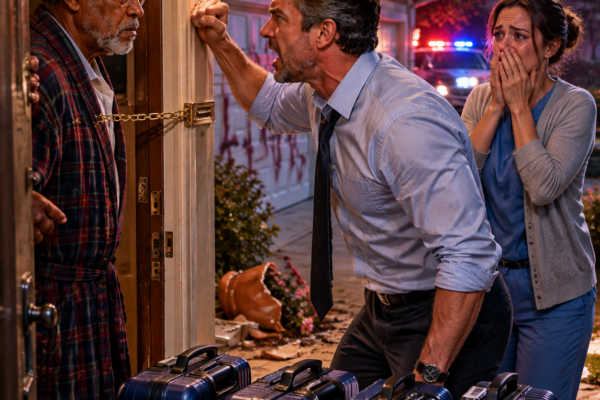
They Laughed at His Limp—Then the Robber Saw the Old Man and Took a Step Back
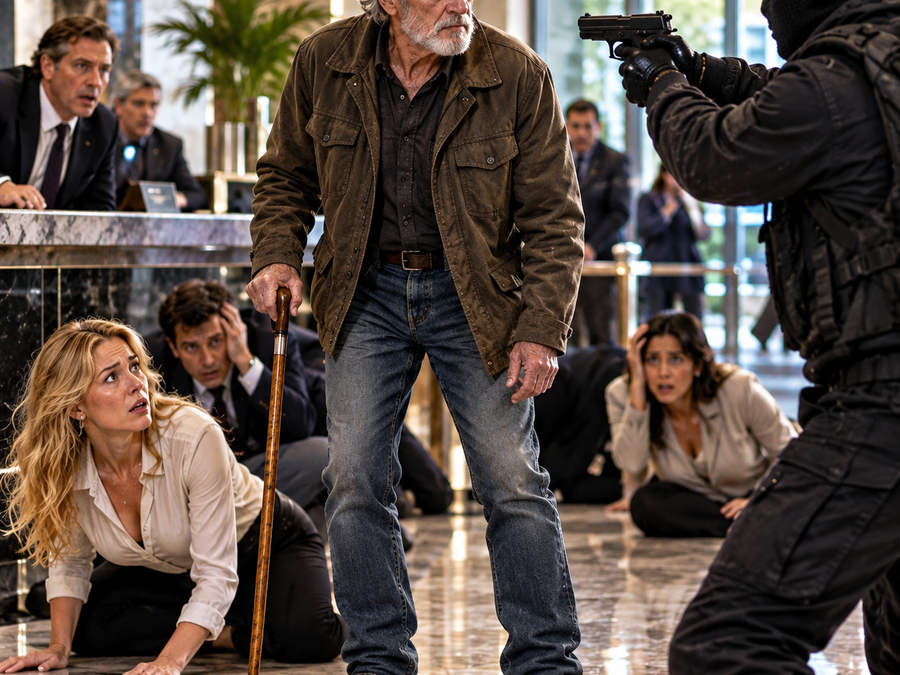
They Laughed at His Limp—Then the Robber Saw the Old Man and Took a Step Back
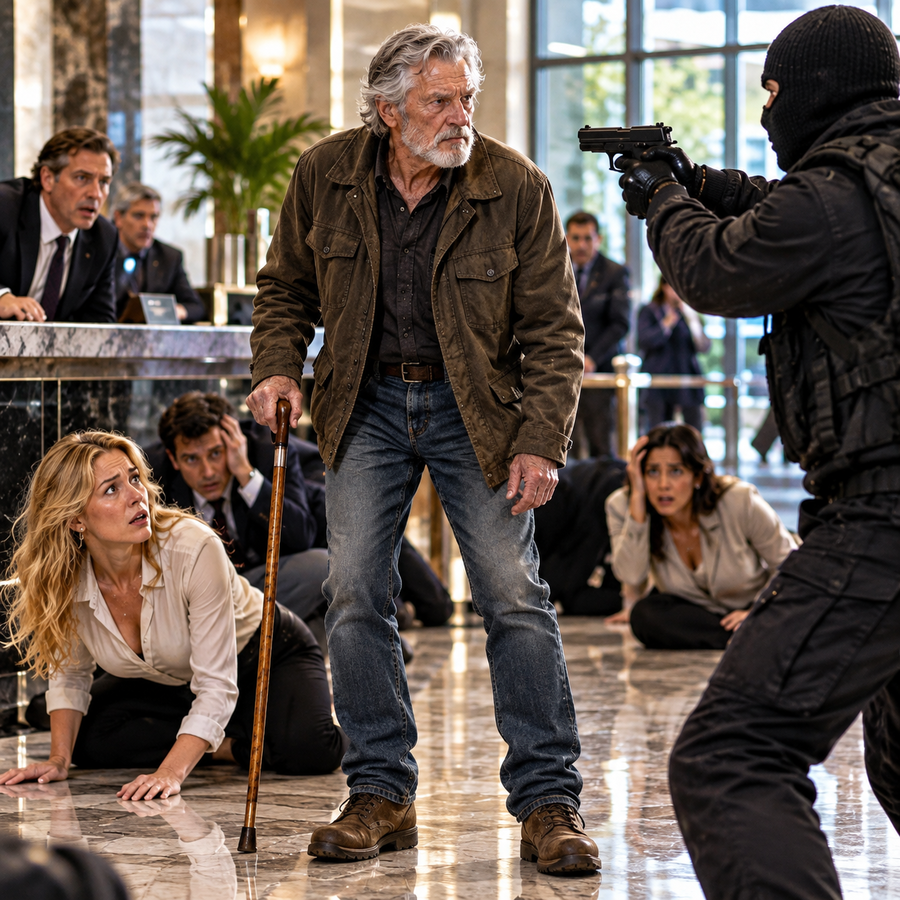
At 9:17 in the morning, Caleb Rowan walked into the bank with a wooden cane and a left leg that barely obeyed him.
Less than 5 minutes later, a wealthy customer laughed at how slowly he moved, and the branch manager coldly asked him to step away from the area reserved for important clients. Caleb did not answer.
He only sat down in the chair near the door and quietly studied everything around him. Then three masked men came through the front entrance.
The laughter stopped. Everyone dropped to the floor.
And in a room full of people younger and stronger than he was, Caleb was the only one who slowly rose to his feet.
The strangest part was not that he stood up. It was the way the man in the mask looked at him and then, without meaning to, took one step backward.
If you love stories where the most overlooked person becomes the one nobody can replace, subscribe now and stay with us. The fog had not finished lifting off the hills when Caleb Rowan turned his 22-year-old Ford onto Chestnut Street in Brayton, Pennsylvania.
A town of 9,000 people and one bank that mattered. He parked three spaces from the door because the closer spots always belonged to men who arrived in a hurry.
It was the first Tuesday of October, and he had two small errands that would decide nothing about the rest of his life.
A savings certificate had matured, and he needed to change the beneficiary on an old account because the woman who had held that place for 31 years had died in March.
He reached across the seat for the cane. It was plain oak, scratched near the handle, the rubber tip worn flat on one side from the way he dragged the foot.
Inside the lobby smelled of new carpet and coffee, and the morning light came through tall windows in clean, expensive slats.
Six people waited at a marble counter polished to a shine, and a glass partition divided the ordinary floor from a quieter corner furnished with leather chairs.
Caleb moved through the door at the pace his body allowed, which was slow, and the slowness made a a of noise in a room where everyone else was moving fast.
The guard near the entrance, a thick man in his 40s named Doug, looked up, registered an old man with a cane, and lost interest within 2 seconds. That was the thing about being 67 and limping.
People decided what you were before you had finished arriving.
Caleb took his place at the end of the line.
Behind him came a man in a charcoal overcoat with a phone against his ear, talking about closing on a strip of commercial land before the end of the week.
His name was Blaine Carrington, 38, owner of four real estate offices across two counties, and he had the particular impatience of a man who believed his minutes cost more than anyone else’s.
Caleb began searching his coat for his identification, and a folded paper slipped from his fingers and drifted under the velvet rope.
Bending was not a quick thing for him. The knee did not hinge the way knees were supposed to, so he had to lower himself sideways, brace on the cane, and reach.
It took 9 seconds.
Blaine made a sound of disbelief at about the fifth. If walking is that much trouble, he said loud enough for the whole line, maybe try banking online, friend.
They built it for exactly this.
A woman near the counter laughed before she could stop herself.
Caleb straightened, folded the paper into his pocket, and looked at Blaine without any of the wounded dignity older men sometimes wear like armor.
“You may be right about that,” he said, and faced forward again.
The mildness of it was the thing Blaine misread.
He heard surrender, and surrender made him comfortable, and comfort made him stop paying attention.
Sterling Whitmore came out of the back office at 20 past 9, 46 years old, in a suit worth more than Caleb’s truck, and he scanned the lobby the way a man scans a room for the only person in it worth greeting.
He found Blaine immediately, lifted the velvet rope with the fluid courtesy of a maître d’, and walked him toward the leather chairs.
Caleb spoke then, quietly, without heat, and said that he had been waiting about 20 minutes. Sterling turned and gave him a smile with nothing behind it.
“We’re prioritizing some clients with more complex financial needs this morning.
You understand.”
Everyone understood.
The sentence meant your money is not large enough to be interesting, and it was polished enough that nobody could call it an insult out loud.
Caleb did not argue.
He took the chair by the window, laid the cane across his knees like a man settling in for a long and boring wait, and began doing the thing he had done in every room he had entered for 40 years without noticing he was doing it. His eyes went to the ceiling corners where two cameras watched the floor, and he saw that the one on the west wall had been mounted too close to a decorative beam, leaving it blind to a wedge of lobby about 4 ft wide.
He found the emergency exit behind the teller stations and counted the steps a average person would need to reach it.
None of it meant anything. It was simply the shape his mind took when it was idle, the way some men hum.
He noticed that Doug kept his right hand resting on his belt buckle rather than near anything useful, and that his posture was the loose, bored posture of a man who had never once had to act inside this building. He noticed the fire alarm pull station by the water cooler, the sprinkler riser behind a half-open utility door, the front glass that was thick but not layered.
Then he looked out at Chestnut Street, where a white panel van sat at the curb in a loading zone angled slightly wrong, nose pointed toward the intersection instead of flush with the lane.
It had been there when he arrived.
Nobody had gotten out.
A woman at the counter was explaining a check. Somewhere behind the partition, Blaine laughed at something Sterling said.
Caleb let 11 minutes pass, then because the habit would not leave him alone, he turned his head and looked through the glass a second time. The van had not moved.
Nothing had been unloaded, and there was no clipboard, no ramp, no delivery of any kind. The heat came on with a soft knock in the ducts and the lobby was warm and ordinary and full of people who had already forgotten there was an old man by the window.
And in the cold morning air, a thin steady line of exhaust rose from the tailpipe and bent away in the wind.
The engine was still running.
It was 9 minutes more before Naomi Pierce called him forward. She was 34, had worked the counter 6 years, and had the kind of face that apologized before her mouth caught up.
“I’m so sorry about the wait, sir.”
She said, and she meant it, Caleb slid his folder across the marble and told her it was all right, that a man his age had made peace with lines. She opened it and found the certificate and the beneficiary form filled out in careful block capitals.
Every box complete, which almost never happened. She started typing.
He watched her hands and noticed she did not have to look at the keyboard.
“Can I ask you something?”
He said in the tone a person uses to ask about the weather.
“That back door behind you, does it open from the outside?”
Her fingers slowed.
“No, sir.
Badge access only.
Staff carry a key card.”
Caleb nodded as though she had confirmed something pleasantly dull, then asked whether the silent alarm still worked if the building lost its internet connection.
Naomi looked up at that and what she felt was not alarm but a soft familiar sympathy because older customers worried about such things all the time, especially the ones who lived alone.
She told him there was a battery backup and a separate line, that the system had been upgraded the year before, and that he had nothing at all to be concerned about. Blaine had come back out from the private corner with a folder under his arm and heard the last half of it.
“What’s the plan, pal?”
He said, grinning, playing to the room.
“You robbing the place today?”
The laugh that followed was louder than the first one because by now the lobby had decided Caleb was a safe target.
Caleb turned his head slightly and for a moment there was something almost warm in his face.
“I’m about 40 years too slow for that line of work.”
he said.
The room laughed again with him this time instead of at him and Naomi laughed too and even Sterling’s mouth twitched.
It was for about 4 seconds a pleasant morning then through the front window Caleb saw the man on the sidewalk adjust his collar.
He was in his 30s in a work jacket with no logo and he had been standing near the newspaper box for at least 6 minutes without buying a paper or looking at a phone.
He pinched the collar at the throat and tugged it.
He let go. He did it again and again.
Three times in a rhythm that was not fidgeting because fidgeting is irregular and this was not. It was a count.
Caleb felt the thing in his chest go very quiet and very cold the way it used to the way it had not in 18 years. He turned his eyes to the van.
The side door slid open and three men stepped down onto the curb in a single unhurried motion. And the last one out pulled the door shut behind him without slamming it.
They were not running. That was the detail that mattered because amateurs run and men who walk believe they have time and men who believe they have time have studied the building.
Caleb turned back to the counter and spoke in a low even voice that was not a request.
“Lock the doors.”
“Right now.”
Naomi’s hand stopped on the keys and her mouth formed the word why.
Sterling heard it from 8 ft away and his face hardened into something between embarrassment and irritation.
“Mr.Rowan, I’d appreciate it if you didn’t frighten my staff.
We have procedures here and they don’t include customers giving instructions.”
Caleb was watching the reflection in the glass behind Naomi’s shoulder converting the width of the sidewalk into seconds.
“Six, maybe seven.”
Then he turned and met Sterling’s eyes directly for the first time all morning and whatever Sterling found there made him forget the rest of his sentence.
“Lock the door.”
Caleb said no louder than before in the voice of a man who had stopped and Sterling’s mouth opened.
Outside, the man by the newspaper box put his hands in his pockets and walked toward the entrance. The front doors of Whitmore and Hale Community Bank banged open hard enough to bounce off the stops.
A woman screamed.
A chair went over and somebody’s coffee hit the carpet and rolled.
The air filled with shouted instructions and the terrible sound of 12 people dropping at once onto a floor they had crossed a hundred times without noticing it.
Caleb lowered himself down as well, bracing on the counter, the bad leg out at an angle because it would not fold any other way.
His heart was going faster than he wanted and he let it because fighting your own pulse is a young man’s mistake.
He turned his head, found the clock above the manager’s office, and fixed the time in his mind the way he had fixed it in a thousand rooms he was no longer supposed to be in.
9:17 in the morning. There were three inside and he was almost certain a fourth behind the wheel.
The one giving orders moved to the center of the lobby and raised both hands and when he spoke his voice was pitched carefully low, which told Caleb more than anything else in the room.
“Nobody here is getting hurt.”
he said.
“Not one person.
You stay down, you stay quiet.
We take what we came for and we’re gone in 4 minutes.
4 minutes.
That’s the whole deal.”
His name was Evan Rourke, 31, and he had rehearsed that sentence enough times that it came out smooth. He wanted the number said out loud because frightened people are unpredictable and he did not want unpredictable.
Men who intend to kill do not negotiate with the floor and they do not offer timelines because a timeline is only useful if you plan to let people leave.
The second man was a different problem entirely. He came in fast, swung toward the teller line, and started shouting in a cracked climbing voice about hands and phones and heads down.
And when a man near the window did not move quickly enough, he kicked a chair hard enough to skid it across the tile. His name was Mason Vale, 27, and everything about him was turned up two notches past where it needed to be.
The third man said nothing at all.
He pulled the blinds halfway, stood with his back to the room, and watched the street. A follower, Caleb, decided with no decisions of his own, which made him dangerous only in proportion to whoever was shouting.
So, the room had a planner, a fuse, and a weather vane, and the planner had already lost color in his face, which meant something had come apart before the doors ever opened.
Sterling Whitmore’s expensive composure had come off him like a coat.
He lay with his cheek against the carpet, making a small, helpless sound each time he exhaled, and Blaine Carrington lay near the partition he had been escorted through with his hands over the back of his skull, shaking in a steady rhythm he could not stop. Mason worked his way down the line of bodies, and when he reached Caleb, he stopped.
The cane lay where it had fallen. Mason hooked a boot under it and sent it skidding across the lobby until it clattered against the water cooler 11 ft away.
“Sit still, old man,” he said, and when that drew nothing, he pushed harder, because men like Mason need the reaction more than the obedience.
“Can you even stand up on your own, huh?
Can you?”
4 yd off, the man who had made the whole lobby laugh at that exact person an hour earlier kept his face against the carpet and could not lift his head. Caleb said nothing, performed nothing, and spent nothing he did not have to spend.
He counted instead, 19 steps from the end of the counter to the front doors for a man with a normal stride.
The gap between Evan and Mason, which kept closing and should not have, because two men controlling a room spread out, and these two drifted together like they needed reassurance.
Evan checking a phone four times in 6 minutes. Naomi kneeling behind the drawer unit, out of the blind camera wedge, but within reach of the alarm.
The angle of the half-closed blinds, the shadow line creeping along the tile, the woman near the water cooler whose breathing had begun to whistle, and above all of it, one detail kept surfacing. Evan Roark kept looking out the window, not at the street in general, but at one specific point past the parking meters, toward the intersection roughly every 40 seconds, and each time his jaw tightened a little more.
A man watching for police sweeps the whole street. Evan was watching for something he expected and was not getting, which meant the money was not the only thing holding this together.
Caleb worked through the possibilities the way he had taught other men to do it, calmly, in order, discarding what did not fit, and arrived at the conclusion that whatever had already gone wrong out there was going to arrive in here within minutes.
It arrived in 90 seconds. Behind the counter, a teller named Russell had been lying with his arm pinned beneath his own chest, and his hand 4 inches from a pedal mounted under the cash drawer, and nobody saw him move because he did not move.
He simply let his weight shift.
Chestnut Street carried on for 110 more seconds, and then the first siren came up out of the east end of town, low and distant and absolutely unmistakable, joined within 15 seconds by a second and a third.
Evan’s head snapped toward the glass, and the color went out of his face.
“No, no, no,” he said.
“That’s 11 minutes early.”
Mason came apart immediately.
He wheeled on the room demanding to know who had done it, and when nobody answered, he demanded again, louder, walking the line of hostages, looking at hands, looking at faces, his breathing audible from across the lobby.
Evan shouted at him to get away from the windows, and Mason shouted back that this was exactly what he had said would happen, and the third man turned around with no idea whose instruction to follow.
Sterling started to say, “There must be some mistake,” and was told to shut his mouth, And he obeyed so fast it was almost pitiful.
In 11 seconds, the room had gone from control to something with no floor underneath it. This was the hinge.
Every situation like this one has a minute when it stops being a robbery and becomes something without a plan. And in that minute, the people on the carpet stop being an inconvenience and start being leverage.
Caleb looked at the cane 11 ft away and decided he was not going to get it.
He put his right palm flat on the seat of the chair beside him, took the weight on his arm because his leg would not take it, and pushed himself upright.
His knee screamed. He let it.
The whole process took seven full seconds, and in a silent room, seconds is a very long time. Heads turned.
The praying stopped. Naomi raised her face above the counter edge, and her lips moved around the word no, and Mason spun and came out high and furious.
“Sit down. Sit down right now.”
Caleb did not sit. He stood with his weight on his good side and one hand resting lightly on the chair back, and old man in a faded coat with no cane and no advantage of any kind, and he did not look at Mason at all.
He looked past him across the lobby directly at Evan Roark and waited until Evan looked back.
12 people watched this happen, and every one of them, including Sterling Whitmore, was certain the old man had lost his mind.
“If you let him keep spinning like that,” Caleb said in a voice that carried without rising, “you will lose control of this room in about 10 minutes, maybe less.
” Mason took a step, and Evan lifted one hand, and the step did not finish.
Because a stranger had just said out loud in plain words the exact thing that had been sitting in Evan’s stomach since the siren started.
The thing he had not said to anyone and would not have known how to phrase. Mason moved anyway, three fast strides, and Evan caught his arm and held it.
Caleb did not straighten up taller or lift his chin or do any of the things men do when they want to look unafraid, because looking unafraid is a challenge, and a challenge was the last thing this room could survive.
He lowered his voice instead, and he let his shoulders drop, and he made himself smaller on purpose.
“You don’t have to prove anything to me,” he said to Mason.
“I’m the slowest person in this building, and we both know it.”
Mason stopped. Something in the arithmetic of the insult had been taken away from him, and without it he had nowhere to put his hands.
Evan let go of his arm.
The room breathed.
“Who the hell are you?”
Evan said.
Caleb considered the question for a moment, and what he did not say was the thing any other man would have said, the line about how they had no idea who they were dealing with.
He had watched that line get people killed.
“Right now,” he answered, “I’m somebody trying to make sure everyone in this room goes home.
That includes you.
” He let it sit.
Then he gestured very slightly at the window.
“There are going to be a lot of them out there in about 4 minutes.
What happens after that depends almost entirely on what they think is happening in here.”
And right now they think nothing, which is the worst thing they can think.
Outside, that was already true. Agent Graham Sloan, 52, arrived at the staging point on Chestnut Street 18 minutes after the first call, and set up a command post with the methodical speed of a man who had done it 90 times.
He had a floor plan on a tablet, two negotiators, a tactical element forming up behind the hardware store, and almost no information.
The blinds were half drawn in a way that made no sense.
The hostages had not been moved to the back, and nobody had called out demands. He ordered the phone line into the branch opened, told his negotiator to dial, and waited to learn what kind of morning this was going to be.
The bank phone rang. Mason said absolutely not, and Evan reached for it anyway, and then pulled his hand back because answering felt like a confession.
Caleb spoke into that hesitation without urgency.
“If you don’t pick it up, the only story they have is the one they invent.
Silence tells them the inside is already out of control, and the moment they believe that, they stop waiting.”
He let a beat pass, picking it up buys you an hour, maybe two.
You don’t have to say anything true.
You just have to say something. Evan looked at the phone, then at the window, then at the old man standing by the chair.
Then he crossed the lobby and picked up the receiver, and from that moment forward, without anyone in the building ever announcing it, Caleb Rowan was running the negotiation. He never touched the phone.
He stood where he was and said quiet things in the gaps, and Evan repeated some of them and ignored others, and the ones he repeated were the ones that kept everyone alive.
“Let the woman near the water cooler sit up,” Caleb said, “because she is going to have an attack, and an ambulance call is a problem you do not want.
Let Naomi bring water to the people on the floor, because a room with something to do is a room that does not panic. Do not move everyone into the vault room, because a sealed room makes the people outside assume the worst and act on it, and leave the blinds exactly where they are, because the people outside need to see enough to stay patient.
” Every instruction sounded like mercy.
Every single one of them was also tactic. In the mobile unit, Agent Sloan had been listening to the call on a headset for 4 minutes with a frown deepening between his eyes.
The man on the line, the one calling himself Evan, was not behaving like someone improvising. He was repeating phrases.
He was pausing in the wrong places, the way people do when they are being fed language.
“Who is talking next to you?”
Sloan asked. Evan said nobody.
Sloan said it again more gently, and in the silence that followed he heard it far off and under the line, a low voice saying something about keeping the blinds where they were.
Sloan took the headset halfway off and stood up out of his chair so fast the tablet slid off the console.
“Play that back,” he said.
“The last 20 seconds, right now.”
Then he pulled the headset halfway off, stood up, and told the perimeter to hold.
Nobody breached that building.
Nobody flashed a window. Nobody so much as tapped the glass.
If that was who he thought it was, nothing out here was going to be done fast.
Inside, the morning aged badly. At 10:40, the third man at the door reported what everyone had already guessed, which was that the street was closed at both ends, and the vehicle they had planned to leave in was now sitting behind two cruisers four blocks away with nobody in it.
The driver had gone. Mason took that news the way dry grass takes a match.
He turned on Evan and accused him of walking them into a building he had not checked, of timing the whole thing off a schedule that was wrong, of getting them boxed into a room with one door and 12 witnesses.
Evan told him to keep his voice down, and Mason told him exactly what he thought of that, and the third man stood between them holding nothing, looking from one to the other. The effect was immediate and total.
Mason spun toward him and then back at Evan, demanding to know if that was true, and Evan said of course it was not, and the denial came out a half second too late because he had to think about it first.
Caleb had not accused anyone of anything. He had simply put the unspoken thing in the middle of the floor where both men had to look at it, which was the entire technique.
And the whole reason he had never in his career needed to raise his voice. Then he turned to Evan and asked a question instead of giving an order.
What do you actually want out of the next hour?
Not out of today.
The next hour.
Evan opened his mouth and discovered he had no answer, and the discovery hit him harder than any threat could have.
Four yards away, Blaine Carrington leaned toward Naomi Pierce, who was crouched beside him with a paper cup of water in each hand, and said in the smallest voice he had ever used, “Who is he?”
Naomi watched the old man standing in the middle of an armed robbery, directing it the way a conductor directs an orchestra that does not know it is being conducted.
“I have no idea.
” She whispered.
Lane shook his head slowly.
“I told him to bank online.”
He said it almost to himself, and the shame in it was so complete that Naomi did not know how to answer.
She pressed a cup into his hand instead, and the two of them stayed low and watched a man they had both, in different ways, dismissed before 9:30 in the morning. Outside, Agent Sloan finally had his confirmation, and it came through on a screen in a plain font that did not do it justice.
Caleb Rowan, 67, former senior instructor, Federal Crisis Response and Hostage Recovery Program, retired on medical grounds 18 years earlier.
Sloan read it twice. Then he found the line he already knew would be there, because he had sat through the course himself in the second year of his career, and he had used what he learned in it at least a dozen times since.
Rowan had designed a methodology the training division had named after him, the Rowan Protocol, a framework for stabilizing a hostage situation from the inside by a person with no weapon, no support, and no way out.
The young officer looked over his shoulder at the file and tried to understand what he was looking at.
“So, he knows what we’re going to do out here?”
he asked.
Sloan kept his eyes on the bank doors.
He thought about a man standing at a whiteboard with a bad leg and a piece of chalk saying that the inside of a building is the only place where the outcome is actually decided, and that everything the people outside do is either support or interference.
“No.”
Sloan said.
Then he paused for a beat because the true version of it needed room.
“He’s the man who taught us to do it.”
The situation turned again at 11:20 when Evan came back from the window with a new idea in his face, and the idea was suspicion.
The people outside were not behaving like people who knew nothing.
They had not moved on the back of the building. They had kept their lights off the glass.
They had asked by name about a woman with a breathing problem.
Somebody in here was telling them things, and Evan said so out loud. Mason did not even have to think.
He crossed the lobby, picked up the oak cane from where it had lain against the water cooler for 2 hours, and brought it back and held it in front of Caleb’s face.
“What have you been doing since you walked in here?”
he said.
“From the beginning.
What are you?”
Everyone in the lobby looked at the cane.
It was scratched, it was plain, and the tip was worn flat on one side. Mason turned it over in his hands, feeling the length of it, and the entire room, including Sterling Whitmore, had the same thought at the same time, which was that something was going to be hidden inside it.
There was nothing inside it. It was a piece of oak that a man used to walk.
Caleb looked at it without any expression at all, and then he answered the question honestly because the time for anything else had passed.
“I worked for the government for 29 years,” he said.
“I taught people how to handle rooms like this one.
” Mason laughed, and the laugh was ugly because it was built out of fear.
“You,” he said, “with that leg.”
did not get angry. He had been angry about his leg for approximately 2 years a long time ago, and then he had stopped because anger did not change the stairs.
“18 years ago,” he said, “there was a building in Ohio, federal offices.
A man went in with a grievance and four hostages, and it went wrong in a way that was partly my fault because I was certain I could control it, and certainty is the most expensive thing a man can carry into a room like this.”
He shifted his weight.
“We got everyone out but one.
A colleague of mine was still inside on the third floor. The lobby was completely silent.
Naomi had stopped moving. Even the third man by the door had turned around.
“I went back in for him,” Caleb said.
“The stairwell on the north side had taken damage nobody had logged.
It came apart under us on the way down. He lived.
He has two daughters now, and the older one is at college in Indiana.”
He paused.
“The leg never came back.
I never worked a live situation again after that day.
They put me in a classroom instead, and I stayed there until they retired me.”
He said all of it flatly, without a single word of self-regard, which was what made it land.
And in that moment, the entire morning rearranged itself in the minds of everyone on the floor.
They had all looked at the limp and read the same thing into it, which was weakness, the slow erosion of a man by time, a reason to sigh in a line and make a joke about banking online.
It had never been that. The limp existed for one reason only, which was that the last time Caleb Rowan had been given a choice between running toward danger and running away from it.
He had chosen without hesitating, and his body had paid the invoice for the rest of his life.
The slowness they had mocked was not evidence of what he could not do.
It was the receipt for something none of them had ever done. Caleb was not finished, and what he said next was aimed entirely at Evan.
“I didn’t tell you that so you’d be afraid of me.
I’m 67, and I can’t cross this room without help.”
He let that be true out loud in front of everyone.
“I told you because 18 years ago I made the worst decision of my life for exactly the reason you’re about to make yours, which is that I thought I still had to be the one holding everything together.
” Evan’s jaw was tight, and his eyes were wet, and he was trying very hard not to let either thing show.
“You still have time to not make your last mistake,” Caleb said.
Evan looked at the floor for a long moment. Mason, standing beside him with the cane in his fist, was already gone somewhere else entirely.
Mason made his decision at 11:51. He was not going out the front with his hands up, and if the back hallway was clear, he was taking it, and he was not taking it alone.
He turned toward the hostages, and his eyes went down the line, the way a man picks fruit, past Sterling, past the woman with the breathing trouble, and settled on Naomi Pierce, the smallest person in the room.
Caleb saw the whole chain of consequence open in front of him in under a second.
A man backing out of a rear door with a hostage held in front of him is the most volatile image a tactical team can be shown, and there were scopes on that alley. If Mason went through that door that way, it would end in 4 seconds, and it would end badly for everyone.
So, Caleb stood up again, and this time he made noise doing it. He dragged the chair deliberately, let it bark against the tile, and Mason spun toward the sound.
Caleb did not lunge, did not reach for anything, did not do a single thing with his hands except hold them where they could be seen.
“If you’re taking someone,” he said, “take me.”
Mason stared at him.
Then he laughed, short and incredulous.
“You can’t even walk.”
Caleb nodded slowly as though the point were a good one.
“That’s right,” he said.
“Which means I can’t run from you, either.”
The logic sat there in the air, airtight and unanswerable, and Mason, who had no answer, took it. As Mason gestured him forward, something happened on the floor that nobody expected.
Blaine Carrington got to his knees, crossed 4 ft of carpet, picked up the oak cane where Mason had dropped it, and held it out.
His hands were not steady. He did not make a speech.
He had spent 2 hours lying on a floor thinking about a joke he had made at 9:20 in the morning, and this was the only sentence he had left.
“You’re going to need this,” he said.
Caleb took the cane and looked at him, and something passed between them that neither man would have been able to explain afterward.
“I know,” Caleb said.
Then he turned and limped toward the rear hallway with an armed man behind him. What Mason did not know was that Evan Roark had already decided.
Caleb had seen it happen 3 minutes earlier in the way Evan had stopped looking at the window and started looking at the people on the floor, which is the exact moment a man stops planning an escape and starts counting the cost. And what nobody inside the building knew was that as Caleb passed beneath the camera in the rear corridor, he let his free hand fall open against his thigh, held it there for a count of three, and then closed it.
It was not a wave.
It was not a signal anyone would notice.
It was a hand position from a training module written in 1994.
And on a monitor in a vehicle on Chestnut Street, Agent Graham Sloan saw it and said very quietly, “Everybody hold.
He is telling us to wait.”
So, they waited, which was the hardest order Sloan had ever given.
And in the narrow hallway behind the vault, with his back against the wall and his weight on the cane, Caleb Rowan talked to a 27-year-old man for 11 minutes.
He did not provoke him.
He did not mention the file in Virginia or the program with his name on it, or any of the thousand things he could have used to make himself the biggest thing in the hallway.
He asked about the brother Mason had mentioned once in passing while shouting at Evan. He let the silences be long.
And slowly, patiently, he narrowed the whole world down until there were only two doors left in it.
“Walk out of this building in handcuffs with a future still attached to you, or turn a failed robbery into the one thing that can never be repaired.” Behind them in the lobby, Evan Rourke set down what he was carrying and placed it on the marble counter and stepped away from it with his hands open.
The third man looked at him, looked at the counter, and did the same thing 8 seconds later. Nobody shouted.
Naomi Pierce would say afterward that the loudest sound in the room was the metal touching the stone. In the hallway, Mason heard it and understood what it meant, and understood a half second after that what it meant for him, which was that he was now the only person left in the building still holding on to a morning that had ended an hour ago.
He stood there breathing hard. Then his shoulders came down and he let go, and it was over.
There was no shootout, no tactical breach, no 67-year-old man disarming three men half his age, because none of that was ever what the morning required.
At 12:19 in the afternoon, the front doors of Whitmore and Hale Community Bank opened and the hostages came out in a slow line with their hands visible into a street full of light and vehicles and people shouting their names. Caleb Rowan came out last.
He crossed the sidewalk at exactly the same pace he had crossed it going in, dragging the left foot, leaning on the oak. This time nobody laughed.
Agent Graham Sloan came through the line of officers and stopped in front of him. And for several seconds the two men simply stood there.
Sloan had rehearsed nothing.
He had 30 people watching him in a scene to manage and an enormous amount of paperwork waiting and he did none of it.
He did not say Mr.Rowan. He said one and he said it the way a man says a word he has not been allowed to use in 18 years.
Instructor. Every officer within 20 ft turned around.
Sterling Whitmore, standing with a blanket over his shoulders and his tie gone, heard it and went completely still because he finally understood, in one terrible instant, exactly who he had told to step aside that morning. Sloan put out his hand and Caleb took it.
“You still remember how it’s done?”
Sloan said.
Caleb glanced down at his own leg, then back up, and there was the faintest dry humor in his face.
“A little slower than I used to.”
Sloan did not let go of his hand.
“But still right on time,” he said.
Behind them a paramedic was helping the woman with the breathing trouble into an ambulance and the three men from the van were being walked one by one toward separate vehicles. And Evan Roark turned his head as he passed and looked for the old man in the crowd.
Caleb met his eyes and gave him a single nod.
It was not forgiveness and it was not approval. It was simply acknowledgement that the man had, at the very end, chosen the better of two terrible doors.
Blaine Carrington found him 20 minutes later near the coffee cart that had rolled up the way coffee carts always do when a street fills with people.
He had rehearsed an apology in his head four different ways, and all four of them had sounded like a man trying to purchase something, so he abandoned them.
This morning, he said, “I behaved like an idiot.”
Caleb considered this for a moment, and then he said, “Yes.”
Blaine made a sound that was half a laugh and half something else entirely, because he had expected to be let off and had not been.
Then he got serious again and said simply, “Thank you.”
Caleb nodded once, and that was the whole of it. And somehow it was enough for both of them.
Sterling Whitmore took longer to come over, and when he did, he brought a prepared statement with him, which was a mistake.
He explained that the branch operated under significant pressure, that there had been a misunderstanding about the queue, that the staff were trained to accommodate all clients equally, and that if anything had come across as dismissive, it certainly had not been intended that
way. Caleb let him finish, which was more courtesy than the speech deserved.
He did not humiliate the man in front of the news crews setting up at the end of the block, and he did not mention the phrase about complex financial needs, though he remembered it exactly. He only said one sentence, and he said it without any edge at all.
“You don’t have to know what a man used to be in order to treat him decently.”
That was the part that stayed with everyone who heard it, and it was not the lesson most of them had been expecting. The easy conclusion from that morning was that Sterling and Blaine should have respected Caleb Rowan because he turned out to be somebody important, a man with a program named after him, and a federal agent calling him by a title.
But that was not the lesson, and Caleb would have been the first to reject it.
The point was never that he had earned his dignity through an extraordinary career. The point was that he had been oated at 9:15 that morning in a line in a worn coat with a scratched cane, when he was nothing to anyone in that building except a slow old man, he would have been worth the same if he had never been anyone at all.
Naomi Pierce caught him last as he was finally making his way back toward the Ford.
She had been thinking about one thing for 3 hours and she could not let him drive off without asking.
“This morning,” she said, “before any of it happened, you asked about the back door and the alarm.
You looked at the cameras.
You were watching that van before anyone else even noticed it was there.”
Caleb opened the truck door and rested his forearm on the frame.
“Old habits,” he said, “they don’t ask permission.”
Naomi nodded and then asked the question she actually wanted answered.
“But if you knew something was wrong,” she said, “why didn’t you leave?”
He was quiet for a moment. He looked back across the street at the gold letters above the door, at the officers still moving in and out, at the paper cups on the sidewalk and the chairs someone had set up right in the lobby.
Then he answered her and the answer had 18 years behind it and a stairwell in Ohio and a colleague with two daughters, one of whom was at college in Indiana.
“Because everyone else was still inside,” he said.
It was the same reason he had gone back up those stairs.
It was the same reason he had stood up in a room where standing up made no sense at all. It was not heroism and he would have argued with anyone who called it that.
It was simply the shape of the man, the way the limp was the shape of his leg. Three weeks later, Whitmore and Hale revised its customer service procedures after portions of the security footage made the regional news.
Sterling Whitmore was not dramatically fired.
The world rarely tidies itself that neatly. He issued a public apology, sat through a retraining program he had previously signed off on without reading, and developed a habit of walking the lobby every morning and speaking to whoever was last in line.
Blaine Carrington still ran into Caleb at the coffee shop two doors down perhaps once a month and they talked about the weather and the Phillies and nothing of consequence.
But he never again stepped in front of him in a line, and he never again looked at a slow person in a doorway and assumed he knew the whole story. Agent Graham Sloan called in November and asked Caleb to come down to the Federal Training Center and speak to a class of young crisis response specialist for one afternoon.
Caleb said no.
Sloan asked again in December and in January and in February, Caleb finally agreed to exactly one session and nothing more.
He walked into the lecture hall on a Thursday morning with the same scratched oak cane and a trainee near the aisle stood up quickly to help him to the front.
Caleb smiled at him and waved him back down.
“Stay in your seat, son.”
he said.
“I can get there.”
Nobody in that room laughed.
He set the cane against the desk, picked up a marker and wrote nine words across the board in block capitals. The person you underestimate may be the one you need most.
He did not explain it.
He did not tell them about the bank or the van parked wrong in a loading zone or the man who adjusted his collar three times on a sidewalk in October. He simply turned around and began teaching and for the next 90 minutes a room full of people in their late 20s wrote down everything a 67-year-old man with a bad leg said to them because they had already learned before he said a word that the slowest person in the room is very often the one paying the most
attention.
That morning a dozen people looked at Caleb and saw nothing but an old man who could not keep up. By the end of the day, they understood that the very leg that slowed him down was the mark of a life spent walking toward the people who needed help instead of away from them.
So before you decide who someone is from across a room, remember that you have never once been told what they walked through to be standing in front of you at all.
If stories about ordinary people carrying extraordinary pasts are the kind you love, subscribe and come with us into the next one.