Part 3: She Moved Into a $3 Cottage After the Divorce — Found a Secret Room Behind the Wall
He came in carrying something against his chest in both hands, and set it on the cloth beside the pie as if it might break. A green tin, dented at one corner with a label in a womans careful hand, recipes.
I took it out of the Goodwill box in the parking lot, he said roughly.
Its been my seat for 2 weeks, and I paid the tax on this place in September, $1,148. I didnt want it to go to a sale.
He swallowed. Mr.Aarons called the shop twice years back.
I put the message on Dads desk both times. He put it in the drawer.
I should have said something every single time. I should have said your name in that hall.
Ruth Ann put her hand on the lid. It was cool and a little greasy as it had always been and under her palm in her mothers writing lay a lifetime of Sunday suppers.
I noticed the quiet, Brent. She said.
Im not going to pretend I didnt.
She lifted her eyes to him.
I noticed the tax, too, and the tin.
I noticed all of it. Her son bent his head.
His hands hanging at his sides opened and shut once and were still. It was not forgiveness yet.
She thought it was something that might grow up to be. At 3:00 a knock came at the door so precise that Clover did not even bark.
Neil Aberdeen stood on the porch in the camel coat with his hat in his hand looking at the sky.
Mr.Aberdeen, come in. The answer is no and it would be no at any figure.
He nodded slowly and something went out of his shoulders. She saw he had been rather hoping to hear it.
Thank you, Mrs.Harmon, and Id look at that sky.
They all looked.
The window had gone the green of old bottle glass. The yard lay in a strange low light and the apple trees stood utterly motionless.
Every leaf, as if the whole hill had drawn a breath and was holding it. At half past three Imogene buttoned her coat to the throat.
I have lived in this county 66 years and I know a sky like youre riding with me.
She looked at the old chimney and something moved at the corners of her mouth. Id say you are about to be well provided for.
Mabel arrived at a quarter to four in the red truck with a storm lantern, a thermos, and a sack of ham sandwiches.
Lines at the county border. She said.
Gusts of 80.
Itll be here before five. She looked around the room at the man in the camel coat and the man in the gray jacket and gave a short hard laugh.
Well, about time somebody used that room. At 20:04, the first gust crossed the orchard like a hand across a tablecloth and every tree bent one way and the leaves went white.
A slate came off the roof and skated into the yard with a sound like a dropped dish. Ruth Ann drew a second pie out of the ovens heat with a board and a dish towel because nothing was going to be wasted on this day and knelt and held the iron door open.
Everyone in, she said. Mabel first.
Clover, you know the way. They went in single file on their hands and knees through the ovens mouth, 20 in wide and 16 high.
The old woman and the dog, the man in the camel coat, her son, and last, hesitating with his good jacket dragging in the soot, Dennis. She came after him and drew the brick back into place behind them and the roar of the world went muffled as if somebody had laid a pillow over it.
At 20:05, the wind arrived in earnest.
It was not like weather.
It was like something enormous driving past, a long dull thunder that shook the dust from the brick and the lamp on the plank table trembled and held. Overhead, they could hear the cottage working.
Slates tearing away into the dark, a branch coming down with a crack like a split beam, the porch roof going in a long wail of nails. Aberdeen sat white-faced against the wall.
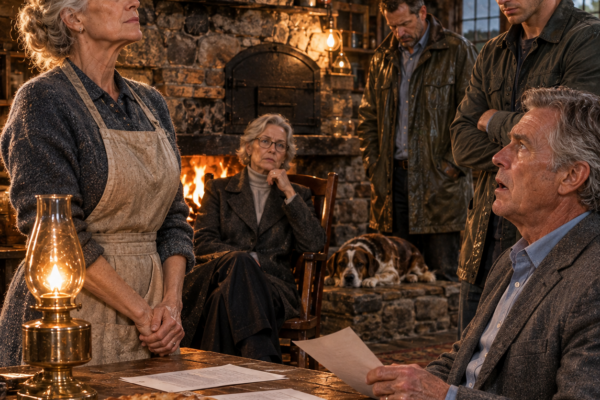
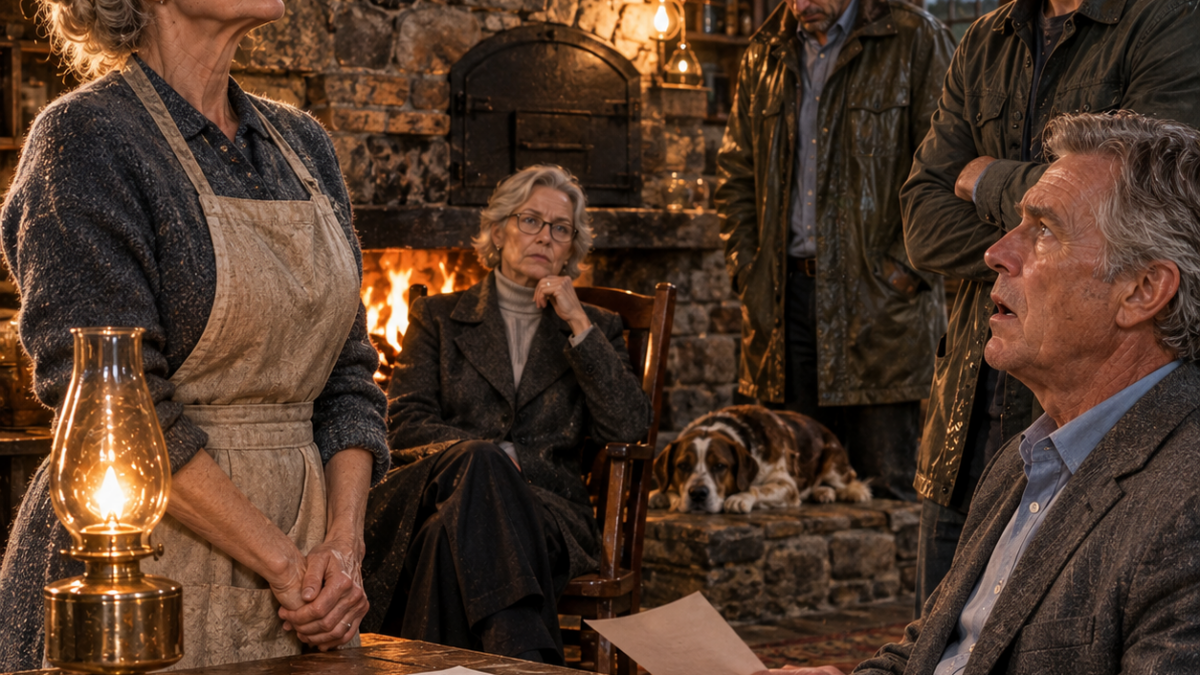
Mabel poured coffee into tin cups. Brent held the dog and Dennis sat on the edge of a cot with his hands hanging between his knees looking at the room his family had built.
He looked at the brick laid so close that a knife blade could not have gone between the courses, and at the jars with Lotties slanted hand on every label.
Then his eyes found the beam and the words cut into the oak and moved over them slowly like a man reading something in a language he had once known.
Nobody should have to knock twice. She never made me knock, he said, scarcely above the wind.
I used to come to the back door when I was nine and shed open it before Id finished. That was the point of it, Dennis, said Mabel.
Ruth Ann cut the pie into six on the plank table with the church key and passed it round on a square of oilcloth and they ate, all of them, in the lamplight with the dogs tail thumping on the boards and the whole hill roaring above them.
It was the best pie she had ever made.
She thought it might have been the heat of the stones.
She thought it might have been something else.
The wind ran for an hour and 20 minutes.
At a quarter past six, it dropped in three or four breaths and the silence was so deep they could hear their own hearts.
In the morning, the world was washed.
The sky was a hard pale blue. The orchard lay on its side in a hundred places, great limbs thrown across the grass, a line of black trunks leaning the one way as though a giant had run his hand through them.
A third of the slates were gone and the porch lay in pieces across the yard.
But the stone cottage stood and the old chimney stood straight through the middle of it with the first sun on its flank as it had stood through the big wind of 1962 and the chimney night of 1980.
Brent and Aberdeen were already sawing a fallen limb off the lane. Mabel was at the stove.
Dennis was in the yard in his shirt sleeves with a splitting maul he did not seem to know what to do with.
And when Ruth Ann came down the steps, he put it down. I have four things to ask, she said.
He nodded, a man who had slept in a kitchen chair. First, my pie money, $2,140, and my phone, and everything else of mine in your house.
Second, youll sell Sycamore Lane yourself and pay Northfield what you owe from the sale, and keep the one shop, the Merryvale shop, where Brent works.
Youll close the other two and live in a smaller place and do an honest days work. Third, every Thursday for a year, youll come to this orchard and work.
Prune, haul, fix the porch, I dont care what.
And the fourth? Im keeping the fourth, said Ruth Ann.
Ill tell you when I know what it is. He looked at her a long time.
Why? he said, and it was not a plea.
Why would you give me anything at all?
Because the room was built for people who had nothing to offer, she said.
And last night, you were one of them.
It seemed the right place to start. Dennis Harmon did something she had not seen him do in 31 years, not at a wedding, not at a funeral.
He nodded and said nothing and picked up the maul.
In the spring, she opened the orchard. Mabel put up a stand at the foot of the lane with a hand-painted sign, Bellflower Orchard, and a basket of Northern Spies on the board, and a smaller sign beneath it that said pie.
People came for cider and apple butter, the clove one most of all, and they stayed for the porch. Lotties lamp stood in the cottage window every night, lit, and it was understood in Merryvale at the pharmacy, at the recorders window, in Imogene Fieldings office that anyone who found themselves with nothing and nowhere to go could be sent up Sparrow Hill Road with no questions asked.
The keeping room got a third cot.
Dennis had not missed a Thursday. He came at 9:00 in the old pickup in a canvas jacket that did not fit him and worked until 4:00 and did not talk much.
In June, he sold the house on Sycamore Lane.
In July, he brought her a pot of soup, thin and salty and honest, and set it on the stove and went red to the ears. She ate every drop.
Brent came Sundays with his wife and the baby, a girl born 2 days after Christmas, and the green tin sat on the shelf beside Lotties receipt book, the two handwritings side by side.
The fourth thing she asked for in the end was Thanksgiving, a chair at the plank table between his son and his granddaughter with the oven lit.
He took it with his hat in his hands. And on the second Sunday in October, a year almost to the week after she had paid $3 with the light going long and orange over the trees and the smell of baking apples drifting across the field, she was standing at the sink when the dog stood up.
A man had come up the lane on foot, a thin stooped man of 72 in a thin coat with a duffel bag on his shoulder and his cap in his hand.
He had the look of someone who has walked a long way with no idea what he will say when he arrives.
He stopped at the foot of the new steps.
He lifted his hand to knock and hesitated. She was at the door before he could.
Come in, she said. Suppers on the stove.
Youll want the chair by the fire.
Maam, I dont want to put you Youre not.
Whats your name? Delbert Haas.
His voice shook.
I fixed school buses 34 years.
They sold the garage. Ive been 2 weeks on the road.
Delbert, this is Clover. And the old dog, nine now and plump, with her ears silky and her white-ticked paw crossed on her knee, got up from the hearth and leaned her whole warm weight against the strangers leg.
He sat. She put a bowl in his hands, and bread, and the last of the pie.
She did not ask a single question.
She told him there was a cot made up behind the oven, and in the morning, if he liked, a porch that wanted fixing, and a man who knew how, and wages.
And when he looked past her at the beam over the cot and the carved words there, and asked, haltingly, what they meant, she told him what she had come to know. It means that when somebody comes up that road with nothing, the door ought to be open before they finish knocking, said Ruth Ann.
Nobody should have to knock twice. Not here, not ever.
Out in the orchard, the red apples hung in the last of the light. On the shelf by the hearth, the green tin sat beside the cloth-bound book.
The oven was lit, and the porch lamp, and the smell of baked apples went out across the dark fields, as it always had, for anyone who happened to be looking for it.