“I’m not your enemy, Marcus. I’m the woman you tried to erase. And I’m still here.”
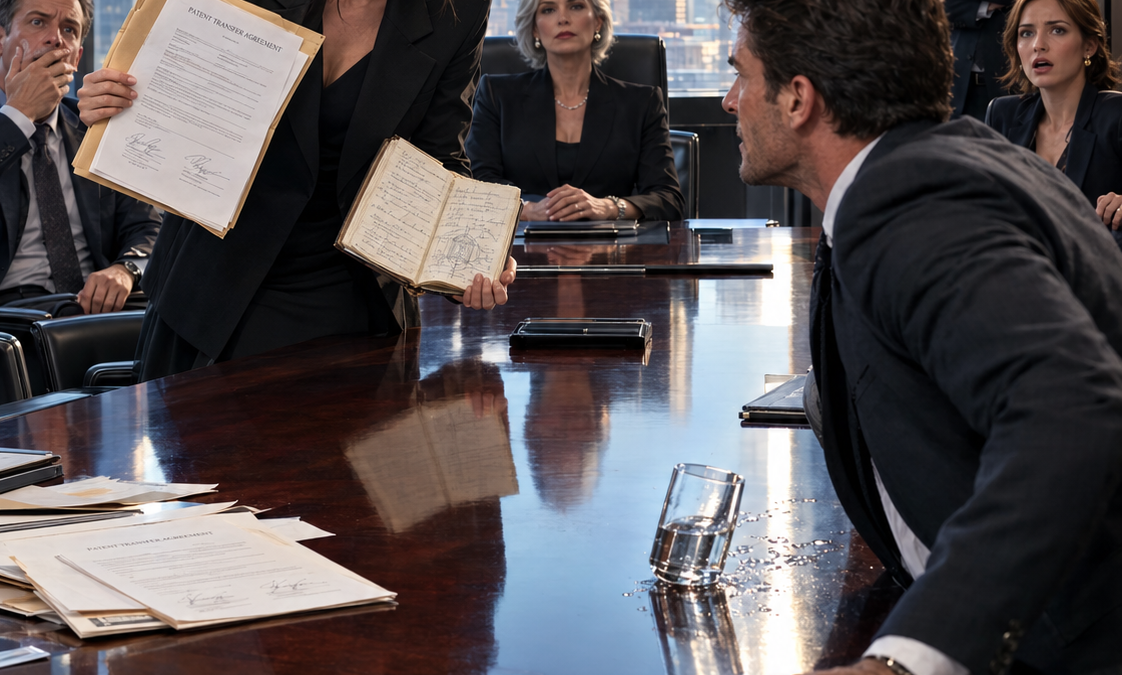
“I’m not your enemy, Marcus. I’m the woman you tried to erase. And I’m still here.”
She signed a power of attorney for a mortgage. He used it to steal her life’s work. She walked into his boardroom with a notebook and walked out with everything.
The boardroom doors didn’t slam. That was the first thing Elena Vane noticed — the quiet. Marcus’s assistant, a woman named Priya who had worked for him for eleven years and never once flinched at a quarterly loss, was standing beside the mahogany table with a single manila folder in her hands. She wasn’t looking at Elena. That was the second thing.
“Mrs. Vane,” Priya said, and the use of the name — not Elena, not Dr. Vane, but the wife-name, the one that belonged to a marriage Elena had stopped believing in three years ago — landed like a deliberate slap. “Mr. Vane asked that this be delivered to you directly.”
“I’m sure he did.”
Elena didn’t take the folder. She was already standing at the head of the table, where she’d been presenting the Helix-7 data to the merger oversight committee. Her laptop was still open. The projected slide behind her showed a protein-fold model that had taken her team nine months to map, and the room — twelve people, twelve faces she’d known for a decade, the women and men who had watched her build Vane Biosciences from a rented lab in a bad part of Ashford into the second-most-valuable division of the Vane Group — was very, very quiet.
Her mother-in-law sat at the far end of the table. Vivienne Vane, silver-haired, immaculate in dove-gray Chanel, had not moved since Priya walked in. Her hands were folded. Her expression was the same one she’d worn when Elena had announced the Helix-7 breakthrough at the family’s Christmas dinner: polite, patient, and utterly unreachable.
“Open it,” Vivienne said. Not a suggestion.
Elena opened it.
The first page was a patent transfer agreement. U.S. Patent No. 9,847,221 — Method for Targeted Protein Degradation via Chimeric Ligand Constructs — the foundational patent for everything Vane Biosciences had built in the last five years, the patent that had brought the Kessler Group to the table for a merger that would create the largest biotech conglomerate on the Eastern Seaboard. The named inventor listed on the original filing was Elena Vane. The current assignee — the entity that now owned it outright — was a holding company called Meridian Global Holdings, registered in the Cayman Islands.
Below that, on the second page, was a copy of a power of attorney. Elena’s signature. Dated six years earlier.
She remembered signing it. It had been for the mortgage on the house in Cambridge — Marcus had needed it to close while she was in Geneva at a conference. That was the whole of it. A mortgage. A house.
“You transferred it,” Elena said. Her voice was calm. She was proud of that. “You used an old POA to move the patent offshore.”
“I restructured an asset,” Marcus said from the doorway.
He’d been there the whole time, she realized. Leaning against the frame, arms crossed, sleeves rolled to the elbow. He looked tired — he always looked tired now, in the way of men who slept four hours and called it discipline. But there was something else in his face tonight, something she’d been seeing for months and hadn’t let herself name: the look of a man who had already decided.
“Restructured,” she repeated.
“For tax efficiency. The merger requires a clean ownership chain.”
“The merger requires my patent to be owned by my company.”
“Your company,” Marcus said, pushing off the doorframe, “is a subsidiary of my family’s holding company. Which makes it mine.”
Three witnesses. That was the rule of the boardroom — Elena had learned it in her first year, when she was still a postdoc Marcus brought to dinner and Vivienne had asked, sweetly, whether she planned to keep working after children. There were always three witnesses. Tonight there were twelve, and every one of them was watching the slow-motion collapse of the woman who had once been considered the smartest hire the Vane Group ever made.
The first witness: Arthur Penhallow, the general counsel, who had drawn up Elena’s employment contract and who was now studying his own hands as though he’d never seen them before.
The second: Lena Ortiz, the head of R&D, who had been Elena’s first hire, her closest ally, and who was currently staring at the patent transfer with an expression of dawning horror that suggested she had known nothing about this — and was doing the math on her own future.
The third: Vivienne Vane. Who had not blinked.
“You can’t do this,” Elena said.
“I already did. Eight months ago.”
Eight months. Before the merger talks. Before the Kessler dinner. Before the night Elena had come home early and found Marcus’s phone on the kitchen counter, lit up with a message from a number she didn’t recognize, a message she hadn’t read because she’d been raised better than that, because she’d believed — foolishly, embarrassingly — that the man she married was still in there somewhere.
Eight months. Before she’d started sleeping in the guest room.
“You knew,” Elena said, turning to Vivienne. “You knew and you let me present to the committee.”
“I knew Marcus was handling the legal structure,” Vivienne said. “I didn’t know the specifics.”
That was a lie. Elena could see it in the way Vivienne’s fingers had curled slightly against the table — the same tell she’d had when she’d told Elena that the family would “prefer” she not use the Vane name professionally. For your own protection, dear. People will think you married up.
The patent was the only thing Elena had ever made that was entirely hers. The lab notebook — the original, the one with the date and the first sketch of the ligand construct, the one she’d kept in a fireproof safe since before she and Marcus were married — was sitting in a storage unit in Somerville, because she’d stopped trusting the house.
She’d stopped trusting the house three years ago, when she found the first withdrawal from their joint account that didn’t match any bill. She’d stayed because of a thousand small reasons, none of them good enough, and because of one large one: she had no family left. Her mother was dead. Her father had disappeared when she was nine. The Vanes were the only people who’d ever claimed her, and even then, only on their terms.
She closed the folder.
“I’ll be filing an injunction by morning,” she said.
Marcus almost smiled. “You’ll be filing it with whose money? The account you share with me? The one I can freeze with a phone call?”
The room held its breath.
Elena looked at him — really looked, for the first time in years. Marcus Vane, forty-three, heir to the Vane Group, the man who had once told her, on a rooftop in Lisbon, that he loved her because she was the only person he’d ever met who wasn’t afraid of him. He’d meant it then. She was sure of that. What she wasn’t sure of was when it had stopped being true — when she’d gone from the woman who challenged him to the woman who inconvenienced him.
“You’re going to regret this,” she said quietly.
“I doubt that.”
“Not because of what I’ll do. Because of what it makes you.”
She picked up her laptop, closed it, and walked out of the boardroom. Twelve pairs of eyes followed her. Priya stepped aside at the door, and Elena saw — just for a second — something in the woman’s face that looked almost like shame.
She didn’t stop walking until she was in the elevator, alone, descending thirty-two floors with the manila folder pressed against her chest and her heart doing something ugly and arrhythmic.
The elevator pinged. The doors opened. The lobby of Vane Tower stretched out in front of her, all marble and glass and the low hum of a security desk that had a photo of Marcus on the wall, and Elena realized, with a clarity that felt like a slap, that she had no plan. No lawyer. No money she could access without him knowing. No family.
Her phone buzzed.
A text from a number she didn’t have saved:
Dr. Vane — I reviewed the Helix-7 filing. There’s a problem with the transfer. Call me. — J. Kessler.
Kessler. The rival family. The merger.
Elena stared at the screen for a long moment, standing in the lobby of her husband’s building, holding the proof of his betrayal in her hands.
Then she typed: Who is this?
The reply came fast.
Someone who wants to watch Marcus Vane lose. Are you interested?
She should have deleted it. She should have walked out, found a lawyer, done this the right way — the way she’d done everything in her life, by the rules, by the book, with her head down and her hands clean.
She typed: Yes.
Chapter 2: The Enemy of My Enemy
The Kessler Group occupied the top four floors of a building on the other side of Ashford, in the new-money district, where the glass was newer and the security guards didn’t wear family crests on their lapels. Elena arrived at 7:15 a.m., still wearing the same clothes from the boardroom, her hair pulled back, her hands steady because she’d spent the two hours between midnight and dawn in a parking garage, on the phone with a lawyer who had told her, gently, that her case was weak.
The POA is valid. He’ll argue implied authority. You’ll spend a year and a half fighting this, and even if you win, you’ll be paying legal fees out of an account he controls.
She’d hung up and called the number from the text. A man answered on the first ring.
“Dr. Vane. I was hoping you’d call.”
“Who am I speaking to?”
“Julian Kessler. I run the Kessler Group’s legal strategy. My father wants the merger. I want to know why Marcus is moving assets around before the due diligence is signed.”
“You think he’s hiding something.”
“I think he’s hiding everything. The patent transfer is just the piece you found.”
Now Elena stood in a conference room on the forty-first floor, watching Julian Kessler pour two cups of coffee. He was younger than she’d expected — late thirties, maybe, with the kind of restless energy that made Marcus look like a statue by comparison. He was also, she noticed, watching her the way a chess player watches an opponent: not with suspicion, but with curiosity.
“You’re not what I expected,” he said.
“Neither are you.”
“I meant it as a compliment.”
“I didn’t.”
Julian’s mouth twitched. “Fair. Let me start over. You’re the co-inventor on the Helix-7 patent. The original filing with the USPTO lists you as such because of a lab notebook entry dated eighteen months before the transfer. Marcus’s legal team missed it — or didn’t care, because they assumed you’d never fight.”
“How do you know about the notebook?”
“Because I pulled the original filing. I do my homework.”
Elena set her coffee down without drinking it. “What do you want?”
“The merger, on my terms. Not Marcus’s. He’s been moving assets into offshore vehicles for a year — not just the patent. Three subsidiaries, two real estate holdings, and a shell company in Malta that I haven’t been able to trace. He’s stripping the Vane Group before the acquisition closes so that when Kessler buys in, we’re buying a shell.”
“And you want me to help you prove it.”
“I want you to help me stop it. There’s a difference.”
She looked at him — at the expensive suit, the careful smile, the eyes that were doing the math on her the same way they’d do it on any asset. He wasn’t a friend. He wasn’t even an ally. He was a man with his own agenda, and she was a tool he’d picked up off the ground.
But he was the only tool she had.
“The notebook,” she said. “You need the original.”
“I need the entry that shows you created the construct before Marcus ever filed. If we can prove the transfer was fraudulent — that he used a POA signed for an unrelated purpose — we can invalidate it. But that’s a civil suit, Elena. It takes years.”
“Unless.”
“Unless we can prove he knew the patent was yours and moved it anyway. That’s fraud. That’s criminal. And that’s leverage.”
Elena was quiet for a long moment. Somewhere below them, Ashford was waking up — traffic, coffee carts, the ordinary machinery of a city that didn’t care about any of this. She thought about the house in Cambridge, the guest room, the way Marcus had started leaving his phone face-down on the table. She thought about the lab notebook in the storage unit. She thought about the message she still hadn’t read, the one from the unknown number, the one she’d seen on his phone eight months ago.
“I’ll get you the notebook,” she said. “But I want something in return.”
“Name it.”
“When this is over, I want the patent back. Not just the right to sue over it — the actual ownership. In my name. Not Vane Biosciences, not the family holding company. Mine.”
Julian studied her. “That’s a big ask.”
“It’s my invention.”
“It’s also the centerpiece of a multibillion-dollar merger.”
“Then you’d better hope I’m as good as my reputation.”
For the first time, Julian Kessler smiled — a real smile, not the corporate one. “I see why Marcus married you. And why he’s afraid of you.”
“He’s not afraid of me.”
“He will be.”
Chapter 3: The Notebook in the Storage Unit
The storage unit was in Somerville, in a building that smelled like dust and old cardboard and the faint chemical tang of someone’s forgotten furniture polish. Elena hadn’t been here in two years. She’d paid the rent automatically, the way she paid everything automatically — a small monthly withdrawal Marcus had never noticed, because he’d stopped noticing the small things years ago.
She found the safe in the back corner, behind a box of her mother’s dishes and a broken lamp she’d never gotten around to fixing. The combination was her mother’s birthday. The notebook was inside, wrapped in a plastic bag, the cover worn soft from years of use.
She opened it to the first page.
June 14 — Ligand construct L-7. First successful degradation of target protein in vitro. Elena Vane, 11:47 p.m.
Her handwriting, younger and sharper, the ink slightly smeared where she’d been too excited to wait for it to dry. Below that, a sketch of the construct — the first version, the one that had worked, the one that had led to everything.
She took a photo of the page and sent it to Julian. Then she sat down on the floor of the storage unit, surrounded by her dead mother’s dishes and her own failed marriage, and let herself cry for exactly ninety seconds.
Her phone buzzed.
This is it. I’m filing with the court in the morning. But we have a problem. Marcus knows about the notebook. He’s filed an emergency motion to bar its use — says it was created during the marriage and is therefore marital property.
Elena stared at the screen. Marital property. He was trying to claim the notebook. He was trying to claim her.
Can he do that?
He can try. But here’s the thing — the notebook predates the marriage. You and Marcus married in 2019. The entry is dated 2017. He has no claim.
She exhaled. So we’re fine.
We’re fine on the notebook. We’re not fine on Marcus. He just called a press conference for tomorrow morning. He’s going to announce that you’re mentally unstable — that you’ve been suffering from burnout, that the patent transfer was a necessary legal protection because you were incapable of managing your own affairs.
The floor of the storage unit was cold. Elena pressed her back against the metal shelf and tried to breathe.
That’s a lie.
Of course it’s a lie. But it’s a lie he can sell. He’s got the family name, the company, and a team of lawyers. You’ve got a notebook and a Kessler.
What do I do?
There was a long pause. Then: You fight back. But not the way he expects. He’s going to paint you as a victim. Don’t let him. Get in front of it. Tell your story first.
To who?
The board. The press. The Kessler family. Anyone who’ll listen. You’re not the crazy wife, Elena. You’re the woman who invented the thing that’s about to make them all rich. Act like it.
She closed the notebook and put it back in the safe. Then she stood up, brushed the dust off her skirt, and walked out of the storage unit into the gray Ashford morning.
She had a press conference to crash.
Chapter 4: The Press Conference
Marcus’s press conference was held in the atrium of Vane Tower, under a glass ceiling that let in the kind of soft, flattering light that made everyone look younger and kinder than they were. He stood at a podium with the Vane Group logo behind him, flanked by Priya and Arthur Penhallow, and he was mid-sentence when Elena walked in.
“—and while I deeply regret the dissolution of my marriage, I want to be clear that Dr. Vane’s contributions to Vane Biosciences are not in question. However, her current state of mind—”
“Her current state of mind is fine.”
The room turned. Elena walked down the center aisle, past the reporters, past the cameras, past the security guard who made a half-hearted move to stop her and then thought better of it. She was wearing the same clothes from the day before, her hair loose, her face bare. She looked, she knew, like a woman who had been up all night fighting for her life. That was the point.
Marcus’s expression flickered — just for a second, so fast that only someone who had spent ten years reading his face would have caught it. Then it smoothed over, the mask back in place.
“Elena. This isn’t the time.”
“It’s exactly the time.” She turned to the reporters. “My husband is telling you that I’m mentally unstable. He’s telling you that he transferred my patent to an offshore holding company for my own protection. He’s lying.”
A murmur ran through the room. Priya’s face had gone pale. Arthur Penhallow looked like a man watching a car crash in slow motion.
“The patent he transferred — U.S. Patent No. 9,847,221 — was invented by me. I have the original lab notebook, dated eighteen months before the transfer, which lists me as the sole inventor. The power of attorney he used to move it offshore was signed for an unrelated mortgage. He knew exactly what he was doing.”
Marcus stepped forward. “Elena, this is not the place—”
“The place is wherever I say it is.” She reached into her bag and pulled out a copy of the notebook page — the photo Julian had printed, the one with her handwriting and her signature and the date. “This is the evidence he tried to suppress. This is the proof that the patent is mine. And this—”
She held up the manila folder from the boardroom.
“—is the transfer agreement. The one he had delivered to me in front of the entire merger committee yesterday, because he thought I would be too humiliated to fight back.”
The cameras were flashing now. A reporter in the front row was already on her phone, calling her editor. Marcus’s jaw was tight, the mask slipping, and for the first time in years — maybe for the first time ever — Elena saw something in his eyes that looked almost like fear.
“You’re making a mistake,” he said quietly, just for her.
“I’m making a correction.”
She turned and walked out of the atrium, past the cameras, past the reporters, past the security guard who now looked at her with something like awe. The doors closed behind her. The Ashford morning was cold and bright, and for the first time in eight months — maybe longer — Elena felt like she could breathe.
Her phone buzzed. Julian.
That was either the bravest thing I’ve ever seen or the dumbest. Possibly both.
She typed back: Are you still willing to help?
More than ever. But we have a bigger problem. My father wants to meet you. Tonight. He’s flying in from Geneva.
Elena stopped on the sidewalk. The Kessler patriarch. The man who had built an empire by buying companies and dismantling them. The man who was, by every account, more dangerous than Marcus Vane on his worst day.
Why?
Because, Julian wrote, he wants to know if you’re worth saving. And if you’re not — he wants to know if you’re worth destroying.
She looked up at Vane Tower, at the glass atrium where Marcus was still standing, still trying to salvage the narrative, still losing.
What time?
Eight. I’ll send the car.
She put the phone in her pocket and started walking. She had ten hours to figure out how to convince a man she’d never met that she was worth more alive than dead.
She didn’t have a plan. But she had a notebook. And she had a name. And for the first time in a very long time, she had nothing left to lose.
Chapter 5: The Kessler Patriarch
The car that arrived at her hotel — she’d checked into a budget place near the airport, the kind of hotel where no one asked for a credit card — was black and silent and driven by a man who didn’t introduce himself. Elena sat in the back and watched Ashford slide past, the old-money districts giving way to the new, the new giving way to the industrial waterfront, until the car stopped in front of a restaurant that didn’t have a sign.
Inside, the room was dim and warm, all dark wood and candlelight, and at the center table sat a man who looked like he’d been carved out of something harder than flesh.
Anton Kessler was seventy-three years old, with white hair and pale eyes and the kind of stillness that comes from decades of being the most dangerous person in every room. He didn’t stand when Elena approached. He didn’t smile. He just watched her sit down and then said, “My son tells me you’re a genius.”
“I wouldn’t go that far.”
“He also tells me you’re married to a man who tried to steal your life’s work. That I believe.”
A waiter appeared and poured wine. Elena didn’t touch hers.
“You want the merger,” she said.
“I want the Vane Group. The merger is a means to an end.”
“And you think I can help you get it.”
“I think you can help me stop it from being worthless. Marcus has been moving money for a year. My people found the patent, but there’s more — three subsidiaries, two properties, and a shell company in Malta. If I buy in now, I’m buying a corpse.”
“You want me to help you find the rest.”
“I want you to help me prove that Marcus Vane has been defrauding his own shareholders. That’s a crime, Dr. Vane. A crime that comes with prison time.”
Elena was quiet. She thought about Marcus, about the man she’d married on a rooftop in Lisbon, about the way he’d looked at her in the boardroom — not angry, not guilty, just certain. He’d been certain he would win. He’d been certain she would break.
“What do I get?” she asked.
“The patent. The truth. And something else — something you haven’t asked for yet.”
“What’s that?”
“Revenge. The kind that doesn’t just hurt him — the kind that ends him.”
Anton Kessler smiled, and it was not a kind smile. “You’re wondering if I’m using you.”
“I’m wondering what happens to me when I’m no longer useful.”
“Smart girl. That’s exactly what happens to people who work with me — they become useful, and then they become liabilities. But you have an advantage they don’t.”
“What’s that?”
“You’re not afraid of me. I can see it in your eyes. You’ve already lost everything that mattered. There’s nothing I can take from you.”
Elena considered this. He was right. She’d spent the last eight months afraid — afraid of losing the marriage, the house, the life she’d built. But Marcus had taken all of that anyway. He’d taken the patent, the company, the future. He’d left her with nothing but a notebook and a name.
“I’ll help you,” she said. “But I have conditions.”
“Name them.”
“I want the patent in my name. Not the Kessler Group. Not a subsidiary. Mine. And I want immunity — whatever happens to Marcus, I walk away clean.”
Anton Kessler studied her for a long moment. Then he nodded.
“Done. But I want something in return.”
“What?”
“I want you to work for me. Not as a lawyer, not as an expert witness. As an executive. You built Vane Biosciences from nothing. I want you to do the same for Kessler — but more importantly, I want Marcus to see you do it. I want him to watch you become the thing he tried to destroy.”
Elena thought about the boardroom, about the twelve faces, about Vivienne’s folded hands and Priya’s shame. She thought about the press conference, about the cameras, about the way Marcus’s mask had cracked.
“Fine,” she said. “When do I start?”
“Monday. Julian will handle the details.” Anton stood, and for the first time, he looked at her with something that might have been respect. “One more thing. My son tells me you’re still living in a hotel. That stops now. You’ll stay at the Kessler estate until we’ve finalized the legal structure.”
“I’m not a charity case.”
“No. You’re a weapon. And I don’t leave my weapons lying around where my enemies can find them.”
He walked out without another word. Julian appeared at her elbow, holding her coat.
“He likes you,” Julian said.
“He threatened me.”
“That’s how he shows affection. You should hear what he says to me.”
Elena took her coat. Outside, the car was waiting, and somewhere in the dark of Ashford, Marcus was probably already planning his next move — probably already drafting the next legal filing, the next lie, the next attempt to erase her.
She got in the car. She didn’t look back.
Chapter 6: The House on the Hill
The Kessler estate was not a house. It was a compound — thirty acres of manicured grounds, a main residence that looked like a small museum, and a separate wing where Julian had set up what he called “the war room.” Elena was given a suite on the second floor, with a view of the gardens and a bathroom larger than her first apartment.
She stood at the window for a long time, watching the sun set over the hedges, and tried to feel something other than exhausted.
Her phone buzzed. Marcus.
She almost didn’t answer. Then she did.
“Elena.”
“Marcus.”
A pause. She could hear him breathing, could almost see him standing in his office at Vane Tower, tie loosened, phone pressed to his ear, the city spread out behind him.
“You’ve made your point,” he said. “The press conference, the Kessler connection. You’ve embarrassed me. Now come home.”
“Home.”
“The house. Cambridge. Where you live.”
“I don’t live there anymore.”
Another pause. “You’re staying with the Kesslers.”
“Yes.”
“That’s a mistake. Anton Kessler will eat you alive.”
“He offered me a job.”
Silence. Then, very quietly: “What kind of job?”
“Executive vice president. Biotech division. Starting Monday.”
The silence stretched. She could hear something in it — not anger, not yet, but something underneath, something she hadn’t heard from him in years.
“He’s using you,” Marcus said finally.
“So are you. The difference is, he’s paying me.”
“Elena—”
“I’m not coming home, Marcus. I’m not withdrawing the press conference. I’m not dropping the lawsuit. And I’m not going to stop until that patent is in my name and your offshore shell companies are in front of a federal judge.”
“You can’t prove anything.”
“I already have the notebook. The transfer agreement. And a team of Kessler lawyers who are very, very good at what they do.”
She heard him exhale. When he spoke again, his voice was different — colder, more controlled, the voice he used in hostile negotiations.
“You think you’ve won something. You haven’t. You’ve made an enemy of me, and I don’t forget.”
“I’m not your enemy, Marcus. I’m the woman you tried to erase. And I’m still here.”
She hung up before he could respond. Then she sat down on the edge of the bed, in the suite of a man who had threatened to destroy her, and realized she was shaking.
Not from fear. From something else. Something that felt almost like power.
Chapter 7: The War Room
Monday morning, Elena walked into the Kessler Group’s headquarters wearing a suit she’d bought with her own money — the last of her savings, a black Theory blazer that still had the tag in the pocket. She’d cut it off that morning with a pair of nail scissors, the way she used to cut tags off lab equipment when the budget was tight.
Julian was waiting in the war room with three lawyers, two forensic accountants, and a wall of documents.
“The Malta shell company is called Orpheus Holdings,” he said, without preamble. “Registered three years ago, same month Marcus took over as CEO of the Vane Group. It’s been receiving transfers from six different Vane subsidiaries — small amounts, under the reporting threshold, but they add up. Total so far: forty-seven million.”
Elena sat down. “What’s it for?”
“We don’t know yet. The money goes in and doesn’t come out. There’s one beneficiary listed — a trust in Liechtenstein. The trust’s named officer is a lawyer who also represents Vivienne Vane.”
Vivienne. Of course.
“She’s been helping him,” Elena said.
“Looks like it. Or she’s been moving money for herself. Either way, it’s fraud.”
Elena stared at the documents — the transfers, the shell companies, the carefully constructed architecture of Marcus’s deception. He’d been planning this for years. Longer than she’d known. Maybe longer than he’d known her.
“I need to see the trust documents,” she said.
“We can’t get them. Not without a court order, and we don’t have enough for a judge yet.”
“Then we need more evidence.”
“We’re working on it. But there’s another problem.” Julian slid a folder across the table. “Marcus has filed a motion to have you declared mentally incompetent. He’s got a psychiatrist who’s willing to testify that you’ve been suffering from paranoid delusions for the last two years.”
Elena opened the folder. The psychiatrist’s report was thorough, detailed, and completely fabricated. It cited incidents she didn’t remember — arguments that had never happened, hospital visits that had never occurred — and concluded that she was a danger to herself and others.
“This is insane.”
“It’s effective. If he wins this motion, he gets control of your assets, your medical decisions, and your legal standing. You won’t be able to testify against him, because you’ll be legally incompetent.”
“So what do we do?”
“We fight it. But we need a counter-evaluation, and we need it fast. I’ve scheduled you for tomorrow morning with a forensic psychiatrist who’s worked with us before.”
“And if she says I’m fine?”
“Then we go on the offensive. We file a motion to compel discovery on the Malta transfers, and we start subpoenaing records. But we need to do it before Marcus can get the competency hearing on the calendar.”
Elena closed the folder. She thought about Marcus, about the way he’d looked at her in the boardroom, about the way he’d said, You’ve made your point.
He wasn’t trying to win anymore. He was trying to erase her.
“Schedule it,” she said. “And Julian—”
“Yeah?”
“Find out who the psychiatrist is. The one he hired. I want to know everything about her.”
Chapter 8: The Forensic Psychiatrist
Dr. Mira Chen was small and sharp and had the kind of quiet authority that made Elena want to sit up straight. She asked questions for three hours — about the marriage, about the patent, about the press conference, about the storage unit, about the ninety seconds she’d spent crying on the floor.
When it was over, she closed her notebook and said, “You’re not delusional.”
“I know.”
“I’m not finished. You’re not delusional, but you are traumatized. You’ve been living in a state of chronic stress for years — probably since the marriage started to deteriorate. That doesn’t make you incompetent. It makes you human.”
“So what do I do?”
“You use it. When Marcus’s lawyer cross-examines you, don’t hide the fear. Don’t hide the anger. Show the court that you’re a woman who has been put through hell and is still standing. Judges hate liars. But they hate bullies more.”
Elena nodded slowly. “Can I ask you something?”
“Of course.”
“Marcus’s psychiatrist — her name is Dr. Helena Marsh. Do you know her?”
Mira’s expression flickered. “I know of her. She’s been disciplined twice by the state board. Once for falsifying a report, once for a conflict of interest. She’s a hired gun. Whatever she says in court, it will be for sale.”
“Can we use that?”
“We can. But it’s a risk. If we attack her credibility, we draw attention to the competency hearing. If we ignore it, we let Marcus control the narrative.”
Elena thought about this. “What if we don’t attack her? What if we just — ask her questions? Under oath. Questions about her relationship with Marcus, about the payments she’s received, about the other cases she’s worked on.”
Mira smiled. “That’s a good strategy. You’re thinking like a lawyer.”
“I’m thinking like a scientist. You test the hypothesis. You find the flaw in the data.”
“And if the data is flawed?”
“Then you throw it out. And you start again.”
Chapter 9: The Settlement Offer
Three days later, Marcus’s lawyer called with a settlement offer.
Elena took the call in the war room, Julian sitting across from her, the speakerphone on.
“Dr. Vane. My client is willing to transfer the patent back to you — full ownership, no strings — if you agree to drop the lawsuit and sign a non-disclosure agreement. You’ll also receive a lump sum of five million dollars and the house in Cambridge.”
Elena looked at Julian. He shook his head, slowly.
“What’s the catch?” she asked.
“No catch. Mr. Vane wants to resolve this amicably. He has no interest in a prolonged legal battle.”
“He has no interest in a prolonged legal battle that he might lose. What about the Malta accounts? The shell companies? The forty-seven million?”
A pause. “I’m not familiar with any—”
“Don’t. Don’t insult me. I have the transfer records. I have the trust documents. And I have a forensic accountant who’s been tracing the money for a week. You tell Marcus that if he wants to settle, he can settle for the full amount — the patent, the accounts, and a public admission that he defrauded the shareholders. Otherwise, I’ll see him in court.”
Another pause. Then, quietly: “He said you’d say that.”
“Then he knows me better than I thought.”
She hung up. Julian was grinning.
“That was fun.”
“It was terrifying.”
“Same thing, in this business.”
Chapter 10: The Mother-in-Law
Vivienne Vane arrived at the Kessler estate the next afternoon, unannounced, in a silver Bentley that looked like it had been polished by hand. She was shown into the library, where Elena was reviewing documents, and she stood in the doorway for a long moment before speaking.
“You’ve made quite a mess.”
“I’ve made a correction.”
“Don’t be clever. It doesn’t suit you.” Vivienne sat down across from her, folding her hands in her lap. “I’m here to offer you a deal.”
“I’ve already had one.”
“This one is better. Marcus will transfer the patent back to you, publicly apologize, and withdraw the competency motion. In exchange, you’ll drop the fraud investigation and leave the Kessler Group. You’ll return to Ashford, take a position at Vane Biosciences, and pretend none of this ever happened.”
“And if I refuse?”
“Then I’ll destroy you.”
Elena set down her pen. “You’ve been trying to destroy me for ten years, Vivienne. You started the day I married your son. You told me I wasn’t good enough, that I’d never be a real Vane, that I was a temporary inconvenience. And I believed you. I spent years trying to prove myself, trying to earn your approval. And then I realized something.”
“What’s that?”
“You were never going to approve of me. Because I was never the problem. You were. You and Marcus and the whole rotten family. You don’t destroy people because they deserve it. You destroy them because it’s the only thing you know how to do.”
Vivienne’s expression didn’t change. But something in her eyes shifted — a flicker of something that might have been respect, or might have been fear.
“You’re making a mistake,” she said.
“I’ve made a lot of mistakes. But this isn’t one of them.”
Vivienne stood. “You think the Kesslers will protect you. They won’t. Anton Kessler is a predator. He’ll use you and discard you, and when he’s done, you’ll have nothing. No husband, no family, no home.”
“I have a notebook. And I have a name. And I have the truth.”
“The truth doesn’t pay legal fees.”
“No. But the forty-seven million in your son’s offshore accounts does.”
Vivienne went very still. “You don’t know what you’re talking about.”
“I know about Orpheus Holdings. I know about the Liechtenstein trust. I know about the lawyer who represents both you and the shell company. And I know that if I go to the federal prosecutor with this, you won’t just lose the company. You’ll lose everything.”
Vivienne stared at her for a long moment. Then she turned and walked out without another word.
Elena sat alone in the library, her heart pounding, and realized she wasn’t shaking anymore.
She was ready.
Chapter 11: The Merger Committee
The merger committee meeting was held in the Kessler Group’s boardroom, a glass-walled room on the forty-fourth floor with a view of the entire city. Elena arrived early, carrying the notebook in her bag, and took a seat at the far end of the table — not at the head, not at the foot, but in the middle, where she could see everyone’s faces.
Anton Kessler sat at the head. Julian was beside him. Across the table sat Marcus, Vivienne, and three members of the Vane Group’s board, all of whom looked like they’d rather be anywhere else.
“Dr. Vane,” Anton said. “Thank you for joining us.”
“Thank you for having me.”
Marcus didn’t look at her. He was studying a document in front of him, his pen moving in small, precise circles — a habit she’d once found endearing, back when she still found anything about him endearing.
“I’ve called this meeting,” Anton continued, “to discuss the revised terms of the merger. As you know, our due diligence has uncovered certain irregularities in the Vane Group’s financial structure. Specifically, the transfer of assets to offshore holding companies without board approval.”
The board members shifted in their seats. Marcus’s pen stopped moving.
“These irregularities,” Anton said, “constitute a breach of fiduciary duty. In some cases, they may constitute fraud. My legal team has prepared a report detailing the findings.”
Julian slid a stack of folders across the table. The board members opened them. Marcus didn’t.
“I’m sure there’s an explanation,” Vivienne said smoothly. “Marcus has been restructuring the company for years. Some of those restructurings involved offshore entities for tax purposes. It’s all perfectly legal.”
“Then you won’t mind answering a few questions,” Elena said.
Everyone turned to look at her.
“The Orpheus Holdings account,” she continued. “Forty-seven million dollars transferred over three years. No board approval, no disclosure, no explanation. Where did the money go?”
Marcus finally looked at her. His eyes were flat, cold, the eyes of a man who had decided she was no longer a person but an obstacle.
“The Orpheus account was a strategic reserve. It was used to fund acquisitions and protect against hostile takeovers.”
“Which acquisitions?”
“Several. They’re listed in the financial statements.”
“No, they’re not. I’ve reviewed the statements. The Orpheus transfers don’t appear anywhere in the Vane Group’s audited financials. Which means either your auditors missed them — or you deliberately concealed them.”
The room was silent. The board members were looking at Marcus now, their expressions shifting from confusion to concern to something that looked like fear.
“I think,” Anton said, “we should take a short recess. Dr. Vane, Mr. Vane — I’d like to speak with both of you privately.”
Chapter 12: The Private Room
The private room was small, windowless, and soundproofed. Anton sat at the head of the table. Elena sat on one side, Marcus on the other. Julian stood by the door.
“I’m going to be blunt,” Anton said. “The merger is dead unless we can resolve this. And by ‘resolve,’ I mean I need a full accounting of every offshore transfer, every shell company, every undisclosed asset. If I don’t get that, I walk away. And when I walk away, I take my lawyers with me.”
Marcus’s jaw tightened. “You’re threatening me.”
“I’m negotiating. There’s a difference.” Anton leaned back. “You have forty-eight hours to produce the documents. If you do, we can still salvage this. If you don’t, I’ll go to the federal prosecutor myself.”
“You wouldn’t.”
“Try me.”
Marcus was silent for a long moment. Then he turned to Elena.
“You did this.”
“I didn’t do anything. You did. You moved the patent, you moved the money, you tried to have me declared incompetent. I’m just the one who caught you.”
“You think this is about the patent? The money?” He shook his head. “This is about you. You couldn’t stand being married to me. You couldn’t stand being second. So you decided to destroy everything I built.”
“I decided to stop you from destroying me.”
“There’s no difference.”
Anton stood. “This is fascinating, but it’s not productive. Mr. Vane, you have forty-eight hours. Dr. Vane — a word, please.”
Marcus walked out. Elena stayed. Anton looked at her for a long moment.
“He’s going to try something. Something desperate.”
“I know.”
“Do you have protection?”
“I have Julian.”
“Julian is my son. He’s not a bodyguard.” Anton reached into his pocket and pulled out a card. “This is the number for a security firm I’ve used for years. Call them. Tell them I sent you.”
Elena took the card. “Thank you.”
“Don’t thank me. Just win.”
 [Tap here for the Next Part ]



