Part 2: “I’m not your enemy, Marcus. I’m the woman you tried to erase. And I’m still here.”
Chapter 13: The Quiet Hour
That night, Elena couldn’t sleep. She wandered down to the kitchen at 2 a.m. and found Julian sitting at the counter, eating cereal out of a mixing bowl.
“You’re up,” he said.
“Couldn’t sleep.”
“Join the club.” He pushed the cereal box toward her. “It’s stale, but it’s all we’ve got.”
Elena poured herself a bowl. They ate in silence for a while, the kitchen dark except for the light over the stove.
“Can I ask you something?” she said.
“Sure.”
“Why are you helping me? I mean, I know why your father is — he wants the Vane Group. But you? You don’t seem like the type to do anything without a reason.”
Julian was quiet for a moment. “You know what my father did to my mother?”
“No.”
“He divorced her when I was twelve. Moved her out of the house, cut her off from the family money, told everyone she was unstable. She spent the next ten years fighting him in court. She lost. She died when I was twenty-two, broke and alone.”
“I’m sorry.”
“I’m not telling you for sympathy. I’m telling you because I know what it looks like when a man tries to erase a woman. I watched it happen to my mother. I couldn’t stop it then. But I can stop it now.”
Elena looked at him — at the expensive suit, the careful smile, the eyes that had always seemed to be doing the math. She’d been wrong about him. He wasn’t a predator. He was a man carrying a debt he could never repay.
“Marcus isn’t your father,” she said.
“No. But you’re not my mother, either. And I’d rather not find out what happens if we lose.”
He stood up and put his bowl in the sink. At the door, he paused.
“Get some sleep, Elena. Tomorrow’s going to be a long day.”
Chapter 14: The Betrayal
The next morning, Elena’s phone rang at 6 a.m. It was Julian, and his voice was tight.
“We have a problem. The forensic accountant — the one who’s been tracing the Malta transfers. He’s gone.”
“Gone where?”
“Disappeared. His apartment is empty, his phone is off, and his wife says she hasn’t seen him since last night. And that’s not all. The documents — the ones he was working on — they’re gone too.”
Elena sat up. “What does that mean?”
“It means someone got to him. Someone who knew what he was working on.”
“Marcus.”
“Probably. But we can’t prove it. And without the documents, we can’t prove the fraud.”
Elena was quiet. She thought about the forensic accountant, a quiet man in his fifties who had spent a week in the war room, tracing transfers and building spreadsheets. She thought about the way he’d said goodnight on Friday, the way he’d packed up his laptop and walked out the door.
“We still have the notebook,” she said.
“The notebook proves the patent is yours. It doesn’t prove the fraud.”
“Then we need something else. Something Marcus can’t make disappear.”
“What?”
She thought for a moment. Then: “The lawyer. The one who set up the Liechtenstein trust. He’s still out there. He knows where the money went. If we can find him, we can flip him.”
“Marcus will have gotten to him too.”
“Maybe. But maybe not. Lawyers are cautious. They keep records. If we can find his files—”
“We don’t have time. The forty-eight hours are almost up.”
“Then we make time.”
Chapter 15: The Lawyer in Zurich
The lawyer’s name was Ernst Vogel. He was sixty-eight years old, semi-retired, and lived in a small apartment in Zurich with a view of the lake and a collection of first-edition novels. Elena found him through a series of phone calls — Julian’s contacts, her own research, a name mentioned once in a document she’d read three times.
She flew to Zurich alone. Julian had wanted to come, but she’d told him no — this was something she had to do herself.
Vogel opened the door with the chain still on. He looked at her through the gap with pale, wary eyes.
“I’m not giving interviews.”
“I’m not a journalist. I’m Elena Vane. Marcus Vane’s wife.”
The chain rattled. The door opened.
They sat in his living room, surrounded by books and the smell of old paper. Vogel poured tea. He didn’t ask how she’d found him.
“You want the trust documents,” he said.
“I want the truth.”
“The truth is expensive.”
“I’m not here to threaten you. I’m here to offer you a choice. You can give me the documents, and I’ll make sure your name stays out of the investigation. Or you can refuse, and I’ll go to the Swiss authorities with what I already have. Either way, Marcus Vane is going down. The only question is whether you go with him.”
Vogel was quiet for a long moment. Then he stood, walked to a safe in the corner, and pulled out a folder.
“These are copies. The originals are in a vault in Geneva. But these will be enough.”
Elena opened the folder. Inside were the trust documents, the transfer records, the correspondence between Marcus and Vivienne — everything she needed to prove the fraud.
“Why are you doing this?” she asked.
“Because I’m old, and I’m tired, and I’ve spent forty years helping rich men hide their money. I’d like to do one thing that matters before I die.”
Elena closed the folder. “Thank you.”
“Don’t thank me. Just make sure he pays.”
Chapter 16: The Return
Elena landed in Ashford at midnight. Julian was waiting at the airport, leaning against a black car, and when he saw her, he smiled.
“You got it.”
“I got it.”
They drove back to the estate in silence. The city slid past, all lights and shadows, and Elena thought about Marcus — about the man she’d married, the man who had tried to erase her, the man who was probably sitting in his office right now, trying to figure out what to do next.
He didn’t know she had the documents. He didn’t know she’d found Vogel. He thought he’d won.
Tomorrow, he would find out he was wrong.
Chapter 17: The Boardroom, Again
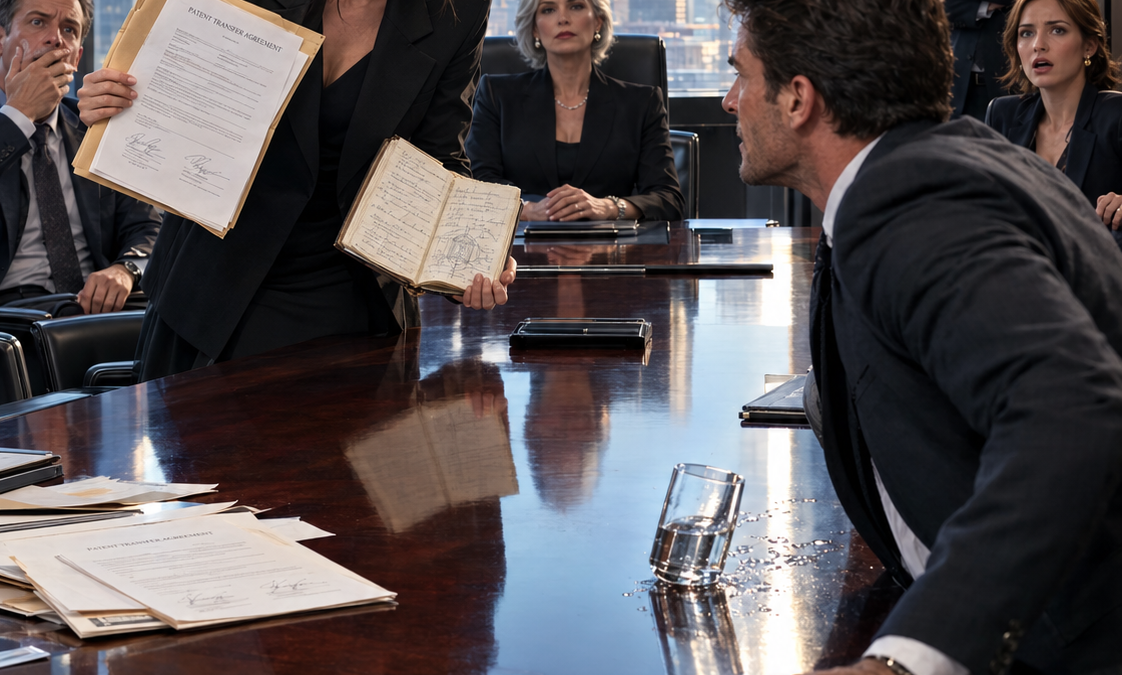
The boardroom was the same as before — glass walls, mahogany table, twelve faces — but everything else had changed. Elena walked in with Julian and Anton, carrying the Zurich folder, and took a seat at the head of the table.
Marcus was already there. So was Vivienne. So were the board members, the lawyers, the merger committee. Everyone who had watched her humiliation three weeks earlier was now watching her return.
“I have new evidence,” Elena said. “The trust documents from the Orpheus Holdings account. The correspondence between Marcus Vane and Vivienne Vane detailing the transfer of forty-seven million dollars to an offshore account. The proof that the patent transfer was fraudulent, and that the competency motion was filed in bad faith.”
She slid the folders across the table.
“I’m filing a formal complaint with the federal prosecutor this afternoon. I’m also filing a civil suit against Marcus Vane, Vivienne Vane, and the Vane Group for fraud, breach of fiduciary duty, and intentional infliction of emotional distress. And I’m requesting that the court freeze all assets associated with the offshore accounts pending investigation.”
Marcus stared at the folders. His face was pale, his hands very still.
“You can’t do this.”
“I already did.”
“You’ll destroy the company.”
“You destroyed the company. I’m just the one who’s going to make sure you pay for it.”
Vivienne stood. “This is absurd. These documents are forgeries.”
“They’re not. They’re certified copies from a Swiss law firm. And I have the original in a vault in Geneva, along with a sworn statement from the lawyer who prepared them.”
The room was silent. The board members were looking at Marcus now, their faces a mixture of shock and horror. Priya, standing by the door, had covered her mouth with her hand.
“I think,” Anton said, “we should take a vote. On whether to remove Marcus Vane as CEO.”
Chapter 18: The Vote
The vote took six minutes. Eleven to one. Marcus was removed as CEO, effective immediately. Vivienne was removed from the board. The merger was put on hold pending the fraud investigation.
Elena watched it happen from the head of the table. She didn’t feel triumphant. She felt tired — bone-deep tired, the kind of tired that comes from three weeks of sleepless nights and endless fear. But she also felt something else. Something that felt almost like peace.
After the meeting, Marcus approached her. He looked smaller than she remembered, diminished, the mask finally gone.
“You won,” he said.
“This isn’t about winning.”
“Then what is it about?”
“It’s about the truth. It’s about the fact that you tried to erase me, and I wouldn’t let you. It’s about the fact that I spent ten years trying to be the woman you wanted, and I finally realized I don’t need your approval. I never did.”
He was silent for a long moment. Then: “I loved you.”
“I know.”
“I still—”
“Don’t. Don’t say it. It doesn’t mean anything anymore.”
She turned and walked out of the boardroom. She didn’t look back.
Chapter 19: The Aftermath
The weeks that followed were a blur of legal filings, press conferences, and quiet conversations in the war room. The federal prosecutor opened an investigation. The SEC opened an investigation. The Vane Group’s stock plummeted, then stabilized as the truth came out and the market adjusted.
Elena testified before the grand jury. She testified before the SEC. She testified in a civil deposition that lasted three days, answering questions from Marcus’s lawyers — the same lawyers who had drawn up the patent transfer, the same lawyers who had filed the competency motion, the same lawyers who had tried to erase her.
Through it all, she kept the notebook in her bag. She didn’t need to look at it anymore. She knew what was in it.
The patent was transferred back to her in a court-ordered settlement. She didn’t return to Vane Biosciences. She didn’t return to Cambridge. She stayed at the Kessler estate, working with Julian on the merger — the real merger, the one that would be built on transparency and due diligence and all the things Marcus had tried to destroy.
One night, three weeks after the boardroom vote, she found herself on the terrace, watching the sun set over the gardens. Julian came out with two glasses of wine.
“You did it,” he said.
“We did it.”
“No. You did it. I just helped.”
Elena took the wine. “What happens now?”
“The merger closes next month. The Vane Group is under new management. The prosecutor is building a case against Marcus and Vivienne. And you—” He paused. “You’re free.”
“Free.”
“To do whatever you want. Go wherever you want. Be whoever you want.”
Elena thought about this. She thought about the lab in Ashford, the rented space with the bad lighting, the first time she’d ever held the notebook in her hands. She thought about Marcus, about the rooftop in Lisbon, about the way he’d looked at her on their wedding day. She thought about all the years she’d spent trying to be something she wasn’t, and all the years she’d spent forgetting who she was.
“I want to build something,” she said. “Something that’s mine. Not Vane, not Kessler. Mine.”
“Then build it.”
She looked at him — at the careful smile, the restless energy, the eyes that had stopped doing the math months ago and started doing something else entirely.
“You’d help me?”
“I’d help you. But I don’t think you need me.”
“No. But I want you.”
He was quiet for a moment. Then he smiled — a real smile, the kind she’d never seen on him before.
“That’s the first time you’ve said that.”
“I know.”
“Say it again.”
“I want you.”
He kissed her then, on the terrace, with the sun setting behind them and the garden stretching out below. It wasn’t a perfect kiss. It was tentative and a little awkward and they bumped noses at one point, and Elena laughed — really laughed, for the first time in months.
It was enough.
Chapter 20: The Trial, Part One
The courtroom was small and wood-paneled and smelled like old carpet and anxiety. Elena sat in the witness box, her hands folded in her lap, and watched Marcus walk in with his lawyers.
He looked different. Older, smaller, the polish gone. He was wearing a suit she didn’t recognize, and his hair was gray at the temples in a way it hadn’t been three months ago.
The prosecutor began the questioning.
“Dr. Vane, can you describe your relationship with the defendant, Marcus Vane?”
“He’s my husband.”
“Were you aware that he had transferred the Helix-7 patent to an offshore holding company?”
“No. I found out when his assistant handed me the transfer agreement in front of the merger committee.”
“And what was your reaction?”
“I felt like I’d been erased. The patent was my life’s work. I’d created it in a rented lab, on my own time, with my own money. And he’d taken it without asking, without telling me, without even considering that it might belong to me.”
“Did you confront him?”
“I did. He said it was a necessary legal restructure. He said the patent was his because I was his.”
“Objection,” Marcus’s lawyer said. “Speculation.”
“Sustained.”
The prosecutor moved on. She asked about the competency motion, about the offshore accounts, about the forty-seven million dollars. Elena answered every question — calmly, clearly, the way Mira had told her to. She didn’t hide the fear. She didn’t hide the anger. She let the court see the woman who had been put through hell and was still standing.
When it was over, Marcus’s lawyer cross-examined her.
“Dr. Vane, isn’t it true that you signed the power of attorney voluntarily?”
“Yes. For a mortgage.”
“And isn’t it true that you never revoked it?”
“No. I didn’t know it needed to be revoked.”
“Didn’t you trust your husband to use it responsibly?”
“I trusted him. That was the problem.”
The lawyer smiled. “No further questions.”
Chapter 21: The Trial, Part Two
The trial lasted two weeks. Elena testified three times. Julian testified twice. Vivienne testified once, and her testimony was so evasive that the judge finally told her to answer the question or face contempt.
Marcus didn’t testify. His lawyers advised against it, and for once, he listened.
The verdict came on a Friday afternoon. The judge read it aloud in a packed courtroom: guilty on all counts. Fraud. Breach of fiduciary duty. Conspiracy. The sentence would be determined at a later hearing.
Elena sat in the gallery, between Julian and Anton, and watched Marcus’s face as the verdict was read. He didn’t flinch. He didn’t look at her. He just stared straight ahead, at the wall behind the judge’s bench, as though he could see something none of them could.
After the hearing, outside the courthouse, the press was waiting. Elena walked past them without stopping. She didn’t have anything to say. The truth had been told. The verdict had been read. There was nothing left to add.
Chapter 22: The Settlement
The civil suit settled three weeks later. Marcus agreed to transfer the patent back to Elena, pay a fine of twenty million dollars, and relinquish all claims to the Vane Group’s remaining assets. Vivienne agreed to the same terms. The house in Cambridge was sold, and the proceeds went to a trust for Elena’s future lab.
She didn’t want the money. But she took it. She’d earned it.
The Kessler Group acquired the Vane Group in a deal that closed on a rainy Tuesday in November. Anton Kessler stepped down as CEO and handed the reins to Julian. Elena was named head of the new biotech division — not as a figurehead, not as a symbol, but as a scientist and an executive with a mandate to build something new.
The first day in her new office, she hung the lab notebook on the wall. Not in a frame — just a nail, a hook, the worn cover facing out. She wanted to see it every day. She wanted to remember what it had cost her.
Chapter 23: The Quiet, Part One
Winter came. The estate was quiet, covered in snow, and Elena spent most of her days in the lab, working on a new project — a protein-degradation platform that would build on the Helix-7 work but go further. Faster. Better.
Julian brought her dinner most nights. They ate in the kitchen, at the counter, the way they had that first night. He told her about his day. She told him about hers. They argued about everything — politics, music, the best way to structure a clinical trial — and made up over coffee.
One night, in December, he asked her a question.
“Why did you stay with him? Marcus. For as long as you did.”
Elena thought about it. “I was afraid. Not of him — of being alone. I’d lost my mother, my father, everyone. The Vanes were the only family I had. I thought if I left, I’d have nothing.”
“And now?”
“Now I know that’s not true. I have the notebook. I have the lab. I have you.”
Julian was quiet for a moment. Then he reached across the counter and took her hand.
“You have me,” he said. “You’ve always had me.”
Chapter 24: The Quiet, Part Two
They didn’t rush. That was the thing Elena appreciated most about Julian — he never pushed, never demanded, never made her feel like she owed him something. He was patient in a way Marcus had never been, and she realized, slowly, that patience was its own kind of power.
In February, they took a trip to Zurich. Not for business — for the lake, the mountains, the quiet. They stayed in a small hotel near the water, and in the mornings, they walked along the shore and talked about nothing in particular.
On the last night, Julian asked her a question.
“What do you want? Not for the company, not for the patent. For you.”
Elena looked out at the lake, at the lights shimmering on the water, and thought about the answer.
“I want to build something that lasts. Something that’s mine. I want to wake up every day and know that I’m doing what I was meant to do. And I want—”
She paused.
“What?”
“I want to be with someone who sees me. Not as a wife, not as an asset, not as a threat. Just as me.”
Julian turned to face her. “I see you.”
“I know.”
“I’ve seen you since the first day. Not the scared woman in the boardroom. The scientist. The fighter. The one who refused to give up.”
Elena reached out and touched his face. “Say it again.”
“I see you.”
She kissed him then, on the balcony, with the lake below and the stars above. And for the first time in years — maybe for the first time ever — she felt like she was exactly where she was supposed to be.
Chapter 25: The Confrontation
Marcus’s sentencing hearing was held in March. Elena attended, not because she wanted to, but because she needed to. She needed to see it end.
The courtroom was the same as before. The same wood panels, the same bad lighting. Marcus stood in front of the judge, wearing a gray suit, his hands cuffed in front of him.
The prosecutor read the charges. The judge asked Marcus if he had anything to say.
He did.
“I want to apologize,” he said. “Not to the court — to my wife. To Elena.”
He turned to look at her, and for a moment, his face was the face she remembered — the face from the rooftop in Lisbon, the face from their wedding day, the face of the man she’d once loved.
“I was wrong. I was scared. I was scared of losing everything — the company, the family, the legacy — and I took it out on you. I tried to erase you, and I’m sorry. I’m sorry for what I did, and I’m sorry for who I became.”
Elena didn’t say anything. She didn’t need to. She’d heard his apologies before, and they’d always been followed by another lie. But this time, something was different. This time, he wasn’t asking for forgiveness. He was just telling the truth.
The judge sentenced him to eight years in federal prison. Vivienne received five years and a fine. The Vane Group was dissolved, its assets sold, its name retired.
After the hearing, Elena walked out of the courthouse into the bright March morning. Julian was waiting for her on the steps.
“How do you feel?” he asked.
“I feel like it’s over.”
“Is it?”
She looked up at the sky, at the clouds moving slowly across the blue, and thought about the question.
“It’s the end of something. But it’s also the beginning.”
Chapter 26: The Lab
The lab opened in June. It was small — just three rooms in a converted warehouse in Ashford’s new biotech corridor — but it was hers. Her name on the door. Her equipment, her team, her vision.
The first day, she stood in the main room and looked around at the empty benches, the new machines, the boxes still waiting to be unpacked. Julian was there, and Mira Chen, and a handful of researchers she’d recruited from Vane Biosciences — people who had watched her fight and decided they wanted to be on her side.
“This is it,” Julian said.
“This is it.”
“Are you nervous?”
“A little.” She smiled. “But I’ve been nervous before. I survived.”
He took her hand. “What’s the first project?”
She looked at the notebook, still hanging on the wall, and thought about the ligand construct, the one she’d sketched at 11:47 p.m. on a June night, the one that had started everything.
“I’m going to finish what I started,” she said. “And then I’m going to build something new.”
RESOLUTION
Chapter 27: The Patent, Reissued
The patent was reissued in September. Elena’s name on the filing, hers alone, no holding companies, no offshore accounts, no lies. She held the certificate in her hands for a long time, reading the words over and over, and then she framed it and hung it next to the notebook.
The lab grew. The first clinical trial launched in January. The second in April. By summer, they had a partnership with a major pharmaceutical company and a waiting list of investors.
Elena hired slowly, carefully. She wanted people who believed in the science, not the money. She wanted people who would fight for the work, not just the paycheck. She wanted people who would never, ever let her sign a power of attorney without reading the fine print.
One afternoon, a young researcher — a woman with a sharp laugh and a tattoo of a DNA helix on her wrist — asked her a question.
“Dr. Vane, why did you name the company Meridian?”
Elena thought about it. The name had come to her in the weeks after the trial, when she was still living at the Kessler estate, still trying to figure out what came next.
“Because a meridian is a line that connects two points,” she said. “It’s not a beginning or an end. It’s a path. That’s what I wanted the company to be. A path forward.”
The researcher nodded and went back to work. Elena watched her for a moment, then turned to the window. Outside, the city was waking up, the sun rising over the buildings, the streets filling with people.
She had a meeting in an hour. A conference call at noon. A dinner with Julian that night.
She had a life. A real one. And it was hers.
Chapter 28: The Wedding
They got married in October, on the terrace of the Kessler estate, with the gardens spread out below and the sky a soft, clear blue. It was small — just family and friends, the people who had stood by her when everything fell apart.
Mira Chen was there. Anton Kessler was there, looking unusually pleased with himself. Julian’s sister, a painter who lived in Copenhagen, flew in for the weekend. A few of Elena’s researchers came, and a few of Julian’s colleagues from the Kessler Group.
Elena wore a simple dress, ivory silk, and carried a bouquet of white roses. She walked down the aisle alone — no father to give her away, no brother, no uncle — because she was done pretending she needed anyone to stand beside her. She had herself. That was enough.
Julian was waiting at the end of the aisle. He looked nervous, which made her laugh.
“Ready?” he asked.
“I’ve been ready.”
They exchanged vows — simple ones, written by themselves, about trust and truth and building something that lasts. When the officiant pronounced them married, Julian kissed her, and the small crowd cheered, and Elena felt something she hadn’t felt in years.
Happy. She felt happy.
Chapter 29: The House
They bought a house in the spring — a small Victorian in a quiet neighborhood, with a garden and a study and a lab in the basement. Elena spent the summer renovating, choosing paint colors and light fixtures, building the kind of home she’d never had.
One night, in August, she found a box in the attic. It was filled with old papers — letters, photographs, documents. At the bottom was a picture of her mother, young and smiling, standing in front of a house Elena didn’t recognize.
She turned it over. On the back, in her mother’s handwriting: Elena, age 2. Our first house.
Elena sat on the floor of the attic and cried. Not because she was sad. Because she’d finally found something she’d thought she’d lost — a connection to the past, to the woman who had loved her before anyone else.
She took the picture downstairs and put it on the mantelpiece. Julian found her there, standing in front of the fireplace, looking at the photograph.
“Your mother?” he asked.
“Yes.”
“She was beautiful.”
“She was. And she was strong. Stronger than I ever knew.”
Julian put his arm around her. “You’re strong too.”
“I know.”
Chapter 30: The Beginning
The company went public in November. Elena stood on the floor of the stock exchange and watched the numbers tick upward, surrounded by her team, her investors, her friends. Julian was beside her, his hand in hers.
After the bell rang, she stepped outside into the cold November air. The city stretched out in front of her — all lights and glass and possibility. She thought about the boardroom, about the patent transfer, about the way she’d felt when she saw her name on the transfer agreement.
She thought about the notebook. The lab. The long nights. The fear. The fight.
And she thought about Marcus, in prison, paying for what he’d done. Not because she wanted revenge. Because the truth mattered. Because she mattered.
Julian came out and stood beside her.
“What are you thinking?” he asked.
“I’m thinking about how I got here. All the steps. All the mistakes. All the choices.”
“And?”
“I wouldn’t change any of it.”
He took her hand. “Not even the bad parts?”
“Especially not the bad parts. They made me who I am.”
She turned to look at him — at the man who had helped her fight, who had stood by her, who had seen her when no one else did.
“Let’s go home,” she said.
They walked to the car, hand in hand, and drove through the city toward the house, the lab, the life they’d built together. The past was behind them. The future was wide open.
And for the first time in a very long time, Elena Vane was exactly where she wanted to be.
Chapter 31: The Letter
Six months later, Elena received a letter. It was forwarded from the courthouse, postmarked from the federal correctional facility in upstate New York, and it was written in Marcus’s handwriting.
She almost threw it away. Then she opened it.
Elena,
I know you don’t owe me anything. I’m not writing to ask for forgiveness. I’m writing to tell you something I should have told you a long time ago.
I was jealous of you. From the beginning. You were smarter than me, more talented, more driven. You built something out of nothing, and I inherited everything I had. I couldn’t stand it. I couldn’t stand that you didn’t need me, that you never needed me, that you would have been fine without me from the day we met.
So I tried to take it from you. The patent, the company, the credit. I told myself it was business. It was never business. It was fear.
I hope you’re happy. I hope you’re building something beautiful. I hope you never think about me again.
But if you do, I hope you remember that I loved you. I know it doesn’t excuse anything. But I did.
Marcus
Elena read the letter twice. Then she folded it, put it back in the envelope, and placed it in the drawer of her desk.
She didn’t cry. She didn’t feel angry. She just felt — done.
Chapter 32: The Second Patent
The second patent was filed in the spring. It was for a new method of protein degradation, one that built on the Helix-7 work but went further — faster, more precise, more effective. The lab had been working on it for two years, and when the filing went through, Elena celebrated with her team, with Julian, with everyone who had been part of the journey.
That night, she stood in her office and looked at the wall. The notebook. The first patent. The second patent. A history of her life, in paper and ink.
She thought about the girl who had sketched the ligand construct at 11:47 p.m., alone in a rented lab, with no money and no connections and no idea what she was doing. She thought about the woman who had walked into the boardroom and seen her name on the transfer agreement. She thought about all the versions of herself she’d been — the daughter, the wife, the victim, the fighter.
She was none of those things anymore. She was just Elena. And that was enough.
Chapter 33: The Anniversary
On the first anniversary of their wedding, Julian took her back to Zurich. They stayed in the same hotel, walked along the same lake, ate at the same restaurant. It was a pilgrimage of sorts — a return to the place where they’d first admitted what they meant to each other.
On the last night, they stood on the balcony and watched the sunset. Julian reached into his pocket and pulled out a small box.
“What’s this?”
“Open it.”
She opened it. Inside was a necklace — a thin gold chain with a small pendant, a single letter E.
“It’s not a ring,” he said. “I know you don’t need a ring. You don’t need anything. But I wanted to give you something. Something small. Something that says—”
He paused.
“What?”
“Something that says I see you. I always have.”
Elena put on the necklace. The pendant rested against her collarbone, warm from her skin.
“I see you too,” she said.
They stood there for a long time, watching the light fade, and Elena thought about the future — about the lab, the patents, the life she was building. She thought about the past, about the notebook, about the moment she’d decided to fight instead of surrender.
She thought about the word meridian — the line that connects two points.
She was the line. She was the path. She was the beginning and the middle and the end.
And she was still here.


