“You sold my life’s work to save your family’s empire. And you’re asking me to help you keep it.”
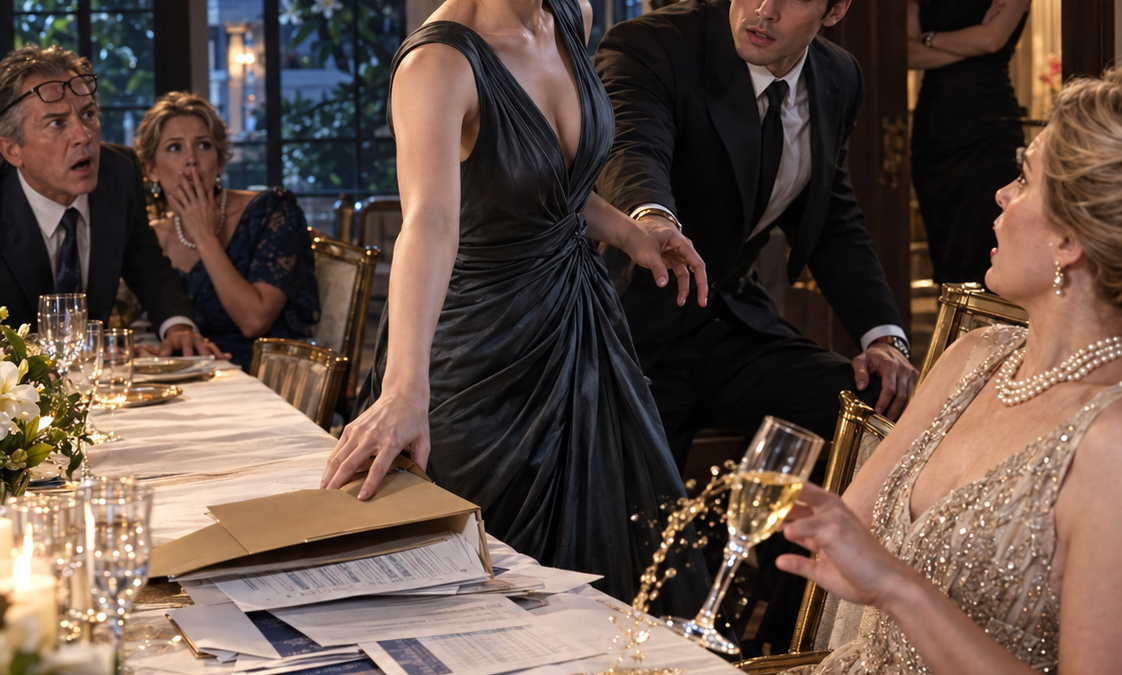
“You sold my life’s work to save your family’s empire. And you’re asking me to help you keep it.”
She thought the formula was lost forever. She found it — and took back everything.
Damian’s lawyer slides the document across the table, and I already know it’s over.
I know it before my fingers touch the paper, before I read the clause, because I’ve spent six years learning the exact angle of Damian Khoo-Rutherford’s shoulders when he’s about to take something from someone. He doesn’t look at me. He looks at the window of the thirty-first-floor boardroom, at the storm rolling in off Marina Bay, at anything but the woman he promised to spend his life with.
“Section fourteen,” the lawyer says. His name is Marcus Teo, and he’s been on retainer with Kestrel-Lim Holdings since before Damian could legally drink. “The intellectual property clause. As you know, Mrs. Khoo-Rutherford—”
“Tan,” I say.
“Pardon?”
“My name is Genevieve Tan. The marriage is being dissolved. Use the name that actually belongs to me.”
Marcus’s mouth tightens. He’s a small man with the kind of immaculate tailoring that costs more than my first apartment, and he’s clearly not used to being corrected. Behind him, through the glass walls, I can see the Kestrel-Lim board turning in their chairs, watching. Eleanor Khoo-Rutherford — Damian’s mother, the family’s iron spine — sits at the head of the table like a queen presiding over an execution.
She’s smiling. She’s been smiling since I walked in.
“Section fourteen,” Marcus repeats, “transfers all intellectual property developed during the course of the marriage to the marital estate, to be divided per the terms of the dissolution agreement. This includes, but is not limited to, formulas, patents, trademarks, and any trade secrets developed by either party during the marriage.”
The room tilts.
“What formula?” I ask, and my voice comes out steadier than I feel.
Damian finally looks at me. His eyes are the color of the bay at dusk, that grey-blue that can look calm until you’re drowning in it. Six years ago, I thought those eyes held the whole world. Now they’re just flat.
“You know exactly which formula,” he says. “Verdant Hour.”
The name lands like a slap.
Verdant Hour. The fragrance I spent three years building. The one that started as a sketch in a battered notebook on a flight to Grasse and became the signature scent of Tan & Wood — the small house I co-founded with my best friend, Cass, before Damian’s world swallowed mine. It’s the only truly profitable thing I’ve ever made. It put us on the map.
And now it’s on a boardroom table, being carved up.
“You can’t do this,” I say.
“We already did,” Eleanor says. Her voice is honeyed and cold at once, a Singapore accent polished by decades of expat dinners and charity galas. “The rights were sold to Aurentia three weeks ago. They’re launching it as a mass-market line next quarter. The proceeds are in escrow pending the divorce.”
The storm outside cracks. Rain starts to hammer the glass.
“Sold,” I repeat.
“Licensed,” Damian corrects. “For a period of ten years.”
“To Aurentia. A company that puts perfume in vending machines.”
“Volume, Gen. Scale.” He says my name like it costs him something. “This is how the business survives.”
“Your business survives. Mine—” I stop. Because this is it. This is the thing I’ve been waiting for, the confirmation I’ve been dreading. “You’re stripping the value from my house. You’re taking Verdant Hour and giving it to a mass-market brand so that when the settlement is calculated, Tan & Wood is worth nothing.”
“That’s not—”
“It’s exactly what it is.” I stand up. My chair scrapes back hard against the marble. “You’re not just divorcing me. You’re erasing me.”
“Mrs. Khoo-Rutherford, please sit down—”
“Tan.” I’m not looking at Marcus. I’m looking at Damian. “Say it. Say the name.”
He doesn’t.
And that’s when I notice the envelope.
It’s sitting under Marcus’s hand, half-hidden by the dissolution agreement. Thick. Cream-colored. Sealed. And on the corner, in my own handwriting — a loop of it, the way I’ve written my name since I was seven years old — is a word I haven’t seen in years.
Genie.
No one calls me that anymore. No one has called me that since my mother died.
“Where did you get that?” I ask.
Damian follows my gaze. Something flickers across his face — confusion, then a mask. “That’s not relevant.”
“Where. Did. You. Get. It.”
“It was in the archive,” Marcus says, and then stops, as if he’s realized he wasn’t supposed to speak.
The archive.
The word does something to the room. Eleanor’s smile falters, just a millimeter. Damian’s jaw goes tight. And I feel the floor shift under my feet — not from the storm, not from the divorce, but from a door opening somewhere in my memory. A door I’d forgotten existed.
“What archive?” I ask. And then, because I already know the answer, because it’s been there all along, buried under six years of marriage and grief and the slow erasure of who I used to be: “The competition archive. The Lux Perfume Prize.”
No one says anything.
And that’s how I know I’ve found it.
Chapter 2: The Girl Who Signed Her Cards
Here’s what I know about the Lux Perfume Prize, and what Damian apparently doesn’t:
When I was twenty-three, before Kestrel-Lim, before the marriage, before I let a man’s world redefine what I was worth, I submitted a fragrance to the Prix Lux Perfume competition. It was a student competition then — open to anyone under thirty with a nose and a dream. I submitted three formula cards, handwritten on cotton paper, each one stamped and dated by the registry office. I entered under my maiden name. Genevieve Tan. I used my mother’s address. I used the signature she taught me — the one with the little loop, the Genie she called me because she said I was magic.
I didn’t win.
I came third, and the judges said my composition was “structurally promising but emotionally unresolved,” and I cried in a bus shelter in Paris and then went home and kept working. I kept working for seven more years. I developed Verdant Hour from the bones of that submission — the same linden blossom opening, the same wet-wood heart, the same strange, green, shadowed drydown that no one else could quite replicate because no one else had my nose.
And I forgot the cards existed.
That’s the truth. I forgot. Life swallowed them. Marriage swallowed them. Damian Khoo-Rutherford looked at me across a candlelit table at a charity auction in 2017 and said you smell like a garden after rain, and I let that become the sentence that defined me. I moved into his penthouse. I took his name. I folded my little house into his portfolio — “for efficiency,” he said, “for protection,” and I believed him because I loved him, and love makes you stupid about paperwork.
The cards stayed in the Lux registry. Filed. Dated. Signed.
And now one of them is in an envelope on a boardroom table, and Damian is looking at me like I’ve just pulled a knife.
“Explain,” he says, and the word is directed at Marcus, not at me.
Marcus has gone pale. “Mr. Khoo-Rutherford, the item was retrieved during due diligence. The registry had digitized its archives, and the Aurentia legal team flagged—”
“Aurentia flagged it? Aurentia knows about this?”
“It surfaced during the IP audit. The board felt—”
“The board—” Damian stands up, and the movement is so abrupt that the junior associate nearest the door flinches. “Get out.”
“Sir?”
“All of you. Out. Now.”
The boardroom empties. Eleanor rises slowly, deliberately, and pauses at Damian’s shoulder. She’s sixty-seven years old, silver-haired, and she can gut a room with a single sentence. She looks at me, then at the envelope, then at her son.
“Fix this,” she says. “Before it becomes a problem.”
And then she’s gone, and it’s just the two of us and a storm.
Chapter 3: The Storm and the Silence
Damian doesn’t speak for a long time.
He walks to the window. The rain is coming sideways now, hammering the glass hard enough to rattle the frame. Thirty-one floors up, Singapore looks like a watercolor left in the sun — the bay, the towers, the shophouses, all bleeding into grey. He stands with his hands in his pockets and his back to me, and I can see the tension in his shoulders, the way he’s holding himself still.
I’ve seen him like this once before. The night his father died.
“When did you find it?” I ask.
“Three weeks ago.”
“And you weren’t going to tell me.”
“There was nothing to tell.”
“There’s an envelope on that table with my handwriting on it. With my name. A name I haven’t used since before I met you. And you’re going to stand there and tell me there’s nothing to tell?”
He turns. His face is a mask, but his voice isn’t — there’s a fray in it, a thread pulled loose. “It doesn’t change anything.”
“It changes everything.”
“It’s a piece of paper.”
“It’s proof of authorship.” I take a step toward the table, toward the envelope. “It’s timestamped. It’s signed. It’s dated years before Verdant Hour existed as a commercial product. It establishes prior ownership under my maiden name — before the marriage, before the estate, before any of this.”
“You don’t know that.”
“I’m a perfumer, Damian. I know exactly what it is.” I reach for it. He moves fast — faster than I expect — and his hand closes over mine on the envelope.
The contact is electric. It always has been. Six years of marriage, and his touch still does something to my nervous system that I’ve never been able to explain or replicate or forget. I hate that. I hate that even now, even with the divorce papers between us, my body still knows his.
“Let go,” I say.
“Gen—”
“Let go of me.”
He does. Slowly. His fingers drag across my knuckles, and then he pulls back and puts a full meter of boardroom between us, which is the most honest thing he’s done all day.
“You can’t use it,” he says.
“Why not?”
“Because it will destroy the Aurentia deal. And the Aurentia deal is keeping the conglomerate afloat. The shipping arm is bleeding. The Hong Kong property portfolio is underwater. My mother has been covering losses with personal capital for two quarters. If this deal collapses, the banks call in the covenants, and everything my family has built for ninety years goes into receivership.”
I want to laugh. I want to cry. I do neither.
“You sold my life’s work to save your family’s empire,” I say. “And you’re asking me to help you keep it.”
“I’m not asking. I’m telling you the stakes.”
“The stakes.” The word is bitter in my mouth. “Do you remember what you said to me when we got married? You said I would never have to choose between you and my work. You said you’d protect both.”
“That was before—”
“Before what? Before I stopped being useful to you? Before your mother decided I was a liability? Before you decided to sell my formula to a company that doesn’t even respect the craft?” I’m shaking. I can feel it in my hands, my knees, my voice. “When did I become something you could trade?”
He doesn’t answer.
And in the silence, I hear it — the thing I’ve been hearing for months, the thing I’ve been refusing to name. The phone call I overheard three weeks ago. The soft, laughing voice on the other end. The way Damian said not now and hung up the moment he saw me.
“There’s someone else,” I say.
His face doesn’t change. That’s how I know it’s true.
“Who is she?”
“Gen—”
“Who. Is. She.”
“It’s not — it’s not what you think.”
“Then explain it. Explain the calls. Explain the nights you come home at two in the morning smelling like a perfume I didn’t make. Explain why your assistant keeps canceling my appointments with you while you’re apparently ‘in meetings’ that don’t show up on any calendar.”
His jaw works. He looks at the window, at the storm, at anything but me.
“Her name,” he says finally, “is Camille. Camille Wee.”
The name lands somewhere in my chest, a small, cold detonation.
“Camille Wee. As in Wee Holdings. As in the family that’s been trying to take over Kestrel-Lim for a decade.”
“She’s not—”
“She’s the enemy, Damian. She’s the literal rival heir. And you’ve been—” I can’t finish. The sentence is too ugly.
“I haven’t touched her.” His voice is sharp now, defensive. “I’ve been negotiating. That’s all. She’s the one pushing the takeover, and I’ve been trying to hold her off, and if you’d just let me explain—”
“Negotiating.” I laugh, and it comes out broken. “For months. Secretly. While your lawyers were drafting papers to strip my company and sell my formula. That’s not negotiating, Damian. That’s building an exit.”
“It’s not—”
“Tell me you love me.”
He stops.
“Tell me you love me, and I’ll believe you.”
The rain hits the glass. The boardroom hums with the building’s quiet machinery. And Damian Khoo-Rutherford, the most powerful man in this city, the man who can buy and sell senators and ships and skyscrapers with a phone call, stands there and says nothing.
I pick up the envelope.
“You said I couldn’t use this,” I say. “Watch me.”
And I walk out of the boardroom, past the stunned junior associates, past Eleanor’s closed office door, past the security guard who’s known me for six years and doesn’t know whether to stop me or bow.
The storm is still going when I reach the lobby.
I don’t care.
I have a piece of paper with my name on it, and a phone in my pocket, and a best friend who’s about to become the most important lawyer in my life.
And I have a plan.
Chapter 4: What Cass Said
Cass meets me at a kopitiam in Tanjong Pagar, two hours later, because she says lawyers’ offices are for people who haven’t just committed grand larceny.
She’s already ordered. Two kopis, one kaya toast, one soft-boiled egg that she’s attacking with a spoon and zero ceremony. Cass — Cassandra Lim, no relation to the Kestrel-Lim Lims, a fact she’s made clear in every professional introduction since we met at nineteen — is the only person who’s ever looked at my life and said you deserve better without an agenda. She’s also the best corporate lawyer in Singapore under forty, which is why she’s already read the envelope contents twice by the time my coffee cools.
“It’s ironclad,” she says. “The competition registration form is stamped, dated, and signed. The formula cards are handwritten, which is actually better than typed — handwriting analysis is admissible, and yours is distinctive. The registry has an original copy. They’re legally required to maintain archives for fifty years.”
“So it proves I wrote it.”
“It proves you wrote it, and it proves you wrote it before the marriage, under your maiden name, with no connection to the Khoo-Rutherford estate.” She taps the envelope. “This is the prior art, Gen. If you can establish that Verdant Hour is a derivative work of the Lux submission, and that the Lux submission predates any marital asset claim, then the formula belongs to you personally. Not to Tan & Wood. Not to the marital estate. To you.”
“Can we do that?”
“Not only can we. We have to do it fast. Aurentia’s launch is in eight weeks. If we file an injunction before the trademark registration is finalized, we can freeze the sale. If we file before the divorce settlement is executed, we can pull the formula out of the asset schedule entirely.”
The kopi is bitter on my tongue. The egg is gone. The rain has stopped, and the afternoon sun is slanting through the kopitiam windows, painting the marble table in gold.
“What’s the catch?”
Cass puts down her spoon. “The catch is that this becomes public. The minute we file, the story leaks. Billionaire’s estranged wife sues her own husband to reclaim a perfume formula. Every gossip columnist in Asia will be on it. Your face. Your marriage. Your mother-in-law. The mistress—”
“There’s no mistress. Not officially.”
“There’s always a mistress, Gen. Officially or not, the world will decide there is, and they’ll paint you as the wronged wife, and then they’ll paint you as the bitter wronged wife, and then they’ll paint you as the woman who tried to destroy a ninety-year-old family legacy for a bottle of perfume.”
I stare into my coffee. The steam curls up, dissolving into the warm air.
“If I don’t do it,” I say, “I lose everything I’ve built. My house. My work. My name. The only thing my mother left me.”
“Then you do it,” Cass says, “and you make sure you win.”
“How?”
“By being smarter than them. By being cleaner than them. By making sure the first story anyone hears is yours, not theirs.” She slides a napkin across the table, and on it, in her sharp, impatient handwriting, is a name. Eleanor Khoo-Rutherford — private communication — 2019. “Damian’s mother sent this to the Lux registry three years ago, requesting a copy of your file. She was denied. She tried to buy the archive. She was denied. The registry’s legal counsel flagged it as a potential conflict of interest and kept the denial on record.”
My hands go cold. “Eleanor knew.”
“Eleanor knew something. She knew enough to try to get her hands on the file. Which means she’s been worried about this for years.” Cass grins, and it’s not a nice grin. “And it means she’s going to be very, very unhappy when she finds out you have the original.”
I take the napkin. I fold it. I put it in my pocket, next to the envelope, next to my marriage certificate, which I apparently still carry around like a wound.
“One more thing,” Cass says.
“What?”
“Damian called me. Twice. While you were in the restroom.”
“What did he want?”
“He wanted to know if you’d talked to me. He wanted to know what you were planning. He wanted—” She pauses, choosing her words. “He wanted to know if you were okay.”
The words hit me somewhere unexpected. Somewhere soft. Somewhere I thought I’d closed off six months ago.
“What did you tell him?”
“I told him you were none of his business.” Cass leans back, folding her arms. “But here’s the thing, Gen. He didn’t sound like a man who’s trying to destroy you. He sounded like a man who’s terrified of losing you.”
“He has a strange way of showing it.”
“He’s a Khoo-Rutherford. They don’t show anything. They just build walls and hope someone cares enough to climb them.” She sighs. “I’m not defending him. I’m just saying — be careful. This isn’t just a legal fight. It’s a marriage. And marriages don’t end clean.”
I look out the window. The sun is going down over the shophouses, turning them the color of old amber. Somewhere in this city, Damian is standing in his glass tower, making phone calls, trying to contain the damage. Somewhere in this city, Eleanor is planning her next move. Somewhere in this city, a woman named Camille Wee is waiting for a deal that will either save or destroy the man I married.
I don’t know what I’m going to do.
But I know I’m not going to lose.
Chapter 5: The Dinner
He shows up at my apartment at eight o’clock.
I know it’s him before I open the door — three sharp knocks, a pause, one more. His pattern. Six years of marriage and he still knocks like he’s impatient with the universe.
I open the door and he’s standing in the hallway holding a paper bag from the hawker stall around the corner. The one that sells laksa at midnight. The one we used to go to when we were first dating, when he was still pretending he wasn’t a billionaire and I was still pretending I wasn’t terrified of his world.
“What are you doing here?” I ask.
“I brought dinner.”
“I can see that.”
“Can I come in?”
“No.”
He doesn’t move. He’s wearing a shirt with the sleeves rolled up, and his hair is disheveled in a way that suggests he’s been running his hands through it, and he looks tired. He looks human. I hate that.
“Five minutes,” he says. “That’s all I need.”
I let him in. I don’t know why. Maybe because I’m tired too. Maybe because the apartment is too quiet. Maybe because, despite everything, some part of me still wants to hear what he has to say.
He sets the bag on the counter and starts unpacking it — laksa, extra noodles, no beansprouts, exactly how I like it. He does this without asking. He does this because he remembers.
“I’m not here to fight,” he says.
“You’re always here to fight. You just call it something else.”
“I’m here to tell you the truth.”
“That would be a first.”
He stops, hands on the counter. His back is to me. I can see the tension in his shoulders, the same tension from the boardroom.
“Camille Wee approached me eighteen months ago,” he says. “She wanted a merger. Our shipping arm, their logistics network. It would have solved both our problems. I said no.”
“Why?”
“Because her terms were predatory. Because she wanted control. Because—” He turns around. “Because I knew what it would mean for you. Tan & Wood would have been absorbed. Your house would have disappeared into their portfolio. I said no to protect you.”
“Then why is she still in your life?”
“Because she didn’t take no for an answer. She started buying up our debt. She started circling our board. She started—” He stops, and I see something flash in his eyes, something I haven’t seen in months. Fear. “She started threatening to expose things. Things about my father. Things about the company. Things about the years before you.”
“What things?”
“My father had a second family. In Hong Kong. A woman, two children. He kept them secret for thirty years. Camille’s mother is the one who introduced them.” He exhales. “Camille has proof. She’s been using it to blackmail me into negotiating. If it comes out, it destroys my mother. It destroys the company’s reputation. It destroys everything my family has built.”
The room goes very still.
“Does Eleanor know?”
“She knows about the family. She doesn’t know Camille knows.”
“And you’ve been—”
“I’ve been buying time. I’ve been trying to find a way to contain it. I’ve been selling assets and mortgaging properties and doing everything I can to keep the company alive without letting Camille take it.” He takes a step toward me. “I didn’t sell Verdant Hour to Aurentia to strip your value. I sold it to keep Aurentia from selling their stake to Wee Holdings. It was the only move I had.”
I want to believe him. I want to believe him so badly it hurts.
“You should have told me,” I say.
“I know.”
“You should have trusted me.”
“I know.”
“You should have—” My voice breaks. “You should have let me help you.”
He’s close now. Close enough that I can smell him — sandalwood, cedar, the faint ghost of the office. Close enough that if I reached out, I could touch him. Close enough that I can see the exhaustion in his face, the lines around his eyes, the way his mouth is trembling just slightly.
“I didn’t know how,” he says. “I’ve been alone with this for so long. I didn’t know how to let anyone in.”
“You let Camille in.”
“No. I never let her in. I let her think she was in. There’s a difference.”
“Is there?”
“Yes.” He reaches out, and his hand hovers near my face, not touching. “Gen. I have made a thousand mistakes. I have been cold and distant and stupid and scared. But I have never, not for one second, stopped—”
The phone rings.
We both freeze. He pulls his hand back. I look at the screen. It’s Cass.
“Answer it,” he says.
I do.
“Gen.” Cass’s voice is tight. “Eleanor just filed an emergency motion. She’s claiming the Lux archive is fraudulent. She’s saying the cards are forgeries, and she’s demanding a handwriting analysis by her own expert. She’s also filed a restraining order against you — claiming you threatened her at the board meeting.”
“I didn’t—”
“I know. But it’s filed. It’s public. And the press has it.”
I look at Damian. He’s watching me, his face pale in the dim light of my kitchen.
“Also,” Cass says, “the story just broke on two major outlets. ‘Billionaire Heir’s Estranged Wife Sues to Reclaim Perfume Rights.’ It’s everywhere. Gen — you’re on every homepage in Asia.”
I hang up.
I look at Damian.
“Your mother,” I say, “just declared war.”
He closes his eyes. When he opens them, there’s something new in them. Something hard. Something resolved.
“Then we fight,” he says. “Together.”
“Together?”
“She’s my mother. I’ll handle her.”
“You’ve never handled her. You’ve never stood up to her once in your life.”
“Then I’ll start now.”
He picks up his phone. He dials. And I hear him say, in a voice I’ve never heard him use with Eleanor, a voice like a blade:
“Mother. We need to talk. And this time, you’re going to listen.”
The line goes dead. He looks at me.
“I’m not letting her destroy you,” he says. “I’m not letting her destroy us. Whatever it takes.”
And for the first time in months, I believe him.
Chapter 6: What Damian Said to His Mother
I don’t hear the call.
He steps into the hallway to make it, and I stand in my kitchen with the laksa going cold on the counter, and I listen to the muffled rhythm of his voice through the door. He’s not shouting. That’s worse. Damian Khoo-Rutherford doesn’t shout when he’s angry. He goes quiet, and the quiet is a blade.
When he comes back, his face is different. Harder. He looks like the man I met ten years ago at a charity auction — the one who could buy and sell the room without breaking a sweat.
“She’s not backing down,” he says.
“What did she say?”
“She said I was choosing you over the family. She said I was betraying my father’s legacy. She said—” He stops. Laughs, short and humorless. “She said you’d already poisoned me. That you’ve been planning this since the day we met.”
“That’s insane.”
“I know.”
“You know, and yet you’ve spent six years letting her say things like that about me.”
He flinches. Good.
“I’m not defending it,” he says. “I’m telling you what she said.”
“Then tell me what you said back.”
He looks at me. For a long moment. And then he says, very quietly: “I told her that if she filed that restraining order, I would resign from the board.”
The room tilts.
“You did what?”
“I told her I would resign. Effective immediately. I told her I would issue a public statement supporting you. I told her that if she wants to fight you, she fights me too.”
“You can’t resign. It’s your company.”
“It’s my father’s company. It’s my grandfather’s company. And it’s been my mother’s company for the last twenty years, whether anyone admits it or not.” He picks up the laksa, starts unpacking it again, like his hands need something to do. “But I’m the CEO. I’m the face. If I walk, the stock tanks. The banks panic. She knows that.”
“So she’ll back off.”
“No.” He sets down the bowl. “She’ll escalate. She’ll go to the board. She’ll try to have me removed. And she’ll use Camille to do it.”
“The mistress.”
“She’s not—” He stops. Breathes. “She’s not my mistress. But yes. Camille will help her. Camille has been waiting for an opening like this.”
I sink onto the stool by the counter. My legs don’t feel entirely reliable.
“Then we’re at war,” I say.
“Then we’re at war,” he agrees.
Chapter 7: The Terms of Engagement
Cass arrives at nine the next morning with three coffees, a laptop, and the expression of a woman who has already read every relevant statute and found them all wanting.
“We have a problem,” she announces, dropping into the chair across from me.
“Just one?”
“Several. But the biggest is this.” She turns the laptop toward me. On the screen is a photograph — grainy, clearly taken from a distance, of me and Damian at the kopitiam two nights ago. The caption reads: “Estranged Wife Meets Billionaire Husband in Secret Late-Night Rendezvous — Reconciliation or Strategic Truce?”
“Someone followed us,” I say.
“Someone followed you. Specifically. There are three more photos — you leaving your apartment, you at the Lux registry office, you getting into a Grab outside Cass’s office. Someone is documenting your every move.”
My blood goes cold. “Eleanor.”
“Most likely. Or Camille. Either way, we need to assume you’re being watched.” Cass takes a long drink of coffee. “Which means every meeting, every phone call, every errand is potentially evidence. You need to be careful.”
“I’m always careful.”
“You married Damian Khoo-Rutherford. You’re not careful. You’re brave, which is different and much more dangerous.”
I can’t argue with that.
Damian arrives an hour later, and the three of us sit around my small dining table like generals in a bunker. Cass has printed the key documents — the Lux registration, the marriage certificate, the divorce petition, the Aurentia license agreement. Damian reads them all, slowly, and I watch his face change as he does.
“The license agreement is worse than I thought,” he says. “Aurentia has the right to sublicense. They’ve already signed a deal with a drugstore chain in Malaysia. If the formula is contested, the sublicense becomes void, and Aurentia will sue for breach.”
“Let them sue,” Cass says. “We’ll win.”
“Can we afford to win? Litigation takes years. Aurentia has better lawyers than us.”
“Gen has the original cards. That’s not a legal argument, that’s a narrative. And narratives win in court as often as facts do.”
Damian looks at me. “You’re sure the registry still has the file?”
“I’m sure,” I say. “I called them this morning. The archive is digitized, and the original cards are in cold storage. They’re willing to produce a certified copy, but only under court order.”
“Then we need a court order,” Cass says.
“Then we need a judge who won’t be afraid of Eleanor Khoo-Rutherford,” Damian says.
The three of us look at each other across my tiny table. The afternoon light is slanting through the window, and somewhere downstairs, someone is frying something that smells like heaven. It’s absurd, all of it. The whole situation. The fact that I’m sitting here planning legal strategy with my estranged husband and my best friend while the smell of char kway teow wafts through the window. Six months ago, I was just a woman making perfume. Now I’m a woman at war.
“I know a judge,” Damian says finally.
“Of course you do.”
“She’s not corrupt. She’s just—”
“Connected?”
“Fair. She’s fair, and she’s not afraid of my mother. I went to school with her daughter.” He pauses. “I’ll make a call.”
“Your mother will see it as a declaration of war.”
“It is a declaration of war.”
I look at him. He looks back. And something passes between us — not love, not forgiveness, but recognition. We’re on the same side. For the first time in years.
“Okay,” I say. “Let’s do it.”
Chapter 8: The Second File
Three days later, Cass calls me at 6 a.m.
“Get dressed. I’m outside.”
“What? Why?”
“The registry opened early. A clerk owes me a favor. We have twenty minutes before the supervisor arrives, and if you want the original cards certified before Eleanor’s lawyers get wind of it, we need to move now.”
I’m in the car in four minutes, hair unbrushed, wearing yesterday’s jeans.
The Lux registry office is in a colonial-era building on Armenian Street — white columns, black shutters, the kind of place that still smells of paper and dust and old money. The clerk, a young woman named Priya with a nose ring and an impressive tattoo of a perfume bottle on her forearm, leads us down to the basement.
“This is the cold storage,” she says. “We keep the physical archives for fifty years. Your file is in cabinet twelve.”
She pulls the drawer open. And there it is.
Three cards. Cotton paper. Handwritten. My handwriting — the loops, the pressure, the little dots over the i’s that my mother always said looked like tiny seeds. The first card describes the opening: linden blossom, bergamot, a whisper of green mandarin. The second describes the heart: wet wood, moss, a strange, dark rose. The third describes the drydown: ambrette seed, vetiver, a base of animalic musk that the judges called “unresolved.”
And there, at the bottom of each card, my signature.
Genevieve Tan.
Genie.
Dated. Stamped. Initialed by the registry clerk on duty that day. Priya’s colleague, an older man named Mr. Ong, brings the certification papers. He’s quiet for a moment, looking at the cards.
“You wrote these?” he asks.
“I did.”
“They’re good. I’m not a perfumer, but I’ve seen a lot of formulas come through here. These are good.” He stamps the papers. “My wife wore something like this once. A garden after rain. She passed three years ago. I never found out what it was.”
I look at the cards. At the linden blossom. At the wet wood.
“It’s called Verdant Hour,” I say. “When it’s launched, I’ll send you a bottle.”
He nods. He doesn’t smile, but something in his face softens.
We leave the registry at 6:45 with a certified copy of the original cards, a sworn statement from Mr. Ong, and a digital scan of the competition registration form. Cass is practically vibrating with satisfaction.
“This is it,” she says. “This is the thing that wins.”
I’m about to answer when my phone buzzes. A text from Damian.
Camille wants to meet. She says she has information about my mother that will help us. She wants to meet you, specifically. I don’t trust her. But I think you should decide.
I read it twice. Three times.
“What does he want?” Cass asks.
“He wants me to meet the woman who’s been blackmailing him.”
“What? Absolutely not.”
“Cass—”
“Gen, she’s the enemy. She’s the literal rival heir. She’s been threatening to expose his family secrets. Why would you—”
“Because,” I say, and I don’t fully understand it myself, “if she wants to meet me, she wants something. And if she wants something, she’ll reveal something. And I want to know what Eleanor is planning.”
Cass stares at me. Then she sighs, and rubs her forehead.
“You’re going to get yourself killed.”
“I’m going to get myself informed.” I pocket my phone. “Set it up. Neutral ground. Somewhere public.”
“Where?”
“The Fullerton. The bar. Tomorrow at eight.”
Cass makes a sound of profound disagreement. But she pulls out her phone and starts typing.
Chapter 9: Camille
Camille Wee is not what I expected.
She’s small and elegant, with a razor-sharp bob and the kind of face that looks perpetually amused. She’s wearing a cream silk blouse and diamond studs that cost more than my monthly rent. She’s drinking a gin and tonic and reading something on her phone when I walk into the Fullerton’s bar.
She looks up. She smiles.
“You’re prettier than the photos,” she says.
“You’re exactly what the photos said.”
“Which is?”
“Expensive.”
She laughs. It’s a real laugh, not a performance. That unsettles me more than anything else.
“Sit,” she says. “I ordered you a negroni. Damian says it’s your drink.”
“Damian talks about me?”
“Damian talks about you constantly. It’s frankly exhausting.” She pushes the glass toward me. “He’s been in love with you since the day you met. Even when he’s terrible at showing it.”
I don’t touch the drink. “Why am I here?”
“Because I want to make a deal.”
“I don’t make deals with people who blackmail my husband.”
“Ex-husband. Almost. And I’m not blackmailing him. I’m negotiating. There’s a difference.” She sips her gin. “Your mother-in-law is a monster. I assume you know that.”
“I’ve had six years of evidence.”
“Then you know she’s been planning this for a long time. The takeover. The divorce. The formula. All of it.” She sets down her glass. “She approached me three years ago. She wanted me to seduce Damian. She wanted me to become his mistress, to engineer a scandal, to give her grounds to push you out of the family and take control of the company. She promised me a share of the conglomerate in exchange.”
My stomach turns. “And you agreed?”
“I considered it. Then I met him. Then I realized he was actually in love with his wife, which made the whole thing pathetic.” She shrugs. “So I pivoted. I started buying up the company’s debt instead. It’s cleaner. Less personal. And it gave me leverage over both of them.”
“Leverage over Eleanor?”
“She has secrets too. The second family in Hong Kong. The offshore accounts. The bribes she paid to suppress a lawsuit in the nineties.” Camille smiles. “I have proof of all of it. And I’m willing to give it to you.”
“In exchange for what?”
“For the formula.”
The bar goes quiet. Or maybe it’s just my ears. The negroni sits on the table, untouched, the ice slowly melting.
“You want Verdant Hour.”
“I want a stake in it. A percentage of the licensing revenue. In exchange, I’ll testify against Eleanor. I’ll provide the documents. I’ll give you everything you need to destroy her.” She leans forward. “You win your formula. You win your divorce. You win your husband. And I get a piece of the most profitable independent fragrance of the decade. Everyone wins.”
“Except Eleanor.”
“Except Eleanor,” Camille agrees. “And frankly, she deserves it.”
I look at her. At the diamond studs. At the cream silk. At the smile that never quite reaches her eyes.
“You expect me to trust you.”
“No. I expect you to trust the evidence. And I expect you to be smart enough to know that your enemy’s enemy is your ally.” She stands. “Think about it. You have forty-eight hours. After that, I go public with the Hong Kong family, and your husband’s empire goes down with his mother.”
She leaves a hundred-dollar bill on the table and walks out.
I sit there for a long time. The negroni turns to water. The bar fills up. And somewhere in the back of my mind, a small, cold voice tells me that nothing about this is simple.
I go home. I don’t sleep.
 [Tap here for the Next Part ]



