Part 2: “You sold my life’s work to save your family’s empire. And you’re asking me to help you keep it.”
Chapter 10: The Thing I’ve Been Avoiding
The next morning, I’m in the bathroom when I notice the calendar on my phone.
I’m late.
I stare at the date. Count backward. Count again. My hands go cold.
I’m seven weeks late.
I sit on the edge of the bathtub for a long time. The apartment is quiet. The light is grey. And I’m doing the math in my head, over and over, because I know exactly when it would have happened — three months ago, the night before the final board meeting, the night Damian came home late and found me in the kitchen and for one moment, we forgot we were falling apart.
We hadn’t touched each other in months before that. We haven’t touched each other since.
I get dressed. I don’t call Cass. I don’t call Damian. I take a taxi to a clinic in Novena, and I sit in a sterile waiting room, and I fill out forms with shaking hands.
The doctor is kind and brisk. The test takes an hour.
When she comes back, her face is neutral.
“Congratulations,” she says. “You’re pregnant.”
I don’t cry. I don’t laugh. I sit there, in a paper gown, in a clinic in Novena, and I think about all the ways this changes everything.
And then I think about Eleanor. About Camille. About the war that’s coming.
And I know, with absolute certainty, that no one can know.
Not yet.
I go straight from the clinic to Cass’s office. She takes one look at my face and closes the door.
“What happened?”
“I need you to keep a secret.”
“Gen—”
“I’m serious. This cannot leave this room. Not to Damian. Not to anyone.”
She sits down. Her face is pale. “What is it?”
I tell her.
She’s silent for a long moment. Then she says, very carefully, “Does Damian know?”
“No.”
“Are you going to tell him?”
“I don’t know.” I sit down across from her. “Everything is falling apart, Cass. The divorce. The formula. The war with Eleanor. If I tell him now, it becomes leverage. It becomes a weapon. It becomes another thing for them to use against us.”
“Or it becomes the thing that brings him back to you.”
“He never left. He’s just been—” I stop. Because I don’t have the words. “I don’t know what he’s been. But I know that if Eleanor finds out I’m pregnant, she’ll use it. She’ll claim I’m trying to trap him. She’ll claim the child is a weapon. She’ll do everything she can to make my life hell.”
Cass reaches across the desk and takes my hand.
“What do you want?” she asks. “Not what’s strategic. Not what’s safe. What do you want?”
I look at her. At my best friend, my lawyer, the only person in the world who’s ever asked me that question and meant it.
“I want to win,” I say. “And I want to do it on my own terms. I want to take back my name, my work, my life. And I want—”
I stop.
“You want Damian.”
“I want the version of him that I married. The one who looked at me like I was the only person in the world.” I pull my hand back. “But I don’t know if that version exists anymore.”
Cass nods slowly. “Then we fight. And we win. And we figure out the rest as we go.”
She stands. She walks to her filing cabinet. She pulls out a folder.
“Camille’s offer,” she says. “I’ve been thinking about it. And I think we should take it.”
“Really?”
“She’s right about one thing. Eleanor is the real enemy. Camille is a problem, but she’s a problem we can manage. Eleanor is a war.” She sets the folder on the desk. “We take Camille’s evidence. We use it. We destroy Eleanor’s case. And then we deal with Camille.”
“And the baby?”
“We keep it secret. Until the right moment.” Cass looks at me. “When the right moment comes, you’ll know.”
I nod. I stand. I walk to the door.
And then I stop.
“Cass,” I say.
“Yeah?”
“When this is over — when we’ve won — I’m going to need you to do something for me.”
“Anything.”
“I need you to help me take back my name. Not Tan. Not Khoo-Rutherford. My mother’s name. The one she gave me.”
Cass smiles. It’s the first real smile I’ve seen from her in weeks.
“Genie,” she says.
I nod.
And I walk out into the afternoon.
Chapter 11: The Evidence
Camille Wee’s evidence arrives in a manila envelope at ten o’clock the next morning, hand-delivered by a courier who doesn’t speak and doesn’t smile.
Cass and I open it together, at her office, with the blinds drawn.
Inside: forty-three pages of documents. Bank statements. Wire transfers. Photographs. And a sworn affidavit from a former Kestrel-Lim accountant named Francis Lau, who worked for the company for twenty-two years before Eleanor fired him in 2019 for “restructuring purposes.”
Cass reads the affidavit twice. Then she sets it down and looks at me.
“This is enough to destroy her.”
“Destroy her how?”
“Tax evasion. Money laundering. Bribery of a public official in Indonesia in 1997.” She taps the page. “The statute of limitations has expired on half of this. But the rest — the offshore accounts, the improper transfers — that’s live. That’s criminal. That’s jail time.”
“Eleanor Khoo-Rutherford doesn’t go to jail. She’s never even had a parking ticket.”
“She does if we make her.” Cass leans back. “The question is whether we’re willing to use it.”
I look at the documents. At the wire transfers. At the photograph of Eleanor shaking hands with a man I don’t recognize.
“She was going to destroy me,” I say. “She was going to take my formula, my marriage, my name. She’s been planning it for years. Why wouldn’t I use it?”
“Because once you do, there’s no going back. The family will fracture. Damian will have to choose — fully, publicly, irreversibly. And if he doesn’t choose you—”
“He will.”
“You don’t know that.”
“Yes, I do.” I stand. “He already has. He told her he’d resign. He told her he’d fight her. He’s never done that before. Not for anyone.”
Cass watches me for a long moment. Then she nods.
“Okay,” she says. “Then we go to war.”
Chapter 12: The Dinner Party
Eleanor’s dinner party is the event of the season.
It’s held at the family estate — a sprawling colonial-era mansion on Nassim Road, all white columns and frangipani trees and a driveway long enough to land a helicopter. Every important person in Singapore is here: bankers, diplomats, old-money families, the entire Kestrel-Lim board. Eleanor stands at the entrance like a general reviewing her troops, wearing a gown the color of dried blood.
I arrive alone.
Damian is already inside — I can see him through the window, standing by the bar, his back to the room. He doesn’t know I’m coming. Cass arranged it. She said it was time.
The invitation came last week, in an envelope addressed to “Mrs. Genevieve Khoo-Rutherford.” Eleanor’s handwriting. A deliberate insult. A reminder that in her world, I’m still defined by my marriage.
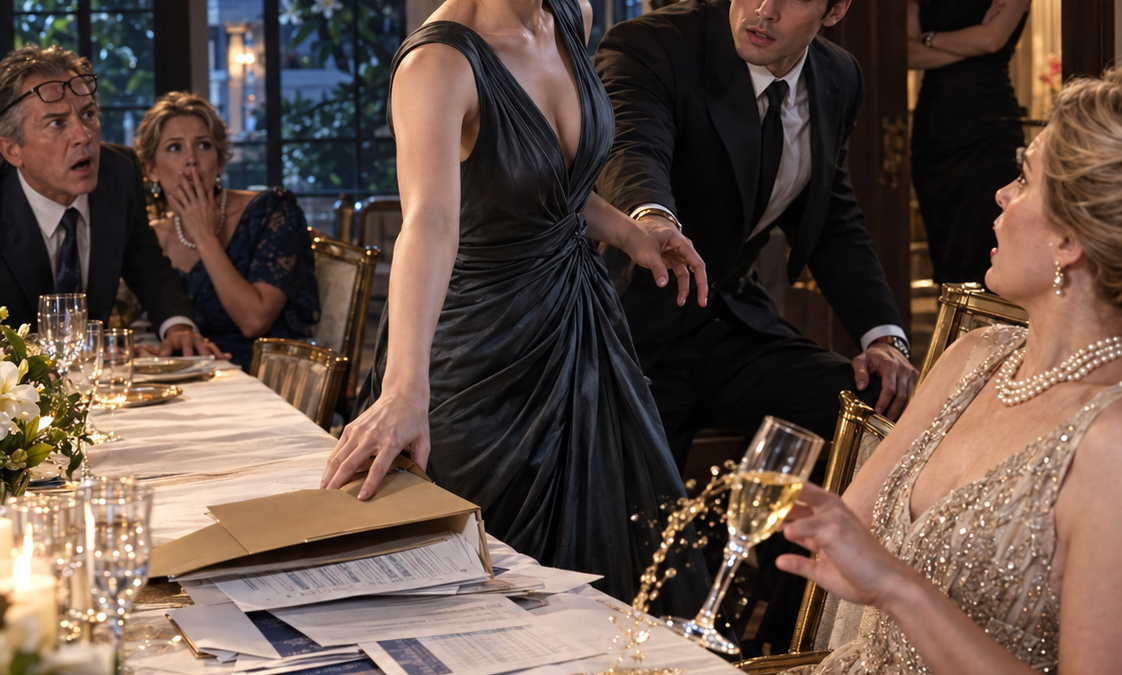
I wore my mother’s earrings. Small jade drops, the only thing she left me. And a dress the color of storm clouds, because tonight is a reckoning, and reckoning requires armor.
The butler takes my wrap. A waiter offers me champagne. I take a glass and walk into the lion’s den.
Eleanor sees me first.
She’s standing with the British High Commissioner and his wife, laughing at something. Then her gaze slides past the ambassador and lands on me, and the laugh dies. Her face doesn’t change — she’s too controlled for that — but her grip on her champagne flute tightens until the stem looks like it might snap.
“Genevieve,” she says. “How unexpected.”
“Eleanor.” I smile. “You look well. The estate is beautiful tonight.”
“You weren’t invited.”
“I was. Your secretary sent the invitation. I have the envelope, if you’d like to see it.”
Her eyes narrow. She knows she sent it. She sent it as a taunt, expecting me to ignore it. She didn’t expect me to show up.
“Enjoy the evening,” she says. “I’m sure you remember the way out.”
I move past her. The room watches. I can feel their eyes on me — the whispers, the speculation. The estranged wife. The woman suing her own husband. The woman who thinks she can take on the Khoo-Rutherfords.
Let them watch.
I find Damian by the bar. He’s holding a whiskey, untouched, and staring at the crowd like he’s somewhere else entirely. When he sees me, his whole body changes. His shoulders drop. His jaw loosens. And for just a second, he looks like the man I married.
“You came,” he says.
“You sound surprised.”
“I am. This is—” He shakes his head. “She’s going to be awful.”
“I know.”
“You don’t have to be here.”
“Yes, I do.” I take his whiskey and sip it. “Because tonight is the night we end this. One way or another.”
He looks at me. And then, for the first time in months, he smiles. Just a little. Just a flicker.
“Okay,” he says. “Then let’s end it.”
The confrontation comes after the first course.
Eleanor rises from her seat at the head of the table. The room quiets. She’s holding a knife, tapping it against her crystal glass, and the gesture is so theatrical that I almost laugh.
“Before we continue,” she says, “I’d like to address something. A matter of family business. I’m sure you’ve all read the papers.”
The table shifts. Everyone knows. Everyone has seen the headlines.
“My daughter-in-law has chosen to make a very public accusation against me. She claims I interfered in her business affairs. She claims I attempted to steal her intellectual property. These claims are false.” She looks at me. “And I have proof.”
She signals to someone at the door. And Camille Wee walks in.
The room gasps. Camille is wearing red — a deep, dangerous red — and she’s carrying a folder. She walks to the table like she owns it.
“Miss Wee has brought evidence,” Eleanor says, “that the formula at the center of this dispute is not, in fact, Mrs. Khoo-Rutherford’s creation. It was, in fact, developed by a team of in-house perfumers at Kestrel-Lim, who worked under my supervision. The registration documents Mrs. Khoo-Rutherford has presented are forgeries.”
The room turns to me.
This is it. This is her play. She’s going to discredit me in front of the entire family, the entire board, every powerful person in Singapore. She’s going to make me look like a liar and a thief.
I stand up.
“That’s a lie,” I say.
“Prove it.”
I look at Camille. She looks back. And then she winks.
“Actually,” Camille says, “I think you should prove it, Eleanor.”
The room goes silent. Eleanor’s face flickers.
“What did you say?”
“I said you should prove it.” Camille opens her folder. “Because I have a few things I’d like to share with the room. Starting with this wire transfer from 1997, from a shell company in the Cayman Islands, to a government official in Jakarta. Your signature, Eleanor. Your account.”
The room erupts.
Eleanor’s face goes white. Her mouth opens. Nothing comes out.
“And this photograph,” Camille continues, pulling out a glossy print, “of you and my mother at a private dinner in 2018. Discussing the terms of a takeover of Kestrel-Lim. In which you offered her forty percent of the company in exchange for destroying your son’s marriage.”
The room is chaos. Board members are shouting. The British High Commissioner is making a discreet exit. Eleanor is standing at the head of the table, and her face is the face of a woman who’s just realized she’s lost.
I look at Damian. He’s staring at his mother. And in his eyes, I see something I’ve never seen before: relief. The relief of a man who’s been carrying a secret for thirty years and finally set it down.
“Mother,” he says. “Is it true?”
She doesn’t answer. She can’t.
“Then it’s over,” Damian says. “You’re done.”
And then he turns to the room. He looks at the board. He looks at the families. He looks at me.
“I’m issuing a statement tomorrow,” he says. “I’m resigning from the board. I’m transferring my shares to my wife. And I’m filing for a legal separation from my mother’s branch of the family. Effective immediately.”
The room gasps. Eleanor staggers. Someone helps her to a chair.
And Damian walks to me. He takes my hand. He doesn’t say anything. He doesn’t have to.
Because this is the choice. This is the public, irreversible choice. And he’s made it.
Chapter 13: Aftermath
The party ends in chaos.
Eleanor is escorted out by her driver. The board members scatter. Camille disappears into the night with a satisfied smile and a promise to call Cass about the licensing deal. And I stand on the terrace of the Khoo-Rutherford mansion, looking out over the frangipani trees, and I breathe for what feels like the first time in weeks.
Damian comes out behind me. He’s holding two glasses of whiskey.
“You look like you need this,” he says.
“I don’t drink whiskey.”
“You drink mine.”
I take the glass. It’s warm from his hand. I sip it. It burns.
“Your mother,” I say.
“Will be fine. She’s been through worse. She’ll disappear to Geneva for a year, then she’ll come back and pretend none of it ever happened.” He leans on the railing. “My father did the same thing. It’s the family way.”
“That’s bleak.”
“It’s realistic.” He looks at me. “Are you okay?”
I think about the answer. I think about the pregnancy. About the baby growing inside me. About the fact that I still haven’t told him. About all the reasons I’m afraid to.
“No,” I say. “But I will be.”
He nods. He doesn’t push. He doesn’t ask.
And I realize, standing there in the darkness, that this is the thing I’ve missed most about him. Not the money. Not the power. Not the sex. The quiet. The way he knows when to be still.
“I have something to tell you,” I say.
He looks at me. His eyes are dark and patient.
“I’m pregnant.”
The words hang in the air between us. The frangipani trees rustle in the wind. Somewhere inside the mansion, a clock chimes eleven.
Damian doesn’t move.
“You’re—”
“Seven weeks. I found out three days ago.” I set the whiskey down. My hands are shaking. “I didn’t tell you because I didn’t know if I could trust you. Because I didn’t know if you’d stay. Because I was afraid you’d use it as leverage, or your mother would, or—”
“Gen.”
“—because I’ve spent six years losing pieces of myself to your world, and I didn’t want to lose this too—”
“Gen.”
He takes my face in his hands. And he looks at me the way he looked at me on our wedding day. The way he looked at me the first time we met.
“I’m not your mother,” he says. “I’m not your enemy. I’m your husband. And I’m the father of that baby. And I’m not going anywhere.”
The tears come then. Fast and hot and unstoppable. I don’t try to stop them. He pulls me into his chest, and I cry into his shirt, and he holds me the way he should have held me six months ago.
“I love you,” he says. “I’ve loved you since the day you said my perfume was ‘competent but uninspired.’ I’ve loved you every day since. I’ve been terrible at showing it. I’ve been cold and distant and scared. But I’ve never stopped.”
I pull back. I look at him. I see the exhaustion in his face, the lines, the gray at his temples. I see the man who’s been fighting a war on three fronts and never asked for help.
“I don’t know if I can trust you,” I say.
“I know. I’ll earn it.”
“It might take years.”
“I have years.” He wipes a tear from my cheek. “I have the rest of my life.”
I close my eyes. I breathe him in. Sandalwood. Cedar. The ghost of the office.
“One condition,” I say.
“Anything.”
“We do this my way. No more secrets. No more boardroom ambushes. No more decisions made without me. I’m not your wife in name only. I’m your partner. In everything.”
He nods. He doesn’t hesitate.
“My way,” I repeat.
“Your way,” he agrees.
And he kisses me. It’s the first time in months. It feels like coming home.
Chapter 14: The New House
Three months later, we move into a new apartment.
Not the penthouse. Not the estate. A small house in Tiong Bahru — a two-story shophouse with a courtyard and a mango tree and a kitchen that’s entirely, gloriously mine. It’s nothing compared to what he’s used to. It’s everything I’ve ever wanted.
Damian leaves Kestrel-Lim Holdings. He transfers his shares to me — a move that makes the financial pages for weeks. He starts a small investment firm with three employees and no board. He works from a converted bedroom on the second floor. He’s happy.
I keep Tan & Wood. I keep Verdant Hour. Aurentia’s license is voided, and the formula is re-registered under my maiden name — Genevieve Tan — with the Lux registry as the official archive. I’m developing new fragrances. A new house. A new identity.
And I’m five months pregnant, and I’ve never been more tired or more alive.
Cass comes over every Sunday for tea. She’s still my lawyer, still my best friend, still the only person who tells me the truth even when I don’t want to hear it. She’s also become Damian’s unofficial business adviser, which she claims is “strictly professional” and which I know is because she likes him now.
Camille Wee and I have an uneasy alliance. She’s a partner in the Verdant Hour license, and she calls me once a month to discuss royalties and market strategy. We’re not friends. We’re not enemies. We’re something else — two women who survived the same war.
Eleanor is in Geneva. She hasn’t called. She hasn’t written. She hasn’t acknowledged the baby’s existence. Damian says it’s better this way. I’m not sure I agree, but I don’t argue.
Chapter 15: The Name
The baby comes in the middle of the night, six weeks early, during a thunderstorm.
Damian drives me to the hospital at 90 kilometers an hour. He holds my hand through the delivery. He cries when the nurse puts our daughter in his arms. He cries harder than I do.
She’s small. She’s perfect. She has my nose and his eyes, and when she screams, it sounds like the whole world is being born.
We name her Vivian Genie Khoo-Tan.
Vivian after Damian’s father’s mother. Genie after my mother.
“Genie,” Damian says, looking at her. “Like magic.”
I nod. I can’t speak. I’m too tired. Too happy. Too everything.
Chapter 16: The Formula
Verdant Hour launches six months later.
Not as a mass-market product. Not in vending machines. As a limited-edition fragrance, hand-poured, sold only through Tan & Wood’s small boutique on Ann Siang Hill. The first batch sells out in four hours. The second batch sells out in two. The waiting list is eighteen months long.
The fragrance is different from what I originally created. I reformulated it. The linden blossom is still there, the wet wood, the moss. But there’s something new — a base note I discovered after Vivian was born. Something warm. Something that smells like home.
I call it Genie.
The reviewers call it “the most important independent fragrance of the decade.” The awards committees agree. And when I walk onto the stage at the Fragrance Foundation Awards in Paris to accept the prize, I’m wearing my mother’s jade earrings and a dress the color of storm clouds, and I’m holding Damian’s hand.
In the audience, Mr. Ong — the registry clerk who certified my cards — is dabbing his eyes with a handkerchief.
I dedicate the award to my mother. To my daughter. To the version of myself I thought I’d lost.
And then I go home.
Chapter 17: The Quiet
The rest is quiet.
That’s what I remember most, when I look back on that year. Not the shouting. Not the boardroom. Not the public confrontation. The quiet.
Damian making breakfast for me on Sunday mornings. Vivian’s first laugh. The way the mango tree in our courtyard drops its fruit in August, and we eat mango sticky rice on the terrace while the city hums below us.
Cass bringing over cheap wine and expensive gossip. Camille sending a lacquered box of French perfumes as a birthday gift. Eleanor sending a terse card from Geneva that says nothing and everything.
The things we survived. The things we built.
One night, when Vivian is sleeping and Damian is reading in the armchair, I sit down across from him and say, “I’m ready.”
He looks up. “Ready for what?”
“To forgive you.”
He closes the book. He looks at me for a long time. And then he says, “I don’t deserve it.”
“No,” I agree. “But I’m giving it to you anyway.”
He reaches across the space between us. He takes my hand. He doesn’t say thank you. He doesn’t need to.
And that’s the thing about the quiet. It’s not the absence of war. It’s the presence of peace. It’s the choice, made every day, to stay.
Chapter 18: The Reckoning
Two years later, Kestrel-Lim Holdings is a different company.
The board has been restructured. The old guard is gone — retired, bought out, or quietly encouraged to pursue other interests. The new board is younger, more diverse, more transparent. And the CEO is a woman named Diane Chua, who once worked for Eleanor as a junior accountant and who now runs the company with a steady hand and a moral compass that everyone notices.
Damian doesn’t run the company anymore. He doesn’t want to. He runs his small investment firm, which has grown to twelve employees and a portfolio of companies he actually believes in. He’s happier than I’ve ever seen him. He’s softer. He laughs more. He plays with Vivian in the courtyard for hours.
And I run Tan & Wood.
The house has grown. We have a flagship boutique in Singapore, a small atelier in Grasse, and a distribution deal in Japan. Verdant Hour is the anchor, but we’ve launched four other fragrances — all of them profitable, all of them mine. I’ve hired a team of young perfumers. I’ve started a scholarship for women entering the industry. I’ve started writing again.
I’ve stopped being afraid.
Chapter 19: The Last Thing Eleanor Said
I see Eleanor one more time.
It’s at the opening of a new gallery in Gillman Barracks — an exhibition of Southeast Asian contemporary art, sponsored by the Kestrel-Lim Foundation. Eleanor is there because Eleanor is always there. She’s back from Geneva. She’s tan and thin and wearing pearls.
She doesn’t approach me. She doesn’t have to. She waits until I’m standing alone by a painting — a large, abstract canvas in greens and greys — and then she materializes beside me.
“You look well,” she says.
“I am well.”
“The child?”
“Vivian is wonderful. She looks like Damian.”
Eleanor nods. Something crosses her face — something almost like regret. And then it’s gone.
“I underestimated you,” she says.
“Most people do.”
“I won’t make that mistake again.”
“I know.”
She turns to go. Then she stops.
“The formula,” she says. “It’s yours. I know that now. I knew it then, too. I just didn’t want to admit it.”
“Why are you telling me this?”
She looks at the painting. At the greens and greys.
“Because I’m old,” she says. “And because I’m tired of being the villain in someone else’s story.”
She walks away.
I stand there for a long time, looking at the painting. It’s beautiful. It’s chaotic. It’s full of hidden things.
And then I go home.
Chapter 20: The Last Page
Vivian turns three in the spring.
We have a small party in the courtyard. Cass comes. Damian’s sister, Priya, comes — she’s become a good friend, and she’s the only member of his family I actually like. Camille sends a gift. Mr. Ong comes, and brings his granddaughter, and Vivian calls him “Uncle Ong” and makes him laugh.
It’s not a big party. It’s not a society event. It’s just us, and the mango tree, and the people we love.
At sunset, after everyone has gone, Damian and I sit on the terrace. Vivian is asleep. The city hums below us. And I think about the last three years — the divorce, the formula, the war, the baby. All of it.
“You know what I keep thinking about?” I say.
“What?”
“The cards. The original formula cards. My handwriting. My name.” I look at him. “I forgot them. I completely forgot they existed. I spent years believing I’d lost everything, and the whole time, the proof was sitting in a filing cabinet in a basement.”
Damian nods. “I forgot too. When I first saw the envelope in the boardroom, I didn’t know what it was. I didn’t recognize your handwriting. I’d never seen it before.”
“Because I stopped writing by hand. After my mother died, I stopped. I typed everything. I lost the habit.”
“But you didn’t lose the cards.”
“No. They were waiting.” I look out at the city. “That’s the thing, isn’t it? The proof was always there. I just had to remember.”
He takes my hand.
“What do you want to do now?” he asks.
I think about it. About the formula. About my mother. About the girl I was, standing in a bus shelter in Paris, crying because she came third.
“I want to write the story,” I say. “Not the formula. The story behind it. How I made it. What it means. What I lost, and what I found.”
“You should.”
“I will.”
He leans over and kisses me. And the mango tree rustles above us. And somewhere in the house, Vivian sleeps.
This is the end of the war. This is the beginning of everything else.
Epilogue: The Registry
One year later, I go back to the Lux registry office.
The building is the same. The columns. The black shutters. The smell of paper and dust and old money. But Priya isn’t there anymore — she’s opened her own perfumery in Bangkok. And Mr. Ong has retired.
The new clerk is a young man with glasses. He doesn’t recognize me. He leads me down to the basement and pulls open cabinet twelve.
My cards are there. Three cotton-paper cards. Handwritten. Dated. Stamped.
I don’t need to see them anymore. I have them memorized. But I came to do one thing.
I take out a new card. A fourth one. Cotton paper. Handwritten. Dated today.
And on it, I write a new formula — a new fragrance. Not Verdant Hour. Not Genie. Something new. Something I’ve been working on for a year, in the quiet hours, in the courtyard, with Vivian on my lap.
At the bottom, I sign my name.
Genevieve Tan.
Genie.
And I file it.
The clerk stamps it. He hands me the receipt. I put it in my pocket, next to my mother’s earrings, next to the photograph of Damian and Vivian that I keep in my wallet.
And I walk out into the Singapore sunshine.
The city is bright. The future is open. And for the first time in my life, I’m not looking over my shoulder.
I’m not running anymore.
I’m not hiding.
I’m home.


