Part 2: “I don’t let anyone destroy what’s mine.”
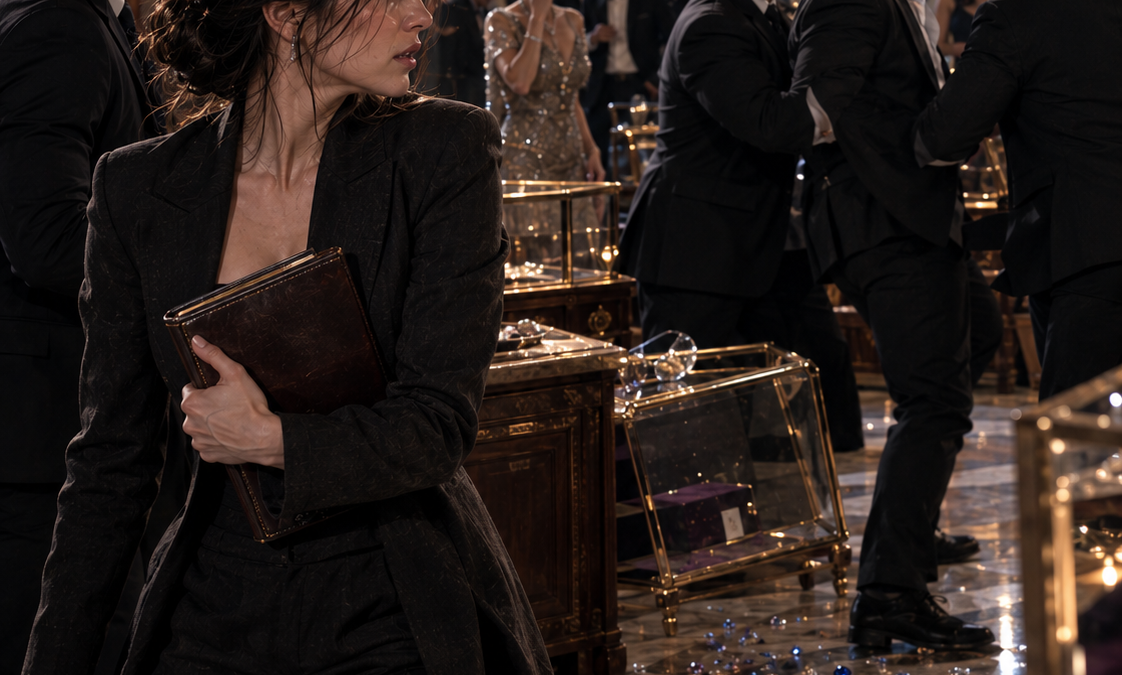
CHAPTER FIVE: The Betrayal in the Ledger
Three days later, Elena found the second ledger.
She’d been going through her grandfather’s papers—boxes of them, stored in the workshop’s basement, untouched for years—looking for anything that might strengthen her case against Julian. She’d found old certifications, old photographs, old letters. She’d found her grandfather’s will, the one that had bound her to this city, to this family, to this impossible situation.
And then she’d found the book.
It was hidden inside a false-bottomed drawer in her grandfather’s desk—a drawer she’d opened a hundred times, never suspecting. The book was smaller than the first ledger, bound in black leather, unmarked. When she opened it, she found a second set of records.
These weren’t certifications. They were transactions.
Payments, transfers, deposits—all recorded in her grandfather’s precise hand. Names she didn’t recognize. Accounts she couldn’t trace. And at the center of it all, a name she did recognize.
Marcus Chen.
Elena’s blood ran cold.
She read the entries three times, trying to make sense of them. Marcus had received payments from the House of Voss—large payments, regular payments, stretching back years. He’d been on the Voss payroll before he’d ever worked for Damian. He’d been involved in the family’s business before he’d ever set foot in the Ashford Dynasty.
And the dates—the most recent entries were from six months ago. After Marcus had started working for Damian. After he’d become Damian’s most trusted advisor.
He’s the mole, Elena realized. He’s been working for Julian all along.
The implications hit her like a wave. Marcus had been feeding information to Julian—information about Damian’s plans, about the merger, about Elena’s investigation. He’d been sabotaging the case from the inside, protecting Julian while pretending to protect her.
And she’d trusted him.
She’d told him about the ledger. She’d let him drive her home. She’d eaten breakfast with him, listened to his warnings about the mole, believed his lies.
Don’t assume that everyone in Damian’s inner circle is on your side.
He’d been warning her about himself. Playing her. Making her trust him so he could betray her more effectively.
Elena grabbed her phone. Then stopped.
If she called Damian, she’d have to tell him everything—not just about Marcus, but about the second ledger, about the payments, about the years of secrets she’d uncovered. He’d want to know why she hadn’t told him sooner. He’d want to know what else she was hiding.
And she was hiding something. Something she’d never told anyone.
The payments in the second ledger weren’t just to Marcus. They were to other people—people with names she’d been taught never to speak. People who’d been involved in something her grandfather had spent his whole life trying to forget.
The House of Voss wasn’t just a jewelry empire. It was a front. A money-laundering operation that had been running for decades, hidden beneath layers of legitimate business. Her grandfather had built it, her father had maintained it, and Julian—Julian had expanded it.
The substituted stones weren’t just fraud. They were a small piece of a much larger crime.
And Elena had just found the proof.
She sat in the workshop, the black ledger open in front of her, and tried to decide what to do.
If she went to the police, she’d expose her family’s crimes—all of them, not just Julian’s. The House of Voss would be destroyed. Her grandfather’s legacy would be in ruins. Everyone who’d ever worked for the company would lose their jobs, their pensions, their futures.
If she went to Damian, she’d have to trust him—trust him with secrets that could destroy everything she’d ever known. Trust him not to use them against her.
If she did nothing, Julian would continue. The fraud would grow. More clients would be cheated. The house would collapse eventually, taking everyone down with it.
The stone doesn’t lie, her grandfather had said. But people do. Your job is to know the difference.
She’d spent years running from that lesson. Running from the truth. Running from the family that had shaped her and the man who’d broken her heart.
She couldn’t run anymore.
Elena picked up her phone and called Damian.
“I need to see you,” she said. “Now. It’s urgent.”
“Where are you?”
“The workshop. Come alone.”
She hung up before he could ask more questions.
Then she waited—in the dark, with the ledgers open in front of her, and the truth burning in her chest like a coal.
The door opened forty minutes later. Damian stepped inside, his coat still on, his expression sharp with concern.
“What’s happened?”
Elena gestured to the desk. “Sit down.”
He sat. Looked at the ledgers. Read the entries.
His face didn’t change as he absorbed the information—but something in his eyes went cold. Colder than she’d ever seen it.
“Marcus,” he said.
“Marcus. And others. The payments go back years—before you hired him, before we even met. He’s been working for my family the whole time.”
“He’s been working for Julian.”
“For your company. For your trust. For everything you’ve built.” Elena paused. “I’m sorry.”
“Don’t apologize. You’re not the one who betrayed me.” He closed the ledger. “There’s more, isn’t there? Something you haven’t told me.”
She hesitated. Then she told him everything—about the money laundering, about the names in the second ledger, about the decades of secrets her family had buried. She told him about her grandfather’s involvement, her father’s complicity, her brother’s expansion of the operation.
She told him the truth.
When she finished, Damian was silent for a long moment.
“You knew about this,” he said. “Before tonight.”
“I suspected. I found the first ledger years ago, before I left for Antwerp. I didn’t understand what it meant then—I was young, I was scared, I didn’t want to believe my family could be involved in something like this.”
“So you ran.”
“I ran.” She met his eyes. “I’ve been running ever since.”
“And now?”
“Now I’m tired of running. I want to stop. I want to tell the truth, whatever it costs.”
Damian stood. Moved to the window. Looked out at the city, dark and sprawling beneath them.
“If we do this,” he said, “there’s no going back. You understand that? We expose your brother, we expose the money laundering, we expose decades of corruption. The House of Voss will be destroyed. Your family name will be destroyed. Everything you’ve ever known will be gone.”
“I know.”
“And you’re willing to accept that?”
“I’m willing to accept the truth. Whatever it looks like.”
He turned to face her. For a moment, he looked almost human—not the ruthless CEO, not the calculating businessman, but the man she’d fallen in love with eight years ago. The man who’d made her laugh. The man who’d held her in the dark and promised her forever.
“I’ll protect you,” he said. “Whatever happens. I won’t let Julian hurt you.”
“You can’t promise that.”
“I can. I am.” He moved closer. “Eight years ago, I let you walk away. I told myself it was for the best—that you deserved a life without the complications of my world, my family, my name. I was wrong.”
“Damian—”
“I’m not asking for anything. I’m not asking you to stay, or to forgive me, or to pretend we can go back to what we were. I’m just telling you the truth. You asked me not to lie to you. This is me, not lying.”
Elena looked at him—at the man who’d broken her heart, and the man who might save her. At the man she’d spent eight years trying to forget.
“I don’t know what I feel,” she said. “I don’t know if I can trust you. I don’t know if I can trust anyone.”
“Then don’t. Trust the evidence. Trust the ledgers. Trust the truth.” He paused. “Trust yourself. That’s enough.”
She wanted to believe him. She wanted to believe that the truth was enough—that if they exposed Julian, if they revealed the fraud, if they brought down the whole rotten system, everything would be okay.
But she knew better. The truth didn’t set people free. The truth destroyed them.
The question was whether she could survive the destruction.
“I need to think,” she said. “Alone.”
Damian nodded. “I’ll be close by. When you’re ready, call me.”
He walked to the door. Paused.
“One more thing. The mole—Marcus. He can’t know we’re onto him. If he suspects we’ve found the ledger, he’ll run. Or worse.”
“I know.”
“Then we need to be careful. We need to be smart. And we need to be fast.” He looked at her. “Tomorrow morning, I’m calling a board meeting. I’m going to tell them everything—the fraud, the money laundering, the years of corruption. I’m going to make sure Julian can never hurt anyone again.”
“And what about me?”
“You’ll be there. Beside me. Telling your part of the story.”
“Julian will try to destroy me.”
“He’ll try. He’ll fail.” Damian’s voice was hard. “Because I’ll be there. And I don’t let anyone destroy what’s mine.”
He left before she could respond.
Elena sat alone in the workshop, surrounded by the evidence of her family’s sins, and tried to find the courage to do what came next.
The stone doesn’t lie, her grandfather had said.
But people did. All the time.
Tomorrow, she’d have to decide which one she was.
CHAPTER SIX: The Boardroom Trap
The Ashford Dynasty boardroom was designed to intimidate. Floor-to-ceiling windows. A table carved from a single slab of black walnut. Leather chairs that cost more than most people’s cars. And at the head of it all, Damian Ashford, looking like a man who’d already won a war Elena hadn’t yet begun to fight.
She sat beside him, her ledgers in a leather portfolio, her hands steady. She’d dressed carefully that morning—a charcoal suit, a cream blouse, her grandfather’s antique watch on her wrist. Armor, of a kind.
Across the table, Julian sat with three lawyers and a public relations consultant. He looked relaxed. Confident. Like a man who’d already planned for every contingency.
He hadn’t planned for this.
“Thank you all for coming,” Damian said, his voice calm and unhurried. “I’ve called this meeting to address a matter of urgent importance. Ms. Voss?”
Elena opened her portfolio. Pulled out the first ledger. Set it on the table.
“This is the original certification record of the House of Voss,” she said. “It was kept by my grandfather, Henri Voss, for forty years. Every stone he certified is recorded here—including the laser inscriptions that make each one identifiable.”
Julian’s expression didn’t change. But his hand, resting on the table, curled slightly.
“Ms. Voss has spent the past two weeks comparing these records against the current inventory,” Damian said. “She’s found twenty-three instances of substitution. Natural stones replaced with lab-grown ones. Clients cheated out of millions.”
“That’s a serious accusation.” One of Julian’s lawyers—a thin man with silver glasses—leaned forward. “Do you have proof?”
Elena pulled out a second folder. Photographs. Certification records. The serial numbers from the lab-grown stones, matched against the ledger entries.
“I’ve documented every substitution,” she said. “The stones in the Moreau estate, the Delacroix necklace, the Petrov earrings—all of them were certified as natural. All of them are lab-grown. The laser inscriptions prove it.”
The room was silent.
Julian smiled. It was a pleasant smile—the same smile he’d worn in the workshop, when he’d threatened to destroy her career. “My sister has been away for a long time,” he said. “She’s clearly mistaken. Perhaps her judgment is clouded by—personal issues.”
“What personal issues?”
“She’s been under a great deal of stress. Our father’s death, the pressure of the inheritance clause, the demands of the certification work. I’m sure she believes what she’s saying. But she’s wrong.”
“I’m not wrong.”
“Ellie.” Julian’s voice was gentle. Condescending. “You’ve always been emotional. Grandfather indulged you—we all did. But this is a business matter. You can’t expect the board to take your word over documented records.”
“The documentation is right here.”
“The documentation you created. You could have altered the ledgers. You could have fabricated the evidence.” He spread his hands. “You’ve been working with Ashford Dynasty for weeks. Everyone knows they’re trying to acquire our company. It’s not a stretch to imagine you’ve been—influenced.”
Elena felt the room shift. The board members were looking at her differently now—doubt creeping into their expressions. Julian’s lawyers were nodding, taking notes.
Damian spoke before she could respond.
“Mr. Voss, are you suggesting that Ms. Voss fabricated evidence to help me acquire your company?”
“I’m suggesting my sister is confused. Misguided. Perhaps manipulated by people who don’t have the House of Voss’s best interests at heart.”
“I see.” Damian leaned back in his chair. “Then you won’t mind if we verify the inscriptions.”
Julian’s smile flickered. “What?”
“The stones in the Moreau estate are still in the vault, aren’t they? The pieces haven’t been sold yet. I propose we send an independent gemologist—someone neither of us has worked with—to examine them. If the inscriptions match the ledger, we’ll know Ms. Voss is telling the truth. If they don’t, we’ll know she’s mistaken.”
The board murmured. Julian’s lawyer leaned in, whispered something.
“That won’t be necessary,” Julian said. “My sister’s accusations are—”
“Are they true or false? It’s a simple question.” Damian’s voice was still calm, but there was steel beneath it. “If you’re confident in your records, you should have no objection to an independent examination.”
“I object to the implication that my records are fraudulent.”
“I’m not implying anything. I’m proposing a verification process. Unless you have something to hide.”
The two men stared at each other across the table. Elena watched Julian’s face—the way his jaw tightened, the way his fingers drummed once against the wood before going still.
“Fine,” Julian said. “An independent examination. But I want my own gemologist present. And I want the results reviewed by the Gemological Institute.”
“Agreed.” Damian stood. “I’ll arrange it. We’ll reconvene in forty-eight hours.”
The meeting broke up. Board members filed out, whispering. Julian’s lawyers packed their briefcases. Julian himself lingered, his eyes fixed on Elena.
“You think you’ve won,” he said, low enough that only she could hear. “But you haven’t. You don’t know what you’ve started.”
“I know exactly what I’ve started.”
“You’ve started a war. And you’re going to lose.” He smiled—that pleasant, empty smile. “You always were the weak one, Ellie. Grandfather should have trained me. He should have trusted me. Instead, he chose you.”
“He chose me because I told the truth.”
“You told the truth because you were too stupid to lie.” Julian turned to go. “Enjoy your victory. It won’t last.”
He walked out. The door closed behind him.
Elena let out a breath she hadn’t realized she’d been holding.
Damian was watching her. “You handled that well.”
“I feel like I just survived a car crash.”
“The crash is still coming. That was just the warning sign.” He moved to the window. “Julian will try something before the examination. He’ll destroy evidence, bribe the gemologist, or find another way to discredit you. We need to be ready.”
“What do you suggest?”
“I suggest you stay close. Very close. Until this is over, you’re a target—and I don’t want you out of my sight.”
Elena’s heart stuttered. “What do you mean?”
“I mean you’re moving into my building. The penthouse. There’s a guest suite—you’ll have your own space, your own entrance. But you’ll be under my protection.”
“Damian—”
“Don’t argue. Julian knows you’re the key witness. If he can’t discredit you, he’ll try to eliminate you. Not physically—he’s too smart for that—but professionally, personally. He’ll find your weak points and exploit them.”
“I can take care of myself.”
“I know you can. But you don’t have to.” He turned to face her. “Let me do this, Elena. Let me protect you. It’s the only way I’ll be able to sleep at night.”
She wanted to refuse. She wanted to prove that she didn’t need him—that she’d survived eight years without his protection, that she could survive this too.
But she thought of Julian’s smile. The threats. The way he’d broken into her apartment, gone through her things, tried to destroy her before she’d even begun.
“Fine,” she said. “I’ll stay. But this doesn’t mean anything.”
“Of course not.”
“I mean it, Damian. This is a business arrangement. Nothing more.”
He nodded, his expression unreadable. “Whatever you say.”
CHAPTER SEVEN: The Penthouse
The Ashford penthouse occupied the top three floors of a building in the heart of the city—a sleek, modern tower that looked like it had been designed by someone who hated poor people. The guest suite was bigger than Elena’s entire apartment, with a bedroom, a sitting room, a bathroom with a marble floor, and a view of the river that made her feel like she was floating.
“This is obscene,” she said, when Damian showed her in.
“You get used to it.”
“I don’t want to get used to it.”
He almost smiled. “Then don’t. There’s food in the kitchen, clothes in the closet—I had someone guess your size. If you need anything else, just ask.”
Elena set her bag down—the ledgers, the files, the evidence she’d spent weeks gathering. She felt exposed, standing in his space, surrounded by his things. The suite smelled like him—cedar and something clean, something expensive.
“Where will you be?”
“My office is on the floor below. I’ll be working late—there’s a lot to prepare for the examination. You should rest.”
“I don’t need rest.”
“You need something. You’ve been running on adrenaline for days.” He paused at the door. “Elena.”
“What?”
“I’m glad you’re here. Not because of the case—because of you. I’m glad you’re safe.”
She didn’t know what to say. So she said nothing.
He left. The door closed. She was alone in his world, surrounded by his things, breathing his air.
She should have felt trapped. She should have felt like a prisoner.
Instead, she felt something worse: she felt safe. And she hadn’t felt safe in a very long time.
The first night, she couldn’t sleep. She wandered the suite, touching things—the books on the shelves, the art on the walls, the ridiculously expensive sheets on the bed. Everything was tasteful. Everything was controlled. Everything was Damian.
At two in the morning, she gave up and went to the kitchen. She found him there, sitting at the island, a glass of whiskey in front of him and a laptop open beside it.
“Can’t sleep?” he asked.
“No. You?”
“I never sleep.” He pushed a second glass toward her—empty, clean. “Whiskey?”
“I shouldn’t.”
“You should. You’ve earned it.”
She poured herself a finger, two. Sat across from him at the island. The kitchen was dim, lit only by the glow of the city through the windows.
“I used to dream about you,” he said, after a moment. “After you left. I’d wake up and expect you to be there.”
“Damian—”
“I know. I’m not trying to—I’m just saying. You were there. And then you weren’t. And I never understood why.”
“You know why.”
“I know the reasons you gave. I don’t know the truth.”
Elena took a sip of whiskey. It burned going down—a clean, expensive burn.
“The truth is I was scared. I was twenty-five years old, I’d just found out my family was involved in something terrible, and I was falling in love with a man whose world was built on everything I was trying to escape.” She met his eyes. “I didn’t know if I could survive you.”
“And now?”
“Now I don’t have a choice.”
He was silent for a long moment. Then: “You always have a choice, Elena. That’s what I’ve always admired about you. You never let anyone make you a victim.”
“I’ve been a victim before.”
“I know. But you didn’t stay one. You rebuilt yourself. You built a career, a life, a reputation. You did it alone, without anyone’s help.” He paused. “That’s not weakness. That’s power.”
Elena looked at him—really looked. He was tired, she realized. The lines around his eyes, the tension in his shoulders. He’d been carrying this weight for years—the company, the family, the secrets. He’d been carrying her weight too, even before she’d come back.
“Why didn’t you tell me?” she asked. “About the ledger. About my family. You knew—you’ve known for years. Why didn’t you tell me?”
“Because I didn’t want to hurt you. Because I knew what it would do to you, finding out the truth about your grandfather.” He set down his glass. “Because I was afraid that if you knew what I knew, you’d never come back.”
“I came back anyway.”
“You did. And now I’m terrified I’ll lose you again.”
The words hung in the air between them.
“I’m not yours to lose,” Elena said, quietly.
“I know.” He stood. “Get some sleep. Tomorrow will be long.”
He walked out before she could respond.
Elena sat alone in the kitchen, the whiskey warm in her chest, and wondered when she’d started wanting him to stay.
CHAPTER EIGHT: The Examination
The independent gemologist was a woman named Dr. Amara Osei—a Ghanaian-born expert who’d spent thirty years in the field and had a reputation for being unimpeachable. She arrived at the House of Voss vault on Wednesday morning with her own equipment, her own team, and a face that revealed nothing.
Elena met her at the door.
“Dr. Osei. Thank you for coming.”
“Ms. Voss.” The older woman nodded. “I’ve read your work on crystalline structure. Impressive.”
“Thank you.”
“I’m not here to be impressed. I’m here to find the truth.” She walked past Elena into the vault. “Show me the pieces.”
The examination took six hours. Dr. Osei and her team examined each stone—the Moreau estate, the Delacroix necklace, the Petrov earrings. They measured, photographed, analyzed. They used lasers and spectrometers and loupes. They read the inscriptions on every girdle.
Julian was there, watching. So were his lawyers. So were the board members. And so was Damian—a quiet presence at the edge of the room, his eyes never leaving Elena.
At four in the afternoon, Dr. Osei called everyone into the conference room.
“Ms. Voss’s findings are correct,” she said. “The stones in the affected pieces are lab-grown. The inscriptions on the girdles are inconsistent with the original certifications. There is no doubt—these pieces were substituted.”
The room erupted.
Julian was on his feet. “This is a setup. She’s been working with Ashford—she’s been planning this for weeks—”
“Dr. Osei is an independent expert,” Damian said, calmly. “You agreed to her examination. You agreed to her findings.”
“I agreed to nothing—”
“You agreed in front of the board. It’s in the minutes.”
Julian’s face went white. He turned to the board members—the men and women who’d trusted him, supported him, believed in him.
“Listen to me. This is a conspiracy. My sister and Ashford—they’re trying to destroy me—”
“Enough.” One of the board members—an older woman named Margaret Chen, no relation to Marcus—stood. “Dr. Osei’s findings are clear. The evidence is damning. Julian Voss, you are hereby suspended from your position as CEO of the House of Voss, pending a full investigation.”
Julian looked like he’d been punched. “You can’t do this.”
“We can. And we are.” Margaret turned to Elena. “Ms. Voss, as the only surviving member of the founding family with no involvement in the fraud, we’d like to offer you the position of interim CEO.”
Elena’s heart stopped.
“I—what?”
“Your grandfather built this house on integrity. Your brother destroyed that legacy. We believe you can restore it.”
“I don’t have experience—”
“You have integrity. You have expertise. And you have the support of this board.” Margaret smiled—a tired, genuine smile. “That’s more than most CEOs start with.”
Elena looked at Damian. He was watching her, his expression unreadable.
She looked at Julian. He was staring at her with pure hatred—the kind of hatred that doesn’t fade, doesn’t forgive, doesn’t forget.
She looked at the board—the people who’d trusted her grandfather, trusted her family, trusted the House of Voss.
“I accept,” she said. “On one condition.”
“What condition?”
“Julian is not just suspended. He’s terminated. And the board cooperates fully with law enforcement. No covering up, no quiet settlements. The truth comes out, all of it.”
Margaret nodded. “Agreed.”
Julian was escorted out. He didn’t look at Elena as he left. He didn’t say a word.
But she knew this wasn’t over. She knew it was just beginning.
CHAPTER NINE: The Space Between
That night, Elena stood on the balcony of Damian’s penthouse, looking out at the city. She’d been offered the job of her life—the chance to rebuild her family’s legacy, to prove that the Voss name still meant something.
She should have been happy. She should have felt victorious.
Instead, she felt empty.
“Congratulations.” Damian’s voice came from behind her. “You handled yourself well today.”
“I felt like I was drowning.”
“You didn’t look it.”
He came to stand beside her at the railing. The city sprawled below them—millions of lights, millions of lives, none of them intersecting with hers.
“I don’t know if I can do this,” she said. “Run the company. Rebuild the house. It’s—it’s too much.”
“You can. You’ve done harder things.”
“Have I?”
“You left me. Eight years ago. You walked away from everything and rebuilt your life from scratch. That was harder.”
She turned to look at him. His face was half in shadow, the city lights reflecting in his eyes.
“Why do you keep bringing that up?”
“Because I keep thinking about it. What I could have done differently. What I should have said.” He paused. “What I should have done when you told me you loved me.”
Elena’s breath caught. “You remember that.”
“I remember everything. Every word, every moment.” He turned to face her. “I was a coward, Elena. I was afraid of what it would mean to love you—to let someone in, to be vulnerable. I’d spent my whole life building walls, and you were the first person who made me want to tear them down.”
“Then why didn’t you?”
“Because I didn’t know how. Because I was afraid that if I let myself love you, I’d lose you. And I wasn’t wrong—I did lose you. But not because I loved you. Because I didn’t love you enough to fight for you.”
Elena felt tears burning behind her eyes. She hadn’t cried in years—not when her father died, not when she’d left Geneva, not when she’d found the evidence of her family’s crimes. She’d taught herself not to cry. Tears were weakness.
But standing here, in the dark, with Damian’s eyes on her—she felt the walls cracking.
“I don’t know how to do this,” she whispered. “I don’t know how to trust you. I don’t know how to let you in.”
“Then don’t. Not yet. Not until you’re ready.” He reached out—hesitated—let his hand fall. “I’ll wait. I’ve waited eight years. I can wait longer.”
“What if I’m never ready?”
“Then I’ll spend the rest of my life proving that I’m worth the wait.”
She looked at him—at the man who’d broken her heart, and the man who might heal it. At the man who’d built walls around himself, and the man who was slowly tearing them down.
“I don’t know what I feel,” she said. “But I know I don’t want to be alone tonight.”
He understood. He didn’t reach for her—didn’t push, didn’t presume. He just stood beside her, close enough that she could feel his warmth, far enough that she could breathe.
They stayed like that for a long time—two people on the edge of something, waiting to see if they’d fall.
CHAPTER TEN: The Mole
Marcus was waiting in the lobby the next morning.
Elena saw him as she stepped off the elevator—standing by the security desk, his expression neutral, his posture relaxed. He looked like he belonged there. He looked like he’d always belonged there.
“Ms. Voss.” He nodded. “Congratulations on yesterday.”
“Thank you.”
“I heard about the examination. The evidence was conclusive?”
“Very.”
“That’s good. That’s what you wanted.” He fell into step beside her as she walked toward the exit. “Damian asked me to drive you to the House of Voss. There’s a lot to do—transition planning, meetings with the board, damage control.”
“I’m sure there is.”
“And I wanted to apologize. For the other day—the breakfast. I didn’t mean to overstep.”
“You didn’t overstep.”
“I did. I was trying to—I don’t know. Protect you. But you don’t need my protection.”
Elena stopped walking. Turned to face him.
“Marcus.”
“Yes?”
“I know.”
He blinked. “Know what?”
“About the payments. The second ledger. The years you spent working for Julian.” She watched his face—the flicker of surprise, quickly masked. “I know everything.”
For a moment, he didn’t respond. Then he smiled—a real smile, not the polite mask he usually wore.
“I wondered when you’d figure it out.”
“You weren’t exactly subtle.”
“I wasn’t trying to be. I was trying to warn you—to keep you away from the truth.” He shook his head. “But you’re too much like your grandfather. You don’t know how to leave well enough alone.”
“Why did you do it?”
“Do what?”
“Work for Julian. Betray Damian. Betray me.”
Marcus was silent for a long moment. Then: “Because I didn’t have a choice.”
“Everyone has a choice.”
“Not when your family is threatened. Not when someone you love is in danger.” He met her eyes. “Julian found out about my sister. She was—she was involved in something, years ago. Something illegal. He threatened to expose her, to send her to prison, unless I helped him.”
“Helped him do what?”
“Everything. Feed him information about Damian’s plans. Sabotage the acquisition. Keep tabs on you—on anyone who might discover the fraud.” He paused. “I never wanted to hurt you. I never wanted to hurt Damian. But I couldn’t let my sister go to prison.”
“Where is your sister now?”
“Safe. Julian kept his end of the bargain—for a while. But when you found the ledger, when you started investigating—he threatened to expose her anyway. I’ve been trying to protect her ever since.”
Elena looked at him—at the man who’d pretended to be her ally, who’d earned her trust, who’d lied to her face. She should hate him. She should want to destroy him.
Instead, she understood.
“I’m not going to expose you,” she said. “But you’re going to help me.”
Marcus’s eyes widened. “What?”
“You’re going to tell me everything Julian has done. Every crime, every cover-up, every threat. You’re going to help me build a case that puts him away for good.”
“And in return?”
“I’ll protect your sister. I’ll make sure she’s safe—from Julian, from the police, from anyone who might come after her.” She paused. “But you have to trust me. And you have to tell the truth.”
Marcus studied her for a long moment. Then he nodded.
“Okay.”
“Okay?”
“Okay. I’ll help you.” He smiled—a real smile, tired and relieved. “I’ve been waiting for someone to give me a reason to stop lying.”
 [Tap here for the Next Part ]


