Part 3: “I don’t let anyone destroy what’s mine.”
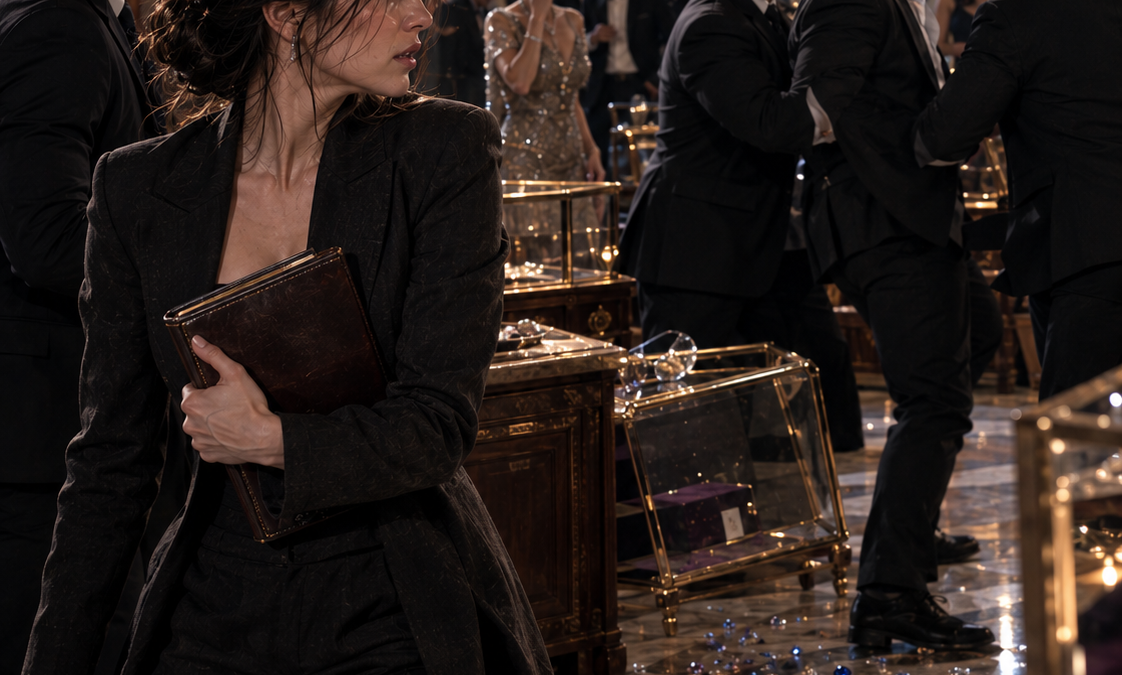
CHAPTER ELEVEN: The Sister
Vivian Ashford was waiting in Elena’s office when she arrived at the House of Voss.
She was dressed in white—a stark contrast to the dark wood and antique furniture—and she looked like she hadn’t slept in days.
“We need to talk,” she said.
“I’m busy.”
“This is important.”
Elena set down her bag. “Fine. Talk.”
Vivian closed the door. Then she turned to face Elena—and for the first time, Elena saw something other than hostility in her eyes.
“Julian called me last night,” Vivian said. “He’s planning something. Something bad.”
“What kind of something?”
“I don’t know the details. But he mentioned you—and Damian. He said he was going to ‘end this once and for all.'” She paused. “I think he’s going to try to hurt you.”
“Why are you telling me this?”
“Because I don’t want him to.” Vivian’s voice cracked. “I know I’ve been—difficult. I know I’ve been cruel. But Julian—he’s not the man I thought he was. He’s dangerous. He’s been dangerous for years, and I’ve been too blind to see it.”
“You were engaged to him.”
“I was. Ten years ago. Before you. Before all of this.” Vivian sat down—heavily, like the weight of the world was on her shoulders. “He was different then. Or I thought he was. He was charming, attentive, everything I thought I wanted. But he was also—controlling. Manipulative. He’d find my weak spots and exploit them. He’d make me feel like I couldn’t live without him.”
“And then?”
“And then I found out he was cheating on me. With multiple women. He laughed when I confronted him—said it was my fault, that I wasn’t enough, that no woman would ever be enough.” She looked up at Elena. “I broke off the engagement. He threatened to destroy my reputation. He nearly succeeded.”
“Why didn’t you tell anyone?”
“I was ashamed. I was afraid. I was—weak.” She took a breath. “But I’m not weak anymore. And I’m not going to let him destroy anyone else.”
Elena sat down across from her. “What do you want me to do?”
“I want you to stop him. I want you to expose him, to put him away, to make sure he can never hurt anyone again.” She paused. “And I want to help.”
“How?”
“I have information. Years of it. He kept records—of everything. The affairs, the fraud, the money laundering. He thought I was too stupid to notice, too trusting to care.” She reached into her bag and pulled out a USB drive. “This is a copy of his personal server. Emails, texts, financial records. Everything.”
Elena took the drive. It was small, unremarkable—and it might hold the key to everything.
“Why are you giving me this?”
“Because I should have done it years ago. Because I was too afraid to stand up to him, and it nearly destroyed me.” Vivian met her eyes. “Because you’re braver than I ever was. And I want to be brave too.”
CHAPTER TWELVE: The Trap
Julian called Elena three days later.
“I want to see you,” he said. “Alone. No Damian, no board members, no lawyers. Just the two of us.”
“Why would I agree to that?”
“Because I have something you want. Something you need.”
“What?”
“Grandfather’s final letter. The one he wrote before he died. The one he left for you—not for me, not for anyone else. You never received it, did you?”
Elena’s heart stopped. “What are you talking about?”
“He wrote you a letter. I found it in his desk, after the funeral. I never sent it—I was angry, jealous, stupid. But I kept it. And I’ll give it to you—if you meet me. Alone.”
“Where?”
“The workshop. Tonight. Midnight.”
He hung up before she could respond.
Elena sat in her office, her hands shaking. Her grandfather’s letter—the last words he’d ever written to her. She’d thought he’d died without saying goodbye, without telling her the things she’d always wanted to hear.
But there was a letter. And Julian had kept it from her for years.
She picked up her phone to call Damian. Then stopped.
If she told him, he’d insist on coming with her. He’d bring security, backup, a whole team of people. And Julian would disappear—with the letter, with the truth, with the last piece of her grandfather she’d ever have.
She had to do this alone.
She texted Damian: I’m fine. Working late. Don’t wait up.
Then she grabbed her coat and headed for the door.
The workshop was dark when she arrived. The old banker’s lamp was on—the one with the green glass shade—casting a pool of light on her grandfather’s desk.
Julian was sitting in her grandfather’s chair.
“You came,” he said.
“Where’s the letter?”
“Patience, Ellie. We have time.” He gestured to the other chair. “Sit down.”
“I’ll stand.”
“Still stubborn.” He smiled—that pleasant, empty smile. “You know, Grandfather always admired that about you. ‘Ellie has fire,’ he used to say. ‘Ellie will go far.’ He never said that about me.”
“I’m not here to talk about Grandfather.”
“No, you’re here for this.” He pulled an envelope from his jacket—yellowed, worn, sealed with wax. “His last words. To you, his favorite.”
“Give it to me.”
“Not yet. First, we need to talk.” He leaned back in the chair. “You’ve made quite a mess, Ellie. The board, the police, the media—everyone’s watching now. Everyone wants a piece of the story.”
“You brought this on yourself.”
“Did I? I was just trying to keep the family business alive. The fraud, the substitutions—it was all for the House of Voss. To keep us solvent. To keep us relevant.” He spread his hands. “And you destroyed it. Destroyed me. For what? For the truth?”
“People trusted us. They trusted our certifications. You cheated them.”
“I cheated them because they wanted to be cheated. They wanted to believe in the magic of natural stones—the romance, the rarity, the value. I gave them what they wanted. I gave them a story.”
“You gave them lies.”
“Lies are stories. Stories are lies. It’s all the same.” He stood. “But I’m not here to argue. I’m here to make you an offer.”
“I’m not interested.”
“You haven’t heard it yet.” He moved closer. “Drop the charges. Call off the investigation. Tell the police you were mistaken—that the evidence was fabricated. In return, I’ll give you the letter. And I’ll disappear. You’ll never see me again.”
“That’s your offer? You’ll run away?”
“I’ll survive. I always survive.” He held up the envelope. “But you won’t get this. Not unless you agree.”
Elena looked at the letter—her grandfather’s last words, trapped in her brother’s hands.
“You’re a monster,” she said.
“I’m a survivor. There’s a difference.” He held the envelope out. “What’s it going to be, Ellie? The truth—or the letter?”
She reached for it.
And the lights went out.
CHAPTER THIRTEEN: The Dark
The lights didn’t just go out—they died. The old workshop’s electrical system, rewired sometime in the 1970s and never updated, gave a final flicker and then nothing. The emergency exit sign above the door glowed faint green, casting the room in a sickly pallor.
Elena’s hand closed on empty air.
“Julian.”
No answer. She heard movement—a scrape of wood against concrete, the whisper of fabric. He was moving in the dark, and she had no idea where.
“Julian, this is stupid. Turn the lights back on.”
“I didn’t do it.” His voice came from her left—closer than she’d expected. “The breaker must have tripped.”
“Then fix it.”
“In a minute. First—the letter.” She heard the envelope crinkle. “You still want it, don’t you?”
Elena’s eyes were adjusting. She could make out shapes now—the workbench, the display case, the dark rectangle of the basement door. Her grandfather’s tools gleamed faintly on the desk, and she thought of the old brass loupe, the one he’d given her when she was nine years old. It was still there, in the drawer.
She knew this room better than she knew her own apartment. She’d spent her childhood here, her adolescence, the summers between university terms. She knew every creaking floorboard, every sticking drawer, every shadow.
Julian didn’t.
“Fine,” she said, keeping her voice steady. “Give me the letter.”
“Agree to my terms first.”
“I’m not agreeing to anything in the dark.”
“Then I’ll wait. I have nowhere to be.”
She heard him settle into the chair—her grandfather’s chair—and the small, satisfied sound he made when he thought he’d won. He was enjoying this. The power, the control, the game.
Elena took a step backward. Then another. Her hand found the edge of the workbench, the familiar grain of the old oak, worn smooth by decades of use.
“Julian, listen to me. You’re not going to walk away from this. The evidence is already in the hands of the police. The board has voted for your termination. Even if I agreed to your terms—which I’m not—it wouldn’t matter. The truth is out.”
“The truth can be managed. Witnesses can be discredited. Evidence can be—questioned.” His voice was calm, almost pleasant. “But you’re right about one thing. I’m not going to walk away. I’m going to fight. And I’m going to win.”
“You’re delusional.”
“Am I?” A pause. “You know what I’ve always admired about you, Ellie? Your faith. Your belief that things will work out, that the truth will prevail, that good people win in the end. It’s charming. Childish, but charming.”
He was to her right now—she could tell from the direction of his voice. Moving slowly, feeling his way through the dark.
“Grandfather didn’t believe that,” Julian continued. “He knew the world was cruel. He knew that power mattered more than truth. That’s why he built the company the way he did—the secrets, the lies, the money laundering. He understood.”
“You’re wrong.”
“Am I? He chose you, didn’t he? He trained you, trusted you, gave you the keys to his kingdom. But he never told you the truth about what that kingdom was built on. He let you believe in the fairy tale—the House of Voss, the noble family business, the legacy of integrity. He kept the ugly parts hidden.”
“He was trying to protect me.”
“He was trying to control you. Same as he controlled everyone. Same as I control everyone.” Another pause. “The difference is, I’m honest about it.”
Elena’s fingers found the drawer. The old brass handle, cold against her skin. She pulled it open—slowly, silently—and her hand closed on the loupe.
“What are you doing?” Julian’s voice sharpened.
“Nothing.”
“You’re lying.”
“Maybe.” She palmed the loupe. It wasn’t a weapon—not really. But it was heavy, solid brass, and it was hers. “Give me the letter, Julian. Then get out of my workshop.”
“Your workshop?”
“Grandfather gave it to me. In the will. You know that.”
“He gave you everything, didn’t he? The workshop, the certification clause, the training, the trust.” His voice was bitter now, the pleasant mask slipping. “I got the company, but only because he had no choice. He would have given you that too, if he could have. But you didn’t want it. You ran away.”
“I ran away because I couldn’t stand to be near you.”
The words landed like a slap. For a moment, the room was silent.
Then Julian laughed—a real laugh, harsh and broken.
“Eight years,” he said. “Eight years, and you still don’t understand. I never wanted to hurt you, Ellie. I never wanted to be the villain. But you—you were always so good, so pure, so perfect. You made me feel like a monster just by existing.”
“That’s not my fault.”
“Maybe not. But it’s the truth.” He moved again—toward the door, she thought. “Here’s your letter. Take it.”
Something brushed against her hand—the envelope. She grabbed it.
“Goodbye, Ellie. I hope you find what you’re looking for.”
The door opened. Light spilled in from the street—dim, orange, sodium lamps. Julian’s silhouette stood in the doorway for a moment.
Then he was gone.
Elena didn’t realize she was crying until she tasted salt.
She stood in the dark workshop, the envelope clutched in her hands, and let the tears come. For her grandfather. For her brother. For the family that had broken itself apart long before she’d ever come home.
The lights flickered back on. The emergency exit sign went dark. Somewhere in the building, the old breaker had reset itself.
She looked at the envelope. Her name was written on the front—Elena—in her grandfather’s careful hand.
She opened it.
My dear girl,
If you’re reading this, I’m gone. And if you’re reading this, it means you’ve found the truth—about the company, about your brother, about everything I kept from you.
I wish I could have told you myself. I wish I’d been braver. But I was a coward, and I let my fear rule me, and I’m sorry.
The House of Voss was never what it seemed. I built it on secrets and lies, and your father continued that legacy, and your brother expanded it. I tried to stop them—tried to turn the company back toward the light—but I was too late, too weak, too old.
You were the only one I could trust. You were the only one who ever understood the stones, who saw the truth in them. That’s why I trained you, why I left you the clause, why I gave you everything I could.
I’m not asking you to forgive me. I’m not asking you to save the company. I’m asking you to tell the truth—the whole truth, whatever it costs. Because that’s who you are, my dear. That’s who you’ve always been.
The stones don’t lie. People do. Your job is to know the difference.
Be brave. Be true. And don’t let them take that from you.
With all my love,
Grandfather
Elena read the letter three times. Then she folded it carefully, placed it in her pocket, and walked out of the workshop.
It was time to finish this.
CHAPTER FOURTEEN: The Confession
Damian was waiting for her when she got back to the penthouse.
His expression was thunderous. “You said you were working late.”
“I was.”
“You went to see Julian. Alone. Without telling me.” He moved closer, his voice tight with barely controlled fury. “Elena—”
“I know. I’m sorry. But I had to.”
“Had to do what? Walk into a trap? Risk your life?”
“He had a letter. From my grandfather. The last thing he ever wrote to me.” She pulled it from her pocket. “I couldn’t let Julian destroy it.”
Damian stared at the letter. Then at her. His jaw worked.
“You could have been hurt.”
“I wasn’t.”
“You could have been killed.”
“I know.” She met his eyes. “But I’m not. And I got what I came for.”
He wanted to argue. She could see it in his posture—the tension in his shoulders, the way his hands closed into fists. But he didn’t. Instead, he took a breath, and let it out slowly.
“What did he do to you?”
“Nothing. He threatened. He tried to make a deal—drop the charges, and he’d give me the letter and disappear. I refused.”
“And he just let you go?”
“He left.” She paused. “There’s something else. The letter—it confirms everything. The money laundering, the fraud, my grandfather’s involvement. He knew. He was part of it. And he wrote it down.”
Damian took the letter. Read it. When he looked up, his expression had changed—the anger replaced by something softer.
“He loved you.”
“Maybe. But he was wrong about me.” She took the letter back. “I’m not who he thought I was. I’m not the pure, perfect girl he remembered. I ran away. I hid from the truth. I let Julian destroy everything.”
“You came back.”
“Because I had to. Not because I wanted to.” She sat down—heavily, on the sofa. “I’ve been telling myself I came back for the inheritance. For the career. For all the practical reasons. But that’s not true. I came back because I wanted to punish him. Julian. I wanted to destroy him the way he destroyed me.”
“And now?”
“Now I don’t know. I don’t know who I am anymore. I don’t know what I want.”
Damian sat beside her. Not touching—just present.
“You’re the woman who found the truth,” he said. “The woman who exposed the fraud, who stood up to her brother, who made the board listen. You’re the woman I’ve been waiting for since the day you left.”
“I’m not the same woman who left.”
“I know. You’re stronger.” He paused. “I’m not the same man, either. I’ve spent eight years building walls, pushing people away, trying to protect myself from ever feeling what I felt when you left. But you’re here now, and the walls are gone, and I don’t know how to protect myself anymore.”
Elena looked at him—at the man who’d made her heart race, the man who’d broken it, the man who might finally be ready to put the pieces back together.
“I’m not ready,” she said. “Not yet.”
“I know.”
“But I want to be.”
He nodded. Didn’t push. Didn’t ask for more.
They sat in silence for a long time, the city glowing below them, the letter between them.
And somewhere in the quiet, Elena realized that she’d stopped running.
CHAPTER FIFTEEN: The Arrest
The police came for Julian at his apartment three days later. Elena watched from a news van across the street—the media had been circling since the board’s announcement, and now they had their story.
Julian emerged in handcuffs, his face a mask of controlled fury. He’d known it was coming—he’d spent the last three days trying to flee the country, but Damian’s people had frozen his accounts. He was trapped.
The charges were extensive. Fraud. Money laundering. Conspiracy. The substituted stones were just the beginning—the second ledger had revealed a network of crimes stretching back decades.
Elena felt nothing as she watched him being led away. No triumph, no satisfaction. Just a hollow emptiness where her brother used to be.
She’d expected closure. Instead, she got silence.
The trial took six months. Elena testified for three days—answering questions about the ledger, the substitutions, her grandfather’s legacy. Julian’s lawyers tried to discredit her, painting her as a jealous sister, an ambitious woman who’d conspired with the Ashford family to destroy her brother.
They failed.
The evidence was too strong. The ledgers, the inscriptions, the records—everything her grandfather had left behind. The truth, finally told.
Julian was sentenced to fifteen years in federal prison. He’d have to sell his shares in the House of Voss, forfeiting his stake in the family business. He’d lose everything.
When the verdict came down, he turned to look at Elena. His expression was unreadable.
She didn’t turn away.
CHAPTER SIXTEEN: The House of Voss
Six months after the trial, Elena stood in the newly renovated showroom of the House of Voss. The display cases gleamed under soft lights. The antique chairs had been reupholstered. The marble floors had been polished to a shine.
It was the same, and it was different.
The board had voted to keep her on as CEO—not interim, but permanent. Margaret Chen had told her that the company needed her: someone who understood both the business and the stones, someone who could restore the House of Voss to its former glory.
Elena had accepted. On her terms.
“We’re opening next week,” she told Damian, as they walked through the empty showroom. “New certifications, new standards. Every piece will be independently verified, with full documentation. No more secrets.”
“It’s a good plan.”
“It’s the only plan.” She stopped in front of the display case that held her grandfather’s antique tools. “I’m going to rebuild this house. Not on lies—on truth. On the things he taught me.”
“Your grandfather would be proud.”
“I hope so.” She turned to face him. “I’ve been thinking about what you said. About waiting. About proving yourself.”
Damian’s expression didn’t change, but something flickered in his eyes. “And?”
“And I’m not ready to jump into anything. But I’m tired of running. I’m tired of protecting myself from everyone, including you.” She took a breath. “So I’m going to offer you something. A deal.”
“What kind of deal?”
“A partnership. You and me. Ashford Dynasty and the House of Voss—not as a merger, not as an acquisition. As equals. You handle the business side, I handle the stones. We share the profits, share the risk, share the credit.”
Damian studied her for a long moment. “And what about us?”
“That’s separate.” She met his eyes. “The partnership is professional. What happens between us—that’s personal. And I’m not ready to define it yet.”
“Then I’ll wait.”
“You always say that.”
“Because I mean it.” He moved closer. “I’ve been in love with you since the day I met you, Elena. I was too scared to say it then, too proud to chase you when you left. But I’m not scared anymore. I’m not proud anymore. I’m just a man who wants to spend the rest of his life proving he deserves you.”
Elena’s heart ached. She wanted to close the distance, to touch him, to let him in.
But she wasn’t ready. Not yet.
“You’ll have to be patient,” she said.
“I’ve waited eight years. What’s another few months?”
She almost laughed. “You’re impossible.”
“I’m determined.” He stepped back—giving her space. “Partners?”
She held out her hand. “Partners.”
He shook it. His grip was warm, firm, full of promise.
They stood there for a moment, hands clasped, the future stretching out ahead of them.
And Elena felt, for the first time in years, that she was exactly where she was supposed to be.
CHAPTER SEVENTEEN: The Stone Doesn’t Lie
The House of Voss reopened on a Tuesday morning, two weeks later.
The press came. The clients came. The board came. Even Vivian Ashford came, dressed in grey, her expression soft for once.
Elena stood at the entrance, greeting guests, accepting congratulations. She felt like a different person from the woman who’d walked into the workshop a year ago—lost, afraid, running from a truth she couldn’t face.
Now she was facing it.
The main attraction was a new exhibit: her grandfather’s original ledger, displayed in a glass case alongside the antique tools he’d used to certify stones. On the wall behind it, a quote from his letter, printed in elegant script:
The stones don’t lie. People do. Your job is to know the difference.
Elena touched the glass case. She could almost hear her grandfather’s voice—patient, precise, teaching her the language of stones.
“You did it.” Damian appeared at her elbow, a glass of champagne in his hand.
“We did it.” She took the glass. “I couldn’t have done it without you.”
“You could have. You just didn’t have to.” He raised his glass. “To the House of Voss.”
“To the truth.”
They drank.
Around them, the party continued—the laughter, the chatter, the celebration. Elena felt a hand on her arm and turned to find Vivian.
“Can we talk?” Vivian asked.
Elena nodded. They stepped into a quiet corner, away from the crowd.
“I wanted to apologize,” Vivian said. “For everything. For the way I treated you at dinner. For the things I said. I was angry—at Julian, at myself, at the world. But I took it out on you.”
“You were hurt.”
“I was. But that doesn’t excuse it.” Vivian met her eyes. “You’re the reason Julian is gone. You’re the reason he can’t hurt anyone else. And I’m grateful. Even if I didn’t show it.”
Elena thought about the USB drive—the evidence Vivian had given her. Without it, the case might have failed. Without it, Julian might have walked free.
“Thank you,” Elena said. “For giving me the evidence. For being brave.”
Vivian smiled—a real smile, tired and genuine. “I’m trying.”
They stood together, watching the party, the clients, the future.
And somewhere in the crowd, Elena saw Marcus Chen—talking to a woman she didn’t recognize, his sister, probably, finally free. He caught her eye and nodded. She nodded back.
They’d made their peace.
The party went on until midnight. The last guests left. The lights dimmed. And Elena stood alone in the showroom, surrounded by her grandfather’s legacy.
Damian found her there.
“You should come home,” he said. “You’ve had a long day.”
“This was my grandfather’s dream,” she said. “This house. This business. He built it on lies, but he wanted it to be something better. He wanted it to stand for truth.”
“And now it does.”
“Now it does.” She turned to face him. “I’ve been thinking about what you said. About waiting. About proving yourself.”
“And?”
“And I think I’ve waited long enough.”
Damian’s eyes widened. For a moment, he looked almost vulnerable—the controlled, powerful CEO replaced by a man who wasn’t sure what to say.
“I’m not saying I’m ready to marry you,” Elena continued. “I’m not saying I trust you completely. But I’m saying—I want to try. I want to see where this goes.”
“Elena—”
“I want to stop running. I want to stop protecting myself. I want to let you in.” She stepped closer. “If you still want me.”
“Want you?” He reached for her—tentatively, like she might disappear. His hands cupped her face. “I’ve never stopped wanting you. I’ve never stopped loving you. From the moment I saw you, eight years ago, standing in my father’s office with that ridiculous loupe in your hand—I knew. You were it. You were everything.”
“I was a mess.”
“You were perfect.”
“I was broken.”
“Then I was broken too.” He touched his forehead to hers. “Let’s be broken together.”
Elena closed her eyes. She felt the warmth of his hands, the steady beat of his heart, the promise in his voice.
“Okay,” she whispered. “Let’s be broken together.”
And she kissed him.
CHAPTER EIGHTEEN: The Wedding
They didn’t get married right away.
Elena insisted on a year-long engagement—not because she didn’t trust Damian, but because she wanted to be sure. She wanted to prove to herself that she could stand on her own, that she could run the House of Voss without his help, that she was choosing him and not just falling into him.
Damian agreed. He’d have agreed to anything, she suspected, as long as she was still there.
The year passed quickly. The House of Voss thrived under Elena’s leadership—new clients, new certifications, new standards of integrity. Damian’s company flourished too, the merger with Voss proving beneficial to both sides.
They spent weekends together at the Ashford estate. They spent weeknights at the penthouse, cooking dinner, watching movies, arguing about everything from business strategy to the correct way to load a dishwasher. They learned each other—not the idealized versions they’d held in their memories, but the real people, flawed and complicated and worth loving anyway.
And slowly, Elena let down her walls.
The wedding was small. Just family, friends, the people who mattered. Helena Ashford sat in the front row, her expression softer than Elena had ever seen it. Vivian was there, serving as a bridesmaid, her smile genuine for once.
Even Marcus came, standing at the back, watching with quiet satisfaction.
Elena walked down the aisle alone. She didn’t need anyone to give her away—she’d given herself away, freely, to the man waiting at the altar.
Damian’s eyes were wet when she reached him.
“You’re beautiful,” he whispered.
“You’re crying.”
“I know. It’s embarrassing.”
“It’s perfect.”
They exchanged vows—simple words, spoken from the heart. Promises of trust, of honesty, of standing together no matter what came next.
“I love you,” Damian said. “I’ve loved you since the day I met you. I’ll love you until the day I die.”
“I love you too,” Elena said. “And I’m not going anywhere.”
The officiant pronounced them married. Damian kissed her—gently, reverently, like she was something precious.
The crowd applauded.
And somewhere, in the quiet of the workshop, Elena imagined her grandfather watching. She imagined him smiling—the stern, proud smile he’d worn when she’d passed her first certification exam, the smile he’d worn when she’d told him she wanted to be a gemologist, just like him.
The stones don’t lie, he’d said.
But people could learn. People could change. People could tell the truth.
And that was the greatest gift of all.
CHAPTER NINETEEN: The New House of Voss
Six months after the wedding, Elena stood in the workshop—the same workshop where everything had begun.
It looked different now. Cleaner. Brighter. The old banker’s lamp was still there, but the desk had been refinished, the floors restored, the walls painted a soft cream instead of their previous dingy gray. The display cases held her grandfather’s tools, preserved under glass, alongside photographs of the family—not the idealized portraits that had hung in the main house, but the real ones. Her grandfather laughing. Her father as a young man. Julian, before everything went wrong.
She didn’t hate him anymore. She’d thought she would—for years, she’d carried the hatred like a stone in her pocket, heavy and cold. But somewhere in the trial, in the testimony, in the months of rebuilding, she’d let it go.
He was her brother. He’d made terrible choices. But he was still her brother.
She wrote to him sometimes. Short letters, nothing sentimental—just updates on the business, on the family, on her life. He never wrote back. But she kept writing anyway.
Maybe one day he’d answer.
The House of Voss had expanded. New offices in three cities. New clients around the world. The certification standards Elena had implemented were now the industry gold standard—no substitutions, no exceptions, full transparency at every step.
The fraud was a distant memory. The scandal had faded. The Voss name meant something again.
But Elena didn’t forget. She kept the ledgers in a safe in her office—both of them, the original and the second one, the one that had exposed her family’s darkest secrets. She kept her grandfather’s letter in her desk drawer. She kept his loupe on her desk, next to her computer, where she could see it every day.
A reminder of where she’d come from. A reminder of what she’d learned.
The stones don’t lie. People do. Your job is to know the difference.
She knew the difference now.
Damian came to the workshop that evening. He found her sitting at her grandfather’s desk, the loupe in her hand, staring at nothing.
“Thinking?” he asked.
“Remembering.” She set the loupe down. “I used to hate this room. After everything that happened—the fraud, the trial, Julian—I couldn’t stand to be here. I thought about selling the building, moving the business somewhere else.”
“What changed?”
“I realized I was running again. And I’m tired of running.” She stood. “This workshop is my history. My family’s history. The good and the bad. I can’t change it—but I can learn from it.”
Damian crossed to her. Took her hand.
“You’re the strongest person I know,” he said. “You lost your family, your career, your sense of self—and you rebuilt all of it. On your own terms.”
“I didn’t do it alone.”
“No. But you could have. That’s the difference.” He kissed her forehead. “I’m proud of you.”
“I’m proud of me too.”
They stood together, hand in hand, in the workshop that had seen everything—the lies, the truths, the betrayals, the redemption.
And Elena realized, finally, that she was home.
CHAPTER TWENTY: The Epilogue
Three years later, the House of Voss was thriving.
Elena had built something remarkable—a jewelry house known not just for its beautiful stones but for its integrity. Clients came from around the world, drawn by the promise of transparency, the certainty that what they were buying was real.
The press called her “the woman who saved the Voss legacy.” The industry called her a visionary. The board called her indispensable.
Elena called herself tired—but in a good way. The work was hard, but it was hers. The life she’d built was complicated, but it was real.
Damian came home late that night. The penthouse was quiet—the lights dim, the city glowing through the windows. He found Elena in the living room, sitting on the sofa, a book open on her lap.
“Long day?” he asked.
“Long week.” She looked up. “You?”
“The same.” He sat beside her. “I talked to my mother today.”
“How is Helena?”
“Still terrifying. Still wonderful.” He paused. “She asked about grandchildren.”
Elena laughed. “Of course she did.”
“I told her we’re working on it.”
“We’re not working on it.”
“We’re practicing.”
She hit him with a pillow. He caught it, laughing, and pulled her close.
They sat together, watching the city, the stars, the future.
“I love you,” he said.
“I know.”
“That’s not an answer.”
“It’s the only answer I’ve got.” She kissed him. “I love you too. Even when you’re impossible.”
“I’m always impossible.”
“That’s why you’re perfect.”
They laughed. They held each other. They let the quiet settle around them like a blanket.
In the workshop, the loupe sat on her grandfather’s desk, waiting for the morning.
In the safe, the ledgers rested—a reminder of what had been, and what could have been.
In the world outside, the House of Voss continued—not as a monument to the past, but as a promise for the future.
And Elena Voss—Elena Ashford now, though she still used her family name for business—stood at the window of her home, and looked out at the city she’d fought for, and knew that she’d won.
Not just the battle against her brother. Not just the battle for her family’s legacy.
But the battle for herself.
She’d started as a victim—a woman running from the truth, hiding from her past, afraid to trust anyone. She’d become a woman who stood up for what was right, who faced her demons, who built something from the ashes of her family’s destruction.
She’d won. On her own terms.
And that—the loupe on the desk, the ledgers in the safe, the man beside her—that was the greatest treasure of all.

