“You’re Not Tired, Sir, You’re Drugged,” the Maid’s Little Girl Said Calmly – Part 2
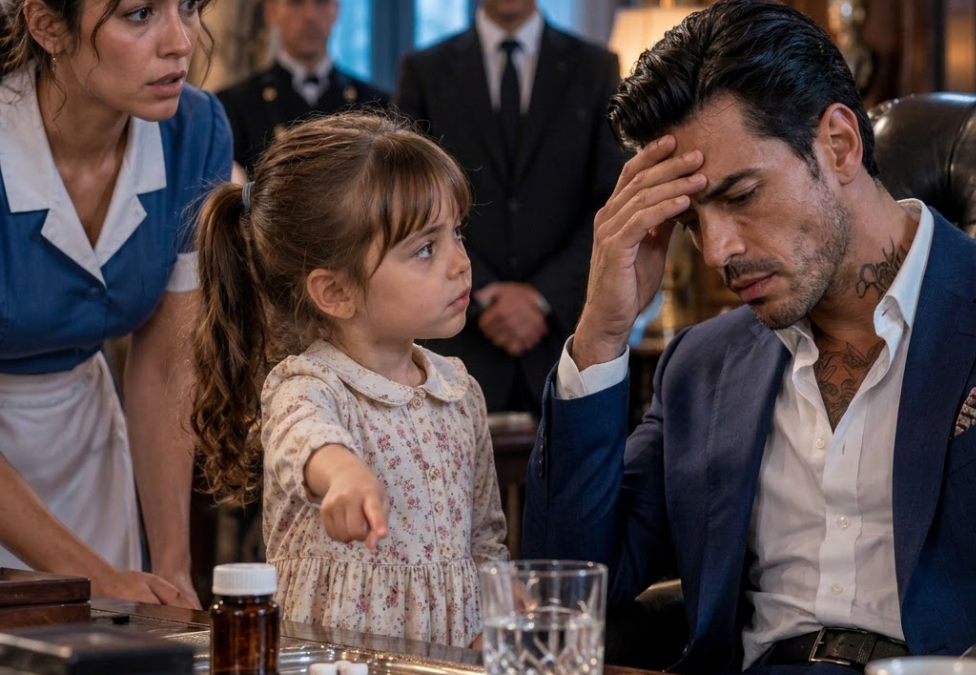
The remaining liquid had been analyzed by an independent laboratory. Nothing unexpected had been found.
Elena’s old access credential had turned out to be part of a flawed security migration rather than proof that she had entered the office.
Even the rose perfume led nowhere. By breakfast the following morning, the mansion had almost returned to its normal rhythm.
Staff crossed polished floors with trays and laundry baskets. Security shifts changed at the gates. Phones rang inside administrative offices.
The machinery of Alessandro’s life kept moving, and normality began doing what normality did best, making yesterday’s fear look embarrassing.
Sophia sat in the kitchen with her notebook buried beneath a mathematics workbook. She had not written in it since hearing the test result. Elena did not tell her to stop, but she did not encourage her either.
Her daughter had been carrying a kind of responsibility no 9-year-old should have carried, and part of Elena clearly hoped a negative test would let Sophia put it down. Upstairs, Allesandro tried to do the same. He had three calls before noon, two contract reviews, and a meeting concerning the port expansion.
Halfway through the second call, he paused while looking at a familiar name on a page and could not remember why it mattered. The blankness lasted perhaps 3 seconds, four at most.
Then the memory returned. The man owned warehouses near the eastern docks. Aleandro continued speaking without allowing anyone on the call to hear what had happened.
Afterward, he remained at his desk with the receiver still in his hand. Stress, he thought.
Sleep deprivation, too much caffeine, too much responsibility.
Dr.Raldi’s explanations sounded more persuasive now that a laboratory had failed to find anything in the glass.
They also made Aleandro angry, though he was no longer certain whether the anger came from pride or fear. At 11:30, Victoria entered carrying coffee in a folder.
She had abandoned the habit of bringing him water without asking.
“I assume this is still permitted,” she said, holding up the coffee.
“Depends.
Did you personally interrogate the beans?”
Twice. They refused legal representation.
“It was the first joke either of them had made since Sophia interrupted the meeting, and for a moment, the tension in the room loosened.
Victoria placed the cup on the far side of the desk and sat down.
How do you feel?”
Like everyone keeps asking me how I feel.
That is usually what happens when someone thinks he may have been drugged and wasn’t.
Victoria watched him carefully.
We don’t know that.
Allesandre looked at her. The test was negative. The test showed nothing unusual in that sample.
That is not the same sentence. He said nothing.
Victoria rested one hand on the folder.
I don’t want you frightening yourself and I don’t want a child frightened either, but I also don’t want us becoming stupid because one test gave us permission to relax.
It was exactly the kind of thing Alessandro himself might have said. That bothered him more than reassurance would have. What do you suggest?
He asked. You already had Dr.Raldi examine you. Have another physician review his findings independently.
If they agree you are exhausted, then perhaps we accept the boring answer.
And if they don’t, then we stopped calling it exhaustion.
Her logic gave Aleandro no obvious reason to distrust her. He almost wished it did.
Suspicion was easier when people behaved badly. That afternoon, Aleandro asked his attorney, Daniel Russo, to bring him every medical record generated during the previous 6 months.
Russo arrived carrying a secure digital archive and two paper folders from Dr.Raldi’s office.
“You’re reopening the medical question?”
he asked.
“I’m changing it.
” Allesandro set the laboratory report aside.
We keep asking what was in the glass? Russo waited. Wrong question.
Maybe. If nothing was in that glass, then what explains everything else? They began with dates rather than diagnosis.
Alessandro’s calendar was one of the most carefully maintained documents in the house.
Meetings, calls, departures, arrivals, even private appointments were logged because people around him needed to know where he was without asking him every 10 minutes.
Dr.Rinaldi’s reports looked ordinary at first.
Blood pressure, complaints of poor sleep, irritability, short-term memory disruption, recommendations to reduce workload. On paper, the progression seemed almost embarrassingly straightforward.
A powerful middle-aged man under chronic stress began showing signs of fatigue and cognitive strain. Russo read two reports and leaned back.
This is what he told you. Yes, and some of it happened.
Yes. Aleandro did not need to pretend otherwise. He had forgotten things.
He had become angry without understanding why. He had experienced moments when familiar objects seemed oddly distant.
If there was a conspiracy, it was parasitic on something real enough to be convincing. Russo opened a report dated 6 weeks earlier.
Private examination. 3:00 in the afternoon. Allesandro looked at the page.
Something in him tightened. Read the date.
Russo did. Alessandro turned toward his computer and opened his calendar.
At 3 that afternoon, he had been in the downstairs conference room reviewing environmental documents with Russo and two outside attorneys. The meeting had lasted from shortly after 2 until nearly 5.
Russo stared at the screen. I was there.
So was I. Could Raldi have seen you before the meeting and entered the wrong time?
Possible. Russo picked up his phone. I can ask his office for the appointment log.
Aleandro stopped him. Not yet. He read the report again.
It described him as unusually fatigued, confused about the date, and unable to recall the names of two scheduled visitors. Do you remember me being confused that day? Russo hesitated.
You were irritated. That is not unusual. No.
Did I forget who you were? Not unless you hit it exceptionally well.
Aleandro opened more records. Another examination supposedly occurred on a Thursday morning. His calendar showed no medical appointment, but that meant little.
Rinaldi frequently stopped by the mansion without being formally scheduled. A third report matched an actual visit.
A fourth was vague enough to have occurred almost any time. Nothing yet proved fraud. It proved paperwork was imperfect, which was hardly a revelation.
When Raldi finally received Alessandro<unk’s call, his explanation came easily.
My assistant enters final reports in blocks.
He said, “Sometimes the electronic system records the documentation time rather than the examination time.
If you are asking whether every time stamp reflects the precise minute I was sitting in front of you, probably not. The report says 3:00 in the afternoon, then I likely saw you earlier. When silence lasted only long enough for Raldi to search his memory without appearing evasive, I would need the raw schedule.
Alessandro, I see dozens of patients with you especially. Some visits are informal. 10 minutes in your office, a conversation after dinner.
You call me at night. I document what matters medically.
Did you examine me that day? If there is a report, yes.
Rinaldi sounded more offended than frightened. You asked me to keep an accurate record because you were concerned about your symptoms.
That was true. Aleandro had asked for documentation after forgetting an important meeting. Then send Daniel the raw appointment logs.
Aleandro said, “Of course.”
Rinaldi lowered his voice.
“Is this because of the child?”
“This is because I’m checking my own records.”
“Good.
Check them. But be careful about turning clerical mistakes into explanations simply because the real explanation frightens you.
Alessandro<unk’s expression hardened.
And what is the real explanation? You are under stress severe enough to affect sleep, judgment, and memory.
I told you that before anyone mentioned poisoning. The doctor did not retreat. You may dislike that answer.
Disliking it does not make it false. When the call ended, Russo looked at Aleandro. He has a point.
I know that was becoming the most irritating phrase in the entire investigation. By evening, certainty had moved farther away instead of closer.
The glass had tested clean. Elena had an alibi.
The access card anomaly had a technical explanation.
Dr.Raldi’s inconsistent time stamp had a plausible administrative explanation.
Aleandro began to understand how dangerous a weak suspicion could become once a man with power decided to feed it. He could investigate anyone in the house. He could search accounts, phones, rooms, histories.
Given enough scrutiny, everyone would eventually look suspicious. That did not mean everyone was guilty.
Downstairs, Sophia was sitting at the kitchen table while Elena prepared vegetables for dinner. Her notebook remained closed. Aleandro stopped in the doorway.
You haven’t written anything today.
Sophia looked embarrassed. Nothing happened. Nothing.
Nothing weird. Elena glanced at him, then went back to cutting carrots.
Allesandre walked in. That sounds useful.
Sophia shook her head. The test said I was wrong.
The test said the glass didn’t contain what we tested for.
That’s basically wrong.
Not necessarily.
Mom says I shouldn’t try to make things fit.
Elena immediately looked up.
I said, “Sometimes when we’re worried, we notice the things that agree with us and forget the ones that don’t.”
Alesandro considered that your mother is right.
Sophia’s face fell slightly.
So, I should stop. No, you should notice the things that prove you wrong, too. She stared at him.
He pulled out the chair across from her and sat. If you believe something, the dangerous part is not finding evidence for it.
The dangerous part is deciding every piece of evidence must support it. Sophia looked toward Elena, perhaps checking whether this was another adult way of telling her she had imagined everything.
“So, what am I supposed to do?”
she asked.
“Write what happens, not what you think it means.”
Sophia slowly pulled the notebook from beneath her workbook. Allesandro noticed a page near the back covered in fractions. You use this for homework?
I ran out of paper. He nodded at the page. Did you finish?
Mostly. Mostly means no. She turned the book around.
One problem had been crossed out repeatedly. Aleandro read it, took the pencil, and showed her where she had reversed the denominator. Sophia stared at the corrected answer, then at him.
You knew that fast. I did go to school.
I thought you had people for math. Elena made a sound that might have been a cough hiding a laugh. Alessandro handed the pencil back.
Finish your homework, he stood, then noticed Sophia had opened the notebook to a page from several weeks earlier. There was an entry about him correcting one of her mathematics problems at the kitchen table. Nothing remarkable.
She had written it because on the same day, she had overheard someone upstairs saying he was too confused to finish a conversation. Alessandro stopped.
“What date is that?”
Sophia read it aloud. He knew the date immediately.
Russo had shown him a medical report from that evening. Dr.Raldi described Alessandro as disoriented, struggling to concentrate, repeatedly losing track of simple questions. Yet, less than 2 hours after the documented examination, Allesandro had sat in this kitchen and walked Sophia through fractions without difficulty.
That did not prove the report false. Symptoms could come and go. Fatigue could improve, but it gave Allesandro a new way to look at the problem.
Not whether Sophia’s notebook proved someone was drugging him.
Whether the official record of his decline matched the life other people had actually witnessed.
Russo returned after dinner when Dr.Raldi’s office finally transmitted what it described as the complete appointment history.
Alessandro and Russo compared it with the medical reports one line at a time. The first inconsistency could be dismissed. The second might be clerical.
The third was harder. A report described an in-person neurological assessment on a Monday for which there was no visit.
No entry at the gate, no physician vehicle on exterior cameras, no call from Raldi’s registered office number, and no appointment in either calendar.
Russo checked again. Maybe he came with someone else. Then he still had to enter the property.
They moved to the next questionable report. Same problem. Medical notes existed.
The corresponding appointment did not.
Another report contained detailed observations about Allesandro<unk’s speech, posture, and orientation on a morning when Alessandro had been outside the state until early afternoon.
Russo sat back slowly.
“That’s not a timestamp error,” Aleandro said nothing.
Someone wrote an examination that couldn’t have happened or documented observations from another time without saying so.
“Yes,” Russo opened the raw file metadata.
The reports had not all been written on the dates printed at the top. Several were created days later, then assigned earlier examination dates.
That could still have an innocent explanation if Raldi documented visits late, but two reports referred to meetings that did not exist anywhere else. Alessandro felt something settle inside him. Not certainty yet, but direction.
The clean glass no longer mattered as much. Maybe Sophia had been wrong about the drink. Maybe the glass was only where her attention had landed because the changes often happened around the same time.
But someone had been constructing a medical history in which Alessandro Moretti appeared more impaired, more confused, and more consistently unstable than the records of his actual movements could support. He turned back to the first disputed report.
Stop asking Raldi for explanations. Russo looked at him.
What do you want instead? Alessandro closed the folder.
Everything. Original appointment logs, drafts, file creation dates, billing records, messages between his office and this house.
No summaries. Russo nodded slowly.
“You think the medical record is the real evidence?”
Allessandre looked toward the kitchen floor below them, where a 9-year-old girl had spent weeks writing down what happened because she did not trust herself to remember it perfectly.
“I think someone else has been writing things down, too.”
The raw records arrived in pieces because no single system inside Dr.Raldi’s practice stored the full history Alisandra wanted.
Appointment schedules came from one server, billing records from another, pharmacy authorizations from a third. Daniel Russo spent most of the morning building a timeline across three screens while Alessandro worked through the original medical reports with a yellow pencil, marking every place where the official version of his decline depended on an event no one could independently verify.

