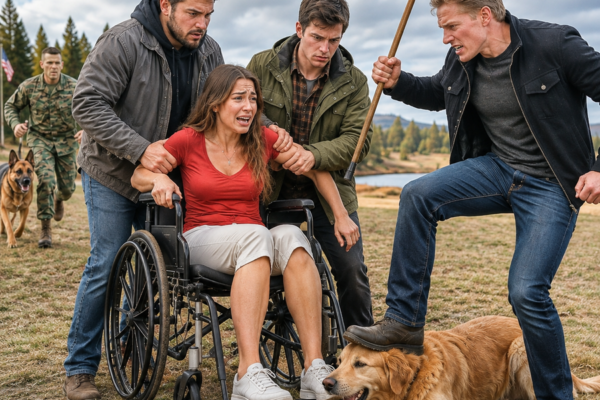
“Nobody Will Help You” They Humiliated Her at Work — Until a Navy SEAL & K9 Changed Everything
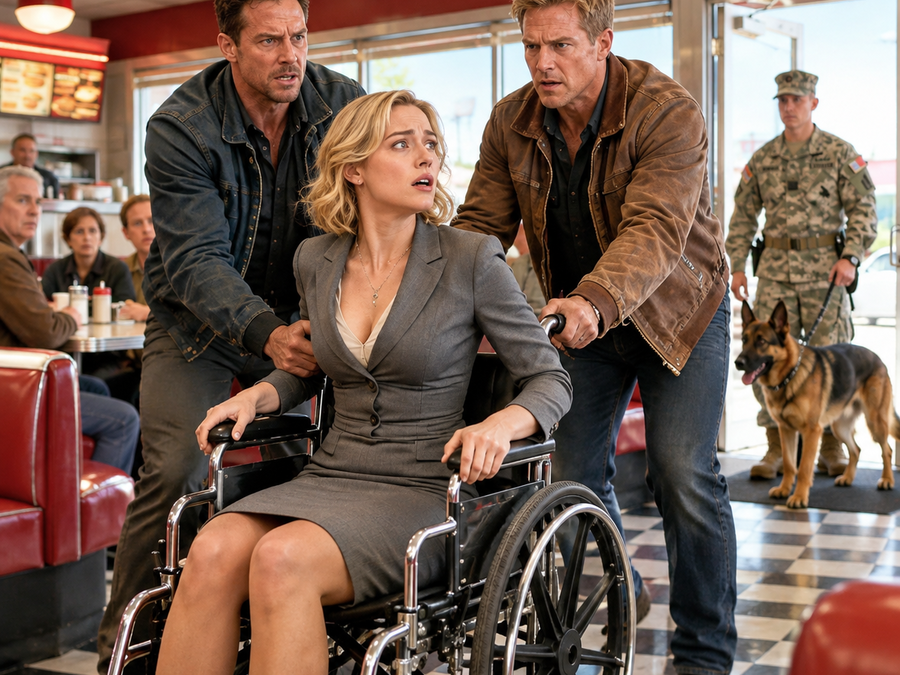
“Nobody Will Help You” They Humiliated Her at Work — Until a Navy SEAL & K9 Changed Everything
She sat alone at that table, humiliated, trembling, while 30 people stared at their phones and pretended not to see.
He moved her wheelchair like she was furniture. He laughed, and every single person in that room let it happen.
But the elevator doors hadn’t opened yet.
And the man stepping out with a German Shepherd at his side and three combat tours behind his eyes, he wasn’t going to look away.
What happened next destroyed a powerful family, exposed a decades-long lie, and proved that the most dangerous person in the room is never the one making the most noise.
The thing about West Haven is that it looked like a city that had figured things out.
Glass towers, clean streets, coffee shops where people typed on laptops and talked about disruption and innovation and quarterly projections.
From the outside, from the highway, from an airplane window, from a marketing brochure, it looked like a place where the right people rose to the top through talent and hard work.
Ava Barnett had believed that once.
She wasn’t sure she believed it anymore.
Well, she arrived at the Viridian Technologies building at 7:43 every morning. Not because her contract required it, not because anyone told her to, but because arriving early meant the elevator was empty, the corridors were quiet, and she had 12 uninterrupted minutes to set up her workspace before the building filled with people who made her feel like a problem to be managed.
The lobby was marble and glass and ambient lighting.
A security guard named Otis, a heavy-set man in his 50s who always smelled faintly of black coffee, greeted her the same way every day.
“Morning, Ms.Bennett.”
“Morning, Otis.”
That was usually the warmest she had before noon. She wheeled herself across the polished floor toward the elevator bank, her chair humming softly against the marble, and pressed the button for the 14th floor.
The doors slid open. She rolled inside.
The doors closed. For 32 seconds, she was alone, and it was fine.
Ava had been 23 months at Viridian.
She’d come in at the junior analyst level, which at a company like this meant you were either invisible or exploited, sometimes both.
She’d spent the first 4 months quietly learning every system, every reporting structure, every spreadsheet architecture the team used.
By month six, she was catching errors in quarterly projections that cost the company money when they went unnoticed.
Her supervisor, a nervous woman named Carol Fitch, had forwarded her corrections upward without attribution more than once.
Ava noticed. She said nothing.
She was building something, a record, a foundation.
You don’t fight a battle you’re not ready to win.
That philosophy had carried her through a lot.
It had carried her through 3 years of physical therapy after the accident, a highway collision that she didn’t cause and couldn’t have prevented, which had compressed her T6 vertebrae in a way that three surgeons said was permanent.
Paraplegia.
No recovery timeline.
No silver lining handed to her. Just a new reality and the choice of what to do with it.
She’d chosen this.
A finance degree, two internships, one brutal licensing exam, and a job at one of the most competitive technology firms in the northeast. She was 20 years old and better at her job than most people twice her age, which made it all the worse, the way certain people in that building looked at her.
Ethan Voss arrived at 9:15, which was 32 minutes after he was scheduled, which was how he arrived every day, because Ethan Voss did not experience consequences the way normal people did.
His father, Richard Voss, sat on the board of three companies, two of which had financial ties to Viridian.
Ethan’s presence at the company was less a career move and more an extended performance, a way of showing up somewhere impressive enough to put on a resume while doing as little actual work as possible.
He was 26.
He had the build
of someone who spent significant money on personal training and the instincts of someone who had never once been truly held accountable for anything. Caleb Mercer was different in that he was slightly smarter and significantly more cowardly.
He followed Ethan the way certain fish follow sharks, not out of loyalty, but out of a biological calculation that proximity to power was the safest place to swim.
He laughed at Ethan’s jokes a half second after Ethan started laughing, which was the tell.
Together they occupied a corner suite on the 14th floor that nobody else had the political capital to complain about, and they treated the open areas, the kitchen, the cafe, the conference rooms, like personal property.
Ava had clocked both of them in her first week.
She’d kept her distance methodically, different lunch hours, different routes between floors.
She wasn’t afraid of them exactly.
She’d learned to metabolize fear into strategy years ago, but she understood what they were.
She’d seen the type.
Men who mistook entitlement for authority and cruelty for confidence.
Men who identified the weakest looking person in a room and chose them specifically.
She had been careful.
But you can only be so careful. It was a Tuesday in late October when it finally broke open.
The company cafe on the 14th floor was a long open plan room with floor-to-ceiling windows on the east side, small tables arranged in clusters, and a service counter where a barista named Priya made coffee with the focused professionalism of someone who decided that if she was going to do this job, she was going to do it right.
Ava was at a corner table near the windows.
She had a half-eaten turkey sandwich, a cold coffee, and her laptop open to a discrepancy she’d found in the third quarter infrastructure budget.
A line item that didn’t align with the vendor invoices she’d cross-referenced the night before.
She was circling it, tracking it backward through 3 months of entries.
She wasn’t thinking about Ethan Voss.
She probably should have been.
He came in with Caleb and two other men she didn’t recognize, uh visitors from the look of their guest badges.
One of them was older, silver-haired, the kind of man who wore expensive suits the way other men wore skin.
They were mid-conversation, Ethan in the center of it, doing that thing he did where his voice was calibrated just loud enough to be heard across the room without technically being a disruption. Ava registered them, made a small internal note, and went back to her laptop.
Then Ethan saw her.
She felt it before she saw it.
That shift in the room’s energy, the way the temperature of a conversation changes when someone spots a target.
He steered his group toward the tables. They settled two clusters away.
Close.
Ava didn’t look up.
“Telling you the junior team doesn’t know what they’re doing.”
Ethan was saying, his voice sliding into that performative casualness he used when he was performing for an audience.
“Half these kids got hired through diversity initiatives.
Nothing against that, but you want someone who actually earned their seat.
” Caleb murmured something appreciative.
Ava kept her eyes on her screen.
“Like, look.”
Ethan again. The group shifted.
She could feel their attention now vectoring toward her.
“We’ve got people here who can barely move through the building on their own.
How are they supposed to keep up with the pace of this company?”
Silence from his audience. The kind of silence that meant they were uncomfortable, but not uncomfortable enough to say so.
Ava’s hands were very still on her laptop.
Don’t react.
Don’t give him the scene he wants.
You have work to do, and he is not worth the documentation you’d have to file afterward.
She began slowly packing up. Methodical.
Unhurried. She was not going to look like she was fleeing.
That was when Ethan stood up.
He walked over.
Not to talk to her.
Not to introduce himself to the silver-haired visitor as a coincidence.
He walked directly to her table, looked at her wheelchair for a beat with an expression that was not quite a smile, and moved it.
Just reached out and grabbed the handle at the back and moved it.
Not far, just enough. A foot, maybe less.
So that the angle between the chair and the table shifted, and she had to recalibrate, had to adjust, had to be reminded that the chair could be moved by someone who chose to move it.
A simple, low-cost cruelty. The kind that leaves no mark.
“Sorry,” he said, not sounding sorry at all.
“Didn’t realize you were parked there.”
Parked. Someone at a nearby table made a sound, halfway between discomfort and stifled laughter.
Caleb was already grinning.
The silver-haired visitor looked briefly at the ceiling.
Ava looked at Ethan.
She kept her face neutral, the way she had trained herself to keep it neutral. The technique her old physical therapist had called the anchor, a way of finding the still point under the current.
She had used it through pain. She could use it through this.
“I wasn’t in your way,” she said.
“No, you’re good.”
He was already half turning back, dismissive, already minding the reaction from his audience.
Just making space. He went back to his table.
Ava breathed once through her nose, finished packing her laptop bag, reached for her coffee cup, and found her hand wasn’t entirely steady, which she hated.
She hated that her body gave him that.
She moved toward the cafe exit.
Then Ethan Voss, in front of witnesses and guests, and the barista who was watching with tight eyes from behind the counter, stepped to the side and placed his chair directly in her path.
Not aggressively, casually, like he’d just happened to pull his chair back at that moment.
But he was watching her.
“Oops,” he said.
The cafe was not loud.
It wasn’t loud enough to cover the laughter from Caleb.
Ava stopped.
Around her, she was acutely aware of people looking at their phones, at their food, at literally anything that wasn’t her face.
30 adults in a modern corporate cafe, and not one of them, not one, said a word.
She had been in this moment before.
The moment when you calculate the cost of speaking against the cost of silence, and the numbers don’t come out cleanly either way.
She was calculating now. And then the elevator doors opened.
She heard the sound before she saw him. Not the doors themselves, the change in the room.
The slight collective reorientation of attention, the way a crowd suddenly shifts when someone enters who occupies space differently than everyone else. She turned.
The man who stepped out was not tall in the flashy way.
He was 6’1, maybe 6’2, built lean and solid in the way that comes from use rather than vanity.
The kind of body that was constructed for function, and had just stopped apologizing for that.
He was wearing dark jeans, a plain charcoal Henley, a worn-in jacket with a small USMC emblem on the chest that was faded enough to be accidental. His hair was short.
His jaw needed a shave, and his left side, moving in perfect synchronization with him, was a German Shepherd.
The dog was extraordinary, not in a decorative way, in the way that a well-calibrated piece of equipment is extraordinary. Jet black with tan markings, vest marked, lean and muscled, with ears that moved independently of each other, and eyes that were processing the room at a speed that made most of the humans in it look slow.
The dog’s name was on his vest in white lettering, Shadow.
The man’s name wasn’t on anything.
He didn’t need it to be.
He stopped three steps into the room, scanned left to right, efficient, practiced, the kind of visual sweep that doesn’t look like what it is to people who don’t know what to look for.
His eyes passed over Ethan’s group, passed over Caleb, landed on the obstacle in the middle of the room, landed on her.
She saw something shift behind his eyes. Not pity.
She would have turned her wheelchair around for pity. Something quieter.
Something that looked like recognition. Shadow had stopped, too.
The dog’s ears had lifted.
He was watching Ava with an attention that seemed disproportionate, given that they’d never met.
The man took two steps forward.
“Are you all right?”
he said.
His voice was level, not loud.
He wasn’t projecting for the room.
He was asking her specifically.
“I’m fine.”
she said. Automatic.
The answer she always gave. He looked at the chair Ethan had placed in her path.
Looked at Ethan. Looked back at her.
“That chair was moved.”
he said.
Not a question.
From behind her, Ethan’s voice, “Hey buddy, this is a private company facility.
Who are you?”
The man didn’t turn around immediately.
He kept his eyes on Ava for one beat longer, like he was finishing the conversation she hadn’t started, and then he turned.
“Nathan Walker.
I have a meeting with your head of corporate security at 10.”
He held up his visitor badge without making a production of it.
“And I asked the lady a question.”
Ethan stood up.
He was accustomed to standing up, making people recalibrate. He had height.
He had money. He had a last name that moved rooms.
He stood up and looked at Nathan Walker in his worn jacket and his faded emblem, and he made a decision. The wrong decision.
“She’s fine.”
Ethan said.
“We were just having a conversation.
There a problem?”
“The chair’s in her way.”
“The chair’s where it is.”
Ethan smiled. The practice smile.
“And again, who exactly are you, man?
You some kind of escort?”
He said the word with just enough inflection to make it mean something else.
The room held its breath.
Nathan Walker didn’t move.
His hands stayed loose at his sides. Shadow sat, not out of disinterest, but with the coiled patience of an animal who understood that sitting was a choice.
“Move the chair.”
Nathan said. Three words.
Nothing in his voice that could be called threatening. Nothing that gave Ethan a legal angle, a complaint to file, a performance to weaponize.
Just three words and two eyes that had seen things in rooms much darker than this one. Ethan looked at Caleb.
Some communication passed between them.
The shorthand of cowardice dressed as confidence.
Then Ethan moved.
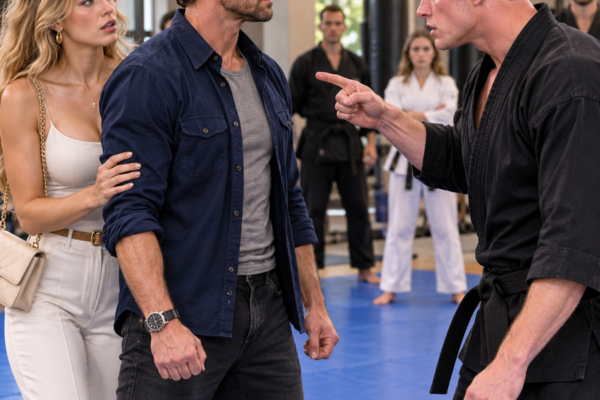
Not toward the chair, toward Ava. He grabbed the handle of her wheelchair.
Her chair, the one she was sitting in, and said with a grin, “Maybe I’ll just park her somewhere else.”
He never finished the motion.
What happened next took less than 4 seconds.
Nathan crossed the distance.
Not running, not rushing, moving with the kind of compressed efficiency that only comes from doing it in the dark under stress.
And his hand closed over Ethan’s wrist.
Not violently, precisely.
He applied torque in the exact amount required to stop the motion without escalation, creating distance between Ethan’s grip and the chair handle without throwing anyone to the ground, without a strike, without anything that looked like what it was to someone who didn’t know what they were watching.
Ethan stumbled back one step.
More from shock than force. The room went completely silent.
Shadow had not moved.
He was sitting in the same spot, but his eyes were fixed on Ethan with an attention that said, “I am sitting because I was told to sit.
I’m not sitting because I am not concerned.”
Ethan stared at his own wrist, then at Nathan.
Something passed through Ethan Voss’s face.
Something that was not quite fear, but was adjacent to it. The thing you feel when you suddenly realize the distance between who you thought you were and what is actually happening.
He straightened his jacket.
“You just assaulted me,” he said.
His voice had changed. The performance was gone.
This was real calculation now.
“You’re done.
You’re done in this city.”
Nathan looked at him for a moment.
“I stopped you from touching someone who didn’t want to be touched,” he said.
“If that felt like an assault, that tells me something about you.”
He turned back to Ava.
You okay?
She realized she’d been holding her breath.
She let it out.
Her hands were steady now. The strange steadiness that comes after the worst thing actually happens and it turns out to be survivable.
Yeah, she said.
Yeah, I’m okay.
Nathan nodded once and then Ethan Voss pulled out his phone.
He made a call in full view of everyone in the room and the first thing he said into it was not a name.
It was Dad.
Priya behind the counter had gone very still.
She had her own phone in her hand and she had been recording for the last 90 seconds.
But she didn’t know yet what Ethan’s father would do with a lawyer and a PR team and 72 hours of head start.
She didn’t know yet what a 60-second clip missing the first 4 minutes could make the world believe.
None of them did.
Not yet.
Ethan’s voice carried across the cafe like he wanted it to.
Low and controlled and meant to be overheard.
Dad. Yeah.
I need you to make some calls.
There’s a situation.
He didn’t say what kind of situation.
He didn’t have to.
The word calls was doing all the work.
It implied machinery, leverage, a network of favors and debts and relationships that ordinary people didn’t have access to.
It was a performance for the room.
A reminder of what he was connected to and what that meant for anyone who’d just crossed him.
Nathan stood with his back to Ethan and his eyes on the middle distance and he looked like a man waiting for a bus.
Unhurried, unimpressed. Which was either the bravest or the most dangerous thing in the room depending on your perspective.
Ava watched Ethan on the phone and felt something cold settle in her stomach. Not fear exactly.
More like the feeling you get when you recognize a weather pattern.
When you’ve seen this guy before and you know what kind of storm it produces.
She had been here for 23 months.
She had learned the topology of this company’s power the way you learn a road you drive every day.
PART 2
Not consciously but in your body, in your instincts. And what she knew with the certainty of someone who had quietly mapped every hierarchy in the building was that Ethan Voss calling his father was not the end of something.
It was the beginning.
Then buzz. She left the cafe before Ethan finished his call.
She didn’t say goodbye to Nathan Walker.
She wasn’t sure what she would have said.
He was still standing near the window when she wheeled past.
Shadow watching her go with those amber eyes that seemed to process information on a frequency humans didn’t have access to.
Nathan gave her a small nod as she passed. Not a good luck nod, more of a I see you nod.
And she kept moving. The elevator was empty.
She pressed 14.
The doors closed.
In the quiet of the ride down, she pulled out her phone and opened the incident reporting portal that Viridian’s HR department maintained.
She’d looked at it before, twice, in the early months when Ethan and Caleb had made comments she couldn’t prove in the way the portal required.
The form asked for dates, times, witnesses, documentation. It asked for specificity in a format that felt designed to make you question whether what happened to you was real enough to report.
She stared at the blank form.
Then she put her phone away.
Not because she was giving up, because she was thinking. On the 14th floor, her desk was in the open plan section near the east windows.
Good natural light, which she’d fought Carol Fitch for during her second month, citing productivity studies, until Carol had moved her without further argument.
It was one of the few battles she’d won cleanly.
She sat down, opened her laptop, and tried to go back to the infrastructure budget discrepancy. The numbers blurred.
She closed the spreadsheet, opened it again, read the same line item four times.
Across the open floor, she could hear Caleb Mercer talking to someone near the printer. Not quite loud enough to make out words, but with a cadence that meant he was telling a story.
She heard her own name once, or thought she did. She put in her earbuds without music, just the physical barrier of them.
An hour passed, then another. She found the discrepancy again, a vendor payment logged twice under different project codes.
Not an accident, she was increasingly sure, but a pattern.
And she was documenting it when Carol Fitch appeared at the edge of her desk, like someone who’d been practicing the approach.
Carol was 42, efficient, cautious in the way of someone who had calculated exactly how much ambition was safe to display, and had settled precisely there. She dressed in careful neutrals.
She had the slightly tightened expression of someone who had heard something and was trying to decide how much it was her problem.
“Do you have a minute?”
she said.
Ava took out one earbud.
“Sure.”
Carol sat in the spare chair and folded her hands on the desk with a deliberateness that said she’d thought about this.
“I heard there was an incident in the cafe this morning.”
“Yes.”
“Do you want to tell me about it?”
“Ethan Voss moved my wheelchair twice and blocked my exit.
A visitor intervened.
Ethan called his father.”
She kept her voice even, factual.
“That’s the summary.”
Carol was quiet for a moment.
“And the visitor?”
“The man with the dog?”
“Nathan Walker.
” “He was here for a security meeting.”
“Right.”
Carol looked briefly at her own hands.
“Ava, I want you to know that I take this seriously.
But a pause.
But the situation is complicated.
Ethan’s family has a significant relationship with the company, and if this becomes a formal complaint, there are processes that need to be followed carefully.
And “Carol.
” Ava kept her voice level.
“Are you asking me not to file a report?”
“I’m asking you to consider the full picture.”
“The full picture.”
Ava looked at Carol Fitch’s careful neutral expression, and she thought about the 10 people in that cafe who had looked away.
She thought about the form on the Viridian portal with its demand for documentation.
She thought about Ethan Voss on his phone saying, “Dad.”
“I’ll consider it,” she said.
Carol nodded, stood, and left.
Ava watched her go.
Then she put her earbud back in and went back to the spreadsheet.
The vendor discrepancy was still there.
She started a new document and began making notes.
So, Nathan Walker’s meeting with the head of corporate security lasted 40 minutes.
He knew this because he tracked time the way he’d been trained to track it.
Not by checking his watch, but by the internal clock that 6 years in the Marine Corps had calibrated to a precision his therapist once told him was a useful adaptation that also makes it very hard to be present.
She hadn’t been wrong.
He was acutely aware of every minute passing in the conference room while Marcus Hale, Viridian’s head of security, walked him through the proposal that had brought him here.
The proposal was a security assessment. Viridian wanted an outside eye on their executive protection protocols.
Nathan had built a small consulting practice on exactly this.
Post-military, practical, no-frills.
He wasn’t famous.
He wasn’t expensive in the way the big firms were expensive, but he was precise.
And in security work, precision was the thing that actually mattered.
“We’ve had three incidents this year where executives have felt personally threatened,” Marcus Hale was saying.
He was a solid, competent-looking man in his late 40s who had the manner of someone who’d worked corporate security long enough to have lost the sharper edges that real threat environments produce.
“Nothing violent, but the threat landscape is changing, and the board wants an external assessment.”
“What kind of threats?
Digital, physical, targeted?”
“Mix of all three.
Some online harassment that escalated to in-person contact. One executive received what turned out to be a credible threat from a former employee.
We handled it, but the board wants to make sure our protocols are where they need to be.
Timeline for the assessment? 30 days.
Full access to the building, the security team, the existing protocols. We can discuss compensation parameters.
I’ll need to walk the building first.
Nathan said, “Not a formal tour, just a walk.”
Hale nodded.
“I can arrange that.
” Today works?
Another nod.
The meeting resolved itself into logistics, contact points, access credentials, and D as that Nathan’s attorney would need to review.
Standard. He signed what he could sign immediately and pocketed the rest.
When he left the conference room, Shadow fell into step beside him automatically, and they moved down the 14th floor corridor toward the elevator bank. He was not thinking about Ava Bennett.
He was thinking about the layout of the floor, egress points, camera placement, the blind spots he’d already mentally cataloged during the 40-minute meeting through a window in the conference room door.
He was thinking about the gap between what a corporate security team believed was covered and what actually was.
He pressed the elevator button.
And then he was thinking about Ava Bennett.
The specific way she’d said, “I’m fine.”
Automatic, practiced, the voice of someone who’d said it so many times it had lost contact with whatever she actually felt.
He recognized it because he’d said it that way himself.
Still did, sometimes.
He was also thinking about Ethan Voss’s face when the wrist lock stopped him.
Not the shock of it, the specific quality of the shock, the way it flickered into something calculating before it finished being surprised.
That was the tell.
Most people, when something unexpected stops them, are just surprised.
They process it, they react emotionally, they course correct. Ethan Voss had moved through surprised and into what can I use this for in under 2 seconds.
That meant he’d done versions of this before.
It also meant he’d gotten away with them.
The elevator arrived.
Nathan stepped in, pressed the lobby button, and spent the ride down doing what he always did when he had 30 seconds and nothing to manage. Running the scenario again.
Looking for what he’d missed.
He hadn’t missed much.
But the phone call bothered him.
Dad.
The way Ethan had said it. Not as a distress call.
Not as an explanation. As a deployment.
The video went live at 2:17 in the afternoon. Ava was still at her desk when she saw it first.
Not from the notification, because she didn’t follow any of the accounts that shared it.
She saw it because her colleague Jasmine, two desks over, made a small sound and turned her monitor to show her.
“Ava,” Jasmine said, “you need to see this.”
The clip was 43 seconds long.
It had been uploaded by an account with a name like a news aggregator.
The kind that sounds legitimate, but has no actual journalism behind it. The footage was from the cafe.
Security camera angle, slightly overhead, slightly grainy, timestamp visible in the corner. But the timestamp started at 10:14.
The incident had started at 10:09. 5 minutes missing.
What the video showed. Two young men sitting at a table, a conversation, a man entering with a dog, the man approaching.
What looked from the angle like an aggressive confrontation.
Nathan’s movement toward Ethan appeared without context.
Appeared without the preceding 5 minutes of harassment. Appeared as exactly what Ethan would have wanted it to appear as.
An unprovoked physical confrontation by a stranger against two employees in their own workplace.
The caption read, “Marine veteran assaults employees at West Haven tech firm.
Video emerging now.
No word yet from company or police.”
43 seconds. Already 11,000 views.
Ava stared at the screen for a long moment.
Her face was very still.
“Someone edited it,” Jasmine said quietly.
I know.
Ava, I know.
She looked at Jasmine.
Jasmine was 24, kind, the kind of person who sent you links to articles about workplace wellness and meant it genuinely.
She was looking at Ava now with that particular expression, the one that said, “I believe you and I don’t know what to do about it simultaneously.”
Which was, in Ava’s experience, the most common expression she saw on people’s faces in difficult moments.
Who has that security footage?
Ava asked.
Building security.
Marcus Hale’s team.
Marcus Hale, who is currently in onboarding meetings with Nathan Walker.
Jasmine blinked. Right.
Ava opened a new tab and looked up the original video link.
The account had posted twice before. Both clips were the kind of content that circulated in workplace grievance communities, both times presenting incomplete footage as a complete narrative.
The account was 2 months old.
She took a screenshot, noted the timestamps on both prior posts, noted the posting pattern.
Then she picked up her phone and called Nathan Walker.
He answered on the second ring. Walker.
It’s Ava Bennett from this morning.
A beat. I know who you are.
There’s a video circulating online, 43 seconds of cafe footage that starts 5 minutes after the incident actually began.
It’s the framing is not good for you.
Silence on his end.
Not surprised silence, more like someone who’s received confirmation of something they were already calculating.
How many views?
She checked. 14,000.
It’s moving fast.
Another pause.
She heard him exhale once, the controlled kind.
Okay. He said.
Just that.
Okay.
That’s all you’ve got?
She said.
What do you want me to say?
I don’t know.
Something more than okay.
I’ve had worse situations than a bad video, he said.
What I need to know is whether you’re planning to stay quiet about this or not.
The directness of it landed differently than she expected.
Most people in his position would have asked her to speak up, would have phrased it as a request wrapped in gratitude. He was just asking where she stood.
“I’m not planning to stay quiet,” she said.
“Then I’ll need whatever documentation you can get.”
“I’m working on it.”
“Good.”
Another beat.
“You doing all right?”
She almost said I’m fine again.
She caught it.
“No,” she said, “but I’m working.”
“That’s the same thing most of the time.”
She didn’t answer that.
They hung up.
By 5:00, the video had 140,000 views and a comment section that was doing what comment sections do.
Taking the visible surface of a story and building the most convenient narrative on top of it. The narrative being built was not friendly to Nathan Walker.
Veteran loses it on employees. This is why they need better reintegration programs.
Where’s the company statement?
Protect your workers. That dog looked aggressive, too.
Who lets animals into corporate spaces?
Ava read the comments for 3 minutes, long enough to understand the shape of what was happening.
Then she closed the tab because reading further was not useful and she had limited attention to spend. She was still at her desk at 5:45 when most of the floor had cleared out.
The overhead lights had shifted to their evening setting, dimmer, cooler, the kind of light that makes a room feel slightly abandoned.
She had four documents open and was moving between them in a rhythm that people sometimes mistook for manic behavior, but was actually just the way she worked when she was building something.
The first document was her incident notes, timestamped, specific, written in the formal language she’d learned from reading through previous Viridian HR cases she’d accessed through the company’s internal knowledge base.
The second was her research on the video account.
The third was a list of names.
Every person she’d been able to identify who was in the cafe between 10:09 and 10:18 using badge scan records she had access to through the financial systems that tracked building resource usage.
The fourth was the vendor discrepancy she’d been working on before everything else happened because she hadn’t been able to stop thinking about it.
And she’d learned to trust that.
Her phone buzzed.
Unknown number, West Haven area code. She answered.
Ms.Bennett? The voice was male, older, with the specific texture of authority that came from decades of having people defer to it.
My name is Richard Voss. I think we should talk.
The floor was empty.
The lights were low.
Outside the east-facing windows, West Haven was moving into its evening colors, orange and gray and the first blue of dusk.
Ava felt the cold thing settle in her stomach again.
She kept her voice completely steady.
“Mr.Voss,” she said, “I I was wondering when you’d call.”
A pause.
She’d surprised him.
She could hear it in the half beat before he recovered.
“I think there’s been a misunderstanding this morning,” he said.
“And I’d like to discuss how we might resolve it in a way that works for everyone.”
“A misunderstanding,” she repeated.
“My son is impulsive.
He doesn’t always think before he acts.
I want you to know I take this seriously.”
The words were right.
The structure of them was right.
Apology adjacent without committing to an apology. Concern performing without conceding liability.
She recognized the architecture.
She’d read enough legal filings in her research habits to know what accountability avoidance sounded like when it was dressed up in the vocabulary of resolution.
“What kind of resolution are you proposing?”
she asked.
“I think we could find something that compensates you appropriately for the stress of this morning.
And perhaps in exchange, we could agree that the situation is best kept from escalating further for everyone’s benefit.”
There it is.
He’d moved faster than she expected, which told her something.
He wasn’t calling to apologize.
He was calling to contain, and he was calling her first before lawyers, which meant either he was confident she was manageable or he was trying to assess whether she was before deploying heavier machinery. She made a decision.
“I appreciate the call, Mr.Voss.”
she said.
“I’ll need to think about what you’ve said.”
“Of course.
Take your time.
I just want everyone to walk away from this in a good place.”
“I understand.”
she said.
“Good night.”
She hung up.
Then she opened a sixth document and typed a full verbatim account of the conversation, time-stamped, including every word she could recall from both sides.
She’d learned something critical in the last few hours.
The thing Ethan Voss’s father feared most wasn’t a lawsuit.
It wasn’t public attention.
Those were manageable problems with known solutions.
What he feared was a record, because a record was the one thing money couldn’t retroactively eliminate.
She was almost at the elevator when she heard footsteps behind her. Not Ethan.
Ethan had left at 3:00.
She’d noted it through the glass wall of his suite on one of her circuits around the floor.
Not Caleb, who’d been gone since 4:30.
It was a man she didn’t recognize, mid-40s, gray at the temples, wearing a viridian lanyard over a sport coat.
He moved with the efficiency of someone who had somewhere to be and had decided that being somewhere else first was an acceptable delay.
He stopped when he reached her. Not aggressively.
Just stopped and looked at her with an expression she couldn’t categorize immediately.
“You’re Ava Bennett.”
he said.
“Yes.”
“I was in the cafe this morning.”
he said.
“I’m Marcus Hale.”
She looked at him.
He was Nathan’s contact, the head of security.
“I know who you are.”
she said. He glanced toward the elevator, then back.
He had the look of someone running internal calculations.
“There’s a second camera,” he said, “in the cafe near the conference room corridor.
Most people don’t know about it because it was installed during a renovation 2 years ago and the documentation got filed under a different project.
” He paused.
“It has a different angle than the one that got posted online.”
Ava was very still.
“What does it show?”
she said.
He looked at her for a long moment.
“Everything,” he said.
And then his phone rang and he looked at the screen and something shifted in his expression. A tightening, a recalibration.
“I have to take this,” he said.
“I’m sorry.”
He stepped away and lifted the phone to his ear and as Ava pressed the elevator button and waited, she heard just the first four words before the doors opened and swallowed the sound.
She heard him say, “Yes, Mr.Voss, I understand.
Continue.”
The elevator doors closed and Ava stood inside the empty car and listened to the hum of the cables and thought about four words.
“Yes, Mr.Voss.
I understand.”
The way Hale had said them, not the words themselves, but the particular quality of resignation underneath them.
The sound of a man recalibrating in real time told her something she needed to know.
Marcus Hale was not Richard Voss’s man.
He was becoming Richard Voss’s man, which was different and the difference mattered because it meant there was still a version of him that hadn’t fully committed.
PART 3
She had maybe a narrow window before that version closed.
The lobby arrived. She wheeled out into the marble quiet of the after-hours building past Otis at the security desk.
He nodded, she nodded back, the ritual of it briefly grounding. And out through the glass doors into the October air, which had turned cold and tasted like rain coming.
She sat in the parking structure for 11 minutes before she called Nathan.
“Hale knows about a second camera,” she said when he picked up.
“Different angle than the one posted online.
He said it shows everything. When did he tell you this?
6 minutes ago, right before he took a call from Richard Voss.
A pause.
She could almost hear Nathan processing it.
The specific quality of his silences was something she was already learning to read, which was strange given they’d spoken for a total of maybe eight minutes across two phone calls.
So, Hale found his conscience and then immediately found out it was inconvenient, Nathan said.
That’s one way to put it.
You think he’ll bury it?
I think he hasn’t decided yet.
Which means we have less time than I’d like.
What do you need from me?
She’d been thinking about that in the elevator.
Nothing tonight.
Tomorrow I need to know if you have any documentation of the security meeting, emails, the agenda, anything that puts you in that building for a legitimate purpose before any of this happened.
I’ve got the original inquiry email, the meeting confirmation, the NDA I signed, all time-stamped.
Good.
Don’t delete anything, don’t post anything, don’t respond to the video.
I wasn’t planning to.
I know, she said.
I’m saying it anyway.
A beat of quiet. Outside the parking structure, she could hear the first drops of rain beginning on the concrete ramp.
Why are you doing this? he asked.
Not suspiciously, genuinely. She thought about that for a second.
Because the right thing to do is usually inconvenient, she said.
And I’m tired of watching inconvenience be the reason people don’t do it.
He didn’t respond immediately.
When he did, his voice had shifted slightly.
Not warmer exactly, but less guarded.
I’ll have everything organized by 8:00 tomorrow morning, he said.
Good night, Walker. Good night, Bennett.
The rain came properly by midnight and was still going when Ava’s alarm went off at 5:45.
She lay in bed for a moment listening to it hit the window.
The specific sound of a heavy October rain on the irregular and dense, and ran through what she knew, what she didn’t know, and what she needed to do in what order.
What she knew, a video existed that was being used to reframe Nathan as the aggressor.
Richard Voss had called her personally within hours of the incident, which meant he was scared enough to move fast, but confident enough to move personally. Marcus Hale knew about a second camera and was currently under pressure to forget about it.
Ethan and Caleb had witnesses who had watched them and said nothing.
Carol Fitch had already signaled which direction the company’s institutional interest was leaning.
What she didn’t know, whether Hale would hold or fold, whether the video account could be traced, whether Richard Voss had already moved on the investigation in ways she couldn’t see yet.
What she needed to do, find an attorney, get to that footage before anyone buried it, build a record that couldn’t be managed.
She was up and at her desk by 6:15 a.m.She found Daniel Hayes through a referral chain she trusted, a law school contact of a former professor of hers, someone who specialized in employment discrimination and had a reputation for taking cases that larger firms avoided because the defendant had money and the plaintiff didn’t.
His office was in the older part of Westhaven, the part that had been built before the glass towers and hadn’t been renovated into irrelevance.
Third floor of a brick building. His name on the door in letters that had been there long enough to show wear.
He was in his mid-50s, lean, with a reading glasses he took on and off while they talked as if they were punctuation. He had a yellow legal pad and a pen that he clicked once, twice before he wrote anything.
He listened to her for 22 minutes without interrupting.
Then he clicked the pen again and said, “The phone call from Voss, did you record it?”
“No, I documented it immediately afterward, word for word, timestamped.”
“That’s something, not as much as a recording, but something.
” He made a note.
“The second camera?”
“You don’t have direct access to that footage?”
“No.”
“Hale would need to pull it.
And Hale is now under pressure from Richard Voss. Hayes looked at her over the rim of his glasses.
Can Voss actually make the footage disappear? Not unilaterally.
There are protocols for security footage retention at a company that size.
But he can slow it down, create procedural obstacles, run out the clock if there’s a retention window.
Some systems only hold footage for 30 days.
Hayes wrote something.
How do you know that? I read the Viridian security policy documentation when I started.
I read everything when I start somewhere.
He looked at her for a moment with an expression she’d seen before from certain people, teachers, a few supervisors, the slight recalibration that happened when they realized she was not what they’d expected from the
surface.
All right, he said, “We need to move on a preservation letter today.
I’ll draft it before noon and it goes to Viridian’s legal department, their security department, and Hale personally, requiring them to preserve all footage from that cafe for the relevant time period.
Destroying evidence after receiving a preservation notice is a very different problem for them than it was before.
” How quickly can you send it?
I said before noon.
He clicked the pen.
I meant it. She was back at her desk by 9:15.
The video now had 430,000 views. There had been two local news mentions overnight, brief, both framing the story as an altercation at a West Haven tech firm, both using the word veteran in a way that implied instability without saying it.
She found Nathan’s full name in one of them, sourced to someone described as familiar with the situation.
Someone who had provided the name to a journalist within 14 hours of the incident. She added that to her documentation.
The 14th floor was at normal morning capacity.
People moved through it with their coffees and their laptops and the particular Tuesday morning energy of a workplace that was pretending very hard that nothing unusual was happening.
She noted four people who made eye contact with her and then looked quickly away, which told her the story had circulated internally. She noted two people who looked at her with the particular expression of someone who had an opinion they had decided not to share.
She noted Jasmine who brought her a coffee without being asked and set it on the corner of her desk without making it a moment.
1400 views on the comment saying he’s dangerous, Jasmine said quietly.
And about 300 saying the video looks edited. The 300 are right, Ava said.
Is anyone going to do anything about the 1400?
Ava picked up the coffee.
That’s what I’m working on.
Ethan arrived at 9:47. He moved differently than he usually did.
Not slower, but with a self-consciousness that hadn’t been there before.
The awareness of someone who knows they’re being observed and has decided that appearing unbothered is their primary task.
He was wearing a better suit than usual. His hair was more deliberate.
He looked like someone who had gotten advice on how to look when things were being watched.
He glanced at her desk once as he passed. She was looking at her screen.
She didn’t look up.
He went into his suite and closed the glass door.
Caleb arrived 12 minutes later and went directly to Ethan’s office without stopping at his own desk.
She noted the time.
At 11:43, a man she’d never seen before appeared at the 14th floor entrance.
Not through the elevator, through the stairwell door, which was unusual. He was in his 30s, well-dressed without being corporate about it, carrying a slim document bag.
He went straight to Carol Fitch’s office.
Ava watched through the glass wall as Carol closed her office door.
Also unusual, Carol almost never closed her office door.
And as the man opened the document bag and placed papers on Carol’s desk, lawyers moved faster when they had something to protect.
She sent Hayes a message. They have outside counsel on the floor.
Can you expedite? His response came in 4 minutes.
Preservation letter just sent. All parties notified.
If they touch that footage now, they own it. She read it twice.
Then she forwarded it to Nathan with no additional text.
His response was three words, “Good.
Thank you.”
At 12:30, her desk phone rang.
Her desk phone almost never rang. Most communication at Viridian happened through the internal messaging system or email.
The desk phones were artifacts of a previous era that nobody had bothered to remove. She looked at the display.
Internal extension.
She didn’t recognize the number.
She picked up.
Ava Barnett. Miss Barnett.
The voice was female, low, careful.
My name is Martha Reed. I work in document processing on 12.
We’ve never spoken.
Ava was very still.
“Okay,” she said.
“I was in the cafe yesterday morning.
” A pause.
“I’ve been at this company for 11 years and I know what I saw and I know what everyone else did, which was nothing.”
“What are you telling me, Miss Reed?”
A longer pause.
The sound of an office environment on the other end, keyboards, distant voices, the ventilation system.
“I have a video on my phone,” Martha Reed said.
“I took it from my table.
It’s not the whole thing, but it starts from before the first time he moved your chair.
It’s 41 seconds.”
Ava put her pen down on her notepad very carefully.
“Have you shown this to anyone?”
“No, I I I almost deleted it last night.
I don’t I have kids.
I’ve been here 11 years and I don’t want trouble.
” Her voice had the texture of someone who had been awake processing a decision and had landed on the uncomfortable side of it.
“But I kept thinking about your face when everyone looked away.
I keep thinking about it.”
“I understand,” Ava said.
And she did.
Not as a platitude, genuinely.
She understood the calculation Martha Reed had been running. The weight of what it cost to be the person who spoke.
“What do I do with it?”
Martha asked.
“Right now, don’t send it to anyone.
Don’t post it.
Can you come to the 14th floor at 1:00?”
A pause.
“Yes.”
“I’ll meet you by the elevator.
We’re going to talk to an attorney together, and after that, I want you to make your own decision about what to do.
But, I need you to know that whatever you decide, you’ve already done something important by calling me.”
She heard Martha exhale, the shaky kind.
“Okay,” Martha said.
“1:00.”
The line went quiet. Ava sat for a moment.
Then, she opened her phone and called Hayes.
“Change your morning,” she said when he picked up.
“We have a witness with phone footage that predates the edited video.
41 seconds.
I need you here by 1:00.”
A beat.
“I’ll move things,” he said.
She met Martha Reed at the elevator at exactly 1:00. Martha was 51, small-framed, with the practical haircut and comfortable shoes of someone whose life had too many moving parts for vanity to rank highly.
She was holding her phone with both hands, and her eyes had the quality of someone who had been crying recently and had stopped, but the evidence was still there.
She looked at Ava for a moment before either of them spoke.
“I should have said something yesterday,” Martha said, “in the room, when it was happening.”
Ava looked at her.
“You’re saying something now.”
Martha nodded.
It didn’t fully absorb the weight she was carrying, but it did something.
They went to the small conference room Ava had reserved, and Daniel Hayes was already there, jacket over the back of a chair, legal pad ready.
He introduced himself without making it formal, without making Martha feel processed, which Ava noted and appreciated.
He asked to see the video. Martha played it.
The three of them watched 41 seconds of a cafeteria table from the angle of someone sitting 6 ft away, shot with the slightly off-center framing of a video taken covertly.
The audio was the background noise of the cafe and the specific sound of Ethan Voss’s voice.
You couldn’t hear everything clearly, but you could see the timeline, the chair, the second obstruction, the exact sequence of events that the viral video had removed.
Hayes watched it twice.
“This is time-stamped on your device?”
he asked.
“Yes,” Martha said.
“And you haven’t shared this with anyone, posted it anywhere, or altered it in any way?”
“No, I No.”
He looked at Ava.
Something in his expression had sharpened.
“We need to get this into evidence preservation immediately,” he said.
“Martha, with your permission, I’m going to prepare an affidavit for you to review.
It will document what you witnessed and what this footage shows.
You don’t have to sign it today, but I want you to read it today.”
Martha looked at her phone and then at Hayes and then at Ava.
“Will this my job?”
“You have retaliation protections under state employment law,” Hayes said.
“If Veridian moves against your employment in response to your cooperation in a discrimination investigation, that becomes a separate legal matter with serious exposure for them.
I want to be straight with you.
That protection exists on paper.
Whether it protects you in practice depends on a lot of factors.
I can’t promise you there’s no risk, but I can tell you that the law is on your side.”
Martha was quiet for a moment.
“My daughter’s in middle school,” she said, not to anyone in particular.
Nobody filled the silence. It deserved to sit there.
Then Martha said, “Okay, write the affidavit.”
Oops.
They were still in the conference room at 2:15 when Hayes’s phone buzzed and he looked at the screen and his expression changed in a way that made Ava look up from the document she was reviewing.
“What happened?”
she said. He turned the phone to show her.
It was a news alert, local outlet, 2 minutes old.
“Richard Voss issues statement.
My son was the victim of an unprovoked physical assault. We are cooperating with law enforcement and expect charges to be filed shortly.
Martha made a small sound. Ava read the headline twice.
Then she sat back and looked at the ceiling for a moment, not defeated, but recalibrating, the way you recalibrate when the terrain changes faster than your map accounted for.
“He’s moving to criminal,” she said.
“That was always an option for him,” Hayes said.
“If Nathan’s facing assault charges, the narrative calcifies.
Victim and perpetrator become legally defined.
Everything we’re building becomes a counter narrative instead of the primary account.”
“How fast can he actually make that happen?”
“Voss has relationships with the DA’s office.
I don’t want to overstate it, but he can apply pressure.
Whether it results in an actual charge depends on the detective assigned and whether they do the work or take the shortcut.”
Ava looked at her phone.
She needed to call Nathan.
She excused herself from the conference room and wheeled into the corridor.
The afternoon light through the east-facing windows was flat and gray from the cloud cover.
Rain still coming down outside, softer now, more persistent. Nathan picked up before the second ring.
“I’ve seen it,” he said.
His voice was even, too even, in a way that told her it was taking effort.
“Where are you?”
“Hotel.
I checked in last night.”
“Are you Have you spoken to an attorney?”
“I’m working on it.
I’ve got a JAG contact from my unit who transitioned to civilian practice.
He’s in DC, but he’s connected here.”
“Good.
Hayes is going to want to coordinate.”
She paused.
“Nathan, there’s a witness with footage that shows the full sequence.
You’re going to be okay.”
A long silence.
“I’ve been in situations before where I did the right thing and it still went wrong,” he said.
“Being in the right doesn’t” He stopped.
“Sorry.”
“Don’t apologize.”
“I’m just saying I’m not assuming.”
“Neither am I,” she said.
“That’s why we’re building the case instead of hoping.”
Something in the quality of his silence shifted.
“Yeah,” he said.
“Okay.
I’ll call you when Hayes and I are done here.”
She went back into the conference room. Martha was reading the affidavit Hayes had drafted, moving through it slowly with the focused expression of someone who was taking it seriously enough to actually absorb every word.
Hayes was on his own phone, moving to the window. Ava sat back at the table and opened her laptop.
She went back to the security policy documentation she’d memorized during her first week at Viridian.
Specifically, the section on footage retention protocols. Specifically, the subsection that described the access log.
The record of every time a footage file was accessed, by whom, on what device, at what time.
The preservation letter Hayes had sent meant the footage had to be retained, but it didn’t prevent someone from viewing it.
And if someone had accessed the file in the hours after the incident, before Hayes’s letter arrived, that access would be logged.
It took her 40 minutes to find the right internal portal.
Her financial analysis credentials didn’t get her into the security system directly, but they got her into the building resource management system, which shared a database architecture with the security infrastructure, and had three overlapping access points she’d noticed during her first month review of the company’s internal documentation.
She
was not supposed to be in this part of the system.
She was in it anyway.
The access log for the cafe camera files, both cameras, the known one and the one Hale had told her about, showed three entries in the 24 hours following the incident. One was Hale at 10:47 in the morning, which was expected.
The second was a building IT administrator at 1:15 in the afternoon, which was procedural.
The third was at 6:03 in the evening.
The user ID was unfamiliar.
She ran it against the employee directory. The name that came back was not Marcus Hale.
It was not anyone from the security team.
It was a name she recognized from a different context, from the board documentation she’d processed as part of her financial work 6 months ago.
The name was Thomas Voss.
Richard Voss’s younger brother.
PART 4
Who sat on Viridian’s board.
Who had accessed both camera files at 6:03 the previous evening.
And who, according to the log, had exported the file from camera one.
The camera with the incomplete footage to an external device at 6:07. The second camera file showed an access entry.
But no export.
Which meant someone had accessed it, viewed it, and then for whatever reason had not exported it.
Maybe it was a technical issue. Maybe the export had been interrupted.
Maybe whoever sent Thomas Voss in there had wanted both files and only gotten one. Or maybe Thomas Voss had watched the second file and realized that exporting it would be a problem.
That having it on an external device when a preservation letter arrived the next morning would be a very serious problem.
So he’d left it.
He’d left it sitting right there in the system.
Accessed and viewed and deliberately not taken.
Which meant it was still there. Ava stared at the access log for a long time.
Then she looked up at Hayes who was just finishing his call.
“I need you to add something to the preservation letter.”
She said.
“Specifically, the security footage access logs, not just the footage itself.
Every access entry, every export record, every user ID from the last 48 hours.”
Hayes looked at her. His reading glasses were off.
“Why?”
She turned her laptop to face him and pointed at the 6:03 entry and the name beside it. She watched his face.
“Well,” he said after a moment.
“That changes things.”
And she at 4:55 Ava’s email pinged.
The sender was Marcus Hale. No subject line.
The body of the email contained four words and a file attachment.
The four words were “You should have this.”
The attachment was a 47-minute export from the secondary cafe camera. High resolution, complete timestamp in the corner running unbroken from 10:06 a.m.to 10:53 a.m.She opened it.
She watched 4 minutes and 22 seconds of footage that showed, without ambiguity, every single thing that had happened in that cafe from before Ethan Voss spotted her at her table to the moment Nathan Walker put himself between her and the handle of her wheelchair.
She watched Nathan’s entry.
She watched the wrist block.
From this angle, from this distance, its proportionality was unmistakable. She watched Ethan reach for his phone immediately afterward with the specific deliberateness of someone executing a plan.
She watched herself in the corner of the frame holding completely still. She watched the room full of people who did not move.
She closed the laptop and sat for a moment with her hands in her lap. Hayes appeared in the doorway of the conference room where Martha had gone back downstairs after signing the affidavit.
“I just got an email from Hale.”
Ava said.
“So did I.”
Hayes said.
He had his phone out.
“He CC’d me.”
Ava looked at him.
“Marcus Hale just made a decision that is going to be very expensive for him professionally.”
She said. Hayes nodded slowly.
“Yeah.”
“He did it anyway.”
“Yeah.”
He pocketed his phone.
“Some people still do.”
Outside the 14th floor windows, the rain had finally stopped. The city below was wet and lit in the early evening way, reflections stretching long and orange across the slick streets, everything clarified by the water and the light in the way that things sometimes are in the aftermath of weather.
Ava looked at it for a moment.
Then she opened her laptop again, attached Hale’s footage file to a new email thread that included Hayes, Nathan’s number, and the secure upload portal Hayes had set up for evidence preservation.
She typed one line before hitting send.
“We have everything.”
Hayes forwarded the footage to three separate secure servers before either of them said another word. It was the right instinct.
Ava had already done the same.
The moment she hit send on her email chain, she’d also uploaded the file to two personal encrypted cloud accounts she maintained separately from anything connected to Veridian.
The kind of redundancy that people called paranoid until the moment it wasn’t.
“Who else knows Hale sent this?”
she asked.
“Right now?”
“Us.
Him.”
Hayes was already typing on his laptop.
“Whoever’s monitoring his outbound email, if Voss has gotten that far into the company’s systems.
Can they get that far?”
“Thomas Voss is a board member.
Board members have relationships with IT governance.
Whether that translates to real-time email surveillance.”
He paused.
“I wouldn’t assume it doesn’t.”
Ava thought about the access log. The 6:03 timestamp.
The deliberateness of it.
“Then we move tonight.”
she said.
Hayes looked at her over his reading glasses.
“Move how?”
“I need a copy of this footage in the hands of someone who can’t be pressured by Richard Voss.
Not another attorney, not another company employee.
A journalist.”
“That’s a significant step.”
“I know what it is.”
He was quiet for a moment, clicking his pen twice.
“If we go to press before the legal process is established, Voss can spin it as a smear campaign.
We lose the moral high ground and the procedural one simultaneously.
If we wait for the legal process, Voss uses the next 72 hours to make Nathan radioactive and the footage a side note.”
She looked at him steadily.
“I’m not saying we release everything.
I’m saying we find someone we trust and we make sure the full footage exists somewhere that Richard Voss cannot reach.
Even if it never runs.
” Hayes considered that.
She could see him working through it. The specific kind of thinking that lawyers did when they were weighing what the rules said against what the situation actually required.
“I know someone at the Westhaven Courier.”
he said finally.
“Investigative desk.
She’s been covering Voss family business ties for 2 years and has never run a story she couldn’t prove.
Can you reach her tonight?
Yes. Do it.
He picked up his phone.
Nathan was already in Hayes’s office when Ava arrived at 7:30.
She’d driven, or rather, she’d navigated the modified hand controls on her car through 40 minutes of post-rain West Haven traffic.
And by the time she wheeled into the elevator of the brick building and up to the third floor, she’d had enough time to notice that she was running on coffee and something that wasn’t quite adrenaline anymore, but hadn’t resolved itself into anything calmer either.
Nathan was sitting in the chair across from Hayes’s desk.
Shadow was lying at his feet, not fully relaxed, chin on paws, but eyes open, tracking movement.
Nathan was in the same clothes as that morning, which meant he’d been moving since they’d last spoken.
There was a manila folder on his knee and a look on his face that said the contents of it had not improved his afternoon. He looked up when she came in.
“You okay?”
he said.
“Ask me in an hour.”
She positioned herself at the side of the desk.
“What’s in the folder?”
He opened it and placed three documents on the desk in front of her.
The first was a one-page police incident report filed that afternoon.
Ethan Voss as the complainant, Nathan as the named respondent. The incident described in language that was accurate in its facts and completely inverted in its framing.
The second was a printout of a statement from a Veridian employee.
She didn’t recognize the name, who attested to witnessing Nathan Walker behave in a threatening and aggressive manner toward two employees without provocation.
The third was a letter from a law firm she recognized as one of the three largest in West Haven, addressed to Nathan directly, informing him that their client Ethan Voss intended to pursue all available civil and criminal
remedies.
She read all three without speaking.
The witness statement, she said.
This person wasn’t in the cafe.
How do you know?
Because I have the badge scan records for the floor during that time window and this name isn’t on them.
She looked at Nathan.
Someone gave this person a script. Can you prove that?
I can prove they weren’t there.
What they were told and by whom is a separate problem. She set the papers down.
Where are we on your attorney? Mike Solace, my JAG contact.
He got here 2 hours ago.
He’s reading everything now and he’ll be here at 8:00.
Good. She looked at Hayes.
And the journalist?
Claire Dunning, she’s reviewed the footage.
She’s not going to run it without more context, but she’s agreed to hold a copy and she’s interested in the broader story, specifically the board connection, Thomas Voss’s access to the security system.
Nathan looked between them.
Someone explain the board connection to me. Ava walked him through it.
The access log, Thomas Voss’s name, the timestamp, the export of camera one and the deliberate non-export of camera two.
She was concise about it.
The way she was concise about everything when the information was complex and time was a factor. When she finished, Nathan was quiet for a moment.
So, someone sent Thomas Voss in to pull the footage that looked good for Ethan and leave the footage that didn’t.
That’s what the log shows.
And the log itself is still in the system. It was as of this afternoon.
Hayes’s preservation letter covers it.
Nathan leaned back in his chair and looked at the ceiling.
Shadow shifted at his feet, resettling. This is bigger than yesterday morning, Nathan said.
It always was, Ava said.
We just needed the documentation to show the shape of it. He looked at her.
There was something in his expression that she hadn’t seen there before.
Not uncertainty, but a version of respect that was different from what people usually offered her.
Most people’s respect for her came wrapped in surprise, like a gift that also contained a receipt.
His didn’t.
“You’ve been building this since yesterday.”
he said.
“I started building it the day I took this job.”
she said.
“I just didn’t know what it was for yet.”
Mike Solace arrived at 8:04, which was close enough to on time for a man who’d flown in from DC on 4 hours notice.
He was 40, compact, with close-cropped gray at his temples, and the economical manner of someone who had worked in military law long enough to develop deep intolerance for anything that wasn’t directly relevant.
He shook Ava’s hand and Hayes’ hand, and sat down and opened his own folder before either of them offered to brief him.
“I’ve read everything Nathan sent.”
he said.
“Here’s where we are.
The police report is real, but thin.
The detective assigned Carver. Dennis.
Carver.
I looked him up.
He’s been on the force 18 years, no disciplinary record, not on anyone’s list as someone who takes direction well.
That’s either good news or relevant news, depending on whether Voss tries to go around him.”
“Will he arrest Nathan?”
Hayes asked.
“Not on this.
Not yet. The report is a complaint, not a warrant.
Carver would need to conduct his own review, and there’s no physical evidence of harm to Ethan Voss.
No medical documentation, nothing.
If the footage becomes part of Carver’s review, this goes nowhere criminally.”
He looked at Ava.
“The footage is the whole game.
We have it secured.”
she said.
“Then we need to get it to Carver’s desk before Voss finds a way to complicate his access to it.”
Solace looked at Hayes.
“Can you make that happen through proper channels?”
“I can file a formal submission tonight.”
Hayes said.
“Attached to our response to the Voss complaint.
Footage, access log, Martha Reed’s affidavit, Ava’s documentation of the phone call from Richard Voss.”
“Do it.”
Solace turned back to Nathan.
“Your part in this is simple.
You don’t talk to anyone without me present.
You don’t post anything.
You don’t respond to the video.
If Carver wants a statement, we give him one in writing.
Everything is documented. Everything is measured.
Nothing is reactive. Nathan nodded.
I know how to not be reactive, he said.
Solace looked at him for a moment. I know you do.
I’m saying it for the record.
The meeting broke at 9:45.
Hayes had two more calls to make.
Solace had a filing to review. Nathan walked Ava to her car in the parking structure adjacent to the building.
She hadn’t asked him to, he’d just fallen into step beside her in the way he seemed to fall into step beside people who needed someone alongside them without making it a statement.
Shadow walked on his left, Ava on his right, and their footsteps echoed in the concrete quiet of the structure. The statement Richard Voss issued, Nathan said, he said my son was the victim of an unprovoked physical assault.
He didn’t say which son.
He means Ethan.
I know, but Thomas was in that security office at 6:00 in the evening pulling footage, and Richard made a public statement by noon.
That’s a 6-hour window where both of them were actively managing this.
That means Richard knew about the second camera.
Ava looked at him. He knew, Nathan said, and he decided to take the risk that nobody would find it.
Or that nobody with access to it would be willing to use it, she said. Nathan was quiet for a moment.
You almost got that right.
She thought about Marcus Hale’s forwarded email.
You should have this.
The decision that lived in those four words and what it had cost him to send them.
Almost, she said. They reached her car.
She opened it and began the small practice sequence of getting herself in.
A process she’d streamlined to 45 seconds over 3 years.
Efficient enough that most people who knew her didn’t notice it happening.
Nathan stood nearby without hovering, without the performance of looking away that some people did. Just present.
When she was settled, he put her chair in the trunk with the same lack of ceremony.
“I need to ask you something,” he said through the open car door.
“Go ahead.”
“The vendor discrepancy, the one you were working on when this all started yesterday.”
He was watching her.
“Is that connected to the Voss family?”
She looked at him for a long moment.
“Why are you asking that?”
“Because you haven’t stopped working on it.
I’ve noticed you going back to it in between everything else.
People don’t keep returning to something unless it’s pulling on them.”
She considered what to tell him and how much of it was confirmed versus suspected, and she decided that he’d earned the honest answer.
“The duplicate payment I found, it’s logged under two project codes.
One of them is a real infrastructure project.
The other one doesn’t correspond to any active project in our system.
When I traced it backward, the approving signature on the second code belongs to a financial controller who left the company 8 months ago.”
She paused.
“The vendor receiving both payments is a company registered in Delaware.
When I looked up the registration, the listed principals are anonymous, but the registered agent is a law firm that also appears in two other Viridian vendor contracts.”
“And the law firm?”
“Is the same firm that sent Nathan Walker a threatening letter this afternoon.”
The parking structure was very quiet.
Nathan leaned against the car door for a moment, not saying anything.
“You found this before yesterday,” he said.
“I found the beginning of it 6 weeks ago.
I’ve been building the picture since then.”
She looked at her steering wheel.
“I didn’t know what it connected to.
I wasn’t sure it connected to anything.
People duplicate vendor payments by accident.
Project codes get misassigned.
But you kept pulling the thread.”
“I kept pulling the thread.”
He straightened.
“Ava.”
He said her name simply, without weight behind it.
“Whatever else happens in the next few days, whatever they try to do with the video, with the complaint, with all of it, the thing you’ve built here matters.
The documentation, the log, the vendor trail.
This is bigger than yesterday morning, and you’ve known that longer than any of us.
She looked at him.
“I know,” she said.
“Does it scare you?”
She thought about that honestly.
“Yes,” she said.
“But not in a way that makes me want to stop.”
He stepped back from the door.
“Drive safe,” he said.
Arsham Dam, she did not drive home. She drove to the Viridian building.
It was 10:20 at night, and the lobby had a different security guard, not Otis, a younger man named Perry, who checked her badge with routine efficiency and waved her through. The elevators were empty.
The 14th floor was dark except for the automated lighting that stayed on at 30% after hours, casting the open-plan area in the cool half-light of a space that wasn’t expecting anyone.
She sat at her desk and opened the vendor documentation she’d been compiling.
The duplicate payments spanned 16 months.
The total sum, when she calculated it precisely for the first time, she’d been working with estimates until now, was $2,430,000.
Distributed across 11 transactions of varying size, never large enough individually to trigger the automatic review threshold, always just below the line that would require secondary approval. Whoever had designed the payment structure knew exactly where those thresholds sat.
That kind of knowledge didn’t come from outside.
It came from inside the company’s financial controls.
From someone who understood the architecture of how money moved through Viridian’s accounting systems.
She built a timeline.
Transaction dates against project approval dates against the departure of the financial controller who’d signed the codes.
The controller, a man named Gerald Ferris, she found him in the archived HR records, had left Viridian with a severance package that was, by the standards of his role and tenure, unusually generous. She noted that.
At 11:45 her phone buzzed.
A text from a number she’d added to her contacts 3 hours ago.
Claire Dunning, the journalist. Watch the footage twice.
I have questions. Are you available tomorrow morning?
She typed back, yes.
7:00 a.m.Your office or coffee shop? Your choice.
The response came in under a minute.
My office.
I’ll have coffee.
Ava put her phone face down on the desk and went back to the financial records. The picture that was assembling itself was not just about Ethan Voss and a man that morning in a cafe.
It was not just about a powerful man trying to protect a careless son from a consequence.
It was about a system of money that had been flowing somewhere it wasn’t supposed to flow for 16 months through a structure that someone had built carefully enough that it had taken a junior financial analyst working alone
in her off hours to catch the edge of it.
PART 5
She wondered how long it would have continued if Ethan Voss had never moved her wheelchair. She wondered if in some terrible accounting the humiliation of that Tuesday morning had been worth what it was about to uncover.
She decided that was the wrong way to think about it.
The right way to think about it was that she had been doing her job, which was to find the things that were wrong and document them precisely and make sure the record existed and that was what she had done. And now the record existed and what happened to it next was a question for courts and journalists and whatever remained of the institutional conscience of the people involved.
She packed up at 12:30. In the elevator she checked her email.
There was one from Hayes sent at 12:08 with the subject line submitted to Detective Carver.
She read the body. Full evidence package submitted via official channels to the West Haven PD investigative unit assigned to the Voss complaint.
Footage, affidavit, documentation of Voss phone call and access log evidence included.
Confirmation receipt attached.
They have everything we have.
Below his sign-off he’d added one line with no punctuation at the end.
Good work tonight. She closed the email.
The lobby was quiet. Perry, the night guard nodded as she passed.
Outside the October air was cold and clean after the rain and the streets were still wet, dark, and reflective. She sat in her car for a moment before starting the engine.
In 36 hours she had built something she hadn’t planned to build out of materials she’d been collecting for months without knowing what they were for.
She had not done it cleanly or without fear or without the specific kind of exhaustion that lived under the skin after a long day of holding yourself together.
She was not okay. She would be okay.
Those were different things and she knew the difference.
She started the car. Across the city in the top floor office of his building, the one with the view of Westhaven that was designed to remind you of exactly how much of it he owned, Richard Voss was on his third phone call of the evening and his second glass of scotch and for the first time in a long time neither of those things was doing what it was supposed to do.
His attorney had called at 11:15 with information that had caused Richard to set down his glass very carefully on the desk.
The police submission, the attorney had said, “Hayes filed a full evidence package tonight.”
“What kind of evidence?”
A pause. The kind that meant the answer was complicated.
“Security footage from a secondary camera in the cafe, a witness affidavit, a documentation of your phone call to Miss Bennett, and another pause access log records from the Viridian security system including the entry from Thomas
on Tuesday evening.”
Richard Voss had been quiet for a long time.
“How thorough is it?”
he asked.
“Very.”
He’d ended the call without responding further.
Now he stood at the window, the scotch untouched, and looked at the city below with the expression of a man who had spent 30 years building a version of the world where the right pressure in the right place resolved most problems and who was encountering for the first time in recent memory a problem that pressure was making worse.
The girl in the wheelchair.
He’d dismissed her.
In the 12 hours since he’d called her himself, he’d assessed and dismissed her.
A junior analyst, early 20s, no political capital, no connections, no obvious resources.
He’d been certain the call was enough.
A suggestion of compensation, a framing of the situation, a quiet signal that the path of least resistance was available to her.
He had not accounted for the fact that she’d been documenting everything he said while he said it.
He had not accounted for the attorney who filed preservation letters at noon and evidence packages at midnight.
He had not accounted for Martha Reed, who had worked quietly at Viridian for 11 years and apparently had more spine than anyone in that building had thought to verify. He had not accounted for Marcus Hale, which was a management failure he would deal with separately.
And he had not accounted, and this was the part that sat in his chest like something cold, for what the access log revealed about Thomas.
Because the access log didn’t just show that Thomas had been in the security system, it showed what Thomas had looked at.
And if Hayes had the log, then Hayes knew that Thomas had looked at the second camera footage, which meant Thomas had seen it, which meant Thomas had made a decision. Richard crossed to his desk and picked up his phone.
His brother answered on the fourth ring, the groggy voice of someone pulled from sleep.
“Tom,” Richard said.
“I need to know exactly what you saw on that second camera.
” A long silence.
“Rich.”
“Exactly what you saw, Tom.”
Another silence.
And in the quality of it, in the specific way his brother didn’t answer immediately, Richard Voss got his answer before a word was spoken.
He set the phone down without hanging up and stood there in the office above the city that was supposed to be his. And the silence on the open line stretched between the two of them like something that had finally run out of places to hide.
Thomas Voss didn’t answer the question.
He didn’t have to.
Richard had known his brother for 54 years, and he understood the grammar of Thomas’s silences the way you understand weather patterns after long enough in one place.
The silence on the open line wasn’t confusion.
It wasn’t sleep.
It was the particular quality of a man who had looked at something he couldn’t unsee and had been waiting since the moment he’d walked out of the Veridian security office for someone to ask him about it directly.
It’s what it looks like.
Thomas said finally. His voice was flat, not defensive, just tired.
Richard sat down behind his desk. Tom, I watched it twice, Rich.
The whole thing.
From before Ethan spotted her to after Walker stepped in.
A pause.
What Ethan did in that room, what he’s been doing apparently for months to that woman, I can’t He stopped.
I can’t put a frame around it that makes it okay.
That’s not what I’m asking you to do.
Yes, it is.
That’s exactly what you’re asking me to do.
That’s what you’ve been asking me to do for 20 years with Ethan, and I’m done.
The flatness was gone now, replaced by something with more weight under it.
I left the file in the system, Richard, on purpose. I knew what I was doing.
The office above the city was very quiet. You understand what that means for us?
Richard said.
I understand what it means for him.
Another pause.
And I understand what that footage means for the girl who’s been sitting in that building for 2 years trying to do her job while your son treated her like furniture.
Thomas’s voice cracked slightly on the last word.
Not melodramatically, just the way voices crack when someone has been holding something for too long and finally lets the weight of it show.
I’m done, Rich.
Whatever happens next, I’m done.
The line went quiet.
Richard Voss sat at his desk in the city that was supposed to be his, and he looked at the scotch he hadn’t touched, and he did not pick it up.
What?
The story broke at 6:47 in the morning. Not in the form anyone had fully expected.
Claire Dunning hadn’t run the footage.
Not yet. Not directly.
What she’d run was something more carefully constructed.
An investigative piece about the Voss family’s financial relationship with Viridian Technologies, including documentation of vendor payment irregularities totaling more than $2 million over 16 months.
The board membership of Thomas Voss.
And the specific detail of his access to the company’s security systems on the evening following an incident involving his nephew.
The incident itself was described precisely and chronologically. Sourced court documents Hayes had filed overnight.
And the witness affidavit from Martha Reed, whose name appeared with her explicit permission.
The video, both of them, the 43-second edited version and Hale’s 47-minute complete export.
Was embedded in the online version with a side-by-side timestamp that made the editorial function of the edit impossible to mistake. Ava read the piece on her phone in her kitchen at 6:51.
Still in the clothes she’d slept in because she’d fallen asleep at her desk at 2:30 and woken at 6:00 with a crick in her neck and her laptop still open.
She read it twice.
The second time more slowly.
Dunning had done it right.
Every claim was sourced. Every document was cited.
The framing was precise without being editorialized.
She didn’t call Richard Voss a criminal.
She laid out what the documents showed and let the documents do the work.
It was the kind of journalism that was hard to attack because it wasn’t performing outrage.
It was just assembling facts in chronological order and trusting the reader to feel the weight of them.
Her phone started ringing at 6:58.
The first call was from Jasmine, who said, “Are you seeing this?”
In a voice that sounded like someone who had been awake since 5:00.
The second was from Hayes, who said, “The DA’s office contacted Sallis at 6:30.
They want the full evidence package.
Carver’s been reassigned to active investigation status.
The third was from a number she didn’t recognize, a West Haven area code, and when she answered it, the voice on the other end was one she’d heard before.
The specific tenor of institutional authority trying to manage a situation it no longer controlled. It was Viridian CEO.
His name was Warren Licht, and she had been in the same room as him twice in 23 months.
Both times at all-hands meetings where he delivered the kind of corporate vision language that sounded like it meant something, but dissolved under examination.
He was 61, silver-haired, the kind of man who had spent long enough at the top of a structure that he’d begun to mistake the structure for reality.
“Miss Bennett,” he said, “I’d like to speak with you this morning, in person.
Would you be available to come in?”
She looked at her kitchen wall for a moment.
“I’ll be in at 9:00,” she said.
As usual, a brief pause.
“Of course.
I’ll have my assistant schedule.”
“Don’t bother,” she said.
“I know where your office is.
” She hung up and called Hayes.
“Licht wants a meeting,” she said.
“I know.
His general counsel called Salas 20 minutes ago.”
Hayes was already in motion.
She could hear it in the background noise.
“Don’t go in without me.”
“I wasn’t planning to.”
“And Ava,” he paused, “you should know the DA’s interest isn’t just the cafe incident.
The financial documentation you built, they want that, too.”
She absorbed that.
“How much trouble is that for me?”
she said.
“I accessed parts of the system I wasn’t technically authorized for.”
“That’s a conversation we’ll have.
The short version is that the public interest in what you found and the manner in which you found it are two different legal questions, and right now the DA is significantly more interested in the first one.
” Another pause.
“You’re not in trouble, but I want you to understand the full picture.”
“I appreciate that,” she said.
9:00. Well, she arrived at the Veridian building at 8:47.
Otis was at the desk. He looked up when she came through the glass doors and something shifted in his expression.
Not the usual morning nod, something that held more weight.
“Morning, Ms.Bennett.”
he said.
“Morning, Otis.”
He held her gaze for a moment longer than usual.
“Proud of you.”
he said quietly, not making a production of it. She stopped.
In 23 months, those were the first words Otis had said to her that weren’t a greeting or a procedural exchange.
She looked at him.
Really looked at him and saw a man in his 50s in a security uniform who had watched her come through those doors every morning for almost 2 years and had seen from his desk in the lobby considerably more than she’d realized.
“Thank you, Otis.”
she said.
He nodded and went back to his monitor.
She went to the elevator. Wow.
The 14th floor had a different quality that morning.
The same people, the same desks, the same ambient noise of a working office, but the texture underneath it had changed. People were looking at her differently.
Not the way they’d looked at her before, the spectrum that ran from pity to dismissal to the particular blindness of people who’ve decided someone isn’t worth the effort of full attention.
This was something else. Some of them looked away quickly, which was its own kind of acknowledgement.
Some of them held eye contact a beat longer than they needed to, which was another kind. Jasmine was at her desk and looked up and gave Ava a small, firm nod that managed to communicate several things simultaneously without requiring any of them to be spoken.
Ava went to her desk, logged in, checked her documentation folders.
Everything intact, everything backed up in four separate locations.
She had 40 minutes before the meeting with Lickt and she used 20 of them to organize the financial documentation into a format that would be immediately usable by a DA’s investigator who knew what they were looking for.
She worked with the same focus she’d had on Tuesday morning before Ethan Voss walked into the cafe.
At 9:02, Hayes arrived on the floor, badge clipped to his jacket, legal pad under his arm.
He came directly to her desk.
“Ready?”
he said.
“Yes.”
They went up to the executive floor together.
Warren Lickt’s office was the kind of room that said money without saying anything so vulgar as a price.
City view from two sides. Furniture that was expensive by being simple.
He was standing when they entered, which was either courtesy or the posture of a man who decided he needed the physical advantage of being on his feet.
Veridian’s general counsel, a compact woman named Rita Soun, was seated at the side table with her own files.
She had the manner of someone who had been doing damage control since before breakfast and had not had a good enough breakfast for the amount of damage involved. Lickt gestured toward the chairs.
“Please, sit down.
” Hayes sat.
Ava positioned herself across from Lickt, which put her slightly lower than the seated people at the table.
An architectural fact about offices that was rarely accidental and which she had stopped being bothered by 3 years ago because the height of the chair you were sitting in had never once determined the quality of what you said from it.
“Miss Bennett,” Lickt began, “I want to say, on behalf of Veridian Technologies, that what you experienced on Tuesday, what happened in that cafe, was completely unacceptable.
It does not reflect our values or our commitment to Mr.Lickt.”
Her voice was even.
“I’ve read the company’s value statement.
I’d like to talk about something more concrete.
” He paused.
Rita Soun wrote something on her notepad.
“Of course,” Lickt said.
Hayes set a folder on the table.
“My client has compiled financial documentation covering 16 months of irregular vendor payments totaling approximately $2.
4 million.
This documentation has been provided to the West Haven DA’s office this morning and is part of an active investigation.
We’re here because we believe Viridian has an interest in cooperating fully with that investigation and because my client has an interest in understanding how this company intends to address what happened to her on Tuesday and what has been happening to her for the 23 months prior.
Rita Sloan’s pen had stopped moving.
Licht looked at the folder, then at Ava.
The financial matter, he said carefully.
You compiled this as part of your regular work? I found the beginning of it as part of my regular work, Ava said.
The irregularity triggered a flag in the projection models I maintain.
I followed it. And the manner in which you accessed the security system logs?
My client accessed systems within the scope of her financial analysis role, Ava said. The access log itself was reachable through the building resource management portal, which her role authorizes.
We’re happy to discuss the precise technical boundaries with your IT governance team.
We’d suggest that conversation is significantly less urgent than the one about what the logs revealed.
Licht absorbed that. He had the look of a man who had received over the last 12 hours information that had comprehensively altered his understanding of his own company and who was in the process of figuring out which version of himself to be in response to it.
Ms.Bennett, he said. I want to ask you directly.
What do you want from this conversation?
She thought about this. Not last night, not this morning.
She’d thought about it six weeks ago when she’d first found the duplicate payment and understood at a cellular level that she was looking at something that was either a mistake or a crime and that either way, what happened next would depend entirely on whether she had the nerve to stay with it.
I want Ethan Voss and Caleb Mercer removed from this company immediately, she said. Not suspended, not relocated, removed.
I want a formal review of disability accommodation practices across every department conducted by an external auditor that I have approval over.
I want the financial investigation fully cooperated with including disclosure of all documentation my team requests and I want my own role and compensation reviewed because I have been doing work significantly above my pay grade for 8 months and that has been convenient for
this company and I’m no longer interested in it being convenient.
The office was quiet. Lickt looked at Rita Soun.
Something passed between them.
“I think,” Lickt said slowly, “that those are reasonable starting points.”
“They’re not starting points,” Ava said.
“They’re the conversation.”
Hayes did not visibly smile but something shifted almost imperceptibly in the line of his jaw.
But why? She was back at her desk by 10:45.
She had no idea what she was supposed to do with the rest of the morning. The adrenaline architecture that had been holding everything up for 60 some hours was doing something complicated.
Not collapsing exactly but reconfiguring like a structure that had been load-bearing under emergency conditions and was now trying to figure out what its normal weight was.
She opened the infrastructure budget she’d been working on Tuesday morning.
The one with the discrepancy she’d been circling when Ethan walked into the cafe.
She stared at it for a while.
PART 6
Then she started working on it because it still needed to be done.
And because work had always been the thing she could come back to when everything else was complicated and because some things about her didn’t change regardless of what happened around them.
At noon her phone showed a text from Nathan. Carver interviewed me at 10:00.
Had the full footage by the time I got there. Took 22 minutes.
She wrote back.
“And?”
He said he’d be in contact.
His exact words were, “This doesn’t look like what it was filed as.”
Then he shook my hand.
She looked at that for a moment.
“Good,” she typed.
“Yeah.”
A pause.
Then, “Can I buy you coffee?
Not in that building.
She thought about her unfinished budget model, about the DA’s investigator who was going to want her time this week, about the meeting she’d have to schedule with the external auditor, about all of it.
Tomorrow morning, she wrote. 7.
You pick the place.
He sent back an address.
A place she’d driven past but never gone into, a coffee shop in the older part of the city, the part that hadn’t been renovated into a brand yet.
She put her phone face down and went back to the spreadsheet.
Three days later, Ethan Voss and Caleb Mercer were placed on indefinite administrative leave pending the completion of the company’s internal review.
The statement from Veridian’s communications team was careful and lawyered and said very little directly, but the effect of it was real.
Their access cards stopped working at noon on Friday.
Ava was in a meeting with the DA’s financial crimes investigator when it happened.
She found out from Jasmine via text. Their badges just got cut.
People on the floor are very quiet.
She read it under the conference table and put her phone away and kept answering the investigator’s questions.
The investigator was a woman named Paula Chen, mid-30s, with the specific demeanor of someone who had spent enough time with financial documentation to genuinely find it interesting. She asked precise questions and wrote down the answers in a form that suggested she was already organizing the information into something larger.
The payment structure, Chen said, looking at Ava’s documentation.
The way it sits just under the automatic review threshold, 11 times over 16 months. Was that intentional architecture or could it be coincidental?
The threshold is documented in Veridian’s internal financial controls manual, Ava said.
It’s not public.
It’s not in any external-facing documentation.
To know where to put the ceiling, you’d need to have read that manual.
Chen wrote something. And Gerald Ferris?
The controller who approved the second project code.
He left with a severance package approximately 40% above the standard for his role and tenure. The calculation is in tab four.
Chen turned to tab four, looked up the numbers, looked at Ava.
“You built this in your off hours,” Chen said.
It wasn’t quite a question.
“I built the first part during work hours when I found the initial flag.
The rest I built at night because I didn’t want to do it on a company system once I understood what I was looking at.
” “Why not?”
“Because if someone was monitoring the system, and I had reason to believe someone was, I didn’t want them to see the shape of what I was building before it was complete.”
Chen was quiet for a moment.
“How long have you been a financial analyst?”
“Two years.”
“Where did you study?”
“Westhaven State finance and accounting double major.”
She paused.
“I also spent about 6 months reading every financial fraud case I could find while I was in physical therapy after my accident.
I had time and I wanted to understand how money moved when people were trying to hide it.”
Chen set down her pen for the first time in 40 minutes.
“That’s an unusual way to spend a recovery period,” she said.
“It was an unusual recovery period,” Ava said.
What? The formal charges against Richard Voss were filed on a Thursday morning, 17 days after the incident in the cafe.
They were not primarily about what had happened in the cafe.
They were about the money.
Conspiracy to commit financial fraud, obstruction of a corporate investigation, and because of what Thomas Voss eventually told the DA’s office in a 6-hour interview that his attorney described afterward as complete and voluntary, conspiracy to tamper with evidence.
The tampering charge was specific, the export of the cafe footage to an external device, directed by Richard, executed by Thomas, in the hours before Hayes’s preservation letter arrived.
Thomas was not charged.
The cooperation agreement he’d negotiated protected him, and his testimony was, by all accounts, specific enough to be the kind of thing prosecutors described as providing significant value.
He resigned from Viridian’s board the day before the charges were filed in a letter that was two sentences long and contained no explanation.
Ethan Voss was charged separately in the civil matter Hayes had filed on Ava’s behalf.
Disability discrimination, hostile work environment, and intentional infliction of emotional distress.
Caleb Mercer was named as a co-respondent.
The civil case would take time. These things always did.
But it existed now in a system that could not be managed with a phone call. The video, the original 43-second edited version, was removed from the platform that had hosted it within 24 hours of the Courier piece running.
After the account that had posted it was identified as having been created from a device registered to a communications consultant whose other clients included Richard Voss’s holding company.
The consultant declined to comment.
The consultant’s three-year relationship with the Voss family was documented in the same Courier follow-up piece that detailed the charges.
Nathan Walker received a formal letter from the Westhaven Police Department stating that no charges would be filed and that the complaint against him had been closed.
The letter was three paragraphs.
He read it twice, folded it, and put it in the inside pocket of his jacket. He told Ava about it the next morning over coffee in the old part of the city at a table that was slightly uneven and that Ava had to compensate for when she positioned her chair.
“How do you feel?”
she asked. He thought about it.
Not the diplomatic version, the actual version.
“Tired,” he said, “and I’m not sure what I was expecting to feel instead of that.”
“Relief takes a while to show up,” she said.
“Sometimes it doesn’t come in the form you think it will.”
“Sounds like experience talking.
” “Three years of physical therapy will give you a decent working knowledge of delayed emotional processing.”
She wrapped her hands around her coffee cup.
The shop was warm and smelled like old wood and roasted beans and the specific comfort of a place that had been doing exactly this for a long time. The security assessment for Veridian.
Are you still going to do it? Licked asked.
I said I’d think about it.
Nathan looked at his coffee.
It’s a legitimate job and I need the work.
The last 3 weeks have not been good for my consulting pipeline.
Do it, she said.
You’re good at seeing what people miss.
You’d know something about that.
She smiled.
Not the managed smile. The real one.
The one that came from somewhere that didn’t calculate first.
I’ve been told I’m thorough, she said.
That’s one word for it.
He looked at her. What happens now for you?
She’d been asked this by Hayes, by Jasmine, by her mother on a phone call 2 nights ago that had lasted 40 minutes and had included a significant amount of crying that Ava had participated in more than she’d intended to.
What happens now? I have a compensation review meeting next week, she said.
And I’m leading the external audit selection process.
And I have about 40 hours of financial documentation to finish delivering to Paula Chen’s office.
She paused.
And I’m going to finish the infrastructure budget discrepancy I was working on when all of this started.
The original one before the cafe.
It’s still wrong.
Someone still needs to fix it. Nathan made a sound that might have been a laugh.
Quiet, real, the kind that came from recognizing something rather than from performance. Shadow was under the table, which the coffee shop had permitted after Nathan showed his documentation card.
The dog was asleep in the way that working dogs sleep. Not fully.
One ear lifted slightly, the rest of him relaxed.
Ava reached down occasionally and ran her hand along his side and he twitched once in acknowledgement without opening his eyes.
He likes you.
Nathan said. He has good judgement.
He does.
Nathan turned his coffee cup in his hands.
I’m going to be in Westhaven for a while.
The assessment will take 30 days minimum.
If they take the follow-on work, longer.
That’s longer than you planned.
Plans adjust. She looked at him for a moment.
This man who had walked out of an elevator into someone else’s crisis without hesitation and had spent 3 weeks in the consequence of that decision with the same steady quality he’d brought to the initial moment.
Not without cost.
She knew it had cost him.
She’d seen it in the phone calls in the controlled exhales in the way he’d said, “I’ve been in situations where I did the right thing and it still went wrong.”
With the specific flatness of someone speaking from experience.
He wasn’t a hero.
Heroes in stories were simple.
Nathan Walker was a man who had made a choice in a cafe and then spent 3 weeks living inside what that choice cost and who was still here. Which was the thing that mattered.
“I’m glad you didn’t look away.”
She said.
He looked at her.
“I’m glad you didn’t either.”
They sat with that for a moment and neither of them felt the need to say anything else about it. The external audit began 6 weeks later.
The auditor Ava approved was a firm from out of state with no existing Viridian relationships and a track record that didn’t include any of the clients in Richard Voss’s network.
The lead auditor, a woman named Rhea Nakamura, arrived on a Monday morning and spent the first 2 hours reading every piece of documentation Ava had compiled before she looked up and said with the flat admiration of a professional recognizing work that was better than expected, “You built this alone.”
“Mostly.”
Ava said.
“I had help toward the end.”
“It’s thorough.”
“I know.”
Nakamura looked at her for a moment.
“How long has this kind of thing been happening here?”
“The financial irregularities?”
“16 months that I can document.”
“Possibly longer.
The audit will tell you.”
“And the other kind of thing, the way they treated you.
Ava looked at the window. November now.
The trees outside had lost most of their leaves and the city had that stripped clear quality of gotten late fall when there was nothing left to hide what it actually was. Longer, she said, but not just here.
That kind of thing doesn’t start in one office.
Nakamura nodded slowly.
No, she said, it doesn’t.
Marcus Hale resigned from Viridian 3 weeks after the charges were filed.
He sent Ava an email the day before he left.
Two sentences. I should have sent that footage the same night I found it.
I’m sorry it took me as long as it did.
She wrote back, you sent it when it mattered. That counts.
She didn’t know if that fully absolved him.
She suspected he didn’t either.
But she meant it and she thought he deserved to know she meant it.
Carol Fitch stayed.
She’d done nothing illegal.
She navigated toward institutional interest the way most middle managers did, which was a failure of courage rather than ethics.
And courage wasn’t something you could be charged with lacking.
She and Ava worked in the same department and maintained a professional relationship that was correct and a little careful and probably the most honest version of what it could be given what had happened between them. Jasmine brought Ava coffee without being asked until one day in January when Ava told her she appreciated it, but she was fully capable of getting her own coffee.
And Jasmine laughed and said, I know, I just like doing it.
And Ava let it go because some things were not worth winning.
Martha Reed received a formal commendation from Viridian’s board, the new board, after Thomas’s departure and two subsequent resignations for her cooperation with the investigation.
She framed it and put it in her daughter’s room, not her own, for reasons she explained to Ava over lunch one afternoon.
I want her to see what it looks like when someone does the hard thing. I want her to know what that looks like.
So when she’s in that moment, she has a picture of it.
Ava thought about that for a long time afterward.
Um, 6 months after that Tuesday in October, Ava received a formal offer for a senior analyst position, two grades above where she’d been, with a compensation package that Hayes had reviewed and described as appropriately corrective.
She sat with the offer letter for 4 days before she signed it.
Not because she wasn’t sure, because she wanted to be sure for the right reasons.
Not because it was the vindication she’d been working toward, but because the work itself was what she’d always wanted.
And the position gave her more of it at a level where her findings would actually reach people who could act on them.
She signed it on a Friday morning and sent it back before she’d finished her coffee.
That afternoon, she was in the middle of a projection model when she got a text from Nathan. Shadow passed his recertification today, first in his cohort.
She smiled at her screen.
Tell him I said good boy.
A pause, then, he says, “Thank you, and also that he expected nothing less.
” She put her phone away and went back to the model.
Outside the east-facing windows, the ones she’d fought Carol Fitch for during her second month, citing productivity studies, the city was moving through its spring transformation.
The trees coming back in that specific pale green of new leaves that only lasted a week before it deepened into summer.
She worked in the afternoon light with the window beside her and the sounds of the floor around her, the ambient noise of a building that was slowly and imperfectly, and without the kind of clean resolution that stories usually required, trying to be different from what it had been.
It wasn’t fixed.
It wasn’t transformed.
It was a workplace in a city in a world that still produced men like Ethan Voss and systems that protected them, and a single audit and a single set of charges and a single woman who’d kept records was not the same as a solved problem.
But the record existed.
The documentation was real. The access log had been entered into evidence.
Martha Reed’s affidavit was in a courthouse file that would be there long after anyone in that cafe had forgotten what they’d looked away from.
And Ava Barnett, who had arrived at the Veridian building every morning for 23 months at 7:43 in order to have 12 minutes of quiet before the building filled with people who made her feel like a problem to be managed. Ava Barnett sat at her desk in the afternoon light working on a projection model that needed to be done and felt for the first time in a long time like exactly the right size for the space she was in.
Not because anyone had finally decided to see her. Because she had never once stopped seeing herself clearly even when everyone around her found it more convenient not to.
That was the thing they hadn’t accounted for.
That was always the thing they didn’t account for.
The truth doesn’t always arrive loudly.
Sometimes it comes in an email at midnight from a man who finally decided the cost of silence was higher than the cost of sending it.
Sometimes it lives in a 47 minute video file that someone chose not to destroy.
Sometimes it’s built line by line in a spreadsheet by a woman working alone at midnight who learned months ago that the most dangerous person in the room is not the one with the biggest name or the highest floor or the longest reach.
It’s the one who keeps the record.