The ER Staff Ridiculed the New Nurse—Until a Navy Helicopter Asked for Her!
The ER Staff Ridiculed the New Nurse—Until a Navy Helicopter Asked for Her!
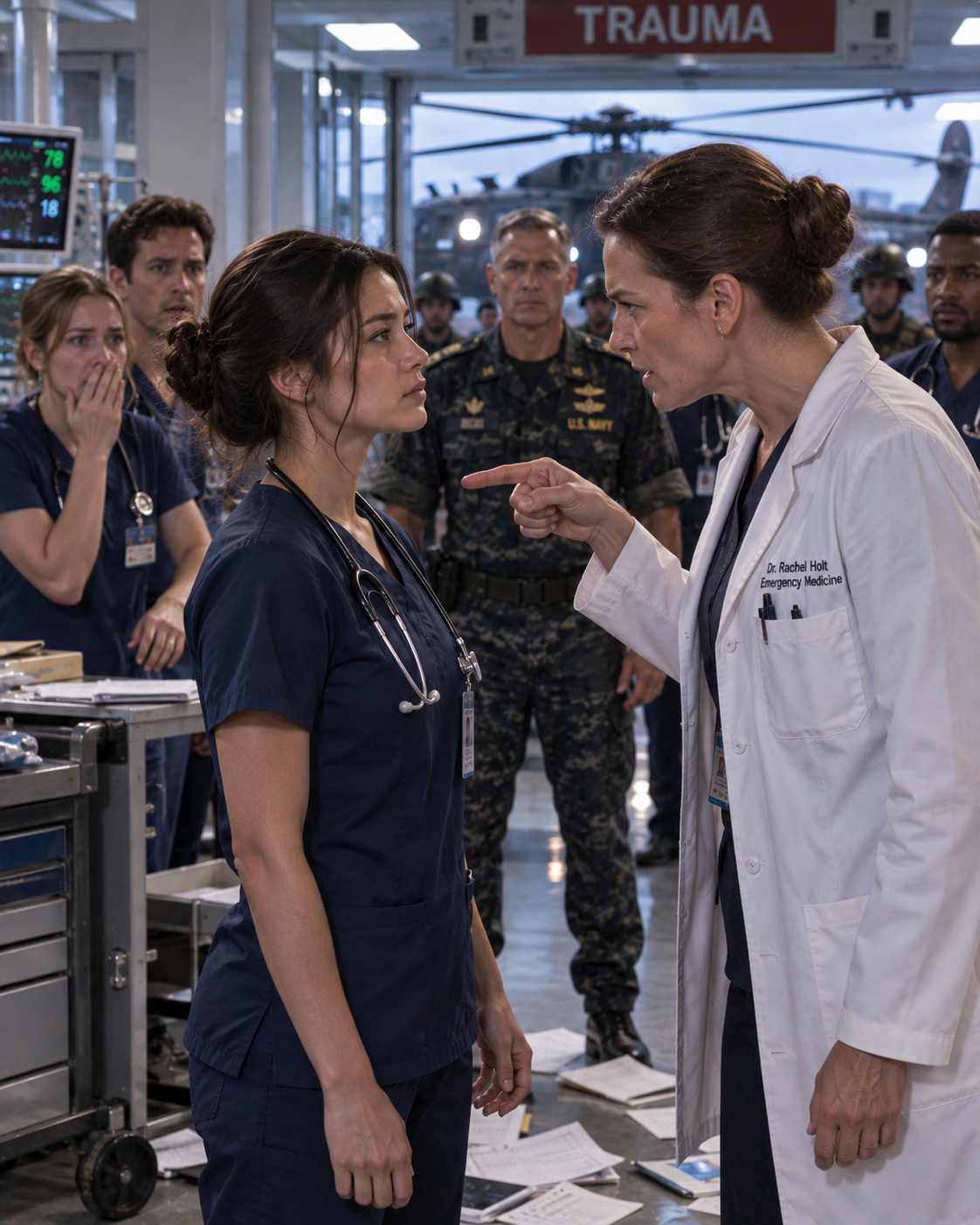
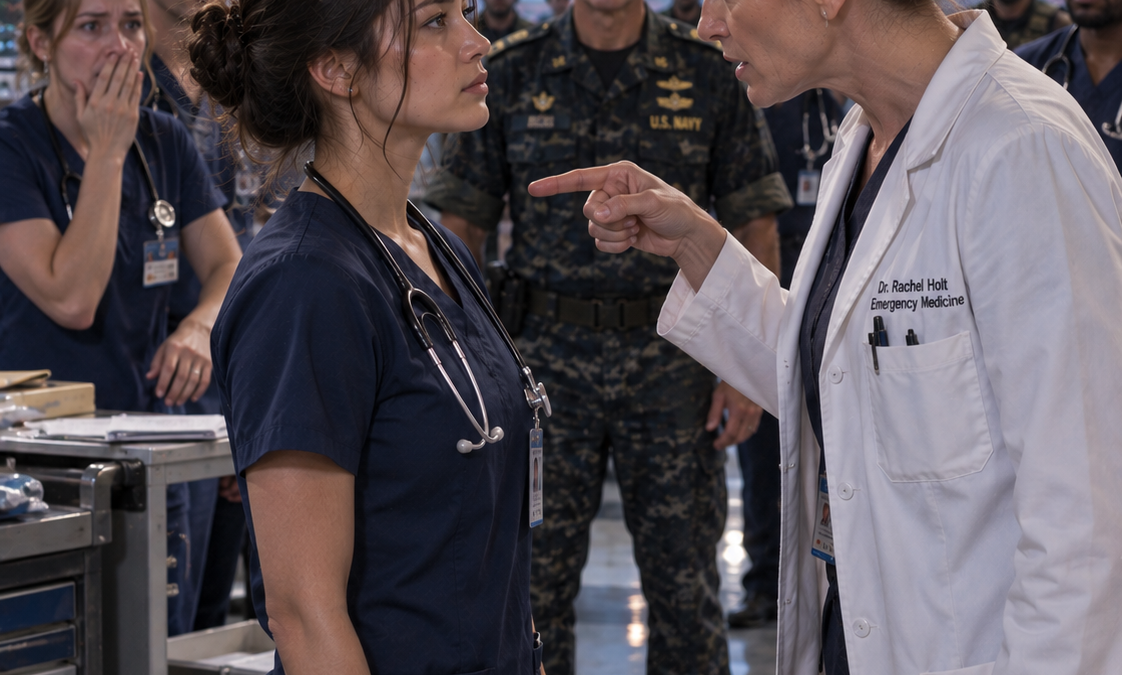
Dr.Rachel Holt snatched the chart out of Avery’s hands, and hurled it across the nurse’s station.
Papers exploded across the floor.
She grabbed Avery’s arm, yanked her forward until they were inches apart, and hissed through her teeth loud enough for the entire trauma floor to freeze.
“You touch another patient in my ER, and I will have your badge stripped before you make it to the elevator.
You are not a nurse.
You are a liability with a stethoscope.”
She shoved her backward into the supply cart. Metal crashed. Silence swallowed the room.
Nobody moved. Nobody said a word.
And Avery Knox, she just stood there steady as a wall.
The shift started at 6:00 in the morning and Avery Knox arrived 11 minutes early. That was the first thing Donna Reyes noticed.
Donna had been a charge nurse at St.Gabriel Medical Center for 14 years. And in her experience, the ones who showed up early on their first day were either terrified or trying too hard. She watched the new nurse badge through the entrance scrub top, slightly oversized, dark hair pulled back without a single strand, out of place, a small duffel bag slung over one shoulder.
No lanyard with inspirational quotes. No personalized badge reel with a cartoon on it. Just the badge, just the scrubs, just the face in a face like that was hard to read.
Donna thought too calm, like someone had ironed out every crease of emotion and left only the surface.
“You must be the new one,” Donna said from behind the station.
“Avery Knox,” she said and extended her hand across the counter.
Donna shook it.
“You’re in trauma today.
Dr.Holt runs that wing. She has a system and she expects you to learn it fast.
Don’t touch anything you haven’t been cleared on.
Don’t offer opinions and don’t fall behind.”
Understood.
I’ll show you the locker room.
Avery followed without another word.
The locker room smelled like disinfectant and the faint trace of someone’s leftover lunch from the night shift.
Three nurses were already in there changing or checking phones and they looked it up when Donna pushed open the door. Ladies, this is Avery Knox.
She’s joining trauma today.
A nurse named Becca Solano, 263rd year out of nursing school, looked Avery up and down with the particular efficiency of someone who had formed opinions long before she finished blinking. Is that scrub top a medium? She asked.
Looks like a large.
It’s fine, Avery said.
We have a supply closet, Becca said. You can get something that actually fits. I appreciate that.
The second nurse, Marcus Webb, tall and perpetually tired looking, didn’t look up from his phone.
The third nurse, Janelle Okafor, gave a small smile that didn’t commit to anything in particular.
Donna showed Avery her locker, handed her the orientation packet she was supposed to have received digitally 3 days ago, but apparently hadn’t, and left.
Becca called after her loud enough for Avery to hear from across the room. Donna, how long does this one last? You think?
Donna didn’t answer.
Becca smirked anyway. Avery opened the locker, set her duffel inside, and stared at the orientation packet for exactly 2 seconds before tucking it under her arm.
She already knew what it would say.
She had already read the hospital’s protocol documents, the ER procedural manual, the department specific guidelines for trauma intake, all of it the night before.
She had read it the same way she used to read mission briefs thoroughly once, and then she put it away because the point was never the paper. The point was to be ready when the paper ran out. She walked onto the trauma floor at 604 and introduced herself to no one in particular because no one was particularly interested.
The first hour passed the way most first hours pass in a place like that slowly and with a particular kind of low-grade tension that comes from everyone watching without appearing to watch. The ER had its rhythms and a new person disrupted them the way a stone disrupts water briefly and then the water moves on. Avery was assigned to prep rooms between patients, assist with intake paperwork, restock supply cards, and shadow a more experienced nurse named Tom Callahan during patient interactions.
Tom was 43 kind in a distracted way, the sort of man who answered questions with half his attention, while the other half managed something else entirely. He showed her where the catheterss were stored, how the inventory system worked on the tablet, in which attending physicians preferred their updates in what format.
“Dr.Holt, he said quietly as they walked the quarter, likes bullet points, verbal, not written.
When you’re updating her lead with the number, then the name, then the status.
Don’t editorialize.
Don’t add context she didn’t ask for.
Got it, Avery said.
And don’t be late with anything she doesn’t forget.
Understood. Tom glanced sideways at her.
You’re pretty quiet.
I’m listening.
He nodded.
But something in his expression shifted the way a person’s expression shifts when they’ve registered something they don’t quite have language for yet.
By 9:00, Avery had restocked two carts, assisted in the intake of four patients, successfully navigated the department’s outdated electronic charting system, and made no errors that anyone could identify.
This did not go unremarked.
Becca was leaning against the wall outside bay 3 when she caught Avery’s eye.
You know you did that intake form wrong for the guy in bay 2, right? Avery turned to look at her. Witchfield.
Becca blinked.
That wasn’t the answer she expected.
She expected uncertainty or defensiveness. The the triage notes. You put secondary complaint in the wrong section.
The secondary complaint was a fall, not a cardiac symptom. So I listed it under injury mechanism rather than symptom history.
The section headings in this system are ambiguous.
If Dr.Holt’s preference is different, I’ll adjust it going forward.
Becca said nothing. Is her preference different? Avery asked.
I I’ll check, Becca said and walked away.
Marcus Webb, who had overheard all of this from the supply room doorway, said nothing but watched Avery walk back toward the nurse’s station with an expression that was harder to read now than it had been an hour ago.
The morning moved forward. Patients came in a construction worker with a hand laceration, a woman in her 60s with chest pain that turned out to be anxiety, a teenager with a concussion from a skateboarding incident, a man who had taken the wrong dosage of his blood pressure medication.
Avery worked each one without fanfare, without flourish. She drew blood.
She checked vital signs she documented. She communicated with the attending physicians with the same measured efficiency she applied to everything else. At 10:47, Dr.Rachel Hold arrived on the floor.
The change in the room’s atmosphere was immediate and physical, the way a pressure change before a storm feels in your chest before your brain registers it.
Nurses straighten. Conversations shorten.
Tom Callahan, who had been leaning on the counter, stood up. Even the ambient noise of the floor seemed to recalibrate. Dr.Dr.Holt was 44, chief of emergency medicine, and she carried herself with the particular authority of someone who had never once in her professional life been wrong, or at least had never allowed the evidence to the contrary to reach her.
She wore her credentials the way some people wear jewelry, visibly, deliberately, and as a form of communication directed at everyone around her. She went through three patient updates before she arrived at Bay 2.
“Who did the intake on this?”
she said, not looking up from the tablet.
Tom said, “The new nurse, Knox.”
Holt looked up. She found Avery with her eyes across the room and walked toward her with the tablet extended.
“The triage notes explain this to me.”
Avery walked to meet her halfway. She looked at the screen.
Secondary complaint was a fall resulting in wrist bruising. I categorized it under injury mechanism rather than symptom history because the patients primary visit was chest pain and the fall was unrelated to the cardiac complaint. The distinction seemed clinically relevant to avoid conflating the two presentations.
Holt looked at her for three full seconds without speaking.
You’re a first week nurse, she said.
Yes. In this department, we follow the charting protocol as standardized.
If you have questions about how something is categorized, you asked Tom.
You don’t improvise.
I understand.
I’ll adjust.
Hold handed the tablet back. She turned to Tom. keep a closer eye on her and then not quietly enough as she walked toward the next bay.
Where did they find this one? It was not a question. Tom looked at Avery.
She was already turning back toward the supply cart.
Don’t take it personally, he said under his breath.
She’s like that with everyone new.
I know, Avery said. How do you know?
She didn’t answer.
She picked up the cart and moved down the corridor. Becca caught the exchange and filed it away the way she filed everything away for later when it might be useful.
She pulled Janelle aside near the medication room and said barely above a murmur, “Something’s off about that one.
” Janelle glanced down the corridor.
Off how she doesn’t react like at all.
Hol practically called her incompetent in front of everyone and she just stood there like it was nothing.
Maybe she’s just professional.
Nobody’s that professional on day one.
Becca said, “It’s not natural.”
Janelle shrugged.
“Or she just doesn’t care what you think.”
Becca didn’t have an answer for that either.
Lunch break was staggered on the trauma floor.
Avery took hers at noon, sat in the break room with a container of food she’d brought from home, and ate without looking at her phone.
Marcus Webb came in halfway through, and made coffee without speaking.
When the machine finished, he poured a cup, stood against the counter, and said, “You prior military.”
Avery looked up. Why do you ask?
Just a vibe, he said. The way you move, the way you talk.
My uncle was a Marine.
You’ve got that thing he had like nothing surprises you.
Things surprise me, she said.
Right, he said, and drank his coffee and didn’t push further.
She finished her food. She rinsed the container.
She went back to work.
By 2:00 in the afternoon, the floor’s rhythm had found its afternoon tempo busier than morning, more unpredictable.
The kind of pace where the 3 minutes between patient calls felt like a gift rather than a gap. Avery had moved through four more patient assists, two of which involved more complex situations than the morning had offered.
A woman brought in by ambulance following a car accident, responsive but disoriented with a suspected internal injury. An elderly man found collapsed in a parking garage presenting with stroke symptoms.
For the car accident patient, Avery had been the first nurse at the bedside when the gurnie came through the bay doors.
She’d done the initial assessment with the kind of speed that was technically correct, but that made the receiving resident pause and glance at her twice.
For the stroke patient, she’d called the symptom recognition before the attending physician had finished reading the intake sheet and said it in the flattest possible tone.
This presentation looks like an es schemic event.
And when the physician turned to look at her, she added, “His speech is affected.
Left side drift, pupil asymmetry.”
Fast criteria met on all four points. The attending a young man named Dr.Eli Crane stared at her.
“Yeah,” he said slowly.
“That’s yes, I was just about to say that.”
Avery nodded and stepped back and let him do his job.
Crane later said to Tom, “Your new one.
What’s her background?”
New grad, Tom said, though even as he said it, he found the words sitting strangely in his mouth.
Crane looked like he wanted to say something else and then didn’t.
The afternoon continued. At 3:15, Dr.Holt came back through the floor for rounds.
She stopped at two patient bays, made corrections on documentation, reassigning tasks that had been completed by the wrong staff member, and then came to stand near the nurse’s station while she reviewed the afternoon’s activity log on her tablet.
She didn’t look up when she spoke.
Knocks. Avery came over from the cart she was restocking.
Yes, the stroke patient from 2:15. You called the symptom cluster before Crane did. I was in the room when the patient came in.
I had a few seconds more observation time. Holt finally looked up.
That’s not the point.
You’re a first week nurse.
You don’t vocalize a diagnosis.
You don’t call anything.
You report what you observe and you let the attending make the assessment. I understand. Do you?
Because from where I’m standing, it looks like you came into this department with the impression that your opinion matters.
The nurse’s station had gone quiet.
Not conspicuously, not the kind of quiet that announces itself, but the kind where people slow their movements and stop turning pages. I said fast criteria, Avery said.
I didn’t say diagnosis.
Holt set the tablet down. Excuse me.
Fast is a screening tool, not a diagnosis. I reported an observation using a standardized framework.
Dr.Crane made the assessment. The silence became something you could touch.
Holt’s voice dropped, which was somehow worse than if it had risen.
Let me be very direct with you, Miss Knox. This is my department.
I have been running trauma at this hospital for 9 years. In that time, I have seen dozens of new nurses come through these doors who thought that confidence was a substitute for experience. It is not.
You have been here for one shift. One shift. And you have already second-guessed the charting protocol and verbalized clinical impressions in front of an attending physician.
That is not impressive. That is reckless.
Do you understand what I am telling you? Yes.
Avery said. Good. Hol picked up the tablet.
Because I will not have dead weight in my department. You are either useful or you are gone.
There is no middle ground here. She walked away.
The station stayed quiet for a moment too long. Then someone dropped a pen. Someone else cleared their throat.
The ambient noise returned like water filling a shape.
Becca caught Avery’s eye from across the counter.
Her expression was the kind that tries to disguise satisfaction as sympathy and doesn’t quite manage either.
She’s not wrong, you know, she said.
Just for what it’s worth.
Avery looked at her for exactly one second.
I appreciate the feedback,” she said and walked back to the supply cart.
Tom found her there a few minutes later. He restocked from the opposite end of the cart and kept his voice low. You okay?
Fine. She does this with everyone new.
It’s not It’s just how she is.
I know you keep saying that like you already know things you shouldn’t know yet.
Avery placed a box of gloves on the appropriate shelf and looked at him.
She’s a good physician, she said.
Her outcomes are in the top 7% for trauma departments in this region. Her staff retention is lower than average, but her patient mortality rate is excellent.
She’s hard on her people because she’s harder on herself.
I understand why she runs the department the way she does. Tom stared at her.
How do you know her outcomes? Public records, hospital reporting database.
A pause. I research the places I work before I start.
He didn’t say anything for a moment.
Then, “Where did you work before this?”
Avery picked up the cart and moved it to the next bay.
“Different places,” she said.
Tom stood where she left him. The afternoon deepened.
At 4:30, a 7-year-old came in with a high fever and a rash that turned out to be viral and not the menitis the mother had been terrified of.
and Avery spent 20 minutes with the child while the mother filled out paperwork talking in a low voice about nothing in particular, cartoons and the child’s stuffed rabbit until the boy stopped crying and actually smiled.
The pediatric nurse who arrived to take over found them like that and looked at Avery with something that wasn’t quite surprise but was close to it.
At 5:00, Marcus Webb said to Janelle in the corridor, “I’m starting to think she’s not new.
She literally just started.”
I know, he said.
That’s what I mean.
At 5:45, Dr.Holt walked past Avery without speaking, which was somehow more unsettling than being spoken to. At 6:10, Becca said loudly near the station, loud enough for the room and specifically for Avery.
First week, and she’s already pissed off the chief.
That’s a new record.
A few people laughed. Not everyone, but enough.
Avery heard it.
She was standing at the computer terminal updating a chart and her fingers didn’t slow, didn’t stop.
She finished the entry, logged out of the system, and started toward the next task.
She had learned a long time ago that words said by people who don’t know, you carry exactly the weight you assign them.
She had learned that in places where the consequences of losing focus were measured not in Bruce feelings, but in lost lives. She had learned it in the kind of training that stripped everything down to what was real and what was noise. The laughter was noise.
She was back at the cart when Tom came up beside her with a look that said he’d heard it, too.
People can be, “It’s fine,” she said.
“It’s not actually.”
She looked at him. There was something in her eyes in that moment that made him stop. Not hurt, not anger.
Something quieter and deeper than either of those things. the look of someone who has already been to the place where those things become irrelevant and who came back from it.
“I’ve had worse critics,” she said and left it there.
“The evening shift change came at 7.
” Avery handed off her patients to the incoming nurse, a man named Gerald, who smelled of coffee and asked clear, competent questions.
She gave her updates in the format Tom had taught her that morning. Bullet points, verbal number, first name, second status, third.
She was putting on her jacket in the locker room when Janelle came in. Hey, Janelle said.
Hey, don’t listen to Becca.
She does that to everyone.
I don’t, Avery said.
Janelle watched her zip up the jacket.
You know what’s weird?
You don’t seem like someone who got rattled today.
I didn’t.
That’s the weird part, Janelle said.
Avery lifted her duffel and looked at Janelle with a directness that wasn’t unkind.
I’ll see you tomorrow, she said.
Yeah, Janelle said. See you tomorrow.
Avery walked out through the ER entrance the same way she’d walked in without hurry, without a look over her shoulder, without the particular hunch posture of someone who had had a hard day and was carrying it home.
She had 13 years of hard days stored somewhere in her body.
Today didn’t even register.
She walked to her car, sat down, and let the silence settle around her for exactly 2 minutes.
Then she started the engine, pulled out of the parking lot, and drove through the wet Seattle streets while the radio played something she didn’t listen to.
Because what she was listening to was inside her, the stored sound of that room. Those voices that laughter filed and categorized and assigned its correct weight, nothing. She had learned to survive things that had no language in a hospital corridor.
She had carried men through burning terrain on her back. She had kept her hands steady in conditions where steady hands seemed like a biological impossibility.
She had earned a clearance level that the people laughing in that breakroom did not have the authorization to know existed. She drove home in the rain.
Tomorrow she would come back in the day after and she would be quiet and she would be useful and she would ask for nothing and draw no attention because that was the arrangement she had made with herself when she left the other life behind. But lives have a way of not staying behind. And somewhere in the logistics of fate, a chain of events had already been set in motion that Avery Knox could not have predicted and could not have stopped and would not be able to hide from.
It would find her exactly when she was most determined to stay invisible. And when it did, nothing about St.Gabriel Medical Center would ever be the same. The second day started the same way the first one ended with Avery Knox arriving before anyone expected her to.
6:53 in the morning, the night shift was still finishing its handoff.
Gerald, the nurse she’d given her patients to the evening before, was at the station finishing his notes.
And when he looked up and saw her badging through the door, he actually did a small double take.
You’re early again, he said.
Habit, she said. He watched her walk toward the locker room. Then he went back to his notes, but his pen moved slower than it had a moment ago.
Tom Callahan arrived at 7:04 and found Avery already at the supply cart running the morning inventory check on the Trauma Bay restocks. He stood in the doorway of Bay 1 and watched her for a moment before she noticed him.
You don’t have to do that, he said.
Night shift is supposed to leave it stocked. They were short two units of saline in the defibrillator pads in bay 3 need replacing. I put in a supply request through the tablet.
Tom walked in slowly. How do you already know how to put in a supply request?
I read the orientation packet. He pulled on a glove and checked the card himself.
She was right. Two units of saline defibrillator pads.
He pulled off the glove. Did you sleep last night?
Some You seem like someone who doesn’t sleep much.
She moved to the next bay. I sleep enough. He followed her.
It wasn’t an aggressive thing.
Just the way you follow someone when you’re not finished with a conversation and they’ve already started moving.
I wanted to say something about yesterday. What Becca said in the breakroom, what Holt said at the station.
That’s not Tom it.
She stopped and turned.
I’m fine.
I genuinely mean that.
I’m not holding anything from yesterday.
I came back today, didn’t I?
He looked at her. Yeah, he said. You did.
Then let’s work.
He nodded and they worked. By 8:15, the floor had its full complement of staff, and the morning had moved into its first real tempo. Two ambulance arrivals within 20 minutes of each other, a man with a suspected broken rib from a fall, and a woman in her 50s brought in by her daughter after complaining of shortness of breath for 3 days.
Avery worked the second intake with Tom. And when the attending physician arrived, she had the vitals charted, the patient history collected, and the medication list already cross- refferenced against the symptoms the daughter had described in the ambulance.
Dr.Crane, the same resident from the day before, looked at the intake summary on the tablet and then at Avery. This is thorough, he said. And thank you.
I mean, it’s genuinely thorough, more thorough than most.
She didn’t answer that.
He went in to see the patient. Becca was at the station when Avery came back to update the chart.
She didn’t say anything at first, just watch the way she moved through the system.
Then did you do extra training somewhere before nursing school? Avery kept her eyes on the screen.
Why?
You just moved different like you’ve done this before, not nursing school before.
Before before everyone has a before, Avery said.
That’s not an answer.
No, she agreed.
It’s not.
Becca stared at her. Avery logged off the terminal and went back to the floor.
Marcus Webb appeared beside Becca and said quietly, “You’re not going to get anything out of her.
” “I know,” Becca said.
“That’s what bothers me.”
At 9:40, a patient named Ben Harrison was brought in through the ambulance bay. Avery was close enough to hear the paramedics report 61 years old, presenting with intermittent chest pain since the previous evening.
Wife had called it in when he started sweating through his shirt at the breakfast table. Blood pressure was elevated in the rig pulse irregular. He was conscious talking irritated at the fuss the way men of a certain generation get irritated at medical attention like their own bodies are inconveniencing them.
I’m fine, he was saying as they wheeled him in.
I told her I was fine. Marjorie calls 911 if I sneeze wrong.
The paramedic, a young woman with a nononsense ponytail, said, “Sir, your blood pressure in the rig was 168 over 104.
I drink too much coffee.”
He said, “Sir, I’m 61 years old.
Everything hurts.
That’s what 61 is.”
He was brought into Bayour. Dr.Crane took the case.
Avery assisted attaching the cardiac monitor leads, drawing the first blood panel, running an EKG strip, while Crane reviewed the paramedic’s documentation.
Ben Harrison looked at Avery while she placed the leads and said, “You’re too young to be a nurse.
” “I get that sometimes,” she said.
“How old are you?”
old enough. He almost smiled.
Almost. Then a ripple of discomfort moved across his face, subtle, the kind of man like him would try to hide. And he shifted his weight on the gurnie.
Avery noticed.
She didn’t say anything.
She finished placing the leads and looked at the monitor. His rhythm was sinus, but the rate was climbing. She stepped back and let Crane do his work, but she positioned herself at an angle where she could see both the monitor and the patient without being in the way.
At 9:57, Crane was on the phone with the cardiology consult.
Ben Harrison was lying back against the pillow with the particular fake relaxation of a man who is more uncomfortable than he’s admitting.
His wife, a small woman with anxious hands, sat in the chair beside him. Ben, she said softly, just let them do their job.
Marjorie, I am letting them. And then he stopped.
The monitor changed pitch. Avery was already moving before the alarm fully registered. The rhythm on the screen had gone from irregular but stable to something that was not stable at all.
VIB, ventricular fibrillation. The heart no longer pumping, just quivering, electric, and useless of muscle firing without direction.
She hit the call button on the wall and said in a voice that was not loud, but that carried with absolute authority, “Code Blue Bay 4.”
Code blue.
Marjorie Harrison stood up with a sound that wasn’t quite a word.
Tom was in the corridor and heard it and came through the bay doors in 4 seconds. Becca came 6 seconds after that. A respiratory tech appeared.
Dr.Crane came back through the door, still holding his phone, saw the monitor, and said, “Start compressions.”
Avery was already doing it. She had Ben Harrison flat on the gurnie, the pillow gone, her hands locked and positioned at the center of his chest, and she was pushing hard, controlled exactly the right depth, exactly the right rate, without hesitation, without the moment of frozen
shock that happens even to good nurses in their first real code. She was just there doing it as if some other part of her had taken the controls.
Tom watched her for one second, just one, and something crossed his face that had no clean name. charging the defibrillator, the tech said.
Becca stood at the medication cart with her hands hovering. She was waiting for someone to call out an order, and she was good at her job. She was capable, but she was waiting.
In a code situation, the first few seconds are a particular kind of chaos. Organized chaos for experienced teams, real chaos for everyone else, and even good people sometimes wait for someone to be the voice. Avery was the voice.
Epinephrine 1 millgram IV push,” she said, still compressing, not looking up.
“Get me the airway kit.
Tom bag him when I break compressions.”
Becca, I need those medications now.
Crane said, “I’m calling it.
Everybody clear.
We’re going to shock.”
Avery stopped compressions, stepped back, hands up. The defibrillator discharged.
Ben Harrison’s body arched.
The monitor traced a line, then another. Then, agonizingly slow, the shape of a rhythm began to reassemble itself.
Not perfect, not clean, but present. A beat, then another.
We’ve got a pulse, Tom said, two fingers at the neck, and his voice did something it hadn’t done in a while.
It cracked just slightly. Marjorie Harrison made a sound from the corner that Avery would carry with her for longer than she expected. Crane was already on the phone calling cardiology back.
The respiratory tech was adjusting the oxygen. Becca was drawing up the next medication with steady hands, steadier now that the worst of the moment had passed.
And Avery was back at the monitor, watching the rhythm, watching the numbers, watching Ben Harrison’s chest rise and fall under its own power again.
Crane looked at her across the gurnie.
“Good call,” he said.
She didn’t respond to that.
She picked up the chart tablet and started documenting the code time of arrest time of intervention medications administered rhythm before and after shock. Accurate, complete, immediate. Tom came to stand beside her a moment later.
His voice was very low. Where did you learn to run a code like that?
Nursing school, she said.
He didn’t say anything for a moment.
Then Avery, she looked up.
That wasn’t nursing school, he said.
I’ve been on this floor for 11 years.
I’ve seen hundreds of codes.
Experienced nurses freeze for 3 seconds. New nurses freeze for 10.
You didn’t freeze for one.
You moved like you’d done it a hundred times under fire.
She held his gaze. The patient is stable, she said.
That’s what matters.
She went back to the documentation. Tom stayed where he was.
He looked at the charts he was filling in precise correct time stamped with the accuracy of someone who tracks time the way most people don’t.
And he felt the particular unease of someone who is standing next to a puzzle they don’t have all the pieces for and they know it and they know the picture is bigger than they thought.
By 11:20, Ben Harrison had been moved to the cardiac care unit.
His wife had held Avery’s hand for a long moment before they took him upstairs and said, “You saved him.
” And Avery had said, “The team did.”
And Marjgerie Harrison had looked at her with wet eyes and said, “You, you specifically, I saw you.”
Avery had nodded and let go of her hand gently. In the corridor outside bay 4, the energy of the floor had shifted.
These things happen after a code successful ones especially.
There’s a particular charged atmosphere, a collective exhale, the relief of the worst thing not happening.
People talk faster, stand closer. The shared adrenaline becomes a kind of temporary intimacy.
Becca found Avery at the sink washing her hands.
She stood beside her and washed hers and didn’t say anything for a moment.
Then I called the medication wrong. Avery looked at her. Epinephrine, Becca said.
I had the wrong concentration in my hand for about 2 seconds before you called the dose. I fixed it before I pushed it, but I had the wrong one. But you caught it, Avery said.
because you called the dose clearly. Becca stared at her own hands under the water.
If you hadn’t been in there, but I was, Avery said.
And so were you. And the patient is upstairs with a pulse.
Becca shut off the water. You ran that code.
Crane ran it. No. Becca turned to look at her.
You ran it. He confirmed it.
There’s a difference.
A pause. Who are you?
Avery dried her hands.
I’m the new nurse, she said and walked out.
At 12:30, Dr.Holt called a brief floor meeting, not unusual, after a codeblue standard debrief protocol. Seven staff members gathered near the station.
Hol went through the sequence with the clinical detachment she brought to everything timeline interventions outcome. What worked?
What could be improved in the response time? When she got to the moment of first compression, she looked at her notes. First compression was initiated by Knox.
She didn’t look up.
Response time from alarm to first compression was approximately 4 seconds. Nobody spoke. Hol looked up.
Then she found Avery at the back of the group. Her expression was not warm. It was not suddenly magically warm, but something in it had shifted by a fraction that those who knew her well might have noticed.
That’s within the gold standard window, she said.
Good response. She went back to her notes.
Tom caught Avery’s eye across the group.
Avery looked away first. After the debrief, Holt stayed at the station to update the incident documentation.
Marcus Webb walked up to Avery in the corridor with both hands in his pockets and said simply, “My uncle would have liked you.”
“The Marine,” Avery said.
“Yeah.”
He looked at her for a moment.
He had this thing where he never talked about what he’d done, service stuff, but when something went wrong, anything like a car accident or one time a kitchen fire at Thanksgiving, he was just instantly there.
No panic, just moving. Already fixing it. He paused.
You’re like that.
She said nothing.
I’m not asking you to tell me anything, he said quickly.
I just wanted you to know that I see it. Whatever it is. He shrugged and started to walk away.
Then he stopped.
And for what it’s worth, the way you ran that code this morning, that’s not nothing.
That’s the kind of thing people don’t forget.
He went back to his section of the floor. Avery stood in the quarter for a moment longer than necessary. She had not expected that.
Not the words themselves, but the accuracy of them.
The way he’d placed his finger on exactly the things she spent every shift trying to keep invisible and said, “I see it not as an accusation, but as a kind of acknowledgement, like he was handing something back to her that she hadn’t known she’d set down.
” She filed it under noise, but it was harder to file this time.
At 2:15, the afternoon brought three new admissions in quick succession. A construction worker with a nail gun injury to the forearm.
A teenage girl brought in by school staff after fainting in gym class.
A man in his late 40s with abdominal pain that turned out to be a kidney stone and rendered him dramatically, colorfully miserable in a way that lightened the floor’s mood just enough.
Avery worked all three without incident, without commentary, without a single moment that called attention to itself. She was precise. She was fast.
She was quiet. She documented correctly.
She communicated clearly. She was to all observable evidence exactly what a firstweek trauma nurse was supposed to be, except for the fact that she did all of it with the particular efficiency of someone who is running far below their actual capacity, the way a professional athlete jogs a warm-up lap.
At 3:40, Becca stopped her near the medication room. I owe you an apology, she said. Avery stopped for what?
Yesterday, the breakroom I the dead weight thing was already floating around and I let it float.
I didn’t start it, but I didn’t stop it either.
And after this morning, Becca stopped. Started again. After this morning, I felt like I should say something.
Avery looked at her. The old calculation ran automatically.
Is this real? Is this angled?
What does she want from this? A remnant of a different kind of life where you could not take an extended hand at face value.
But Becca’s face was not performing anything.
She just looked like someone who’d had a hard morning and was trying to be decent.
It’s already gone, Avery said.
Is it really?
I don’t carry things, she said.
It’s a waste of weight.
Becca exhaled. Okay, good.
I just Okay. She turned to go and then turned back. What was your unit before nursing?
You were somewhere.
I’m not going to keep pushing if you don’t want to say, but I’m asking directly.
A long pause. I moved around, Avery said.
A lot of different places.
That’s still not an answer.
No, Avery said, but it’s all I’ve got right now.
Becca nodded slowly, accepting something she wasn’t entirely sure she’d accepted.
Okay, she said. Fair enough.
She walked away. Avery went back to the cart.
At 4:50, Tom found her in the break room during a brief window between patients. She was standing at the window with a cup of coffee, looking at nothing in particular, or rather looking at the middle distance, the way people look when their thoughts are somewhere else entirely.
You okay? He asked.
Fine. You say that a lot.
Because I mean it a lot. He poured himself a cup of coffee and came to stand beside her. not across from her, beside her, looking in the same direction.
I’ve been a nurse for 11 years, he said.
I’ve worked with all kinds of people, people with real talent, people with great instincts, people who trained under the best programs in the country.
He paused. None of them ran a first code the way you ran that one.
She didn’t answer.
I’m not going to ask you again, he said.
Whatever you’re not saying, I’m not going to drag it out of you.
But I want you to know that whatever is back there, whatever you’re carrying that you don’t talk about, it saved that man’s life today.
So whatever you think of it, it has value even if you don’t want it to.
She was quiet for a long moment. Ben Harrison is upstairs right now with a heartbeat, she said finally.
I know that that part lands. Tom looked at her sideways, but another pause, this one longer.
The part that doesn’t land, she said, is what happens after that.
When people start looking at you differently, when the thing you did becomes the thing they put on you. She turned the cup in her hands.
I came here to be a nurse. Just a nurse.
Nothing else. Tom was quiet.
I know that sounds strange, she said.
Given this morning, it doesn’t sound strange, he said.
It actually makes more sense than most things you’ve said since you got here.
He drank his coffee.
But Avery, I don’t think the kind of person you are gets to be invisible.
Not for long.
It’s just not how that works.
She looked out the window. Yeah, she said quietly.
I know. The break room was still.
The floor outside was not there. Was movement out there. Voices.
The sounds of a hospital afternoon. The particular alive and urgent sound that place always had.
But in here, for this one moment, it was still.
Then Avery’s pager went off.
She looked at it, set her coffee down, straightened up. Tom looked at the page or two. His expression changed.
It wasn’t a patient alert.
It wasn’t a code blue or a supply notification or a shift update.
It was a message from the administrative office.
Three words routed through the hospital’s internal system to her specific badge number.
Three words that made Tom Callahan’s eyebrows draw together in confusion because they didn’t make any sense in the context of a trauma nurse’s first week at a hospital.
Three words that made the stillness in Avery’s face do something it had not done once in two full days cracked slightly at the edges.
Not enough for most people to see. Tom could see it.
What does that mean? He said, nodding at the pager.
She read it again. The message said authorization request pending.
Clearance flag active. She put the pager in her pocket.
Nothing, she said. Her voice was absolutely level.
Too level. The kind of level that is itself a sound if you know what to listen for.
Just admin. She walked out of the breakroom.
Tom stood there with his coffee going cold in his hand, staring at the doorway she’d walked through.
And for the first time since she’d arrived, he felt something he hadn’t quite felt before.
Not curiosity, not the professional interest he’d been packaging his questions in all day.
Something closer to the feeling you get when you realize the story you’re standing in is bigger than the part you can see.
He set his coffee down. Outside on the floor, Avery Knox walked back toward the trauma bay with the same measured stride she always used. Steady, even, unhurried.
But her jaw had set in a way it hadn’t been set before.
And somewhere in the administrative layers of St.Gabriel Medical Center, a flag that had been dormant for three years had just been activated by a query from a source that had no business contacting a civilian hospital.
A source with a three-letter designation that didn’t appear in any public directory.
And the chain of events that Avery Knox had moved to Seattle to escape was no longer behind her. It had found the building.
The flag had found the building, but the building didn’t know it yet.
Avery walked the trauma floor with the same stride she’d used all day, measured even giving nothing away.
But underneath that surface, something had tightened. The pager message was 3 days early.
She had run the numbers when she first took the position at St.Gabriel calculated the probability that her clearance file would surface before she’d had enough time to establish herself as just a nurse, just a face in the department, just another name on the rotation board.
She had estimated 3 months, maybe four. Long enough to become ordinary. Long enough that when people looked at her, they saw a colleague instead of a question.
3 days.
That was all she’d gotten.
She pushed it down, filed it, kept moving. At 5:10, the floor was running a steady afternoon tempo. Becca was working bay 2.
Marcus was on the far end of the corridor.
Tom had gone to assist with a patient transfer upstairs and wouldn’t be back for 20 minutes.
Dr.Her hold had finished her rounds and was in her office doing what attending chiefs do at the end of a heavy afternoon paperwork phone calls the administrative weight that comes with running a department that never stops.
“Dr.Crane found Avery
at the nurse’s station and stopped beside her without preamble.”
“The Harrison family asked about you,” he said.
She kept typing.
“I know.”
His wife came by before they moved him to cardiac. She asked me if you were a doctor. Avery looked up at that.
I told her you were a nurse, he said. First week, he paused.
She didn’t believe me.
I’ll take that as a compliment, Avery said and looked back at the screen.
Crane didn’t move.
Where did you do your clinical rotations, University of Washington? And before nursing school, the typing stopped, brief, almost imperceptible, then resumed.
Different thing, as she said.
He nodded slowly, the nod of someone and who accepts an answer while simultaneously noting that it wasn’t really one.
You know, I did my residency at John’s Hopkins.
We had this attending their trauma surgeon former army 14 years in the field before he went back to school. You remind me of him. In what way?
The way he moved in a code, Crane said. Like the emergency was the normal state and the calm was the exception.
Avery said nothing.
It’s a compliment, he added.
I know, she said. Thank you.
He walked away. She stared at the screen for a moment longer than the documentation required and then she continued. At 5:35, the first sound came from outside.
It was subtle enough that only two people on the floor registered it. Initially, a low thrming in the distance, the kind of sound that a busy urban hospital produces background noise enough to mask.
Helicopters weren’t unusual over Seattle.
The hospital had a rooftop landing pad for air transport cases and medical helicopters came in three or four times a week. It was background routine except this sound had a different frequency.
Marcus Webb stopped in the middle of the quarter and tilted his head slightly. The way you tilt your head when something registers at a level below conscious thought.
He stood there for 3 seconds, which was long enough that Janelle passing by with a medication tray said, “You okay?
Do you hear that?”
She paused. Hear what? That sound outside?
She listened.
I don’t I mean kind of.
Is that a helicopter?
Yeah, he said, but it’s He stopped.
It’s different.
Janelle looked at him the way people looked at someone being overly particular about something they consider minor.
It’s probably just air transport.
Air transport comes from the south, he said.
That’s coming from the water.
She moved on with her tray.
He didn’t move on.
At 5:40, Dr.Holt’s desk phone rang.
She picked it up with the particular resignation of someone who has answered a desk phone thousands of times and long since stopped expecting good news from one. The voice on the other end was male official carrying the particular flatness of someone reading from a prepared statement while also being genuinely urgent. This is Commander Dale Watts Naval Air Station Whidby Island.
I need to speak with the administrator on call. Holt sat up. This is Dr.Rachel Holt, chief of emergency medicine at St.Gabriel, what is this regarding?
A brief pause. Doctor, we have a military medical transport inbound to your facility. ETA6 Minutes.
We have a critical patient combat related trauma significant hemorrhage.
We’re requesting emergency landing clearance on your rooftop pad in immediate activation of your trauma team.
We receive military transports, she started. doctor.
His voice cut through hers without being rude about it, which was somehow more authoritative than if he’d raised it.
We are also requesting a specific member of your medical staff by name. We need her at the pad when we land. Holtz pen stopped moving.
We don’t operate that way here.
I assign the name is Avery Knox. He said she is currently listed as a registered nurse on your staff.
What I can tell you is that her background and her specific qualifications make her the most appropriate person to receive this patient. I cannot elaborate on that in this call.
I need her on that roof in 6 minutes.
The silence in Holt’s office was the kind that has weight.
Commander, she said carefully. Ms.Knox is a first week nurse. Whatever you believe her qualifications to be, doctor, one word, flat, clean, final.
Please get her to the roof. He ended the call. Holt sat with the phone in her hand for four full seconds.
Then she set it down with a precision that suggested she was controlling something she would not ordinarily have needed to control. She stood smoothed her coat and walked out of her office onto the trauma floor.

