The ER Staff Ridiculed the New Nurse—Until a Navy Helicopter Asked for Her! (PART 2)
PART 2
She found Avery at Bay One.
“Knock,” she said.
The word landed in the space between them like something physical. Avery turned. The two of them looked at each other and something passed between them.
Something Hulk couldn’t name yet.
Something that had to do with the particular quality of Avery’s stillness in this moment, which was not the same as her ordinary stillness.
This was different. This was the stillness of someone who has been waiting for a specific thing and has just heard it arrive. I just received a call from Naval Air Station Whidby Island.
Holt said her voice was at its most controlled. They have a military transport inbound.
6 minutes. They are requesting you specifically on the roof. The floor had gone quiet.
Not the postcode quiet from earlier in the something deeper.
The kind of quiet that happens when people register at some animal level that something is happening that doesn’t follow the usual rules.
Becca had stopped moving near bay 2. Marcus had come three steps closer without meaning to.
Tom, who had just returned from upstairs, stood in the quarter doorway.
Avery’s face did not change, but her eyes did something.
They went somewhere briefly, somewhere private and far away, and then they came back. All of it lasted less than 2 seconds. How critical is the patient?
She said. Hol blinked.
That was not the question she had expected.
I don’t have full details.
Hemorrhagic trauma, combat related, penetrating or blunt. I Holt stopped. penetrating.
That’s what they said.
Avery was already moving. She went to the trauma supply wall and pulled down a surgical kit with a particular calm of someone who knows exactly which shelf it lives on.
She checked it without opening it, weight integrity sealed. She added a second item, something from the high shelf that she reached without looking, and Tom watched her hands and his mouth open slightly because what she had just pulled down was not a standard nursing kit.
It was a thoricottomy tray. Knocks.
Holt’s voice carried something new.
“What are you doing?”
“Preparing,” she said.
“For what exactly?”
She turned.
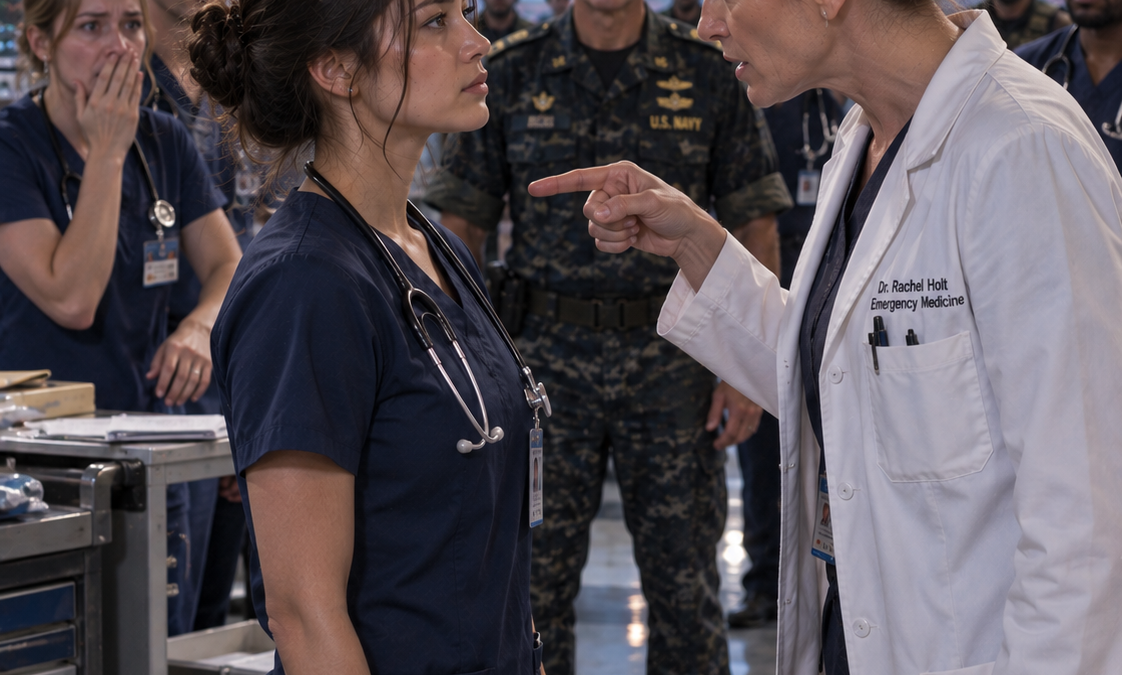
She looked at Rachel Holt directly fully for the first time since she’d arrived at this hospital.
Not the careful, differential look she’d used in every exchange before this, but straight on level the look of someone who has stopped performing a role because the role has become irrelevant.
“I’m going to the roof,” Avery said.
Hold held her gaze 2 3 4 seconds. Something moved through her expression. Not anger, not confusion, something more complicated than either of those.
It was the look of a physician who has just realized she is not the most qualified person in the room and is in the process of recalibrating.
Someone needs to tell me what’s happening, Hol said quietly, directed at Avery.
Not a demand, a genuine question, which from Rachel Holt was something close to extraordinary.
I’ll explain what I can, Avery said.
After she picked up the kits, looked at the room. Tom, come with me.
I need hands.
Tom didn’t hesitate.
Yeah, he said, and came forward. Becca said, what do you need from us? Keep bay one open.
Full trauma setup. I may need to bring him down fast. Him, Marcus said.
Avery was already at the stairwell door. Get the elevator staged, she said over her shoulder.
Then the door opened and she was gone.
Tom behind her and the floor stood in the particular electric silence of people who have witnessed the beginning of something they don’t have the frame for yet.
Becca turned to Marcus. Marcus turned to Janelle.
Janelle turned to look at the stairwell door. What Becca said carefully is she. Nobody answered.
The stairwell was four flights. Avery took them without hurrying, which meant Tom was doing slightly more than his usual pace to keep up.
He carried the secondary kit she’d handed him and said nothing for three flights.
On the fourth he said Avery. Yeah. Naval Air Station Whidby Island.
Yeah.
That’s a military installation.
Yes. And they called the hospital and asked for you by name. Yes.
He didn’t say anything else until they pushed through the rooftop access door.
The sound hit them immediately. The helicopter was close now.
close enough that the air had that particular agitated quality.
And from the north, the running lights were visible in the gray Seattle afternoon’s sky moving fast and low.
Not a medical helicopter. Tom knew helicopters.
Not professionally, but his brother-in-law flew them for a commercial company, and he’d learned enough over years of family conversations to know what he was looking at.
What was coming in from the north was not a civilian medical transport.
“That’s military,” he said.
“Yes,” she said.
Avery.
He turned to look at her her the wind was picking up as the helicopter descended toward the pad and her hair was moving and her face was set and she was watching the aircraft with an expression he had never once seen on a nurse’s face.
It was not apprehension. It was not excitement.
It was the expression of someone calibrating, measuring altitude, measuring angle, estimating where the aircraft would set down and how many seconds it would take to reach the door once it did. What did you do before this?
She watched the helicopter come in. It was a military green two crew visible through the cockpit glass and behind them the shape of someone working a figure moving over another figure.
Desperate and intent a long time ago. She said I was a different kind of medic. The skids touched the pad.
The side door was open before the rotors had finished their deceleration.
And a man in a flight suit dropped out and moved towards them with the kind of urgency that doesn’t allow for formality.
He was 30some darkeyed a name tape on his chest that read Garza. And when he saw Avery Knox standing there with the thoricottomy tray, he stopped for exactly half a second and something in his face released.
Knox, he said, “What have we got?”
she said. Not a question. Already moving toward the aircraft.
Chief Petty Officer Danny Reeves, 29, i. e. fragmentation southwest of Kandahar.
Evac took 40 minutes. GSW secondary to the frag.
Right hemthorax tension. Numo developing BP is 60 over palpable and dropping.
He’s been in and out for the last 10 minutes.
She was at the door. She climbed in. She climbed.
Tom stood on the pad and watched her disappear into the aircraft. And then he did something he had not consciously decided to do.
He followed her. He climbed through the door after her and pulled it into position behind him because she had said she needed hands and he had said yes and he was not the kind of man who changed his answer. Inside the aircraft there was a young man on the litter who was the color of old paper.
He was breathing but each breath was its own argument labored asymmetric the right side of his chest not moving the way the left was. There were two other crew members, one monitoring vitals, one trying to manage an IV that had positional issues.
The interior smelled of metal and antiseptic and something older that Tom had no reference for.
Avery was at the patient’s right side with the kit open before Tom had fully oriented himself.
IVs infiltrated. The crew member said we lost access 20 minutes out.
I see it.
Her hands were on the patient’s chest palpating reading.
Trachea’s deviated.
He’s got tension.
She looked up. Garza needle decompression. 14 gauge second intercostal midclavicular.
Garza was already pulling it from the kit. Tom, she said, I need you on the IV right anticubital large boore.
Can you do that in here? Yeah, he said. And he meant it because in 11 years he had placed IVs in harder conditions than a stationary helicopter.
Go, she said. She watched Garza perform the needle decompression chest punctured air released immediate and audible and the patients next breath was marginally less agonized than the one before. His blood pressure on the monitor was still catastrophically low.
The right side was filling again even as they watched. Not fast enough for the needle to be enough.
He’s still bleeding into the chest, she said.
Garza looked at her. What do you need?
She looked at the patient, at the monitor, at the kit. She calculated something that took less than 3 seconds and was more complex than any calculation Tom Callahan would have been able to put into words.
“I need this door open in more light,” she said.
“And I need everyone who isn’t assisting to step back.”
Garza opened the door. The Seattle sky poured in. Avery Knox opened the thoricottomy tray.
Tom had the IV placed. Large bore confirmed running. He looked over at what she was doing and something happened in his chest that was not clinical.
He had assisted in thoracictoies before in the O under full surgical conditions with scrub nurses and anesthesiologists in a controlled environment. He had never seen one set up on the roof of a hospital inside a military helicopter with a cold wind coming through an open door. Avery, he said, talk to him, she said.
Keep him with us. Tom leaned toward this patient.
Danny, my name is Tom.
We’ve got you.
Stay with me. Can you hear me? A sound from the patient.
Not a word, but a sound. Good,
Tom said.
Good. Keep making that sound.
Don’t stop.
Avery worked. What happened in the next 4 minutes on that rooftop in the side door of a military helicopter over the Seattle skyline with the rotor still turning and the wind coming off the sound and the gray afternoon pressing down.
What happened in those four minutes was not something that belonged in the professional biography of a firstweek trauma nurse. It was not something that fit inside the story that St.Gabriel Medical Center thought it was telling about Avery Knox. Her hands did not shake.
They did not hesitate. They moved through procedures that require surgical training, field experience, and a particular kind of nerve that is not taught and cannot be faked.
And they move through them with the economy of someone for whom this was not an extreme event, but a recalled one. A muscle memory pulled from somewhere deep and old and still apparently very much intact.
At the 6-inute mark, Danny Reeves’ blood pressure began to climb.
At the 8-minute mark, he opened his eyes. At the 9-minute mark, he said something that was mostly air, but that Garza, who was closest, heard clearly. He looked at Avery.
He said, “Lieutenant.”
The word landed in the helicopter like a stone dropped into still water.
“Tom heard it.”
Garza’s expression didn’t change, which meant he already knew.
which meant this was not a surprise to anyone in this aircraft except Tom Callahan, who was standing against the far wall of the helicopter with an IV bag in his hand and the sudden dizzying sensation of a frame shifting around a picture he’d been looking at for 2 days.
Avery didn’t correct the patient.
She said quietly, “You’re okay, Danny.
You’re going to be okay.
We’re taking you down.”
She looked at Garza. We need to move him now.
He’s stable enough for the elevator.
we get him to bay one and I can complete the procedure properly. Understood, Garza said.
Tom, she said, not looking at him. Yeah. His voice was steady.
That was the thing about Tom Callahan. When things were hardest, he went the quietest.
Yeah, I’m here.
She looked at him then full on the same direct look she’d given Hope, but different in temperature, not assertive, something more like an acknowledgement, like she was handing him something he hadn’t asked for, but that she owed him anyway.
I’ll explain everything, she said.
Later. I know you will, he said. They moved Danny Reeves off the helicopter and onto the gurnie that Marcus Webb had staged at the rooftop access door because Marcus had guessed correctly that someone would need it there and the elevator was waiting because Janelle had held it and bay one was set up exactly as Avery had specified because Becca had done it correctly and completely without being told twice.
The elevator doors opened on the trauma floor and the gurnie came through and the floor reorganized itself around the incoming patient the way a good trauma floor does not. Chaos, not stillness, but the specific purposeful motion of people who know their jobs and are doing them.
Dr.Holt was standing at the entrance to bay 1. She looked at the patient.
She looked at Avery Knox walking beside the gurnie with her hands already in gloves. She looked at the blood on those gloves, fresh and real, and the evidence of something that had happened up on that roof. And then she looked at Garza, who was still in his flight suit, who had followed the gurnie off the elevator and into the hospital without anyone stopping him because the expression on his face was not one that invited being stopped.
“Dr.Holt,” Avery said, coming through the bay doors, “I need you in here with me.
The procedure is partially completed. Right.
Thoricottomy tension resolved, but the bleeding source needs to be secured and he’s going to need a chest tube and surgical consult.
Hol looked at her. This woman first week 24 hours ago, the subject of a speech about dead weight was now standing in bay one with blood blood on her gloves telling her what she needed to do.
And Rachel Hol, who had been right about most things for most of her professional life, and who was correct enough about herself to know what mattered and what didn’t.
when a patient was on the table, walked into bay one and said, “Talk me through what you did on that roof.”
Avery talked. Holt listened. They worked.
Outside the bay, through the glass, the trauma floor stood in a collective stillness that felt like held breath.
Becca had both hands pressed flat on the nurse’s station counter, staring at the bay.
Marcus was beside her, not speaking. Janelle had a hand over her mouth. Tom stood slightly apart from all of them, still holding the IV bag.
He’d carried off the elevator, looking at Avery through the glass with an expression that had moved entirely beyond anything clinical or professional.
Garza came to stand beside Tom. He looked through the glass, too.
Tom said, “Lieutenant.”
That’s what he called her.
Garza said, not confirming, not denying, just acknowledging that the word had been heard.
“What was her unit?”
A pause.
“I can’t answer that.”
“Can or won’t?”
“Both,” Garza said.
“But I’ll tell you this.”
He looked at Tom directly.
That woman right there has been in places that most people in this country don’t know exist.
She has done things that most people in this building cannot imagine.
And she left all of it and came here because she wanted to save lives in a way that didn’t require anyone to die first.
He looked back through the glass. So whatever you thought of her before today, you can keep it or you can update it.
That’s your call.
Tom looked at Avery through the glass. She was talking to Hol.
Both of them focused entirely on the patient between them. Two physicians because that was what she looked like now.
That was what she had always looked like. Only now there was no frame of first week nurse left to put around it. Two physicians working with the synchronicity of people who are doing the most important thing in the room.
Becca said softly from beside Tom. Oh my god.
Nobody asked her to elaborate.
At 647, Danny Reeves’ blood pressure stabilized at 92 over 60.
Not good, but alive. Moving in the right direction.
Hull called for the surgical team and the chest tube went in and the attending surgeon arriving in the bay at a near run took one look at the state of the patient and then at the state of the room and said, “Who performed the initial thoricottomy?”
Tom pointed at Avery through the glass. The surgeon looked.
“She’s a nurse,” he said.
Tom looked at him.
“Yeah,” he said.
“She is.”
The surgeon watched for a moment longer. Then he went into the bay.
Outside, the Seattle evening was coming in through the high windows of the trauma floor in shades of gray and blue and something almost purple. The particular quality of light that city gets when the clouds come in low over the water. The hospital noise had resumed around them.
Other patients, other emergencies, the relentless metabolism of a place that never closes. But on this floor, in this corridor, there was still the residue of something that had shifted.
Becca turned to Marcus and said very quietly, “She’s not a first week nurse.”
“No,” he said.
“She was never a first week nurse.
” “No,” he said again.
“Then what is she?”
He looked at the bay at Avery Knox, who was now standing slightly back from the patient, letting the surgeon lead, returning to a supporting role with the same ease that she’d stepped out of one 40 minutes ago.
Because that was the thing about her. She was not interested in the credit. She was not interested in the authority.
She was interested in the outcome. She always had been.
From the first moment she walked onto this floor with her oversized scrub top and her orientation packet and her face that didn’t react to anything.
I think Marcus said slowly.
She’s exactly what she said she was.
He paused. Just not only that. Threw the glass at Avery looked up for one moment.
Brief accidental.
The kind of moment that happens when you’re not watching for it.
Her eyes met Tom’s through the glass.
She held his gaze for two seconds. Then she looked back at her patient and Tom Callahan stood in the corridor of the trauma floor of St.Gabriel Medical Center and felt a particular sensation of a man who has been standing next to something extraordinary for 2 days and has only just understood what he was looking at. Somewhere above them on the rooftop pad, the military helicopter was still sitting where it had landed.
Somewhere in the hospital’s administrative system, a clearance flag was still active and blinking.
And somewhere outside this building, the chain of events that Avery Knox had set in motion simply by existing in a public institution under her real name had moved to its next link because the people who had made that call to Commander Watts had not made it quietly. And the kind of attention that follows military helicopters landing on civilian hospital rooftops in broad daylight in a major American city was a particular kind of attention that no one in this building had yet considered. But it was coming.
The floor didn’t know that yet.
Avery did. The surgical team was still working on Danny Reeves when the first news van pulled up outside the hospital.
Avery didn’t know that yet.
She was in bay one assisting the attending surgeon with the chest tube placement. her hands doing what her hands did steadily correctly without the kind of performance that requires an audience.
The surgeon, a compact man named Dr.Elliot Voss, who had been in emergency thoracic surgery for 22 years, had stopped asking questions about her background approximately 8 minutes into their work together because the answers were evident in the work itself. And Voss was old enough and experienced enough to let evidence overrule expectation. Suction, he said, she suctioned.
Hold that. She held it. He looked at her hands, then at her face.
Then he went back to work and didn’t say anything for a while, which was its own form of respect from a man who’ trained under two of the most demanding surgeons in the Pacific Northwest and had adopted their economy of communication as his own.
At 712, Danny Reeves’ blood pressure was 98 over 64.
At 719, it was 102 over 70.
At 7:23, Voss said he’s going to make it.
And the way he said it flat and clinical was the way physicians say the truest things without decoration because the truth doesn’t need any.
Avery stepped back from the table. She pulled her gloves off and dropped them in the biohazard bin and stood for a moment with her hands at her sides. And the thing that moved through her in that moment was not triumph.
It wasn’t relief exactly.
It was something quieter and more specific. The feeling of a debt paid to a particular kind of universe.
the one that asks you to be what you are when it costs something. Tom was at the bay door when she came out.
He had a bottle of water and he held it out without speaking, which was more considerate than anything either of them could have said in that moment. She took it, drank half of it. How is he?
Tom asked. Stable.
Voss is finishing.
He’s going to need recovery time, but the critical window is closed.
Tom nodded. Then Gar has been in the waiting area. He said the hospital administrator has been trying to reach him.
She looked up and Tom added his voice dropping there’s something happening outside.
Janelle looked out the front and said there are news cameras. Avery closed her eyes just for a second.
It was the first truly unguarded thing he had seen her do in 3 days and it lasted less than two full seconds before the mask reassembled itself and she opened her eyes and they were steady again. How many? She said three vans that she counted.
How did they know?
military helicopter landing on a civilian hospital roof in the middle of the city,” he said quietly.
“People have phones.”
She looked at the ceiling. Not at the floor, not at the wall at the ceiling.
The way people look when they’re calculating something with their whole mind, and they need the rest of their senses to quiet down for it.
“Okay,” she said.
“Okay, I need to talk to Garza before the administrator gets to him.”
She was already moving. Tom fell into step beside her. Avery, the administrator is going to want to talk to you, too.
I know.
And Holt, she’s been at the station since you came out of the bay.
She hasn’t moved.
She’s just waiting for me.
I think for an explanation.
She’ll get one, Avery said in the right order.
They found Garza in the family waiting area. Off the main quarter, he was sitting with his elbows on his knees and his hands clasped the flight suit still on. And when he saw Avery, he stood immediately with the automatic reflex of someone whose body still lived by certain protocols.
How is he was the first thing he said. Stable 102 over 70. Voss is closing.
Something went through Garza’s face then fast and real and impossible to perform.
And he sat back down heavily and put both hands over his face for a moment, not crying, just the physical expression of attention that had nowhere else to go.
He’s got a daughter, Garza said into his hands.
14 months old. He showed me the picture 3 days ago.
I know, Avery said. She sat down across from him.
Who made the call to use my name? He lowered his hands.
Commander Watts.
When it became clear Reeves wasn’t going to make it with standard transport.
Watts went through the clearance database for any qualified personnel within range. Your file came up. He paused.
Your real file. How much of it? Enough.
He said, “Your certification record, your field medical history, your deployment logs.”
He looked at her carefully.
He didn’t know you’d gone civilian.
The flag in the system still had you listed as active reserve. She was quiet. Avery, that flag, I know what the flag means.
It means the department still considers you. I know what it means, Garza.
Her voice was very controlled. Not sharp.
Just final the way a door closes when it’s properly shut.
What I need to know right now is what Watts intends to do with the information from this call and who else has access to it. Garza looked at her steadily.
I can find out, but it’s going to take a few hours.
Find out, she said. He nodded.
Then for what it’s worth, I didn’t know you were here.
Watts didn’t tell me your name until we were already in the air.
If I’d known.
It doesn’t matter.
She said, “Danny’s alive.
That’s what matters.”
“Yeah,” he said.
But you know this isn’t going to stay quiet.
She looked at him.
No, she said it’s not.
She stood. She looked at Tom who had been standing in the doorway with the particular posture of a man trying to give people space while also not being willing to leave. She gave him a look that said she was ready and he straightened up and they walked back toward the trauma floor together.
At 7:41, a woman in a charcoal blazer walked through the main hospital entrance and identified herself at the front desk as Carol Shen, a reporter from the Seattle affiliate of a national news network. She asked to speak with someone about the military helicopter that had landed on the roof approximately 90 minutes earlier.
The desk receptionist called the administrator’s office.
The administrator, a man named Douglas Price, who had been in hospital administration for 16 years and who considered himself unflapable, felt something very much like a flap begin in his chest. He called Dr.Holt first.
Holt answered on the second ring.
I’m aware, she said before he finished his sentence.
I need 15 minutes. Carol Shen is in my lobby, he said.
I heard you. 15 minutes. She hung up.
She was looking at Avery Knox. They were standing in the corridor outside the nurses station and the floor around them had achieved the particular configuration of people who are professionally obligated to be doing something else and are doing it very slowly and in close proximity. Becca was charting.
Marcus was checking a monitor. Janelle was organizing a cart. All of them within clear listening range.
All of them not quite succeeding at looking like they weren’t.
I need the full version, Holt said. Her voice was not its usual temperature.
It was human, which was different and harder to navigate. I was a Navy Seal medic, Avery said.
Not quietly.
She’d already decided that quiet was not available to her anymore.
Not on this floor. Not tonight.
14 years of service, three deployments. I held the rank of lieutenant.
My specialty was combat trauma penetrating injuries, field surgery, mass casualty situations. She paused. I left the service 3 years ago.
I enrolled in a registered nursing program because I wanted to continue doing what I do in a context that wasn’t a battlefield.
I came here because St.Gabriel’s trauma program has one of the highest acuity rates in the Pacific Northwest and I thought I could be useful.
The corridor was very quiet. Hol looked at her for a long time.
A Navy Seal medic, she said. Yes. And you applied for a floor nursing position?
Yes. Why not a practitioner position or surgical?
Because I didn’t want the attention, Avery said.
I wanted to come in quietly and do the work and not make it about what I used to be. And now, Holt asked. Avery looked at her evenly.
Now, a reporter is in the lobby and a Navy helicopter is on my roof and a soldier is in bay 1 with a pulse because of work done on that roof. So, the quiet version is over.
Hold held her gaze for 5 6 7 seconds. the kind of look that goes somewhere and comes back changed. The administrator is going to want to talk to you, she said finally.
I know, and so am I properly after this is sorted.
That’s fair.
Holt started to turn and then stopped. She turned back and what she said next was not something that Rachel Holt said often or easily or without it costing her something significant. the response time on Ben Harrison this morning.
The way you ran that code. She stopped, restarted.
I have been telling myself it was training. Good nursing school training. Exceptional instinct.
She paused.
It wasn’t that.
No, Avery said.
It wasn’t.
You have more field experience than anyone on this floor. Probably.
Hol looked at her one more time. I called you dead weight.
You didn’t know?
No, Holt said, “I didn’t.
” And then she walked toward the administrator’s office and her back was very straight and her hands were at her sides and she was doing the specific kind of emotional accounting that takes place inside very competent people when they have been significantly wrong.
Marcus Webb let out a long slow breath from his position at the monitor.
“Seal medic,” he said to no one in particular.
Becca said also to no one in particular, “the scrub top.”
Marcus looked at her. She had a scrub top that was too big, Becca said. I made a thing of it on day one.
She pressed her pen against her lips.
She probably didn’t care even a little bit.
No, Marcus agreed.
She probably didn’t.
Janelle had stopped pretending to organize the cart.
She was just standing there looking at Avery, who had moved to the nurse’s station and was logging into the terminal with the same composed efficiency she brought to every administrative task.
“Does this change anything?”
Janelle said, “For the department, I mean, does she stay?
Does she go?”
Nobody had an answer for that.
At 8:04, Douglas Price’s office had three people in it.
Price himself, Dr.Holt, and a woman named Patricia Laauo from the hospital’s legal and communications team, who had arrived with a note pad in the expression of someone who considers every situation primarily as a liability.
A fourth person arrived at 806 Commander Dale Watts, who had driven down from Whidby Island in a government vehicle and who entered the office with the quiet authority of someone who does not need to announce it. Price stood to shake his hand with the nervous energy of a man who was already aware the situation has outgrown his usual toolkit.
“Commander Watts, thank you for coming in person.”
“Of course,” Watts said.
He looked around the room.
“Is Knox here?”
We were about to send for her.
Price said, “I’d like her present for this conversation.
” Watt said.
“This concerns her directly and she deserves to be in the room.”
Price looked at Lao. Lao looked at her notepad.
Holt, who had taken the chair in the corner, said, “I’ll get her.”
She came back with Avery 2 minutes later.
Avery walked into the administrator’s office and looked at Commander Watts, and something complicated moved between them.
Not warmth exactly, but recognition.
the recognition of two people who have existed in the same world and understand each other’s coordinates without needing to explain them.
Lieutenant Knox, Watt said.
I’m not a lieutenant anymore, she said.
No, he said, but the title is still earned. Price cleared his throat.
Perhaps we should. Mr.Price, Watt said.
I’ll be direct with you because I think that’s the most useful thing I can do for everyone in this room.
He sat down, which was somehow more commanding than standing had been. What happened on your rooftop this evening was irregular. I made a request through unofficial channels because we had a critical patient in a limited response window.
The outcome is that a young man who would have died in transit is currently recovering in your cardiac unit. That outcome was made possible entirely by Miss Knox.
He looked at Price directly. This hospital did not do anything wrong.
Miss Knox did not do anything wrong. What happened on that roof was extraordinary and extraordinary things are messy, but they are not liabilities. Patricia Laauo wrote something on her notepad.
Price sat back. The media presence outside will be significant.
Watts said, “I won’t pretend otherwise.
A military transport requesting a specific civilian by name is a story.
The footage from the roof is already circulating online.”
He paused. But the story it tells Mr.price is a very good one for your hospital and for Miss Knox. The room was quiet.
Avery had been standing just inside the door and she said then without inflection, “I didn’t come here for a story.”
Watts looked at her.
“I know.
I came here to work.”
“I know that, too.”
He held her gaze.
“And I owe you an apology for the way this surfaced.
The flag in your record was administrative. It should have been updated when you separated.
It wasn’t.
That’s a failure on our end, not yours.
She absorbed that. Is it being updated now?
It’s been updated as of 4:00 this afternoon.
A pause, a significant one, because the flag being updated meant something specific. It meant her record now reflected her actual status, which meant no further automated contact, which meant the machinery that had found her building 3 days into her new life would stop turning in her direction.
“Thank you,” she said.
He nodded.
You saved a good man’s life tonight.
I was doing my job, she said. Hold from the corner said very quietly.
Yes, you were. The meeting lasted another 22 minutes. Patricia Laauo produced a media statement that Watts reviewed and modified in two places and Holt approved.
Price asked three administrative questions that Watts answered with patience and Lao annotated thoroughly.
At the end, when the room was breaking up, Watts touched Avery’s arm briefly as he passed her at the door.
For what it’s worth, he said low enough for only her, “You were one of the best we ever trained.
The fact that you’re doing this instead, that’s not a lesser thing.
I understand that now.”
She looked at him.
“Did you understand it before?”
A beat.
“No,” he said honestly.
“I didn’t.”
She nodded.
“Thank you for saying so.”
He left.

