3 Families Returned This Retired K9—Until a Nurse Read His Collar and Whispered, “I Remember You” – Part 1
3 Families Returned This Retired K9—Until a Nurse Read His Collar and Whispered, “I Remember You”
The third family left Rook without saying goodbye.
The retired military K9 stood behind the kennel gate and watched them disappear through the rehabilitation wing doors, silent as the latch clicked shut behind them. He did not bark.
He did not pace. He simply turned, lowered himself onto the concrete, and kept his eyes on the corridor.
“Three families in six weeks,” Mark Ellison said.
The hospital’s K-9 program coordinator clipped another rejected placement form onto his board.
At this point, I’m running out of people willing to try.
Emily Carter stopped on her way back from the veteran’s recovery ward.
At 34, she had learned not to confuse silence with calm. Her Navy scrubs carried the creases of a 12-hour shift, and the coffee in her hand had been cold long enough to leave a thin brown ring beneath the lid.
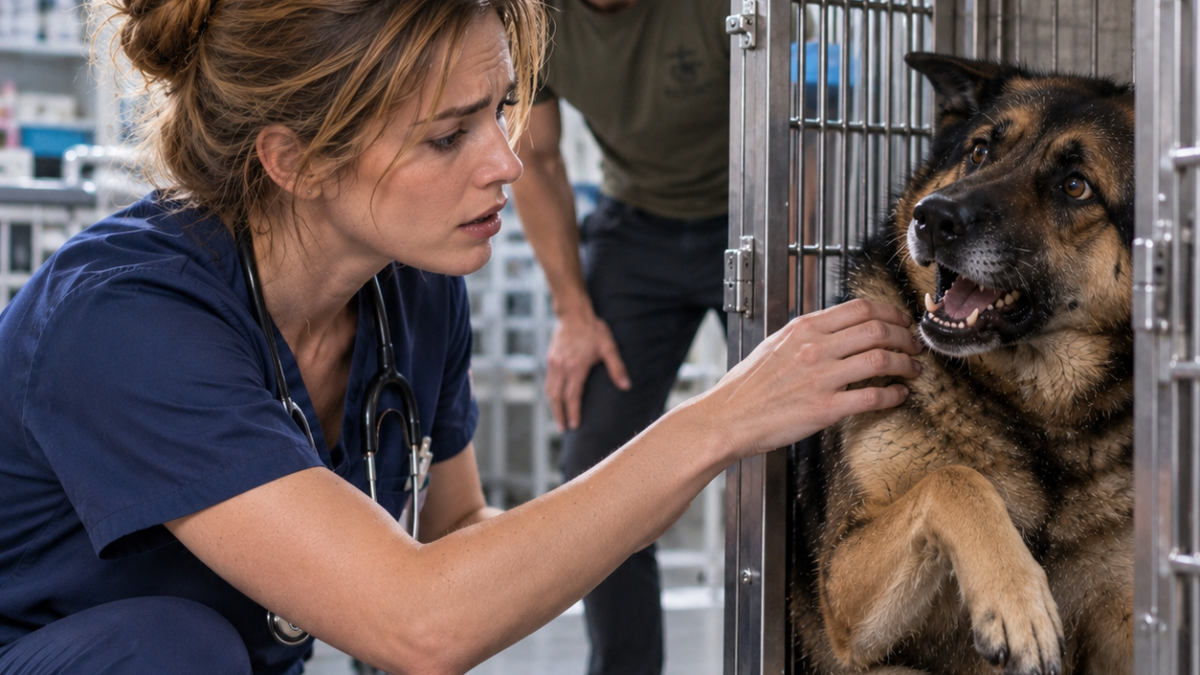
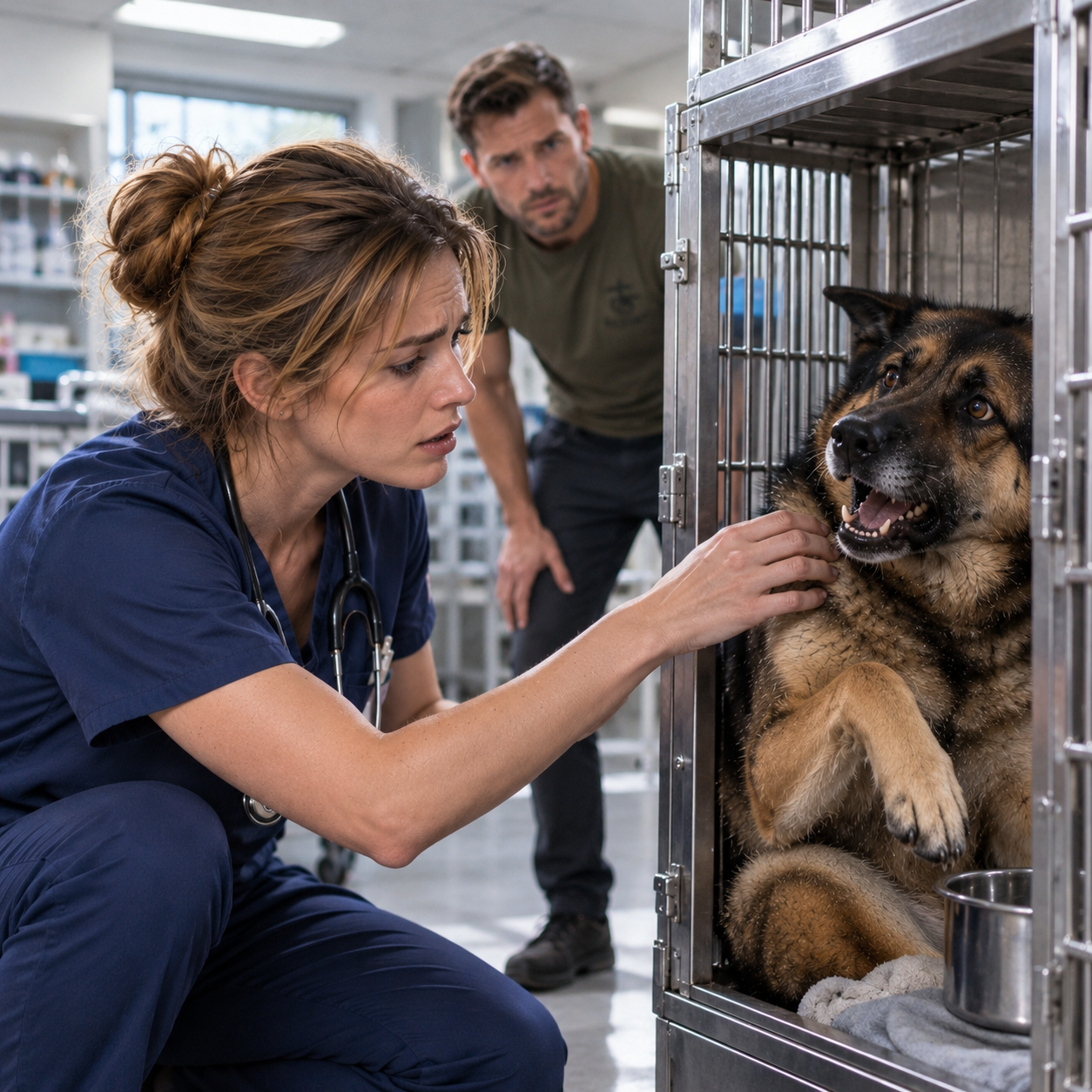
She looked through the gate. The German Shepherd was large, gray beginning around his muzzle, full water bowl, almost untouched food, old dark leather collar. A scratched metal plate sat half hidden beneath the fur at his throat.
“What did he do?”
Emily asked.
Wouldn’t let the husband touch him.
Wouldn’t take food.
ignored every command except down. Spent half the visit blocking the doorway.
Bite. No.
Snap. No.
Mark looked at her.
He doesn’t have to hurt somebody to be wrong for a home.
Emily didn’t argue.
Months out of military service, Rook had been placed through the hospital’s partner program with families prepared to give a retired working dog a quiet life.
Three times he had come back. Mark tapped the paperwork against his leg.
People want a dog they can live with.
Rook acts like he’s still waiting for orders nobody’s giving him.
Rook? Emily asked. Program name easier for placement.
She looked again at the old collar. And the plate.
Mark followed her eyes. Came with him. As if the attention itself had weight.
The shepherd lifted his head. The collar shifted.
Fluorescent light crossed the scratched metal, exposing one word before the fur settled over it again. Wraith. Emily read it silently, then once aloud.
Wraith.
The shepherd’s eyes found hers.
Mark glanced from Emily to the dog. Old service name, call sign, maybe.
Records aren’t clear.
We kept Rook for the placement file. Emily looked at the worn plate.
Whatever Wraith had once meant, the dog carrying the name had already been returned by three families who wanted nothing more from him. She did not move closer. Wheels whispered against the polished floor behind them.
A rehabilitation aid was pushing a veteran past the kennel, one leg elevated beneath a gray blanket. Wraith changed instantly.
His ears lifted, his head came up. Before the wheelchair reached the doorway, he was standing. He moved to the front of the kennel and angled his body between the passing veteran and the open corridor behind him.
No growl, no bark. He simply held the position until the wheelchair passed.
Emily’s coffee stopped halfway to her mouth.
Mark was already looking back at his paperwork. When does he leave?
She asked. Transport review Monday morning.
If there’s no placement recommendation, regional holding facility.
Can that move? Not without something measurable in his file.
Emily looked back at Wraith. He had returned to the same spot facing the rehabilitation corridor.
How long do I have? Mark studied her. Until tomorrow afternoon.
Give me that. For what? Emily set her coffee down.
To watch him before somebody asks him for something.
Mark’s expression tightened slightly.
Three families already watched him. No, they tried to take him home.
She crouched.
Wraith’s shoulders tightened.
Emily stopped immediately. Instead of moving closer, she sat on the floor several feet from the gate, turned her body sideways, and rested her hands loosely in her lap. Mark frowned.
What are you doing watching from the floor? He noticed me crouch. Emily kept her eyes off Wraith, so I stopped.
The ventilation system breathed overhead. Somewhere farther down the hall, metal instruments rattled inside a cart. Wraith shifted.
His collar gave a faint metallic click. Emily did not look at the plate again.
Every family walks straight up to him, she said.
That’s usually how introductions work.
And every time he backs away. Mark folded his arms.
He’s trained.
Commands should give him structure. He heard them. He ignored them.
Emily watched the reflection in the kennel glass instead of turning toward the dog.
He didn’t ignore the room.
Mark’s expression changed just slightly.
Wraith’s attention moved with every sound from the rehabilitation wing.
Wheelchairs, uneven footsteps, doors opening, doors closing. Not the food, not the toys, not the people trying to take him home.
Emily waited.
After almost a minute, Wraith’s shoulders lowered.
He stepped back once, then settled onto the concrete while she remained there. His eyes stayed on the doorway. Mark glanced at the clock.
Tomorrow afternoon doesn’t move.
I know.
Then whatever you think you’re seeing, find it fast.
He walked toward the office. Emily remained on the floor.
Wraith’s breathing slowly evened out.
Then a cane tapped against the hallway tile once. Twice.
Before the veteran carrying it reached the kennel. Wraith was on his feet again.
He moved forward, turned sideways, and placed himself between the injured man and the open doorway. The veteran passed. Wraith held position until the sound of the cane faded down the corridor.
Then he looked once at Emily. She looked at the scratched plate beneath his throat. Wraith.
Three families had seen a dog who would not settle into a home. Mark had seen a retired K9 waiting for orders nobody was giving him. Emily finally understood what everyone else had called refusal.
Wraith wasn’t waiting to be taken home.
He was still guarding someone. The transfer order was waiting when Emily returned for her next shift.
Mark set Rook’s file on the counter between them.
Monday, 800 a. m.
through the kennel window. The shepherd was standing exactly where Emily had left him, watching an older veteran work his way down the corridor with a walker.
Click, step, click, step.
Rook’s ears tracked every uneven movement.
The scratched plate beneath his collar stayed mostly hidden, but Emily no longer needed to see it to remember the name engraved there. Wraith.
Final behavior notes are due tomorrow afternoon, Mark said. Emily kept watching the dog. Give me until then.
For what?
To find out whether he’s refusing people or refusing what people keep asking him to become.
Mark rubbed a hand across his jaw. Three placements failed.
Emily, I can delay paperwork.
I can’t invent a reason to keep him here.
Don’t invent one.
She slid the file back toward him. Let him give us one. Mark studied her, then pulled the transfer sheet from the folder and left it unsigned.
Tomorrow afternoon, I need something measurable. Fair.
Emily went back to work. On every break, she returned to the kennel and changed almost nothing.
Same chair, same distance, same quiet warning before the outer door opened. No reaching through the gate, no repeated commands, no treats held between her fingers like a bargain.
When an aid suggested calling Rook over, Emily shook her head. Leave him and exit.
You want him to do nothing? I want to see what he does when nobody pushes him.
For the first 10 minutes, Rook stayed near the rear wall. His food remained untouched. Emily opened a patient chart and read.
Afternoon light stretched across the concrete, catching dust in the air. A wheelchair passed outside.
Rook’s head lifted.
A supply cart followed. One ear turned. Then a veteran with a cane paused near the drinking fountain.
Rook stood until the man moved on. Emily wrote down the time.
Nothing else. 20 minutes passed before claws scraped softly against the floor.
She did not look up. Rook approached the bowl, stopped, looked at her, then ate. A few mouthfuls at first, then more.
Emily marked the distance between them and the time he began. When Mark read the sheet later, he frowned.
“Eating with you 6 feet away doesn’t make him placement ready.”
“No.
” “Then what did we learn?”
Emily glanced through the glass.
“He eats when nobody asks him for anything.
That could mean a dozen things.”
“It could,” she tapped the observation sheet.
“But now it’s something we can test instead of something we assume.”
Mark looked at the notes again. wheelchair, cart, cane, food, distance. Tomorrow morning, he said inside the enclosure.
I stay at the gate. Emily nodded.
His choice whether I get close. The next morning, the air inside the enclosure smelled of damp fur and floor antiseptic.
Mark remained beyond the gate while Emily placed Rook’s bowl on the concrete and stepped away.
She did not call him. He waited 40 seconds before approaching. He ate.
When he finished, he stayed within several feet of her instead of retreating to the rear wall. Emily noticed the change, but did not reward it with movement.
She waited. Rook looked toward the corridor, then back at her. The old leather collar had twisted against his neck, the buckle pressing crookedly into the thick fur.
Emily raised one hand slowly, not to grab him, just to straighten it. Rook exploded backward.
The metal bowl shot across the concrete with a violent scrape.
His hind quarter struck the wall, his body locked rigid, his eyes fixed not on Emily’s face, but on her hand.
Mark’s fingers closed around the gate latch.
Emily, stay there. She lowered her hand immediately.
Then she stepped sideways, clearing Rook’s path to the doorway.
I’m backing off.
No command, no soothing touch, no second attempt.
Rook’s chest moved fast beneath his coat.
Emily kept her hands visible and waited. 5 seconds. 10.
The shepherd shifted sideways, not deeper into the kennel, toward the corridor.
His shoulder turned toward the doorway, and his eyes went back to the veteran’s wing.
Even frightened, he had returned to the same position. Emily looked at the collar. The leather had shifted enough to expose part of the scratched plate, raw.
Then fur covered it again. She already knew the rest.
What she didn’t know was why a hand moving toward that collar frightened him more than a stranger sitting inside his enclosure.
“Write that down,” she said.
Mark released the latch.
“What exactly?”
“He ate with me inside.
He stayed near me after he finished.
He didn’t react when I moved around the enclosure.
Emily kept her eyes on Rook.”
The reaction started when my hand moved toward the collar. Mark looked at the worn leather, which makes him harder to place. Maybe.
Emily picked up the observation sheet from the floor, but hard to place describes our problem.
It doesn’t explain his.
Mark was quiet.
Rook’s breathing slowed.
A walker clicked somewhere beyond the glass. His ears turned immediately toward it.
His body followed. Emily added one more note to the sheet.
Mark watched her right. You still think the doorway matters more than the collar?
I think they’re two different questions.
Which one comes first? Emily looked through the kennel window toward the rehabilitation wing. An elderly veteran was moving slowly past with an aid beside him.
Rook tracked every step. The one he keeps answering.
Mark followed her gaze.
For the first time, he did not look at the dog’s untouched toys, the placement form, or the handling notes.
He watched where Rook was watching. The veteran reached the end of the corridor.
Only then did the shepherd settle. Mark left the transfer form unsigned on the counter.
Tomorrow, he said, “Show me what he’s watching for.
” Emily looked at Rook.
“Yesterday, everyone had been asking why the retired K9 would not become somebody’s dog.”
Now, Mark had finally asked what Rook was still trying to do. Rnrn.
The next morning, Mark was waiting outside Rook’s enclosure with the observation sheet folded beneath his arm.
He did not touch the gate.
“You said he’s watching for something,” he said.
“Show me.
” Emily looked through the glass.
Rook was already awake, standing where the kennel corridor opened toward the rehabilitation wing. His body faced the doorway, his eyes tracked movement beyond it.
Not in here, Mark’s eyebrows lifted.
You want him out? Controlled room. No handling test.
No placement commands unless safety requires one.
We watch what he chooses when there’s something real to respond to.
Mark checked the wall clock. 15 minutes.
20 minutes later, Rook entered a small rehabilitation room on a loose lead held by Mark. Warm sunlight cut across the rubber flooring. Parallel bars ran along one wall, and the room smelled faintly of disinfectant and vinyl padding.
Rook ignored the equipment, his attention locked onto Daniel Price. The young Marine was halfway between the parallel bars, moving carefully on forearm crutches. Before each difficult step, Daniel tugged once at the strap around his right wrist, shifted his weight, then moved.
Rook watched every adjustment. Daniel glanced over.
“That the dog nobody wants.”
“That’s the one,” Mark said.
“What am I supposed to do?”
Daniel asked. Emily stayed near the wall.
“What you were already doing?
That’s it.
That’s it.”
Daniel looked at Rook once more, then returned to the bars. Mark let the lead hang loose. Out of habit, he said.
Rook, sit.
One of Rook’s ears turned toward him.
Nothing else did. Mark glanced at Emily. She raised one hand.
Wait. Daniel reached the end of the bars and began his turn. His right crutch planted slightly wider than the left.
He corrected it. Behind him, an aid pulled a stainless steel tray from a supply cart. The edge caught.
Metal struck tile with a sharp crash. Daniel flinched.
His right crutch slipped several inches. Rook moved before anyone said his name.
He crossed the room fast. Not toward the fallen tray, not toward the aid.
Toward Daniel. He stopped beside the marine and angled his body between Daniel and the open doorway. No bark, no growl, silent, balanced, watching.
Daniel froze with both hands locked around the crutches. Mark began gathering the loose lead.
Don’t, Emily said, he stopped.
Rook was not pulling toward the noise.
He wasn’t looking at the tray at all.
His eyes moved from Daniel’s unstable stance to the open doorway, then back to Daniel.
Emily kept her voice level. Daniel, you steady? He tested the rubber tip of his right crutch against the floor.
Give me a second. Take it. Daniel breathed out.
His fingers found the wrist strap. One tug, he reset the crutch himself. Okay.
Emily did not tell him to move. Daniel made that decision.
He shifted his left foot and completed the turn. Rook moved with him.
Daniel took another step. The shepherd matched it close enough to respond far enough not to touch him. Step.
Pause. Step.
By the third, Daniel’s grip had loosened.
By the fifth, he was looking ahead instead of down. The fallen Trey remained behind them. Rook never looked back at it.
He stayed beside Daniel until the marine reached the chair and lowered himself into it. Only then did Rook step away. Mark stared at the slack lead in his hand.
He heard the crash.
Yes, but he didn’t go after it.
Emily watched Rook return to the center of the room. No.
Mark looked toward Daniel. He went to him. Daniel rested the crutches against his knees.
Felt like he knew I was off balance before I did.
Emily didn’t answer for Rook.
She didn’t need to.
Mark looked down at the command section of his observation sheet. Sit.
No response. then at Daniel, then at Rook.
He still ignored the command. Emily nodded. Yes.
And chose this instead. Yes.
The answer landed differently when Mark said it himself. He looked toward the open doorway. Rook had positioned himself where he could see Daniel, Emily, Mark, and the corridor at once.
“That doesn’t make him ready for somebody’s living room,” Mark said.
“No.”
Emily looked at the same doorway.
“Maybe that’s not the question anymore.”
Silence settled over the room. Daniel rubbed his thumb once across the wrist strap. Can I try another pass?
Mark looked at him.
You don’t have to prove anything for the dog.
I know. Daniel set the crutches beneath his arms.
I want to see what he does. Emily stepped farther back.
Then it’s your session.
Daniel stood. No tray fell this time. No one called Rook.
Daniel moved between the bars at his normal pace. One step, two. Rook watched from the center of the room.
Daniel reached the first difficult turn. His shoulders tightened. His thumb caught the wrist strap.
Rook stood. He crossed the room and stopped several feet away.
Daniel saw him, took one breath, reset his right crutch, and continued. Rook followed.
Mark’s eyes dropped to the observation sheet.
This time, when his pen moved, he did not write beneath the command section. He drew a single line through placement evaluation. Beneath it, he wrote functional behavior assessment.
Daniel reached the chair and sat. So, what happens now?
Mark looked at the new heading. One supervised session tomorrow. We document what he does without pretending we already know what it means.
Emily nodded. You approve the canine protocol.
Mark looked at Daniel. And you participate only if you want to.
Daniel tightened the wrist strap once, then released it.
I’ll do it.
Mark handed Emily the sheet. Two days earlier, everyone had measured Rook by the commands he ignored, the hands he avoided, and the homes he could not fit into.
Now, the first measurable thing in his favor had come from a decision nobody had ordered him to make. The dog nobody wanted had not forgotten how to work.
Everyone had simply been asking him to stop. The next afternoon, Mark stayed against the wall with his clipboard and let the lead hang loose. Daniel sat beside the parallel bars, one forearm crutch across his knees, his thumb brushing once across the strap at his right wrist.
Rook waited near the doorway. Same thing as yesterday?
Daniel asked. Emily shook her head. Yesterday we watched what he did when you lost balance.
Today we find out what happens when nothing goes wrong. Daniel glanced at Rook. What do I do?
Your normal session.
Don’t perform for him.
And him? We give him the same deal. Emily took a chair several feet away and sat.
Mark wrote the time at the top of the assessment sheet. No command followed. Daniel stood.
His sneakers gave a soft squeak against the rubber floor as he entered the parallel bars. The first steps were controlled. Rook remained at the doorway.
Daniel reached the turn. His shoulders tightened.
His right hand closed harder around the rail and his thumb caught the wrist strap. Emily saw it. So did Rook.
Pause. she said.
Daniel, I’m fine.
I know. Emily stayed in her chair. Take one breath before you decide what comes next.
Daniel drew air through his nose and released it slowly again.
Across the room, Rook’s ears shifted.
Daniel’s shoulders dropped half an inch.
Rook left the doorway. He crossed the room without looking at Emily or Mark and lowered himself several feet from the bars.
Daniel noticed him. Emily said nothing.
Another breath, longer this time.
Rook’s chest rose and fell against the mat.
Daniel watched once, then exhaled, not perfectly with the dog. Close enough. He adjusted his grip and moved.
Step, pause, breathe. Rook stood when Daniel advanced.
When Daniel stopped, the shepherd settled again. On the second pass, Emily gave only one reminder. On the third, none.
Daniel reached the difficult turn, felt his shoulders rise, and stopped himself. Breathe.
Reset. Step.
Rook remained beside the bars. By the fourth pass, Daniel was no longer looking toward Emily at all.
Mark lowered his clipboard.
He’s pacing himself off the dog.
Emily kept her voice quiet.
For now, you don’t want that.
I want Daniel to own the rhythm eventually. Daniel heard her. at the chair.
He lowered himself carefully and wiped his forehead with the back of his wrist.
You think I’m going to depend on him?
Emily looked at him. I think anything useful should leave you with more choices, not fewer.
Daniel considered that. Then he looked toward the far end of the bars. His thumb touched the wrist strap once.
One more.
Emily didn’t answer.
Neither did Mark. Daniel stood because he had decided to.
This time, Rook stayed where he was. Daniel took the first step alone, then the second.
His shoulders tightened before the turn. He paused.
One breath, reset, another step. Rook watched from several feet away.
Daniel completed the turn. Only then did the shepherd rise and follow, keeping distance between them.
Mark’s pen moved across the sheet.
Daniel reached the chair and sat. His breathing was heavier now, but controlled. He looked at Rook and smiled faintly.
You made me do that one myself. Rook settled near the bars.

