Betrayed by Her Fiancé and Sister, She Chose the Mafia Boss—Now They Could Only Watch
Betrayed by Her Fiancé and Sister, She Chose the Mafia Boss—Now They Could Only Watch
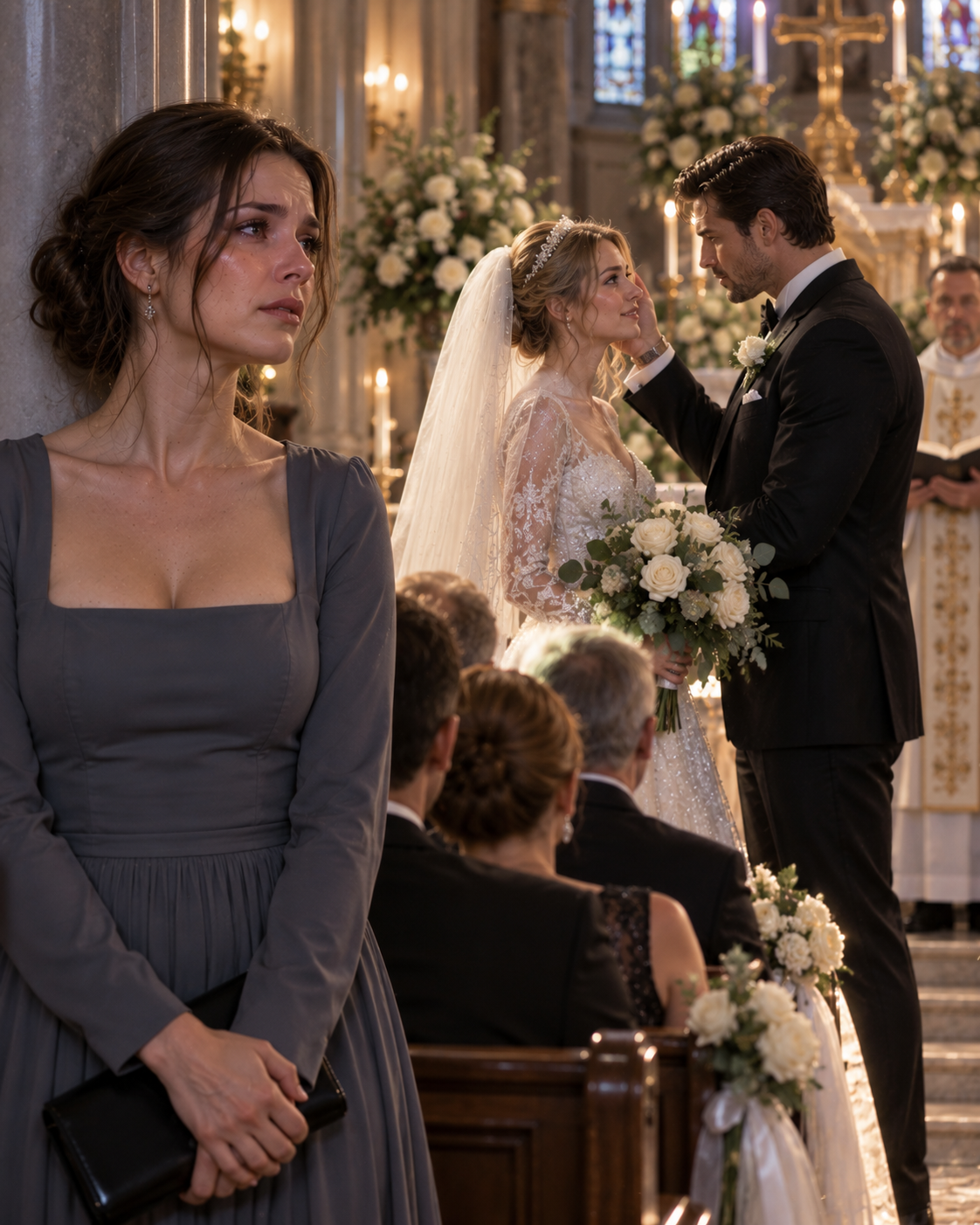
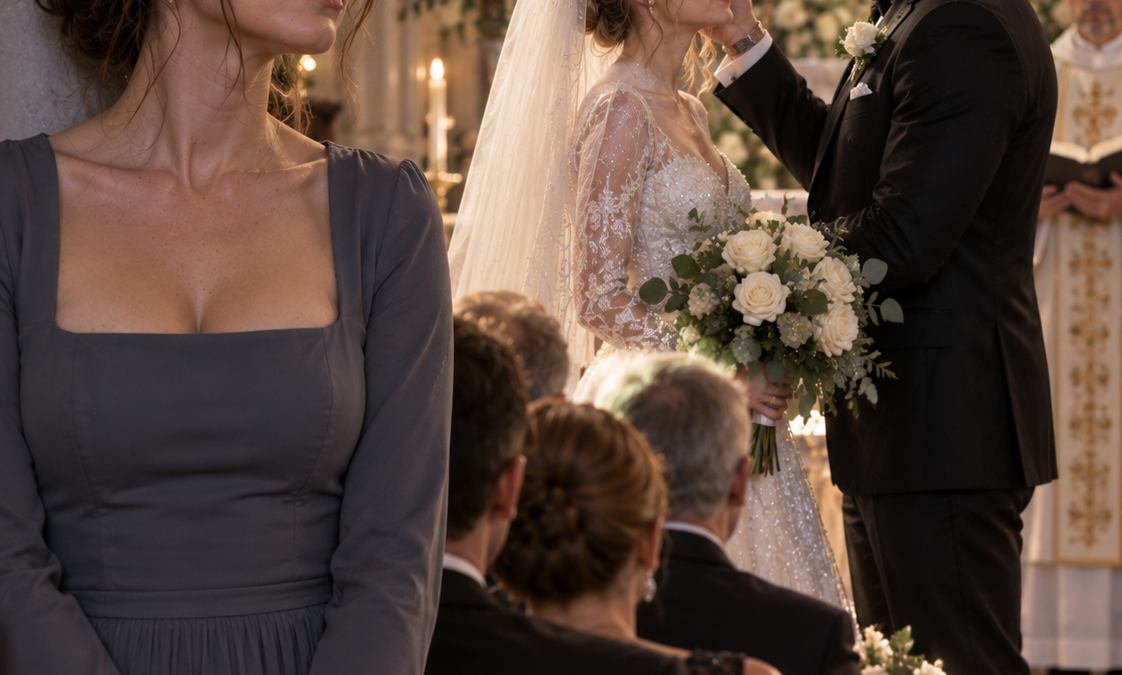
Preston Whitmore reached across the altar and straightened Meline Carter’s veil with the same careful hands that had once brushed the hair from Evelyn’s face on a Tuesday morning when she had a fever and couldn’t get out of bed.
That was the moment Evelyn understood.
Not when she’d received the invitation.
Not when she’d seen her sister’s name printed beside his.
Not even when she’d walked into the church and heard the organ play.
It was that small practice gesture, so intimate, so automatic, that told her this hadn’t started yesterday.
This had been going on for a long time.
She stood in the back of the church in a gray dress she’d bought 3 days ago because nothing in her closet felt right anymore.
And she watched the man she had loved for 6 years touch her younger sister’s face like he’d been doing it in secret for God knows how long.
The pews were full of Boston’s finest.
People she’d attended dinner parties with.
People who had smiled at her from across tables, asked about her work, called her by her first name. Not one of them turned around.
Evelyn Carter was 34 years old and had spent the last decade building a career in legal research that most people in her field quietly envied and publicly ignored.
She wasn’t flashy.
She wasn’t loud.
She worked in a corner office on the seventh floor of a firm that paid her well and promoted her slowly and occasionally forgot to invite her to lunch.
She had a one-bedroom apartment in Cambridge with good windows and too many books, a coffee maker she’d owned since graduate school, and a cat named Morris, who was indifferent to her the way only cats and ex-boyfriends can be.
She had Preston for 6 years.
She had Preston Whitmore, whose family had been Boston money for three generations, who wore his wealth the way some people wear old sweaters, casually and without thinking about it, who had walked into her life at a charity auction she’d attended alone and said, “You look like you’re calculating an exit strategy.”
And she’d laughed before she could stop herself.
He wasn’t the most emotionally available man she’d ever dated.
She knew that early.
He had a habit of going quiet at precisely the wrong moments, of turning conversations about feelings into discussions about logistics, of saying, “I love you.
” Most convincingly when they were in public, and least convincingly when they were alone.
But she’d told herself that was just how some men were built.
That consistency was its own kind of love. That showing up, paying attention, choosing someone day after day, that counted.
She’d been wrong about a lot of things.
She found out about the wedding the way people find out about most devastating things, by accident.
A email meant for a different Evelyn forwarded by mistake from Preston’s assistant.
She’d stared at the subject line for four full minutes before she opened it.
The details were already confirmed. The venue, the florist, the guest list. Her own name was not on it.
She’d called Preston.
He hadn’t answered.
She’d called three more times.
He’d finally picked up on the fourth and said in a voice that was almost steady, “I should have told you sooner.”
That was all the explanation she got. She should not have gone to the church. She knew that while she was getting dressed.
She knew it when she called a car. She knew it the entire 20-minute drive, sitting in the back seat, watching her own reflection in the rain streaked window. But something in her, the part that had loved him seriously, the part that had built a future in her mind with his name in it, needed to see it with her own eyes.
needed the confirmation to be physical and undeniable, not just a forwarded email and four words over a telephone. So, she went.
The church was St.Sebastian’s on Beacon Hill.
Of course, it was. The Whitmore family had been attending that church for 50 years.
Preston’s grandmother was buried in the churchyard.
The stone steps were flanked by white roses. And the doors were propped open, and the music was already playing when Evelyn arrived and slipped inside and stood at the very back, half hidden behind a pillar, and looked up at the altar.
And there was Meline. Her sister was 28, 6 years younger, 3 in taller, and possessed of a social ease that Evelyn had always quietly marveled at and never quite managed to replicate.
Meline had their mother’s eyes and their father’s confidence and a laugh that filled rooms in a way Evelyn’s never had.
They had not been close in the way sisters in movies are close. They were civil.
They called on birthdays. They attended the same family dinners and talked around each other in the practiced way of people who share blood, but not much else.
Or so Evelyn had believed.
Standing at the back of St.Sebastian’s watching Preston take Meline’s hands at the altar.
Evelyn understood that she had been watching the wrong story entirely.
She’d thought she was the main character in her own relationship.
Turned out she’d been a placeholder.
The veil adjustment. That was what finished her.
Preston reached up with both hands, careful and sure, and straightened the lace at Meline’s temple.
Meline looked up at him with an expression that Evelyn recognized. Open, trusting, privately delighted.
And something in Evelyn’s chest cracked at a molecular level.
She didn’t cry.
Not then.
She couldn’t.
The grief was too large and too sudden, and it pressed against the inside of her ribs like something that needed more room than she had to give it. She turned around and walked back out the door. Nobody stopped her.
Nobody called after her.
Two women near the front who’d seen her enter, women she’d met at the Whitmore Fourth of July party 2 years ago, women who’d asked for her card, turned back to the altar without a word.
She walked down the stone steps in the rain.
She hadn’t thought to bring an umbrella.
The April storm had been forecast since yesterday, and she’d known it and walked out of her apartment without one anyway, which felt in this moment like a small and perfect metaphor for her entire adult life.
The street outside the church was mostly empty, a few black cars idling at the curb, valet and white jackets standing under the awning of the reception venue next door, already arranging themselves for the evening crowd. Evelyn walked past all of it.
She didn’t know where she was going.
She just needed to be moving. Needed the cold air and the rain and the sound of her own footsteps doing something purposeful, even if the purpose was simply escape. She ended up at the harbor.
It was a 12-minute walk from St.Sebastian’s, and she made it in 9, and by the time she reached the water, she was soaked through, the gray dress clinging to her arms, her hair flattened against her forehead, rain running down the back of her neck.
She stood at the railing above the dark water and put both hands on the cold iron and just breathed.
The harbor smelled like salt and diesel and something she couldn’t name.
Something ancient and indifferent, like the ocean really didn’t care what happened to her, which was almost comforting in its honesty.
She thought about the last 6 years in pieces.
The first apartment they’d shared briefly when they were figuring out what they were.
The way Preston took his coffee, black, too hot, too fast, burning his mouth every single time and never changing.
The fight they’d had in December about whose family to spend Christmas with, which she’d thought at the time was a fight about logistics, but now understood was a fight about whether he ever intended to choose her.
The way Meline had visited for Thanksgiving 18 months ago, and stayed for 5 days, and was warm and charming and helpful in the kitchen, and hugged Preston goodbye at the door. 5 days. Evelyn gripped the railing harder.
She was so deep inside her own head that she didn’t hear the car stop behind her.
Didn’t hear the door open.
Didn’t register anything until a black coat, heavy wool, warm, smelling faintly of something expensive and unidentifiable settled over her shoulders from behind.
She spun around.
The man standing in front of her was not someone she’d seen before, and she would have remembered.
He was somewhere in his mid-40s, not conventionally handsome in the Preston Whitmore sense of square jaw and good breeding, but the kind of man who occupied space with a density that made the air around him feel different. Dark eyes, gray at the temples.
He was wearing a charcoal suit that had not been bought off a rack, and he was now standing in the rain without his coat, watching her with an expression that was not pity and not curiosity, and not the particular brand of cautious male interest she’d learned to identify and deflect.
It was something else, assessment, maybe the kind of attention you’d pay to something that surprised you.
Behind him, a black sedan sat at the curb with the engine running.
The driver didn’t look back.
You’re going to get sick, the man said.
His voice was lower than she expected, unhurried, the voice of someone who’d learned a long time ago that raising it was unnecessary.
I’m fine, Evelyn said, which was the least accurate sentence she had ever spoken.
He looked at her for a moment at the soaked dress, the ruined hair, the iron grip on the railing, and said nothing.
He didn’t call her on it.
He just stood there in the rain getting wet while she wore his coat, and the silence between them was strangely not uncomfortable.
“That’s Dominic Ashford’s car,” someone said behind her.
She turned. A man in a valet uniform had stepped out from under the awning further up the block and was murmuring urgently to his colleague.
Both of them were staring at the sedan. The name meant something. Evelyn was a legal researcher.
She knew names. Dominic Ashford had come across her desk twice in the last 3 years. Once in connection with a federal case her firm had adjacent involvement in.
Once in a newspaper article about a waterfront development deal that certain city council members had been suspiciously enthusiastic about. The Asheford family had been in Boston for nearly as long as the Witors, but in a completely different direction.
Old money in the Whitmore sense meant prep school and riotta season and country club memberships. Old money in the Ashford sense meant something murkier, longer rooted, and considerably more dangerous. She looked back at him.
You’re Dominic Ashford, she said.
Yes, I know who you are. Most people do, he said without any particular pride or discomfort.
Just fact.
Then you’ll understand why I’m not in the mood for whatever this is.
She meant to hand his coat back. She started to take it off.
The rain hit her shoulders immediately, and she stopped. Something at the corner of his mouth shifted.
Not quite a smile.
“Keep it,” he said.
“I have others.
She kept it.”
She didn’t know why she stayed at the railing instead of walking away.
She was cold and embarrassed and grieving in that raw, stupid way that doesn’t leave room for dignity.
And the sensible thing would have been to call a car and go home and sit with Morris and be furious in private. But there was something about the way this man stood in the rain without apparent concern for his suit or his schedule or the spectacle of it that made her not comfortable exactly, but less alone. You came from St.Sebastians, he said.
It wasn’t a question.
I did. The Whitmore wedding. She looked at him sharply.
You know them? I know everyone in this city. He paused.
I also know that the man marrying Meline Carter was engaged to her sister until about 3 months ago. The words landed without softening. Evelyn felt them in her sternum.
3 months, she repeated. Give or take.
The invitations went out 6 weeks ago. Yes.
He let that sit there. Let her do the arithmetic on what it meant. That the engagement had been broken.
That the wedding had been planned. That the invitations had been sent.
that all of this had happened in an overlap that meant the ending of her relationship and the beginning of theirs weren’t as sequential as she’d been led to believe.
The rain came harder.
“Why are you telling me this?”
she asked. Dominic Ashford was quiet for a moment.
He looked out at the harbor the way people look at large bodies of water when they’re choosing their words carefully.
“Because someone should,” he said.
She didn’t have an answer to that.
She turned back to the water. behind her.
She heard him, not leaving, not coming closer, just present, the way a person can be present without making demands of the space.
“I have a proposal for you,” he said after a while.
She almost laughed.
“I’m not in this market.”
“Not that kind.”
He was quiet again, “Then I need a wife.
You need a reason to walk back into that ballroom tonight and not feel like the woman they discarded.
Those two things aren’t unrelated.”
She turned around slowly. He was watching her with the same steady attention as before.
Rain running down the side of his face, suit jacket soaked through the shoulders now, and he looked completely unbothered by all of it.
“You don’t know me,” she said.
“I know enough.”
“That’s not reassuring.
” “It wasn’t meant to be reassuring,” he said.
“It was meant to be honest.”
She stared at him.
The harbor wind was cold and the rain hadn’t let up.
And she was wearing a stranger’s coat and her sister was at this moment probably dancing with the man.
Evelyn had spent 6 years building a life with. And Dominic Ashford was standing in front of her offering something that made no sense and every kind of terrible sense simultaneously.
Tell me what you mean, she said. All of it. What you actually mean.
He looked at her for a long moment. Not here, he said. You need to get warm first, then we can talk.
She should have said no. Every reasonable self-protective instinct she possessed told her to say no, to hand back his coat and walk away and process this night alone the way she processed everything quietly, systematically without asking anyone for anything.
Instead, she heard herself say, “Where?”
And Dominic Ashford nodded once and turned back toward the sedan and held the door. Evelyn stood in the rain for another 3 seconds. She looked back at the harbor one more time, at the dark water, the lights of the far shore blurring through the weather, the city that had just watched her get replaced without blinking.
Then she walked to the car. The car was warm.
That was the first thing.
Evelyn hadn’t realized how cold she’d gotten until the door closed behind her and the heat from the vents touched the side of her face and her hands started to shake.
not from fear, from the body finally being allowed to react to 40 minutes of standing in April rain without a coat. She pressed her fingers flat against her thighs to stop it and stared straight ahead at the partition between the passenger cabin and the driver.
Dominic got in on the other side.
He didn’t look at her immediately.
He said something to the driver in a low voice. Two words, maybe three, and the car pulled away from the curb smoothly, like it had been waiting for exactly this and nothing else. Where are we going?
Evelyn said, “Somewhere with towels and a working fireplace.”
“That’s not an address.”
“No,” he agreed.
She looked at him. He was looking out his window at the rain blurred street, and she had a moment to study his profile without him knowing.
The slight tension in his jaw, the line of his shoulders, the way he held his hands loose in his lap, like a man who had trained himself out of fidgeting a long time ago. He looked like someone who had learned stillness the hard way.
You said you’d explain, she said.
I will.
I’d like to start now.
He turned from the window and looked at her with that same unhurried attention.
You’re still shaking.
I’m aware.
Then let me rephrase.
You’ll hear it better when you’re not hypothermic.
It was not said unkindly. That was the thing she kept bumping against. The absence of condescension in his voice.
He wasn’t managing her.
He wasn’t performing patience.
He was just stating what he observed, the way someone states the weather. She looked away first.
The car took the bridge north, away from Beacon Hill, away from St.Sebastian’s and the reception venue and all of it.
The city thinned on either side of them. The rain followed.
Evelyn sat with Preston’s face in her mind.
That moment at the altar, hands on the veil, and tried to locate something useful inside the wreckage of the last 3 hours. Anger would have been useful.
Anger was clean and gave you direction. What she had instead was something more diffuse, a kind of stunned exhaustion, like her entire nervous system had overloaded and tripped its own breaker.
She felt hollow. Carefully, precisely, hollow.
She noticed she was still wearing Dominic Ashford’s coat.
The estate was 40 minutes north of the city, set back from the coastal road behind an iron gate that opened without the car slowing down. The driveway was long and the grounds on either side of it were dark in the rain, but she could see the shapes of trees and something like a garden wall.
And then the house itself, not a mansion in the showy sense, not the kind of thing Preston’s family built to be photographed.
It was large and old and serious, stone and dark timber, the kind of structure that said, “We have been here a long time and intend to remain.”
A woman was waiting at the front door.
late 60s, gray hair pulled back, the build of someone who’d spent decades on her feet.
She didn’t look surprised to see Evelyn.
She didn’t look anything in particular.
She simply stepped aside and said, “The blue room’s ready.”
And that was that.
“This is Margaret,” Dominic said.
“She’s run this house for 23 years.”
“24,” Margaret said, already walking.
Evelyn followed her up a staircase that smelled like old wood and something floral she couldn’t identify.
The blue room turned out to be exactly that, a bedroom with walls the color of a deep winter sky, a fireplace that was already going, and a bathroom attached where towels had been set out that were thicker than anything Evelyn owned.
“There are dry clothes in the wardrobe,” Margaret said from the doorway.
“Nothing fancy, practical.”
“Thank you,” Evelyn said.
Margaret looked at her for a moment with an expression that was difficult to categorize.
“Not warm, exactly.
not cold, measured like she was seeing something and filing it away.
He doesn’t bring people here, Margaret said.
Then she pulled the door closed. Evelyn stood alone in the blue room for a full minute before she moved.
She peeled off the gray dress and hung it over the radiator. She stood under the hottest shower she could tolerate until the shaking stopped and her fingers stopped feeling like they belonged to someone else. She put on the clothes from the wardrobe, dark trousers, a cream colored sweater that was too large in the shoulders, wool socks.
She looked at herself in the bathroom mirror and thought, “You don’t look like someone who just watched her sister marry her ex- fiance.
You look like someone who borrowed someone else’s life by accident,” which she supposed was close enough to accurate.
Dominic was in the study on the ground floor when she came back down. The room was book heavy and fire lit and smelled like coffee and something she eventually identified as gun oil faint almost beneath detection but there he was standing at the window with his back to her and a cup in his hand still in his suit but without the jacket now sleeves rolled to the elbow.
He heard her come in and turned around eternally. She looked at the chair nearest the fire and sat in it without being invited.
Talk.
He sat across from her, put his cup on the table, looked at her with that steadiness she was beginning to think might just be his face’s default setting.
I’ve been a widowerower for 4 years, he said.
My wife’s name was Catherine.
She died of a brain aneurysm in the kitchen of this house on a Thursday morning in November. She was 41. He said it flatly without the particular cadence of someone performing grief, which meant the grief was real and old and had been compressed into something manageable.
before she died. She was the reason a significant number of people in this city took me seriously outside of the circles I was born into.
Not because of anything she performed, because of who she was. Evelyn waited.
I run a family organization, he said. I think you know what that means.
I’ve read enough federal case files to have a working definition.
Then I won’t dress it up.
The Ashford family has been operating in New England for 60 years. I inherited it at 32 when my father had a stroke.
I’ve spent the last 12 years converting as much of it as possible into legitimate enterprise, real estate, logistics, private security contracting, a shipping concern up the coast.
We still have aspects that wouldn’t survive a close look from the right federal prosecutor.
He met her eyes.
I’m telling you this because you said you’d researched me and because I’d rather you know what you’re considering than agree to something you don’t understand.
I haven’t agreed to anything.
No, he said you haven’t.
She looked at the fire. You said you need a wife.
I need a particular kind of wife. There are factions within my own organization that have spent the last 3 years interpreting my restraint as weakness. My refusal to authorize certain operations, my movement toward legitimate business.
They read it as softness.
Catherine’s death removed a stabilizing factor I hadn’t fully understood while she was alive.
I was precise about it, analytical, but not without feeling.
She could hear that he’d thought about this many times in many different ways, and had arrived at honesty as the most efficient option.
A wife who is clearly her own person, educated, professionally established, not dependent on me for identity or income, communicate something specific to the people I need to communicate it to.
It says, “The man at the top has not become sentimental or easily managed.”
It says he chose carefully that he still chooses carefully. You want a symbol?
Evelyn said, “I want a partner.”
The symbolic value is a side effect. A partner in what exactly? In being seen, in attending the right events and handling the right rooms and not flinching when someone says something designed to test you.
You’d have complete independence in your professional life.
No interference, no requests, no obligation to perform anything beyond what we’d agree to in a contract.
a contract,” she repeated.
“Yes.”
She looked at him fully.
“You’re describing a business arrangement to start.
And what does it become?”
He held her gaze.
“I don’t know.
I’d rather not speculate about that in advance.
It was the most honest thing he’d said, which somehow made it the most unsettling.”
She stood up, walked to the window because she needed to be moving. Outside, the rain had eased slightly.
She could see the dark shape of what might be a garden wall, a stone path going somewhere, the faint line of the ocean beyond it all. Preston knew about you, she said to the window. The timing you mentioned, 3 months.
He ended our engagement 3 months ago and didn’t tell me until last week.
That means while he was ending us, the wedding was already being planned. Yes. Why?
Dominic was quiet for a moment. She heard him shift in the chair.
That’s the part I’d let you discover on your own.
She turned around.
Don’t do that.
He looked at her steadily. The Whitmore family has been under federal financial surveillance for 14 months. Their primary assets are significantly overvalued.
There are investors, quiet ones, old family money, who have been looking for a way to insulate themselves from the fallout.
Maline Carter’s uncle, Gerald Carter, manages three of those investment accounts.
Evelyn felt something cold move through her that had nothing to do with the weather.
“Gerald,” she said softly.
“He came to every family Christmas.
He brought the same wine every year. He asked about my work like he found it interesting.
He finds your work professionally inconvenient.”
Dominic said, “You’re a legal researcher with access to federal case filing databases and the analytical capacity to connect things other people miss.”
An alliance between the Witmore family and the Carter family through Meline removes a potential liability. You. The word landed in the room like something dropped from a height.
Evelyn stood very still.
She thought about the last 3 months, the slight cooling she’d attributed to stress.
Preston’s distracted quality at dinner, which she’d read as work pressure.
The way he’d stopped asking about her cases.
the two times she’d mentioned the Witmore name in the context of adjacent federal proceedings and he’d changed the subject.
He hadn’t gotten tired of her.
He’d been afraid of her.
“He threw me away,” she said, “because I might accidentally do my job too well.”
Dominic didn’t soften it.
“That’s my read.”
She turned back to the window. The ocean was barely visible now, just a dark suggestion beyond the wall.
But she fixed her eyes on it because she needed something that wasn’t moving, and the room felt suddenly very small.
She had loved Preston Whitmore for 6 years.
She had reorganized her professional schedule around his family’s summer house in Gloucester.
She had smiled through a hundred dinners with people who’d looked right through her because she’d believed she was building something that mattered.
She had been without knowing it, a piece on a board being moved by hand she couldn’t see.
The grief that came then was different from what she’d felt at the church.
The church grief was the grief of loss. This was the grief of humiliation.
The particular savagery of realizing you were never the point of your own story.
She didn’t cry.
She pressed one hand against the window glass and felt the cold come through it and breathed. All right, she said.
All right, what? She turned around.
Tell me what the contract looks like. Dominic studied her face for a moment. Whatever he saw there seemed to satisfy some internal assessment.
He stood, went to the desk in the corner, and opened a drawer. He came back with a folded document, not fresh, not just printed, something that had been prepared. She looked at it, looked at him.
You had this ready. I had it prepared as a possibility.
You knew I’d be at the church.
I knew you might be. He held it out.
Read it. Take as long as you need. She took it.
She stood by the fire and read it the way she read everything professionally, line by line, twice, paying attention to what was included and what was conspicuously absent. It was thorough.
Duration of arrangement, minimum one year, reviewed quarterly. Financial provisions that were more than fair.
Professional autonomy clause that was more explicit than she’d expected.
mutual exit conditions. A single line near the bottom that she read three times.
All parties enter this agreement with the understanding that the arrangement may develop in directions not anticipated at signing. She looked up.
This line, yes, it’s not typical contract language.
No, it’s a hedge.
It’s honesty, he said with a quietness that didn’t invite argument.
She looked back at the document.
She thought about her apartment in Cambridge with its good windows and its indifferent cat and the six years of her life that had just been retroactively reclassified as collateral damage in someone else’s financial strategy.
She thought about walking back into that reception ballroom tomorrow, the second evening of the Whitmore wedding celebration, as the woman who hadn’t been invited, as the woman who’d slipped out of the church in a wet dress, as the woman nobody had bothered to turn around for.
She thought about the particular expression on Preston’s face when he’d finally picked up her call.
That almost steadiness, the voice of a man who’d already made peace with what he was doing to her and wanted it over quickly.
She put the document on the mantle. I need tonight, she said. You have it.
I’ll give you my answer at 7 tomorrow morning.
That’s fine.
She looked at him.
He was standing 6 ft away, fire light on one side of his face, and he looked like a man who was accustomed to waiting for things and didn’t find it difficult.
Why me? She said specifically. You could have approached any number of women in this city, women who run in your world, women who already understand the rules.
Dominic was quiet for a moment. He looked at the fire.
Because every woman in my world already knows what they’d be getting, he said.
And every one of them would come with their own agenda, their own family’s interests, their own calculations.
I watched you stand at a railing in the rain for 20 minutes and not ask anyone for a single thing. He looked back at her.
That’s rarer than you’d think.
She held his gaze.
That’s not a complete answer, she said.
No, he said.
It’s not.
He picked up his coffee cup from the table.
I’ll have Margaret show you to your room.
The blue one’s already prepared.
I know. She already took me there.
Then good night, Miss Carter. She crossed the room toward the door. Her hand was on the frame when she stopped.
Evelyn, she said, “What?”
She turned halfway.
“If we’re going to do this, uh, and I haven’t said yes yet, but if we are, it’s Evelyn.”
He looked at her from across the study, fire light behind him.
“Good night, Evelyn,” he said.
She went upstairs. She lay in the blue room with the fire burning low and the rain finally stopping outside and her mind refusing to slow down.
She ran the contract language through her head again from memory, the provisions, the exit clauses, the hedge at the end. She thought about Gerald Carter bringing the same wine to Christmas dinner for as long as she could remember.
She thought about the way Preston had said, “I should have told you sooner.”
Not, “I’m sorry, not I was wrong.”
and how that single grammatical choice now made complete terrible sense.
He wasn’t sorry.
He was sorry about the timing.
She thought about the look on Dominic Ashford’s face when she’d asked why her specifically.
She thought, “You are considering agreeing to marry a man you met two hours ago who runs a criminal organization and lives in a stone house by the ocean and speaks like someone who has seen enough of the world to stop being surprised by it.”
She thought, “You are also a woman who spent 6 years building a life that turned out to be someone else’s insurance policy.
” She thought, “Those two things might not be unrelated.”
At some point before midnight, the exhaustion caught up and she slept. And when she woke, it was 6:43 and pale light was coming through the curtains and Margaret was already moving somewhere downstairs because she could hear footsteps with the particular purpose of someone who had been awake for hours.
She sat up. She put her feet on the floor.
She thought about it for exactly four more minutes, which was how long it took to acknowledge that her answer had already been decided somewhere around the third hour of lying in the dark, and that what she’d called sleeping on it had actually been her mind running the numbers and arriving at a conclusion her conscious self was only now catching up to.
She stood up. She found the dry clothes from the night before. She went downstairs.
Dominic was in the kitchen, not the formal dining room, the kitchen, standing at the counter with coffee and the morning paper, jacket off, and he looked up when she came in without any particular surprise, like he’d expected her at roughly this time.
She sat down across the counter.
“Yes,” she said.
He looked at her steadily.
“You’ve read the contract twice.
I want one modification.”
Which the professional autonomy clause. I want it broader.
Not just no interference, no consultation requests, no referrals, no cases directed my way through intermediaries. My practice stays completely separate from anything connected to your organization. If I find out later that a client came to me through you, the contract voids.
He considered this for about 4 seconds. Done.
In writing, I’ll have it amended before we leave.
She looked at him.
We’re leaving today.
The reception is tonight. He poured a second cup of coffee and put it in front of her without asking how she took it.
Black, it turned out, which she did.
If you’re going to walk back in there, it shouldn’t be as a rumor.
It should be as a fact. She wrapped both hands around the mug. The morning was gray through the kitchen window, the ocean visible now, flat and put, the kind of calm that comes after weather has exhausted itself.
Preston will be there, she said. Yes. Meline will be there.
Yes, Gerald Carter will be there. Dominic set his cup down.
He looked at her with a directness that was neither reassuring nor cruel. Gerald Carter will be there, he said.
And so will the two federal agents he doesn’t know have been attending every Whitmore social function for the past 8 months.
Evelyn’s hand stilled around the cup.
What?
She said, “The investigation I mentioned, it’s further along than the Whitmore family knows.
Last night was a threshold event. Certain financial transactions cleared in a pattern that apparently means something significant to the people monitoring them. He held her gaze.
Tonight’s reception may be the last social function Gerald Carter attends as a free man.
The kitchen was very quiet.
Evelyn looked at the cup, then at the window, then back at Dominic Ashford, who was watching her with the careful attention of someone who had just handed a person something heavy and was making sure they didn’t drop it.
You knew this last night, she said when you made the proposal. I knew the investigation existed.
I didn’t know the timeline had accelerated.
But you knew tonight was significant. A pause. Fractional.
Yes. She felt something shift inside her.
Not anger, not quite, but something adjacent to it. The sensation of a floor that you thought was solid developing a slight give.
Is that why you approached me? She said. because of what happens tonight.
Because of what it looks like if I’m there.
He didn’t answer immediately.
He looked at her the way he’d looked at her at the harbor.
That full unhurried attention. When he spoke, his voice was measured.
I approached you, he said, because of what I saw at that railing. Everything else is context. He picked up his cup.
But I won’t tell you the context is irrelevant.
That would be a lie, and I don’t do that.
Evelyn sat with it. The fire in the kitchen was smaller than the one in the study, but it was doing its job, and the coffee was good, and the morning light was coming through the window in that gray coastal way that makes everything look like a painting of itself.
And she was sitting across a kitchen counter from a man who had told her more truth in 12 hours than the man she’d loved for 6 years had managed in 6 years.
She put the cup down. I want the amendment in writing before we sign, she said. and I want to be the one who decides when we enter that room tonight, not you.
We go in when I say.
Something in Dominic’s face changed.
Small. The jaw eased a fraction of a degree. Agreed, he said.
She nodded once, picked up the coffee. Outside, the ocean sat flat and gray and patient, doing what oceans do, holding its depth below a surface that gave nothing away, waiting for someone to be foolish enough to assume that calm meant simple. Evelyn Carter had signed contracts before.
She knew that the moment of signing was never the actual point of no return. The point of no return was always earlier, some quieter moment when a decision crystallized in the body before the mind caught up.
For some people, it was a conversation. For some, it was a silence. For her, she understood now it had been the moment she turned away from the harbor railing and walked toward the car.
Everything after that was just paperwork.
The stylist’s name was Ranata, and she worked in silence, which Evelyn appreciated.
Margaret had arranged everything by 9 in the morning, a woman arriving at the estate with two cases, and the particular efficiency of someone accustomed to making people presentable on short notice.
She didn’t ask questions.
She looked at Evelyn once, walked a slow circle around her, and said, “We’ll go dark.”
Something that doesn’t apologize.
And Evelyn said, “Fine.”
and sat down in the chair in front of the mirror in the blue room. She watched herself being worked on and tried not to think too hard about what she was preparing for.
The contract had been amended and signed at 8:15 at the kitchen counter with two witnesses she didn’t know.
Quiet men who materialized from somewhere in the house and disappeared again immediately after. The professional autonomy clause now ran to three paragraphs.
Dominic had read her additions without comment and initialed each one. His handwriting was small and deliberate, the kind that suggested a person who chose what to commit to paper carefully.
She’d kept her copy folded in the pocket of the trousers she’d worn to breakfast.
When Ranata arrived, she moved it to her bag. Outside the window, the day had gone from gray to a thin, washed out blue.
The ocean was visible, calm now, almost gentle, the way April coastal weather sometimes pivoted without warning after a storm.
Evelyn kept looking at it between Ranata’s interventions and thinking about the last thing Dominic had said before she’d come back upstairs.
I won’t tell you the context is irrelevant.
That would be a lie and I don’t do that.
She’d been turning that sentence over since breakfast.
Not because it alarmed her, because it was so precisely calibrated. The acknowledgement of the context, the refusal to minimize it, the line held between honesty and manipulation.
She had spent 6 years with the man who’d excelled at speaking in ways that felt honest without actually being so.
She knew the difference between the two constructions.
Dominic’s version was different.
She just hadn’t yet determined how much different mattered.
Ranata finished at 11.
She stepped back, looked at her work, made one small adjustment at the temple, and said, “There.”
She didn’t show Evelyn the mirror with a flourish.
She just started packing her cases. Evelyn looked at herself.
She looked like someone else.
Not in a costume sense, in the sense that the woman in the mirror had all of Evelyn’s actual features, the dark eyes and the slightly too strong jaw and the 5’6 posture that had always read as more reserved than she intended, but composed differently, deliberate, the kind of face that walks into a room and doesn’t immediately look for permission to be there.
She thought that is what it looks like when you stop waiting for people to see you. She held the thought for 3 seconds and then let it go because sentiment was not something she could afford tonight. Dominic was in the entrance hall when she came down the stairs at 6:15.
He was already dressed, a dark suit, white shirt, no tie, and he was talking to someone on the phone in a low voice, one hand in his pocket facing the door. He heard her on the stairs and turned around.
He looked at her.
nothing theatrical in it, but he went quiet for a moment and the person on the phone said something he didn’t answer right away.
I’ll call you back, he said into the phone and hung up.
Evelyn reached the bottom of the stairs. Problem?
No. He studied her with that assessment she was beginning to recognize.
You ready? Ready?
I said I’d tell you when you did.
She looked at the front door. She thought about the ballroom.
She thought about Preston’s face.
Meline’s face, the 200 guests who had been present at St.Sebastian’s yesterday and hadn’t turned around.
She thought about Gerald Carter’s wine at Christmas dinner.
“Now,” she said.
The drive back into the city was 40 minutes, and they spent most of it in a silence that wasn’t uncomfortable.
Evelyn sat with her bag in her lap and watched the coastal road give way to suburbs, give way to the denser geometry of Boston proper, and she ran through the evening the way she’d run through case strategy, entry, variables, probable reactions, pressure points, the federal agents Dominic had mentioned, the pattern of financial transactions he’d described, Gerald Carter, who would be in that ballroom not knowing a clock
had already run out.
“Tell me what to expect when we walk in,” she said.
Silence first, then a lot of people trying to figure out what to do with their faces. I mean structurally, the room where the family will be positioned. He glanced at her.
You’re approaching it like a deposition.
I approach everything like a deposition. Something at the corner of his mouth.
The Whites will be at the family table on the east side of the room. Gerald Carter usually positions himself near the bar. He likes a fixed point.
Preston and Meline will be at the center table. first dance probably at 8.
He paused. The agents will be distributed.
You won’t recognize them unless you’re looking for specific behavioral patterns.
What patterns?
People who are watching everything except the people you’d expect them to watch.
She filed it, looked back at the window.
Don’t manage me tonight, she said.
Don’t steer me or signal me or do anything that makes it look like I’m following your lead.
I wasn’t planning to.
I’m saying it explicitly so we both know.
Understood. He looked at the road.
Same goes. She glanced at him.
Same goes what?
Don’t manage me.
If something happens that I need to respond to, don’t put your hand on my arm and give me a look.
I’ll handle what I need to handle.
She considered this. What might you need to handle?
Hopefully nothing. He said it in a tone that meant possibly something. She let it sit.
The reception venue was the Alderton Club on Commonwealth Avenue, a building that had been making Boston money feel comfortable about itself since 1887. The exterior was Georgian brick and brass fittings and window boxes that contained flowers even in April because the Alderton Club was the kind of place that paid someone to ensure it. There were photographers on the steps and a line of black cars at the curb and through the tall windows, Evelyn could see the interior lit gold and crowded.
The driver pulled to the front. Evelyn sat for one more moment.
She looked at the entrance.
She thought about the gray dress she’d worn yesterday and the rain and the harbor railing and the particular quality of invisible that she’d felt walking back down those church steps.
She thought about 6 years and one forwarded email and four words over a telephone. She opened the door herself.
The cold hit her and she stood on the sidewalk outside the Alderton Club and Dominic came around from his side and stood beside her and he didn’t offer his arm or his hand.
He simply stood there present and waited. She put her hand in the crook of his arm. Her choice.
“All right,” she said.
They went in.
The ballroom was large and chandelier lit and smelled like cut flowers and warm champagne and 200 people’s competing perfumes.
The noise of it hit them at the door. that specific orchestrated den of Boston money socializing. And then something moved through the room the way a change in air pressure moves, invisible but felt, and the noise dropped.
Not to silence, but close. Heads turned. The specific ripple of recognition that moves through a room when someone unexpected walks into it.
And then the second ripple, slower and more complicated, as people identified Dominic Ashford and then looked at the woman beside him and tried to place her and couldn’t.
A photographer near the entrance raised a camera, lowered it, raised it again.
Evelyn kept her chin level and walked into the room like she’d designed it herself.
She spotted the family table first.
two Whitmore aunts she’d met at a Fourth of July function.
A cousin she recalled being aggressively boring at Thanksgiving.
Preston’s mother, Elellanor, at the center, a tall woman of 63, who had always treated Evelyn with the specific warmth of someone who had not yet determined whether she was a permanent fixture worth investing in.
Eleanor
Witmore was looking at her now with an expression that moved through several phases in rapid succession before settling with visible effort on composed. Then she found Preston.
He was standing near the center table with a champagne glass in his hand and Meline at his side and a smile on his face that belonged to a conversation he was no longer having because he’d stopped mid-sentence when he saw her.
The glass didn’t move.
His mouth didn’t close all the way.
He looked like a man who had done a calculation he was absolutely certain about and was watching it come back wrong. Meline saw her 3 seconds later.
Whatever Evelyn had expected from her sister’s face, it wasn’t this.
Not defiance, not guilt precisely, but something that looked like a collision of both. A face that had been prepared for a lot of scenarios tonight and had not prepared for this particular one.
Meline’s eyes went to Dominic first, then back to Evelyn.
Something in her color changed. Evelyn looked away from both of them, kept walking.
Dominic moved beside her with the ease of a man who had entered rooms like this. rooms that rearranged themselves around his presence many times before.
He didn’t perform it.
He just walked and the performance happened around him. A man intercepted them near the edge of the dance floor, mid-50s, silver-haired, a face that had trained itself into permanent pleasantness.
He put his hand out to Dominic with the particular confidence of someone who didn’t expect rejection.
Dominic, the man said, what a surprise.
We didn’t know you were acquainted with the families.
Gerald, Dominic said, and shook the hand with enough pressure to be neutral. This is my wife, Evelyn.
The sentence landed differently than she’d expected.
Not because of the word, she’d known it was coming, but because of the quality of Dominic’s voice when he said it, unhurried, unperforming, like a statement of simple established fact.
👉 [Tap here for the Next Part ] 👈