“Check That Desk, Sir!” —The Maid’s Daughter Warned the Mafia Boss. Seconds Later, He Turned Pale (part 3)
Part 3
Weapons were drawn. Communications were switched to the encrypted frequency.
The three teams separated according to the geometry that had been drawn on the walnut desk 4 hours ago before they split. Aleandro looked at every man. He did not speak.
He only nodded. Every man understood.
Team A moved off toward the front of the building. Team B circled east toward the service lines that fed the warehouses power.
Timci, Alessandro, Victor, and the two best shooters the Moretti family owned began the walk toward the storm sewer access. Watches were synchronized. 11:21 at night, team A struck the front door with a small charge of C4, and the first blast of the night went up into the rain like the opening note of an orchestra, tuning itself in a room that had not yet realized a concert was about to begin.
It was not a large explosion. It was designed to be loud, not lethal. Somewhere inside the warehouse, gunfire answered.
First one weapon, then three, then a chorus. The building woke. Team B cut the primary feed at the eastern junction.
Every light inside the warehouse went out at once. Every camera went dark.
The building had been depending on grid power without a live backup.
A small arrogance of Leonardo Russo’s.
One Victor had noted in his own three days of listening, and it paid for that arrogance. Now, in 3 seconds of total blindness, Allesandro and Victor entered the storm sewer. The water in the tunnel reached the tops of their boots.
The stench was thick. Three decades of settled Bronx runoff, black with grease and iron. Thermal optics dropped down over four sets of eyes.
The soldiers led. Alisandro walked at the middle. Victor walked at the rear, not because he mattered less, but because Aleandro had refused.
At the last moment before descent, to allow Victor to be the first target if someone had thought to wait for them inside the tunnel. 30 seconds later, they reached the steel door of the eastern basement.
Sound came through it, muffled but unmistakable.
A woman’s breathing held tight.
A child’s voice, thin and broken, crying.
Victor stopped breathing. Aleandro raised his hand. Three fingers, then two, then one.
The countdown. He nodded to the lead soldier.
The man pressed a small breaching charge against the hinges of the door and stepped back into the shadow of the tunnel wall. The steel door blew inward.
Inside the basement, Elena was tied to a wooden chair in the middle of the concrete floor. A cloth was bound across her mouth.
The bruises on her face were worse than the videos had shown. The swelling on her left eye had spread down into the cheek, and there was dried blood on her chin from a wound Aleandro could not see clearly. Beside her sat Luchia, also tied, her small body slumped forward against the ropes, her head hanging.
Two guards stood in the room. One held a short-barreled pistol at the left corner.
The other stood beside Elena’s chair with a black-handled knife.
Both had turned their heads toward the sound of the gunfire above them. Neither was ready for the breach at their back. Victor entered first as Aleandro had promised.
Victor fired two rounds into the chest of the man with the pistol center mass. Both rounds inside a space no wider than a fist. The guard folded to his knees and pitched forward before his own weapon had cleared its holster.
Aleandro moved on the knifeman. He crossed the distance in two strides.
The Damascus blade came free of the sheath at his hip in the same motion, and the fight ended in two seconds, clean, unshowy, the way his father had taught him at 15.
The knife had been on his belt at Victor’s request only 9 hours earlier, returned before departure as a symbol, not a working tool, but it worked now with the ease of the tool it had always been.
Victor dropped his weapon and ran to Elena. His hands shook as he pulled the cloth from her mouth and cut the ropes at her wrists with a small folding blade from his coat pocket.
She opened her eyes slowly, as if she were afraid of what she would see. She recognized him.
She burst into tears without a sound. She had learned to weep without sound in the last 3 days, and her body had not yet remembered how to weep any other way.
She whispered, “You came.
You really came.”
Victor could not answer. He gathered her against his chest with one arm and reached across her to lift Lucia.
Aleandro had already begun to cut the ropes on the child. Lucia was half-conscious, drugged, but breathing evenly. Her small chest rose and fell in a rhythm that told Aleandro she was still alive and still whole.
Her eyes opened halfway. She recognized the man leaning over her, not the boss of a family, not the head of the eastern seabboard, her godfather, the man who had held her at her christening, the man who had given her the pink cardigan. She smiled a weak, drifting smile and closed her eyes again.
Allesandre lifted her carefully as though she were made of paper. He turned to Victor. Out now through the tunnel.
Victor nodded. He lifted Elena. She was exhausted, unable to stand, and cradled her against him.
One arm beneath her knees, one across her back. The two soldiers took point again.
Weapons raised. They moved out into the basement corridor.
Above them on the upper floors, the gunfire had not slowed. Team A was drawing fire at the front.
Team B was holding the eastern service door for their exit. The building itself had begun to fill with smoke from something burning on the second floor, a curtain, a wooden pallet. Aleandro did not know and did not care.
He was counting distance, 60 m to the tunnel mouth, 50, 40. At the bend of the concrete corridor, halfway to the exit, a figure staggered around the corner behind them. He was not part of a coordinated ambush.
He was one of Leonardo’s men, lost in the confusion of the raid.
Cut off from his squad, guessing at a way out and taking the wrong turn. He had come down the wrong stair and picked the wrong hallway.
And now he stood facing the backs of four intruders and two hostages. And he raised his weapon.
The barrel came up. It came up level with Elena. Victor saw it first.
He could not fire. His weapon lay on the concrete of the basement floor behind them. Dropped the moment he had lifted Elena into his arms.
He could not shout sound. Did not travel faster than a bullet.
and the barrel was already raised. He had time for one thing only. He turned.
He pushed Elena bodily toward Alisandro. A hard, deliberate shove that sent her into the wall on the safer side of the corridor.
And he placed himself between her body and the barrel of the Russo soldier’s gun.
He did not raise his hands. He did not try to shield her with his arms. He turned his back to the shooter on purpose so that when the rounds came, they would strike him and not go through him.
Four shots, one after another.
Three of them found the middle of Victor’s back.
The fourth went wide, struck the concrete wall 10 cm above Aleandro<unk’s temple, and buried itself in the block with a small final puff of gray dust.
Elena screamed. The sound came out of her the way an animals scream comes out of an animal not from the mouth alone, but from the whole chest.
From 3 days of silence torn open in a single second, the corridor amplified it, and for one long half heartbeat, every man in team C stood frozen inside that sound.
Lucy awoke to her mother’s scream.
Her small eyes opened and she saw her father folding forward. The front of his body still turned to shield her mother. The silver crucifix at his throat suddenly loose.
The chain snapped by the impact, falling free of his shirt collar and rolling in a small arc across the concrete floor. Slick with the blood that had already begun to reach it.
Alisandre did not think. He passed Lucia into the arms of one of the soldiers without looking at either of them. He caught Elena by the shoulder and pushed her against the safe corner of the wall.
Then he turned and raised his own weapon. He fired three rounds at the Russo shooter. Chest, throat, forehead.
The man had not yet finished his fourth trigger pull. The shots were not rushed.
They were not angry. They were precise the way his father had taught him to shoot at 15 in the cellar of an old brownstone in Bay Ridge. When precision under pressure had been the only inheritance his father had cared about giving him, the shooter dropped where he stood.
His body had not yet touched the concrete before Alisandre was already turning back. He knelt beside Victor. Three holes in the back of the black wool coat.
The blood coming out of them was dark and there was a fine frothing at the edges of the middle wound. The frothing that meant a round had crossed a lung and the lung was filling.
Victor was still conscious. His eyes were unfocused, drifting, but he found Elena where Alessandro had pushed her, safe against the wall. He found Luchia in the arms of the soldier.
He found both of them alive, unharmed, breathing, held. Then he smiled. Aleandro had known Victor Romano for 15 years.
And in 15 years, he had never seen the man smile like this. It was not a smile of relief.
It was not a smile of pain shared. It was not even the small private half smile Victor sometimes gave to Alessandro across a dinner table when both of them noticed the same absurdity in a room, and neither of them chose to name it. It was the smile of a man who had done the one thing he had asked to be allowed to do.
He whispered to Elena, and his voice was already thinning.
“I promised, didn’t I?”
Elena went down on both knees beside him. She took his hand between hers and held it against her chest, and her tears began to fall onto his face, running along the line of his cheekbone toward his ear.
She was speaking to him, but she was also speaking to some part of the ceiling above them. To the god she had stopped speaking to at 15 years old and had begun speaking to again three days ago. Do not go.
Do not go. Lucia needs you.
I need you. You do not get to go. You do not get to go.
Victor’s eyes moved from her face to Alessandro<unks.
His hand rose slowly, unsteadily, and he found Aleandro<unk’s wrist and closed his fingers around it.
The grip was weak. The grip was the grip of a man who had already begun to leave his own body. Alessandro, forgive me.
Alessandro cut him off. His own voice cracked a small, private fracture along a single sentence.
The first crack anyone had heard in his voice in 20 years, and there were only four people in the corridor to hear it, and none of them would ever speak of it. You have never betrayed me, Victor.
Not the night of the bomb. Not tonight.
Not one time. Keep your eyes open. You are not going anywhere.
There is a kind of loyalty that survives even the bullet meant for someone else. It does not need forgiveness because it never asked permission to exist. Victor Romano had lived his life carrying two loves he could not divide and in the end they both survived because he refused to choose which one to save.
Aleandro pressed his palm down over the largest of the wounds in Victor’s back and drove his weight through the heel of his hand.
Blood welled through his fingers and ran down onto the concrete. He raised his other hand to his throat.
Mike medical to the eastern basement corridor. Now the medical team had been staged with the assault force 200 m back from the warehouse under the sagging steel awning of an abandoned scrapyard.
They were moving before the transmission had ended. 30 seconds.
They came in through the same tunnel team C had entered by. Four men with a folding stretcher and a hard case of trauma supplies and an oxygen unit slung between two of them. Alessandro did not lift his hand from the wound until they were beside him.
E2 extraction point straight to Mount Si. Dr.Rossi is already waiting. Elena and Lucia go with him.
He looked down. The silver crucifix was still lying on the concrete where it had rolled a moment before.
The broken chain curled around it. The small silver arms of it wet with the same dark blood that was now everywhere across the floor. He picked it up.
He wiped it once against the sleeve of his own coat.
Then he leaned over Victor and placed the crucifix flat against the center of Victor’s chest, the same place it had rested for 15 years, minus the chain without ceremony.
He did not tie it. He did not fasten it.
He only laid it there.
Elena did not release Victor’s hand as the medical team lifted him onto the stretcher.
She walked beside him with her fingers threaded through his. And Lucia, awake now, entirely awake.
All of her small body finally in the world clung to her mother’s leg with both arms and could not form words.
She only cried silently, the way she had learned in the last 3 days from a mother who had been teaching her without knowing. The helicopter lifted from the E2 extraction point 6 minutes later.
Aleandro stood in the open ground beside the concrete pad and watched the rotor lights climb into the black sky above the Bronx. Rain fell across his shoulders and sheets. He did not move as the aircraft banked south and vanished behind the roof line of the warehouse district.
Then he turned back toward the building. Inside that structure on the third floor in the corner office at the end of the east hallway was a man he still needed to see with his own eyes. A man he would not be handing to any helicopter.
Aleandro walked back into the warehouse through the front. The main hall had already been secured.
Tony’s team and Marco’s team had converged on the ground floor and the fighting there was over.
Russo bodies lay scattered along the concrete, some slumped against overturned crates. Some fallen mid-stride in the middle of the open floor. Some half inside the doorways they had tried to defend.
Three Moretti soldiers had taken rounds and were being treated against the far wall by the second medical team. None of them were going to die.
Tony came out of the eastern corridor to meet him. There was blood streaked across his cheek and along the line of his jaw.
It was not his blood. He had confirmed this by wiping it once with the back of his hand and moving on.
His voice was low, professional, entirely functional. He is on the third floor, end of the eastern hallway. Five bodyguards left with him.
Aleandro did not stop. He crossed the main hall and started up the metal staircase without slowing his stride.
Tony fell in behind him at the left. Marco came down from the second floor landing and joined them at the right.
Weapon already reloaded.
Aleandro<unk’s right hand was still wet.
He did not look at it. He did not wipe it against his coat.
Victor’s blood had darkened the seam between his thumb and forefinger and had begun to stiffen along the underside of his cuff, and he carried it up the stairs the way another man might have carried a rosary.
Second floor, two Russo guards opened up from the crack of a service door on the east side of the landing. The muzzle flashes lit the wall behind them in a stuttering yellow.
Tony dropped to one knee and returned three rounds in a controlled burst. One guard went down inside the doorway. Marco fired twice from the corner and took the second man high in the throat.
The service door swung slowly closed behind them on its own weight. Third floor. The final two bodyguards had positioned themselves in front of the corner office at the end of the eastern hallway.
They were young. Aleandro registered this without emotion and their weapons were held too tight.
Aleandro dropped the man on the left with the first round he fired at the top of the stairs. Tony took the man on the right two seconds later.
Aleandro walked the length of the hallway alone. Tony and Marco held position at the mouth of the corridor, out of the line of the door.
He stopped in front of the office. He did not kick. He did not raise his voice.
He did not identify himself. He spoke in the calm, level tone he had used one afternoon 11 months ago at a Walnut conference table in Midtown Manhattan to close a real estate deal for four apartment buildings in Queens.
Leonardo, open the door. If I have to kick it in, I will let you bleed for 3 hours before I let you die. If you open it, I will kill you in 30 seconds.
Choose. Silence for 6 seconds.
Nothing moved on either side of the wood. Then the lock turned. The door opened inward slowly, and Leonardo Russo stood on the other side of it.
55 years old, baldled across the crown, the last of his gray hair combed back over his ears, small gold rimmed glasses catching the emergency light from the corridor. He wore a white dress shirt with the top two buttons open.
His tie loosened but not removed. His hands were raised not fully only to the middle of his chest and incomplete surrender designed to buy him three sentences before the decision was made. His mouth found a smile.
Allesandro brother, we can talk. This is only business.
Aleandro walked into the office slowly. He did not smile back.
He closed the door behind him with the same care Tony had closed the study door on Long Island 4 hours earlier. He glanced around the room.
A cheap cherrywood desk with a scratched veneer. Fake leather chairs whose stitching had begun to split at the seams. A liquor cabinet stocked full but stocked entirely with imported bottles that any true dawn of the eastern seabboard would have recognized as low-grade knockoff labels.
Framed prints on the walls of cars and boats Leonardo did not own. A room built to impress men who did not know better.
This was the office of a man who had been playing at being a boss. It was not the office of a boss.
Alessandro spoke. His voice remained level. You kidnapped the wife and the 8-year-old daughter of the man I hold as blood.
You forced him to plant a bomb to kill me. You made 37 videos of a child being terrorized so you could hold a knife to the heart of her father. And now you tell me this is only business.
Leonardo’s lips parted to answer.
He did not get the chance. His right hand dropped from the middle of his chest toward the pistol he had holstered inside his suit jacket. The motion was slow.
It was the motion of a man who had spent a decade believing he could outnegotiate anyone in any room and had never had to draw for himself. Alisandro was faster.
Aleandro had been faster for 20 years. He fired one round. It struck Leonardo in the chest, not in the heart to the right of it into the upper lobe of the right lung.
Aleandro had chosen the placement. He wanted this man to bleed slowly. He wanted this man to have three minutes of consciousness in which to understand that he was dying in the corner office of the very building from which he had schemed to seize the eastern seabboard and that his death was being administered by the man he had believed he had already erased.
Leonardo went down, his hand clutched at the front of his shirt. The pistol slipped from his fingers and clattered against the corner of the cherrywood desk before falling to the floor. His mouth opened.
It shaped what might have been a word. No sound came out. Allesandre walked to him.
He did not crouch.
He knelt on one knee beside the fallen man and looked directly into Leonardo Russo’s eyes.
He did not speak. He did not need to.
There was nothing that needed to be said inside those three minutes that had not already been said by the placement of the round. Allesandre waited.
He watched the small ragged rise and fall of Leonardo’s chest slow, then stagger, then stop.
3 minutes and 7 seconds after the shot, he rose. He walked to the door.
He opened it and stepped out into the hall. Tony was waiting at the corner. Aleandro extended his right hand.
Tony reached into the breast pocket of his own coat and produced a folded white handkerchief and passed it to him. Aleandro wiped his hand.
Victor’s blood mixed with Leonardo’s blood dark on the white cloth and returned it.
Tony pocketed it without looking at it. Finish here, Allesandro said quietly.
No one of Leonardo’s organization walks out.
Then burn the building down to the concrete. Do not leave a single mark that reads Moretti. In the morning, the fire department will find a gas explosion of unknown origin.
Tony nodded. Allesandre walked back down the metal staircase. He crossed the ground floor without looking at any of the bodies.
He stepped out into the rain and crossed the broken lot to the SUV where Marco was already waiting behind the wheel. He opened the rear door and got in.
“Mount Sinai,” he said.
“Direct, do not stop.
” Marco pulled the vehicle around and drove.
Aleandro sat in the back seat with his hands on his knees and his eyes on the rain running down the window 52 minutes away on a surgical table in an operating theater on the fourth floor of the hospital. Victor Romano was still fighting a battle that had nothing to do with the one they had just won.
And Alessandro Moretti did not know whether the man he had called his brother for 15 years would still be breathing when the sun came up over the East River, Mount Si. 2:15 in the morning, Allesandro arrived directly from the Bronx.
He was still wearing the body armor beneath his suit jacket.
The vest concealed under a fresh coat he had pulled from the SUV’s rear compartment during the drive.
Beneath the sleeve of the coat, the underside of his right cuff was still darkened by a stain that had not fully dried. He had wiped his hand twice on the drive down.
It had not been enough. The hospital security team met him at the service entrance.
They were Moretti men placed inside the building at midnight quietly under the pretext of a private security detail for a family patient and they had been waiting for him for the last hour. Two of them fell in on either side and led him to the private elevator that ran to the fourth floor.
Neither of them spoke. The elevator doors opened onto the recovery corridor. Dr.Rossy stepped out of the operating theater at almost the same moment.
30 years the doctor had served this family. 30 years of pulling rounds out of Moretti bodies in back rooms and warehouse basements and private surgical suites paid for in cash. His scrubs tonight were dark with blood at the chest and along the seam of the right hip.
His glasses had slid down the bridge of his nose. His face was gray with the exhaustion of a man who had been standing over a table for 4 hours and had not yet decided what he could safely tell the man walking toward him. He met Allesandro halfway down the corridor.
“Three rounds,” he said.
His voice was clipped, professional, without softness. the way he had learned to give reports in this house long ago.
The way Alisandro required them. One entered close to the spine.
We removed it. The cord is intact.
He will walk again. One passed through the right lung.
We placed a chest drain. That one gave us the most trouble.
He lost a great deal of blood before we opened him. The third stopped 3 cm from the heart.
We did not extract it. The risk of moving it was greater than the risk of leaving it in place.
He is alive, but the next 48 hours will decide. Aleandro nodded.
He did not speak. There was nothing to say that Rossi did not already know.
Elena had been brought into the family waiting area at the end of the corridor. The bruises on her face had been photographed for the record the family kept of its own wounds, then cleaned and treated. The split at her lower lip had been closed with three small, careful stitches.
She was whole. She would carry marks for a month, and she would carry the memory for the rest of her life, but her body would come back.
Lucia had been given a light sedative to help her rest. She was sleeping in the room beside her mother on a folded cot under the watchful eye of a nurse who had orders not to leave her side.
Allesandre walked past the waiting area without stopping. He stepped into the recovery room where Victor lay. Victor was motionless on the bed.
A tube ran into his mouth for the ventilator. Two intravenous lines were seated in the veins of both forearms.
Monitors on the wall above the headboard traced the slow patient sinowave of his heart, and the ventilator worked in a quiet mechanical rhythm that answered it in count. The room smelled of antiseptic and of the faint metallic edge that no post-operative room fully hid. The silver crucifix was lying on the small bedside table.
The chain was still broken. A nurse had unfassened it and set it aside when the surgical team had cut his shirt open in the ambulance bay. It rested there beside a plastic cup of water.
Victor could not drink, its dented silver arms catching the low blue light of the room. Allesandro picked it up.
He looked at it for a long time. Then he sat down in the chair beside the bed.
He laid the crucifix flat against the center of Victor’s chest over the hospital gown, over the bandages, over the place it had rested for 15 years and left it there without the chain.
It did not need the chain. It only needed to be where it had always been.
He took Victor’s right hand.
He did not squeeze. He did not hold tight. He simply closed his own hand around Victors and let it rest there against the sheet.
He did not let go for 37 hours. Elena came in. She stood at the foot of the bed for a long moment.
One hand at her mouth and then she went out again to check on her daughter and came back and stood at the foot of the bed again. Allesandre watched her the third time she came. He rose from the chair, walked to her and placed his free hand, the left one, the one that was not holding Victor lightly on her shoulder.
She needs you, he said. I am here with him.
Elena nodded. She did not argue.
She went back to Lucia’s room and stayed there.
Dr.Rossi came and went. He checked the monitors.
He adjusted an introvenous line. He nodded at Alisandre without speaking and left. He returned every 4 hours through the first night and every six through the day that followed.
And each time he came, he took the pulse at Victor’s other wrist and made a small note on the chart at the foot of the bed and did not disturb the boss on the other side.
Nurses came and went. Fluid bags were exchanged. The catheter drain from the chest was measured and emptied.
Someone brought Alisandro coffee at some point on the first morning. Someone brought him coffee again in the late afternoon.
He drank it black. He did not eat.
He did not sleep. His phone had been switched off since the Bronx.
At the 37th hour, Victor’s eyes opened.
He could not speak. The ventilator was still down his throat, but his eyes found Alessandro across the small distance of the bed.
And they held. They focused.
They knew his fingers moved, weak, searching.
They found Alessandro<unk’s hand.
Aleandro closed his own hand tighter. Victor exhaled a slow, thin breath through his nose and closed his eyes again. But this time it was the sleep of the living.
Aleandro lowered his head. He did not weep.
He had not wept since the funeral of his father, and he did not weep now, but his shoulders shook once a single silent contraction that moved through him from the base of the neck to the small of the back, and for the space of 30 seconds he
sat with his head bowed over the hand he was holding, and he did not lift it.
Then quietly, he took the boss’s control down over his face again.
He rose from the chair. He walked out into the corridor for the first time in 37 hours. Elena was sitting on one of the green plastic chairs against the wall.
Lucia asleep across her lap with a hospital blanket pulled up to the child’s chin.
She looked up at Aleandro<unk’s approach.
She read his face before he spoke. And she began to shake before he said anything because after 72 hours of learning to read the terrible faces of men, she had begun to be able to read the good ones, too. Alisandro said two words.
He is awake. Elena broke.
It was the first sound she had made since her scream in the basement corridor of the Bronx. the first real sound, the first sound that carried, the first sound of the woman she had been before Tuesday. She wept openly without covering her mouth, and the sound of it woke Luchia in her lap.
And the child looked up at her mother’s crying face and understood, in the way small children sometimes understood the largest things without being told them, that the world had opened again.
3 weeks later, Victor could sit up. He could eat broth without help. He could laugh when Lucia climbed onto the chair beside his bed and unfolded in careful order.
Every drawing she had made during the two weeks her mother had kept her home from school.
The bruises on Elena’s face had faded to a pale yellow along the cheekbone, and only the small stitched line at her lower lip still marked her.
She had begun to smile again, though the smile still carried a small tremor at one corner that Allesandro doubted would ever entirely leave. Aleandro visited on the Wednesday of the third week. He brought a bouquet of sunflowers.
The flower Victor had once told him 6 years ago in a Long Island kitchen at Christmas was Elena’s favorite.
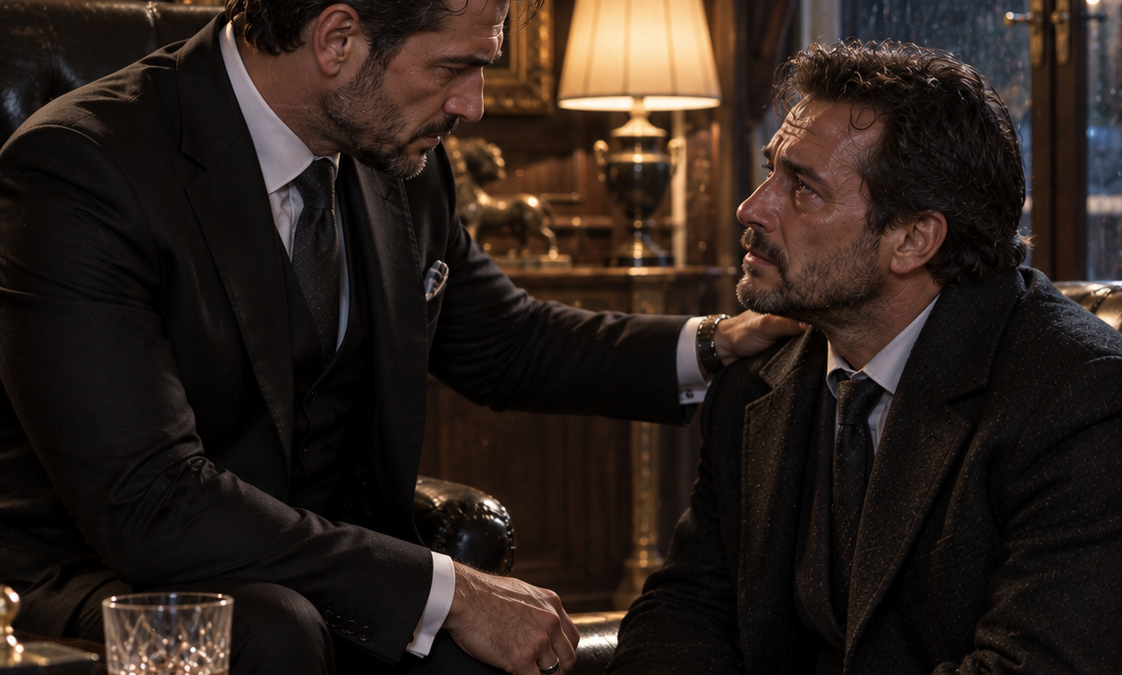
Elena took Luchia down to the cafeteria for ice cream to give the two men the room. Victor spoke first. His voice was still, but it was steady now.
Alessandro.
Before anything else, “Thank you.”
Aleandro set the flowers down on the bedside table and took the chair.
“For what?
Forgiving? For listening? For bringing them home?
for not killing me in that room the night I asked you to, which is what your father would have ordered.”
Aleandro did not answer immediately. He looked at Victor for a long moment.
Then he said quietly, “My father taught one thing wrong.
He taught it having never had to choose.
I chose differently.”
Victor nodded. He drew a slow breath. His chest still achd at the sight of the third round.
The one 3 cm from the heart, the one that would remain inside him for the rest of his life. and he spoke the sentence he had been holding for three weeks.
I have something to ask. Ask. I want to leave the family.
Allesandre was not surprised. He had known.
He nodded slowly. Not because I have lost faith in you.
Not because I am angry. Not because I regret 15 years. Only because I want to live an ordinary life with Elena and Luchia.
I want my daughter to grow up knowing her father as a carpenter or a truck driver. Anything that is not a gun. I want to sleep at night without listening for the sound of someone coming for my child a second time.
Allesandre reached into the inside pocket of his coat and drew out a thick sealed envelope. He laid it on the bedside table beside the sunflowers. Enough for three generations.
Your daughter will attend the finest university she can be admitted to without borrowing a single dollar. Your wife will have the house she has wanted since the day you married her.
This is not wages. This is not payment for silence.
This is the gift my father would have given you on the day he put that crucifix around your neck if he had lived to see a knight like the one in the Bronx. Victor opened the envelope. He looked at the amount.
He opened his mouth to refuse. Do not, Alisandro said.
This is not a discussion. Victor closed the envelope. He nodded.
Then he took Alessandro<unk’s hand once without words.
Four of my men will keep watch over your house for 5 years. Aleandro continued. At a distance, you will never see them.
You will never know they are there. But if any surviving fragment of the Russo organization or anyone else considers laying a hand on your family, they will die before they reach your gate.
Victor’s grip tightened.
Aleandro rose. He walked to the door. He stopped there, one hand on the frame, and did not turn back.
Live a long time, Victor. For me, for Lucia, for Elena.
Then he stepped out. The door closed softly behind him.
Nine months later, the small brick house sat at the edge of a coastal town in Connecticut. Two stories, a wooden swing on the front porch Victor had built himself.
Tomato plants in the backyard rising in neat rows along a trellis Elena had staked out over three weekends in April. No high fence, no iron gate, no cameras. A yellow Labrador dozed on the porch in the late afternoon light.
Allesandro stopped the black car 40 m up the street. He stepped out alone.
No guards, no driver. He wore a gray wool sweater instead of a suit, something he had done perhaps four times in 20 years.
He did not ring the bell. He did not open the gate. He only stood at the low hedge that bordered the sidewalk and looked across it.
In the backyard, Victor was pushing Luchia on the wooden swing. She was 9 years old now.
Her laughter carried across the yard the way the laughter of a child carried only when the child had been permitted to live the whole of a childhood without knowing what had almost been taken from her. Victor was laughing with her, the easy, unguarded laugh Alisandro had never once seen in 15 years on the man who had stepped in front of seven bullets meant for him.
Beneath Victor’s collar, the silver crucifix, its chain repaired, caught the low sun.
Elena stepped out of the back door with a tray of fresh bread and set it on the wooden garden table. She was smiling.
She was calling her husband and her daughter to supper. She saw Aleandro at the hedge. She stopped.
She did not wave. She only smiled the small, wordless, grateful smile of a woman who had understood the geometry of the man standing at the end of her walk and understood that he would not cross the hedge because to cross the hedge would be to bring the dark with him.
Allesandro inclined his head to her. Not long, only a single nod. Then he turned away.
Before he reached the car, he heard Lucia’s voice float across the yard.
Baba and she was calling her father. Not him. that was better than anything he had allowed himself to hope for.
He did not turn back. He was afraid that if he did, he would want to stay, and that was the one thing his world would not permit, but he smiled a rare, quiet, private smile no one but himself would ever know had existed.
As he opened the door of the car, he drove away slowly. In the rear view mirror, the red brick house grew small. The swing kept moving.
Smoke rose from the kitchen chimney. The yellow dog did not stir on the porch. Aleandro fixed his eyes forward.
He was going back to New York, back to the Long Island estate, back to the walnut desk that nine months ago had almost been his tomb. The desk that now, under the summer afternoon light through the tall French windows, carried no trace of the bomb and no trace of the blood. But the mark inside him did, and he was grateful for it.
Sometimes the greatest betrayal is not betrayal at all. It is a good man forced to choose between two loves he cannot divide. And sometimes the greatest mercy is not forgiveness.
It is refusing to call it betrayal in the first place.
—END—