Part 4: Man Tried to Take Her Mom’s Farm—Then a Navy SEAL & K9 Uncovered His Costly Mistake
How to navigate the world from a chair, how to read a horses ears to understand its mood, how to track data with enough rigor to be useful, how to ask adults direct questions and wait for actual answers. Sophie was a fast learner.
On the Saturday of the planting, the two girls were at the fields edge in the mid-morning sun, Sophie standing and Mia in her chair, both looking at the planter making its rows.
Sophie had a handful of soybean seeds shed taken from the planting bag and was examining them in the particular way of a child who has decided she needs to understand what a thing actually is before she can be satisfied with knowing what it does.
They dont look like much, Sophie said. Theyre not supposed to yet, Mia said.
How does something this small turn into a whole plant?
Mia considered the question seriously.
Ethan says its about conditions. The seed already knows what to do.
It just needs the right conditions.
Sophie looked at the seeds in her palm. Then she looked at the rows the planter was laying down.
Does the field know what to do? The field is the conditions, Mia said.
Sophie thought about this for a moment.
Then she put one seed carefully in her jacket pocket because she had decided she needed to keep it, which was the kind of decision that 7-year-olds made without requiring a reason. Claire was watching them from 10 yd down the fence line.
She had her arms crossed and her face was turned slightly toward the sun, eyes half closed, and she had the look of a person who has been underwater for a long time and has finally surfaced and is paying attention to what breathing feels like.
Ethan brought the tractor around at the end of the row and killed the engine near the fence. South quadrants done, he said.
Winds picking up from the northwest.
I want to finish the center rows before it gets above 12 knots, or well get seed drift. You say knots?
Claire said.
He looked at her.
Miles per hour. I want to finish before it hits 15.
You said knots.
Old habit.
She smiled at that, a real one, not the careful version shed had in the early months.
The real one reached her eyes and stayed there a beat longer than the polite kind. Go finish your rows, she said.
He went back to the tractor. Well, the dedication happened in early June, which was Mias idea, and which shed organized with a level of logistical competence that surprised everyone except Ethan, who had stopped being surprised by Mia approximately 2 months into knowing her.
Shed called it a farm opening, which was not a traditional agricultural event category, but which accurately described what it was. The first day the Callaway Farm Educational Program was officially open to visitors.
Six families from the area had signed up for the first session. Parents with children who had various physical and developmental differences, drawn by a flyer that Mia had written herself and that Claire had posted at the county extension office and the pediatric therapy clinic in Broken Bow.
The flyer said, in Mias direct prose, Come learn to grow things.
Everyone can grow something. No experience necessary.
Ethan had read it and told her it was good.
Shed said she knew. The morning of the opening, the farm was ready in the imperfect, real-world way that things are ready when a lot of people have worked on them without unlimited time or resources.
The raised vegetable beds were built to accessible heights, with the compacted granite under gravel paths Mia had specified running between them.
The chicken enclosure had a gate modified to open with a single hand. The wheelchair route from the parking area to the barn and then to the garden ran smooth and level, and had been tested by Mia in both directions in both dry and wet conditions.
The small barn had a white board and four low tables and chairs in two sizes, adult and child, and smelled like new wood and earth. Dolores Fitch brought coffee and rolls without being asked and set them on the porch table and then stood back and didnt offer to help with anything else, which was the right read of the situation.
Earl Briggs stood near the fence with his wife, a compact, observant woman named Ruth, who had said approximately 40 words to Ethan in all the time hed known Earl, and who he had concluded was the more capable of the two by a significant margin, and watched the families arrive. Three of the children were in wheelchairs.
One had braces on both legs and walked with forearm crutches.
Two had no visible physical difference, but held their parents hands with the particular grip of children who were uncertain in new places.
Mia positioned herself near the parking area. She did not wait for someone to come to her.
She rolled toward each family as they arrived, introduced herself by name, asked the childrens names, and then, without preamble, without the excessive cheerfulness that adults sometimes deployed with children they considered fragile, began telling them what they would do today.
Were going to plant basil and check on the tomato seedlings, and if theres time, Ill show you how to tell if a chicken is happy or stressed by how it holds its feathers.
I know that sounds weird, but its actually useful.
A small boy on forearm crutches looked at her chair. Is it hard to garden in that?
he asked. Depends on the garden, Mia said.
Thats why we built this one the way we did.
Come on, Ill show you. She turned her chair and led them through the gate.
Ethan watched from near the barn. Beside him, Ranger sat with his attention on Mia.
Not anxious, not on alert, just watching, the way he watched everything hed decided was his responsibility.
Claire appeared at Ethans shoulder.
Shes been planning this since February, Claire said quietly.
I know.
She made a spreadsheet of every accessibility modification and rated them by importance. Then she and Sophie built a priority list.
Claire paused.
Sophies contribution to the priority list was that the chicken gate needed to be lower because, and I quote, some wheelchairs are shorter.
Sophies not wrong.
No. Claire watched her daughter move through the garden with the group of children around her.
Shes going to do something large with her life.
She already is, Ethan said.
Claire looked at him.
He was watching the garden and he had the particular expression. Not quite a smile, but the precursor to one.
The face of a man who was feeling something he hadnt made room for and was making room for it now, slightly awkwardly, because that was how he did things.
She put her hand on his arm briefly, just briefly.
He didnt move away. The The session ran 3 hours and ended with every child having planted something in a small pot to take home, basil mostly, with two tomatoes and one very optimistic attempt at a pepper by the boy on the forearm crutches who had decided that if he was going to grow something, it should be challenging.
Mia had walked them through the planting process with the practical directness she applied to everything and shed handled the moments when something was physically difficult for a particular child. A grip that didnt work.
A reach that wasnt quite there. By adjusting the setup rather than the expectation, which was what good teaching looked like regardless of the subject.
When the families were leaving, the boy with the crutches stopped at the gate.
Are you coming back?
He asked Mia. I live here, she said.
Can I come back? Were doing this every other Saturday until fall, she said.
Your parents can sign up at the extension office. He nodded, serious.
He looked at his pepper pot. What if it dies?
Come back anyway, Mia said. Well figure out why and try again.
He walked to his parents car.
Mia watched him go.
Ethan was loading the last of the tool storage back into the barn, and he heard that exchange from 12 ft away, and he stopped moving for a moment.
Well figure out why and try again. 8 years old and she already understood the most important thing there was to understand about working with living things.
That failure was information, not verdict, and the correct response to it was to understand it and continue.
Hed learned that at 26 in a training environment that made the lesson expensive. Shed apparently arrived there on her own.
He went back to loading tools.
In July, Marcus Webbs office processed the first application Ethan brought in as a consulting agent for the FSA program. A family in Valley County, fourth generation cattle operation, 92 acres, operating loan called early after two consecutive drought years.
The situation was structurally similar to what his father had faced in 1991.
Different only in the details and in the fact that this time someone had shown up before the letter arrived. The application cleared in 3 weeks.
Marcus called to tell him. Two for two.
Marcus said. Its early.
Ethan said. I know its early.
Im noting the data point.
Note it. Ethan was in his truck heading back toward Cedar Hollow from a site visit to a Custer County grain operation that Diane Briggs had flagged.
Whats the current caseload for the district? Were tracking 31 operations at some level of risk in the five-county area.
Seven of those are what Id call acute. Decision window is within the next 9 months.
Send me the seven.
You sure?
Send me the seven.
A pause. You know this isnt The position doesnt require you to Marcus Sending the seven.
Marcus said. The files came through by the time Ethan reached Cedar Hollow.
He pulled over on the county road outside town and read through the summaries on his phone.
Not to solve anything today, just to understand the shape of what was in front of him.
The way you looked at a field before you worked it. Get the lay of the land, note where the problems were.
Understand what the soil wanted before you decided what it needed. Seven families, seven sets of people who had built something over years or decades and were now in the specific kind of danger that didnt look like danger from the outside.
No fire, no collision, just a slow compression of options until there werent any. He put the phone down and drove the rest of the way to Cedar Hollow.
That evening, he was at the Callaway farm for what had become a Thursday standing arrangement. Dinner, which had evolved from breakfast and then lunch into dinner through the same mechanism of gradual practical inevitability that had governed most of the past 8 months.
Sophie and Mia were at the kitchen table with the soil science project that had grown from a school assignment into something more substantial.
A multi-section notebook on the specific history of the Callaway farm soil with data from Ethans testing, photographs Mia had taken of the amendment process, and a comparative section on regional soil types that had started as Sophies idea and that Mia had turned into actual research.
Their teacher had asked to display it. Claire was at the stove.
Ranger was under the table with his chin on Mias foot, which was his preferred position during household activity.
Available, connected, technically resting. Ethan was at the table with the seven files.
Youre working. Claire said without looking up from the stove.
Reading.
Same thing with you.
He looked up. She had her back to him, stirring something that smelled like the chicken and vegetable stew shed made twice before, which hed eaten both times without saying anything specific about it, but which shed apparently noted.
Seven families in the five-county area, he said, at acute risk.
Im going to start making contact next week. She was quiet for a moment.
All farms? Mostly.
Ones a market garden operation.
Ones an orchard.
Same problems?
Different details, same shape.
He closed the file on top. Operating loans, balloon clauses, refinancing failures.
The infrastructure of a system that works fine until it doesnt.
She turned from the stove. Then you help them?
Some of them.
Maybe most.
He was honest about it. Not all.
Some are past the window where the programs can reach them. But even those, knowing whats happening and why is better than not knowing.
She looked at him for a moment. Youre doing what you wish someone had done for your father, she said.
Hed been looked at like that before. The thing where a person said an accurate thing about you directly, and you had to decide whether to acknowledge it or redirect.
Yes, he said.
She turned back to the stove. Good, she said.
After dinner, when Sophie and Mia had taken Ranger to the back porch to do whatever they did on the back porch in the summer evenings, a ritual Ethan didnt entirely understand, but that involved a specific sequence of snacks and observations about the field that both children took seriously, Ethan and Claire sat at the kitchen table with the last of the coffee and the particular quiet of a house where the work was done and nothing was required.
Ive been thinking about something, Claire said.
What?
She wrapped both hands around her cup. The program.
Mias program. She paused.
We had six families in June.
We had eight in July.
Diane Briggs called me last week to say two families from Dawson County had reached out.
Theyd heard from someone who came in June, and they wanted to know if they could bring their kids. Thats good.
Its more than I planned for.
She looked at the cup. Ive been thinking about formalizing it.
Not big, just enough structure to be sustainable.
A nonprofit designation maybe, or a fiscal sponsorship through the extension office. Diane said they could host it administratively if I wanted to keep the program at the farm.
She looked up.
Earls wife Ruth offered to help. She has a background in nonprofit management from before she retired.
Ruth Briggs ran a nonprofit for 15 years.
She managed a rural health access program in three counties. Clare almost smiled.
Earl doesnt mention it often.
I think he doesnt want people to know shes more qualified than he is. Ethan looked at the table.
He thought about the structure.
The way a formalized program created accountability and also sustainability.
The way a fiscal sponsor reduced liability while maintaining operational flexibility. Youd need to think carefully about the mission statement, he said.
The disability accessible component is specific enough to distinguish you from general farm education programs.
That specificity makes you more competitive for certain grant funding.
Clare looked at him steadily. Youve thought about this.
Ive thought about adjacent things.
Youre doing it again. What?
Making it smaller than it was.
She set her cup down.
Ethan. You think about things that relate to people you care about.
You should just say that.
The kitchen was quiet.
Outside through the screen door, Mias voice carried from the back porch, explaining something to Sophie about the way the soybeans in the south field would look when they were close to harvest. The specific color change in the leaves, the way the pods felt when they were ready.
Sophie asked a question Ethan couldnt make out.
Mia answered it.
Ranger made the low contented sound he made when he was settled and wanted nothing.
I think the program is important, Ethan said. I think Mia built something real today with those families, and shes going to build something more real over time.
And I think formalizing it makes sense, and Ruth Briggs is probably an excellent person to help you do it. Clare waited.
And I think about this farm, he said, more than is strictly professional.
She was quiet for a moment. I know, she said.
I think about it, too.
He looked at her.
She looked back. This was the part he was bad at, the part where the practical frame fell away, and what remained was just two people in a kitchen at the end of an evening, which was either simple or the most complicated thing in the world, depending on how you looked at it.
Im not he started.
I know, she said again.
You dont have to have it figured out. I usually have things figured out.
I know that, too. She picked up her cup.
You can have this one be different.
He thought about that, about the difference between a problem and a situation, the way a problem required a solution, and a situation required patience, and how hed spent most of his adult life defaulting to the former because it was cleaner, because solutions were finite and situations were not, because caring about something you couldnt fully control was the one kind of risk that training didnt reduce.
He told Mia he was afraid of getting things wrong when it mattered. Shed pointed out that he hadnt gotten this one wrong.
Okay, he said. Clare looked up.
Okay, he said again.
I dont have it figured out.
She held his gaze for a moment, then she nodded once, the the nod that meant thats enough for now, and stood to take her cup to the sink. He sat at the table and listened to his daughters voice from the back porch, patient and interested, asking Mia what the field would look like in the fall.
The harvest came in September, 6 months after the planting, which was how time moved on a farm, in large, definite intervals, not the small daily accounting of other kinds of work.
The south acres 41 bushels per acre, which was below the county average, but 14 bushels above what the depleted soil would have produced without the winter amendment. Ethan wrote the number in his own field notes and noted it against the soil test results from the fall survey, which showed measurable nitrogen improvement in the top horizon and the early signs of restored microbial activity in the amended zones.
It was not a triumph. It was a data point, and the data pointed forward.
Claire stood at the edge of the harvested field with the late September sun cutting low and gold across the stubble. And she looked at the cleared rows with the expression of someone who understood for the first time, not as a financial category, but as a physical fact, that this was going to keep going.
Mia was beside her in the chair, Ranger on her other side. Sophie was there, too, standing in the stubble with her sneakers getting dusty, holding the same soybean seed shed taken from the planting bag in April, which shed kept in her jacket pocket through the summer, and which had somehow survived.
Its the same one, she told Mia. It didnt grow, Mia said.
It wasnt in the right conditions, Sophie said seriously.
Mia looked at her. What are you going to do with it?
Sophie considered. She looked at the harvested field, at the clear rows, at the pale blue sky of a Nebraska September.
Plant it next spring, she said, when the conditions are right. Ethan was at the equipment shed cleaning the harvester attachment, and he heard that through the open space between the shed and the field, and he stopped working for a moment.
Hed come to Cedar Hollow to be quiet. Hed come to find a distance between himself and the kinds of situations that required the particular skill set hed spent 14 years developing, because skill sets that sharp cut in both directions, and hed needed to understand who he was without them before he could figure out who he who going to be next.
He hadnt planned any of this.
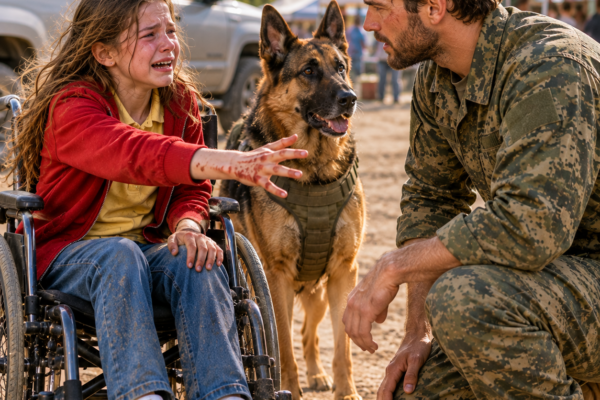
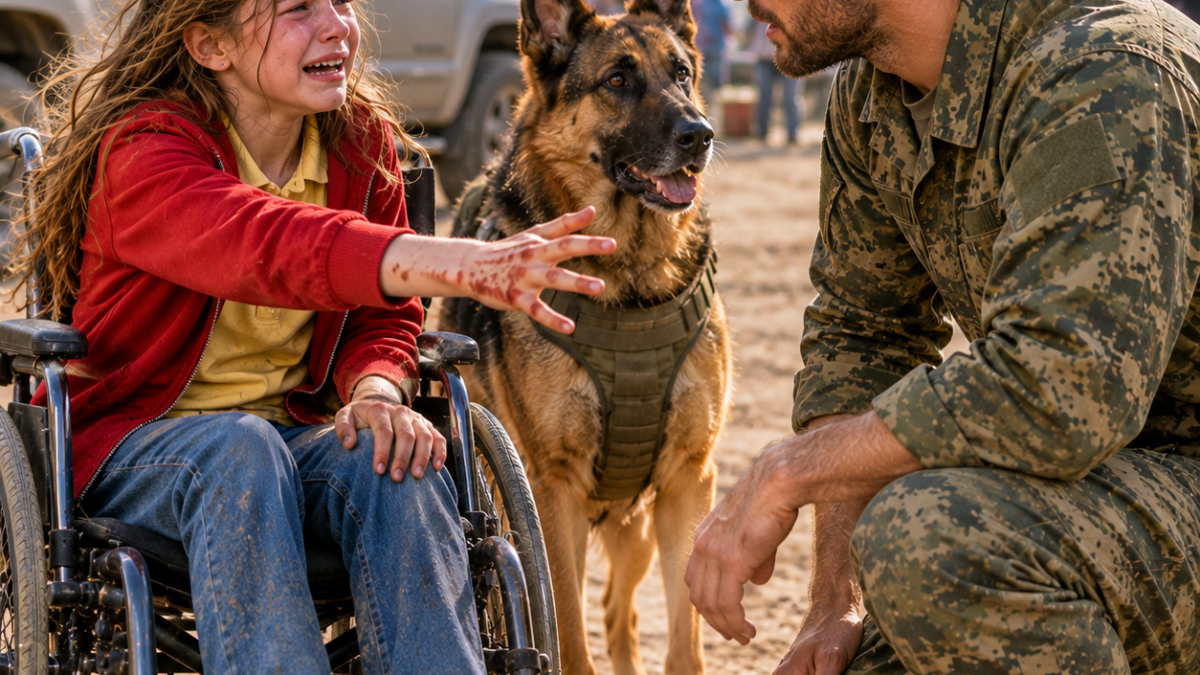
An 8-year-old in a wheelchair had rolled toward him on a cracked sidewalk on a cold October morning, and Ranger had stood up, and the rest of it had followed from there.
Not because it was fated or arranged, but because Ethan Vance had learned, in 14 years of operating in places that required absolute clarity about what a situation actually needed, that the correct response to a person asking for help was to help.
Everything else had been detail. He went back to cleaning the equipment.
Ranger appeared at the shed door and sat down, watching him.
All right, Ethan said. He put down the cleaning cloth and walked out to where his daughter and the girl who had become her closest friend were standing in the harvested field in the September sun.
And he stood with them for a while. And the field stretched out around them, quiet, and finished, and ready to begin again.
There are people in this world who carry their capability quietly, who have learned things from hard places and bring those things to bear in ordinary moments without announcement.
The world tends to misread them as cold, or distant, or strange, until the moment arrives when what theyve learned is exactly whats needed.
Strength isnt always whats loudest in the room. Sometimes its the hand that steadies the wheel before the fall, the call made before the letter arrives, the path built to the width that was actually needed.
And sometimes courage isnt standing tall. Its refusing to stop moving when someone you love needs you to reach them.