A U S Marine Brings Two Lost German Shepherds Home—What Happens Next Stuns the Marine – Part 5
He signed Rers form, then Scouts. Two names, one address, one home. Ethan sat down the pen.
Scout was asleep against Ranger’s side.
Ranger raised his head briefly, looked at Ethan, and lowered it again. There was nothing left to decide.
Spring came slowly to Durango. By late March, snow still covered the highest ridges of the San Juan Mountains, but the lower fields had begun turning green again. Meltwater ran along the edges of the roads.
Sunlight stayed over the valley longer each afternoon, and the porch outside Ethan Walker’s cedarsighted house had finally become warm enough for two dogs to stretch beneath it without immediately searching for shelter from the cold.
Ranger had changed, not completely. An unfamiliar vehicle slowing near the driveway could still lift his head from the rug.
The metallic crash of a dropped tool in Ethan’s garage sometimes brought his ears forward and tightened his shoulders for a few seconds.
Years of training had not disappeared simply because Ranger had finally found a home. The difference was what happened afterward.
Months earlier, Ranger would have risen automatically. He would have checked the window, then the door, then the hallway.
Now he sometimes raised his head, listened, and made a choice. More often than not, the old German Shepherd decided the sound could survive without his supervision. Then he went back to sleep.
Scout had grown almost beyond recognition from the 5-month-old puppy Ethan had found wandering behind Ranger in the snow. His legs were longer, his chest broader, and his black and tan coat had begun taking on the heavier shape of an adult German Shepherd. His ears now stood properly, although one occasionally tilted sideways when he was tired.
His personality had changed much less. Scout still believed most objects had been placed on Earth for his investigation.
He still carried Ethan’s gloves through the house whenever one was left within reach.
And despite having his own oversized dog bed near the fireplace, he continued squeezing himself onto Rangers. Ranger had stopped resisting. Sometimes Scout would climb onto the bed, circle twice, and collapse half across the older shepherd.
Ranger would open one eye, then move several inches. That was as close as he ever came to complaining.
The adoption papers Ethan had signed after Walter’s rescue had changed nothing about their daily life, and everything about how Ethan thought about it.
There was no longer a date when Ranger and Scout might leave. No more temporary arrangement.
No more telling Clare or Megan that he was only keeping them until something was settled. Two stainless steel bowls now sat permanently beside the kitchen door.
Rangers scouts. Home had become a fact rather than a question. At Second Ridge Veteran Center, Noah Parker continued volunteering several afternoons each week.
The quiet 16-year-old, who once disappeared into the workshop whenever a room became too crowded, had begun taking on responsibilities without being asked. He still preferred working with his hands, but he no longer avoided people simply because conversation might follow.
Noah helped Walter repair benches, walked scout around the property, brushed Rers’s heavy coat, and began reading everything Clare gave him about canine behavior and rehabilitation.
One afternoon, Ethan found him sitting on the workshop steps with a veterinary rehabilitation textbook open beside him.
“You planning something?”
Ethan asked. Noah shrugged.
“Maybe.”
“That usually means yes.”
The teenager looked toward Ranger, who was resting beneath a maple tree.
“I was thinking about animal behavior or veterinary rehabilitation after school.”
Ethan nodded.
“You’d be good at it.”
Noah glanced at him, almost suspicious of the compliment.
You don’t know that.
I know you built a ramp for a dog for anybody asked you to. That seemed to satisfy him. The larger idea began almost accidentally.
Megan Foster had been receiving more calls about retired working dogs whose families were struggling to understand them. Some were former military dogs.
Others had worked with police departments or detection teams. A few were older dogs whose routines made ordinary adoption difficult. Clare saw the same pattern medically.
Walter saw another side of it at Second Ridge. Too often people assumed retirement meant a working dog should immediately behave like an ordinary pet.
Ranger had taught them otherwise. One afternoon, the four adults sat around a scratched wooden table at Second Ridge while Noah worked nearby. Megan spread several folders across the surface.
“We keep treating these dogs like they failed placement,” she said.
“Sometimes the placement failed them.”
Player nodded.
“A family hears retired working dog and imagines a perfectly trained pet.”
“And then they’re surprised when he sleeps beside the door,” Ethan said.
Walter looked toward Ranger. The old shepherd was asleep several feet away. then stop trying to make the dogs fit the families.
That became the beginning of Second Watch K9 program. It was small. There was no expensive facility, no polished advertising campaign.
Second Ridge offered space for introductions and temporary visits. Clare handled medical assessments and recovery plans.
Megan screened potential families carefully. Walter recruited veterans who understood routines, patience, and the complicated feeling of leaving structured service behind. Ethan handled transportation, repairs, and most of the work nobody else had given a title.
Noah volunteered wherever he could. Their guiding principle was simple.
A working dog did not need to forget its past in order to deserve a future. Ranger became the first dog associated with the program.
Although Ethan refused every suggestion that they call him a mascot, Ranger did not perform demonstrations, he did not wear a special vest. Nobody asked him to impress visitors.
He simply came with Ethan. Scout usually came too.
That turned out to be enough. The first few introductions taught everyone something.
Ranger rarely approached nervous dogs immediately. He gave them distance. He might lie nearby or sit with Ethan and wait until the other dog made the first move.
Scout had once been incapable of that kind of patience. Now he was learning.
The clearest proof arrived on a warm April afternoon. Megan brought in another retired German Shepherd named Cooper. Cooper was 11, slightly smaller than Ranger, with a dark sable coat, a gray muzzle, and an old stiffness through his hips that made him move carefully.
He had spent years in detection work before retirement and had recently struggled through another unsuccessful placement. He was not aggressive.
He simply became uncomfortable when unfamiliar people or dogs crowded him too quickly. When Cooper entered the fenced yard at Second Ridge, he immediately moved toward the far corner. Megan gave him space.
So did Ethan. Scout did not, at least not initially.
The young shepherd took several excited steps forward. Then he stopped.
Ethan had not called him. Ranger had not moved.
Scout simply looked back. Ranger was lying beneath the maple tree with his head between his paws.
He watched Scout quietly. For several seconds, nothing happened. Then Scout turned toward Cooper again.
Instead of approaching, he lowered himself onto the grass several yards away. No barking, no pulling, no attempt to force an introduction. He waited.
Cooper remained near the fence. Scout stayed where he was.
A minute passed, then another. Finally, Cooper lifted his head. He took one careful step toward Scout, then stopped.
Scout did not move. From the porch, Noah smiled. Ethan looked toward Ranger.
The old shepherd had closed his eyes. Something had been passed forward without a command.
Ranger had once taught Scout to stop at doors, wait at curbs, respect distance, and understand that protection did not always require action. Now Scout was using those lessons for someone else.
That afternoon, Ethan drove home with both dogs in the back seat. Scout reached the front door first. Ranger followed at his slower pace.
Inside, the two stainless steel bowls waited beside the kitchen entrance. Scout drank from his, then immediately checked Rangers, as though months of evidence had not convinced him the second bowl contained exactly the same water. Later, both dogs moved toward the living room.
Scout ignored his enormous new bed. He climbed directly onto Rers. Ranger looked at him.
Scout settled anyway.
After a moment, Ranger shifted to one side and placed one front leg loosely across Scout’s shoulders.
Ethan went outside and sat on the porch. The evening sun was dropping behind the San Juans when his phone vibrated.
The email was from his command. His requested transfer had been approved.
Ethan would move into a training assignment based close enough to Colorado that he could keep the house, continue helping at Second Ridge, and remain with Ranger and Scout. Months earlier, the news might have frightened him.
Training meant change. Change meant moving farther from the identity he had spent most of adulthood building.
Now Ethan read the email twice, then put the phone down. In the yard, Noah and Walter were finishing a wooden sign they had been working on for several days.
Walter held one side while Noah tightened the final screws.
Across the front, burned carefully into the wood, were the words, “Second Watch K9 Program.”
below them. Every working dog deserves a home after the mission. Ethan looked through the open door.
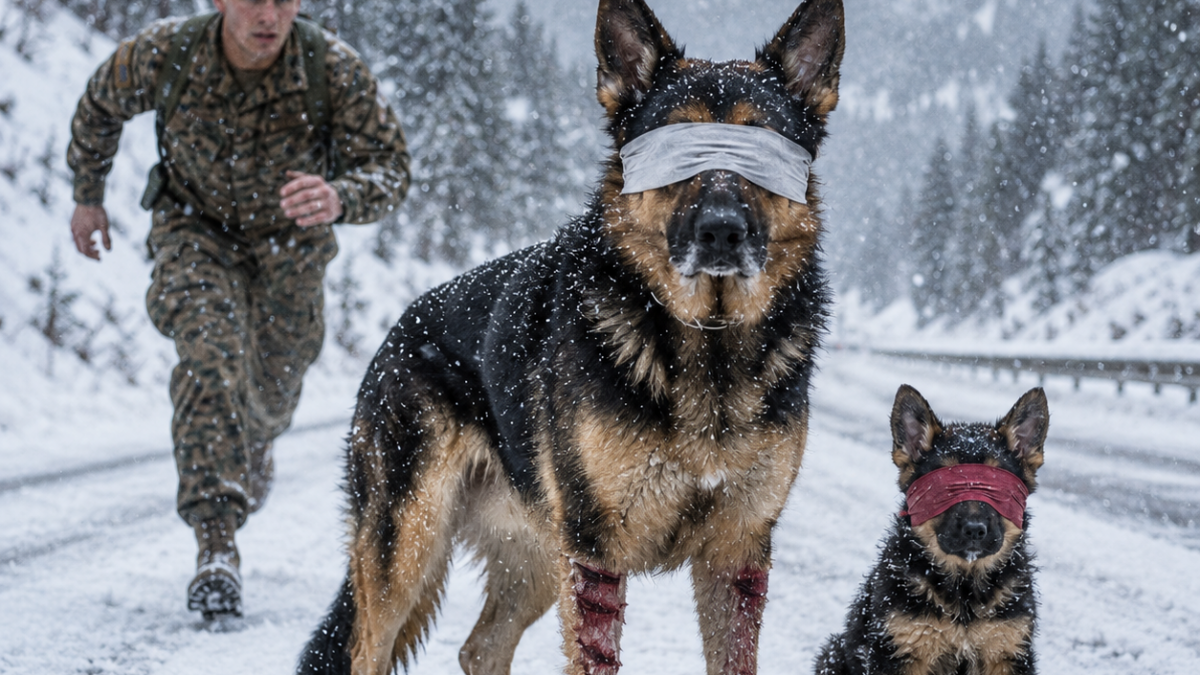
Ranger was asleep. Scout was pressed against him. Months earlier, Ethan had found them walking through falling snow with their eyes covered.
Ranger guiding a puppy who could not see where he was going. Now both dogs could see perfectly well.
But that was no longer the most important part. Scout did not need Ranger to show him every step anymore.
Ranger no longer needed a mission to tell him where he belonged. And Ethan was beginning to understand that a life could change without becoming empty. The sun lowered across the porch.
A truck passed somewhere along the road.
Rers’s ear moved once.
He did not get up. Scout remained beneath his leg.
Two bowls waited by the door. Two dogs slept beside the fireplace. And for the first time in years, Ranger let someone else keep watch.
You know what stays with me most about Ranger’s story?
It wasn’t the snow or the bandage over his eyes.
It was knowing that when Scout wandered through that broken fence, Ranger followed him into the storm. Even unable to see, he refused to let the puppy face the road alone. Ranger had spent his life believing love meant duty.
Guarding doors, following trails, protecting others. But Scout taught him something different. Love could also mean resting by the fire, sharing a bed, chasing a tennis ball, and finally trusting that he was safe enough to close his eyes.
Maybe that was what God wanted Ethan to understand, too. Ranger was learning how to live without a mission, while Ethan was quietly learning the same lesson. And because one Marine stopped on a snowy road, Scout found a family.
Ranger finally found peace. Noah discovered a future working with animals.
Walter came home safely. And Second Watch was created so other retired canines would never have to prove their worth just to deserve a home. Tonight, I pray God blesses you, protects your family, brings peace to the parts of your heart that are still standing guard and reminds you that your worth is greater than what you can do for others.