Part 2: “I don’t want to manage you anymore. I want to be the person you choose. Not the person you’re stuck with.”
Chapter 5: The Vote
The Hyeon Industries boardroom was a monument to power.
A single mahogany table, long enough to seat twenty, stretched the length of the room. The walls were lined with portraits of Kang family patriarchs—generations of men who had built the company from a shipping outfit to a sprawling conglomerate. The windows looked out onto the river, the same river Yun-ji had stared at from the terrace three weeks ago, when she’d first held the envelope in her hands.
Now she stood at the edge of the table, and every eye in the room was on her.
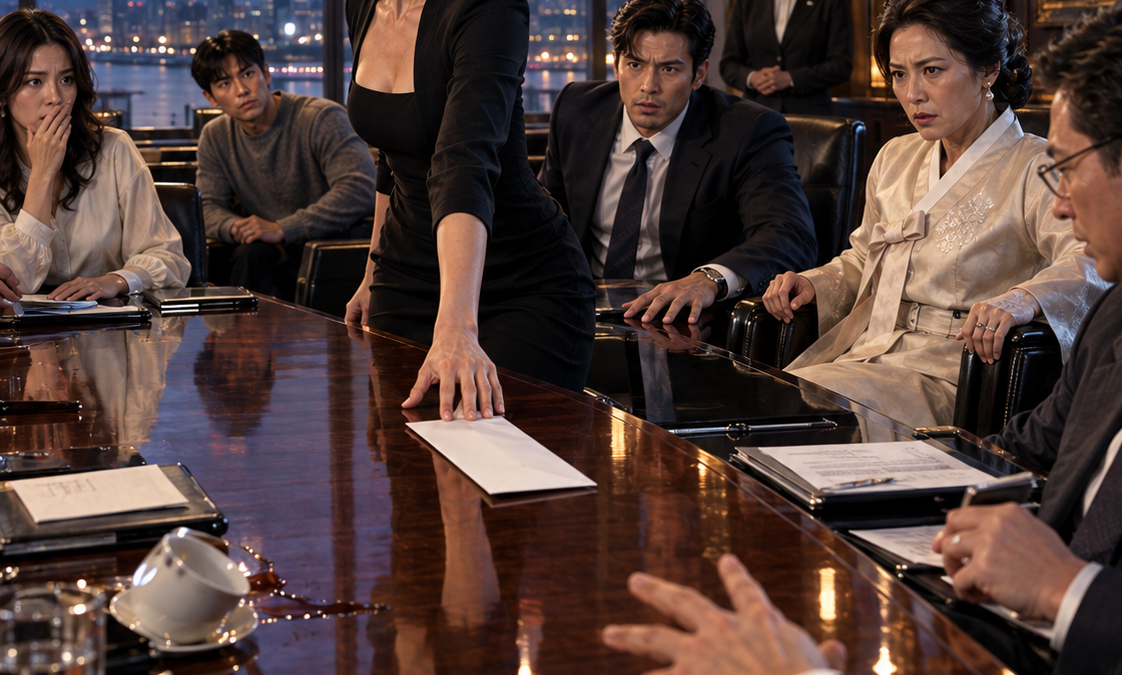
Madame Hyeon sat at the head of the table, her silk hanbok pristine, her expression carved from ice. Min-ho was on her right, his face unreadable. The Baek Group’s chairman, Baek Seung-ho, sat across from them, flanked by two lawyers with briefcases full of paperwork. Ji-yeon was in the corner, silent and still, her hands folded in her lap.
“We’re here to finalize the merger agreement,” Soo-jin said. “Ms. Seo’s presence is a formality—the contract requires that family members be informed of material changes to the company structure.”
“Thank you, Madame Hyeon.” Yun-ji kept her voice steady. “But I’m not here as a formality.”
Soo-jin’s eyes narrowed. “Excuse me?”
“I’m here as a shareholder.” Yun-ji reached into her bag and pulled out the envelope—the acknowledgment, the clause, the weight of eight years of secrets. “And as the wife of the CEO, I have the right to disclose information that materially affects the merger.”
Min-ho’s head turned. His eyes met hers—sharp, questioning, the same expression he’d worn on the terrace when he’d asked what was in her pocket.
“What information?” he asked.
Yun-ji slid the acknowledgment across the table. It landed in front of him, face up.
“Your father had a second family,” she said. “A son named Kim Jae-won, born in 1994. Eight years ago, your father signed a notarized acknowledgment recognizing him as a legal heir, entitled to a full share of the estate under Korean civil law.”
The room went silent.
Soo-jin’s face didn’t change—but her hands, folded on the table, went white at the knuckles.
“That’s a lie,” she said. “A fabrication. My husband would never—”
“It’s notarized.” Yun-ji’s voice cut through the room. “And there’s more. The family trust includes a clause—added fifteen years ago—that grants any acknowledged heir a seat on the board and voting shares equal to the eldest son’s.”
The Baek Group’s chairman leaned forward, his eyes sharp with interest. “Is this true?”
“It’s true.” Ji-yeon’s voice came from the corner. She stood up, her movements slow but deliberate. “I witnessed the acknowledgment. I filed it myself. Mr. Kang signed it eight years ago, after his cancer diagnosis, because he wanted to ensure his second son was provided for.”
Soo-jin’s composure cracked—just a hairline fracture, but visible. “You,” she said to Ji-yeon. “You’ve been holding this secret for eight years. You worked for my husband. You were loyal to him.”
“I was loyal to him,” Ji-yeon said. “That’s why I kept his secret. But I’m not loyal to the lie.”
Min-ho hadn’t moved. He was staring at the acknowledgment, his face pale, his hands flat on the table.
“Kim Jae-won,” he said slowly. “He’s twenty-nine. He lives in Busan.”
“You knew?” Yun-ji asked.
“I knew my father had a mistress. I suspected there might be a child.” Min-ho’s voice was tight. “I never had proof. I never looked for it.”
“You never wanted to find it,” Soo-jin snapped. “Because you knew what it would do to the company. To the family.”
“The company is already fracturing,” Yun-ji said. “The Baek Group’s merger was always a short-term solution. If the board votes today without disclosing this clause, you’re building a merger on a lie. And when the truth comes out—because it always comes out—the Baek Group will have grounds to sue for fraud.”
Baek Seung-ho’s lawyer leaned over and whispered something in his ear. The chairman’s expression shifted—from interest to calculation.
“Ms. Seo is correct,” he said. “If the acknowledgment is valid, the merger’s due diligence would need to be redone. The terms would change.”
Soo-jin’s face went white. “You can’t—”
“I can.” Baek’s voice was mild, but his eyes were cold. “I don’t do business with families that hide liabilities. Either the Hyeon family resolves this internally and presents a unified front, or the deal dies.”
The room erupted. Board members spoke over each other, lawyers scrambled for documents, and Soo-jin’s voice cut through the chaos like a blade.
“This is your doing,” she said to Yun-ji. “You’ve been planning this from the moment you walked into my house. You’re nothing but a—”
“Mother.” Min-ho’s voice was quiet, but it stopped the room. He stood up, the acknowledgment still in his hand. “That’s enough.”
“She’s trying to destroy us.”
“She’s trying to save us.” He looked at Yun-ji, and something in his expression shifted—something that looked almost like respect. “She could have gone to the press. She could have filed a lawsuit. She could have burned the whole thing down without warning. Instead, she brought it to the board.”
Yun-ji met his eyes. “I brought it to you first. On the terrace.”
“I know.”
“I asked you for a divorce.”
“I remember.” His mouth curved—not quite a smile, but close. “I also remember telling you that contracts can be renegotiated.”
Soo-jin stared at her son as if she’d never seen him before. “You’re taking her side?”
“I’m taking the company’s side.” Min-ho’s voice was hard. “The merger is dead if we don’t resolve this. The only way to resolve it is to honor the clause. Bring Kim Jae-won into the family, give him his shares, and present a unified front to the Baek Group.”
“And if I refuse?”
“Then you can explain to the board why you’d rather lose the company than share it.”
The silence stretched. Soo-jin’s hands were trembling—with rage, with shock, with something that looked almost like fear. She had controlled this family for forty years. She had managed her husband’s affairs, buried his secrets, and built a fortress of appearances around the Hyeon name.
Now the fortress was crumbling. And the woman she’d spent two years dismissing was the one holding the hammer.
“Fine,” Soo-jin said. The word came out like a wound. “Fine. Bring him in. Give him his shares. But this isn’t over, Yun-ji. You’ve made an enemy today.”
“I’ve been your enemy since the day I walked into your house,” Yun-ji said. “The only thing that’s changed is that now I’m a useful one.”
The board voted seven to three to honor the clause. The Baek Group agreed to a thirty-day extension to renegotiate the merger terms. And Kim Jae-won, a photographer from Busan who had never asked for anything from the Hyeon family, received a phone call from a lawyer he’d never met, informing him that he was now a board member of one of the largest conglomerates in the country.
Yun-ji didn’t stay for the aftermath. She walked out of the boardroom and down the corridor, her heels clicking on the marble floor, her heart pounding in her chest.
She’d done it. She’d taken the secret and turned it into leverage. She’d forced the family to acknowledge what they’d spent decades trying to bury.
But she’d also made an enemy of her mother-in-law. She’d thrown the family into chaos. And she’d put herself at the center of a storm she wasn’t sure she could survive.
Min-ho caught up with her at the elevator.
“That was the most reckless thing I’ve ever seen anyone do,” he said.
“Thank you.”
“It wasn’t a compliment.” He stepped in front of her, blocking the elevator door. “You could have told me. You could have given me time to prepare.”
“You would have buried it.”
“Yes.” His voice was flat. “I would have buried it. And then I would have spent the rest of my life lying to the board, lying to the Baek Group, lying to myself. You saved me from that.”
Yun-ji stared at him. “You’re not angry.”
“I’m furious.” He stepped closer. “But I’m also—” He stopped, his jaw working. “I don’t know what I am. I don’t know how to feel about a woman who just upended my entire company and then stood there like she’d done nothing more than serve tea.”
“I didn’t do it for you.”
“I know.” His eyes searched hers. “You did it for yourself. That’s what makes it terrifying.”
The elevator doors opened behind him. Yun-ji stepped around him, but he caught her wrist—gently, but firmly.
“Yun-ji.”
She turned.
“The divorce,” he said. “Is that still what you want?”
She thought of the contract. The debt. The two years of being managed and dismissed. She thought of the envelope, and the way it had felt to hold power in her hands for the first time in her life.
“No,” she said. “I want a renegotiation.”
Min-ho’s grip loosened. His expression didn’t change, but something in his eyes shifted—a flicker of something that might have been relief, or hunger, or both.
“Then we negotiate,” he said.
Chapter 6: The Photographer from Busan
Kim Jae-won arrived in the city three days later, and Yun-ji met him at the airport because no one else would.
He was taller than she expected—lean, with the kind of quiet watchfulness that came from spending years behind a camera. His hair was dark and slightly disheveled, his clothes simple: a gray sweater, worn jeans, a canvas bag slung over one shoulder. He looked like a man who had spent his life trying not to be noticed.
“You’re Yun-ji,” he said. Not a question.
“I am.”
“My mother told me about you.” He fell into step beside her, his voice neutral. “She said you were the one who found the acknowledgment.”
“I was.”
“And you decided to use it.”
“I decided to honor it.” Yun-ji led him toward the car. “There’s a difference.”
Jae-won didn’t respond. He loaded his bag into the trunk and slid into the passenger seat, his eyes fixed on the city skyline as they pulled out of the airport.
“I never wanted this,” he said finally. “The Hyeon name. The shares. The board seat. My mother spent twenty years telling me that the family would never accept me, and I believed her. I built a life that had nothing to do with them.”
“And now?”
“Now I’m sitting in a car with a woman I’ve never met, on my way to meet a family that doesn’t want me, because a piece of paper my father signed eight years ago says I belong.” He turned to look at her. “Why did you do it?”
“Because the alternative was letting them bury the truth again.” Yun-ji kept her eyes on the road. “I’ve spent two years being buried. I know what it feels like.”
Jae-won was quiet for a moment. Then he said, “My mother loved him. My father. She loved him until the day he died, even though she knew he would never leave his wife, never acknowledge her publicly, never give her anything more than a few days a month and a son he could never claim.”
“I’m sorry.”
“Don’t be.” His voice was steady. “She made her choices. I made mine. And now you’ve made yours.”
Yun-ji glanced at him. “You’re not angry.”
“I’m still deciding.” His mouth curved—a small, wry smile that reminded her, unexpectedly, of Min-ho. “Ask me again in a week.”
Chapter 7: The Dinner
Madame Hyeon hosted a dinner that night—a “family welcome” for Kim Jae-won, staged with the precision of a state funeral.
The table was set for twelve. Soo-jin sat at the head, her expression frozen in a mask of polite welcome. Min-ho was on her right, his face unreadable. Se-ra, Min-ho’s sister, had flown in from New York for the occasion, and she watched Jae-won with the curious, slightly wary expression of someone who had heard the rumors and didn’t know what to believe.
Jae-won sat across from Min-ho. The two men looked at each other across the length of the table, and Yun-ji felt the room hold its breath.
“So,” Se-ra said, breaking the silence. “You’re a photographer.”
“I am.”
“What do you shoot?”
“Mostly people.” Jae-won’s voice was calm. “Portraits, mostly. I like capturing the moment before someone realizes they’re being watched.”
“That sounds vaguely threatening,” Se-ra said, but she was smiling.
“It’s not meant to be.” He glanced at Min-ho. “I’m not here to threaten anyone. I’m here because I was told I have a right to be.”
Soo-jin’s fork scraped against her plate. “You have a legal right. That’s not the same as a moral one.”
“Mother,” Min-ho said.
“It’s all right.” Jae-won set down his chopsticks. “She’s right. Legal and moral are different things. My father made a choice eight years ago. I didn’t make that choice. I didn’t ask for it. But I’m here now, and I’m not going to apologize for existing.”
The silence that followed was heavy. Yun-ji watched Soo-jin’s face—the way her jaw tightened, the way her hands trembled slightly before she folded them in her lap.
“Your mother,” Soo-jin said slowly. “Kim Eun-sun. Does she still live in Busan?”
“She does.”
“She never contacted us. Never asked for money. Never made any claim.”
“No.”
“Why?”
Jae-won’s expression didn’t change. “Because she loved him. And because she knew that if she made a claim, she would be dragged through the courts, through the press, through the kind of public humiliation that would destroy her and everyone around her. She chose to protect me instead.”
Soo-jin’s mask cracked—just slightly, just enough. For a moment, Yun-ji saw something other than contempt in her eyes. Something that might have been grief, or guilt, or the ghost of a marriage that had been complicated in ways no one had ever fully understood.
“She was a fool,” Soo-jin said.
“Maybe.” Jae-won picked up his chopsticks again. “But she was a fool who kept her promise. She never spoke his name to anyone who didn’t already know it. She never sold her story to the press. She never asked the Hyeon family for a single won.”
“Then why are you here?”
“Because I made a promise too.” He looked at Yun-ji. “She asked me to come. She said it was time.”
Chapter 8: The Renegotiation
The dinner ended early. Soo-jin excused herself before dessert, and the rest of the family scattered to their corners of the house. Jae-won was given a guest room on the east wing, far from the main family quarters—a gesture of hospitality that was also a message about where he stood in the hierarchy.
Yun-ji found Min-ho in his study, staring at the contract on his desk.
“You’ve been reading that for an hour,” she said.
“I’ve been reading it for two years.” He didn’t look up. “I just never noticed how many clauses there are.”
Yun-ji walked into the room. The study was Min-ho’s territory—dark wood, leather chairs, a window that overlooked the river. He spent more time here than in any other room in the house, and she’d always assumed it was because he preferred work to her company.
Now she wondered if it was something else.
“You want to renegotiate,” he said.
“I do.”
“Sit down.”
She sat. He slid the contract across the desk—the prenuptial agreement, the debt repayment schedule, the long list of conditions that had defined her life for two years.
“What do you want changed?” he asked.
“Everything.” She met his eyes. “I want the debt restructured so it’s in my name, not yours. I want a job—a real one, not a ceremonial position. I want my own income, my own bank account, my own control over my finances. And I want the clause that ties my presence in this family to the merger’s success removed.”
Min-ho’s expression didn’t change. “That’s a lot.”
“I’m aware.”
“You’re asking me to give up control.”
“I’m asking you to treat me like a partner.” She leaned forward. “You said you married me because I looked at you like a problem you hadn’t solved yet. You said you wanted to see what I’d do when I figured it out. Well, I’ve figured it out. I’m not a problem. I’m not a tool. I’m the woman who just saved your company from a hostile takeover by exposing a secret your family spent decades trying to bury.”
“You also exposed my father’s infidelity to the entire board.”
“I exposed the truth. The infidelity was his choice, not mine.”
Min-ho was quiet for a long moment. The fire crackled in the grate. Outside, the wind had picked up, and the chandelier in the foyer sang its low, mournful note.
“All right,” he said.
Yun-ji blinked. “All right?”
“I’ll have the lawyers draw up new terms.” He stood up and walked to the window, his back to her. “The debt will be restructured in your name. You’ll be given a position in the company—something real, not ceremonial. And I’ll remove the merger clause.”
“Why?”
He turned. The firelight caught the planes of his face, and for a moment, he looked almost vulnerable—a man who had spent his entire life being managed, just like her.
“Because you were right,” he said. “On the terrace. I’ve spent my whole life managing my mother instead of winning. I’ve spent two years managing you instead of—” He stopped.
“Instead of what?”
“Instead of asking you what you wanted.” He walked back to the desk. “So I’m asking now. What do you want, Yun-ji?”
She thought of the photographer from Busan, who had spent his life trying not to be noticed. She thought of Ji-yeon, who had kept a secret for eight years because she believed in something bigger than loyalty. She thought of her father, who had died without ever saying the words she’d needed to hear.
“I want to stop being invisible,” she said.
Min-ho nodded slowly. “Then I’ll make sure you’re seen.”
Chapter 9: The First Crack
The new contract was signed a week later, and it changed everything and nothing.
Yun-ji had her own bank account now, her own income, her own position at Hyeon Industries—a director of cultural affairs, which was a real job with real responsibilities and a real budget. She had meetings to attend, decisions to make, and a staff that reported to her.
But she still slept in the same room as Min-ho’s, in a separate bed, in a marriage that felt more like a business partnership than a love story.
And she still felt like she was waiting for something.
The breaking point came on a Thursday afternoon, when she walked into Min-ho’s office unannounced and found him on the phone, his voice low and urgent.
“I don’t care what it costs,” he was saying. “Find out who leaked the acknowledgment. I want a name by Friday.”
Yun-ji stopped in the doorway. Min-ho looked up, and his expression shifted—from anger to something more complicated.
“I’ll call you back,” he said into the phone, and hung up.
“You’re investigating the leak,” Yun-ji said.
“I’m protecting the company.”
“The company is fine. The merger is back on track. Jae-won is cooperating. What are you actually doing?”
Min-ho stood up. “I’m trying to find out who else knew about the acknowledgment. Who else might use it against us. Who else—”
“Who else you can’t trust.” Yun-ji stepped into the room. “You’re not protecting the company. You’re protecting yourself.”
“From what?”
“From the same thing that’s been eating at you since the board meeting.” She stopped in front of his desk. “You’re terrified that I’m not the only one who’s been lying to you.”
Min-ho’s jaw tightened. “You lied to me for three weeks. You had the envelope in your pocket at every dinner, every conversation, every night we spent in the same house. You looked me in the eye and told me it was your father’s debt.”
“I know.”
“You asked for a divorce.”
“I know.”
“And now you’re standing here, telling me I’m the one with trust issues.”
Yun-ji met his eyes. “I lied to protect myself. You’ve been lying to yourself for years. You told me you wanted to see what I’d do when I figured out the answer to the problem. But you never stopped to ask what the problem actually was.”
Min-ho was silent. The city hummed outside the window—a low, constant sound that filled the space between them.
“What was it?” he asked finally. “The problem.”
“Me.” Yun-ji’s voice was steady. “I was the problem. Not because I did anything wrong, but because I didn’t fit. I wasn’t the wife your mother wanted. I wasn’t the family ally your board expected. I wasn’t the kind of woman who could be managed with a contract and a debt.”
“And now?”
“Now I’m the woman who saved your merger and made your mother an enemy.” She smiled—a small, crooked smile that didn’t quite reach her eyes. “I’m still not the wife anyone wanted. But I’m the partner you need.”
Min-ho stared at her. The phone on his desk buzzed. He didn’t answer it.
“Partners,” he repeated.
“Partners.” Yun-ji turned to leave. “You should probably start acting like it.”
Chapter 10: The Gallery
Jae-won’s first exhibition in the city opened three weeks later, in a small gallery downtown that Yun-ji had helped him secure.
She went alone. Min-ho had a board meeting; Soo-jin had refused to attend; Se-ra had sent a polite text saying she’d try to stop by. The gallery was quiet when Yun-ji arrived—just Jae-won, the curator, and a handful of guests who had come out of curiosity rather than connection.
The photographs were stunning. Portraits, mostly, but with an intimacy that felt almost intrusive—a woman laughing with her head thrown back, a child staring at something just out of frame, an old man with hands like maps. Jae-won had a gift for capturing the moment before people realized they were being seen.
“You came,” he said, appearing beside her.
“I said I would.”
“You said a lot of things.” He handed her a glass of wine. “I wasn’t sure which ones were true.”
Yun-ji took a sip. “I’m not sure either. But I’m trying.”
Jae-won was quiet for a moment, looking at the photographs. “My mother called me last night. She said she’s proud of me. She said she always knew I’d find my own way, even if it didn’t look like the way she expected.”
“That’s a good thing.”
“It is.” He turned to her. “She also said I should tell you something.”
“What?”
“She said the acknowledgment wasn’t the only thing my father left behind.” Jae-won’s voice was careful. “There’s a letter. He wrote it the same day he signed the papers. My mother kept it—she never opened it. She said it was for me to decide what to do with.”
Yun-ji’s breath caught. “Do you have it?”
“He gave me a box of things when I left Busan. The letter was at the bottom. I haven’t read it yet.”
“Why not?”
Jae-won looked at the photographs again. The woman laughing. The child watching. The old man with hands like maps.
“Because reading it makes him real,” he said. “And I’ve spent my whole life keeping him at a distance.”
Yun-ji thought of her own father—the forged Rothko, the unpaid debts, the quiet death that had left her with nothing but a name she couldn’t use. She thought of all the things she would have said to him if she’d had the chance.
“Read it,” she said. “Whatever it says, you’ll survive.”
Jae-won nodded slowly. “Maybe.”
They stood in silence for a moment, surrounded by photographs of strangers caught in moments of truth.
“Min-ho is trying,” Yun-ji said finally. “He’s not good at it. But he’s trying.”
“Trying to what?”
“To be a partner. To stop managing and start listening.” She set down her glass. “I don’t know if it’s enough. But I’m trying too.”
Jae-won’s mouth curved. “Then maybe you’ll both figure it out.”
The gallery door opened. Yun-ji turned to see Min-ho walk in—still in his suit, his tie loosened, his expression slightly out of place in the quiet room.
“You came,” she said.
“I said I would.” He walked toward her, his eyes scanning the photographs. “These are good.”
“I know.”
He stopped beside her. Jae-won had stepped away, giving them space.
“I read the letter,” Min-ho said.
Yun-ji’s heart stuttered. “What letter?”
“The one my father wrote to Jae-won. Ji-yeon gave it to me last night. She said I should know what was in it before the truth came out any other way.”
“And?”
Min-ho’s expression was unreadable. “He apologized. For not being there. For choosing the family over the woman he loved and the son he couldn’t claim. He said he hoped Jae-won would understand that some choices aren’t choices at all—they’re just the only path you can see.”
Yun-ji was quiet.
“He also said something about you,” Min-ho continued. “Or about the kind of woman he hoped Jae-won would find. Someone who wouldn’t let him hide. Someone who would see him for who he was and not what the family wanted him to be.”
“That’s a lot to put on a photographer from Busan.”
“It’s a lot to put on anyone.” Min-ho turned to her. “I’ve been thinking about what you said. About being invisible. About managing instead of winning.”
“And?”
“I don’t want to manage you anymore.” His voice was low, almost rough. “I don’t want to be your contract. I don’t want to be your problem. I want—” He stopped, his jaw working.
“What?”
“I want to be the person you choose. Not the person you’re stuck with.”
Yun-ji looked at him—really looked, the way she hadn’t let herself look since the day she’d signed the contract. He was tired. He was stubborn. He was the most infuriating man she’d ever met.
And he was trying.
“I don’t know if I can choose you yet,” she said. “I don’t know if I trust you. But I know I don’t want to manage you either.”
Min-ho nodded slowly. “Then we figure it out together.”
“Together,” she repeated.
The word felt strange in her mouth—new and uncertain, like a language she’d never learned to speak. But it also felt like something she could grow into.
 [Tap here for the Next Part ]