Part 3: “I don’t want to manage you anymore. I want to be the person you choose. Not the person you’re stuck with.”
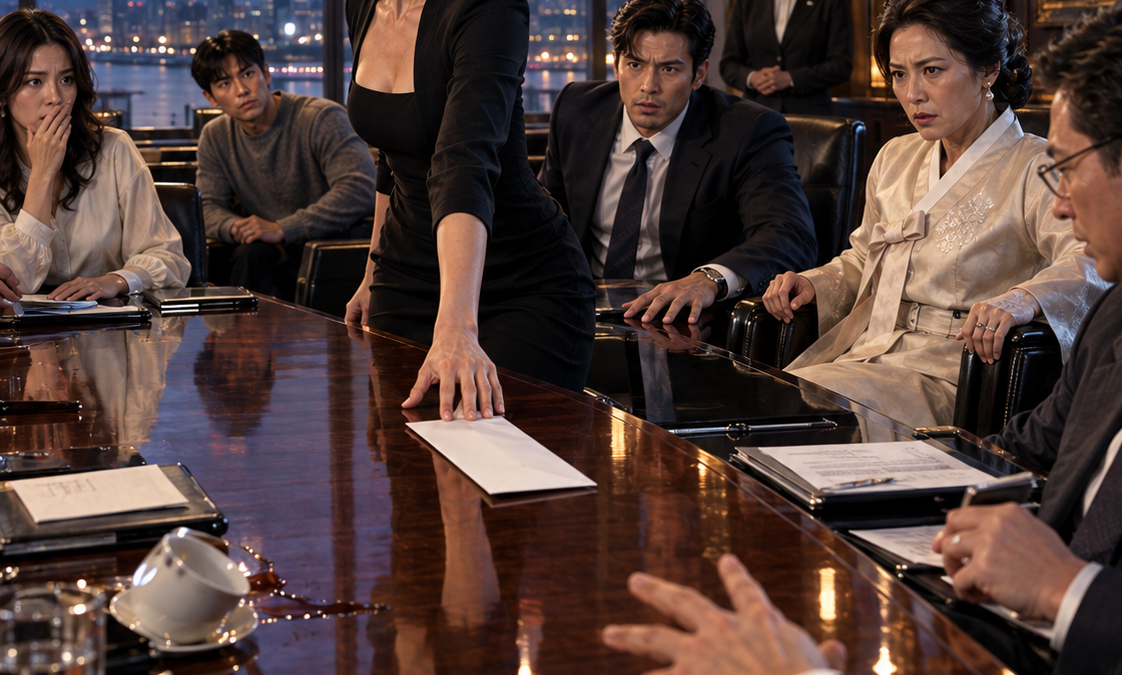
Chapter 11: The Betrayal
The betrayal came from the place she least expected.
Ji-yeon called her at midnight, her voice shaking.
“The clause,” she said. “The inheritance clause. There’s a provision I didn’t tell you about.”
Yun-ji sat up in bed, her heart pounding. “What provision?”
“The clause grants the heir a seat on the board and voting shares equal to the eldest son’s. But there’s an additional condition—buried in the fine print. If the heir is not publicly acknowledged within ninety days of the patriarch’s death, the clause becomes void.”
Yun-ji’s blood went cold. “Kang Dae-hyun died eight months ago. The ninety days have already passed.”
“Exactly.” Ji-yeon’s voice was barely a whisper. “The clause is void. The acknowledgment is still valid—Jae-won can still inherit under Korean law—but the board seat and the voting shares? They’re gone.”
“Unless—”
“Unless the board votes to honor them anyway. Which they might, if they believe the clause is still active.” A pause. “But if someone tells them the truth, Jae-won loses everything.”
Yun-ji’s mind raced. The board meeting. The vote. The seven to three decision. Soo-jin’s furious expression. The Baek Group’s extension.
“Who else knows about this provision?” she asked.
“Just me. And now you.” Ji-yeon’s voice cracked. “I should have told you earlier. I should have checked the date. I was so focused on the acknowledgment that I didn’t think to look at the timeline.”
“It’s not your fault.” Yun-ji swung her legs out of bed. “I need to call Min-ho. I need to tell him before someone else does.”
“Yun-ji—”
“What?”
“Your mother-in-law knows.” Ji-yeon’s voice was heavy. “I told her. I thought she should know the truth. I didn’t realize—”
“You told Soo-jin?”
“She came to me this afternoon. She asked about the clause. She said she wanted to understand the legal implications. I didn’t think—”
Yun-ji’s hand tightened on the phone. Soo-jin knew. Soo-jin had the information she needed to destroy Jae-won’s claim—and with it, the leverage Yun-ji had used to save the merger.
“Where is she now?” Yun-ji asked.
“I don’t know. She left the office an hour ago. She said she had a meeting.”
With the board, Yun-ji thought. She’s calling an emergency meeting. She’s going to tell them the clause is void.
“Ji-yeon, listen to me.” Yun-ji stood up, her voice steady despite the panic rising in her chest. “Call every board member you can reach. Tell them there’s a discrepancy in the legal review and the meeting is postponed until tomorrow. Do whatever you have to do to buy me time.”
“What are you going to do?”
“I’m going to find my mother-in-law.”
Chapter 12: The Confrontation
Soo-jin was in the garden.
Yun-ji found her at the edge of the property, standing by the koi pond, her silk robe wrapped tight against the cold. The moon was full, and its light reflected off the water in silver fragments.
“You knew,” Yun-ji said.
Soo-jin didn’t turn. “I suspected. Ji-yeon confirmed it.”
“And you’re going to tell the board.”
“I’m going to protect this family.” Soo-jin’s voice was calm—the same calm she’d used at every dinner, every correction, every dismissal. “The clause is void. The shares belong to Min-ho. The merger is secure. And Kim Jae-won goes back to Busan with nothing.”
“You can’t do that.”
“I can.” Soo-jin finally turned. Her face was pale in the moonlight, her eyes hard. “I’ve spent forty years protecting this family. I’ve buried my husband’s affairs, managed his secrets, built the Hyeon name into something that would survive him. I’m not going to let a stranger’s son—or a debt-ridden art dealer’s daughter—destroy everything I’ve built.”
Yun-ji stepped closer. “You’re not protecting the family. You’re protecting yourself. Because if the truth comes out—if the board knows the clause is void and the merger was built on a lie—they’ll know you’ve been managing them too. And you’ll lose everything.”
Soo-jin’s expression flickered. “You think you’re the first person to threaten me? I’ve been threatened by better people than you.”
“I’m not threatening you.” Yun-ji’s voice was steady. “I’m telling you the truth. The clause is void. The board vote was based on a lie. If you go to them now, you’re admitting that the merger was fraudulent from the start. The Baek Group will walk away. The stock will tank. And you’ll be the one who destroyed the company—not me.”
Soo-jin was silent. The koi swam lazy circles in the pond, their orange bodies flashing in the moonlight.
“What do you want?” she asked finally.
“I want Jae-won to keep his shares and his seat. I want the merger to go through. And I want you to stop trying to destroy me.”
“And if I refuse?”
Yun-ji reached into her pocket and pulled out her phone. “Then I call the Baek Group’s lawyers and tell them everything. The voided clause, the fraudulent vote, the fact that you knowingly withheld material information from the board. I don’t know if they’ll sue—but I know they’ll walk away, and I know they’ll make sure no one else touches Hyeon Industries for a decade.”
Soo-jin stared at her. For a long moment, neither of them spoke.
“You’re bluffing,” Soo-jin said.
Yun-ji held up the phone. “Try me.”
The silence stretched. The koi circled. The wind moved through the garden, carrying the scent of pine and cold water.
Then Soo-jin laughed—a dry, humorless sound that was worse than any insult.
“You’re not what I expected,” she said. “When Min-ho brought you home, I thought you were a placeholder. A debt that could be managed. A wife who would smile at dinners and stay out of the way.”
“I was never a placeholder.”
“No.” Soo-jin’s smile faded. “You’re not. You’re something much more dangerous.”
She turned and walked back toward the house, her silk robe trailing behind her like a ghost.
“Tomorrow,” she said over her shoulder. “The board meeting. I’ll tell them the clause stands. But this isn’t over, Yun-ji. It’s just the beginning.”
Yun-ji watched her go. The phone was still in her hand—the screen dark, the bluff still intact.
She’d won this round. But Soo-jin was right. It was just the beginning.
Chapter 13: The Quiet Before
The board meeting came and went.
Soo-jin kept her word—grudgingly, with the expression of a woman swallowing glass—and the clause was upheld. Jae-won took his seat at the table. The Baek Group’s lawyers reviewed the revised terms and found them acceptable. The merger was back on track.
And Yun-ji went home.
The house was quiet when she walked in—the kind of quiet that felt like held breath. Min-ho was in the kitchen, of all places, standing at the counter with a cutting board and a pile of vegetables.
“What are you doing?” Yun-ji asked.
“Cooking.” He looked up. “I thought you might be hungry.”
“You’ve never cooked in your life.”
“I’ve been watching videos.” He gestured vaguely at his phone, which was propped against the coffee maker, displaying a paused tutorial on how to julienne carrots. “It’s not going well.”
Yun-ji laughed—a real laugh, the first one in weeks. She walked over and took the knife from his hand.
“Here,” she said. “Like this.”
She showed him how to slice the carrots, her hands moving with the muscle memory of years spent cooking for herself in cramped Seoul apartments. Min-ho watched, his expression intent, as if he were studying a contract.
“You’re good at this,” he said.
“I had to be. After my father died, I couldn’t afford to eat out.”
He was quiet for a moment. Then: “Tell me about him. Your father.”
Yun-ji’s hands stilled. “Why?”
“Because I realized I don’t know anything about you.” He leaned against the counter. “I know your debt. I know your education. I know the shape of your life before you came here. But I don’t know what you loved about him. I don’t know what you miss.”
Yun-ji set down the knife. The kitchen was warm, the overhead light casting soft shadows across the counter.
“He taught me to see art,” she said. “Not just to look at it—to see it. The brushstrokes, the colors, the things the artist was trying to say without words. He used to take me to galleries when I was a child, and he’d ask me what I felt when I looked at a painting. Not what I thought. What I felt.”
“And what did you feel?”
“Everything.” She smiled—a small, sad smile. “I felt everything. That was the problem. He saw the world so clearly, and he loved it so much, and then he made one mistake and it all fell apart.”
“The forgery.”
“He didn’t forge it. He authenticated it. He believed it was real, and he staked his reputation on it, and he was wrong.” She picked up the knife again. “The debt was his. The shame was his. But he never let me carry it alone. He used to tell me that the only thing that mattered was the truth—even when it was ugly, even when it hurt.”
Min-ho was silent for a long moment. “He sounds like a good man.”
“He was a complicated man.” Yun-ji resumed slicing the carrots. “But he loved me. That’s the part I miss.”
Min-ho reached out and covered her hand with his—warm, solid, unexpected. She looked up.
“I don’t know how to do this,” he said. “I don’t know how to be what you need. But I want to try.”
Yun-ji’s heart stuttered. “Min-ho—”
“I know you don’t trust me yet. I know I haven’t earned it.” His voice was low. “But I want to. I want to be the person you choose. Not because of the contract, not because of the debt, not because of the company. Just because.”
She looked at him—really looked, the way she’d learned to do in the weeks since the board meeting. He was still the same man: controlled, calculating, dangerous to his enemies. But there was something different in his eyes now. Something open.
“I don’t know how to do this either,” she said. “But I’m willing to try.”
He leaned in. She didn’t pull away.
The kiss was soft, tentative—the kind of kiss that asked permission rather than demanded surrender. And when they pulled apart, Yun-ji felt something shift in her chest. Something that felt like hope.
Chapter 14: The Public Exposure
The merger’s final approval came on a Tuesday, at a shareholders’ meeting that drew every major player in the Hyeon and Baek families.
The hotel ballroom was packed. Orchids climbed the walls. Crystal chandeliers scattered light across the crowd. The press was corralled behind a velvet rope, their cameras clicking as the families filed in—the Hyeons on one side of the aisle, the Baeks on the other, like a wedding that no one wanted to attend.
Yun-ji walked in beside Min-ho. She wore black—a simple dress that made her look like she belonged, or at least like she didn’t care whether she did. Min-ho’s hand rested lightly on her elbow, a gesture that was both protective and possessive.
“You’re nervous,” he said.
“I’m not.”
“Your hand is cold.”
“That’s the air conditioning.”
He smiled—a small, private smile that was just for her. “You’re a terrible liar.”
“I’m a great liar. You just know me too well.”
They took their seats at the family table. Soo-jin was already there, her expression carved from stone. Jae-won sat beside Se-ra, his camera bag tucked under his chair—a small act of defiance in a room full of people who would have preferred he leave it at home.
The meeting began. The Baek Group’s chairman spoke about synergy, about growth, about the future. Min-ho spoke about the company’s commitment to its employees, its shareholders, its community. Everything was polished. Everything was planned.
Then Soo-jin stood up.
“I have something to say,” she said.
The room went quiet. Yun-ji’s heart started to race.
“For the past several months, this family has been through a difficult time.” Soo-jin’s voice was steady, but Yun-ji could see the tension in her shoulders. “We’ve confronted secrets that should have stayed buried. We’ve made decisions that not everyone agreed with. And we’ve welcomed someone into our family who—” She paused. “Who deserves to be here.”
Yun-ji blinked. Beside her, Min-ho went very still.
“Kim Jae-won is my husband’s son,” Soo-jin continued. “He is a Hyeon by blood, and he has every right to the shares and the seat that this board voted to give him. I want to make that clear—publicly, on the record, in front of everyone here.”
The room erupted in whispers. The press cameras clicked faster. Jae-won stared at Soo-jin as if he’d never seen her before.
“And there’s something else,” Soo-jin said. “My daughter-in-law, Seo Yun-ji, is the one who discovered the acknowledgment. She could have used it to destroy this family. Instead, she used it to save us. I have not always been kind to her. I have not always been fair. But I am—” She paused again, her jaw working. “I am grateful.”
Yun-ji’s throat tightened. She didn’t trust this—couldn’t trust this. Soo-jin didn’t change. Soo-jin didn’t apologize. Soo-jin managed.
But the room was watching. The press was watching. And Soo-jin was standing there, in front of everyone, saying the words that Yun-ji had never expected to hear.
“Thank you,” Soo-jin said. “That’s all.”
She sat down. The room was silent for a beat. Then the applause started—tentative at first, then louder, until it filled the ballroom like a wave.
Min-ho leaned toward Yun-ji. “Did you know she was going to do that?”
“No.”
“Neither did I.” He took her hand under the table. “What do you think?”
Yun-ji looked at Soo-jin—at the rigid set of her shoulders, the tightness around her mouth. This wasn’t forgiveness. This wasn’t a change of heart.
This was a tactical retreat.
But it was also a public acknowledgment. A line drawn in front of the entire company, the entire press, the entire world.
“I think,” Yun-ji said slowly, “that she just made it impossible for anyone to take it back.”
Chapter 15: The Reckoning
The shareholders’ meeting ended with handshakes and champagne. The merger was approved. The family was unified—or at least appeared to be. And Yun-ji walked out of the ballroom with her head held high and her hand still in Min-ho’s.
But the reckoning came later, in the quiet of the car ride home.
“You knew,” Min-ho said. “About the voided clause. You knew before the board meeting.”
“Yes.”
“You didn’t tell me.”
“I was going to. Ji-yeon called me at midnight. I went to find your mother before I had a chance to tell you.”
“And if my mother had gone to the board? If she’d told them the truth?”
“Then I would have told them everything.” Yun-ji met his eyes. “The acknowledgment, the clause, the fact that your father signed it in a moment of guilt and then spent eight years trying to forget it. I would have burned it all down.”
Min-ho’s grip on the steering wheel tightened. “You would have destroyed the company.”
“I would have told the truth.” Her voice was steady. “The company would have survived or it wouldn’t. But I wasn’t going to let your mother bury the truth again.”
He was quiet for a long moment. The city lights flashed past the windows—red, white, gold, a blur of color in the dark.
“You’re terrifying,” he said finally.
“I know.”
“I mean it as a compliment.”
“I know.” She smiled—a real smile, the kind that reached her eyes. “You’re not so bad yourself.”
Chapter 16: The Choice
The house was quiet when they got home. Soo-jin had gone to her rooms. Jae-won had taken a cab to his hotel. The staff had retired for the night.
Yun-ji stood in the library, looking out at the city. The fire was lit—she’d lit it herself, a small rebellion that had become a habit.
Min-ho walked in behind her. She heard his footsteps on the hardwood, felt the warmth of his presence at her back.
“I meant what I said,” he told her. “In the kitchen. I want to try.”
“I know.”
“I want to be your partner. Not your contract. Not your problem.” He stepped closer. “I want to be the person you choose.”
Yun-ji turned. He was close—close enough that she could see the firelight reflected in his eyes, the small scar above his eyebrow that she’d never asked about, the way his mouth curved when he was trying not to smile.
“I don’t know how to choose you,” she said. “Not yet. I’ve spent two years being managed. I’ve spent my whole life being a debt. I don’t know what it feels like to want something without calculating the cost.”
“Then let me teach you.” He reached out and took her hand—gentle, patient. “Let me show you what it feels like to be wanted.”
Yun-ji’s breath caught. “Min-ho—”
“I’m not asking for forever. I’m not asking for promises.” His thumb traced circles on her palm. “I’m asking for tonight. And tomorrow. And the day after that. One day at a time, until you trust me enough to choose.”
She looked at him—really looked, the way she’d learned to do in the weeks since the board meeting. He was still the same man: controlled, calculating, dangerous to his enemies. But there was something different in his eyes now. Something open. Something vulnerable.
Something that looked like hope.
“One day at a time,” she repeated.
He nodded. “One day at a time.”
She kissed him. This time, it wasn’t tentative. This time, it was a choice.
Chapter 17: The New Terms
Six months later, Yun-ji stood in the gallery of her own exhibition.
The space was filled with photographs—not Jae-won’s, but hers. She’d spent the past six months learning to see again, to capture the moments that mattered: the light through the window of her new office, the way Min-ho’s hands looked when he was concentrating, the expression on Soo-jin’s face when she thought no one was watching.
The exhibition was called “Invisible,” and it was about all the things people didn’t see—the quiet moments, the hidden wounds, the small acts of courage that no one ever noticed.
Jae-won had helped her curate it. He stood beside her now, his camera around his neck, his expression proud.
“You did it,” he said.
“I did.”
“The family’s here. Min-ho, Se-ra, even your mother-in-law.” He glanced at her. “That’s a lot of Hyeons for one small gallery.”
Yun-ji looked across the room. Min-ho was talking to the curator, his hands moving as he explained something. Se-ra was studying a photograph of a child laughing. And Soo-jin was standing in the corner, her expression unreadable, her gaze fixed on a portrait of Yun-ji’s father.
“She came,” Yun-ji said.
“She did.”
“I didn’t think she would.”
Jae-won was quiet for a moment. “She’s complicated. But I think she’s trying. In her own way.”
Yun-ji nodded. The gallery filled with people—strangers, friends, family. The exhibition was a success. And for the first time in her life, she felt like she was exactly where she was supposed to be.
Min-ho appeared beside her. “Congratulations.”
“Thank you.”
He took her hand. “I have something for you.”
“What?”
He reached into his pocket and pulled out a small box—velvet, dark blue, the kind of box that made Yun-ji’s heart stutter.
“Min-ho—”
“It’s not what you think.” He opened it. Inside was a key—simple, silver, unremarkable. “It’s to the new apartment. The one on the other side of the river. I bought it for you.”
Yun-ji stared at him. “You bought me an apartment?”
“I bought you a choice.” He closed the box and pressed it into her hand. “You can stay in the house. You can live in the apartment. You can leave entirely, if that’s what you want. But I wanted you to know that you have options. You’re not trapped. You’re not a contract. You’re not a debt.”
Yun-ji’s throat tightened. “Min-ho—”
“I told you I wanted to be your partner. Partners don’t trap each other. They choose each other.” He met her eyes. “So I’m choosing you. Not because I have to. Because I want to.”
She looked at the key in her hand. It was small, unremarkable—just a piece of metal. But it meant more than any diamond he could have given her.
“I choose you too,” she said.
Min-ho’s expression shifted—from careful control to something raw, something real. He pulled her close, and she let him.
Across the room, Soo-jin watched them. Her expression was still unreadable, but there was something in her eyes—something that might have been respect.
Or maybe just the beginning of it.
Chapter 18: The Inheritance
The will was read on a Friday afternoon, in the same boardroom where the merger had been approved.
The family gathered—Min-ho, Soo-jin, Se-ra, Jae-won, and Yun-ji. The lawyers sat at the head of the table, their documents spread out like a map of the past.
Kang Dae-hyun’s estate was divided as follows: the company shares went to Min-ho, as the eldest son and CEO. The Seoul properties were split between Soo-jin and Se-ra. The Busan gallery—a small building that no one had known he owned—went to Kim Eun-sun.
And then there was the last item.
“A personal bequest,” the lawyer said. “To Seo Yun-ji.”
Yun-ji’s head snapped up. “What?”
The lawyer slid a document across the table. “Mr. Kang left you his art collection. The one he kept in the private vault at the foundation. He wrote a letter explaining his reasoning.”
Yun-ji opened the letter. The handwriting was shaky—the handwriting of a man who had been sick, who had known he was dying.
Dear Yun-ji,
I never met you. I knew about you—my son told me about the contract, the debt, the woman who had agreed to marry him for reasons that had nothing to do with love. I knew about your father, too. The forged Rothko. The debt. The shame that followed you like a shadow.
I know what it feels like to carry a secret that isn’t yours. I know what it feels like to be trapped by choices you didn’t make. And I know what it feels like to want something more than what you’ve been given.
I don’t know if you’ll find what you’re looking for in my family. But I hope you do. And if you don’t—if the Hyeons prove to be as cold and unforgiving as I fear they are—I hope this collection gives you something to hold onto. Something that belongs to you, and only you.
Art was the only thing I ever loved without complication. I hope it brings you the same peace.
—Kang Dae-hyun
Yun-ji set down the letter. Her hands were trembling.
“What is it?” Min-ho asked.
She looked at him—at the man who had spent two years managing her, and six months learning to love her. She thought of the key in her pocket, the apartment across the river, the choice he had given her.
“I think,” she said slowly, “that your father just gave me my inheritance.”
Chapter 19: The View from the Other Side
The apartment was small—much smaller than the Hyeon mansion, much smaller than anything Min-ho had ever lived in. Two bedrooms, a kitchen with a window that looked out over the river, a living room with hardwood floors and a fireplace that actually worked.
Yun-ji moved in on a Sunday.
Min-ho helped her carry boxes. He didn’t complain, didn’t suggest hiring movers, didn’t try to manage the process. He just carried boxes and asked where she wanted things, and when they were done, he stood in the middle of the living room and looked around.
“It’s nice,” he said.
“It’s small.”
“It’s yours.”
Yun-ji smiled. “That’s the point.”
He walked to the window and looked out at the river—the same river they’d both stared at from different sides, for different reasons. The sun was setting, and the water reflected the sky like a mirror.
“I never asked you,” he said. “Why did you stay? After the board meeting, after the merger, after everything. You could have left. You had the key. You had the money. You had every reason to walk away.”
Yun-ji joined him at the window. “Because I wanted to find out what would happen if I stayed.”
“And what happened?”
“I found out that I’m not invisible.” She leaned against him—just slightly, just enough. “I found out that I can fight. I found out that I can win. And I found out that some people—not all, but some—are worth fighting for.”
Min-ho’s arm wrapped around her waist. “Am I one of them?”
“Ask me again in six months.”
He laughed—a real laugh, the kind she’d never heard from him before. “You’re impossible.”
“I know.”
“I like it.”
The sun sank below the horizon. The river turned from silver to gold to deep, endless blue. And Yun-ji stood in her own apartment, in her own life, with a man who had learned to see her.
It wasn’t a fairy tale. It wasn’t a contract. It was something harder and better: a choice, made every day, by two people who had finally learned what they were worth.
Chapter 20: The Woman Who Chose
The exhibition closed after three weeks, but the photographs stayed with Yun-ji.
She kept one for herself—a portrait of her father, taken the year before he died. He was standing in his gallery, surrounded by paintings, his hands in his pockets, his expression somewhere between pride and grief.
She hung it in the living room of her apartment, above the fireplace. And every morning, when she walked past it, she thought about the choices that had brought her here.
The choice to marry Min-ho. The choice to open the envelope. The choice to bring the truth to the board, and the choice to stay when she could have left.
She thought about Soo-jin, who had made her own choices—bad ones, complicated ones, choices that had hurt people and protected people in equal measure. She thought about Jae-won, who had chosen to come to the city, to claim his name, to build a relationship with a family that had never wanted him.
And she thought about Min-ho, who had chosen to change. Not for her—she knew better than to believe that. But because of her. Because she had shown him that there was another way to live.
The door opened. Min-ho walked in, his tie loosened, his sleeves rolled up. He was carrying takeout from the Korean place down the street—the one with the best galbi in the city.
“Dinner,” he said.
“You cooked last time.”
“I burned last time.”
“Fair point.”
They ate on the floor, because Yun-ji hadn’t bought a dining table yet. The fire crackled. The river gleamed through the window. And Min-ho told her about his day—the board meeting, the new contract, the rival executive who had tried to poach their best engineer.
Yun-ji listened. She laughed. She argued. She told him about her day—the new artist she’d discovered, the gallery owner who had tried to cheat her, the photograph she’d taken that morning of the sunrise over the river.
It was ordinary. It was everything.
And when Min-ho leaned over and kissed her—soft, slow, the kind of kiss that felt like a promise—Yun-ji kissed him back.
She was not a debt anymore. She was not a contract. She was not the invisible daughter-in-law who smiled at dinners and stayed out of the way.
She was the woman who had chosen.
Epilogue: The View from the Top
One year later, Yun-ji stood on the balcony of the Hyeon Foundation’s flagship hotel—the same balcony where she’d first held the envelope, where she’d first told Min-ho she wanted a divorce, where she’d first started to become the person she was meant to be.
The city stretched below her, glittering in the evening light. The river cut through it like a vein of silver. And in the distance, she could see the gallery where her exhibition had been, the apartment where she still spent most nights, the office where she ran the cultural affairs division of one of the largest conglomerates in the country.
Min-ho joined her at the railing. “What are you thinking about?”
“The first time I stood here.”
“You were wearing a green dress. You looked like you wanted to jump.”
“I wanted to escape.” She smiled. “I didn’t know how.”
“And now?”
“Now I know.” She turned to him. “I know how to fight. I know how to win. I know how to choose.”
Min-ho took her hand. “And what do you choose?”
Yun-ji looked at him—at the man who had started as her adversary, become her partner, and was slowly becoming something more. She thought of the road that had brought her here: the debt, the contract, the envelope, the vote. She thought of the enemies she’d made and the allies she’d found.
She thought of the woman she’d been—invisible, managed, trapped—and the woman she’d become.
“I choose this,” she said. “All of it.”
Min-ho smiled—the real smile, the one that reached his eyes. “Then I guess we’re stuck with each other.”
“I guess we are.”
They stood together at the railing, looking out at the city. The sun was setting, and the sky was full of color—gold and pink and deep, endless blue.
It wasn’t a fairy tale. It wasn’t a contract. It was something harder and better: a life, built one choice at a time, by two people who had finally learned what they were worth.

