CEO Asked a Single Dad Why He Was Alone—His Answer Left Her Speechless (Part 1)
CEO Asked a Single Dad Why He Was Alone—His Answer Left Her Speechless (Part 1)
PART 1
“You’re doing this wrong,” the woman said flatly, watching him wrestle a soaking wet bed sheet into a machine that had already eaten his last two quarters.
Landon Hayes turned around slowly. He hadn’t slept in 31 hours. His daughter was sick. His wallet held $11. And a stranger in a dry coat was critiquing his laundry technique. He looked at her, really looked, and said the only thing he had left in him. “Lady, if you knew what today cost me, you wouldn’t say a single word.”
She went completely silent.
The rain came down like the city had a grudge. Not the polite kind of Chicago rain that mists your jacket and makes the street lights look romantic. This was the kind that punishes you. Sideways. Cold. Deliberate. The kind that finds the gap between your collar and your neck and makes sure you feel it in your spine.
Landon Hayes felt it in everything. He was moving fast down West Belmont. Head down. One plastic bag looped around each wrist. A prescription receipt crumpled in his coat pocket and a seven-year-old girl’s voice looping in his head like a broken record. “Daddy, my ear hurts. Daddy, I’m cold. Daddy, when are you coming back?”
He’d promised Mia he’d be back before her show ended. That was 45 minutes ago. The pharmacy had taken 22 minutes because the insurance card kept declining. Not because he wasn’t covered, but because someone at the billing office had entered his date of birth wrong. A single digit. A clerical error. Nothing that meant everything when your child had an ear infection at 8:00 on a Tuesday, and you were standing under fluorescent lights arguing with a pharmacist named Gerald who looked like he’d rather be anywhere else on Earth.
Landon understood that feeling deeply. He’d had to pay out of pocket. $63, which was fine, which was survivable, which left him with $11 and a full tank of gas he’d been nursing for nine days. What was not fine—what was not survivable in his head—was the laundry.
He’d meant to do it Sunday, but Sunday was when Mia started running the fever. And Monday was a double shift at the distribution warehouse because Tony called out and nobody else could cover, and Landon needed the overtime more than he needed his back to stop aching. And now it was Tuesday night and Mia’s school uniform, her only school uniform, was sitting in a hamper smelling like sweat and Tylenol. And Wednesday was picture day and his daughter had already asked him twice if her dress was going to be clean.
“Yes, baby,” he’d told her. “It’ll be clean.” He had to make that true.
So here he was, running through a Chicago rainstorm at 8:47 p.m. with a child’s medication in one bag and a week’s worth of laundry in another because that’s what you do when you’re the only one. You don’t get to put it down. You don’t get to say, “I’ll handle it tomorrow.” Tomorrow has its own disasters already scheduled.
The Sunshine Laundromat on Clark Street was the only one still open this late. He’d used it twice before. He remembered it being fine. Adequate. The kind of place that does what it says. What he did not remember was the handwritten sign on the front door: “Cash only. Three machines out of service. Sorry for the inconvenience.”
He stood in front of that sign for a full four seconds in the rain, reading it like maybe the words would rearrange themselves if he waited long enough. They didn’t.
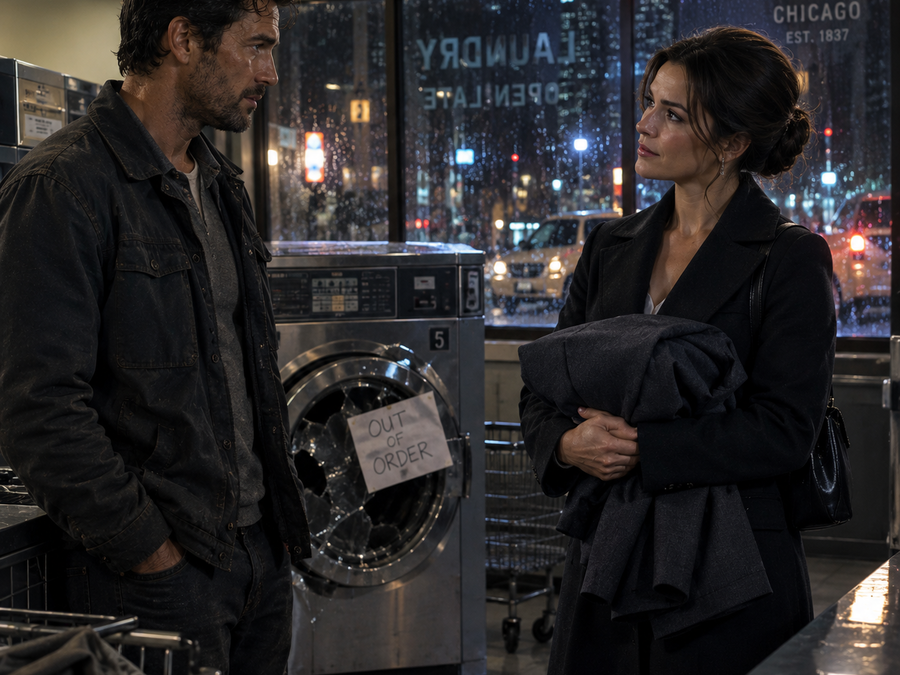
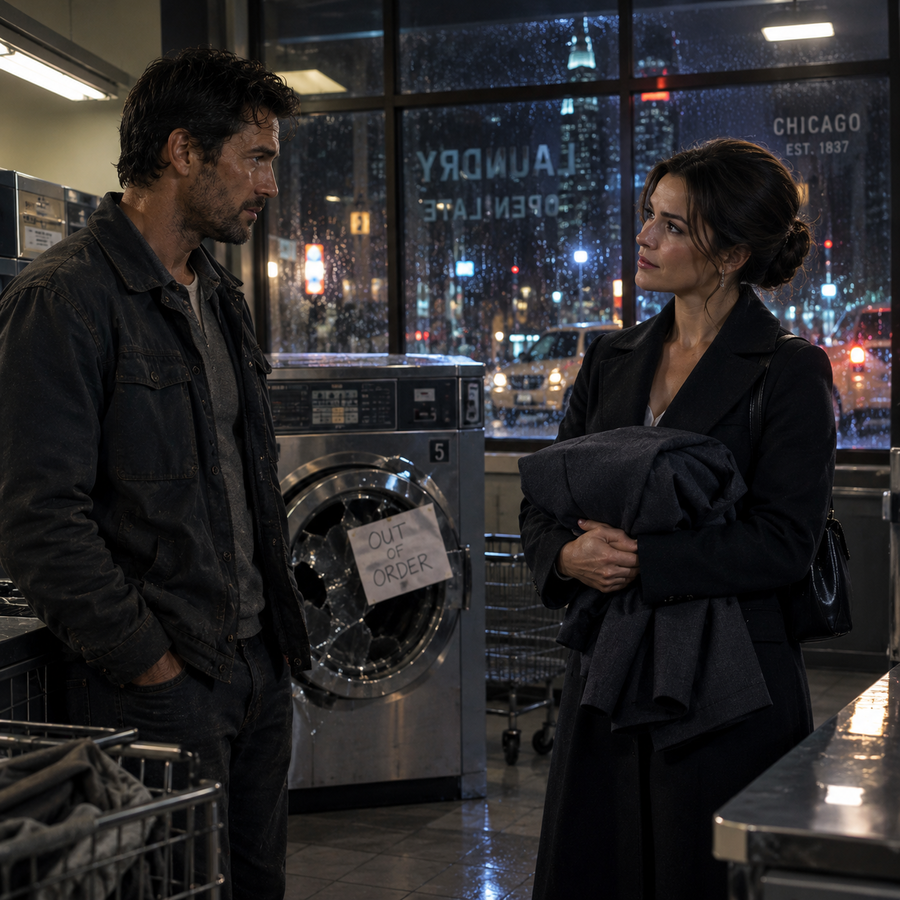
He pushed through the door. The laundromat was nearly empty. Overhead lights buzzed the way they always do in places that smell like industrial detergent and other people’s dryer sheets. A small television mounted in the corner was playing a nature documentary on mute. Three of the eight washing machines had paper signs taped to them: “Out of Order” in handwriting that had given up trying to be neat. An older man sat in the corner reading a newspaper. A teenager with earbuds was texting with both thumbs. And at the far end of the row of plastic chairs, a woman sat alone, folding a dark blazer over her knee with the careful precision of someone accustomed to doing things correctly.
Landon barely registered any of them. He was doing math. $6 for two large-load washers. That was the price on the board. He had $11. Detergent was $2 from the vending machine on the wall. That left $3. The dryers were $1.50 per cycle. He was going to be okay. He was going to thread this needle.
He fed quarters into machine number four. Nothing happened. He tried again. Nothing. He moved to machine number five. It accepted his quarters, filled with water, made a sound like it was considering his request, and then stopped completely and sat there, full of water and Mia’s school uniform and approximately $4 of his last $11.
“No,” Landon said quietly. “No, no, no.” He pressed the button. Nothing. He pressed it again. Nothing. He crouched down in front of the machine like maybe eye contact would help. He put his hand flat on the side of it. He took a breath.
“You’ve got to be kidding me,” he said to the machine.
“It does that,” a voice said from behind him.
He turned. The woman who’d been folding the blazer was looking at him now. She was maybe 40, 45. Dark hair pulled back. Good coat—the kind that cost more than his rent—and still looked like she’d grabbed it without thinking. Her face was composed in the way that people who run things learn to compose their faces. Not unkind. Not warm. Just measured.
“Machine 5,” she said. “It stops mid-cycle. You have to hit the door twice, hold the button, then restart. There’s a trick to it.”
Landon blinked at her. “You figured that out tonight?”
“I’ve been here 40 minutes.” She paused. “It was my third machine.”
He looked at her—at the good coat, the careful posture, the way she was sitting on a plastic chair like she’d chosen it—and something shifted in the math of the room that he couldn’t quite name.
“Thanks,” he said. He tried the trick. Door twice. Hold. Restart. The machine hummed back to life. He exhaled so hard his shoulders dropped two inches. “Thank you,” he said again. And this time he meant the whole evening, not just the machine.
He sat down three chairs away from her and pulled out his phone. Checked the time. Called the neighbor, Mrs. Garza, who was watching Mia. It rang four times. “Please pick up. Please. She’s probably fine. She’s fine. Pick up.”
“Hello?” Mrs. Garza’s voice was warm and slightly annoyed the way she always sounded after 8:00.
“It’s Landon. I’m so sorry. I know it’s late. How’s she doing?”
“She’s sleeping. Took her medicine. Asked me three times if you were coming.”
He pressed his eyes shut. “I’m at the laundromat. Maybe another hour.”
“She’s fine, mijo. She’s sleeping.”
“Okay. Thank you. I’ll be there as soon as—”
“Landon.” Mrs. Garza’s voice shifted to something softer. “She showed me the picture she drew at school. The one with the two of you at the lake.”
He didn’t say anything.
“She wrote, ‘My daddy carries everything.'” Mrs. Garza said. “I thought you should know that.”
He ended the call before she could hear anything in his voice.
He sat there for a minute with his phone in his hands, not looking at it. The woman, three chairs away, was not looking at him. She was folding a shirt with the same careful attention she’d given the blazer. He noticed she was doing laundry the way people do when they’re trying to disappear into a task. Methodical. Focused. Present in the work. He recognized that—he did it at the warehouse when the shift was long. He did it when Mia was sleeping and he was cleaning the kitchen at midnight and he just needed his hands to be busy so his brain would agree to slow down.
“Long day,” he asked. He didn’t entirely mean to.
She glanced over. “Is it that obvious?”
“You’ve been folding that same shirt for six minutes.”
She looked down. He was right. She set it aside. “Long week.”
“What do you do?” he asked. It was a stranger question, the kind you ask in laundromats and waiting rooms.
She paused a half-second too long. “Finance,” she said. Not a lie, exactly. Not the whole truth, either. He’d learn later what that pause meant. But right now, it was just a word in a laundromat. And he nodded like it meant something ordinary.
“You?” she asked.
“Distribution warehouse. Nights mostly.” He leaned back in the plastic chair. “And whatever else comes up.”
“Like late-night laundry runs.”
“Like late-night laundry runs,” he agreed.
For a moment, neither of them said anything. The dryer across the room tumbled. The nature documentary showed a bird doing something improbable with its wings.
Then she said, carefully, not looking at him, “You mentioned someone named Mia on the phone.”
“My daughter. She’s seven. She’s sick. Ear infection.”
“She’ll be okay.” He said it the way he said everything—with confidence he constructed rather than felt. “She’s tough.”
“Is she with her mother?”
The question landed in the room like a stone in still water. He looked at the woman. Her expression was neutral. Genuinely curious. Not cruel, not probing for something. Just a question that strangers sometimes ask because they don’t know not to.
“No,” Landon said simply. “There’s no mother. It’s just us.”
Silence.
“I’m sorry,” the woman said. “I shouldn’t have—”
“It’s fine.” He meant it. “People ask.”
She studied him for a moment. “Do they ask why?”
He smiled. Not a happy smile, exactly, but a real one. The kind that comes from somewhere deep. “Sometimes,” he said. “And then I tell them, and they don’t know what to say after that. So I’ve learned to give the short version.”
She set down the shirt she’d picked up again. She turned toward him slightly, the way people do when they’ve decided something deserves their full attention. “What’s the short version?” she asked.
Landon looked at the washing machine, where Mia’s uniform was spinning clean now, or getting there. And he thought about Mrs. Garza’s voice and the picture with the two of them at the lake and the word “everything.”
“She chose to leave,” he said. “I chose to stay. That’s it. That’s the whole story.” He glanced at the woman. “Some people think that’s sad. I think it’s just a fact. She’s mine and I’m hers and we figure it out every day.”
The woman was very quiet.
“I’m Victoria,” she said finally.
“Landon.”
They didn’t shake hands. The distance between the chairs felt right somehow. Like they’d agreed on it without discussing it.
Twenty minutes later, machine 5 started beeping in a way that suggested a new and creative problem. Landon got up, went through the two-door-hold-restart sequence. Nothing. He tried it again. The machine made a sound he’d never heard a machine make before—a kind of grinding reluctance—and then went completely, defiantly silent.
“Oh, come on,” he said.
Victoria appeared beside him. She’d crossed the room without him noticing. “Let me try,” she said.
“It’s my laundry—”
“I don’t need—” She said it without looking at him, reaching past him to press the sequence. “But you look like someone who’s been fighting things alone all day, and I have nothing else to do for the next 20 minutes.”
He stepped back. She tried the sequence three times, each attempt slightly different, with the patient experimentation of someone who actually pays attention to cause and effect. On the fourth try, the machine lurched back into motion.
He stared at it. “How did you—”
“It needs a longer hold on the second press. The timing is slightly different on the older models.” She stepped back. “I noticed it when I was dealing with machine 3.”
He looked at her. “You really were here before me.”
“I was.” She walked back to her chair, picked up the shirt she’d abandoned. “This is my third laundromat this month that’s had broken machines. I’ve been doing research.”
“You do research on laundromats.”
She hesitated. Just a fraction. “I do research on a lot of things.”
Something about the way she said it made him look at her differently. Just briefly. Like catching a different angle of light on something you thought you understood. But before he could follow that thread, the vending machine across the room ate her dollar without dispensing the detergent pods she’d selected.
“You’ve got to be kidding me,” she said softly, and the words were so close to what he’d said 20 minutes ago that he actually laughed. A real laugh. Short. Surprise. Genuine.
She looked at him.
“Long day,” he said.
“Long day,” she agreed. And for a moment, she was smiling, too.
He got the detergent from the machine using the technique of hitting the coin return with his palm at a 45-degree angle—a skill acquired over years of using equipment that the city had given up maintaining. He handed her the pods without making a thing of it. She accepted them without making a thing of it.
“Your daughter,” Victoria said after a while. “What’s she like?”
He didn’t hesitate. With Mia, he never hesitated. “She’s got opinions about everything,” he said. “Every dinosaur, every planet, every cloud shape. She’ll tell you exactly what she thinks before she figures out she’s supposed to be polite about it. It’s my favorite thing about her.” He paused. “She told her teacher last month that the math worksheet was designed by someone who didn’t understand how children think.”
Victoria looked up from her folding. “Was she right?”
“Completely,” Landon said. “The teacher agreed with her.”
Victoria smiled. Not the polished kind. The real kind. Involuntary. Warm. Reaching her eyes. “She sounds formidable,” Victoria said.
“She gets that from me,” Landon said, and didn’t entirely mean it as a joke.
At 9:52 p.m., with the laundry moving to the dryers, the older man in the corner fell asleep over his newspaper and snored once, loudly, waking himself up and looking around in dignified confusion. Landon and Victoria both looked at him, then at each other.
“Okay,” Victoria said, pressing her lips together to hold back the laugh.
“Okay, that man is living his best life,” Landon said.
And it broke open—both of them laughing in a fluorescent laundromat on a Tuesday while the city drowned outside. Laughing the way you only laugh when you’re exhausted and the absurdity finally overwhelms everything else. It lasted maybe 30 seconds, but Landon would remember it. He would remember it later, when everything got harder and the laughter was much harder to find. He would remember this moment as the one where he thought, “I don’t know who this woman is, but she’s real, and tonight that matters.”
He didn’t know yet that he’d need that memory. He didn’t know yet what was coming. He didn’t know that the prescription receipt in his pocket and the custody filing that had been quietly drafted three blocks away in a downtown law office and the name Greystone Development on a building he passed every day on his way to work—that all of it was already in motion. Already pulling toward him. Like gravity. Like a system designed by people who counted on men like him being too tired to fight back.
He didn’t know any of it yet.
But Victoria Sterling, CEO of Sterling Capital Group, board member of four companies, the woman who’d spent the last week reading financial documents that had made her go cold in a way she hadn’t felt since her first hostile takeover—Victoria was starting to connect something. Something small. Something that had been nagging at her since she’d seen the name on his prescription receipt when he’d pulled it from his pocket. Hayes.
She’d seen that name today. In a document attached to a filing. She looked at him—at this man laughing in a laundromat. This man who carried everything. This man with $11 and a sick daughter and a uniform that needed to be clean by morning. And she felt the first cold fingers of something that wasn’t just suspicion. It was recognition.
They’re already moving on him, she thought. And he has no idea.
She said nothing. Not yet. Because she wasn’t sure. And because she needed to be sure before she said anything that would change his whole night, his whole life, in a way she couldn’t take back.
She folded the blazer. She watched the dryers turn. She thought about documents and names and a man named Harland who had smiled at her across a conference table three days ago like he had already won something.
Outside, the rain kept coming. And in a laundromat on Clark Street, two strangers sat five feet apart, each one carrying something the other didn’t know about yet. One of them was about to find out.
She didn’t sleep that night. Not because she couldn’t. Victoria Sterling had trained herself over 20 years of corporate warfare to sleep anywhere, anytime, on command. Planes. Green rooms. Once in a car outside a courthouse in downtown Boston while her legal team argued inside. Sleep was a resource. She managed it like everything else.
But that night in her hotel room—she’d been staying at the Marriott on Michigan Avenue all week, avoiding her own empty townhouse in Lincoln Park—she lay on top of the covers, fully dressed, and stared at the ceiling and thought about the name on that prescription receipt. Hayes. Landon M.
She’d seen it in the Greystone file. Third page. A list of tenant households flagged for what the document called “accelerated resolution.” Legal language for something that wasn’t legal at all. She’d skimmed it at the time, focused on the financial irregularities, not the names. But now the name had a face. Had a laugh. Had a daughter named Mia who had opinions about dinosaurs and drew pictures of her father carrying everything.
Victoria sat up. She pulled her laptop from the nightstand and opened the Greystone file. She found it in four minutes. Hayes, L. Unit 4B, 1714 North Kedzie. Flagged for family court referral. Coordinated with Alderman Driscoll’s office.
Family court referral.
She read it three more times.
“That’s not a real estate document,” she said aloud to no one. “That’s a weapon.”
Landon got home at 11:14. Mrs. Garza was asleep in the armchair, television still on. He woke her gently, walked her to the door, pressed $20 into her hand even though she tried to refuse. She was 68 years old and getting up at midnight was not nothing.
He checked on Mia. She was curled on her side, one arm around the stuffed elephant she’d named Gerald—after the pharmacist, because Mia found the world’s bureaucratic annoyances hilarious rather than defeating—and Landon desperately hoped she’d keep that quality her whole life. He sat on the edge of her bed for a moment. Just a moment.
“I got your uniform,” he whispered. “It’s clean. You’re going to look great for pictures.”
Mia didn’t stir. He smoothed the blanket. He got up.
He went to the kitchen and stood at the sink, drinking water and looking at absolutely nothing. And for 90 seconds, he allowed himself to be completely empty. No next task. No mental checklist. No calculations. Just a man standing in a kitchen at 11 p.m., being tired in a way that the body doesn’t recover from in one night.
Then he set the glass down, opened his laptop to check the next day’s warehouse schedule, and saw the email.
It was from a law office he’d never heard of. Subject line: “Notice of Filing—In the Matter of Hayes, M.—Circuit Court of Cook County.”
His stomach dropped before he finished reading the subject line. He opened it. He read it once quickly, the way you do when your brain refuses to believe it. He read it again slowly.
It was a petition filed by someone named Richard Caulfield, listed as a “concerned party,” alleging that Landon Hayes maintained an unsafe and financially unstable home environment and requesting a court-ordered evaluation of custodial arrangements for one Mia Adeline Hayes, age seven.
Landon sat down. He hadn’t chosen to sit. His legs made the decision.
Unsafe. The word sat in his chest like something swallowed wrong. Unsafe. He worked 50-hour weeks. He kept the lights on. He bought the medicine. He did the laundry in the middle of the night in a rainstorm so his daughter would have a clean uniform for picture day. He had never once—not one single time—put anything ahead of that little girl’s safety.
And someone had filed a paper with a court calling him unsafe.
He didn’t know who Richard Caulfield was. He didn’t know yet that Richard Caulfield was a proxy. A name attached to a filing that served a purpose entirely unrelated to Mia’s welfare. He didn’t know yet. But he was starting to feel it. That specific feeling of a man who realizes—slowly and with cold certainty—that something is happening to him that he did not cause and cannot see the full shape of yet.
He sat at the kitchen table until 1:00 in the morning. Then he went to bed because Mia needed him functional tomorrow. That was the only math that mattered.
Victoria called her attorney at 7:00 a.m. “I need everything you can find on a company called Greystone Development. Specifically their connection to family court filings in Cook County in the last 18 months.”
Her attorney, a sharp woman named Dana Park who had been practicing long enough to be unfazed by anything, paused for only a second. “That’s a very specific ask for 7 a.m.”
“I had a long night.”
“Do you want to tell me what I’m looking for?”
“Tenants being pushed out through custody manipulation,” Victoria said. “Someone is filing or funding family court actions against renters in buildings Greystone wants to acquire. The court pressure forces families out without a formal eviction. No paper trail that connects directly to the landlord.”
Another pause. Longer this time. “Victoria,” Dana said carefully. “If that’s what this is, that’s not a real estate dispute. That’s fraud. Possibly worse.”
“I know what it is,” Victoria said. “That’s why I’m calling you.”
She almost didn’t go back. There was no reason to. The laundromat was done. She’d gotten her laundry. She’d had an unexpected conversation with a man she’d never see again. That was the whole thing. Life moved forward.
But she’d written down his name. Landon Hayes. She’d done it automatically, sitting in the plastic chair while he was on the phone with Mrs. Garza, pulling the paper and pen from her coat pocket. The way she pulled paper and pen at every meeting. Automatic. Habitual. “I might need this.”
She looked at the name on the paper for a long time. Then she did something she hadn’t done since she was 26 years old and just starting out and still believed that coincidences meant something. She followed the instinct.
She went back to the laundromat—not because she expected him to be there, just because it was the only address she had. She asked the man at the counter, the same older man who’d fallen asleep over his newspaper, if he knew a regular named Landon. Described him briefly. The man squinted.
“Big guy. Works nights. Got a little girl sometimes. Yeah, he lives on Kedzie. Four, five blocks up.” The man shrugged. “Comes in here every couple weeks. Good tipper for a laundromat.”
Victoria said thank you. And stood on the sidewalk and thought about what she was doing.
You’re a CEO, she told herself. You don’t knock on strangers’ doors.
Then: You also don’t let a man walk into a trap when you can see the trap and he can’t.
She walked four blocks north. She found him on the front steps of 1714 North Kedzie—which she recognized from the Greystone file the moment she saw the address on the building. He was sitting on the stoop with a cup of coffee and a look on his face that she recognized because she’d worn it herself. The look of someone processing a disaster quietly, alone, because there is no one else to process it with.
He looked up when he heard her footsteps. He stared.
“I know,” Victoria said. “This is strange.”
“You could have led with that,” Landon said slowly.
“You got an email last night,” she said. “Or a letter. Something from a law office.”
Every muscle in his face shifted. “How do you know that?”
“Because your address is in a file I’ve been reading for six days. And your name is attached to a court filing that has nothing to do with your daughter’s welfare and everything to do with this building.”
Landon stood up. He was taller than she’d registered in the laundromat. Or maybe it was just that he was standing on his own ground now, outside his own door, and it changed something about the geometry.
“Who are you?” he said. Not aggressive. Not soft, either. Precise.
“My name is Victoria Sterling. I’m the CEO of Sterling Capital Group. We were approached three months ago to co-invest in a development portfolio managed by a company called Greystone. I’ve been conducting due diligence.” She held his gaze. “What I found in their documents is why I’m standing on your sidewalk at 8:00 in the morning.”
The silence between them was different from the one in the laundromat. That silence had been two strangers choosing to be comfortable near each other. This one was the sound of a man recalibrating everything he thought he knew about the previous 12 hours.
“Come inside,” he said.
The apartment was exactly what she expected and nothing like she’d imagined. Small. Clean. Organized with the precision of someone who couldn’t afford disorder. One wall had a long strip of Mia’s drawings taped up in a careful row. Dinosaurs, mostly, in various emotional states. A planet with a face. A picture of two people at a lake, one much shorter than the other, with handwriting underneath that Victoria couldn’t read from where she stood but recognized from Mrs. Garza’s description.
Landon put a cup of coffee in front of her without asking. She accepted it without comment. He sat across from her at the kitchen table and said, “Tell me everything.”
So she did.
She told him about the Greystone portfolio—12 residential buildings across three Chicago neighborhoods, all in areas where property values were accelerating. She told him about the tenant displacement pattern. Residents pressured to leave not through formal eviction, which created legal liability, but through a quieter, crueler method. Noise complaints filed in bulk. Code inspections triggered selectively. And in cases involving single parents, renters with any prior family court involvement, or households flagged as financially vulnerable—third-party petitions filed in family court. Petitions that alleged instability. Petitions designed not to succeed in court, but to terrify. To cost money in legal fees. To make a parent look over their shoulder and decide that fighting an address wasn’t worth the risk to their child.
Landon listened to all of it without interrupting. When she finished, he said, “How many families?”
She hadn’t expected that to be his first question. Most people would have asked about themselves first.
“At least 14 that I’ve identified,” she said. “Possibly more. And they all got emails like mine, or letters, or calls.” She paused. “Most of them left. They couldn’t afford not to.”
He nodded slowly. His jaw was tight. “Who is Richard Caulfield?”
“A paralegal who does contract work. He signed petitions for three different firms, all with connections back to Greystone’s legal structure. He’s a signature. A placeholder.”
Landon was quiet for a long moment. Outside, the city was starting its morning sounds. Buses. Horns. Voices. The ordinary percussion of a Tuesday becoming a Wednesday.
“Why are you telling me this?” he said. “You don’t know me.”
“I knew your name before I knew your face,” Victoria said. “I saw what they were doing to you in a file. And then I met you. And now I can’t read the document the same way I did before.”
He looked at her with something she couldn’t fully name. Not gratitude. Not suspicion. Something more complicated and more honest.
“What do you want me to do?” he asked.
“Nothing yet. I need to be sure about the alderman connection before we move. If Driscoll’s office is coordinating with Greystone, this is bigger than I thought. And moving too soon could collapse the case before we have enough to—”
“Mia has a school picture today,” Landon said.
Victoria stopped.
“I did the laundry last night,” he said. “In a rainstorm. At 10 p.m. So her uniform would be clean because she asked me twice if it was going to be clean.” He wasn’t raising his voice. He wasn’t breaking. He was just saying the thing that was true. “Whatever you’re planning, whatever timeline you’re working on, there is a seven-year-old going to school this morning who doesn’t know that someone filed a paper trying to take her away from the only parent she has. And I would like to know how long before that becomes the part of the story she’s old enough to understand.”
Victoria sat with that. She had been in a hundred high-stakes rooms. She had said hard things to powerful people. She had held positions under pressure that most people would have surrendered in the first 20 minutes. She had never felt a sentence land on her the way that one did.
“I’m not going to let them take her,” she said, and she meant it as a statement of professional intention, but it came out sounding like something else. Something that surprised even her.
Landon studied her face. “You barely know us.”
“I know enough.”
The sound of small feet on the hallway floor interrupted everything. Mia appeared in the kitchen doorway in her school uniform—clean, pressed, exactly as promised—with her hair in two uneven braids that Landon had clearly attempted with great effort and moderate success. She had Gerald the elephant tucked under one arm, and she was looking at Victoria with the unself-conscious evaluation of a child who has not yet learned to be polite about curiosity.
“You’re not Mrs. Garza,” Mia said.
“No,” Victoria agreed. “I’m Victoria.”
“Why are you here, Mia?”
“Mia—” Landon started.
“I’m helping your dad with something,” Victoria said.
Mia considered this. “Is it important?”
“Very.”
Mia nodded seriously. “My dad helps with important things. He helped Mr. Kim on the second floor move his couch when his back went out. And he helped Mrs. Garza when her nephew was in the hospital. He does that.” She looked at her father. “Is she a friend?”
Landon looked at Victoria. Victoria looked at Landon.
“Yes,” he said after a moment. “She’s a friend.”
Mia accepted this with the efficiency of someone who has more important things to think about. “I want the brontosaurus for breakfast. The vitamin.”
“The brontosaurus is Tuesday,” Landon said. “Wednesday is Stegosaurus.”
Mia’s expression indicated she found this policy unreasonable but was choosing her battles. She climbed into her chair and accepted the Stegosaurus vitamin with dignified resignation.
Victoria watched Landon move through the small kitchen with the ease of someone who had cooked breakfast in this space 10,000 times. He knew where everything was without looking. He knew how Mia took her toast. He knew she’d want the orange juice poured before she asked.
There was a word for what Victoria was watching. And the word was home. Not a place. A practice. Something built every morning, maintained through repetition and intention and love that didn’t announce itself. And someone wanted to dismantle it from a file in a downtown office using legal language and proxy signatures and the weight of a system that moved slowly enough that most people gave up before it ever reached resolution.
Not this time, Victoria thought.
Her phone buzzed. Dana Park’s number. She stepped away from the table.
“Tell me.”
“I found three more filings,” Dana said. “All connected to the same cluster. And Victoria—one of the board members at Greystone is on the municipal development committee. This goes to city hall.”
Victoria turned and looked at Landon, helping Mia with her second braid. His big hands gentle and careful. His voice low and patient.
“I know,” she said into the phone. “We’re going to need the full paper trail. Everything.”
She hung up. Mia was looking at her again with those direct, unhurried eyes.
“Are the important things okay?” she asked.
Victoria crouched down to her level. “They’re going to be,” she said. “I promise.”
It was a promise she had no guarantee she could keep. She made it anyway.
Dana Park called back 40 minutes after Mia left for school. Landon was still at the kitchen table. He hadn’t moved much. He had his second cup of coffee in front of him and a legal pad where he’d been writing down everything Victoria had told him. Names. Dates. Addresses. The way he wrote—warehouse inventory. Methodical. Precise. Because if his hands were moving, his brain stayed functional. And right now, he needed his brain more than he’d ever needed it.
Victoria took the call standing near the window. Landon watched her face change. Not dramatically. Victoria Sterling didn’t do dramatic. But he’d spent enough time reading people—in close quarters, in warehouses, in custody waiting rooms, in his own kitchen—to know when someone was absorbing something bad and deciding simultaneously how much of it to show.
She was absorbing something bad.
“How many?” she said into the phone. A pause. “All in the same 18-month window.” Another pause. “Send me everything. Yes, everything. I don’t care how long it takes to compile.”
She hung up. She stood there for a second with her back to him.
“Tell me,” Landon said.
She turned around. “22 families. Dana found 22 households that received either family court filings, code enforcement actions, or both. All in buildings on Greystone’s acquisition list. 18 of those buildings have since been sold or are under contract.”
“22 families,” Landon put his pen down. “18 buildings in 14 months.” He did the math without being asked. “18 buildings. City neighborhoods. Rising property values. Whatever those buildings were worth individually, together they formed a portfolio that would make someone extraordinarily wealthy. And the cost of acquiring them—the true cost, the one that didn’t appear in any financial disclosure—was paid by 22 families who had done nothing except live somewhere that someone more powerful wanted.”
“They ran a machine,” Landon said. It wasn’t a question.
“Yes. And nobody caught it because each piece looks like a separate thing. A code complaint here. A custody concern there. Nothing that connects unless you’re looking at the whole map.”
“But you were looking at the whole map.”
“I was looking at the financial structure,” Victoria said. “Which led me to the legal structure. Which led me to the filings.” She sat back down across from him. “Greystone approached Sterling Capital for co-investment. That’s why I had access to their internal documents. They gave me the map without realizing what they’d given me.”
Landon was quiet for a moment. “Why didn’t they realize it?”
Victoria’s expression shifted into something he recognized. Something he saw in the mirror sometimes. The look of someone who understands exactly why they were underestimated. “Because they looked at me and saw a potential partner,” she said. “Not an auditor.”
He nodded slowly. “When do we move?”
“I need one more piece. The alderman connection. If Driscoll’s office coordinated with Greystone directly, we have a government corruption angle that makes this impossible to bury. Without it, Greystone’s lawyers argue it was a coincidence. Overzealous property management. A contractor who acted independently.” She leaned forward. “With it, we shut the whole thing down and nobody walks away clean.”
“How long to get it?”
“Dana thinks 48 hours. Maybe 72.”
“I have a court date in 21 days,” Landon said. The number sat between them like something with weight.
“I know,” Victoria said.
“21 days to respond to a petition filed by someone I’ve never met about a daughter I’ve raised alone for four years using a legal system that—” He stopped. Pressed his hand flat on the table. Started again. “I cannot afford the kind of attorney who fights something like this, Victoria. I know what those retainer fees look like. I’ve seen them.”
“You won’t need to,” she said. “Dana is already on it. She knows a family law attorney who owes her a significant professional favor. We’ll have representation in place by end of day.”
He stared at her. “Why are you doing this?”
“Not the corporate case. I understand the corporate case. But this. The attorney. Being in my kitchen.”
Victoria was quiet for a moment. A real moment. Not a strategic pause. The kind of quiet where a person finds the honest answer instead of the easy one.
“Because I sat in that laundromat and watched you fight six broken machines for a school uniform,” she said. “And I thought: the system is designed to exhaust people like him until they give up. And I am part of that system. I have been for 20 years.” She met his eyes. “I’d like to be a different part of it. Just this once. Starting now.”
He held her gaze. He didn’t say thank you. Some things are too large for thank you.
He said, “Then let’s get to work.”
The next 36 hours moved like weather. Dana Park filed a formal response to the custody petition by noon, citing procedural deficiencies and requesting a full disclosure of the petitioner’s standing—a move that would force Richard Caulfield into the open, require him to demonstrate a legitimate connection to Mia’s welfare, and buy Landon time while the larger investigation developed.
Caulfield’s attorney, a downtown firm Landon had never heard of, responded within four hours. Which meant they were watching. Which meant they had resources allocated to this. Which meant this was not, in any universe, about a concerned citizen worried about a little girl’s well-being.
“They responded in four hours,” Landon told Victoria over the phone that evening. He was at the warehouse on break, standing in the parking lot in the cold because the breakroom was too loud to hear.
“You file a custody petition and your lawyer responds to the counter in four hours. That’s not how concerned citizens work.”
“No,” Victoria agreed. “That’s how corporate legal teams work when they need a timeline to hold. They’re trying to slow me down. They’re trying to keep you scared and distracted while the building transaction closes. If they get the sale through before the evidence surfaces, the new ownership structure creates enough legal distance that Greystone can claim no knowledge of what their contractors did.”
Landon pressed his back against the warehouse wall and looked up at a sky with no stars. “When does the sale close?”
A pause. “16 days,” Victoria said quietly.
He closed his eyes. 16 days. Five days less than his court response window. The timeline wasn’t accidental. Nothing about this was accidental.
“I need you to trust me for 16 days,” Victoria said.
“I’m already trusting you.”
“I let you into my kitchen, Landon.” Her voice shifted lower. More direct. “I need you to not do anything that gives them ammunition. Don’t miss work. Don’t be late picking up Mia. Don’t have any conversation about this with anyone who isn’t me or Dana. They will use anything. A missed payment. A bad day. A neighbor who says you seemed stressed. Anything becomes evidence of instability in front of the wrong judge.”
“So I perform normalcy while my life is being taken apart.”
“Yes.”
“I’ve been doing that for four years,” he said. “I know how.”
She didn’t answer immediately. When she did, her voice was quieter. “I know you do. I’m sorry I said it like it was new information.”
He let that sit for a second. “Get the alderman connection,” he said. “I’ll handle everything else.”
It was Dana who found it. And the way she found it was almost too simple—which is often how large corrupt structures finally come undone. Not through sophisticated investigation, but through a document that someone forgot to redact. An email chain obtained through a public records request that Dana had filed as part of a broader inquiry into Greystone’s municipal permits.
Third email in the chain. Between a staffer in Alderman Driscoll’s office and a Greystone project manager. Subject line: “RE: Kedzie/Courtland timeline.”
Body of the email, three lines: “Legal has confirmed the Hayes filing is active. Should clear within 30 days. Recommend accelerating the permit review on our end to align.”
The Hayes filing. His name. In a city government email. Coordinated with a real estate transaction.
Dana called Victoria at 6:00 a.m. on a Thursday. Victoria called Landon at 6:03. Landon was already up. He was always up by 5:30.
He listened to her read the email aloud. Word by word. And he sat at his kitchen table in the early quiet of the apartment and felt something move through him that wasn’t anger, exactly. It was larger than anger. It was the feeling of finally seeing the full shape of a thing that had been pressing against you in the dark.
“They used his name,” Landon said—not to Victoria, almost to himself. “They put my daughter’s custody case in a city government email about a real estate permit.”
“Yes.”
“She’s seven years old.”
“Yes.”
“And somewhere, a city staffer typed her father’s name into an email and hit send and went home for dinner.”
“Landon.”
“I’m okay.” He wasn’t. But he was functional, which was the same thing right now. “What do we do with it?”
“Victoria has a board meeting at Harland Group tomorrow. One of Greystone’s major backers. She’s going in.”
The boardroom on the 42nd floor of the Harland Group building was the kind of room designed to remind you who had power. Long table. Real wood. Views that made the city look like a resource. Men in suits arranged in the specific geometry of people who had never been told no by someone they couldn’t buy.
Victoria walked in wearing a gray suit and carrying a leather portfolio and the particular expression she’d been perfecting since she was 23 years old: utterly calm, fully prepared, and absolutely done negotiating.
She had been invited to this meeting as a potential board ally. They thought she was here to say yes. She let them get through 12 minutes of preamble—acquisition timeline, projected returns, community development language that recycled itself every three sentences without saying anything real. Then she opened her portfolio.
“I’d like to discuss the Kedzie corridor properties,” she said. “Specifically, the methodology used to accelerate tenant transitions.”
A man at the far end of the table—50s, silver-haired, the particular stillness of someone who controls things—looked at her with an expression that was almost a smile. His name was Arthur Harland. She’d met him twice before, at charity events, where they’d been pleasant to each other and said nothing real.
“Standard market processes,” Harland said. “Nothing unusual for urban redevelopment.”
“I have an email from Alderman Driscoll’s office,” Victoria said, “coordinating a family court filing against a private citizen with your permit approval timeline.” She paused. “That’s not a market process. That’s a conspiracy.”
The room went quiet in the way that rooms go quiet when something irreversible has just been said. A younger man—three seats from Harland, legal counsel, she could tell by the instinctive way he straightened—started to speak.
“I’d think carefully,” Victoria said, without looking at him, “about what you say in the next 30 seconds. Because this conversation is being documented, and you are all currently in the room.”