A Freezing Puppy Lay Alone Until a Navy SEAL Found Him in the Snow (part 2)
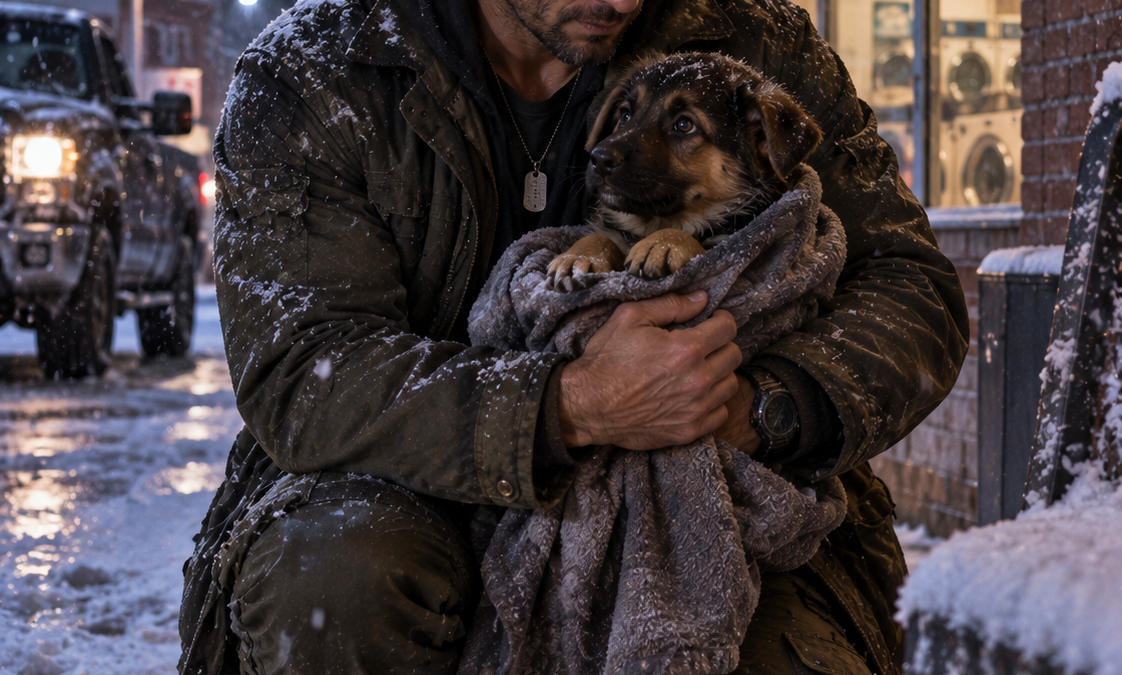
Part 2
Caleb did not answer.
He reached down very slowly and rested two fingers against the fur between Rook’s shoulders.
The puppy did not move away. The morning of the meeting looked too clean for what Caleb Varic was carrying inside him.
North Haven had woken beneath a bright winter sky, the kind that made every roof line sharp and every pine branch glitter, as if the town had been polished overnight by some patient northern deity with a weakness for cruelty. The snow along the road shone white.
Harrow Lake lay frozen beyond the trees, flat and pale, holding the sun without warmth. Caleb drove toward the animal clinic with both hands on the wheel.
Rook sat on the passenger seat, clipped safely into the black harness with dark blue trim that still looked newer than anything else in Caleb’s life.
The puppy had eaten more that morning than he had on the first day. Not enough to satisfy Norah perhaps, but enough for Caleb to notice the difference. His cream gray coat had begun to dry into softness instead of clinging to his thin body and tired patches.
One ear stood. The other leaned outward, skeptical of optimism.
Caleb told himself the meeting was good. That word had become an accusation.
A good family wanted to meet Rook. A good family with a fenced yard, experience, patience, and a child gentle enough to sit on the floor and wait.
A good family could offer the puppy things Caleb did not know whether he could offer without breaking something inside himself. A good family meant the system was working exactly as it should.
So why did every mile toward the clinic feel like betrayal? Rook shifted beside him, nose lifting toward the heater vent, then toward Caleb. He made no sound.
He did not know about foster agreements or adoption lists. He did not know that humans could turn love into paperwork because paperwork made loss seem civilized.
Caleb looked at the road.
Don’t look at me like that, he said quietly.
Rook blinked.
That wasn’t a discussion.
The puppy rested his chin on the towel. Caleb had faced men with rifles who looked less disarming than this dog did while doing nothing. At the clinic, doctor Norah Witam met them in the lobby.
She wore a dark green sweater beneath her coat this time, sleeves pushed slightly at the wrists, hair tied back with a pencil stuck through the knot, as if she had decided efficiency and grooming could negotiate later. She glanced at Caleb then at Rook.
He looks brighter, she said. He ate some.
Some is better than none. Caleb nodded.
Norah studied his face for half a second too long. You can still say no to the meeting.
I said I’d bring him.
That is not the same thing it is today. Norah did not argue.
That was one of her more irritating qualities. She knew when silence would do more damage than words.
She led them into a larger room at the back of the clinic where the floor was rubberized and easy to clean, and a few toys had been placed near the wall. A window looked out over the parking lot where sunlight flashed off snowbanks. Caleb positioned himself near the door without meaning to.
old habit. Know the exits.
Know the room. Know what could happen if things went wrong.
Nothing was going to go wrong. That was the problem. The Halden family arrived 5 minutes early.
Daniel Halden entered first, removing his wool cap as soon as he crossed the threshold. He was in his mid-40s, tall and broad in the quiet way of men who worked with their hands rather than for mirrors.
His sandy brown hair was cut short, his beard trimmed close, and sawdust seemed somehow present around him, even though his canvas jacket was clean. He had a calm face, not soft, but careful.
Grace Holden followed beside him. She was a little younger, with dark, auburn hair tucked into a loose braid over one shoulder, and a face made gentle, not by weakness, but by attention. She paused when she saw Rook and instead of smiling too widely or making the high bright noises people often aimed at frightened animals, she only lowered her voice.
“Oh,” she said.
“There you are.”
Their daughter stood partly behind Grace at first, holding a soft toy fox in both hands. Molly Halden was nine, small for her age, with a round face flushed by the cold and light brown hair escaping from two uneven braids.
Her eyes were serious in the way children’s eyes become serious when they have been told something matters and have chosen to honor it.
Rook pressed against Caleb’s boot.
Caleb felt it through the leather. Norah handled the introduction simply. No sentiment, no ceremony.
Daniel shook Caleb’s hand with a grip that neither challenged nor apologized.
Grace nodded warmly. Molly did not move toward Rook. That was the first thing Caleb resented.
The child had been taught well.
Hi, Rook,” Molly said from where she stood.
Rook watched her. Molly looked at Nora.
“Should I sit?”
Nora smiled slightly.
“That would be fine.”
Molly sat cross-legged on the floor several feet away, placed the soft fox in front of her, and folded her hands in her lap as if waiting for church to begin.
Rook’s ears shifted.
Caleb kept the leash loose. Grace crouched beside Molly, not too close to the puppy.
Daniel remained standing, hands relaxed at his sides. No one rushed.
No one crowded him. No one tried to prove they were kind by overwhelming a creature that had already survived too much.
It was, Caleb thought, deeply inconvenient. Rook took one step forward, then stopped.
He looked up at Caleb. The glance lasted less than a second, but Caleb felt it like a hand closing around his ribs.
Then Rook moved toward Molly. The room was silent except for the hum of the heater. Rook approached the toy first.
He sniffed it, backed away, then returned. Molly did not reach out.
She waited until Rook sniffed her knee, then whispered, “You can have it if you want.
” Rook took the fox gently by one ear.
Molly’s whole face lit up, but she stayed still.
Grace’s eyes softened.
Daniel looked down and smiled in a way that told Caleb he had known dogs long enough to understand that this tiny exchange was not tiny at all. Caleb began immediately to look for flaws.
The fenced yard could have gaps. Children forgot rules.
Daniel’s work schedule might change.
Grace seemed gentle, but gentleness could become nervousness when a dog chewed something valuable or refused food. Molly was careful now, but childhood had weather inside it. Noise, friends, doors left open, sudden laughter, birthday parties.
A puppy like Rook needed quiet. Then Rook carried the fox back toward Caleb and dropped it beside his boot. Caleb looked down.
Molly looked too. He brought it to you, she said.
He brings things where he thinks they belong, Caleb said before he could stop himself. The words hung there.
Grace heard them. Norah certainly did. Daniel asked about feeding then, perhaps kindly pretending not to notice what Caleb had revealed.
Caleb gave a precise answer. Small portions, softened food, no pressure, same place. Grace asked whether Rook reacted to loud noises.
Caleb said yes sometimes. Molly asked if he liked blankets.
Caleb looked at the puppy. He tolerates them.
Molly accepted this with the seriousness of a diplomat receiving a border report.
Then maybe he could have one that’s his something.
And Caleb bristled. He already has one, he almost said, but he did not. Because the truth was Rook did not have a blanket.
He had an old towel, a folded throw near the stove, and a man pretending none of those things had become personal. Norah suggested letting the family take Rook for a short walk inside the clinic hallway.
Caleb’s first answer formed instantly.
No. It rose clean and sharp.
A trained response to risk.
Instead, he heard himself say, “Keep the leash loose.”
Daniel took the leash, careful to keep his hand low. Rook resisted for one heartbeat, looking back at Caleb. Then Grace made a soft clicking sound with her tongue, not commanding, only inviting.
Rook stepped forward. Molly walked beside her mother, hands in her coat pockets so she would not reach too soon.
They went slowly down the hallway. Caleb remained in the room with Nora. He hated the empty space near his boot.
Norah waited exactly 12 seconds. Caleb counted them without wanting to.
You are very quiet, she said.
I’m watching.
You are glaring at decent people through a wall.
I can’t see through walls, I said glaring, not succeeding.
Caleb gave her a look. Norah folded her arms.
They’re good people.
I know. They understand shepherds. I heard they understand he needs time.
Caleb looked toward the hallway.
He could hear Molly’s voice low and delighted, saying something about the fox.
Rook’s nails clicked softly on the floor.
He’s not a normal puppy, Caleb said.
No, Nora agreed. But needing patience does not make him impossible.
I didn’t say impossible.
No, you’re building a case for irreplaceable.
That landed too close.
Caleb’s jaw tightened.
I’m trying to make sure he isn’t abandoned twice.
Norah’s expression changed.
Not with pity. Pity would have angered him.
This was worse. This was recognition.
Are you sure that’s all you’re trying to prevent?
The hallway noises seemed to recede. Caleb looked at her.
Norah did not soften the question by taking it back. He could have answered several ways. He could have said he had no personal stake.
He could have said he was only fostering, only following procedure, only doing the temporary thing he had agreed to do. He could have said the Halden family was better equipped.
He could have said anything that sounded reasonable. Instead, he said nothing because sometimes silence is the only honest answer a man has left.
Rook returned a minute later with the fox in his mouth and Molly walking carefully behind him. The puppy came straight to Caleb, pressed the toy against his boot, then sat, uneven ears lifted.
Molly stopped several feet away. He keeps checking where you are.
Caleb stared at the dog. Molly added very softly.
Maybe he thinks you’re the safe place.
No one spoke. The child did not know what she had done.
She had simply named the thing adults had been circling like wolves around a fire. Caleb looked away first. After the meeting, Grace did not ask for an immediate answer.
That too made things harder.
We’d like to think about it, she said.
And you should, too. Daniel nodded.
He’s been through a lot.
Moving him again should be done carefully if it’s done.
If it’s done.
Caleb disliked how grateful he was for those words. Molly crouched once more, still not touching Rook until he stepped forward.
When he did, she let him sniff her fingers.
“If you come live with us,” she whispered.
“I’ll be careful.
” Then she looked at Caleb and with the brutal mercy of children, said, “But if you stay with him, I think that’s okay, too.”
Grace placed a hand gently on her daughter’s shoulder.
Come on, honey. The Halden family left with the soft dignity of people who had not gotten what they came for, but refused to turn disappointment into pressure.
Caleb stood in the parking lot afterward, Rook beside him. Sunlight flashing across the snow so brightly it almost hurt to look.
Norah stood near the clinic door.
“You don’t have to decide this second,” she said.
“I know.
You do need to decide honestly.”
Caleb looked down at Rook.
The puppy was chewing the fox’s ear, the gift Molly had left behind.
Honestly, the word followed him home. By late afternoon, the sky had clouded over. Caleb parked by his house and sat for a moment with the engine off.
Rook slept on the passenger seat, one paw resting on the toy fox. The heater ticked as it cooled.
Through the windshield, Caleb could see his porch, the wood pile, the kitchen window. The ordinary structure of the life he had spent two years reducing to something survivable. A life could be survivable and still not be alive.
Inside, Rook woke enough to trail after him from room to room. Not closely, not confidently.
But he checked kitchen, hallway, stove, Caleb, then back to the stove. His world was still small, but Caleb had somehow become one of its fixed points.
That should have frightened him. It did.
Near dusk, Amos Bell appeared by the back fence carrying something wrapped in a towel. Caleb opened the door before the old man could knock against the frame with his elbow.
What is that? Caleb asked. A constitutional crisis, Amos said.
Also, Stew.
I didn’t ask for stew.
You didn’t ask for personality either.
But here we are. Amos stepped in far enough to place the container on the counter. Rook lifted his head from near the stove, saw Amos, and gave a cautious wag of his tail.
“Ah,” Amos said.
The wolf cub remembers greatness.
“He remembers your pocket smelled like biscuits yesterday.
Greatness takes many forms.
” Caleb did not smile.
“Not quite.”
Amos glanced at him, then at the toy fox on the floor.
“Meeting happened?”
Caleb gave him a short look.
“I live next door, not in a cave,” Amos said.
Norah called my house by mistake once 10 years ago and since then I know everything. The family is good. That sounds terrible.
They have a fenced yard experience. A daughter who knows not to rush him.
Monsters, Amos said gravely. Caleb leaned against the counter.
He’d be safe there.
Amos removed his gloves finger by finger. His hands were nodded with age but steady. Safe is a fine thing.
Not always the whole thing. Caleb looked toward Rook.
The puppy had dragged the fox into the edge of the shadow beneath the table. Not hidden, just placed there between light and dark.
“I can’t keep him just because I don’t want to lose him,” Caleb said.
“No,” Amos agreed.
“That surprised him.”
The old man continued.
“But you also shouldn’t give him away just because wanting him scares you,” the kitchen held the words.
Caleb’s throat moved once.
Amos’s voice lost some of its humor.
After June died, I kept her gardening gloves by the back door for three years.
Didn’t use them, didn’t move them, just looked at them every spring like they were going to tell me what to plant.
Caleb said nothing. One day I put them on, Amos said. Hands were too small, of course.
Woman had sparrow hands and the will of a bear. I planted beans badly. They came up anyway.
He shrugged as if embarrassed by the length of his own honesty.
Point is, keeping love locked in a drawer doesn’t preserve it.
Mostly, it just keeps your hands empty.
Caleb looked at Elena’s blue mug on the table.
The water inside it caught the last dim light from the window. Amos noticed where he was looking, but did not mention it.
That was kindness, Caleb thought. Not the kind that knocked loudly at the front door, but the kind that left a lamp on and pretended it had always been there.
After Amos left, the house felt different. Not warmer exactly, though the stove was burning well. More witnessed.
As if the walls knew Caleb could no longer pretend the decision belonged to someone else. He fed Rook at the usual time.
The puppy approached the bowl, hesitated, then nudged it 2 in toward Caleb’s chair before eating.
Not a full meal. Not yet, but enough.
Afterward, Rook carried the toy fox to Caleb’s boot, set it down, and rested his chin beside it.
Caleb remained standing for a long time. Then he sat.
The dog tags beneath his shirt shifted against his chest. Once those tags had told the world who to notify if Caleb did not come home. Now they rested above a heart that had spent 2 years avoiding anything that could make coming home matter.
Rook slept. Caleb did not.
Night gathered over North Haven. Snow began again, light as ash.
In the kitchen, Elena’s mug sat on the table.
The empty bowl sat on the floor.
and Rook’s breathing made a soft uneven rhythm near Caleb’s feet.
At 6:12 the next morning, before the town was fully awake, Caleb called Nora. She answered on the third ring, voice rough with sleep but alert.
“Is he all right?”
“Yes,” Caleb said.
A pause.
Then Norah said, “All right.
What happened?”
Caleb looked down. Rook had woken and was watching him from the rug. The toy fox under one paw.
I want to adopt him, Caleb said. The words came out plain. No speech, no decoration, no noble explanation to make him sound less afraid.
On the other end of the line, Norah was quiet for a moment.
Then she said, “Good.
I’ll start the paperwork.”
Caleb frowned slightly.
That’s it.
What did you want? Trumpets?
No. Excellent.
We’re fresh out.
For the first time that morning, Caleb almost laughed.
Norah’s voice softened only a little.
I’ll call the Haldens.
I should talk to them. You can if you want. Grace already suspected this might happen.
Caleb closed his eyes briefly. Of course, she had.
Later that morning, Grace Halden sent a message through Nora. Caleb expected disappointment, perhaps resentment, at the very least a polite distance. Instead, the message said they were glad Rook had found the person he trusted, and if Caleb ever needed help when he had to travel or when Rook needed another safe place, they would be willing to be part of that circle.
Molly had added one line in crooked handwriting Norah photographed and sent along. Tell Rook the fox is his. Caleb read the message twice.
Then he looked at Rook, who was chewing the fox with grave concentration, as if honoring a sacred duty. You have people, Caleb said quietly. Rook looked up.
Caleb realized with a strange and inconvenient pressure behind his ribs. That the sentence was not only true for the dog. By noon, he was back at the clinic signing the adoption papers.
Norah slid them across the counter without ceremony. Caleb appreciated that there were enough ceremonies for loss in the world. Perhaps choosing to keep something alive did not need to be dressed in speeches.
He signed his name, Caleb Veric, owner. The word looked too large on the page.
Outside, the winter sun shone over North Haven with cold brilliance. Rook walked beside him, still thin, still cautious.
The fox toy tucked awkwardly in his mouth. At the truck, Caleb opened the passenger door, then stopped.
“Rook looked up at him.”
“Home,” Caleb said.
The puppy climbed in.
“This time, when Caleb drove away from the clinic, he did not tell himself it was temporary.
He did not tell himself it was just for a few days. He did not tell himself the house would remain unchanged.
The road ahead curved toward the lake, toward the pines, toward the small home at the end of the drive where Elena’s mug waited on the table and an empty bowl waited on the floor.
For the first time in years, Caleb was not returning to a place where grief lived alone. He was bringing someone home. The first thing Caleb Varic learned after adopting Rook was that a house did not change all at once.
It changed by inches.
A leash appeared on the hook beside the back door, hanging where Elena’s red scarf had once lived through three winters, because neither of them ever remembered to move it.
A bag of puppy food claimed space in the pantry with the confidence of an occupying army.
A soft gray mat lay near the stove, though Rook usually ignored it in favor of sleeping half on Caleb’s boot, as if comfort meant less than proximity.
The toy fox Molly Halden had given him moved around the house like a small orange ghost. Caleb found it under the table beside the wood pile once inside one of his old work boots.
Rook carried it with great seriousness as though the fox had been entrusted to him by a council of woodland elders and not a 9-year-old girl with uneven braids. Caleb did not say this aloud.
He was not becoming that kind of man. Not yet. Still, on the second morning after the adoption papers were signed, he caught himself stepping over the toy instead of putting it away.
That was how it began. Not with a grand surrender, but with the quiet acceptance that some disorder had earned the right to stay.
Elena’s blue mug remained on the kitchen table for several days.
Then Caleb moved it to the open shelf above the counter, not hidden, not centered like a shrine, just present. Beside it, he placed a small clay pot he bought from the general store because the woman at the counter said the plant inside was hard to kill.
“That sounds like a challenge,” Caleb had said.
The woman had laughed as if he had made a real joke. Caleb had carried the plant home with the uneasy dignity of a man transporting contraband.
Now the little green leaves stood beside Elena’s mug, bright against the old wood shelf.
Caleb still looked at the mug sometimes and felt pain move through him, but the pain no longer slammed every door in the room. It sat there with him. It breathed.
It made space for the plant, for the dog bowl, for the scratch of Rook’s nails on the floor.
Rook improved slowly, which was to say, honestly, he ate better, but not perfectly. Some mornings he finished half his food, backed away, and watched the bowl from under the table.
Other mornings, he nudged it two or three inches toward Caleb’s chair before eating, as if relocating the meal closer to the nearest fixed star.
The empty off-white bowl remained beside his own. No longer strange, no longer a trick.
It had become part of the ritual. Caleb did not rush him.
That was new. In the old life, Caleb had believed problems respected pressure. Push long enough, train hard enough, plan sharply enough, and the world would eventually yield.
Rook had taught him that fear was not a door to kick open. Fear was more like a wounded animal under a porch. You sat nearby.
You spoke softly. You made the weather less hostile. Then you waited for it to decide the open air would not kill it.
On the fifth day, Caleb took Rook into town. He told himself it was for socialization because Norah had recommended brief, controlled exposure to ordinary environments. That sounded professional enough to protect him from the truth, which was that Rook had begun staring at the door every afternoon, and Caleb had begun wanting an excuse not to sit alone until dark.
North Haven’s main street was small enough that strangers were noticed, and familiar faces became weather patterns.
The bakery sat between the pharmacy and a bait shop that remained open year round out of either optimism or stubbornness. Snowbanks lined the curbs. The lake wind ran down the street with icy fingers, tugging at coat hems and loose signs.
Rook walked close Caleb’s left boot, harnessed snug around his thin chest.
He did not tremble as much as before, though the passing rumble of a delivery truck made him stop and lean hard against Caleb’s leg.
Caleb stopped with him. No command, no correction, just waiting.
A woman leaving the bakery saw them and smiled that the little one from Norah’s post.
Caleb considered pretending not to hear, but Rook looked up at him as if interested in his answer.
“Yes,” he said.
“He’s beautiful.”
Rook, who had recently tried to chew the corner of a firewood receipt, accepted the compliment with the somnity of royalty. The woman introduced herself as Beth Larkin, owner of the bakery.
Though Caleb had known her by sight for 2 years, she was round-faced, quick moving, and carried the smell of cinnamon and yeast as if surrounded by a personal weather system.
She asked Rook’s name and did not ask Caleb any questions about himself, for that alone, Caleb nearly trusted her.
“Rook,” he said.
Beth looked delighted.
“Like the bird or the chess piece?”
Caleb glanced down at the puppy who was sniffing a patch of snow as if decoding a treaty. Depends on the day, Beth laughed.
Well, tell him he’s welcome outside my shop anytime.
I keep dog biscuits behind the counter.
Rook’s ears moved.
Caleb looked down.
You don’t even know what that means.
Rook’s expression suggested he was willing to learn.
After that, town became harder to avoid. The mail carrier began waving.
A boy on a bicycle called Rook a baby wolf, then nearly rode into a snowbank from looking back too long.
At the hardware store, an old man Caleb barely knew said, “Good dog,” in passing, and Rook watched him go, as if considering whether the title might someday fit.
Each small exchange left Caleb faintly unsettled. He had spent 2 years becoming invisible in plain sight. Rook ruined that in less than a week.
The puppy moved through North Haven like a tiny herald sent ahead of a reluctant king, announcing Caleb’s return to the land of ordinary human contact.
Amos Bell approved of this development far too much. The old man came over most afternoons now, usually with an excuse so thin it could have frozen in the air.
He needed to borrow a screwdriver. He had made too much stew.
His porch step looked suspicious. His cat, Pickle, had rejected a blanket, and perhaps Rook had lower standards. Pickle herself was a large, elderly gray cat with the moral certainty of a queen and the body shape of a bread loaf.
She first appeared on Amos porch during one of Caleb’s visits, stared at Rook for a full 10 seconds, and hissed with magnificent disgust.
Rook backed into Caleb’s shin.
Amos nodded. High praise. She usually throws in a curse.
I thought you said she was friendly. I said she was family.
Different word. Despite himself, Caleb laughed.
Not much. A short breath rough around the edges.
Amos pointed at him. There. Heard it.
Heard what? structural damage, ice cracking, man thawing, very dangerous. Caleb shook his head, but the smile remained longer than he meant it to.
That afternoon, Amos invited him in for coffee. Caleb nearly refused out of habit.
“Rook decided for him by stepping onto Amos’ porch, sniffing the threshold, and sitting down with the confidence of an invited guest.”
“Traitor,” Caleb muttered.
Rook wagged once.
Inside Amos’ house smelled of woodm smoke, old books, and something savory simmering on the stove.
The walls held framed photographs. Amos, younger and broader, beside a woman with bright eyes and a scarf tied around her hair. Amos and the same woman in a canoe.
Amos and a gray kitten that must have been pickle before she achieved dictatorship. June, Amos said, seeing Caleb look. Caleb nodded.
No apology, no question. Amos seemed to appreciate that.
They drank coffee at the kitchen table while Rook slept on the rug and Pickle watched him from the windowsill with the expression of a judge awaiting evidence. Amos talked about nothing important, the snowplow schedule, the price of heating oil, a leak in the bait shop roof. It was the kind of conversation Caleb used to consider unnecessary.
Now he wondered if unnecessary things were what kept people from becoming hollow.
A knock came at Amos’ back door just after 3.
A woman stepped in without waiting for much invitation, brushing snow from her shoulders. She wore a red brown rescue jacket over a dark thermal shirt, black outdoor pants, and waterproof boots dusted white. Her brown hair was tied back low, and her face had the alert windburned look of someone who spent more time outside than explaining why.
A radio clipped to her jacket murmured once, then fell quiet.
Amos, if you ignore another notice about the lake access, I’m stapling the next one to your forehead.
Amos lifted his coffee. Good afternoon to you too, Mara.
The woman’s gaze moved to Caleb, then Rook, then back to Caleb with quick practical intelligence.
You must be Veric, she said. Caleb stood.
Caleb, Maraken, North Haven Rescue Coordination. She shook his hand firmly.
No testing, no performance.
I’ve heard your name.
That usually means trouble. usually means potential trouble.
She looked toward Amos. This one is current trouble. Amos sighed.
I walked near the old boat house, not across the lake. You walked past three warning signs and one orange rope. I respected the rope emotionally.